Just-in-Time (JIT) inventory management is a lean, demand-driven strategy that coordinates material deliveries with production schedules so raw materials arrive exactly when production is scheduled to begin — eliminating waste, reducing storage costs, and freeing working capital.
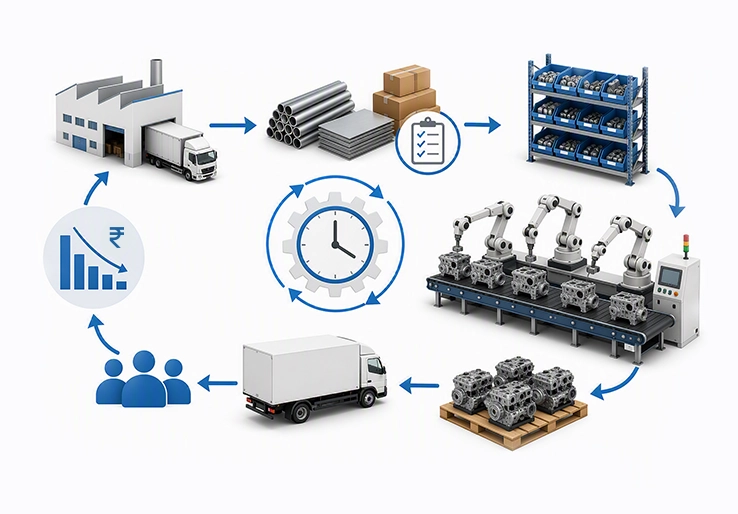
Just-in-time (JIT) inventory management is a lean, demand-driven strategy that coordinates material deliveries with production schedules so that raw materials arrive exactly when production is scheduled to begin — no sooner. By maintaining minimal inventory on hand to meet customer demand, businesses eliminate waste, reduce storage costs, and free working capital that would otherwise sit idle on warehouse shelves.
Just-in-time inventory and just-in-time manufacturing have been central concepts in supply chain operations for decades, and a growing number of businesses across industries have adopted this approach. With intensifying competition and rising pressure to improve profitability, JIT has become a proven path to leaner operations and stronger bottom lines — though it can become problematic when global supply chains come to a screeching halt.
By reading this guide, you will understand:
JIT is a form of inventory management that requires working closely with suppliers so that raw materials arrive as production is scheduled to begin, but no sooner. The goal is to have the minimum amount of inventory on hand to meet demand. JIT inventory ensures there is enough stock to produce only what you need, when you need it — achieving high-volume production with minimal inventory and eliminating waste throughout the entire production process.
JIT originated in post-World War II Japan. Taiichi Ohno developed JIT as part of the Toyota Production System, which was established between 1945 and 1970. Toyota pioneered Just-in-Time inventory management in the 1970s, drawing inspiration from American supermarket restocking systems where shelves were replenished based on actual customer consumption rather than forecasts. Toyota Motor Corporation dramatically reduced finished-goods inventory in key plants from months of supply to mere hours, a transformation that helped make Toyota the world's top automaker by volume. Since then, JIT has evolved into a global inventory management practice adopted across manufacturing, retail, healthcare, and technology sectors.
Key takeaways: There are more advantages than disadvantages to practicing JIT if you have a proven, reliable supply chain and accurate demand planning. JIT has potential risks if you don't have accurate and frequently updated sales forecasts. Before implementing JIT, make sure your inventory system works with JIT inventory management.
JIT is what's known as a lean management process. In JIT, all parts of any production or service system — particularly people — are interconnected. They inform each other and are mutually dependent on generating successful outcomes. This practice's origin comes from Kaizen, a Japanese term meaning "change for the better." Like JIT, the Kaizen philosophy looks to continuously improve operations, involve all employees from assembly line workers to the CEO, and reduce waste while improving quality.
JIT aims to minimize resource consumption and waste by targeting the seven types of waste (muda) identified in lean manufacturing:
Continuous improvement is fundamental to JIT for refining processes and quality. High quality and zero defects are crucial in JIT due to limited stock — every defective unit has an outsized impact when there is no buffer inventory to absorb the loss. JIT aims to eliminate non-value-adding steps like excess inventory and overproduction, keeping only what's necessary at each stage of the manufacturing process.
The core distinction between JIT and traditional inventory management lies in the pull vs. push system:
| Aspect | JIT (Pull System) | Traditional (Push System) |
|---|---|---|
| Trigger | Actual customer demand drives production | Forecasted demand drives production |
| Inventory levels | Minimal inventory on hand | Large safety stock buffers |
| Storage costs | Low — reduced warehousing footprint | High — extensive warehouse space required |
| Cash flow | Improved — less capital tied in stock | Constrained — significant capital in unsold inventory |
| Risk profile | Vulnerable to supply chain disruptions | Vulnerable to obsolescence and dead stock |
| Supplier dependency | Requires reliable suppliers with timely deliveries | Less dependent on delivery precision |
| Waste | Minimized through demand-driven production | Higher risk of overproduction and inventory waste |
In a just-in-case (JIC) strategy, businesses maintain safety stock to buffer against supply chain delays, demand surges, or supplier failures. JIT takes the opposite approach: it deliberately reduces these buffers to expose inefficiencies and force process improvement. The trade-off is clear — JIT saves money through reduced inventory costs but increases exposure to disruption risk.
Understanding how these principles translate into measurable business outcomes is what makes JIT compelling for operations leaders.
JIT inventory management boosts a company's ROI by lowering inventory carrying costs, increasing efficiency, and decreasing waste. Companies that are successful at JIT inventory management maximize profits by keeping investment in stock as low as possible, using data-driven inventory management systems to coordinate every aspect of their supply chain operations.
The financial advantages of JIT are substantial and measurable:
Typical successful JIT implementations see inventory reduction of 40–60%, resulting in freed working capital in the millions for mid-sized manufacturers.
JIT maximizes operational efficiency by minimizing inventory levels across the entire supply chain:
To support these goals, businesses can invest in new technology or update existing solutions that link their system with suppliers to coordinate the delivery of parts and materials.
JIT inventory management ensures that stock arrives as it is needed for production or to meet consumer demand, but no sooner. The goal is to eliminate waste and increase the efficiency of your operations. Since the main objective is often quality and not the lowest price, JIT requires long-term contracts with reliable suppliers.
Organizations may vary in how they implement JIT in their environment, but the general steps follow a cycle of continuous improvement:
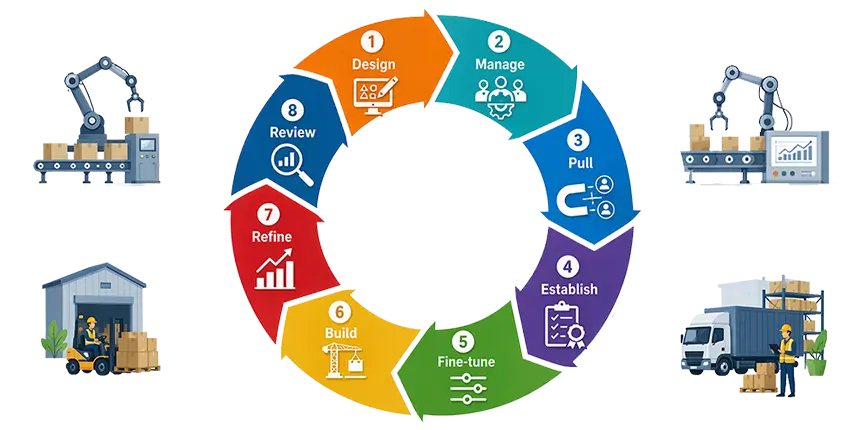
The JIT process begins with a review of essential manufacturing building blocks: product design, process design, personnel, and manufacturing planning. Plans are put in place to eliminate disruption, minimize waste, and build a flexible system.
A Total Quality Management (TQM) review ensures continuous improvement throughout the process. Management defines workers' roles and responsibilities, establishes statistical quality control measures, stabilizes schedules, and evaluates load and capacity levels.
Educate the team on production and withdrawal methods using signaling methods like Kanban. Review lot size policies and reduce lot sizes — in JIT, one is the ideal lot size, reducing in-process inventory, carrying costs, and storage space while making inspection and rework easier.
Vendor relationships are vital to the success of JIT. Review vendor lists, settle on preferred suppliers, negotiate contracts, and discuss lead times, delivery expectations, and usage metrics. JIT requires strong supplier relationships for timely deliveries.
Determine inventory needs, policies, and controls. Reduce inventory movements to the minimum required for continuous flow manufacturing.
Inform your team about the skills and capabilities needed. Conduct team education and empowerment sessions. Cross-trained workers can be deployed to different areas to keep production moving.
Reduce the number of parts and steps in production through process redesign, standardization, and comprehensive review of the entire process.
Define and implement quality measures and metrics. Conduct root cause analysis of any problems. Emphasize improvements and track trends to improve every aspect of JIT.
Kanban — a Japanese scheduling system using visual signal cards — is the operational backbone of most JIT implementations. It functions as the communication mechanism that triggers replenishment only when items are consumed. In a Kanban-driven JIT system, a production station sends a signal upstream when it needs more material, creating a pull-based flow that prevents overproduction and keeps inventory levels precisely calibrated to actual usage.
Kanban provides visibility for control: using communication tools keeps the entire team informed of inventory levels across the production floor. This transparency is essential for maintaining the discipline JIT demands.
The JIT inventory methodology uses a variety of techniques to smooth operations. The lean method focuses on optimizing organization, paying attention to detail, having small lot sizes, increasing transparency, fostering cell manufacturing, and using a pull (rather than push) approach.
Implementing JIT inventory management requires a systematic approach that gradually transforms operations while maintaining business continuity. Success depends on thorough assessment, organizational readiness, and the right technology infrastructure.
Before converting to JIT, conduct a comprehensive readiness audit:
Follow this eight-step framework to implement JIT inventory management systematically:
Map every inventory flow in your organization, identify all seven types of waste, measure lead times across suppliers, and set baseline KPIs for inventory turnover, working capital tied up, and production efficiency.
Define target KPIs (inventory turnover improvement, lead time reduction, working capital freed), set timelines for each product line, and plan for production leveling. Efficient production scheduling is necessary to avoid bottlenecks in JIT.
Evaluate and rank suppliers by reliability, negotiate long-term contracts, and consider bringing critical suppliers closer geographically. Build the strong supplier relationships that JIT demands.
Deploy ERP modules with real-time inventory control capabilities, Kanban software, demand forecasting tools, and supplier integration platforms. LOGIC ERP offers supplier portals, real-time inventory visibility, demand sensing capabilities, and automated reorder triggers that support JIT implementation.
Start with one product line or one facility to test JIT in a controlled scope. Measure results against baseline KPIs and address issues before expanding.
Cross-train employees, instill a Kaizen mindset, deploy visual management tools, and empower teams to stop the line when defects or bottlenecks appear. Continuous improvement is fundamental to JIT.
Expand the JIT system across plants and product lines once the pilot is validated and refined.
Maintain monitoring systems, review root causes of any disruptions, adjust processes, refine production flow, standardize procedures, and reduce variation on an ongoing basis.
| Criterion | ERP Systems | Kanban / Pull Tools | Demand Forecasting Software | Supplier Integration Platforms |
|---|---|---|---|---|
| Core feature | Real-time inventory visibility, automated reorder | Visual workflow management, pull signals | Predictive analytics, trend analysis | Order coordination, delivery tracking |
| Cost range | Medium to high (licenses + implementation) | Low to medium | Medium (often AI/ML-based) | Medium |
| Implementation complexity | High — requires process redesign | Low to medium | Medium — requires clean historical data | Medium — depends on supplier tech readiness |
| Best for | Mid-to-large enterprises, multi-location | All sizes, especially shop floor | Businesses with variable demand | Companies with multiple supplier dependencies |
| JIT-specific value | End-to-end inventory tracking, KPI dashboards | Triggers replenishment at consumption | Reduces forecast error, critical for JIT | Ensures timely deliveries across the supply chain |
LOGIC ERP can serve as the technological backbone for JIT implementation, offering real-time inventory visibility across supplier, warehouse, and production environments. Its dashboards track key metrics like inventory turnover and holding costs, while flexible lot sizing and supplier portal features support the precise coordination JIT demands.
JIT inventory management spans a remarkably wide range of industries:
Major corporations across every industry take advantage of JIT inventory management:
JIT minimizes inventory by producing goods only as needed-whether that means Dell assembling a laptop after receiving a customer order or Toyota sequencing parts deliveries to arrive at the assembly line within hours of use.
JIT inventory management requires everyone in an ecosystem and supply chain to commit and work cohesively. If any part of that arrangement breaks down, it risks the entire infrastructure. Here are the most significant challenges and proven strategies to address them.
Supply chain disruptions can halt production in JIT systems because there are no inventory buffers to absorb delays. The semiconductor shortage during 2020–21 is a stark example: automotive firms operating on JIT lost an estimated 7.7 million vehicles in production due to chip shortages. In 2022, a cyberattack on Kojima Industries, a Tier-1 Toyota supplier, led Toyota to suspend all Japanese plants because there was no buffer inventory to absorb the interruption.
Solutions:
JIT requires precise forecasting to avoid inventory shortages. JIT can lead to stockouts if demand unexpectedly increases — without finished goods on hand, a company may not be able to meet massive and unexpected orders immediately. Adapting to sudden surges or declines is difficult because of the reliance on forecasting.
Solutions:
JIT requires strong supplier relationships for timely deliveries. A supplier who does not deliver goods on time and in the right amounts can disrupt the entire production process. Higher transportation costs can arise from frequent small shipments.
Solutions:
The business's entire workflow needs to convert to a lean framework. These actions affect the organization and the entire supply chain. Undisciplined staff or team members not on board with JIT can affect productivity, quality, and overall outcomes.
Solutions:
These challenges are manageable with comprehensive planning, but they require honest assessment of your organization's readiness before committing to JIT.
Before converting to JIT inventory management, assess if the entire organization is ready. Consider these six factors:
The roots of JIT stretch back to post-World War II Japan, where resource scarcity forced manufacturers to find radically more efficient production methods:
JIT inventory management delivers substantial cost savings when implemented with the right technology, reliable suppliers, and organizational commitment. JIT minimizes inventory holding costs by reducing excess stock, enhances cash flow by freeing up working capital, and improves product quality by focusing resources on necessary production.
However, success depends on having the right foundation:
The future of JIT is moving toward AI-driven demand sensing, digital twin simulation, IoT-enabled real-time monitoring, and intelligent supply chain management that can adapt dynamically to disruptions while maintaining lean inventory principles.
Call at +91-73411-41176 / +91-73411-41175 or send us an email at sales@logicerp.com to book a free demo today!
A JIT inventory system is a management strategy where materials and products are ordered and received only as they are needed in the production process or to fulfill customer orders. JIT minimizes inventory by producing goods only as needed, reducing storage costs and eliminating excess inventory. The system relies on precise coordination between production schedules, supplier deliveries, and customer demand.
The just-in-time method of inventory control is a pull-based approach where replenishment is triggered by actual consumption rather than forecasts. Using tools like Kanban signals, production stations communicate upstream when materials are needed, maintaining minimal inventory levels throughout the entire production process. This method requires robust inventory management systems for tracking inventory in real time.
JIT inventory focuses specifically on managing inventory levels — ensuring raw materials, components, and finished goods are available only when needed. JIT manufacturing is the broader application of lean principles to the entire manufacturing process, encompassing production scheduling, workforce management, equipment utilization, and quality control. JIT inventory is a component of JIT manufacturing, not a separate concept.
Just-in-time minimizes inventory by producing and ordering only what's immediately needed, reducing waste and inventory costs. Just-in-case maintains safety stock buffers to protect against supply chain disruptions, demand spikes, or supplier failures. JIT saves money through reduced holding costs but increases vulnerability to disruptions. JIC provides security but ties up working capital. Many companies now use hybrid approaches, applying JIT for stable, predictable items and JIC for critical or volatile components.
EOQ calculates the optimal order quantity that minimizes total inventory costs (ordering costs plus holding costs) based on fixed assumptions about demand and lead times. JIT, by contrast, aims to reduce lot sizes as close to one as possible, ordering frequently in small quantities matched to actual production needs. EOQ optimizes within a traditional push system; JIT fundamentally restructures the system to eliminate the need for large batch ordering.
Dell builds computers using JIT based on customer specifications — no computer is assembled until a customer places an order, and components are delivered to the assembly line precisely when needed. Similarly, Amazon uses JIT to maintain minimal inventory levels, relying on sophisticated logistics networks to fulfill orders rapidly without holding excessive stock in warehouses.
TOC identifies the single most limiting factor (constraint) in a system and focuses improvement efforts there. In JIT, TOC helps identify bottlenecks in the production process that could disrupt flow — whether a slow supplier, an unreliable machine, or a capacity-limited workstation. By systematically addressing constraints, JIT systems achieve smoother production flow and prevent the cascading delays that minimal inventory buffers cannot absorb.
JIT is most effective in industries with predictable demand and high holding costs. Automotive manufacturing, consumer electronics, retail and e-commerce, healthcare, food and beverage, and apparel all benefit from JIT practices.
Key metrics include inventory turnover ratio, lead time from order to delivery, fill rate or service level percentage, inventory holding costs as a percentage of inventory value, rate of defective parts detected, working capital tied up in inventory, and shrinkage or obsolescence rates. Benchmarks for successful JIT implementation include inventory reduction of 40–60%, productivity gains of 15–25%, and lead time reduction from weeks to days.
At minimum, you need an ERP system with real-time inventory tracking, demand forecasting capabilities, supplier integration tools, and Kanban or pull-scheduling modules. LOGIC ERP provides these capabilities through its inventory management software, including real-time visibility across supplier, warehouse, and production environments, automated reorder triggers, and analytics dashboards for monitoring JIT performance metrics.
Supply chain reliability is essential in JIT because materials must arrive precisely when needed to avoid production delays. Since JIT minimizes inventory buffers, any disruption can halt operations, making dependable suppliers crucial for maintaining continuous production flow.
JIT streamlines business operations by reducing excess inventory, cutting waste, and improving production efficiency. It fosters better coordination between departments and suppliers, enabling faster response to customer demand and enhancing overall operational agility.
JIT reduces production costs by lowering storage and handling expenses, minimizing waste from obsolete or defective products, and improving labor productivity through smoother workflows. This lean approach leads to significant cost savings across the manufacturing process.
Effective inventory management ensures accurate tracking, timely replenishment, and alignment with actual demand in a JIT system. It prevents overstocking and stockouts, enabling production to operate efficiently with minimal inventory.
JIT reduces inventory costs by maintaining minimal stock levels, which lowers warehousing, insurance, and depreciation expenses. This lean inventory approach frees up capital and reduces the risk of holding obsolete or excess inventory.
Inventory control in JIT is demand-driven and pull-based, relying on real-time consumption signals rather than forecasts. This approach requires precise coordination and continuous monitoring to maintain low inventory levels without disrupting production.
JIT inventory management software offers real-time inventory visibility, automated reorder triggers, demand forecasting, and supplier coordination. These features help maintain optimal stock levels, improve accuracy, and support seamless supply chain communication.
Continuous improvement, or Kaizen, is vital in JIT to identify inefficiencies, reduce waste, and enhance product quality. It promotes a culture of ongoing refinement, ensuring the JIT system adapts to changes and sustains high performance.
Effective JIT implementation involves assessing readiness, building strong supplier partnerships, investing in technology, training staff, piloting the system, and continuously monitoring and refining processes to ensure lean, efficient operations.
Popular Products