Discover what cross-docking is, how it works, its various types, key benefits, and real-world examples across industries like retail, FMCG, and e-commerce. Learn how cross-docking optimizes warehouse operations and supply chains.
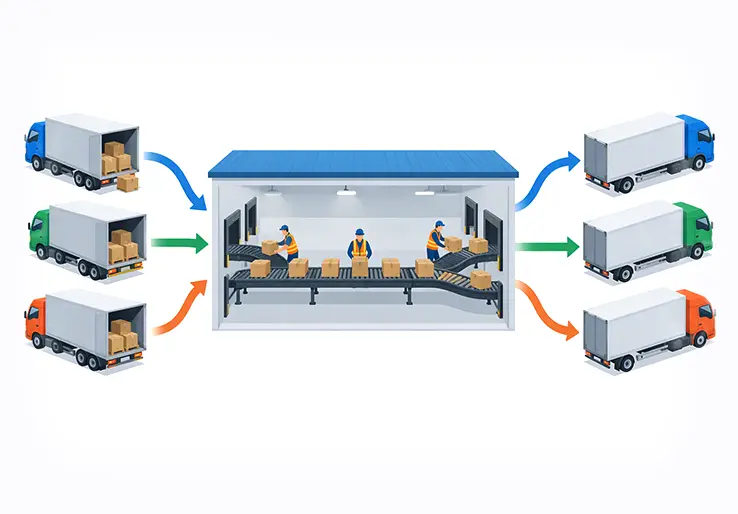
Cross-docking is a logistics and warehouse management process in which incoming goods are received, sorted, and transferred to outbound shipments with little or no long-term storage. Instead of placing products into racks and holding them for days or weeks, a cross docking facility moves them from inbound docks to outbound docks within hours, often in under 24 hours. The goal is simple: keep goods in motion and eliminate the costs of storing them.
For supply chain and warehouse operations leaders, logistics professionals, and businesses evaluating or implementing cross docking, this model has become more important as e-commerce volumes rise and customers expect same-day and next-day delivery. Traditional warehousing, where goods sit for days or months before being picked and shipped, adds time, labor costs, and capital to the supply chain. Cross docking compresses that timeline by linking suppliers, cross dock facilities, carriers, and retail stores or end customers into a continuous flow that improves fulfillment speed, lowers inventory and handling costs, and helps high-volume, time-sensitive operations respond faster.
This guide explains how cross docking works step by step, the main types and industry use cases, where it outperforms traditional warehousing, the benefits and challenges to expect, and how to implement it with the right processes, technology, best practices, metrics, and real-world examples. This logistics strategy cross-links every participant in the chain. Suppliers send Advance Shipping Notices (ASNs); the cross docking facility receives, scans, sorts, and consolidates shipments; carriers pick up outbound loads on tight schedules. The entire supply chain benefits when each step is synchronized. LOGIC ERP supports cross docking operations through integrated WMS and ERP workflows that connect order allocation, inventory visibility, dock scheduling, and transportation planning in a single platform.
Cross docking meaning: cross-docking is a distribution method where incoming shipments are unloaded, sorted by destination, and reloaded onto outbound vehicles with minimal or no storage. Products pass through the facility rather than being stored in it, typically dwelling for less than 24 hours.
What is cross docking in practice? A distribution center configured for cross docking looks different from a traditional warehouse. There are few or no storage racks. The building is designed around dock doors, staging lanes, and conveyor systems. Products arrive at inbound docks, get scanned and sorted, then move to outbound docks aligned with their final destination. Cross-docking minimizes storage time by transferring goods directly from receiving to shipping.
The practice was pioneered by the trucking industry in the 1930s for less-than-truckload (LTL) consolidation. The U.S. military adopted it in the 1950s. Walmart turned cross docking into a competitive advantage in the late 1980s by pairing it with real-time sales data systems.
Common unit types flowing through cross docking services include full pallets in grocery and FMCG networks, cases and cartons for retail store replenishment, and individual parcels for e-commerce fulfillment. Products like perishable dairy, fresh produce, fast-selling electronics, and over-the-counter pharmaceuticals are typical candidates because they benefit from rapid delivery and minimal storage time.
Understanding how cross docking works starts with walking through the sequence of events inside a cross dock facility, from the moment an inbound truck backs into a dock door to the moment an outbound vehicle departs.
The process begins when an inbound shipment arrives at the facility. The truck is assigned to a specific receiving door based on a dock appointment schedule. At this point, ASN data, product IDs, and routing information have already been transmitted to the warehouse management system. Forklifts or conveyors unload pallets, cases, or cartons from the trailer. Each unit is scanned using barcode or RFID technology, and the system verifies SKU, lot number, and quantity against the ASN. Quality checks happen here: inspectors confirm packaging integrity, labeling accuracy, and (for perishables or pharmaceuticals) temperature compliance.
Next comes sorting and consolidation by destination. Based on order allocations, items are directed to staging lanes organized by store, city, carrier route, or customer. Multiple smaller inbound shipments may be merged into full truckloads for outbound efficiency; alternatively, a single large inbound load may be split into several smaller outbound shipments. If outbound trucks are not yet ready, goods rest briefly in staging zones. This temporary staging must be short, typically a few hours, and each unit’s location is tracked in the system.
Once sorted, products move to the outbound dock. Loading crews place items onto outbound trucks or delivery vans, verify outbound manifests, and confirm the correct load mix. The shipment is dispatched, carrier documentation is completed, and real-time tracking begins.
Here is a concrete example of how cross docking works in real time. Three suppliers in North India ship goods to a cross dock facility in Gurgaon. Supplier A sends pallets destined for Delhi stores; Supplier B ships cartons for Jaipur distributors; Supplier C delivers parcels for Chandigarh customers. On arrival, products are unloaded, scanned, and sorted by destination. Delhi and Jaipur loads are consolidated onto two outbound trucks that depart the same afternoon. Chandigarh parcels are grouped and loaded onto smaller delivery vans. Total dwell time: approximately four to six hours.
Real-time data, dock scheduling software, and barcode or RFID identification keep this process synchronized. Without these, the cross docking process breaks down into delays, misroutes, and idle trucks.
The cross-docking process flow can be summarized in a single line: Supplier → Inbound Dock → Sorting & Consolidation → Outbound Dock → Store / Customer.
Compare this with the traditional warehouse flow: Supplier → Receiving → Put-away to Storage → Picking → Packing → Shipping. Traditional warehousing stores goods for days or months before they are picked, packed, and dispatched. Each additional step introduces a handling touchpoint, more labor, and more time.
Continuous cross docking minimizes inventory dwell time and handling by removing the put-away and picking stages entirely. Fewer touches mean lower damage risk and higher throughput. A cross dock facility can process the same volume of goods through a fraction of the warehouse space required by a conventional storage operation because there are no racks holding weeks of inventory.
Cross docking is not a single model. Businesses mix several types of cross docking depending on their freight profile, demand variability, and transportation network. Two axes define the taxonomy: when the destination allocation is decided (pre-distribution vs. post-distribution) and how freight physically moves through the facility (continuous, consolidation, or deconsolidation).
The five main types are pre-distributed cross docking, post-distributed cross docking, continuous cross docking, consolidation cross docking, and deconsolidation cross docking. Each aligns with specific use cases in retail, FMCG, ecommerce, and manufacturing, which are covered in the sections and examples below.
These two models differ in when and where the routing decision happens.
Pre-distribution cross docking sorts goods before they arrive at the facility. Suppliers assign quantities and labels per destination based on confirmed sales orders, store allocation plans, or ASN data in the ERP. When goods reach the cross dock, they are already tagged for a specific store or route; the facility only needs to unload, verify, and move them to the right outbound door. This approach works well for stable store replenishment programs where demand is predictable and suppliers have the capability to pre-sort.
Post-distribution cross docking sorts goods after they arrive at the facility. Products reach the cross dock without a final allocation. The warehouse management system assigns them to destinations in near real time using current orders, inventory levels, and demand signals. This cross docking method provides greater flexibility for volatile ecommerce demand and frequent promotional shifts.
Key practical differences:
These three patterns describe how freight size and direction change inside cross dock facilities.
Continuous cross docking handles high-velocity SKUs that flow almost directly from inbound to outbound trucks with minimal staging time. Continuous cross-docking requires little or no storage time; goods dwell for under two to four hours. Daily dairy deliveries and fresh produce are textbook examples. The facility acts as a transfer point, not a holding area.
Consolidation cross docking merges smaller shipments into larger loads. Multiple LTL or parcel shipments from different suppliers are combined into a full truckload heading to a regional hub or large customer. Cross-docking can reduce transportation costs by consolidating shipments this way, lowering per-unit transport costs and improving truck utilization.
Deconsolidation cross docking divides large shipments into smaller deliveries. A full container arriving from an overseas supplier or a bulk truckload from a domestic plant is broken into multiple smaller outbound shipments for different cities or outlets. This pattern supports last-mile distribution in dense retail networks.
Large 3PLs and retailers often run all three patterns in the same cross docking terminal during a single day, switching between them based on the SKU profile and inbound/outbound schedule of each shipment.
Cross docking adapts to sector-specific constraints. In retail, fashion chains route new-season collections directly from import ports to stores using cross docking, bypassing long term storage entirely. A national apparel retailer might move merchandise from a central cross dock near Mumbai to 100+ retail stores across India within 48 hours of arrival from the port. Walmart’s distribution centers are the canonical example: goods from multiple suppliers are cross-docked to store-bound outbound trucks almost continuously, with dwell times kept to hours.
In manufacturing, just-in-time delivery relies on cross docking for components. Automotive parts arrive at a cross dock near the assembly plant and flow directly to production lines within hours, avoiding the cost and space of holding parts inventory. Construction sites also benefit from improved efficiency through timely material deliveries using cross docking. In construction, cross-docking minimizes on-site inventory and coordinates material delivery so that components arrive when needed rather than weeks early. This lowers site congestion by preventing unneeded materials from being on site, and cross-docking reduces the risk of damage or theft by minimizing on-site exposure of materials.
For ecommerce, commerce cross docking operates at parcel level. Orders from multiple online marketplaces are consolidated at a regional facility, sorted by destination pincode, and shipped via parcel carriers the same day. Speed is the primary driver.
Food, beverage, and pharmaceutical cross docking demands temperature-controlled handling and regulatory documentation. Cold-chain compliance (HACCP for food, GMP for pharma) must be embedded in the cross docking workflow, with quality checks at inbound and before outbound transfer. Cross-docking is ideal for time-sensitive goods like perishables, where it speeds up delivery times and reduces spoilage risk.
The cross docking benefits center on measurable improvements in cost, speed, and inventory flow. Here is what the data shows.
Reduced Warehouse Storage and Inventory Carrying Costs. Cross-docking reduces inventory holding costs by keeping goods in motion and shrinking the square footage and racking required, directly reducing storage costs. Products that dwell under 24 hours do not accumulate storage fees, insurance, or depreciation charges associated with long term storage. A study of a French FMCG company and major retailer found that a hybrid cross-docking and warehousing configuration reduced total supply chain cost by 6.4% compared to pure traditional warehousing.
Faster Order Fulfillment. Cross docking eliminates put-away and picking steps, cutting order cycle time. This supports same-day store replenishment and one- to two-day ecommerce shipping commitments. Cross-docking minimizes storage time and handling costs simultaneously, compressing the gap between supplier shipment and customer receipt.
Reduced Product Handling and Damage Risk. Each touch is a risk. Cross docking reduces handling costs by minimizing the number of times pallets and cases are moved. Cross-docking improves inventory accuracy by reducing handling points, which also lowers shrinkage and packing errors.
Improved Inventory Flow and Working Capital. Less capital sits in slow-moving or excess inventory. Cross-docking keeps inventory moving quickly, reducing the risk of obsolescence for products with short shelf lives or fast-changing consumer preferences. Better alignment with actual demand replaces forecast-driven buffer stock.
Sustainability. Fewer storage facilities, optimized truck utilization through consolidation, and lower energy consumption for lighting, heating, and cooling contribute to a smaller environmental footprint. Research published in Sustainability identifies environmental benefits as a growing area of cross-docking research.
It enhances supply chain efficiency by reducing transportation costs when consolidation patterns are used, and it speeds up delivery times for perishable goods that cannot afford days in a warehouse.
Cross docking demands precision. When it fails, the consequences are immediate because there is no storage buffer to absorb mistakes.
Demand Planning Dependency. Without accurate forecasting, demand forecasting errors create stockouts or excess transfers. Pre-distribution cross docking is especially vulnerable: if store allocations are locked in before goods leave the supplier, late demand changes mean misrouted inventory with no easy correction.
Operational Complexity. Cross-docking requires precise coordination of shipments. Inbound and outbound schedules must align tightly. Delays in inbound shipments can disrupt logistics operations downstream; if a supplier truck arrives four hours late, outbound trucks either wait idle or depart with incomplete loads. Supply chain timing is critical for cross-docking success. Cross-docking requires precise coordination among multiple stakeholders, including supply chain partners such as suppliers, carriers, dock staff, and store teams.
Suitability Limits. Cross docking is not a fit for slow-moving SKUs, bulky items requiring elaborate inspection or customization, or very low-margin products where handling cost savings do not offset setup effort. Highly seasonal products with sporadic demand complicate scheduling.
Technology and Infrastructure. Investing in technology is crucial for successful cross-docking operations. Systems for barcode or RFID scanning, dock scheduling, ASN processing, and real-time tracking are prerequisites. Without them, misroutes, shrink, and delays multiply. Cross-docking operations require a skilled workforce for efficiency; training staff is essential for managing fast turnover in cross-docking environments where errors are less forgiving.
Change Management. Shifting from a "store everything" mindset to a flow-based cross docking approach requires buy-in from suppliers (who may need to pre-label shipments), carriers (who must align on tighter schedules), and internal teams accustomed to static inventory. This is a cultural shift as much as an operational one.
Cross docking, warehousing, and direct shipping are complementary strategies. Most businesses combine them based on SKU velocity, demand patterns, and network density.
| Factor | Cross-Docking | Traditional Warehousing |
|---|---|---|
| Storage time | Hours (under 24h) | Days, weeks, or months |
| Handling steps | Receive, sort, load | Receive, put-away, pick, pack, ship |
| Warehouse space | Minimal; mostly dock doors and staging | Large; racking, aisles, pick zones |
| Responsiveness | High; goods flow same day | Lower; depends on pick/pack capacity |
| Cost structure | Handling, transport coordination, labor costs | Storage costs, inventory carrying costs, picking labor |
| Best for | Fast-moving, predictable, time-sensitive SKUs | Slow movers, seasonal stock, safety buffers |
Traditional warehousing is the better choice for slow-moving spare parts, bulky items needing long-term holding, safety stock for seasonal demand peaks, or networks where transportation is infrequent and consolidation windows are long.
Cross docking differs from direct shipment and dropshipping in that it still uses an intermediate cross docking facility. In dropshipping, the supplier ships to the end customer without any retailer handling inventory. Cross docking inserts a sorting and consolidation step that enables route optimization and quality control before the final destination.
A practical hybrid example: a consumer electronics brand warehouses slow-moving accessories and spare parts in a traditional DC while using cross docking for fast-turn flagship products during launch phases. Both operations can run through the same inventory management software, routing each SKU to the right fulfillment path.
Cross docking fits specific conditions. Before implementing cross docking, evaluate whether your product mix and network support it.
Ideal conditions:
Situations where cross docking is risky:
Companies can start with a subset of SKUs and a few major corridors before expanding. A pilot on your top 20 fastest-moving SKUs across two or three routes reveals whether the cost savings and speed improvements justify wider rollout.
Cross docking is one strategy within the broader supply chain management framework of the supply chain industry. It does not replace all other warehouse functions; it integrates with them.
Inside the warehouse, cross docking interacts with receiving (where inbound quality checks occur), dock appointment scheduling (which prevents bottlenecks), and yard management (which tracks trailer positions). The logistics process shifts emphasis from static stock counts to flow-through metrics. Inventory management becomes about real-time visibility: where is each pallet right now, which outbound door is it assigned to, and when does the carrier truck arrive?
Cross dock facilities are often located near ports, inland container depots, major highways, or consumption hubs to reduce transfer times. A facility near Delhi-Mumbai Expressway nodes, for example, can serve both northern and western India routes with shorter transit legs.
Network design may evolve as cross docking scales. Companies sometimes add dedicated cross dock hubs while trimming older storage-heavy warehouses, optimizing their supply chain for speed and reducing operational costs. The physical layout of a cross dock hub prioritizes dock doors and staging lanes over deep storage racks.
A cross docking system requires tight integration between warehouse execution and business planning layers. Effective cross-docking requires real-time visibility into supply and demand, and real-time data accuracy is essential for effective cross-docking.
WMS capabilities that support cross docking operations:
ERP capabilities that enable cross docking:
LOGIC ERP orchestrates cross docking workflows by linking order allocation, inventory availability, and transportation plans to WMS-directed dock operations. The platform can track inbound and outbound shipments, flag dwell-time exceptions, and generate performance reports that feed continuous improvement cycles.
Cross docking changes the relationship between inventory and operations. Instead of measuring success by how much stock sits in the warehouse, the focus shifts to how fast inventory moves through it.
For suitable SKUs, cross docking reduces average on-hand inventory and safety stock requirements. Products spend hours in the facility, not weeks. This frees working capital and reduces warehousing costs, but it raises the stakes on supply reliability. If a supplier misses a delivery window, there is no buffer stock to cover the gap.
Real-time visibility becomes the core requirement. Inventory is "in motion" more often, so systems must track it accurately across incoming and outgoing vehicles, docks, and staging lanes instead of static bin locations. ERP systems that provide real-time inventory visibility are essential for this.
Cross docking supports lean, just-in-time delivery principles by matching inbound supply closely to outbound orders. The risk side: thin inventory buffers mean that inaccurate data or demand forecasting errors can quickly impact service levels. Disciplined scanning, integrated WMS/ERP, and clean master data are non-negotiable.
Practical guidelines for running cross docking efficiently:
Measuring cross docking performance requires a focused set of KPIs:
Users of LOGIC ERP can configure these metrics inside standard or custom reports, tying operational data back to financial outcomes like cost per order and cost savings per lane.
Retail. A national fashion chain receives new-season inventory at a central cross dock near Mumbai. Containers from overseas are unloaded, sorted by store allocation, and dispatched to 100+ stores across India within 48 hours. No garment sits in a warehouse. The cross docking method reduces markdowns by getting products onto sales floors faster. Walmart operates its distribution centers on a similar model, using its Retail Link platform to share POS data with suppliers, enabling continuous replenishment through cross docking with dwell times kept to hours.
FMCG / Grocery. A beverage company uses continuous cross docking at a regional hub to replenish supermarkets daily. Mixed pallets from multiple bottling plants arrive in the morning, are sorted by store route, and loaded onto outbound trucks by early afternoon. Each grocery supply chain partner receives a delivery within the same business day.
Ecommerce. An online marketplace operator consolidates seller shipments overnight at a cross dock in Bengaluru. By dawn, parcels are deconsolidated by courier route for next-day delivery across Karnataka. Sorting accuracy is critical; a misrouted parcel costs both time and customer trust.
Food & Pharma. Temperature-controlled cross dock operations handle dairy and pharmaceutical shipments that cannot afford dwell time outside cold rooms. Mandatory quality checks (batch, lot, expiry, temperature logs) are completed at inbound before transfer to outbound vehicles. The French FMCG case study demonstrated that cross docking combined with traditional warehousing reduced total supply chain cost by 6.4% versus pure storage-based operations.
Manufacturing. Automotive parts arrive at a cross dock near a plant in Pune. Components from multiple suppliers are sorted by assembly-line sequence and delivered to the production floor within hours, supporting just-in-time manufacturing without holding parts inventory.
A phased roadmap for operations and supply chain leaders considering implementing cross docking for the first time:
Assess Current Flows and Identify Candidates
Map your existing receiving-to-shipping timeline, handling steps, and costs. Profile SKUs by velocity, demand predictability, and perishability. Identify lanes (supplier-to-customer corridors) with the highest volume and frequency. These are your cross docking pilot candidates.
Design or Adapt the Facility
Configure dock door assignments, staging lanes, and flow paths. An I-shaped layout works for most small to mid-sized operations. Ensure separation between inbound and outbound areas, with clear signage and system-driven staging zones.
Define SOPs
Document procedures for receiving, scanning, sorting, staging, and loading. Specify quality check requirements, labeling rules, and escalation protocols for exceptions (late trucks, damaged goods, ASN mismatches).
Configure WMS and ERP
Set up cross docking rules in your system: which SKUs are eligible, how inbound shipments map to outbound orders, how dock appointments are managed, and what alerts trigger when dwell time exceeds thresholds. LOGIC ERP implementation teams can help map these processes into system workflows, ensuring data flows match physical flows.
Pilot and Iterate
Start with one cross dock facility, a limited SKU set, and a small group of stores or customers. Measure dock-to-dock time, on-time dispatch, and accuracy for four to eight weeks. Refine before scaling.
Engage Partners
Align transportation partners on trailer schedules, documentation requirements, and contingency plans for delays. Require suppliers to provide ASNs and, where feasible, pre-labeled shipments.
Call at +91-73411-41176 / +91-73411-41175 or send us an email at sales@logicerp.com to book a free demo today!
Cross-docking is a logistics process where goods are received at a cross dock facility, sorted by destination, and loaded onto outbound transportation with minimal or no storage. Products move from inbound to outbound docks within hours, avoiding traditional warehouse storage.
The primary purpose of cross-docking is to reduce storage time, lower inventory holding costs, and speed up delivery to stores or customers. It eliminates the put-away and picking steps of conventional warehousing, streamlining the flow of goods.
In a cross-docking warehouse, goods arrive at inbound docks, are scanned and verified, sorted by destination or route, moved to outbound docks, and loaded onto outbound trucks. The focus is on maintaining product flow rather than storage.
The five main types of cross-docking are pre-distribution, post-distribution, continuous, consolidation, and deconsolidation. Pre-distribution sorts goods before arrival, while post-distribution sorts goods after arrival. Continuous cross-docking requires minimal storage, consolidation merges smaller shipments into larger loads, and deconsolidation divides large shipments into smaller deliveries.
Cross-docking reduces warehouse storage costs, speeds up order fulfillment, lowers handling and labor costs, decreases inventory carrying costs, and minimizes product damage by reducing touchpoints. It helps supply chain participants meet customer expectations for rapid delivery.
A grocery retailer receives shipments from multiple suppliers at a regional cross dock each morning. Products are sorted by store route and loaded onto outbound trucks by noon. Stores receive fresh stock the same day without any goods entering long-term storage.
Cross-docking moves goods through a facility in hours with minimal storage, while traditional warehousing stores goods for days or weeks before picking, packing, and shipping. Cross-docking has fewer handling stages, whereas warehousing offers more flexibility for holding inventory.
Cross-docking is best suited for businesses with high-volume, fast-moving products, predictable demand, frequent transportation lanes, and coordinated supply chains. It may not be practical for businesses with slow-moving inventory, volatile demand, or sparse delivery networks.
Warehouse Management Systems (WMS) support cross-docking by managing dock scheduling, barcode scanning, product identification, rule-based routing, staging zone control, and real-time tracking. These features automate sorting and allocation, making cross-docking operationally viable.
Cross-docking uses an intermediate facility where goods are sorted and consolidated before reaching the customer. Drop shipping ships goods directly from the supplier to the end customer without intermediate handling. Cross-docking allows better quality control, shipment consolidation, and route optimization.
By eliminating long-term storage, cross-docking removes storage fees, reduces costs related to insurance and depreciation, cuts labor for put-away and picking, and frees working capital tied up in warehouse stock.
Industries such as retail, FMCG, e-commerce, food and beverage, pharmaceuticals, automotive manufacturing, and construction use cross-docking. Each industry adapts the method to its specific needs, including temperature control, regulatory compliance, and just-in-time delivery.
Cross-decking in construction involves laying heavy structural planks perpendicular to primary supporting beams. It distributes loads across several members and creates a usable surface for load-carrying in structures like bridges. This is different from cross-docking in logistics and is used in timber bridges, low-volume roads, and composite slab constructions.
Cross docking is a logistics process where incoming shipments are unloaded, sorted, and transferred directly to outbound transportation with minimal or no storage time. This method accelerates the flow of goods through the supply chain, reducing warehouse storage and handling costs while improving delivery speed. It is particularly effective for fast-moving, time-sensitive products such as perishables and high-demand retail items.
Cross docking plays an important role and it offers several key benefits including reduced warehouse storage and inventory holding costs, faster order fulfillment, lower labor and handling expenses, and improved supply chain responsiveness. By minimizing storage time, cross docking decreases the risk of product damage and obsolescence. It also enhances inventory flow and working capital management by keeping products moving based on real-time demand.
A cross docking facility is a specialized cross dock warehouse designed to facilitate the rapid transfer of goods from inbound to outbound transportation. These facilities typically have an I-shaped layout with inbound docks on one side and outbound docks on the other to enable smooth, efficient product flow. Unlike traditional warehouses, cross docking facilities have minimal storage racks and focus on sorting, staging, and consolidating shipments for immediate dispatch.
Demand forecasting errors can significantly impact cross docking operations by causing misallocation of products and routing errors. Since cross docking relies on precise timing and minimal storage buffers, inaccurate forecasts may lead to stockouts, overstocking, or shipment delays. Pre-distribution cross docking is particularly vulnerable because goods are pre-labeled for destinations based on forecasts. Effective cross docking requires accurate, real-time demand data and flexible systems to adapt to changing conditions.
There are five main types of cross docking services:
Cross docking improves supply chain efficiency by reducing storage time and handling steps, leading to faster order fulfillment and lower inventory carrying costs. It enables better synchronization between inbound and outbound shipments, reduces warehouse space requirements, and minimizes product damage through less handling. By consolidating shipments and optimizing routes, cross docking lowers transportation costs and enhances overall supply chain responsiveness and agility.
Cross docking is important because it significantly enhances supply chain efficiency by minimizing storage time and handling of goods. This process allows products to move quickly from inbound to outbound transportation, reducing warehouse storage costs and speeding up order fulfillment. By cutting down on inventory holding and labor costs, cross docking helps businesses lower operational expenses. It also reduces the risk of product damage and obsolescence by limiting the number of times goods are handled. Additionally, cross docking improves inventory flow management and supply chain responsiveness, which is crucial for meeting customer expectations for fast delivery, especially for time-sensitive or high-demand products. Overall, cross docking supports a leaner, faster, and more cost-effective logistics operation.
Popular Products