The pick pack and ship process is the core of warehouse and order fulfillment operations — and picking alone accounts for approximately 50-60% of warehouse operational costs, making it the single largest lever for improving efficiency.
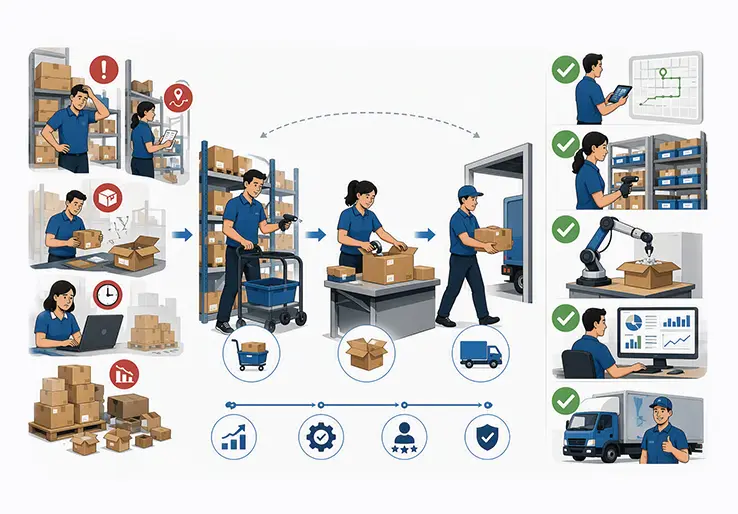
The pick pack and ship process is the core of warehouse and order fulfillment operations: items are picked from inventory, packed securely, and shipped through carriers to the customer. When any stage breaks down — misrouted picks, wrong-sized boxes, delayed carrier handoffs, or poor real-time visibility — the result is higher labor cost, lower accuracy, shipping delays, and more customer complaints. Picking alone accounts for approximately 50-60% of warehouse operational costs, making it the single largest lever for improving warehouse efficiency.
This guide is built for warehouse managers, fulfillment center operators, ecommerce business owners, and logistics professionals who need to improve pick pack and ship performance in a single warehouse or across multiple sales channels. It focuses on the full process, the main operational challenges at each stage, proven fixes such as picking methods and technology options, common implementation obstacles, and how LOGIC ERP helps optimize fulfillment workflows. The goal is practical: reduce waste, improve delivery speed, protect margins, and keep customer experience consistent as order volume grows.
In short, pick pack and ship is the end-to-end workflow of retrieving products, packaging them correctly, and dispatching them on time — and optimizing it requires fixing inefficiencies in picking, packing quality, shipping coordination, and process visibility. Whether your operation handles a few hundred daily orders or thousands, the same pressure points usually determine cost, speed, and service levels.
By the end of this article, you will understand:
The pick, pack, and ship process is the core workflow in e-commerce fulfillment. This process includes retrieving items from inventory locations, packing them securely with appropriate materials, and handing them to a carrier for last-mile delivery. Every sales order flows through these three stages, and the speed and accuracy at each step directly determine customer satisfaction and operational profitability.
Streamlined processes lead to faster order delivery. Conversely, operational inefficiencies can increase costs and impact profit margins — often in ways that compound silently until they become systemic. Average pick and pack costs in 2026 run approximately US$1.50–3.50 per single-item order, with an additional US$0.50–1.00 per extra item. When you factor in storage, handling, and shipping inputs, total fulfillment cost per order reaches US$3.00–5.50 for many e-commerce operations.
The pick pack ship process includes three main steps: pick, pack, and ship. Each stage has distinct operational requirements, failure modes, and optimization opportunities.
Pick and pack operations face challenges that fall into three interconnected categories.
include warehouse layout inefficiencies, suboptimal slotting, and unstandardized processes at the packing station.
encompass system integration gaps between your warehouse management system, shipping platforms, and carrier networks.
involve the inability to track orders, inventory, and performance metrics in real time across the supply chain.
Poor planning can lead to inefficiencies in fulfillment processes, and disorganization can reduce efficiency and increase errors in warehouses. Understanding which category your primary bottlenecks fall into is the first step toward implementing efficient picking strategies and targeted solutions. With these fundamentals established, let's examine each challenge area in detail.
These challenges rarely exist in isolation. A picking strategy mismatch creates downstream packing delays. Packing errors generate returns that consume warehouse workers' time. Shipping visibility gaps erode customer experience and trigger support costs. The compounding effect means that even modest improvements at one stage often unlock disproportionate gains across the entire process.
Suboptimal picking strategies are the most expensive problem in warehouse operations. Operations still using single-order piece picking in large facilities — where one picker walks the full warehouse for each sales order — lose 20-30% in productivity compared to optimized approaches. Piece picking is ideal for low order volumes, but as order counts grow, the travel time per pick becomes unsustainable. Common picking methods include single-order picking, batch picking, and zone picking, and matching the right method to your operation's profile is essential.
Poor warehouse layout amplifies picking inefficiency. When fast-moving SKUs are stored far from pack and ship areas, or when inventory management ignores ABC velocity analysis, pickers spend more time walking than picking. As SKU counts grow due to product diversification or expansion across various sales channels, storage often spreads into less efficient areas — narrow aisles, split locations, upper shelves requiring equipment.
Inventory location inaccuracies force pickers into search mode. When items aren't where the system says they should be, pick times spike, orders stall, and error rates climb. Advanced inventory management prevents stock discrepancies, but without disciplined cycle counting and real-time scanning, even the best inventory management software can't compensate for sloppy put-away practices. Good picking habits reduce the likelihood of wrong items being sent out, but those habits depend on accurate data.
Incorrect packing materials directly inflate costs and damage rates. Using oversized boxes increases dimensional weight charges from every shipping carrier, while insufficient protection leads to damaged goods during transit. Incorrect packing materials can lead to damaged goods during shipping — some operations report return rates of 6-10% or higher when packaging standards are inconsistent. Using appropriately sized boxes minimizes shipping expenses and product damage simultaneously. Packing involves selecting appropriate box sizes for items, and right-sized boxes reduce shipping costs and damage risk.
Inadequate quality control at the packing stage is where missing or incorrect items slip through. Quality control checks ensure accuracy before sealing packages, but when verification steps are skipped under time pressure — especially during peak periods — mis-packs drive returns, replacements, and customer dissatisfaction. The packing process includes verifying items against the original order; without this step, error rates climb into problematic territory.
Manual packing process bottlenecks emerge most visibly during demand surges. Static pack stations with limited tooling, inconsistent layouts, and no standardization create queues and variable output quality. WIKA Instrument Corporation's lean initiative demonstrated this clearly: by reducing pack-size variety from approximately 20 standard sizes down to 4, and standardizing packing station layouts, they cut work-in-process inventory from 2 hours to under 30 minutes. Automated packing processes reduce errors and improve efficiency, but even without full automation, standardization yields significant gains.
Carrier selection inefficiencies silently erode margins. Automated shipping software helps select cost-effective carrier routes, but many operations still default to a single carrier relationship without evaluating regional alternatives or negotiating volume-based rates. Choosing the right carrier impacts shipping costs and delivery speed — and the gap between optimal and suboptimal carrier selection can represent thousands in monthly overspend.
Lack of real time tracking affects both operational decision-making and customer satisfaction. Real-time tracking enhances customer satisfaction during shipping, and it has become a baseline expectation rather than a differentiator. Shipping labels contain tracking information for packages, and accurate shipping labels minimize delivery errors and enhance service. When tracking data is delayed or inaccurate, customer service teams absorb the impact.
Integration gaps between warehouse systems and shipping platforms create friction at the worst possible point — the final handoff. When the order management system, WMS, label printers, dimension/weight stations, and carrier APIs operate in silos, manual data entry creeps in, label misprints occur, and carrier pickup windows get missed. Customer satisfaction is influenced by speed and accuracy during fulfillment, and these integration failures undermine both.
Addressing pick pack ship challenges requires matching solutions to your operation's specific bottlenecks rather than deploying technology for its own sake. The most successful implementations start with process optimization, layer in technology, and measure continuously.
Implementing efficient picking strategies is the highest-impact change most warehouses can make. A well-optimized workflow allows businesses to handle higher order volumes effectively without proportional increases in headcount or warehouse space.
Beyond picking strategy selection, warehouse management software optimizes picking and packing processes through intelligent pick path routing, dynamic slotting based on SKU velocity, and real-time inventory visibility. Accurate inventory management is critical for successful picking and packing operations — the best strategy in the world fails if inventory data is wrong.
| Solution Type | Implementation Cost | ROI Timeline | Best For |
|---|---|---|---|
| Warehouse Management System | $50,000-$200,000 | 12-18 months | Operations over 500 orders/day |
| Barcode Scanning | $10,000-$30,000 | 6-12 months | Any size operation |
| Automated Picking Systems | $500,000+ | 24-36 months | High-volume operations |
For smaller operations or those new to warehouse automation, barcode management systems offer the fastest payback with minimal disruption. Mid-size operations running 500+ orders daily should evaluate a full warehouse management system that integrates pick and pack software with shipping, inventory, and order processing modules. Large-scale fulfillment centers processing thousands of orders may justify automated picking systems — mobile robotics, conveyor-based sortation, or pick-to-light systems — though these require longer payback horizons.
The case studies reinforce these benchmarks. Premier Yarns deployed mobile robotics and conveyor-based sorters in their 60,000 sq ft e-commerce warehouse and doubled daily picks to approximately 1,000 orders per day while cutting fulfillment lead times from 5-10 business days to 2-3 days. Medifast upgraded its sorting system and saw production rise 30% within the first week and 79% within eight months. BW Retail Solutions integrated WMS and shipping software, achieving 4× throughput while increasing labor efficiency by 45-60%.
Optimized systems reduce labor costs significantly — but only when technology solutions are properly integrated with existing processes and people. This leads directly to the implementation challenges that determine whether these solutions deliver on their promise.
Even proven solutions face resistance, technical hurdles, and scaling pressures during rollout. Anticipating these obstacles and planning for them is what separates successful implementations from expensive shelf-ware.
Warehouse workers accustomed to familiar routines often view new systems as threats rather than tools. Comprehensive training programs with hands-on practice sessions — not just classroom instruction — build confidence and competence simultaneously. Gradual rollout starting with pilot areas allows early adopters to demonstrate benefits, creating internal advocates. The most successful transitions, like NorthShore Care Supply's shift to voice-picking and AMRs, emphasized how automation freed employees to focus on higher-value tasks rather than replacing them.
Integration complexity is frequently underestimated. Existing legacy systems, multiple SKUs across various sales channels, carrier contracts, and custom order requirements create a web of dependencies. An API-first approach ensures seamless data flow between inventory control systems, pick and pack software, shipping platforms, and customer-facing portals. Using a 3PL provides access to advanced technology without significant investment for operations that lack internal technical resources, though outsourcing is most beneficial when demand is uneven or rapidly growing. Outsourcing can help scale operations quickly in response to demand fluctuations and reduces the burden of logistics management on businesses. LOGIC ERP's integrated warehouse management solutions address compatibility issues by unifying pick, pack and ship operations, inventory management, barcode scanning, and order management within a single platform — eliminating the multi-vendor integration challenge that derails many implementations.
Seasonal demand spikes expose every weakness in a pick pack ship process. Flexible staffing models combined with cross-training programs ensure warehouse workers can shift between picking, packing, and ship operations as volume dictates. Automated systems that maintain accuracy during volume surges — like barcode-verified picking and automated label print-and-apply — prevent the error rate spikes that typically accompany rushed manual processes. Outsourcing can improve customer service through specialized support during peak windows, and modular technologies that allow adding pick zones or packing stations provide physical scalability without permanent overhead.
Budget realism matters: implementation budgets frequently run 30-40% over initial vendor quotes due to integration customization, training time, and throughput dips during transition. Planning for this variance from the start prevents mid-project stalls. WIKA's approximately $100,000 investment in lean pack cell redesign achieved payback in roughly 10 months — a 17% productivity gain and 43% reduction in errors — demonstrating that not every improvement requires massive capital outlay.
LOGIC ERP Software offers a comprehensive solution designed specifically to tackle the complex challenges of pick, pack, and ship operations in modern warehouses and fulfillment centers. By integrating advanced inventory management software, order management systems, and warehouse management capabilities into a single platform, LOGIC ERP streamlines every step of the fulfillment process.
Key reasons to choose LOGIC ERP include:
Choosing LOGIC ERP for pick, pack, and ship optimization means investing in a proven technology platform that transforms warehouse operations into a well-oiled, cost-effective, and customer-centric fulfillment engine.
Successful pick pack ship optimization requires addressing challenges systematically rather than chasing individual fixes. The warehouses achieving the strongest results — doubled throughput, 40%+ error reductions, decreased labor costs — share a common pattern: they diagnose root causes, match solutions to their operational profile, standardize before automating, and measure relentlessly.
A well-optimized workflow allows businesses to handle higher order volumes effectively while maintaining the accurate order fulfillment and timely delivery that drive customer expectations in competitive markets. Efficient packing minimizes shipping costs and damages. Real-time tracking enhances customer satisfaction and transparency. Together, these improvements create a genuine competitive edge and deliver cost savings that compound over time.
Your immediate next steps:
For operations ready to move beyond point solutions, exploring integrated approaches to inventory control in supply chain management, omnichannel retail fulfillment, and distribution management will help sustain efficiency gains as your e-commerce business scales across market demands and multiple sales channels.
Call at +91-73411-41176 / +91-73411-41175 or send us an email at sales@logicerp.com to book a free demo today!
Fulfillment services encompass the entire process of receiving, processing, picking, packing, and shipping customer orders. They often include managing inventory, handling returns, and providing customer support. In the pick, pack, and ship context, fulfillment services ensure efficient order fulfillment by streamlining these steps, often through third-party logistics providers (3PLs) to scale operations and improve accuracy.
Efficient order fulfillment minimizes errors, reduces labor costs, and speeds up delivery times. By optimizing picking methods, packing with the right materials and box sizes, and ensuring smooth shipping processes, businesses can increase customer satisfaction and lower operational expenses.
Packing peanuts are lightweight, protective infill materials used in the packing process to fill voids inside boxes. They prevent items from shifting during transit, reducing the risk of damage. Using packing peanuts appropriately enhances product protection without significantly increasing shipping weight or costs.
A packing slip is a document included inside a package that lists the items contained in the shipment. It helps the recipient verify the order contents and assists in returns or exchanges if necessary. Including packing slips improves order accuracy and customer communication.
Secure sealing ensures that packages remain closed and intact during transit, preventing items from falling out or being tampered with. Proper sealing reduces damage risk and protects the contents, contributing to higher customer satisfaction.
Using the right-sized box minimizes shipping costs by reducing dimensional weight charges and prevents product damage by limiting movement inside the package. It also supports sustainable packaging practices by reducing material waste.
Real-time tracking provides customers with transparency about their order status, enhancing satisfaction and trust. For warehouse operations, it enables better shipment monitoring, proactive issue resolution, and improved coordination with carriers.
Businesses should consider outsourcing when facing uneven demand, rapid growth, or when internal logistics capabilities limit scalability. Outsourcing to a 3PL can provide access to advanced technology, specialized expertise, and flexible capacity to improve customer service and reduce operational burdens.
Technologies such as warehouse management systems (WMS), barcode scanning, automated packing systems, and integrated shipping platforms enhance accuracy, speed, and visibility. These tools reduce errors, optimize workflows, and provide data for continuous improvement.
Quality control involves verifying order accuracy, inspecting items for damage, and ensuring proper packing before shipment. Integrating quality control at both the picking and packing stages helps reduce returns, improve customer satisfaction, and protect brand reputation.
Customer satisfaction in pick pack and ship refers to how well the fulfillment process meets or exceeds customer expectations regarding order accuracy, delivery speed, and transparency. High customer satisfaction is achieved by minimizing errors, providing real-time tracking, and ensuring timely delivery.
Reducing labor costs in the pick pack and ship process involves optimizing picking strategies such as batch or zone picking, using barcode scanning technology to increase productivity, and automating packing tasks. Efficient workflows and proper staff training also contribute to lowering labor expenses.
Pick and pack is the process of selecting ordered items from inventory (picking) and preparing them for shipment by packing them securely. It is a critical step in order fulfillment that directly impacts accuracy, shipping costs, and delivery times.
The pick pack and ship process consists of three main steps: picking items from inventory, packing them with appropriate materials and box sizes, and shipping the orders through selected carriers. Each step must be optimized for accuracy and efficiency to ensure customer satisfaction.
A pack warehouse focuses on the packing stage of order fulfillment, where picked items are verified, packed securely using right-sized boxes and protective materials, labeled, and prepared for shipment. Efficient pack warehouses streamline packing workflows to reduce errors and speed up processing.
Pick and pack software enhances warehouse operations by optimizing picking routes, managing inventory in real-time, automating packing instructions, and integrating shipping label generation. This leads to improved accuracy, faster order processing, and reduced labor costs.
Pick pack and ship is a core fulfillment process that directly influences supply chain efficiency by ensuring orders are accurately processed and delivered on time. Streamlined pick pack and ship operations reduce delays, lower costs, and improve overall supply chain responsiveness.
Order processing in pick pack and ship encompasses receiving customer orders, managing inventory allocation, picking items, packing, and shipping. Efficient order processing ensures timely fulfillment and accurate delivery, which are vital for customer satisfaction.
The pick pack ship process is a fundamental workflow in warehouse management and e-commerce fulfillment, involving three critical steps: picking, packing, and shipping customer orders. During the picking stage, warehouse staff retrieve items from inventory shelves based on customer orders, which accounts for approximately 50-60% of warehouse operational costs. Efficient picking strategies like batch picking, zone picking, or wave picking help reduce labor costs and improve accuracy. The packing stage involves verifying the picked items against the order, selecting appropriately sized boxes, adding protective materials, and securely sealing packages to minimize shipping costs and prevent product damage. Finally, the shipping stage includes choosing the best carrier and shipping method, generating accurate shipping labels with tracking information, and dispatching the orders for delivery. Real-time tracking throughout the process enhances customer satisfaction by providing transparency and timely updates. Optimizing the pick pack ship process through technology integration and process standardization is essential for reducing errors, lowering costs, and ensuring fast, accurate order fulfillment in competitive warehouse operations.
Popular Products