A style matrix in apparel is the structured grid that maps every combination of style, size, and color into individual SKUs, each carrying its own stock levels, price, and sales data.
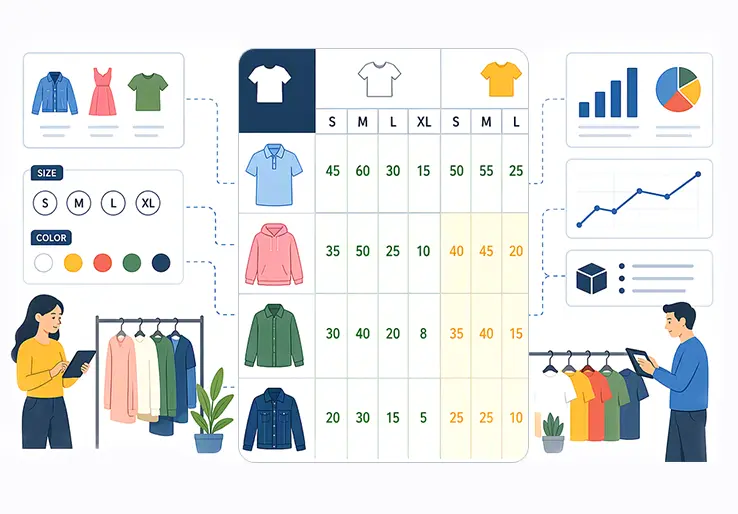
Fashion retailers and apparel brands in 2026 face a compounding challenge: every new style multiplied by sizes and colors creates dozens of SKUs, and every new sales channel multiplies the locations where those SKUs must be tracked. A mid-size brand launching 350 styles in a single season can generate close to 8,000 active SKUs. Apparel software must manage thousands of style-color-size combinations across warehouses, retail stores, marketplaces, and D2C websites, all at once.
A style matrix in apparel is the structured grid that maps every combination of style, size, and color into individual SKUs, each carrying its own stock levels, price, and sales data. Apparel inventory management tracks thousands of SKUs simultaneously using this matrix as the foundation for purchasing, allocation, and replenishment. Generic ERP systems and spreadsheets treat each variant as a standalone record, which breaks down once the SKU count crosses a few hundred. An apparel-native data model, by contrast, treats the style as a parent entity with size and color as structured dimensions, keeping the entire variant set organized and queryable.
LOGIC ERP is built on this principle. Its core structure treats the style color size matrix as the primary unit of work, from purchase orders through apparel POS. This article covers what a style matrix is, how it works, its benefits, practical examples, and best practices for apparel retailers and manufacturers.
A style matrix is a structured grid that combines a parent style with its size and color variants to produce unique SKUs, each with its own inventory, price, and sales data. It enables apparel businesses to manage all style-size-color combinations in one interface for tracking, replenishment, and decision making.
Here is what each component means:
A T-shirt style offered in 5 sizes and 6 colors produces 30 SKU combinations. The matrix displays all 30 in a single grid. Apparel software tracks inventory by style, color, and size using this matrix as its core data model, rather than flat product lists used by generic software.
A typical 2026 seasonal drop includes 150 to 400 different styles. Each style may have 8 to 20 variants. A style-color-size matrix tracks 20 variations per product on average; add a new color to an existing style, and every size in that style’s ladder replicates.
Why does this complexity keep growing?
Consumer Expectations
customers demand full size runs and color options in every channel, whether that is a marketplace listing, a franchise store, or a D2C site.
Multi-Channel Operations
D2C websites, wholesale accounts, franchise outlets, SIS counters, and distributors each require variant-accurate inventory. Multiple channels and multiple stores multiply the tracking points.
Carry-Forward Styles
core basics persist across seasons, so active SKU counts accumulate rather than reset.
Category-Specific Sizing
T-shirts use S through XXL. Denim requires waist-length pairs (4 waists × 3 lengths × 3 washes = 36 SKUs per style). Sneakers span US 6 through 12, sometimes with width options.
Generic ERP or spreadsheets buckle under this volume. Every added color or size adds rows, not just cells, creating exponential complexity that only a matrix-native system handles reliably.
Instead of manually creating 48 product records for a single style, planners define one style and attach size and color sets. The system auto-generates all variant SKUs. This alone eliminates hours of data entry per collection.
SKU codes follow a structured pattern derived from matrix coordinates (MP101-BLK-M, MP101-WHT-L), which reduces mis-coding and duplicate SKUs. Warehouse teams see every size-color quantity for a given style on one screen, without scrolling through thousands of flat SKU rows.
Inventory allocation becomes more precise. Managers can spot that XL is running low while XS is abundant, then trigger a store transfer or targeted reorder at the variant level. This keeps size runs intact, a requirement for strong sell-through performance.
A style matrix also reduces manual errors in stock posting and price updates, improving overall inventory accuracy. In LOGIC ERP, the matrix is native to the data model. All purchasing, sales, returns, and transfers operate at the variant level automatically, without workaround configurations.
The workflow moves from style definition through inventory analysis in seven steps.
Create the Style
Define the style code, description, brand, gender, category, season, fabric, and fit. Example: "MTS-2301 Men’s Graphic Tee SS26."
Add Available Colors
Select or create color codes (BLK, WHT, NVY, RED) with display names and swatches. Each color links to fabric dye or print BOMs if needed.
Add Size Combinations
Assign the size scale (S through XXL for tops, 28 through 38 for denim) and set the display sequence for reports and billing screens.
Generate SKU Combinations
The system auto-creates every style-size-color variant as a distinct SKU record. A single style can generate up to 48 unique SKUs. Each gets a unique barcode for scanning.
Capture and Track Inventory
Purchase orders, goods receipt notes, production output, and stock transfers are entered at SKU level via the matrix screen. Every movement updates variant-level quantity.
Track Sales and Returns
When a customer buys Style MTS-2301 in Navy, size L, that specific variant’s stock decrements. Returns add back to the correct matrix cell. POS and eCommerce channels feed into the same pool.
Analyze Sales and Stock Movement
Merchants review sell-through per size-color, spot broken size runs, and flag aging inventory directly in the matrix format.
LOGIC ERP supports this end-to-end flow with matrix-based screens for GRN, stock transfer, replenishment, and billing.
A robust style matrix is built on specific master data fields in apparel ERP. Core elements of a style matrix include axis categories, merchandise balance, and lifecycle tracking. Axis categories typically list product types on one axis and key variables (size, color) on the other.
Merchandise balance ensures the collection is not overly weighted in one direction, helping designers maintain a healthy ratio of basic everyday wear versus statement runway pieces.
| Element | What It Means | Example Value |
|---|---|---|
| Style / Design | Parent design identifier | MP-101 Polo Tee |
| Size | Size ladder and codes | S, M, L, XL, XXL |
| Color | Color variants and swatches | Black, Navy, White |
| SKU / Variant | Style + Size + Color code | MP101-BLK-M |
| Season | Collection cycle | SS26, AW26 |
| Fabric | Material or process | 100% Cotton, Denim |
| Brand | Brand or sub-brand | LOGIC |
| Category | Product type or gender | Men’s Tops |
| Quantity | Inventory per variant per location | 20 units in Warehouse A |
| Price / MRP | Selling price or MRP | ₹1,499 |
These elements map into a logical data model: a parent style table, attribute tables for size and color, and a variant (SKU) table linking all three. LOGIC ERP keeps these elements standardized across outlets to avoid duplicate styles and inconsistent SKU coding. Clean master data is the prerequisite for unified reporting across all of a fashion retailer’s stores and channels.
Below is a matrix for one T-shirt style. Rows represent colors; columns represent sizes. Numbers are on-hand stock per variant.
| Color \ Size | S | M | L | XL |
|---|---|---|---|---|
| Black | 20 | 35 | 40 | 25 |
| White | 15 | 30 | 35 | 20 |
| Blue | 10 | 25 | 30 | 15 |
A merchandiser scanning this matrix sees that Blue-S (10 units) is at risk of stockout, while Black-L (40 units) is well covered. Buyers and planners use this view to trigger replenishment, inter-store transfers, or markdown decisions on slow variants.
Here is a second example for a denim style with waist and length combinations:
| Color \ Waist × Length | 30×30 | 30×32 | 32×30 | 32×32 |
|---|---|---|---|---|
| Indigo | 12 | 8 | 14 | 10 |
| Black Wash | 10 | 6 | 12 | 8 |
This proves that the style color size matrix is flexible enough to handle different apparel categories, from T-shirts to denim to footwear.
The matrix controls product variety to prevent option overload and manage inventory complexity. Without it, apparel brands run blind at the variant level.
The matrix simplifies decision-making during line reviews by letting teams evaluate proposed styles in context, comparing new additions against existing assortment depth.
LOGIC ERP combines these benefits with barcode/RFID support, ai driven insights, and real-time inventory synchronization across omnichannel operations.
Both retailers and apparel manufacturers rely on the fashion matrix, but at different points in the supply chain. Retailers use it to allocate and replenish across stores. Manufacturers use it to plan production quantities and fabric consumption. Below are the specifics.
Fashion retailers use the matrix to manage store-wise stock for each style-size-color combination. Real-time inventory visibility is crucial for multi-store operations; without it, stores sell out of core sizes while other outlets sit on excess.
POS and eCommerce integration update variant-level inventory in real time, supporting BOPIS (Buy Online, Pick Up In Store) and ship-from-store workflows. Cohesive storytelling creates a unified narrative on the retail floor by ensuring logical product flow across size and color assortments.
Sales analysis by size-color at the store level reveals which stores sell more XL, which colors are regional favorites, and where stock needs to move. Multi-store POS software ties these insights into automated replenishment workflows.
Live cross-store lookups let staff locate a needed size-color during an in-store visit, converting a potential lost sale into a confirmed transaction. Full visibility across the network is the difference between a satisfied customer and a lost one.
Apparel manufacturers plan production by style, then explode it into size-color quantities using the matrix. Gap analysis helps teams identify missing categories, color options, or price points before production begins. Assortment balance helps design teams maintain a mix of basic everyday items and trendy seasonal pieces.
It connects creative decisions with merchandising, allowing for informed decision-making based on the collection strategy. It also streamlines sourcing and material consolidation by mapping fabric and trim choices systematically; aggregate fabric meters are calculated across all variants for bulk procurement.
Size-wise and color-wise production tracking monitors WIP at cut, sew, wash, and finish stages per variant. Matrix-based production orders in LOGIC ERP’s apparel manufacturing module align output with confirmed orders and forecasted demand, reducing overproduction of slow sizes and underproduction of top sellers.
Traditional SKU management uses a flat list of products. Each size-color variant exists as an independent record, without visible grouping under a parent style. This structure causes fractured reporting, duplicated metadata, and poor inventory visibility.
| Factor | Style Matrix | Traditional SKU Management |
|---|---|---|
| Style management | Centralized under parent style | Fragmented across individual records |
| Size/color tracking | Matrix-based grid view | Isolated SKU lines |
| Stock visibility | Full visibility per variant per location | Limited; requires manual compilation |
| Analysis speed | Instant matrix dashboards | Manual exports and pivots |
| Replenishment | Rule-based by variant performance | Ad hoc, often delayed |
| Data model fit for apparel | Native structure for style-size-color | Bolted-on attributes, prone to errors |
The difference is structural. LOGIC ERP is built with the matrix as the core data model, avoiding the limitations of generic ERP where variant tracking is an afterthought.
Apparel retailers using generic inventory tools or spreadsheets face predictable problems:
These issues erode margins, hurt customers, and complicate season planning. The cost of not using a matrix compounds with every new style and every new store.
Apparel ERP software manages complex style-color-size matrices as a native function, unlike generic ERP that treats variants as optional extensions. It supports real-time inventory tracking across multiple locations.
Key capabilities:
Over 600 apparel brands trust AIMS360 for inventory management in similar workflows, illustrating how the apparel industry broadly depends on matrix-native systems. LOGIC ERP is another example of an apparel ERP with native support for style matrix management.
LOGIC ERP is built for the apparel industry’s data shape. Here is what that means in practice:
The result: a single product defined once, tracked everywhere, analyzed at every level of the matrix.
These practices apply to operations, merchandising, and IT teams maintaining a clean, reliable style matrix:
The path from a single product design to profitable inventory runs through one structure: the style matrix. Style feeds into size and color, which generate SKUs, which carry variant-level inventory, which drive smarter allocation and purchasing across every location and channel.
Apparel inventory complexity demands a matrix-based data model. Flat SKUs and generic ERPs cannot deliver the real time visibility, accuracy, or analytical depth that fashion retailers and apparel brands need to compete in 2026 and beyond.
A well-maintained style matrix reduces stock imbalance, protects margins on working capital, and gives customers the size and color they want, when and where they want it.
Manage complex apparel inventory with greater accuracy and real-time visibility using LOGIC ERP.
Call at +91-73411-41176 / +91-73411-41175 or send us an email at sales@logicerp.com to book a free demo today!
A style matrix is a grid combining style, size, and color to manage all SKU variants in one structure. Each cell corresponds to a unique SKU with its own inventory, price, and sales data.
In the apparel industry, a style matrix covers garments, footwear, and accessories with multiple sizes and colors. Apparel inventory matrix views are standard in apparel ERP and fashion retailers systems for tracking clothing variants.
Define a style, attach size and color sets, and auto-create SKUs. Track quantity and sales per matrix cell. Matrix-based screens are used for stock entry, transfers, and replenishment decisions.
A style is the parent design (one T-shirt model). A SKU is one specific size-color combination of that style. One style with 6 sizes and 4 colors produces 24 SKUs.
The matrix consolidates all variants, making it easier to see what is in stock, what is selling, and where gaps exist. This leads to fewer stock-outs, better replenishment, and accurate inventory allocation across stores.
Fashion retailers need variant-level accuracy to avoid broken size runs, overselling, and excess inventory. It improves customer experience by ensuring the right size and color is available when and where customers need it.
Apparel ERP is built to manage style matrices natively. Generic ERP often cannot handle them without heavy customization. LOGIC ERP includes native style-size-color matrix management, SKU generation, and variant-level reporting.
Manufacturers use the matrix for size-wise and color-wise production planning and fabric/trim consumption calculations. It aligns production quantities with order books and demand forecasts.
Define the style master, set up size scales and colors, and use apparel ERP or style matrix software to generate the matrix. Manual spreadsheets work for 10 styles; they fail at 100.
Simplified SKU control, improved stock visibility, better replenishment, more accurate purchasing, and stronger margins. Strong style matrix management supports AI-driven analytics and advanced demand forecasting for apparel businesses.
A style matrix in fashion retailers is a structured grid that organizes every style by its size and color variants, allowing retailers to manage thousands of SKUs efficiently. It simplifies inventory allocation and stock visibility, ensuring accurate tracking across multiple sales channels.
Apparel software provides native support for style matrix management by automating SKU generation, tracking inventory at the variant level (style, size, color), and enabling real-time updates across warehouses, retail stores, and eCommerce platforms. This eliminates manual errors and streamlines inventory allocation.
Inventory allocation in apparel ERP refers to the process of distributing stock based on style, size, and color demand patterns using AI-driven insights. This ensures optimal stock levels in each location, reduces stockouts, and improves customer experience by having the right products available at the right time.
A robust data model in apparel ERP organizes complex style-size-color matrices as native entities rather than flat SKUs. This enables apparel brands to maintain accurate inventory visibility, streamline replenishment, and generate AI-driven insights for better purchasing and sales forecasting.
Generic software and ERP systems often treat products as single SKUs without native support for style-size-color matrices. This leads to fragmented data, manual SKU creation, inventory inaccuracies, and poor customer experience due to overselling or stockouts.
AI-driven insights analyze sales patterns, demand fluctuations, and inventory movement at the SKU level. In apparel ERP, these insights optimize inventory allocation, forecast demand accurately, and support strategic decisions that enhance operational efficiency and customer satisfaction.
Style matrix management ensures accurate stock visibility for every size and color variant, reducing the chances of stockouts or overselling. This leads to timely order fulfillment, consistent size availability, and a seamless shopping experience both online and in-store, boosting customer loyalty.
Popular Products