A payment gateway is a secure digital technology that sits between customers, merchants, and banks — the invisible bridge that captures card or UPI details, encrypts them, routes them to the right bank, and returns an approval or decline within seconds.
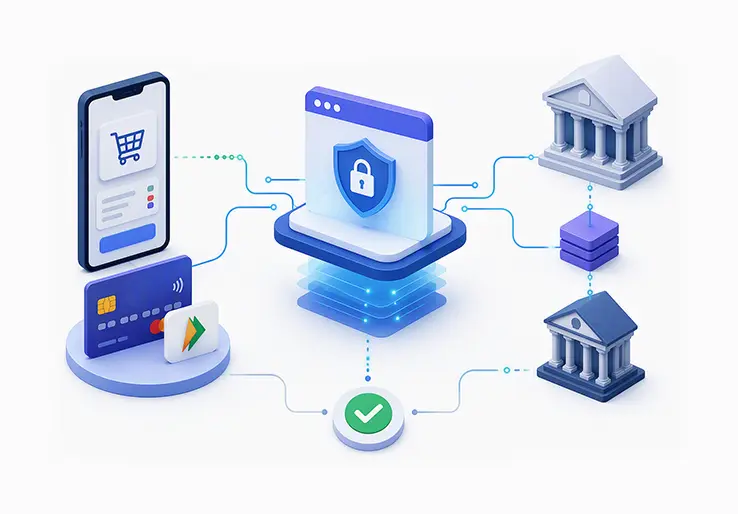
A payment gateway is a secure digital technology that sits between customers, merchants, and banks, making it possible to accept payments online, at a physical POS counter, or through a mobile app. Think of it as the invisible bridge that captures your customer's card or UPI details, encrypts them, routes them to the right bank, and returns an approval or decline — all within seconds.
The scale of digital payments in India makes this bridge indispensable. UPI alone processed approximately 228.3 billion transactions worth nearly ₹300 lakh crore in 2025, with monthly volumes regularly crossing 20 billion. UPI now accounts for roughly 85% of all digital payment transactions in India by volume. Add card payments, net banking, and wallets, and it's clear: cash-only retail is a shrinking category.
Common use cases span ecommerce checkout pages, QR-based in-store payments at supermarkets, subscription billing for gyms and SaaS platforms, and utility payments. Payment gateways are no longer standalone tools bolted onto a website — they're deeply embedded in ERP, billing, and POS systems.
LOGIC ERP, an Indian retail-focused ERP and POS platform, integrates tightly with leading payment gateway providers to serve Supermarkets, fashion and apparel, footwear, pharmacies, restaurants, electronics, and departmental stores. This guide covers definitions, technical flows, gateway types, fees, benefits, selection criteria, future trends, and how LOGIC ERP simplifies the entire integration for Indian businesses.
A payment gateway is a secure service that authorises and routes digital payments between customers, merchants, and financial institutions. It acts as an intermediary between a customer and a merchant, securely transmitting payment information between banks so that the transaction can be verified, approved, and settled.
Payment gateways support over 100 payment methods for transactions, covering cards (Visa, Mastercard, RuPay), UPI, net banking, mobile wallets, EMI, BNPL, and international transactions — across web, app, and in-store channels.
Here's where a gateway sits in the chain: your customer-facing interface (website, app, or POS terminal) collects payment details and hands them off to the payment gateway. The gateway encrypts this data and forwards it to the payment processor or acquiring bank, which communicates with the card network or UPI switch, and then with the issuing bank. The response flows back the same way. The gateway enables businesses to link their business bank account to multiple payment methods, ensuring all settlements land in one place.
Modern gateways also handle tokenization, OTP flows, and two-factor authentication as mandated by RBI for card and UPI payments in India.
These three terms often get used interchangeably, but they play distinct roles in every transaction.
A payment processor is the entity that connects to card networks like Visa, RuPay, and Mastercard, as well as issuing and acquiring banks, to actually execute the fund transfer. It handles the heavy lifting of moving money between banks, managing risk checks, and processing chargebacks.
A payment gateway, on the other hand, is primarily the secure "front door" for digital payments. It captures payment data, encrypts it, and routes it to the processor. The processor is the "plumbing" that moves funds; the gateway is the interface that initiates and monitors the flow.
Then there are the banks. The acquiring bank holds the merchant's account and receives payment authorisations on the merchant's behalf. The issuing bank is the customer's bank — the one that issued the card or holds the bank account being debited. The acquiring bank sets merchant-facing transaction fees, while the issuing bank decides on approval based on the customer's balance, credit line, and risk profile.
In India, RBI-authorised payment aggregator entities often bundle the gateway, processing, and settlement process into a single service for small businesses and SMEs. This is why providers like Razorpay, PayU, Paytm, or Cashfree Payments appear to do "everything" — they're operating as aggregators.
LOGIC ERP integrates at the payment gateway layer. It doesn't replace banks or processors. Instead, it orchestrates data and automated reconciliation between the gateway's settlement reports, your invoices, and your general ledger.
The complete payment flow usually finishes in under five seconds, but behind the scenes, your payment data makes several hops through multiple systems.
Here's the realistic path: the customer selects a payment method (card, UPI, wallet, or net banking) on the merchant's website, app, or POS terminal. The merchant's system sends the transaction request to the payment gateway. The payment gateway encrypts the sensitive payment details using encryption protocols like SSL and TLS to protect data during transmission. It then forwards the encrypted payload to the payment processor or acquiring bank.
The processor routes the request through the appropriate payment network — Visa or Mastercard for cards, NPCI for UPI and RuPay — which then contacts the issuing bank. The issuing bank checks available funds, runs fraud and risk checks, and sends back an approval or decline response along the same path.
This entire authorisation typically takes two to four seconds in India when networks are running smoothly. When a bank's server is slow or down, the gateway's auto-retry logic kicks in, attempting alternate routes or queuing the request. Modern gateways can handle up to 10,000 transactions per second — Paytm, for instance, handles 10,000 transactions per second during peak loads.
From the customer's perspective, visible actions include entering an OTP, confirming a UPI collect request, or scanning a QR code. Within LOGIC ERP, the system sends transaction details to the gateway, captures the response, updates the invoice with the payment status, and reflects changes in inventory and accounts — all in real time.
Let's break the flow into stages that any non-technical retailer can follow.
Customer Initiates Payment
The buyer picks a payment method — card swipe, UPI scan, wallet, or net banking — at the checkout page or POS counter. This is where the journey begins.
Data Encryption
The moment payment details are entered, the payment gateway encrypts the data. Tokenization is used to secure sensitive payment information, replacing raw card numbers with unique tokens. Payment gateways ensure PCI-DSS compliance for secure transactions, meaning they follow strict global standards for handling cardholder data.
Bank Authorization
The encrypted payload travels to the acquiring bank or UPI PSP, which forwards it through the card network or NPCI switch to the issuing bank. The issuing bank runs its checks — balance, fraud rules, transaction limit — and issues a verdict.
Payment Approval or Decline
Approvals go through instantly. Declines happen for reasons like insufficient funds, incorrect OTP, expired card, velocity limits, or risk flags. Failed transactions are logged and the customer is prompted to retry or choose another method.
Settlement Process
Approved transactions enter the settlement cycle. In India, UPI settlements are often T+0 (same day), while card payments typically settle at T+1 or T+2 — meaning the merchant's business bank account receives funds one or two business days later.
Invoice Generation
Once payment is confirmed, the ERP or POS system — like LOGIC ERP — instantly generates a GST-compliant invoice, updates the ledger, and aligns the payment status with inventory records. This stage is where billing software adds the most value.
The "type" of payment gateway usually refers to how it's integrated and how the customer experiences checkout.
Hosted payment gateways redirect customers to third-party pages for payment processing. The merchant's site hands off to the gateway's secure page. Pros: lower PCI compliance burden for the merchant. Cons: the redirect can cause drop-offs and reduces branding control.
Self-hosted payment gateways allow payments to be processed directly on the merchant's website. The merchant collects card or payment details on their own page and sends them server-to-server to the gateway. This is common among larger Indian ecommerce sites that want full control over checkout UX.
API-hosted payment gateways offer tailored integration into websites or apps for seamless payment processing. Using REST APIs and SDKs, the checkout happens entirely within the merchant's page or app — no redirects. Popular with modern D2C brands and high-conversion-focused retailers.
In-app SDKs, UPI deep links (Intent flows), mobile wallets, and one-tap card payments via tokenization fall here. Local bank integration gateways also connect to specific banks for payment processing, enabling direct debit or net banking flows on mobile.
These orchestrate UPI Intent, Collect, Autopay, and both static and dynamic QR codes for offline stores. With UPI dominating Indian retail volumes, this type is essential. LOGIC ERP supports dynamic QR-based payments directly from the POS screen.
LOGIC ERP works with multiple integration models — integrated payment gateways via APIs for POS terminals and hosted checkout options for ecommerce add-ons.
Feature set determines success rate, reconciliation effort, and customer satisfaction more than brand name alone. Here's what to look for.
Multi-payment Support
A capable gateway handles UPI, RuPay/Visa/Mastercard debit cards and credit cards, net banking across 50+ banks, digital wallets, BNPL/EMI, and international cards in major currencies. Payment gateways support over 100 payment methods for flexibility, and leading providers push even higher — PayU supports over 150 payment methods including UPI and cards, while CCAvenue provides over 200 payment options including 27 currencies.
PCI DSS and RBI Compliance
Payment gateways must comply with PCI-DSS standards. This includes data localisation, card tokenization, advanced encryption, and mandatory 2FA for online transactions. Fraud prevention systems are integral to payment gateway security.
Real-time Transaction Processing
Payment gateways provide real-time transaction tracking and reporting, with auto-retry logic to handle India's variable network conditions and improve success rates. Top-tier gateways deliver 99.99% uptime, ensuring reliable payment processing for businesses.
Refund Management
Handling instant refunds, partial refunds for returns and RTO orders, with status syncing back to ERP is non-negotiable for retail.
Subscription and Recurring Payments
UPI Autopay and card-based standing instructions support SaaS, gym memberships, and education fee collection.
Multi-store and Omnichannel Support
A single payment gateway account mapping to many outlets, websites, and apps — with location-wise reporting — saves operational overhead for chains.
LOGIC ERP leverages these features through integrated dashboards, automatic reconciliation, and GST-ready reports that pull data from every connected gateway. For deeper insight, explore retail analytics capabilities within LOGIC ERP.
Understanding payment gateway charges is critical for margins, especially in low-margin verticals like grocery and pharmacy where every basis point matters.
Common fee components:
| Fee Type | Typical Range (India 2026) |
|---|---|
| Setup fees | Often ₹0 for SMEs |
| UPI P2M MDR | 0% (zero MDR policy) |
| RuPay debit card MDR | 0% for many merchants |
| Visa/MC debit card MDR | 0.40%–0.90% |
| Credit card MDR | 2.0%–3.0% + GST |
| Net banking | ~1.5%–2.0% or flat fee |
| International cards | 3%–4% + FX markup |
| Annual maintenance fee | Varies; some waived on volume |
Foreign transaction fees range from 2.5% to 3.5% for businesses accepting international customers.
Chargeback fees (₹200–500 per dispute), refund processing charges, cross-border markups, FX conversion margins, and additional gateway plugin charges can add up. PayU has no hidden fees in its pricing model, but not every provider follows this approach — always ask.
Cashfree provides T+1 settlement for faster cash flow, and Paytm offers flexible settlement options like T+1 and same-day. Faster settlement means your daily cash flow improves, but some gateways charge a premium for instant settlement.
Negotiate volume-based slabs, review GST charged on fees, and reconcile invoices against actual gateway reports using your ERP. Comparing offers from providers like Paytm payment gateway, Cashfree Payments, or others becomes manageable when LOGIC ERP acts as the unified reconciliation layer.
Manual card machines, standalone UPI apps, and cash-only registers create reconciliation headaches. Every mismatch between what was billed and what was collected is potential leakage. Integrated payment gateways solve this.
Faster Checkout
Customers at supermarkets and busy apparel stores move through queues quicker when UPI and card payments process directly through the POS without switching devices. Payment gateways streamline the checkout process, helping to reduce cart abandonment — both online and in-store.
Improved Customer Experience
One-tap UPI, tokenized cards, and automatic SMS/email receipts from the ERP billing system make the buying journey seamless. Payment gateways can enhance customer trust by providing secure transaction environments.
Secure Transactions
Integrated gateways reduce scope for pilferage, incorrect cash handling, or unrecorded sales. Every transaction is logged, timestamped, and tied to an invoice.
Real-time Payment Confirmation
The POS shows payment status immediately, preventing delivery for unpaid or failed transactions and reducing revenue loss.
Simplified Reconciliation
Automation features in payment gateways can simplify billing and reconciliation processes. Payment, invoice, tax, and settlement data flow into a single ERP ledger instead of scattered spreadsheets. You can track payments across outlets and payment modes from one dashboard.
Better Cash Flow Visibility
Daily cash position, ageing of settlements, and bank-wise payout tracking become possible from ERP dashboards. Payment gateways improve conversion rates with optimized checkout flows, which directly translates to higher revenue.
Omnichannel Payments
Whether a sale happens in-store, online, or via a marketplace, the payment data converges in one system — enabling true omnichannel reporting.
Physical retail in India is now "phygital." Customers expect to accept digital payments in every store format, from a neighbourhood kirana to a multi-floor department store.
Supermarkets & Grocery
High-velocity, small-ticket transactions demand fast checkout in Supermarket and Grocery retail business. UPI QR at counters and card tap payments, integrated with loyalty and inventory, keep queues short and billing accurate.
Apparel & Footwear Retailers
The trial-to-billing journey matters here in Apparel & Footwear retail business. EMI options for higher ticket sizes, e-receipts tied to loyalty tiers, and saved-card options via tokenization drive repeat purchases.
Electronics & Appliances
BNPL/EMI is a significant conversion driver in Electronics and Appliance retail business. High-value card payments need robust risk and chargeback tracking. Serial number and IMEI-wise billing tied to payment records adds an accountability layer.
Pharmacies
Frequent small-ticket transactions require speed in Pharmacy retail business. Quick settlement cycles help with inventory restocking of fast-moving medicines. GST compliance for pharma is especially strict, making integrated pharmacy billing essential.
Restaurants & QSRs
Table-wise billing, split bills, tip handling, and QR-based scan-and-pay flows integrated with restaurant POS software reduce order errors and speed up table turns.
Department Stores & Lifestyle Chains
Multi-counter, multi-floor setups need centralized payment reporting through Departmental Store, Lifestyle and Fashion retail chains. Without it, reconciling end-of-day collections across 15 counters becomes a daily nightmare.
LOGIC ERP is a unified retail ERP + POS platform designed for Indian tax, banking, and payment regulations from the ground up.
The POS screen handles barcode billing, discount application, inventory sync, and direct linkage to payment options at checkout — all without switching systems. Customers can pay via card, UPI, wallet, or net banking from the same billing screen.
LOGIC ERP works with several gateway providers so merchants can choose based on their bank relationships and fee structures. Razorpay processes payments through UPI, cards, wallets, and net banking. Paytm supports payments via UPI, cards, wallets, and net banking. Cashfree offers UPI, cards, wallets, and BNPL payment options. PayU supports over 150 payment methods. CCAvenue provides over 200 payment options including 27 currencies. The LOGIC ERP × Razorpay integration is one example of how tightly these connections work.
Dynamic QR codes generated per bill, automatic payment status capture, and prevention of duplicate entries — all from within the POS. Integration uses robust APIs, SDKs, and plugins to ensure reliability.
Settlement statements from different gateways and payment methods are mapped to invoices and ledger accounts automatically. No more matching Excel sheets manually.
Tax calculation, HSN/SAC codes, e-invoice, and e-waybill (where applicable) stay aligned with payment data, ensuring audit readiness.
Head office gets a real-time view of outlet-wise collections, bank-wise settlements, and payment mode performance across the chain. Learn more about multi-store retail strategies with LOGIC ERP.
AI helps retailers move from reactive firefighting to proactive decisions about payments and customer behaviour. Here's how LOGIC ERP applies it.
Smart Payment Analytics
Identify which payment methods convert best by city, store, or time of day. If UPI dominates mornings but cards spike during evening sales, you can optimize terminal allocation, QR placement, and staff training accordingly.
Fraud Detection Support
Rule-based and AI-assisted flags catch suspicious patterns — unusually high refunds from a single counter, split-billing abuse, or repeated declined transactions from the same terminal. Payment gateways enable real-time transaction monitoring and reporting, and LOGIC ERP adds a layer of business-context intelligence on top.
Sales Trend Analysis
Combining transaction data with item-wise sales data reveals which products sell better on credit card EMI versus UPI, helping retailers plan inventory and craft targeted promotions.
Customer Payment Preferences
Segment customers by preferred payment modes — UPI versus card versus wallet — and tailor offers accordingly. Loyalty programmes can be linked to payment behaviour for deeper engagement.
Automated Reporting
Scheduled settlement reports, bank reconciliation statements, and management dashboards reduce hours of manual work each week. Transaction history is available for audit at any point.
LOGIC ERP focuses on analytics and orchestration while relying on PCI DSS-compliant gateways for raw payment processing. The ERP doesn't store raw card data — it tracks transactions, statuses, and settlements.
Predictable settlement cycles are critical for paying suppliers, rent, and salaries. Over 60% of small businesses face cash flow gaps, and delayed payments can disrupt inventory replenishment cycles. A well-integrated payment gateway directly addresses this.
In India, UPI settlements are typically T+0 (same day). Card payments settle at T+1 or T+2. Net banking varies. Bank holidays and cut-off times shift actual credit dates, so tracking the settlement cycle precisely matters. Cashfree provides T+1 settlement for faster transactions, which helps small businesses manage cash flow more effectively.
Routing all gateway settlements into one business bank account simplifies accounting and GST compliance. You can track payments mode-wise and gateway-wise without combing through multiple bank statements.
LOGIC ERP, combined with your gateway, can break down daily settlements by payment method, bank, outlet, and gateway. This is where real time payment tracking turns operational. Over 30% of small businesses delay growth due to limited credit access — knowing your exact cash position daily helps you negotiate better with suppliers and lenders. Pine Labs enables real-time credit access through UPI integration, adding another dimension to manage cash flow.
A common retail pain point: the gateway report says ₹5.2 lakh was processed yesterday, but only ₹4.9 lakh hit the bank. The difference could be chargebacks, refund deductions, or timing. LOGIC ERP's auto reconciliation flags these discrepancies and helps you track transactions to their source, so you can spot missing payouts or chargebacks quickly.
"Cheapest MDR" is not always the best payment gateway. Reliability, integration depth, and fraud tools matter just as much as fees.
Prioritise gateways with pci dss compliance at Level 1, strong fraud detection tools, tokenization, and RBI-compliant data localisation. PayU is PCI-DSS Level 1 certified for security, setting a benchmark. Look for gateways that offer a secure payment gateway environment with advanced encryption.
Compare MDR by payment type (UPI, debit, credit, international). Check for hidden fees — chargeback fees, refund processing charges, setup fees, and monthly minimums. Ask for a complete fee schedule, not just the headline MDR.
Compare real T+1 performance, not just what's promised. How does the gateway handle disputes? What happens during bank downtime? High payment success rates matter more than marginal fee savings.
Stress the importance of ready-made connectors or open APIs that work smoothly with systems like LOGIC ERP. PayU offers a fast, one-click payment experience, and Paytm supports integration with platforms like Shopify and WooCommerce — check if similar connectors exist for your POS. Over 5 lakh businesses trust PayU for reliable payment processing, but fit with your ERP matters more than popularity.
Check for Indian business-hour support, clear escalation paths, and SLAs for failed or stuck transactions.
Ensure the gateway handles seasonal peaks (Diwali, festive sales), multi-store rollouts, and expansion needs. Payment gateways enable businesses to scale and manage increasing transaction volumes — but only if the infrastructure is ready.
Indian retailers are increasingly selling to NRIs and global customers online, making cross border capabilities a practical requirement rather than a future consideration.
When a customer outside India pays with a Visa or Mastercard, the payment gateway routes the transaction through international card networks. The gateway can offer either Dynamic Currency Conversion (DCC) — showing the price in the customer's local currency — or charge in INR with the bank handling FX. An international payment gateway must support multi-currency processing for this to work smoothly.
Foreign transaction fees range from 2.5% to 3.5% for businesses, often higher than domestic MDR. FX conversion margins, scheme fees, and cross border processing charges add up. CCAvenue supports 27 currencies for international payments, and Pine Labs' international payment gateway supports multi-currency transactions — making them relevant options for export-focused retailers.
International transactions often have longer settlement timelines. Chargebacks from foreign cards follow different network timelines and can be harder to contest. 88% of business leaders feel cross border payments affect cash flow, and 50.6% of wholesale cross border payments settle within one hour — but retail settlements are often slower.
Integrated payment gateways with LOGIC ERP allow tagging international sales, handling currency conversion at the invoice level, and generating separate reports for export revenue. This keeps domestic and international payment data cleanly segmented for accounting and compliance.
If you're looking to collect online payments from international customers, evaluate gateways that support the specific global payment schemes and currencies your customer base uses.
India's leadership in UPI — handling nearly 50% of the world's real-time instant payment volumes according to Government of India data — positions the country at the forefront of payment innovation.
AI-powered Fraud Prevention
Behavioural analytics, device fingerprinting, and real-time risk scoring are becoming standard features rather than premium add-ons. Expect gateways to flag fraudulent transactions before they complete, not after.
Contactless and Tokenized Payments
NFC tap payments, wearable payments (smartwatches, rings), and card tokenization at POS are growing steadily. As card-on-file rules tighten, tokenization becomes the default.
UPI Growth and Innovations
UPI Lite for small-value offline transactions, UPI for credit lines enabling MSMEs to access working capital, and UPI Autopay for recurring payments are expanding what a single payment gateway can offer through the UPI rail.
Embedded Finance
Lending, BNPL, and insurance are being integrated directly into checkout and ERP systems. Customers can access a credit line or EMI option without leaving the billing screen.
Voice and Biometric Payments
Pilot programs for voice authorisation and fingerprint/face authentication linked to bank accounts and wallets are underway. These may reach mainstream adoption within 2–3 years.
LOGIC ERP is architected API-first and cloud-ready to plug into new payment rails and gateway features as they launch. As the payment solution landscape evolves, the ERP layer adapts without requiring merchants to rebuild their billing or inventory systems.
LOGIC ERP is an end-to-end retail ERP + POS platform that brings inventory, billing, GST, and payments under one roof — purpose-built for Indian retail.
Unified Retail POS
Single-screen billing with integrated gateway options, customer data capture, and discount controls. No toggling between apps. Razorpay processes payments for over 12 million merchants, and LOGIC ERP connects you to this scale through its Razorpay integration and similar connectors.
ERP + Payments Synergy
Item, tax, and payment data are unified for accurate profitability analysis and outlet performance tracking. You see not just what sold, but how it was paid for, and what margin each payment mode delivers after fees.
Inventory Synchronization
Real-time stock updates on every successful invoice and payment prevent overselling — critical during festive peaks and flash sales.
GST Billing and Compliance
E-invoicing, e-waybill where applicable, and automated GST reports fed by accurate payment data. Every online payment, card swipe, and UPI transaction maps cleanly to your GST returns.
Omnichannel Retail
Support for web, app, marketplace, and in-store payments with centralised reconciliation and reporting. Explore how omnichannel retail works with billing and POS in the LOGIC ERP ecosystem.
Cloud Deployment
Access your payment dashboards, settlement reports, and business intelligence from anywhere with Cloud ERP software. No dependency on a single physical location.
Trusted by Thousands of Retailers
Years in the Indian market, serving everything from single-store pharmacies to multi-chain supermarket operations, LOGIC ERP has a strong implementation and support ecosystem that enables businesses to accept payments confidently and grow.
Call at +91-73411-41176 / +91-73411-41175 or send us an email at sales@logicerp.com to book a free demo today!
Get an Overview of Payment Gateways and Integration Modes
A payment gateway is a secure digital technology for online transactions and in-store payments. It acts as an intermediary between a customer and a merchant, authorising and routing payment data to banks for approval and settlement.
The customer chooses a payment method. The payment gateway encrypts the payment details and sends them to the acquiring bank, which routes them through the card network or UPI switch to the issuing bank. The bank approves or declines, and the response flows back. Settlement follows within T+0 to T+2.
Yes. Payment gateways ensure PCI-DSS compliance, use SSL/TLS encryption, tokenization, and OTP-based 2FA as mandated by RBI. They capture payment data and encrypt it for security at every stage.
Absolutely. Modern gateways offer APIs, SDKs, and plugins for integration. LOGIC ERP connects with multiple payment gateway providers to accept payments across UPI, cards, wallets, and net banking.
There's no single "best" — it depends on your payment modes, volume, fee tolerance, and ERP compatibility. Evaluate based on security, faster payment processing, settlement speed, and integration support. Compare providers like Razorpay, PayU, Paytm, Cashfree, and CCAvenue against your specific requirements.
Yes. LOGIC ERP supports integration with leading gateways for UPI, card payments, wallets, net banking, and international payment processing. It also handles payment links for collect payments scenarios.
Yes. LOGIC ERP generates dynamic QR codes per bill at the POS, captures payment status automatically, and supports UPI Intent and Collect flows for online businesses.
It eliminates manual entry, auto-matches settlements to invoices, flags mismatches, and generates consolidated reports. This reduces errors and speeds up daily closing.
UPI P2M is 0% MDR. Debit cards range from 0%–0.9%. Credit cards run 2%–3%. International transactions cost 3%–4%. Always check for hidden fees, annual maintenance fee charges, and GST on fees.
Supermarkets, fashion and apparel, footwear, pharmacies, restaurants, electronics, and department stores all see measurable gains in speed, accuracy, customer satisfaction, and business growth from integrated payment gateways.
Payment Gateway Acts as the crucial intermediary that securely transmits payment information between customers, merchants, and banks. It ensures that all payment data is encrypted and processed following regulatory standards, safeguarding sensitive information throughout the transaction lifecycle.
The payment gateway processes every transaction by capturing payment details, encrypting them, and routing the information to the acquiring bank or payment processor. It manages authorization, fraud checks, and communicates approval or decline responses in real time, enabling seamless payment experiences.
Businesses can accept payments online effortlessly through integrated payment gateways. These gateways support multiple payment methods including cards, UPI, wallets, and net banking, enabling merchants to provide customers with convenient and secure checkout options across websites and mobile applications.
While payment gateways offer convenience, merchants should be aware of potential hidden fees. These may include chargeback fees, refund processing charges, cross-border transaction fees, and monthly maintenance costs. Transparent fee structures are essential for accurate cost management and profit calculation.
Paytm Payment Gateway is a popular choice in India, offering extensive support for UPI, cards, wallets, and net banking payments. Known for its ease of integration and trusted brand presence, it provides merchants with a reliable platform to collect payments with zero MDR on UPI transactions and flexible settlement options.
Cashfree Payments stands out for its fast settlement cycles and comprehensive payment options, including UPI, cards, wallets, and Buy Now Pay Later (BNPL). It offers robust APIs for seamless integration and real-time transaction tracking, helping businesses manage cash flow efficiently.
Collect payments securely and efficiently using modern payment gateways that automate transaction processing and reconciliation. Whether online or in-store, these systems enable businesses to accept diverse payment modes, improve customer experience, and maintain accurate financial records.
Popular Products