Learn what Return Merchandise Authorization (RMA) is, how the return process works, its benefits, and how ERP software simplifies return approvals and inventory tracking.
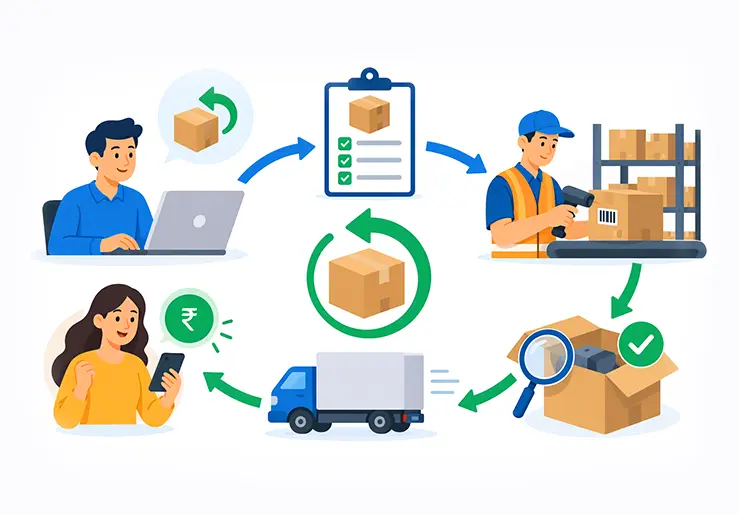
Since 2020, e-commerce sales in the U.S. have more than doubled, fueling a sharp rise in product return volumes. Return rates for online purchases have climbed to roughly 17% for large retailers in 2024, up from pre-pandemic averages around 13%. For retailers, distributors, and ecommerce businesses, the cost of handling these returns—shipping, inspection, restocking, customer service—has become a serious drag on margins.
The pain points are familiar. Unstructured email threads for return requests. Packages arriving at the warehouse with no tracking number or reference. Customers waiting weeks for a refund while support teams scramble to locate their returned product. Finance teams chasing down duplicate credit notes or missed restocking fees. These problems multiply as return volume grows.
A structured return merchandise authorization (RMA) process acts as the gatekeeper of reverse logistics. It defines formal steps by which returns are approved, tracked, processed, and accounted for, protecting both your margin and customer satisfaction. Over 50% of buyers read return policies before purchase, and 96% of consumers review return policies before buying online. A well-framed return policy, backed by a reliable RMA system, reduces customer service inquiries and builds trust.
Integrated ERP platforms like LOGIC ERP centralize the entire return merchandise authorization process alongside inventory, warehouse operations, and finance. This gives every stakeholder—from support agents to warehouse teams to accountants—real-time visibility into every open return.
A Return Merchandise Authorization (RMA) is a formal approval workflow through which a customer must obtain authorization—signified by a unique tracking number issued by the seller—before returning a product for refund, repair, or replacement. The terms "return authorization," "return merchandise authorization," "return material authorization," and return goods authorization are often used interchangeably across B2B and B2C contexts. The RMA meaning is consistent: it is a structured process to manage and control product returns.
An RMA serves several purposes. It validates whether a return is eligible under the company’s return policies or warranty period. It helps prevent fraudulent returns and abuse of policies. And it ensures that every product return is traceable—connecting the return shipment to the original order for tracking purposes so that inventory can be updated and financial entries posted correctly. An RMA permits customers to return defective or unwanted products through a controlled channel rather than sending items back without notice.
Key participants in a typical RMA flow include:
A modern RMA can be requested via online forms, customer portals, POS terminals, or helpdesk tickets—not just by phone or email. These digital channels allow structured capture of product data, reason codes, photos, and serial numbers right at intake.
The return merchandise authorization number is the primary tracking ID for any product return. Think of it as the thread that connects a customer’s request, the physical package, the warehouse inspection, and the financial resolution into a single traceable record.
Here is the typical lifecycle. A customer requests an RMA by providing proof of purchase—such as an invoice or order number—along with the return reason and product details. The system validates eligibility and generates a unique RMA number (for example, RMA-2026-09-000145, where "2026-09" indicates September 2026). This authorization number appears on the RMA form, in email confirmations, and on return labels sent to the customer.
When the package arrives, the warehouse team scans or keys in this number to connect the physical item with the digital RMA record. From there, the RMA number triggers downstream workflows:
RMA numbers track product returns throughout the process, provide customers a reference for tracking returns, help prevent return fraud and abuse of policies, and allow warehouses to update inventory management software in real time. Returned products without an RMA may not be eligible for refunds, which is why clear instructions to customers at the start of the process matter so much.
Here is a detailed walkthrough of a standard return merchandise authorization process used by online and offline retailers. The RMA process typically involves initiating a return request and receiving approval, followed by shipping, inspection, and resolution.
Customer Raises a Return Request
The customer initiates the process by submitting the reason for return, proof of purchase (invoice or order number), and product information such as SKU or serial number. Customers must provide proof of purchase to obtain an RMA. Photos or video of the product condition may also be required for high-value or fragile items.
Policy and Warranty Validation
The business reviews whether the return falls within the eligibility window, checks product condition requirements, and confirms the item is not in a non-refundable category. Return policies may stipulate time limits, item condition, and eligibility for returns. RMA approval is contingent on the return policy and eligibility criteria.
RMA Approval and Number Assignment
If eligible, the system generates a unique RMA number and captures metadata: return reason code, product type, batch or serial number, and expected disposition. Automated systems can instantly issue RMA numbers to customers, cutting approval time from days to minutes.
Sending Return Instructions and Labels
Upon approval, customers receive an RMA number and shipping instructions, including packaging guidelines and where to ship or drop off the item. Prepaid shipping labels may be included depending on the return reason and policy.
Product Return Shipment or Store Drop-Off
The customer ships the item back or drops it off. Items should be packaged securely for return and must often include the RMA number visibly on the package.
Receipt and Check-In
At the warehouse or returns center, the team scans the RMA number to log receipt, checks condition upon arrival, and confirms all parts or accessories are included.
Inspection and Testing
The seller inspects the returned item to verify its condition and processing resolution. For electronics, this might involve firmware checks, serial number verification, and functional testing. RMA processes can include a quality control inspection of returns to ensure the product matches the stated reason for return.
Resolution Decision
Possible outcomes of the RMA process include refunds, exchanges, or repairs. If the item is ineligible—damaged by misuse, outside the warranty period, or missing components—the return may be rejected. Restocking fees may apply per policy.
Inventory and Accounting Updates
Resalable items go back into stock. Damaged goods are written off or sent for refurbishment. Finance issues a credit note, refund to the customer’s account, or store credit. All data flows into analytics for return trends, cost tracking, and supplier performance.
Example: An apparel ecommerce business allows returns for wrong sizes. A customer requests a return through the online store portal, receives an RMA number, ships the item with the return label, and the warehouse inspects to confirm the garment is unworn with tags attached. The replacement is shipped, inventory is updated so the returned item becomes available for resale, and the customer receives automated communications at each step—RMA approved, product received, inspected, resolved. This kind of transparency keeps customers happy and reduces support calls.
The flowchart below illustrates the standard RMA process from initial request to final resolution.
Figure 1: RMA Process Flow
Return Request → Review & Approval → RMA Number Issued → Product Return (Shipping/Drop-off) → Receipt & Scan at Warehouse → Inspection & Testing → Resolution (Refund / Replacement / Repair / Reject) → Inventory & Finance Updates
ERP automation hooks into this flow at several critical points. At the approval stage, LOGIC ERP can automatically determine eligibility based on configurable business rules (return window, product category, customer history). At the warehouse, barcode scanning ties the physical package to the digital record instantly. At the finance stage, credit notes and refund postings are generated automatically, ensuring accurate reconciliation.
This standard flow can be customized for different business models. A drop-ship retailer might route the return directly to the vendor. A marketplace model might require the third-party seller to handle inspection and resolution. A wholesale distributor might use vendor return authorization workflows with different approval chains. The core logic stays the same—structured intake, tracked movement, inspected resolution, and updated records.
Different RMA types matter because they involve different workflows, owners, and business rules. Understanding which type applies to a given scenario keeps your RMA management clean and your reports accurate.
Customer Return Authorization covers end-customer returns to the retailer. This is the most common type in B2C retail and ecommerce—covering defects, wrong items, size or color issues, and changes of mind. The customer service team typically owns this workflow.
Vendor Return Authorization handles returns from the retailer back to the supplier or manufacturer. A distributor might return excess inventory or defective batches under agreed terms. The purchase or procurement team manages these RMA requests, and the process often involves supplier chargebacks or credit memos.
Warranty Return Authorization applies when products are returned under a manufacturer’s or extended warranty. Serial number tracking, warranty registration, and proof of purchase date are critical. Service centers or OEM partners may handle the repair or replacement. This type is common in electronics and industrial equipment.
Ecommerce Return Authorization is specific to online order flows. It handles reverse logistics, return labels, drop-off points, exchanges, and sometimes returnless refunds for low-value items. Ecommerce brands often embed this into their customer portal for self-service.
Internal Stock Return Authorization covers movement within the company—store-to-warehouse, warehouse-to-distribution center, or moving defective batches for disposal. Operations teams own this process.
LOGIC ERP can classify these types using distinct RMA reasons and document types, so reporting stays segmented and actionable across the supply chain.
Understanding why customer returns happen is directly tied to both customer satisfaction and cost control. When you capture accurate reason codes in the RMA form, patterns emerge that point to fixable problems.
Returns generally fall into a few categories:
Quality-Related
Defective unit out of the box, damaged in transit, DOA (dead on arrival), warranty failure after a few months of use, or improper installation by the customer.
Logistics and Shipping
Wrong item shipped, wrong quantity, shipment delayed past promised delivery date, or lost in transit by shipping carriers.
Customer Preference
Wrong size or color, product doesn’t look like the listing photos, buyer’s remorse, or "bracketing" (ordering multiple sizes to try at home).
Administrative
Product not as described on the product page, pricing errors, duplicate orders, or excess inventory returns from franchise stores. In FMCG, expired or near-expiry goods are a common trigger.
Grouping reasons by category inside your ERP reports helps identify systemic issues. For instance, if a specific SKU shows a high defect rate in Q2 2026, that signals a manufacturing or supplier quality problem worth investigating before further returns pile up.
Capturing photos or videos during the return request is now common practice for high-value or fragile items. This customer data speeds up inspection and reduces disputes about product condition.
When return volumes are low, spreadsheet- or email-based RMAs can work. But as an ecommerce business scales, manual processes break down quickly.
Delayed Return Approvals. Manual verification through email chains means customers start waiting days for a simple yes-or-no answer. Inconsistent application of return policies across branches or channels compounds the problem—one store might approve a return that another would reject.
Poor Return Tracking. Without a centralized RMA system, it is difficult to track returns across their lifecycle. Open RMAs get lost in inboxes. Items returned without an RMA may be refused or incur fees, but without a robust system, unauthorized packages slip through and create confusion.
Inventory Inaccuracies. Returned items sitting in a "grey area"—physically in the warehouse but not reflected in the system—lead to stock counts that don’t match reality. This undermines forecasting and replenishment. Accurate inventory reconciliation becomes nearly impossible.
Financial Errors. Manual refunds and credit notes increase the risk of transaction errors: double refunds, missed credit notes, incorrect restocking fees, or tax misclassification. These reconciliation problems drain finance team hours.
No Analytics. Without structured data, you cannot detect fraudulent returns, serial returners, or supplier quality issues. You are flying blind on which products generate the most returns and why—making it hard to take corrective action on future returns.
Specialized return management software or ERP RMA modules centralize the full return merchandise authorization process into a single platform. The right RMA software eliminates the gaps that manual processes create and gives every team—from customer service to finance—a shared view of every return.
Here are the features that matter most:
| Feature | What It Does | Business Benefit |
|---|---|---|
| Guided RMA creation | Structured intake forms with required fields | Consistent data capture, fewer incomplete requests |
| Configurable approval rules | Rules by channel, product type, price, reason | Faster approvals, consistent policy enforcement |
| Automatic RMA number generation | System assigns unique authorization number | Eliminates manual numbering errors |
| Barcode/QR code scanning | Scan items at receipt and inspection | Faster check-in, fewer manual errors |
| Integrated return labels | Generate and send labels from within the system | Smoother customer experience, trackable shipments |
| Return reason libraries | Standardized reason codes across channels | Clean data for analytics and root cause analysis |
| Supplier return management | Vendor RMA and chargeback workflows | Recover costs from defective supplier inventory |
| Multi-store/multi-warehouse tracking | Visibility across all locations | Centralized control for omnichannel retail |
| Disposition routing | Automatic routing to restock, refurbish, or scrap | Maximizes recovery value |
| Return analytics dashboards | KPIs, trends, and drill-down reports | Data-driven decisions on products, suppliers, policies |
LOGIC ERP’s RMA module supports these capabilities, linking return records through inventory, warehouse operations, and finance in a single integrated environment.
An ERP system like LOGIC ERP unifies sales, inventory, warehouse management, and finance around a common RMA record. Instead of juggling separate tools, every stakeholder works from one platform.
Centralized Return Request Management. All return merchandise—whether from POS, ecommerce, or wholesale—flows into one RMA dashboard. Support agents see the same data as the warehouse team and finance. This eliminates the "where is this return?" problem that plagues disconnected systems. Customers can initiate returns through a self-service portal, and automated communications keep them informed at every stage.
Automated Approval Workflows. The system applies business rules before auto-approving or flagging an RMA for manual review. Rules might check whether the request falls within 30 days of purchase date, whether the product is unworn, or whether the customer has exceeded a return frequency threshold. Automation speeds up the RMA process significantly and reduces manual processing errors.
Real-Time Inventory Updates. When RMAs change status—received, inspected, approved, rejected, restocked—inventory levels update automatically across all locations. This prevents the "grey area" problem and improves stock accuracy for replenishment and forecasting.
Integrated Billing and Refund Processing. The ERP generates credit notes, replacement invoices, and adjustments for tax and coupon codes automatically. Whether the resolution is a refund to the customer’s account, store credit, or an equivalent cash value exchange, the financial record stays clean. No more chasing down mismatched entries.
Multi-location Return Management. For businesses with multiple retail stores, warehouses, or distribution centers, the ERP tracks which location received the return, allocates costs correctly, and ensures every item is accounted for. RMA automation helps track returns through the supply chain end to end.
Return Analytics and Reporting. Detailed reports on return rates, return reasons, product defects, and pending resolutions help managers spot problems early. If a product line suddenly spikes in returns, you see it in the dashboard—not three months later in a quarterly review.
A robust RMA system delivers measurable outcomes. RMA processes can improve customer satisfaction and loyalty because customers receive faster resolutions, transparent updates, and a hassle-free return process. RMA is essential for managing product returns in ecommerce, where the customer experience during returns directly impacts whether they buy again.
Key benefits include:
Automating RMA processes can save time and reduce errors across every department involved in the return process.
Even the best RMA software fails if policies and processes are unclear. Effective RMA management requires alignment between technology, people, and policy.
Define a Clear Return Policy. Publish eligibility windows (e.g., 30 days from purchase date), condition requirements (unused, tags attached, original packaging), non-refundable categories (perishables, personal care), and how restocking fees are handled. Require customers to obtain an authorization number before shipping anything back. A well-framed return policy reduces customer service inquiries because customers know exactly what to expect.
Use Standardized RMA Numbers and Reason Codes. Every store, channel, and warehouse should use the same terminology and format. This ensures your return analytics are consistent and comparable across locations.
Categorize Return Reasons Consistently. Use structured reason libraries (quality, logistics, preference, administrative) so you can identify recurring issues and take corrective action—whether that means switching a supplier, updating product descriptions, or improving packaging.
Integrate Returns with Inventory. Ensure accepted, damaged, and rejected products are recorded correctly and promptly in your stock management system. Delayed updates create phantom inventory.
Establish Inspection Procedures. Define quality checks before approving refunds, replacements, or restocking. Document what "acceptable condition" means for each product category.
Train Employees. Frontline store staff, call-center agents, the warehouse team, and finance users should all understand the RMA workflow inside LOGIC ERP or similar systems. Everyone needs clarity on hand-offs and responsibilities.
Monitor RMA Metrics. Track approval time, processing time, percentage of fraudulent or rejected returns, and cost per return. Periodically adjust rules or policies based on what the data tells you.
Data-driven RMA management beats intuition, especially for multi-location retailers and fast-growing online stores. Here are the KPIs that matter:
| Metric | What It Measures | Why It Matters |
|---|---|---|
| Return Rate | Percentage of orders returned | Apparel often 20–40%; electronics 8–12%. Tracks overall return health. |
| Return Approval Time | Time from customer request to RMA issued | Best in class: under 1 day. Directly impacts customer experience. |
| Return Processing Time | Receipt to resolution | Average is 9–10 business days; best in class: 3–5 days. |
| Refund Processing Time | Resolution to money back in the customer’s account | Target under 48 hours for customer loyalty. |
| Product Defect Rate | Returns caused by defects vs. other reasons | Identifies quality or fulfillment issues by SKU. |
| Return Cost per Order | Full cost: shipping, labor, handling, restocking | Helps quantify the true margin impact of returns. |
| Restocking Rate | Percentage of returned products added back to inventory | Target 60–80% for Grade A items. |
| Repeat Return Rate | Frequency of returns by same customer | Flags potential abuse or sizing/description problems. |
LOGIC ERP and similar systems can generate these KPIs automatically from RMA and inventory transactions, providing detailed reports without manual data gathering.
Example: If your dashboard shows a spike in the return rate for a particular SKU in Q2 2026, you can drill into the reason codes, identify that 70% of returns cite "product not as described," and update your product listing before further returns erode your margin.
The core concept of an RMA is consistent across industries, but workflows differ significantly based on product characteristics, regulatory requirements, and customer expectations.
In apparel and fashion, return rates run between 20–40%, driven by size and color exchanges, bracketing behavior (ordering multiple sizes), and subjective fit issues. Speed matters here—the faster a returned garment gets inspected and re-listed, the sooner it sells again before the season ends. Accurate product data, consistent sizing charts, and fit tools on the online store help reduce future returns.
In electronics, return rates average 15–20%. Serial number tracking, warranty claims, and DOA detection are critical. Inspection involves technical diagnostics—firmware checks, functional testing, and verification that the issue is a genuine defect rather than improper installation or customer misuse. Vendor or manufacturer involvement is common for warranty return authorization, and the entire return often requires coordination with OEM repair centers.
In FMCG and grocery distribution, returns center on expired or near-expiry goods, damaged stock, and incorrect shipments. Batch and lot tracking is essential for traceability. Suppliers are frequently involved through vendor return authorizations and credit note processing. Regulatory compliance—especially for recalls—adds complexity.
In pharmacy and healthcare retail, strict regulatory requirements govern what can be returned, restocked, or disposed of. Batch-level return tracking, temperature-sensitive handling for certain products, and compliance-focused workflows make this one of the most tightly controlled RMA environments. The customer permanently relinquishes ownership of returned pharmaceutical products in most jurisdictions, and disposal rules are non-negotiable.
Many businesses still rely on ad hoc email- and spreadsheet-based return processes. Here is how that compares to a software-driven approach:
| Parameter | Manual Return Processing | RMA / ERP-Based Processing |
|---|---|---|
| Request Intake | Email, phone, paper forms | Centralized digital portal with structured fields |
| Approval Logic | Manual review, inconsistent | Configurable rules, auto-approve or flag |
| Tracking Visibility | Limited; requires chasing updates | Status-based tracking with automated notifications |
| Inventory Updates | Delayed, error-prone | Real-time updates upon scan and inspection |
| Financial Reconciliation | Spreadsheets, manual matching | Integrated credit notes, refunds, and tax handling |
| Fraud Control | Minimal | Serial number validation, pattern detection, photo evidence |
| Reporting | Time-consuming, often retroactive | Automated dashboards and detailed reports |
| Multi-Location Management | Difficult to coordinate | Centralized visibility across all stores and warehouses |
The difference is practical. A warehouse team using barcode scanners tied to the RMA system processes returns in minutes. The same team working from handwritten notes and email printouts takes hours—and makes more mistakes. A robust system replaces guesswork with structured data at every step.
Needs differ by business type and scale. A single-brand online store has different requirements from a multi-warehouse distributor handling thousands of RMA requests per month. Here is a practical checklist:
Must-Have Features:
Integration Requirements:
Evaluation Criteria:
Questions to Ask Vendors:
LOGIC ERP is a strong fit for retailers and distributors seeking integrated RMA, inventory, and financial management in one platform—rather than bolting together standalone tools that don’t share customer information or product data.
If your business is dealing with delayed refund processing, poor return tracking, or inventory mismatches from unstructured returns, it is time for a change.
LOGIC ERP connects RMA creation, return authorization, warehouse receipt, inspection, and financial posting in one integrated platform. Instead of juggling spreadsheets, emails, and disconnected tools, your team works from a single source of truth.
What you get:
The result: faster resolution times, fewer manual errors, stronger fraud controls, and better visibility into which products, suppliers, or processes need attention. An RMA number tracks each returned product through the process, from the moment the customer requests a return to the final inventory and financial update.
Return Merchandise Authorization (RMA) is a critical component of effective return management for retailers, distributors, and ecommerce businesses. By providing a structured and traceable process for approving, tracking, and resolving product returns, RMA systems protect profit margins while enhancing customer satisfaction. The unique RMA number acts as a vital link between the customer, warehouse, and finance teams, ensuring accurate inventory updates and financial reconciliation.
Manual return processes often lead to delays, errors, and poor visibility, but integrated ERP solutions like LOGIC ERP simplify RMA workflows by automating approvals, inventory adjustments, and refund processing. This centralized approach improves operational efficiency, reduces fraud risk, and delivers valuable analytics for continuous improvement.
Implementing best practices such as clear return policies, standardized reason codes, and thorough inspection procedures combined with modern return management software empowers businesses to handle growing return volumes confidently. Ultimately, a well-managed RMA process supports customer loyalty, optimizes supply chain operations, and drives sustainable business growth.
Call at +91-73411-41176 / +91-73411-41175 or send us an email at sales@logicerp.com to book a free demo today!
A Return Merchandise Authorization is a formal process and unique tracking number that a seller issues to approve and track a product return. An RMA is the first step in returning a product and ensures that every return is documented, inspected, and resolved properly. It is sometimes also called return goods authorization.
An RMA number is important because it connects the returned product to the original order, enables the warehouse to process returns efficiently, updates inventory records, and provides the customer a reference for tracking. Without it, returned items may not be eligible for refunds.
No. The RMA is the authorization for the customer to return an item. A refund is one possible outcome after the item is inspected. Other outcomes include replacement, repair, or rejection.
The customer initiates the return by submitting a return request with proof of purchase. The business reviews eligibility. If approved, an RMA number is issued with detailed instructions for return shipment. The item is inspected upon arrival, and a resolution is determined for refund, exchange, or repair.
You can, but it introduces risks: unauthorized returns, missing inventory, financial mismatches, and difficulty detecting fraud. A structured RMA process ensures every return is tracked and accounted for. You may want to require customers to obtain an RMA before shipping anything back.
It depends on your policy and the return reason. Many businesses cover return shipping for defective products but require the customer to ship at their own expense for preference-based returns like wrong size or buyer’s remorse.
Yes. Exchange is a common resolution. The RMA system should support replacement invoicing, outbound shipping for the new item, and proper inventory adjustments for both the returned and replacement products.
Use serial number verification, require photo or video evidence at request, set limits on return frequency per customer, and configure automated fraud detection rules. Flag high-value or suspicious RMA requests for manual review.
Yes. ERP systems like LOGIC ERP automate eligibility checks, RMA number generation, customer notifications, inventory updates, and financial postings. RMA automation can increase customer satisfaction and loyalty while significantly reducing manual errors.
By tracking returns through the system in real time scanning upon receipt, recording inspection outcomes, and updating stock levels automatically RMA software eliminates the "grey area" where returned items exist physically but not digitally. This directly improves forecasting and replenishment.
Return Management Software (RMS) is a specialized digital solution designed to streamline and automate the entire product return process for businesses. It manages return requests, authorizations, shipping labels, product inspections, refunds, replacements, and restocking. RMS integrates closely with inventory management software to ensure that returned products are accurately tracked and updated in inventory records in real time. This integration helps maintain accurate stock levels, prevents discrepancies, and improves operational efficiency by linking return authorizations with inventory updates, financial transactions, and warehouse workflows.
Return Merchandise Authorization (RMA) is important because it provides a formalized process to approve and track product returns. It helps businesses control reverse logistics, prevent fraudulent returns, and maintain accurate inventory and financial records. RMAs ensure that returns are processed efficiently and transparently, improving customer satisfaction and protecting profit margins.
A well-managed return merchandise authorization process enhances customer satisfaction by providing clear guidelines, faster return approvals, and transparent communication throughout the return lifecycle. Customers appreciate knowing their return status, receiving timely refunds or replacements, and having a hassle-free experience, which encourages repeat business and loyalty.
A return merchandise authorization number is a unique identifier assigned to each approved return request. It links the returned product to the original order and tracks its journey through the return process from approval and shipment to warehouse receipt and final resolution. This number is essential for efficient inventory updates, fraud prevention, and customer communication.
Return material authorization is another term for return merchandise authorization, referring to the formal approval process that authorizes a customer to return a product. It ensures that the return is valid under company policies and provides a tracking mechanism through a unique authorization number.
For ecommerce businesses, return merchandise authorization streamlines the often complex reverse logistics of online sales. It reduces errors in return approvals, improves inventory accuracy by linking returns to stock management systems, and enhances customer experience with faster resolutions and clear return instructions. It also helps manage shipping labels, track returns, and prevent abuse of return policies.
Return labels are pre-printed or digital shipping labels provided to customers to facilitate the return of products. They include the RMA number and shipping information to ensure the returned item is correctly identified and routed back to the warehouse. Proper use of return labels reduces lost or misdirected returns, speeds up processing, and improves overall return management efficiency.
An authorization number is a unique code issued during the return merchandise authorization process that grants permission to return a product. It serves as a reference for the customer, warehouse, and finance teams to track and process the return accurately. This number is crucial for linking the return to the original sale and ensuring compliance with return policies.
Popular Products