A Complete Guide to Enterprise Resource Planning Systems
ERP (Enterprise Resource Planning) is software that integrates and manages core business processes like accounting, inventory, sales, and operations in one system. It helps businesses streamline workflows, improve efficiency, and access real-time data for better decision-making.
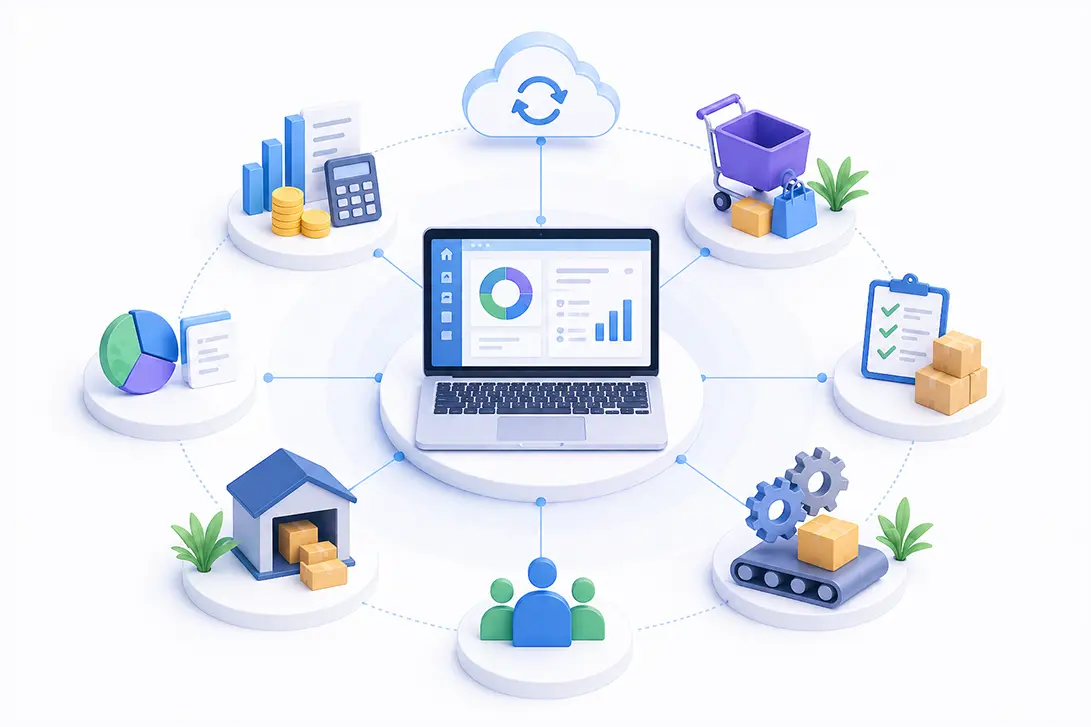
Enterprise resource planning (ERP) is an integrated business management system that unifies core business processes accounting, procurement, manufacturing, human resources, and supply chain management into a single software system with a centralized database. Enterprise resource planning (ERP) is an integrated system that organizations use to manage day-to-day business activities such as accounting, procurement, project management, and supply chain operations. Early ERP systems were expensive and primarily accessible to large companies due to high costs of purchase, implementation, and maintenance. Today, organizations use ERP systems to eliminate data silos, automate workflows, and gain real-time visibility across all business functions.
This guide covers ERP fundamentals, deployment models including the rise of cloud based systems as a modern evolution of ERP deployment implementation considerations, and measurable business benefits for organizations of all sizes. Whether you're a business owner evaluating your first ERP solution, an IT manager comparing ERP deployment models, or an executive building a business case for digital transformation, this content addresses the practical questions driving your decision-making process. Deploying ERP software is a critical step for organizations seeking operational efficiency and scalability. Cloud ERP software utilizes advanced security protocols and vendor-managed cybersecurity to protect sensitive business data from cyber threats, providing an additional layer of data security for modern organizations.
What you'll learn from this guide:
Enterprise resource planning (ERP) is a type of software that organizations use to manage day-to-day business activities such as accounting, procurement, project management, and supply chain operations. ERP systems centralize data from various business functions, providing a unified view that enhances decision-making and operational efficiency.
Enterprise resource planning software manages day-to-day business activities by connecting previously disconnected departments, processes, and data sources into a unified ERP platform. ERP systems support all core business functions including finance, HR, supply chain, and manufacturing and facilitate productivity and collaboration by automating tasks, streamlining workflows, and enabling seamless interdepartmental communication. Instead of finance using one system, operations another, and HR a third, ERP systems consolidate everything into a central database where the same data flows automatically between business units.
This architecture creates what organizations call a "single source of truth" eliminating duplicate data entry, reconciliation errors, and the delays that occur when departments operate in isolation. When a sales order is entered, inventory management updates immediately, manufacturing receives production schedules, finance prepares invoicing, and analytics dashboards reflect the change in real time.
ERP Software (Enterprise Resource Planning) is a system that integrates and manages all core business processes in one platform to streamline operations and improve efficiency.
An ERP system is an integrated platform that manages multiple business processes through interconnected modules sharing a common database. Unlike standalone applications that handle single functions, ERP solutions provide end-to-end workflows spanning financial management, supply chain management, manufacturing, customer relationship management (CRM), and human resources.
Modern ERP systems serve as the operational backbone of organizations, connecting front-office activities (sales, customer interactions) with back-office functions (accounting, procurement, production planning). This integration enables data transparency across the organization executives see real-time dashboards, managers track operational efficiency, and employees access the information they need without requesting reports from other departments.
The scope of an ERP software system extends beyond the application itself. It encompasses the data architecture, configuration settings, business rules, automated workflows, and integration points connecting the ERP to external systems. Many ERP systems also include built-in business intelligence capabilities, enabling predictive analytics and scenario modeling.
Financial software focuses specifically on accounting and finance functions: general ledger, accounts payable, accounts receivable, financial reporting, and budgeting. These systems handle transaction recording, bank reconciliation, and compliance reporting effectively but operate independently from other business operations.
Enterprise resource planning ERP encompasses all financial management capabilities while extending far beyond them. ERP modules include procurement and supply chain, manufacturing and production planning, warehouse management, customer relationship management CRM, human resources management, and project management. The financial modules within ERP connect directly to these operational areas when inventory arrives, accounts payable updates; when customers pay invoices, cash management reflects the change.
Compliance capabilities also differ significantly. ERP systems provide comprehensive audit trails spanning all business functions, multi-currency and multi-entity consolidation, and regulatory reporting across jurisdictions. Financial software may require manual data gathering or separate integrations to achieve similar compliance coverage.
Modern ERP solutions support emerging technologies like machine learning for demand forecasting, anomaly detection in financial transactions, and predictive cash flow analysis. Many accounting software packages lag in these AI-embedded capabilities, particularly for cross-functional analytics that span operations and finance.
Understanding these differences matters when selecting software. Organizations outgrowing basic accounting software often discover that adding separate systems for inventory management, CRM, and HR creates integration complexity and data inconsistencies that ERP systems solve architecturally.
ERP systems deliver measurable value across multiple dimensions of business performance. Organizations implementing enterprise resource planning software report significant improvements in operational efficiency, decision-making speed, and cost management.
Cloud ERP adoption in manufacturing environments produces 10-20% reductions in production lead times and 15-30% improvements in schedule adherence. Inventory carrying costs decrease by 12-18% through improved visibility and demand planning capabilities.
Companies using ERP systems report 50-70% reduction in days required for monthly financial close. Automated workflows eliminate manual reconciliation, duplicate data entry, and the report compilation that previously consumed finance team capacity.
Businesses realize 10-20% reductions in administrative overhead through process automation and elimination of redundant activities across departments.
Real-time dashboards and analytics enable scenario planning, predictive forecasting, and faster response to market changes. Executives access performance data without waiting for manual report generation.
ERP platforms accommodate business expansion, new locations, legal entities, product lines, and markets without requiring replacement of core systems. Modules scale with organizational complexity.
Enterprise resource planning evolved through distinct technological generations, each expanding the scope and capability of business management systems.
The first business computing systems focused on inventory control and bill-of-materials processing on mainframe computers. These systems automated material tracking but operated in isolation from other business functions.
MRP systems calculated material needs based on production schedules and inventory levels, enabling manufacturers to plan procurement and reduce stockouts. This represented the first integration of demand planning with inventory management.
Manufacturing Resource Planning (MRP II) extended beyond materials to include capacity planning, shop floor scheduling, financial integration, and quality control. Systems began connecting manufacturing operations with accounting and human resources.
The term 'enterprise resource planning' was coined in the 1990s to describe software that integrates multiple business functions into a single system, moving beyond just manufacturing to include finance, HR, and other critical operations. During this period, ERP emerged as a new type of business management system that unified previously siloed business processes. Gartner coined the term "ERP" around 1990 to describe software that integrated multiple business functions such as finance, HR, and other critical operations beyond just manufacturing. Early ERP systems were expensive solutions, primarily accessible to large companies due to their high costs of purchase, implementation, and maintenance. SAP R/3 (1992), Oracle Applications, PeopleSoft, and JD Edwards established the modern ERP vendor landscape. These systems ran on client-server architecture and required significant on-premises infrastructure.
ERP systems expanded to include front-office functions (e-commerce, CRM), web-based interfaces, and more modular architectures. Integration with internet technologies enabled broader accessibility and external collaboration.
SaaS ERP solutions eliminated infrastructure requirements, reduced implementation timelines, and introduced continuous update models. Current ERP platforms embed machine learning for predictive analytics, natural language interfaces, and hyperautomation of routine workflows.
This evolution continues today, with composable ERP architectures enabling organizations to adopt modules incrementally rather than implementing monolithic suites.
Selecting an ERP solution requires understanding both deployment models (where the software runs) and market segments (which organizational size and complexity the software addresses). These decisions significantly impact total cost, implementation timeline, and ongoing operational requirements. Cloud based systems represent a modern category of ERP software, offering ease of adoption and continuous improvements through SaaS technologies, and are increasingly favored over traditional on-premise solutions for their flexibility and scalability.
Software is installed on servers within your organization's data center. This model provides maximum control over data, infrastructure, and security configurations. Organizations handle all hardware maintenance, software patching, backup procedures, and upgrade projects internally.
On-premises ERP suits organizations with specific data residency requirements, existing IT infrastructure investments, or regulatory constraints requiring physical control of systems. However, this model involves significant upfront capital expenditure, ongoing IT staffing, and typically slower adoption of new features since upgrades require planned projects rather than automatic deployment.
This model combines on-premises and cloud components. Organizations might keep sensitive financial data or legacy processes on local servers while running other modules (CRM, analytics, collaboration tools) in the cloud. Hybrid approaches suit organizations transitioning between deployment models or with mixed requirements across business units.
Hybrid ERP introduces complexity in integration, data synchronization, and vendor management. Organizations should evaluate whether the flexibility justifies the operational overhead compared to fully cloud-based alternatives.
The ERP vendor hosts software on cloud infrastructure (their own or major cloud providers like AWS, Azure, or Google Cloud). Organizations access the system through web browsers; the vendor handles infrastructure, security patches, performance optimization, and feature updates. Cloud-based ERP systems operate on remote servers managed by a third party, offering scalability and lower upfront costs, but they may provide less control over data security.
Cloud-based ERP systems offer lower initial costs (subscription pricing instead of license purchase), faster implementation timelines, automatic updates, and accessibility from any location. In 2026, approximately 70% of new ERP implementations selected cloud deployment models. This approach particularly benefits organizations wanting to minimize IT infrastructure management and maintain access to current software capabilities.
Designed for organizations with fewer than 250 employees, small business ERP focuses on essential modules financial management, basic inventory management, and core CRM systems. These solutions prioritize ease of implementation, affordable subscription pricing, and minimal customization requirements. When legacy or outdated systems lead to data inaccuracies, hinder reporting capabilities, or cannot support business growth, organizations may need to consider implementing a new ERP system to address these challenges.
Organizations with 250-2,500 employees require additional capability, advanced financial reporting, multi-location support, more sophisticated supply chain management, and industry-specific functionality. Mid-market solutions balance feature depth with manageable complexity.
Large organizations with multi-country operations, numerous legal entities, and complex regulatory environments require comprehensive ERP platforms. Enterprise solutions, i.e. LOGIC ERP provides global capabilities, extensive localization, intercompany accounting, and support for thousands of concurrent users.
Inventory management across locations, point-of-sale integration, e-commerce platforms, demand forecasting, omnichannel fulfillment, and returns management. Retail organizations depend on real-time inventory visibility to prevent stockouts while minimizing carrying costs.
Explore More Manufacturing ERPProduction planning, material requirements planning (MRP), bill of materials management, shop floor control, quality management, and product lifecycle management. Manufacturing ERP enables production scheduling optimization, inventory reduction, and traceability from raw materials through finished goods.
Cloud ERP adoption in manufacturing produces measurable results: 10-20% reduction in production lead times, 15-30% improvement in schedule adherence, 12-18% reduction in inventory carrying costs, and 5-10% material cost savings through better vendor governance.
Explore More Distribution ERPDistribution ERP software is designed to optimize the complex processes involved in the distribution industry, including inventory management, order fulfillment, logistics, and supplier coordination. It enables distributors to efficiently manage stock levels, track shipments, automate purchasing, and streamline warehouse operations. By integrating sales, finance, and supply chain functions, distribution ERP improves visibility across the entire distribution network, reduces operational costs, and enhances customer service. This type of ERP system supports real-time data sharing, demand forecasting, and compliance with industry regulations, making it essential for wholesalers, distributors, and supply chain partners aiming to increase efficiency and scalability.
Explore MoreERP architecture centers on a central database shared by all functional modules. Rather than separate applications maintaining isolated data stores, ERP modules read from and write to the same data structure. This design eliminates synchronization delays, version conflicts, and the reconciliation work required when different systems contain different versions of the same information.
Business rules and workflows connect activities across modules. When a customer places an order, the process triggers inventory checks, procurement if stock is insufficient, manufacturing scheduling if build-to-order applies, shipping coordination, invoicing, and revenue recognition all automatically without manual handoffs between departments.
Modern ERP solutions support composable architectures using APIs and microservices. Organizations can implement modules incrementally, integrate third-party best-of-breed applications where needed, and extend functionality without modifying core systems. This flexibility allows ERP platforms to evolve with business needs rather than requiring replacement when requirements change.
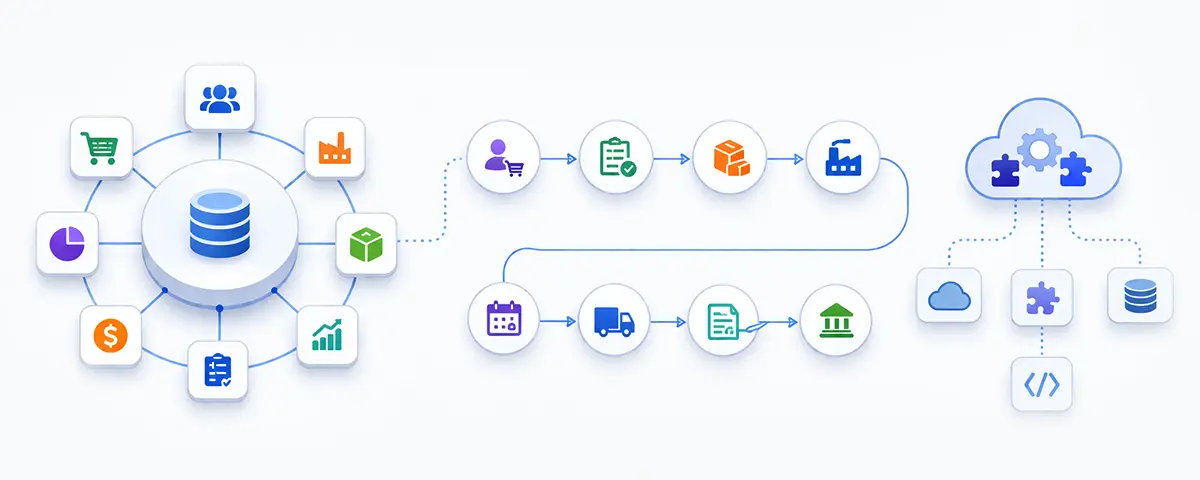
General ledger, accounts payable, accounts receivable, fixed assets, cash management, budgeting, financial consolidation, and financial reporting. Finance modules provide the foundation for all ERP implementations, ensuring accurate transaction recording and compliance with accounting standards.
Procurement, inventory management, warehouse management, order management, demand planning, and logistics. These modules optimize the flow of materials and products from suppliers through distribution to customers.
Payroll processing, benefits administration, recruiting, performance management, workforce planning, time and attendance, and expense management. HR modules centralize employee data and automate administrative processes.
Lead management, opportunity tracking, sales forecasting, customer service, and marketing automation. Many ERP systems include CRM capabilities or integrate seamlessly with dedicated CRM systems to connect customer interactions with operational processes.
Material requirements planning, production scheduling, shop floor control, quality management, and product lifecycle management. Manufacturing modules optimize resource allocation and production efficiency.
Real-time dashboards, KPI monitoring, trend analysis, predictive analytics, and scenario modeling. Analytics capabilities enable data-driven decision-making across all business functions.
Comparison of Business Value and Benefits:
| Business Function | Without ERP | With ERP |
|---|---|---|
| Data Management | Disconnected spreadsheets and databases across departments | Centralized real-time database with single source of truth |
| Financial Reporting | Manual compilation from multiple sources, days or weeks delay | Automated dashboards and instant report generation |
| Process Efficiency | Manual, error-prone workflows with handoffs between systems | Automated, standardized processes with audit trails |
| Collaboration | Siloed departments with limited visibility into other areas | Cross-functional transparency and coordinated workflows |
| Scalability | Systems struggle with business growth, require replacement | Flexible modules scale with organizational complexity |
| Decision Making | Decisions based on outdated or incomplete information | Real-time analytics enabling proactive management |
| Compliance | Manual documentation gathering, inconsistent controls | Automated audit trails and regulatory reporting |
These transformations translate directly to financial performance:
ERP implementation requires significant organizational commitment beyond software selection. Understanding common challenges enables better planning and more realistic expectations. A key step in ERP implementation is to assess current systems and workflows to identify inefficiencies, bottlenecks, and gaps that the ERP can address. Data migration is often the most time-consuming step in ERP implementation, requiring careful planning to clean, validate, and format existing data before transferring it into the new system. Ongoing maintenance and support after launching an ERP system are essential to ensure the system remains aligned with evolving business needs and to address any issues that arise.
Total cost of ownership extends beyond software licensing. Implementation services (configuration, customization, integration), data migration, training, change management, and internal staff time often exceed software costs. Organizations should budget 30-50% more for advanced modules and complex requirements.
First-year costs by organization size:
For small businesses, ERP costs are typically lower as requirements are simpler and involve fewer users.
Mid-sized organizations require more advanced functionality and scalability.
Large businesses have complex operations and require highly scalable ERP systems.
Cloud ERP reduces upfront capital requirements through subscription pricing and eliminates infrastructure investment. However, organizations should calculate multi-year TCO rather than comparing only initial costs.
Legacy data rarely maps cleanly to new ERP structures. Data cleansing, removing duplicates, correcting errors, standardizing formats often consumes more time and resources than organizations anticipate. Master data governance (customers, vendors, products, chart of accounts) requires cross-functional agreement before migration.
Each integration with existing systems or third-party applications represents a mini-project requiring analysis, development, testing, and ongoing maintenance. Pre-built connectors accelerate common integrations; custom integrations require middleware or API development.
New ERP systems change how people work. Resistance emerges when employees feel excluded from decisions, inadequately trained, or pressured to adopt unfamiliar processes quickly. Initial productivity often drops after go-live before improvements materialize.
Successful ERP implementation requires leadership alignment and visible sponsorship, comprehensive training programs before and after go-live, super-users in each department who support colleagues, communication explaining why changes are happening and how they benefit the organization, and hypercare support during the critical weeks following launch.
Evaluation criteria should include functional fit with current and anticipated business needs, industry expertise and vertical-specific capabilities, deployment options supporting your preferred model, vendor roadmap alignment with technology trends, support and training services availability, and security and compliance certifications.
Customization creates ongoing maintenance burden and complicates future upgrades. Favor configuration (settings, workflows, rules within standard parameters) over custom development. Customize only when standard functionality cannot support requirements that provide competitive differentiation or meet regulatory mandates.
Realistic implementation timelines by organization complexity:
Common delay causes include poor data quality requiring extended cleansing, stakeholder decision delays during design phases, scope expansion (adding modules or requirements mid-project), insufficient testing before go-live, and change management failures affecting user adoption.
Phased approaches reduce risk by delivering value incrementally. Deploy core financials first, then add supply chain modules, then manufacturing rather than attempting everything simultaneously.
Moving from evaluation to implementation requires systematic preparation:
Document existing applications, data sources, integrations, and pain points across all business functions.
Identify must-have capabilities, nice-to-have features, and processes that require flexibility for future evolution.
Include software, implementation services, data migration, training, and contingency (15-20% minimum).
Request demonstrations focused on your specific business processes rather than generic feature tours.
Determine phasing strategy, timeline expectations, and internal resource allocation.
Identify stakeholders, plan communication strategy, and allocate training resources before vendor selection.
Organizations that invest in preparation before vendor selection achieve better outcomes than those rushing to implementation. The right ERP system supports business growth for years; the decision merits thorough evaluation.
Book a Free DemoERP stands for Enterprise Resource Planning. Main components include financial management (accounting, reporting, budgeting), supply chain management (procurement, inventory, logistics), human resources management (payroll, recruiting, performance), manufacturing (production planning, quality control), customer relationship management (sales, service, marketing helping manage and improve customer relationships), and business intelligence (analytics, dashboards, reporting). ERP systems provide essential business functions including accounting and finance, human resource management, supply chain management, and manufacturing.
Implementation timelines vary by organizational complexity: small businesses typically require 2-6 months, mid-market organizations need 6-12 months, and enterprise implementations span 12-24+ months. Factors affecting duration include number of modules, data migration complexity, integration requirements, customization scope, and organizational change readiness.
Cloud ERP runs on vendor-managed infrastructure accessed through web browsers, offering lower upfront costs, automatic updates, and reduced IT burden. On-premises ERP installs on company-owned servers, providing maximum control over data and infrastructure but requiring significant IT investment and management. Cloud deployment is now the default for most new implementations, representing over 70% of current ERP deployments.
Costs include software licensing or subscription, implementation services, data migration, training, and internal staff time. Contact LOGIC ERP experts for more details.
ERP tools are software applications that help businesses manage and automate core processes like accounting, inventory, sales, purchasing, and operations. With LOGIC ERP, these tools are integrated into one platform, allowing seamless data flow and better control over business activities.
The best ERP tool depends on your business size, industry, and requirements. LOGIC ERP is considered a strong choice for retail, distribution, and manufacturing businesses due to its industry-specific features, scalability, and ease of use.
The three main types of ERP systems are On-Premise ERP, Cloud-Based ERP, and Hybrid ERP. LOGIC ERP offers flexible deployment options to suit different business needs.
ERP is used to manage and automate business processes such as finance, inventory, sales, procurement, and reporting. LOGIC ERP helps businesses streamline operations and improve decision-making with real-time data.
An ERP system is a single software that connects all departments of a business so they can work together efficiently. LOGIC ERP simplifies business management by bringing everything into one place.
An example of ERP software is LOGIC ERP, which helps businesses manage inventory, billing, accounting, and operations from a centralized system.
CRM focuses on managing customer relationships and sales, while ERP manages the entire business including finance, inventory, and operations. LOGIC ERP includes CRM features along with full business management capabilities.
ERP software is used to automate workflows, manage data, and improve efficiency across departments. LOGIC ERP helps businesses reduce manual work and gain better control over operations.
The five key components of ERP include Finance & Accounting, Inventory Management, Sales & CRM, Human Resources, and Supply Chain Management. LOGIC ERP covers all these components in one integrated system.
ERP software is a centralized system that integrates all business functions into one platform, ensuring smooth data flow and operational efficiency. LOGIC ERP is designed to simplify complex business processes.
LOGIC ERP is a widely used ERP software that supports retail, manufacturing, and distribution businesses with end-to-end automation.
A cloud-based ERP system is hosted online and can be accessed from anywhere via the internet. LOGIC ERP offers cloud capabilities for flexible and remote business management.
Yes, ERP can be deployed on the cloud, allowing businesses to access data anytime and scale easily. LOGIC ERP supports cloud-based operations for modern businesses.
ERP for billing helps automate invoicing, manage payments, apply taxes like GST, and track financial transactions. LOGIC ERP provides fast and accurate billing with full compliance.
Some of the top ERP systems include LOGIC ERP, SAP, Oracle. LOGIC ERP stands out for its industry-specific solutions and cost-effective implementation.
Examples include LOGIC ERP, SAP ERP, Oracle ERP, and Microsoft Dynamics. LOGIC ERP is especially popular among Indian businesses.
Top ERP systems include LOGIC ERP, SAP, Oracle, Microsoft Dynamics, and NetSuite, each offering different capabilities based on business needs.
Key advantages include improved efficiency, real-time data access, reduced errors, better decision-making, and scalable growth. LOGIC ERP delivers all these benefits with industry-focused features.
The stages include Planning, Requirement Analysis, System Design, Development, Testing, Deployment, and Support & Maintenance. LOGIC ERP ensures smooth implementation with expert guidance.
Yes, Advantage ERP is a software solution. However, LOGIC ERP offers more advanced and industry-specific features for growing businesses.
ERP business software helps organizations manage operations, finances, inventory, and more in one system. LOGIC ERP is a complete business management solution.
ERP software is used to streamline business operations, automate workflows, and improve productivity. LOGIC ERP enhances efficiency across all departments.
The four pillars are Finance, Inventory, Operations, and Human Resources. LOGIC ERP integrates all these pillars into one platform.
ERP works by collecting data from different departments, storing it centrally, and updating it in real time across modules. LOGIC ERP ensures seamless data flow and automation.
ERP is a business management system used to handle daily operations. Businesses use LOGIC ERP by implementing modules based on their needs and training teams accordingly.
Implementing ERP involves selecting software, defining requirements, configuring modules, training users, and going live. LOGIC ERP provides full support throughout this process.
ERP management software is used to control and optimize business processes from a single platform. LOGIC ERP helps businesses manage operations efficiently.
ERP integrates all business functions into one system and automates data flow between departments. LOGIC ERP ensures real-time visibility and better coordination.
ERP uses a centralized database where all transactions are recorded and shared across modules instantly. LOGIC ERP automates this process for accuracy and speed.
ERP stands for Enterprise Resource Planning. It refers to software that helps businesses manage and integrate their core processes. LOGIC ERP is a powerful example of modern ERP solutions.
Yes, modern ERP platforms provide APIs and integration capabilities for connecting with existing systems. Pre-built connectors exist for common applications (e-commerce platforms, CRM systems, banking services). Integrating cloud applications can extend the value of an existing ERP system by enhancing legacy software and enabling the adoption of cloud capabilities. Custom integrations require additional development. Integration complexity should factor into implementation planning and budget.
Key evaluation criteria include functional fit with business requirements, industry expertise and vertical capabilities, deployment options matching your preferences, vendor financial stability and product roadmap, implementation partner quality, support and training services, security certifications and compliance capabilities, and total cost of ownership over your planning horizon.
ERP systems eliminate duplicate data entry across departments, automate workflows that previously required manual handoffs, provide real-time visibility into operations through dashboards, enable faster financial closing through automated consolidation, reduce errors through data validation and audit trails, and deliver analytics enabling proactive rather than reactive management.
Manufacturing organizations gain production optimization, inventory reduction, and quality traceability. Retail benefits from inventory visibility across channels and demand forecasting. Healthcare improves patient scheduling, billing accuracy, and regulatory compliance. Professional services organizations optimize project profitability and resource utilization. Any industry with operational complexity, regulatory requirements, or growth ambitions typically realizes significant ERP benefits. ERP systems often automate compliance tracking and security procedures, providing audit trails and reducing risk.
ERP stands for Enterprise Resource Planning. It is a comprehensive software system that integrates core business processes such as finance, procurement, manufacturing, human resources, and supply chain management into a unified platform.
The best ERP software depends on your business size, industry, and specific needs. Leading solutions like LOGIC ERP Software with Cloud, SAP S/4HANA, Microsoft Dynamics 365, and NetSuite are renowned for their scalability, comprehensive modules, and cloud capabilities. Choosing the right ERP involves evaluating features, deployment options, vendor support, and total cost of ownership to ensure alignment with your business goals.
ERP software refers to a suite of integrated applications that help organizations automate and manage day-to-day business activities. It provides a single source of truth by centralizing data and processes, which improves operational efficiency, enhances data accuracy, and supports informed decision-making across departments.
Popular ERP software examples include LOGIC ERP Cloud software, SAP ERP, Oracle ERP Cloud, Microsoft Dynamics 365, NetSuite, and Odoo. These platforms serve various industries with modules covering finance, supply chain, HR, manufacturing, and customer relationship management. They offer both cloud-based and on-premises deployment options to suit diverse business requirements.
A comprehensive list of ERP software features both on-premises and cloud-based solutions such as LOGIC ERP Software, SAP, Oracle, Microsoft Dynamics, NetSuite, Sage Intacct, Infor, Epicor, and industry-specific ERP providers. This variety allows businesses to select systems that best fit their size, industry, and operational complexity.
ERP accounting software integrates financial management with other business modules, automating tasks like general ledger, accounts payable/receivable, and financial reporting. This integration enhances accuracy, ensures compliance with accounting standards, and provides real-time financial insights for better decision-making.
LOGIC ERP is the top best ERP software development company in Delhi offering comprehensive, customizable, and scalable ERP solutions tailored to meet the unique needs of businesses across industries. With a strong focus on innovation and customer satisfaction, LOGIC ERP delivers cloud-based and on-premises ERP systems that streamline operations, enhance financial management, optimize supply chains, and improve human resource processes. Our expert team combines deep industry knowledge with the latest technologies such as artificial intelligence, machine learning, and Internet of Things (IoT) integration to empower organizations to achieve operational excellence and competitive advantage. LOGIC ERP ensures seamless implementation, ongoing support, and user training to maximize adoption and ROI. Whether you are a small startup or a large enterprise, LOGIC ERP provides modular ERP software that grows with your business, helping you automate workflows, improve data accuracy, and make data-driven decisions. Choose LOGIC ERP for trusted ERP software development services in Delhi that drive business transformation and sustainable growth.
Yes, modern ERP platforms provide APIs and integration capabilities for connecting with existing systems. Pre-built connectors exist for common applications (e-commerce platforms, CRM systems, banking services). Integrating cloud applications can extend the value of an existing ERP system by enhancing legacy software and enabling the adoption of cloud capabilities. Custom integrations require additional development. Integration complexity should factor into implementation planning and budget.
Key evaluation criteria include functional fit with business requirements, industry expertise and vertical capabilities, deployment options matching your preferences, vendor financial stability and product roadmap, implementation partner quality, support and training services, security certifications and compliance capabilities, and total cost of ownership over your planning horizon.
ERP systems eliminate duplicate data entry across departments, automate workflows that previously required manual handoffs, provide real-time visibility into operations through dashboards, enable faster financial closing through automated consolidation, reduce errors through data validation and audit trails, and deliver analytics enabling proactive rather than reactive management.
Manufacturing organizations gain production optimization, inventory reduction, and quality traceability. Retail benefits from inventory visibility across channels and demand forecasting. Healthcare improves patient scheduling, billing accuracy, and regulatory compliance. Professional services organizations optimize project profitability and resource utilization. Any industry with operational complexity, regulatory requirements, or growth ambitions typically realizes significant ERP benefits. ERP systems often automate compliance tracking and security procedures, providing audit trails and reducing risk.
ERP stands for Enterprise Resource Planning. It is a comprehensive software system that integrates core business processes such as finance, procurement, manufacturing, human resources, and supply chain management into a unified platform.
The best ERP software depends on your business size, industry, and specific needs. Leading solutions like LOGIC ERP Software with Cloud, SAP S/4HANA, Microsoft Dynamics 365, and NetSuite are renowned for their scalability, comprehensive modules, and cloud capabilities. Choosing the right ERP involves evaluating features, deployment options, vendor support, and total cost of ownership to ensure alignment with your business goals.
ERP software refers to a suite of integrated applications that help organizations automate and manage day-to-day business activities. It provides a single source of truth by centralizing data and processes, which improves operational efficiency, enhances data accuracy, and supports informed decision-making across departments.
Popular ERP software examples include LOGIC ERP Cloud software, SAP ERP, Oracle ERP Cloud, Microsoft Dynamics 365, NetSuite, and Odoo. These platforms serve various industries with modules covering finance, supply chain, HR, manufacturing, and customer relationship management. They offer both cloud-based and on-premises deployment options to suit diverse business requirements.
ERP systems eliminate duplicate data entry across departments, automate workflows that previously required manual handoffs, provide real-time visibility into operations through dashboards, enable faster financial closing through automated consolidation, reduce errors through data validation and audit trails, and deliver analytics enabling proactive rather than reactive management.
Manufacturing organizations gain production optimization, inventory reduction, and quality traceability. Retail benefits from inventory visibility across channels and demand forecasting. Healthcare improves patient scheduling, billing accuracy, and regulatory compliance. Professional services organizations optimize project profitability and resource utilization. Any industry with operational complexity, regulatory requirements, or growth ambitions typically realizes significant ERP benefits. ERP systems often automate compliance tracking and security procedures, providing audit trails and reducing risk.
ERP stands for Enterprise Resource Planning. It is a comprehensive software system that integrates core business processes such as finance, procurement, manufacturing, human resources, and supply chain management into a unified platform.
The best ERP software depends on your business size, industry, and specific needs. Leading solutions like LOGIC ERP Software with Cloud, SAP S/4HANA, Microsoft Dynamics 365, and NetSuite are renowned for their scalability, comprehensive modules, and cloud capabilities. Choosing the right ERP involves evaluating features, deployment options, vendor support, and total cost of ownership to ensure alignment with your business goals.
ERP software refers to a suite of integrated applications that help organizations automate and manage day-to-day business activities. It provides a single source of truth by centralizing data and processes, which improves operational efficiency, enhances data accuracy, and supports informed decision-making across departments.
Popular ERP software examples include LOGIC ERP Cloud software, SAP ERP, Oracle ERP Cloud, Microsoft Dynamics 365, NetSuite, and Odoo. These platforms serve various industries with modules covering finance, supply chain, HR, manufacturing, and customer relationship management. They offer both cloud-based and on-premises deployment options to suit diverse business requirements.
A comprehensive list of ERP software features both on-premises and cloud-based solutions such as LOGIC ERP Software, SAP, Oracle, Microsoft Dynamics, NetSuite, Sage Intacct, Infor, Epicor, and industry-specific ERP providers. This variety allows businesses to select systems that best fit their size, industry, and operational complexity.
ERP accounting software integrates financial management with other business modules, automating tasks like general ledger, accounts payable/receivable, and financial reporting. This integration enhances accuracy, ensures compliance with accounting standards, and provides real-time financial insights for better decision-making.
LOGIC ERP is the top best ERP software development company in Delhi offering comprehensive, customizable, and scalable ERP solutions tailored to meet the unique needs of businesses across industries. With a strong focus on innovation and customer satisfaction, LOGIC ERP delivers cloud-based and on-premises ERP systems that streamline operations, enhance financial management, optimize supply chains, and improve human resource processes. Our expert team combines deep industry knowledge with the latest technologies such as artificial intelligence, machine learning, and Internet of Things (IoT) integration to empower organizations to achieve operational excellence and competitive advantage. LOGIC ERP ensures seamless implementation, ongoing support, and user training to maximize adoption and ROI. Whether you are a small startup or a large enterprise, LOGIC ERP provides modular ERP software that grows with your business, helping you automate workflows, improve data accuracy, and make data-driven decisions. Choose LOGIC ERP for trusted ERP software development services in Delhi that drive business transformation and sustainable growth.
Top Pune-based ERP providers i.e. LOGIC ERP offers customized ERP development, implementation, and support services. They focus on helping local businesses automate workflows, improve operational efficiency, and scale growth. Pune's thriving IT ecosystem supports innovation in cloud ERP and industry-specific solutions.
India’s ERP software companies include LOGIC ERP Cloud Software, Infosys, TCS, Wipro, Zoho, and Ramco Systems. These firms offer both off-the-shelf and customized ERP solutions, leveraging advanced technologies like AI and cloud computing to meet diverse industry requirements and drive digital transformation.
Chennai hosts top ERP software companies such as LOGIC ERP, offering custom ERP development, implementation, and support services. These companies serve manufacturing, retail, and service industries, focusing on delivering scalable, integrated ERP solutions with local market expertise.
ERP software price varies based on deployment model, modules, user count, and customization level. Cloud ERP typically follows subscription pricing with lower upfront costs, while on-premises solutions require upfront licensing and infrastructure investment. Costs also include implementation, training, and ongoing support. Contact LOGIC ERP experts at +91-73411-41176 or send us an email at sales@logicerp.com to explore ERP software price or cost structure today!
The top 10 ERP software globally include LOGIC ERP software solutions for business management, SAP ERP, Oracle ERP Cloud, Microsoft Dynamics 365, NetSuite, Infor, Epicor, Sage Intacct, Odoo, Syspro, and IFS. These platforms offer comprehensive modules, flexible deployment options, and serve a wide range of industries with scalable solutions.
Custom ERP software is tailored to an organization’s unique workflows and requirements. It offers flexibility to automate core business processes, integrate with existing systems, and adapt as the business evolves, ensuring alignment with specific operational and strategic goals.
ERP billing software automates invoicing, payment processing, and revenue tracking within the broader ERP ecosystem. It reduces errors, accelerates cash flow, and integrates financial transactions with accounting and customer management modules.
ERP software for small business types offers affordable, easy-to-use modules for finance, inventory, and CRM. These solutions help streamline processes, improve data accuracy, and support growth without the complexity and cost of enterprise-grade systems.
Types of ERP software include on-premises, cloud-based, hybrid, industry-specific, and open-source ERP systems. Each offers different deployment and customization options to meet varying business requirements and IT strategies.
Benefits of ERP software include automation of core business processes, improved data accuracy, enhanced collaboration, cost savings, and scalability for business growth. ERP systems also support regulatory compliance and provide real-time insights for better decision-making.
ERP enterprise software serves large organizations with complex operations, offering extensive modules, multi-entity support, and advanced customization. These systems provide robust scalability, compliance features, and integration capabilities to support global business requirements.
ERP software training ensures users are proficient in system functionalities, improving adoption rates and maximizing the benefits of automated core business processes. Training programs include hands-on sessions, documentation, and ongoing support.
ERP supply chain software manages procurement, inventory, warehouse, and logistics operations. It improves demand forecasting, reduces costs, and enhances collaboration between suppliers and internal teams, ensuring efficient product flow from source to customer.
Contact LOGIC ERP at +91-73411-41176 / +91-73411-41175 or email at sales@logicerp.com to explore ERP software solutions tailored to your business needs. Our experts provide comprehensive guidance on selecting, implementing, and optimizing ERP systems to maximize operational efficiency and drive growth. Whether you're seeking cloud-based or on-premises ERP, LOGIC ERP offers scalable, customizable platforms designed to streamline processes across finance, supply chain, human resources, and more. Reach out today for a free consultation and discover how LOGIC ERP can transform your enterprise resource planning strategy.
India's top ERP software includes LOGIC ERP Cloud software for business management, TallyPrime, SAP Business One, Oracle NetSuite, and Zoho ERP. These solutions cater to diverse industries and comply with local regulations such as GST. They offer modules for finance, inventory, procurement, and human resources, supporting businesses from small enterprises to large corporations. Selection depends on business size, industry needs, and desired deployment models.
Each ERP software module corresponds to a major business function:
ERP business management software integrates core business processes into a unified system, enabling companies to automate workflows, centralize data, and improve collaboration. It supports financial management, supply chain operations, human resources, manufacturing, and customer engagement, enhancing operational efficiency and strategic planning.
LOGIC ERP 2.0 is an advanced, AI-powered, cloud-enabled ERP platform designed to streamline retail, distribution, and manufacturing operations. It combines intelligent automation, real-time analytics, and a user-friendly interface to enhance billing, inventory, and supply chain management. With AI-driven insights, predictive analytics, and smart decision-making capabilities, LOGIC ERP 2.0 helps businesses improve efficiency, reduce manual errors, optimize operations, and drive faster, data-driven growth.
LOGIC ERP The best ERP software companies in Bangalore provide comprehensive, scalable, and customizable ERP solutions in Bangalore, combining deep industry expertise with cutting-edge technologies like AI, machine learning, and IoT integration. Our cloud-native ERP platform ensures seamless deployment, robust security, and ongoing support to help businesses of all sizes achieve operational excellence and sustainable growth.
Hyderabad is home to prominent ERP providers including LOGIC ERP, offering cloud ERP solutions, industry-specific customizations, and digital transformation services, serving clients across manufacturing, healthcare, IT, and other sectors.
LOGIC ERP is the top rated ERP company in Mumbai that helps to unify core business processes such as finance, procurement, manufacturing, human resources, and supply chain management into a single, centralized platform. It enables organizations to automate workflows, improve data accuracy, enhance collaboration across departments, and gain real-time visibility into operations. LOGIC ERP supports scalable business growth by providing modular, customizable features tailored to various industries and business sizes. With cloud-based deployment options, advanced security measures, and integration capabilities, LOGIC ERP helps businesses streamline operations, reduce costs, and make data-driven decisions effectively.
Chennai-based ERP software development companies LOGIC ERP, providing customized ERP solutions, implementation services, and ongoing support. They cater to manufacturing, logistics, and service industries, emphasizing scalable and cloud-enabled ERP platforms.
LOGIC ERP is recognized as the top-rated ERP software development company in Dubai, delivering customized ERP solutions tailored specifically for the Middle East market. We focus on ensuring full compliance with regional regulations, including VAT and other local tax laws, while offering multi-currency support and multilingual capabilities to serve diverse business needs. Our cloud-native ERP platform provides secure, scalable, and flexible solutions designed to streamline operations, enhance financial management, optimize supply chains, and improve human resource processes. At LOGIC ERP, we combine deep industry expertise with cutting-edge technologies such as artificial intelligence, machine learning, and IoT integration to empower businesses to stay competitive in a rapidly evolving market. Our dedicated local support and training resources ensure seamless implementation and high user adoption rates. Whether you are a small enterprise or a large corporation, LOGIC ERP offers modular, scalable solutions that grow with your business and drive operational excellence across industries in Dubai and the broader Middle East region.
ERP business management software integrates core business processes into a unified system, enabling companies to automate workflows, centralize data, and improve collaboration. It supports financial management, supply chain operations, human resources, manufacturing, and customer engagement, enhancing operational efficiency and strategic planning.
LOGIC ERP 2.0 is an advanced, AI-powered, cloud-enabled ERP platform designed to streamline retail, distribution, and manufacturing operations. It combines intelligent automation, real-time analytics, and a user-friendly interface to enhance billing, inventory, and supply chain management. With AI-driven insights, predictive analytics, and smart decision-making capabilities, LOGIC ERP 2.0 helps businesses improve efficiency, reduce manual errors, optimize operations, and drive faster, data-driven growth.
LOGIC ERP The best ERP software companies in Bangalore provide comprehensive, scalable, and customizable ERP solutions in Bangalore, combining deep industry expertise with cutting-edge technologies like AI, machine learning, and IoT integration. Our cloud-native ERP platform ensures seamless deployment, robust security, and ongoing support to help businesses of all sizes achieve operational excellence and sustainable growth.
Hyderabad is home to prominent ERP providers including LOGIC ERP, offering cloud ERP solutions, industry-specific customizations, and digital transformation services, serving clients across manufacturing, healthcare, IT, and other sectors.
LOGIC ERP is the top rated ERP company in Mumbai that helps to unify core business processes such as finance, procurement, manufacturing, human resources, and supply chain management into a single, centralized platform. It enables organizations to automate workflows, improve data accuracy, enhance collaboration across departments, and gain real-time visibility into operations. LOGIC ERP supports scalable business growth by providing modular, customizable features tailored to various industries and business sizes. With cloud-based deployment options, advanced security measures, and integration capabilities, LOGIC ERP helps businesses streamline operations, reduce costs, and make data-driven decisions effectively.
Chennai-based ERP software development companies LOGIC ERP, providing customized ERP solutions, implementation services, and ongoing support. They cater to manufacturing, logistics, and service industries, emphasizing scalable and cloud-enabled ERP platforms.
LOGIC ERP is recognized as the top-rated ERP software development company in Dubai, delivering customized ERP solutions tailored specifically for the Middle East market. We focus on ensuring full compliance with regional regulations, including VAT and other local tax laws, while offering multi-currency support and multilingual capabilities to serve diverse business needs. Our cloud-native ERP platform provides secure, scalable, and flexible solutions designed to streamline operations, enhance financial management, optimize supply chains, and improve human resource processes. At LOGIC ERP, we combine deep industry expertise with cutting-edge technologies such as artificial intelligence, machine learning, and IoT integration to empower businesses to stay competitive in a rapidly evolving market. Our dedicated local support and training resources ensure seamless implementation and high user adoption rates. Whether you are a small enterprise or a large corporation, LOGIC ERP offers modular, scalable solutions that grow with your business and drive operational excellence across industries in Dubai and the broader Middle East region.
Popular ERP software in India includes LOGIC ERP, TallyPrime, SAP Business One, Oracle NetSuite, Zoho ERP, Ramco Systems, and Microsoft Dynamics 365. This list spans solutions for various business sizes and industries, offering diverse deployment options and localized features to meet Indian market needs.
LOGIC ERP is the best ERP software in Saudi Arabia offering comprehensive, customizable, and scalable solutions tailored to meet the unique needs of businesses across industries. With deep expertise in cloud-based ERP deployment, LOGIC ERP enables organizations to streamline operations, improve financial management, optimize supply chains, and enhance human resource processes. The platform supports Arabic language and complies with local regulations, including VAT and Zakat requirements, ensuring full legal compliance and smooth business operations. LOGIC ERP’s modular design allows companies of all sizes from small enterprises to large corporations to select the functionalities they need and scale as their business grows. Its cloud-native architecture provides secure, remote access, automatic updates, and integration with emerging technologies such as AI, machine learning, and IoT, empowering businesses to stay competitive in a rapidly evolving market. Key features include real-time analytics dashboards, automated workflows, multi-currency and multi-entity support, and robust data security measures. LOGIC ERP also offers dedicated local support and training resources to facilitate seamless implementation and user adoption. Whether you are in manufacturing, retail, healthcare, or professional services, LOGIC ERP delivers a unified platform that drives operational efficiency, compliance, and strategic decision-making, making it the preferred ERP solution in Saudi Arabia.
Contact LOGIC ERP at +91-73411-41176 / +91-73411-41175 or send us an email at sales@logicerp.com for detailed guide on ERP software today! Get free guide of ERP software free download now!
Smart ERP software integrates advanced technologies such as artificial intelligence (AI), machine learning, Internet of Things (IoT), and automation to optimize business processes. These systems provide predictive analytics, intelligent workflow automation, and real-time insights, enabling organizations to enhance efficiency and agility.
ERP systems use a combination of software technologies including relational databases, application servers, web interfaces, and APIs. Modern ERP platforms leverage cloud computing, AI, machine learning, and mobile applications to deliver scalable, flexible, and user-friendly solutions.
ERP software is used to automate and integrate core business processes such as accounting, procurement, inventory management, human resources, manufacturing, and customer relationship management. It improves data accuracy, operational efficiency, compliance, and decision-making across the organization.
Enterprise Resource Planning (ERP) software is an integrated suite of applications designed to manage and automate core business functions. It centralizes data from finance, operations, supply chain, human resources, and customer management into a unified platform, enabling real-time visibility, streamlined workflows, and data-driven decision-making.
ERP systems are central to managing and protecting an organization’s sensitive data, making data security a top priority for any ERP deployment. Modern ERP systems, including cloud based ERP and cloud based ERP solutions, are designed with advanced security features such as data encryption, granular access controls, and continuous software updates to defend against evolving cyber threats. To ensure robust data security, organizations should implement best practices such as conducting regular security audits, providing comprehensive employee training, and actively monitoring ERP system activity for unusual behavior. These measures help safeguard sensitive business information, maintain data integrity, and ensure compliance with regulatory requirements. By prioritizing data security, ERP solutions facilitate operational efficiency, effective risk management, and support sustainable business growth. Secure ERP systems not only protect valuable assets but also build trust with customers, partners, and stakeholders, reinforcing the organization’s reputation and long-term success.
Two-tier ERP is a deployment strategy where an organization operates two distinct ERP systems: a primary system at the corporate headquarters and a secondary system for subsidiaries, divisions, or regional offices. This model enables companies to standardize core business processes at the enterprise level while allowing smaller business units to use a more agile, often cloud based ERP tailored to their specific operational needs. With two tier ERP, the corporate ERP system manages centralized functions such as financial consolidation, compliance, and global reporting, ensuring consistency and control across the organization. Meanwhile, subsidiaries or business units can implement their own ERP systems to handle local business processes, adapt to regional requirements, and innovate more rapidly. This approach reduces complexity, accelerates deployment for new units, and supports business growth without sacrificing oversight of core business processes. Two-tier ERP is especially valuable for large, diversified organizations seeking to balance global standardization with local flexibility.
Machine learning transforms enterprise resource planning (ERP) systems by automating complex data analysis, enabling predictive insights, and enhancing decision-making processes. It helps ERP platforms identify patterns, forecast demand, detect anomalies, and optimize workflows, resulting in increased operational efficiency and reduced manual intervention.
Best practices for accurate financial reporting in modern businesses include maintaining centralized and clean data, automating data consolidation, implementing robust internal controls, ensuring compliance with regulatory standards, and leveraging real-time reporting tools. Utilizing ERP systems integrated with advanced analytics and audit trails further improves accuracy and transparency.
Businesses identify and prioritize their critical business needs for ERP implementation by conducting comprehensive assessments of current processes, identifying inefficiencies and bottlenecks, defining strategic goals, involving key stakeholders, and evaluating the scalability and flexibility required to support growth. Clear prioritization ensures that the ERP system aligns with organizational objectives and delivers measurable value.
Popular Products