Discover how a Warehouse Execution System (WES) optimizes warehouse workflows by coordinating people, inventory, and automation. Learn key features, benefits, and how WES improves order fulfillment, labor utilization, and operational visibility in modern warehouses.
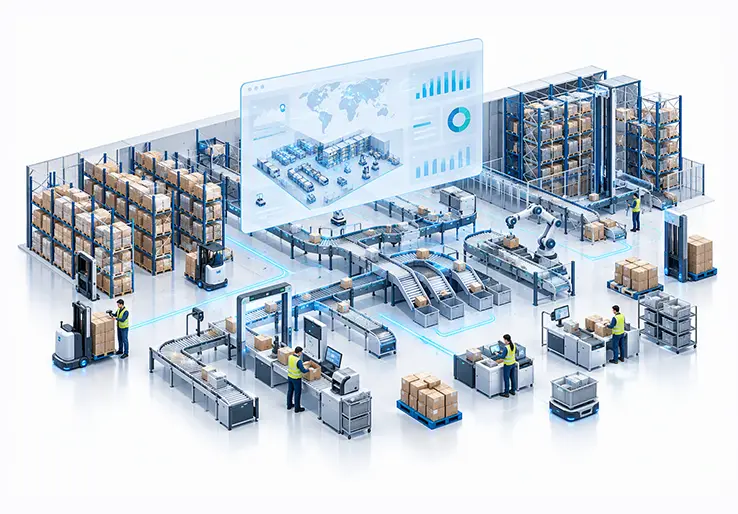
Since around 2018, warehouse complexity has accelerated at a pace that most planning systems were never designed to handle. E-commerce volumes have surged, omnichannel fulfillment has become the norm, and automation investments — from conveyor systems to autonomous mobile robots — have introduced new coordination demands. During Black Friday 2025, online sales hit USD 11.8 billion in a single day, up 9.1% year-over-year. Warehouses that couldn’t dynamically shift priorities, rebalance labor, and coordinate automated equipment in real time faced delayed shipments, inventory stockouts, and overwhelmed packing stations.
The problems in a typical warehouse or distribution center are often structural, not cosmetic. Paper-based task management persists in far too many facilities. A warehouse management system might track inventory accurately, but it doesn’t orchestrate minute-by-minute task execution. Automation equipment runs on its own control layer, disconnected from labor decisions. Supervisors firefight with radios and spreadsheets. Manual processes dominate exception handling, and real time visibility into what’s actually happening on the warehouse floor is limited to whoever walks the aisles.
This is where warehouse execution software enters the picture. A warehouse execution system (WES) is real-time software that acts as the operational brain between planning systems like ERP and WMS and equipment control layers like WCS, coordinating people, warehouse tasks, and automation to execute orders efficiently inside a warehouse or distribution center. For warehouse operators, supply chain managers, logistics teams, and businesses dealing with high order volumes, omnichannel fulfillment, or automation integration, that real-time coordination directly affects fulfillment speed, inventory accuracy, labor utilization, scalability, and customer service. This article explains what a warehouse execution system is, how it works, its core features and benefits, how it compares with WMS and WCS, where it fits across industry use cases and ERP integrations, what to look for during selection and implementation, and How LOGIC ERP Supports Connected Warehouse Operations.
A warehouse execution system is real-time software that orchestrates inventory movement, labor resources, and automation to execute orders efficiently inside a warehouse or distribution center. Unlike systems focused on record-keeping or equipment control, WES software manages workflows between planning and equipment control — turning strategic decisions ("these 4,000 orders must ship by 5 PM") into moment-by-moment instructions ("assign picker #12 to zone B, route tote to pack station 7, release replenishment for SKU X").
A Warehouse Execution System (WES) coordinates warehouse operations by sitting in a logical layering between other systems. The ERP system and order management handle order intake, allocation, and financials. The warehouse management system (WMS) manages inventory, storage locations, and order allocation. The WES layer manages execution flow — when tasks are released, how they’re prioritized, and who or what executes them. The warehouse control system (WCS) drives physical equipment like conveyors, sorters, and AS/RS at the machine level.
Core processes WES touches include:
The terms warehouse execution system, warehouse execution software, and WES software are synonyms. Definitions differ slightly among vendors, but the orchestration idea is consistent across all of them.
Growing SKU counts and product variability across sectors like fashion, FMCG, and electronics have made manual task management increasingly unreliable since around 2020. A warehouse handling 5,000 SKUs requires fundamentally different coordination than one with 500.
Customer expectations for same-day or next-day delivery in major markets (US, EU, India) stress traditional WMS-only setups that rely on batch processing and end-of-shift reports. Order fulfillment speed is now a competitive differentiator, and businesses without execution-layer software routinely miss carrier cutoff times during demand spikes.
Omnichannel operations compound the problem. Orders from e-commerce sites, marketplaces, and physical stores share inventory pools, requiring real time visibility and smarter task prioritization to avoid overselling and mispicks. Meanwhile, 56% of supply-chain organizations expect increased innovation investment by 2026, reflecting recognition that current tools aren’t sufficient.
Warehouse labor challenges persist — shortages, higher wages, and turnover — making better labor utilization and dynamic task management essential rather than optional. And while warehouse automation has grown rapidly (conveyors, sortation, AMRs, shuttle systems), automated warehouses still underperform without coordination software that ties human and machine work together.
Key pain points WES addresses:
WES operates in a continuous feedback loop: data input → analysis and prioritization → task creation and resource allocation → execution by people and automated equipment → feedback and adjustment. WES optimizes task execution in real-time for efficiency, constantly recalculating as conditions on the warehouse floor change.
Here’s a concrete example. An order is placed at 9:05 AM. The WMS allocates stock and confirms inventory availability. The WES then prioritizes the order based on its carrier cutoff (2:30 PM), assigns a picker in the closest zone, sequences the pick alongside other nearby picks to minimize travel, and routes the completed tote via conveyor to packing station 4 — which has the shortest queue. If at 9:20 AM that conveyor jams, the WES reroutes to station 6 and adjusts downstream dispatch timing.
WES integrates manual and automated tasks in warehouses, replacing static "waves" with near real-time or waveless processing. Torrid, for example, switched to waveless fulfillment via WES and reduced order cycle time by approximately 75% while cutting labor costs by 22%. The system uses data from scanners, IoT sensors, WCS, and WMS to dynamically adapt execution — rerouting work from congested zones, pulling replenishment forward, or delaying non-urgent tasks.
Step-by-step execution flow:
WES makes real-time decisions about task prioritization by ranking the work queue based on due dates, carrier cut-off times, customer priority, service level agreements, and inventory availability. Unlike static scheduling, WES allows dynamic task prioritization during demand fluctuations — priorities can shift multiple times per shift as new orders arrive, carriers adjust pickup windows, or inventory issues surface.
Consider these scenarios:
Task prioritization is driven by configurable business rules rather than hard-coded logic. Operations teams define the rules; the WES acts on them continuously, factoring in constraints like zone congestion, resource availability, and inventory availability at pick locations.
Task allocation is the decision of which worker, workstation, picker, pallet jack, AMR, or robot executes each task. WES considers location, skills, workload, and travel distance to make optimal assignments. WES enhances resource utilization by optimizing task assignments — matching the right person or machine to each task at the right moment.
WES continuously balances labor and machine workloads to maximize throughput. If real-time visibility shows idle capacity at receiving while picking zones are backlogged, the system reassigns qualified staff accordingly. WES enhances operational agility by adjusting workload distributions during peak times — for instance, during a 6–9 PM peak, WES automatically moves more staff to single-piece picking and defers non-urgent replenishment to the night shift. WES helps balance service levels, labor, and material flow across the entire warehouse operation.
Resource allocation considers:
KPI impacts include improvements in orders processed per hour per operator, labor utilization rates, and overtime reduction. Destination Maternity, for example, reduced its workforce by approximately 44% after deploying WES-driven automation while simultaneously increasing throughput across all channels.
WES breaks order fulfillment into coordinated micro-tasks, synchronizing picking, replenishment, consolidation, packing, and loading into a single adaptive workflow.
Picking optimization moves beyond simple wave-based releases. WES supports waveless, batch, zone, and cluster picking, routing pickers along shortest-path sequences based on live inventory locations. Travel distance reductions of 15–30% are common when switching from manual routing to WES-optimized paths.
Replenishment management ensures forward pick locations are restocked before they run out. WES monitors real-time demand against minimum stock thresholds and triggers replenishment tasks proactively. If a popular SKU nears depletion at a pick-face, WES prioritizes that replenishment above less urgent moves to avoid stockouts mid-shift.
Packing and dispatch coordination pairs completed picks with packing stations based on workload and carrier requirements. WES sequences packing lanes by route or carrier and aligns dock schedules with TMS data or carrier arrival times.
How WES synchronizes each sub-process:
WES provides dashboards for monitoring workloads, inventory, and performance metrics — giving supervisors a live view of task queues, station utilization, conveyor load, and throughput vs. target for the current hour or shift. This operational control replaces ad-hoc radio calls and manual walkthroughs.
When exceptions occur — a conveyor jams, a scanner fails, a robot goes offline, or a worker calls in sick mid-shift — WES automatically reroutes work and updates task assignments. If a backup develops in packing, the system temporarily slows the release of new pick tasks while pulling additional labor to packing to clear the queue. In one American retailer’s deployment, WES reduced response times to bottleneck incidents by 25–50%.
Typical exceptions and WES responses:
This eliminates unnecessary waiting and reduces the time supervisors spend on reactive problem-solving.
While feature sets differ by vendor, most WES solutions share core capabilities focused on workflow orchestration, integration capabilities, and advanced analytics. Warehouse execution system software is designed to deliver operational execution improvements measurable in hours and days, not just quarterly reports.
The following subsections describe each feature from a practical, operations-focused perspective:
WES provides real-time visibility into warehouse operations — showing the status of each order, task, workstation, and piece of equipment on dashboards accessible via browser or mobile devices. This is fundamentally different from end-of-day or hourly batch reporting common in legacy WMS systems or ERP systems.
Intelligent order prioritization rules allow the system to rank work by promised delivery date, customer type, route, carrier cutoff, order value, or product temperature requirements. Managers can override or adjust priorities during seasonal peaks or flash sales, and WES recalculates all affected task queues automatically.
Practical dashboard examples:
Automated task allocation uses algorithms to assign tasks while minimizing empty travel and balancing workloads automatically. WES coordinates the flow so that no worker crosses an aisle unnecessarily and no machine idles while tasks pile up elsewhere.
While the warehouse management system WMS remains the system of record for stock, WES relies on accurate inventory management data to ensure picks, replenishments, and moves are feasible and optimally sequenced. Inventory accuracy is the foundation on which effective task execution depends.
Picking optimization strategies include shortest-path routing, cluster picking, batch picking, and dynamic slotting. Barcode and RFID integration captures movements in real time, confirming each task and maintaining location-level accuracy.
Specific optimization levers:
Labor management within WES goes beyond headcount tracking. It covers shift planning, workload balancing across zones, monitoring labor utilization, and managing indirect tasks like housekeeping or cycle counting during low-demand periods. WES can suggest moving people between zones based on live volumes — for example, shifting three pickers from returns to outbound when carrier cutoffs approach.
Packing and dispatch management groups completed picks into packing tasks, sequences packing lanes by route or carrier, and aligns dock schedules with TMS or carrier arrival times. Support for value-added services like kitting, labeling, and bundling ensures these steps are inserted into the workflow without causing downstream bottlenecks.
Station-level visibility includes:
WES analytics capabilities include dashboards and reports for throughput (lines per hour, orders per hour), order cycle time, dock-to-stock time, and queue age — often updated in near real time. Data from WES can feed business intelligence tools to support predictive maintenance (such as detecting declining conveyor throughput patterns) and continuous improvement projects.
Automation integration is central to WES capabilities. WES connects to conveyor PLCs, sorters, AS/RS, AMRs, AGVs, pick-to-light systems, and robotics through APIs or fieldbus interfaces, enabling synchronized warehouse automation. For example, in shuttle-based AS/RS environments, WES coordinates the release of totes from storage based on downstream packing station availability — preventing staging area overflows while maintaining consistent throughput.
Integration capabilities extend to open APIs, message queues, and standardized interfaces connecting to ERP, WMS, TMS, and e-commerce platforms — making WES the connective tissue in modern logistics technology stacks.
WES benefits fall into five categories important for both manual and automated facilities: speed, accuracy, productivity, flexibility, and scalability. WES is most effective in warehouses with high order volumes and complex labor coordination needs, though even mid-sized operations see measurable returns.
Destination Maternity saw a 240% increase in e-commerce fulfillment and a 7.3% reduction in freight charges. These results demonstrate what happens when warehouse execution replaces fragmented, manual coordination.
WES empowers warehouses to move from reactive, manual decision-making to proactive, system-driven orchestration. Here’s how it impacts each major process:
| Warehouse Process | Common Challenge | How WES Helps |
|---|---|---|
| Receiving | Delayed processing, dock congestion | Coordinates receiving tasks and dock scheduling in real time |
| Put-Away | Incorrect or delayed storage assignments | Improves task allocation with location-aware assignments |
| Inventory | Limited visibility, mislocated stock | Provides real-time tracking and scan verification |
| Picking | Slow, inaccurate, high travel time | Optimizes task execution with routing and sequencing |
| Replenishment | Empty pick locations causing delays | Supports timely, demand-driven replenishment triggers |
| Packing | Processing bottlenecks at stations | Coordinates workflow and balances station workloads |
| Dispatch | Missed carrier cutoffs, delayed shipments | Improves task sequencing aligned with shipping operations |
| Workforce | Uneven workload, idle staff | Supports resource allocation and cross-zone rebalancing |
The key difference is that WES doesn’t just flag problems — it actively rebalances the entire warehouse operation in response to them.
This comparison matters because searchers frequently ask "WES vs WMS vs WCS" and the boundaries between these systems are genuinely blurry.
| Aspect | WMS | WES | WCS |
|---|---|---|---|
| Primary Focus | Warehouse management — inventory, locations, orders | Warehouse execution — task orchestration, workflow optimization | Warehouse control — automation equipment control |
| Typical Functions | Receiving, put-away, inventory tracking, order allocation | Task prioritization, resource allocation, labor balancing, real-time workflow | Conveyor control, sorter logic, AS/RS movements, PLC commands |
| Decision Horizon | Hours to shift-level | Minutes to seconds | Milliseconds to seconds |
| Manages | Inventory records, storage locations | People, tasks, workflows, machines | Physical equipment signals |
| System Owner | IT / Operations | Operations / Engineering | Engineering / Automation |
WES coordinates operations between WMS and WCS. WMS manages inventory and order fulfillment processes. WCS controls physical automation equipment like conveyors, sorters, and robotic systems. WMS typically uses batch processing for order management, while WES operates in near real-time, making continuous adjustments.
Many vendors blur these lines — some WMS platforms add WES-like task sequencing, and some WCS products add basic orchestration. Focus on what capabilities the system actually delivers rather than what label it carries. As Supply Chain Research notes, what matters is the decision tempo and whether the system handles human, machine, inventory, and workflow orchestration together.
WES doesn’t replace warehouse technology like barcode scanners, RFID tags, or robotics — it coordinates them. The technologies a warehouse needs depend on its size, process complexity, and automation level.
Many mid-sized companies in 2024–2026 start with barcode-only operations and progressively add automation, making WES integration capabilities crucial from day one.
WES is especially valuable where order volumes, SKU diversity, and automation levels are high or growing. Here are the primary segments:
WES rarely operates alone. WES projects require integration with multiple existing systems — ERP for orders and financials, WMS for inventory and locations, TMS for freight and routing, e-commerce platforms for order intake, and automation controllers for equipment execution.
Data flows in both directions: orders arrive from ERP or OMS, inventory locations come from WMS, carrier information comes from TMS, and task feedback flows from WES back into ERP and WMS for status updates and financial reconciliation.
Integration capabilities are a key selection factor. Look for:
A typical flow: online order created in Shopify → ERP/OMS → WMS allocates stock → WES sequences and assigns tasks → WCS/automation executes → confirmation flows back to WMS/ERP → customer receives shipment notification.
WES generates rich operational data, enabling better measurement of warehouse performance than manual processes or basic WMS reports. Define operational KPIs to measure WES project success from day one.
Key KPIs to track:
Operations teams should set target thresholds and alerting rules for these KPIs and review them weekly or monthly to drive continuous improvement.
Selection should focus on fit rather than feature checklists. WES may be part of a broader platform (such as WMS+WES) rather than a standalone product.
Evaluation criteria:
Map your existing systems and identify the gaps WES must fill, especially around task management and resource allocation. Consider total cost of ownership, pilot project options, and phased rollouts to reduce risk.
Analyze warehouse workflows before implementing a WES. This means walking the warehouse floor, timing processes, and identifying where delays, errors, and workarounds happen — not just reviewing system reports at a whiteboard. Automation can expose weak warehouse processes quickly during WES implementation, so process redesign should precede technology deployment.
Initial implementation costs can exceed $1 million for WES systems in large, highly automated facilities, though cloud-based WES solutions can significantly reduce upfront investment for mid-sized operations.
Implementation roadmap:
Common pitfalls to avoid: underestimating integration complexity with legacy systems, skipping the process analysis phase, and failing to secure operator buy-in before go-live.
LOGIC ERP is not positioned as a standalone WES but as an integrated ERP and WMS platform that supports many WES-like capabilities and can integrate with specialized WES or warehouse control system solutions when required.
Relevant LOGIC ERP capabilities for warehouse execution include:
LOGIC ERP can connect to automation equipment or third-party WES via APIs, providing a unified data backbone for order, inventory, and financial information. This makes it a natural foundation for businesses building toward a fully connected warehouse environment.
Facing inventory inaccuracies, warehouse bottlenecks, and limited operational visibility? LOGIC ERP connects ERP, WMS, and warehouse processes so you can monitor and manage inventory, warehouse operations, and business workflows from a unified platform.
A warehouse execution system is the operational intelligence layer that turns plans into action — coordinating people, inventory, and machines in real time across the warehouse floor. By sitting between the WMS and WCS, WES fills the critical gap where strategic decisions meet physical execution, orchestrating task prioritization, resource allocation, and workflow optimization at a pace that manual management simply cannot match.
The core benefits are clear: faster and more reliable order fulfillment, improved inventory accuracy and real time visibility, higher productivity through better labor utilization, and scalable operations ready for growth and automation. When comparing WES vs. WMS vs. WCS, focus on what capabilities solve your actual problems — warehouse orchestration and real time operations demand the WES layer.
Looking ahead, the role of AI, robotics, and advanced analytics in warehouse execution will only grow. The WES market is projected to reach USD 4.3 billion by 2030, reflecting rapid adoption across modern warehouses worldwide. Selecting an integrated, scalable solution now — potentially with LOGIC ERP at the core of your ERP and WMS foundation — helps future-proof your warehouse technology stack for the demands ahead.
Call at +91-73411-41176 / +91-73411-41175 or send us an email at sales@logicerp.com to book a free demo today!
A warehouse execution system (WES) is real-time software that orchestrates task execution, labor, and automation inside a warehouse or distribution center. It sits between the WMS (which manages inventory) and the WCS (which controls physical equipment), coordinating the flow of work across people and machines.
WES receives order and inventory data from WMS and ERP, prioritizes tasks based on business rules, allocates work to available resources, monitors execution in real time, and adjusts dynamically when conditions change. It operates in a continuous loop of prioritization, assignment, execution, and feedback.
Core WES features include real-time visibility, intelligent order prioritization, automated task allocation, picking optimization, replenishment management, labor management, barcode/RFID integration, packing and dispatch coordination, analytics, and automation integration.
Key benefits include faster order fulfillment, higher warehouse productivity, improved inventory accuracy, better labor utilization, reduced picking errors, fewer operational bottlenecks, and scalable operations that adapt to volume changes.
WMS manages inventory records, storage locations, and order allocation on a shift or hourly basis. WES focuses on real-time task orchestration — deciding when, in what order, and by whom each task is executed. They complement each other.
WCS controls physical automation equipment (conveyors, sorters, AS/RS) at the machine level, operating in milliseconds. WES operates at a higher level, coordinating both human and machine work across the warehouse. WES acts as the orchestration layer between WMS and WCS.
Yes. WES typically integrates with ERP, WMS, TMS, OMS, e-commerce platforms, and automation controllers via REST APIs, message queues, or file-based interfaces. Integration with existing systems is a core WES requirement.
Most enterprise WES solutions support multi-site visibility and can coordinate operations across multiple warehouses. WES enhances efficiency in automated facilities by orchestrating heterogeneous automation assets alongside manual labor.
WES improves order fulfillment speed by reducing wait times between process steps, optimizing task sequencing, and dynamically reallocating resources when bottlenecks form. Order fulfillment optimization happens continuously, not just at wave release.
Absolutely. WES is particularly valuable for e-commerce and omnichannel operations where order volumes fluctuate, SLAs vary by channel, and rapid processing is essential for improved customer satisfaction and competitive delivery speeds.
Optimizing warehouse operations involves improving the efficiency and effectiveness of all warehouse activities, including receiving, storing, picking, packing, and shipping. It focuses on reducing delays, minimizing errors, maximizing resource utilization, and streamlining workflows using technology such as warehouse execution software, automation, and real-time visibility tools.
Automated processes in warehouses use technology like conveyors, robotics, and software to perform repetitive tasks without manual intervention. This reduces human error, speeds up order fulfillment, and allows staff to focus on more complex tasks, ultimately increasing overall warehouse efficiency and throughput.
Warehouse efficiency measures how effectively a warehouse uses its resources to process orders accurately and quickly. High efficiency means faster order fulfillment, lower operational costs, and improved customer satisfaction, making it a critical factor in competitive supply chain management.
ERP systems integrate various business functions, including inventory management, order processing, and financials, to provide a unified platform. In warehouse operations, ERP helps coordinate orders, track inventory in real time, and facilitate communication between departments, enhancing overall operational control.
Other Warehouse Management Systems (WMS) primarily focus on inventory control, storage management, and order allocation. In contrast, Warehouse Execution Systems (WES) specialize in real-time task orchestration, dynamic task prioritization, and workflow optimization, acting as a bridge between WMS and automation equipment.
WES functionality includes real-time order prioritization, automated task allocation, labor and resource management, picking optimization, replenishment management, and integration with warehouse automation. This functionality enables warehouses to execute orders efficiently by coordinating people, machines, and workflows dynamically.
Warehouse software encompasses systems like WMS, WES, and WCS that manage and optimize warehouse operations. It is essential for maintaining inventory accuracy, enhancing order fulfillment speed, supporting automation, and providing real-time operational visibility.
Dynamic task management allows warehouses to continuously adjust task priorities and resource allocation based on real-time conditions such as order urgency, equipment status, and labor availability. This flexibility improves throughput, reduces bottlenecks, and ensures timely order fulfillment.
Integration capabilities refer to a WES’s ability to connect and communicate seamlessly with other systems like ERP, WMS, TMS, e-commerce platforms, and automation equipment. Strong integration ensures data consistency, real-time updates, and coordinated workflows across the entire supply chain.
Warehouse automation uses equipment like conveyors, sorters, robots, and automated storage systems to perform tasks faster and with greater accuracy than manual labor. When integrated with WES, automation enhances throughput, reduces errors, and supports scalable operations.
Real-time visibility provides up-to-the-minute information on inventory levels, order status, labor productivity, and equipment performance. This transparency enables proactive decision-making, quick issue resolution, and continuous process optimization.
Task prioritization is the process by which a WES ranks warehouse tasks based on criteria such as order deadlines, customer priority, inventory availability, and resource constraints. Effective prioritization ensures that critical orders are fulfilled on time and resources are optimally utilized.
Popular Products