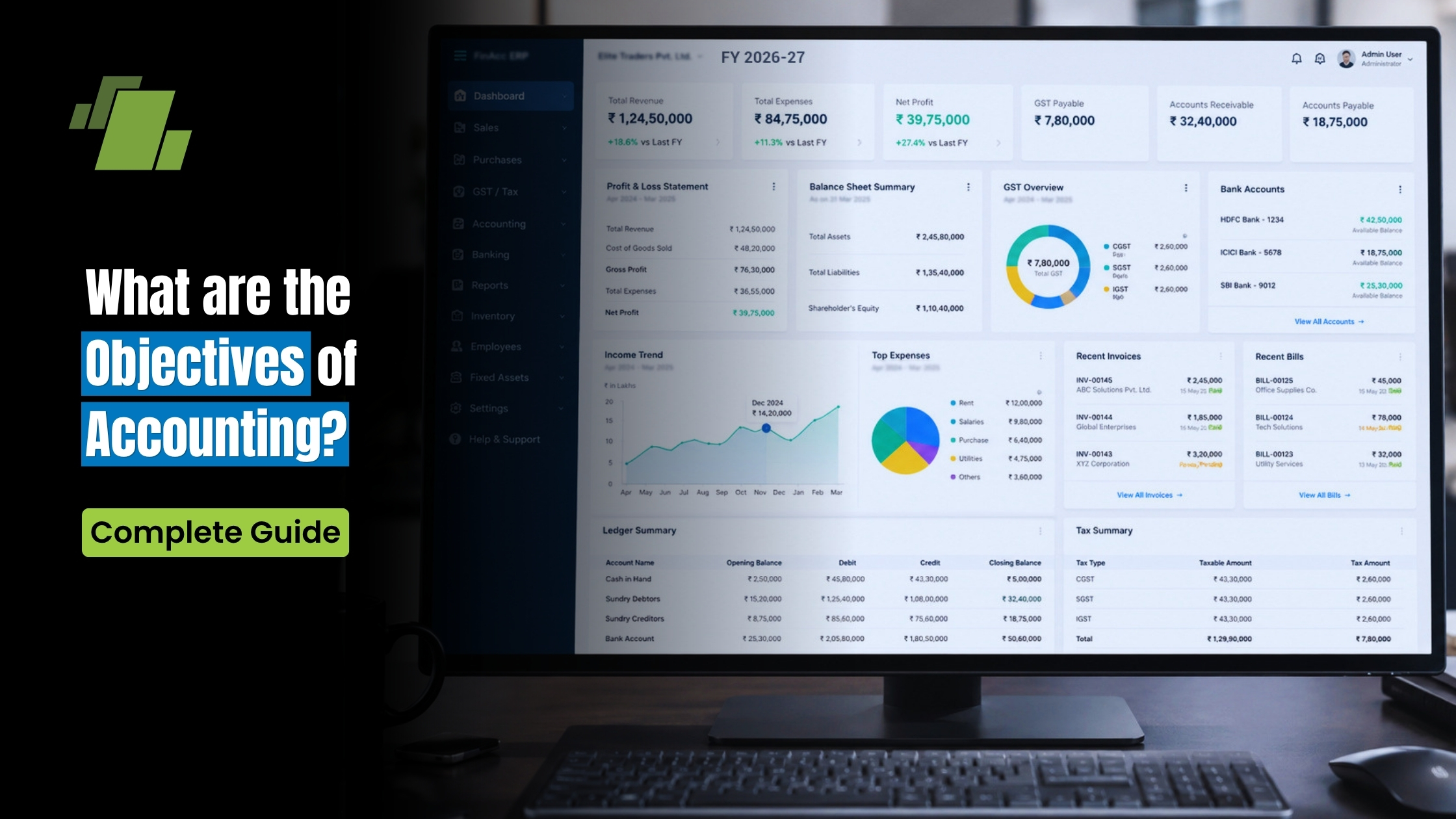
What are the Objectives of Accounting? Complete Guide

Summary
Discover the seven core objectives of accounting, including maintaining accurate financial records, measuring business performance, ensuring compliance, supporting decision-making, and preventing fraud. Learn how LOGIC ERP accounting software help businesses automate accounting processes, improve accuracy, and enhance financial management.
✨ Summarize this article with AI


Contact Us
Free Demo Request
Table of content
- Introduction
- Understanding Accounting Objectives
- Primary vs Secondary Objectives
- Historical Development
- The 7 Core Objectives of Accounting
- Maintaining Systematic Records
- Determining Financial Performance
- Assessing Financial Position
- Ensuring Legal Compliance
- Providing Stakeholder Information
- Facilitating Decision-Making
- Detecting and Preventing Fraud
- Implementation Methods and Best Practices
- Systematic Implementation Process
- Technology Integration Comparison
- Common Challenges and Solutions
- Why Choose LOGIC ERP Accounting Software?
- Conclusion and Next Steps
- Frequently Asked Questions (FAQs)
- Additional Resources
Introduction
The objectives of accounting define the fundamental purposes that guide how businesses record, report, and analyze their financial transactions. The accounting process produces accounting information, which is systematically recorded, organized, and utilized to assess a company’s financial health, support strategic decisions, and ensure compliance with regulations. These seven core objectives maintaining systematic records, determining financial performance, assessing financial position, ensuring legal compliance, providing stakeholder information, facilitating decision-making, and detecting and preventing fraud form the backbone of every effective accounting system and directly impact a company’s financial health and operational success.
This guide covers the complete framework of accounting objectives, from foundational record-keeping principles to advanced fraud detection strategies. Whether you’re a business owner evaluating your current accounting process, a finance student building foundational accounting skills, a seasoned professional seeking deeper insights, or an ERP system user looking to maximize your software’s capabilities, this resource addresses the practical applications that matter to your role.
The main objective of accounting is to maintain systematic financial records of all business transactions. One primary objective is to provide reliable and relevant accounting information to users for decision-making. Other important objectives include determining profit and loss through financial statements, assessing financial position via balance sheets, ensuring compliance with tax regulations and accounting standards, providing transparent financial information to internal and external users, supporting informed decision making through accurate financial data, and detecting and preventing fraud through internal controls.
By understanding these accounting objectives, you will:
- Evaluate whether your current accounting system supports all seven objectives effectively
- Identify gaps in record-keeping, compliance, or stakeholder reporting within your organization
- Understand the important objectives of accounting and how modern ERP systems like LOGIC ERP automate and strengthen each objective
- Benchmark your fraud prevention capabilities against industry standards
- Develop actionable strategies for improving financial planning and strategic decision making
Understanding Accounting Objectives
Accounting objectives are the fundamental goals that govern what the accounting function exists to achieve within any organization. These objectives shape the design of accounting systems, dictate reporting standards, establish internal control structures, and determine how financial information flows to stakeholders. One of the primary objectives of accounting is to maintain systematic records of all financial transactions, which supports accuracy and accountability within an organization.
In modern business operations, these objectives are not abstract concepts they are embedded directly into the technology infrastructure. ERP systems integrate these objectives through automated transaction capture, real-time financial reports, compliance monitoring, and advanced analytics that transform raw financial data into strategic insights.
Primary vs Secondary Objectives
Primary objectives represent the non-negotiable foundations of any accounting function. These include maintaining accurate records of all business transactions, measuring financial performance through income statements and, specifically, the profit and loss account, which is essential for determining business profits or losses over a given period and assessing overall financial results, and determining financial position through balance sheet preparation. These objectives align directly with regulatory requirements under GAAP and IFRS standards, ensuring that financial statements meet the needs of investors, creditors, and tax authorities.
Secondary objectives extend the value of accounting beyond basic compliance. These include minimizing operational costs through efficient systems, building stakeholder confidence through transparent reporting, supporting environmental and social accounting initiatives, and facilitating taxation processes. While primary objectives are legally mandated, secondary objectives often differentiate organizations that merely comply from those that leverage accounting as a strategic advantage.
Historical Development
The formal framework for accounting objectives emerged following the 1929 stock market crash, when public demand for financial discipline and reliable reporting led to landmark legislation including the U.S. Securities Exchange Act of 1934. The Trueblood Study Group in 1972 identified numerous objectives of financial statements, and the Financial Accounting Standards Board (FASB), established in 1973, formalized these objectives in its Conceptual Framework establishing that financial reporting should provide information useful to investors, creditors, and others in making decisions.
Modern ERP systems like LOGIC ERP evolved within this regulatory context, embedding audit trails, integrated transaction recording, real-time dashboards, and compliance monitoring directly into their architecture. Research on ERP implementation in the oil and gas sector demonstrated that continuous auditing features reduced fraud risk, increased efficiency, and enhanced audit credibility showing how technology advances the practical application of accounting objectives.
Understanding this historical evolution connects directly to why today’s accounting systems must balance regulatory compliance with operational efficiency and strategic value creation.
The 7 Core Objectives of Accounting
Building on the foundational understanding of what accounting objectives represent, this section examines each of the seven core objectives in detail explaining their practical importance, implementation requirements, and connection to modern business operation.
Maintaining Systematic Records
Maintaining systematic records of financial transactions is crucial for ensuring accuracy and accountability within an organization. This objective encompasses the complete, accurate, chronological, and consistent recording of all sales, purchases, expenses, receipts, payments, and cash flows through double-entry bookkeeping where every debit has a corresponding credit, maintaining the fundamental accounting equation.
Accurate record-keeping helps prevent errors and fraud by providing a clear and organized account of all financial activities. In modern ERP systems, this objective is implemented through transaction modules covering general ledger, subledgers, accounts payable/receivable, and fixed assets. Each entry includes timestamps, user identification, and complete audit trails that support both internal management and external audit requirements.
Systematic record-keeping supports the preparation of financial statements, which are essential for assessing a company’s financial position and performance. Without this foundation, no other accounting objective can be reliably achieved.
Determining Financial Performance
Accounting helps in determining the profit or loss of a business by preparing financial statements, which is essential for assessing financial performance. This objective involves measuring revenues, expenses, gains, and losses over a defined accounting period whether quarterly, annually, or on custom intervals required for management accounting purposes.
The income statement serves as the primary tool for this objective, applying accrual method principles and the matching concept to accurately reflect when economic activity occurred. Financial accounting helps businesses track their financial performance by systematically recording and summarizing financial transactions, which allows for accurate reporting and analysis over time.
By preparing financial statements such as the income statement and balance sheet, businesses can assess their profitability and financial position, which is crucial for tracking performance over time. Year-over-year comparison, trend analysis, and ratio analysis (gross margin, return on sales, return on assets) all depend on consistent profit and loss statement preparation. Regular financial reporting enables businesses to compare current performance against past results, helping them identify trends and make informed decisions to improve profitability.
Assessing Financial Position
This objective focuses on determining what the business owns and owes at a specific point in time analyzing assets, liabilities, and equity to evaluate the company’s financial health, liquidity, and solvency. The balance sheet (statement of financial position) serves as the primary output, distinguishing between current and non-current items while addressing complexities like contingent liabilities and off-balance sheet obligations. The balance sheet provides insights into a business’s financial standing, helping stakeholders understand the company’s stability and risk exposure.
Accurate financial reports enable businesses to assess their company’s financial health, which is crucial for making informed decisions about future investments and operational strategies. Financial institutions and investors rely heavily on financial position data when evaluating creditworthiness, setting lending terms, or making investment decisions.
ERP systems aggregate this information automatically, managing fixed asset depreciation schedules, tracking current assets like inventory and receivables, and monitoring liabilities for accurate, real-time views of business’s financial standing.
Ensuring Legal Compliance
Financial accounting ensures compliance with legal, fiscal, and regulatory requirements, supporting ethical conduct and reducing legal risks. This objective encompasses meeting tax obligations, adhering to reporting standards (GAAP/IFRS), satisfying industry-specific regulations, and maintaining records required for audit procedures.
Companies prepare audited financial statements every year to stay compliant with regulations, which is a key aspect of legal compliance in financial accounting. Requirements vary by jurisdiction but universally include timely reports, accurate filings, proper disclosures for related party transactions and contingencies, and internal controls aligned with frameworks for public companies.
Financial accounting helps businesses avoid legal complications and penalties by ensuring compliance with accounting standards and tax regulations. ERP systems facilitate this objective by embedding regulatory rules, automating compliance deadlines, maintaining version-controlled documentation, and providing the audit trails that tax authorities and regulators require.
Providing Stakeholder Information
Another key objective of accounting is to provide relevant financial information to stakeholders, which aids in informed decision-making and improves transparency. By ensuring that financial data is accessible and understandable, accounting improves transparency, fostering trust and supporting compliance with regulations. Stakeholders include shareholders, investors, creditors, lenders, management, employees, regulatory bodies, and in some cases, the broader public or community.
Financial accounting enhances decision quality by providing clear and standard reporting of financial information, which promotes accountability and trust among stakeholders. This objective demands consistent disclosure practices, timely delivery of financial results, and comparability across reporting periods and among peer organizations.
The consequences of failing this objective are severe misleading or opaque reporting has destroyed significant value. Transparent financial reports, verified through third-party audits, build the confidence that stakeholders need to make investment, lending, and partnership decisions.
Facilitating Decision-Making
Financial accounting provides relevant financial data that helps in strategic decision-making, guiding decisions related to investments, budgeting, pricing, cost control, and expansion. This objective bridges financial accounting with management accounting, supporting internal users through budgets, variance analysis, forecasts, and cost-benefit analyses.
Decision types supported by this objective include pricing strategies, capital investment analysis (capex versus lease), resource allocation across different departments, expansion planning, and cost reduction initiatives. The vital role of accounting in decision making extends beyond historical reporting to predictive analytics and scenario modeling.
Modern ERP systems provide real-time dashboards and business intelligence tools that transform accounting records into actionable insights. By analyzing trends, reviewing financial data, and comparing standard versus actual costs, accounting objectives help organizations identify areas to improve efficiency and optimize resource utilization. Research demonstrates that organizations implementing continuous auditing through their ERP systems achieved improved efficiency and reduced fraud risk through better data application and knowledge management.
Detecting and Preventing Fraud
This objective focuses on protecting organizational assets through internal controls, segregation of duties, approval workflows, audit trails, and systematic fraud risk assessments. Preventing fraud requires both proactive controls that prevent unauthorized transactions and detective measures that identify irregularities after they occur.
The scale of fraud risk is substantial: according to the Association of Certified Fraud Examiners (ACFE) 2024 Report to the Nations, organizations lose approximately 5% of their revenue annually to occupational fraud, with a median loss of USD 145,000 per incident globally. Asset misappropriation accounts for 86-89% of fraud cases, while financial statement fraud though representing only about 5% of cases results in far larger losses with a median of USD 766,000 per incident.
ERP systems address this objective through transaction logging, role-based access control, and increasingly sophisticated anomaly detection. Research in deep learning approaches has demonstrated effectiveness in detecting anomalous journal entries through techniques like autoencoders and adversarial autoencoders, representing the future of automated fraud detection.
All seven objectives work together as an integrated framework: systematic records enable performance measurement, financial position assessment supports stakeholder communication, compliance protects against legal risk, decision support drives strategic planning, and fraud detection safeguards the integrity of the entire system.
Implementation Methods and Best Practices
Systematic Implementation Process
With a clear understanding of the seven core objectives, organizations must translate these concepts into practical systems and procedures that deliver consistent results across all business operation contexts.
Organizations should implement comprehensive accounting objective frameworks from the earliest stages of operations, with particular emphasis during business scaling, prior to capital raising, when facing increased regulatory exposure, and when deploying or upgrading ERP systems.
- Establish chart of accounts and transaction coding system: Design an account structure that clearly distinguishes revenue streams, expenditure categories, asset types, and liability classifications. Configure your ERP to enforce consistent coding and prevent posting errors that compromise accurate records.
- Implement daily recording procedures and approval workflows: Deploy subledger systems with automated capture capabilities for receipts and invoices. Establish digital approval hierarchies with validation rules and daily reconciliation routines that maintain systematic financial records integrity.
- Set up monthly closing and financial statement preparation: Create standardized closing procedures including accruals, adjustments, inter-company balances, depreciation calculations, and inventory valuations. Prepare income statement, balance sheet, and cash flow statement outputs within defined timelines.
- Create compliance monitoring and audit preparation systems: Implement jurisdictional tax and regulatory compliance checks, internal audit schedules, external audit readiness protocols, and documentation standards. Establish regulatory update mechanisms to address changes in accounting standards and tax regulations.
Technology Integration Comparison
Below is a comparison of different technology integration approaches for accounting systems:
| Criterion | Manual/Spreadsheet | On-Premise ERP | Cloud-Based ERP |
|---|---|---|---|
| Accuracy | High error risk | Structured validation | Automated validation with updates |
| Efficiency | Labor-intensive | Streamlined workflows | Automated with real-time processing |
| Compliance Support | Manual tracking | Embedded rules | Auto-updating regulatory modules |
| Stakeholder Reporting | Delayed, manual compilation | Integrated reports | Real-time dashboards and analytics |
| Fraud Detection | Limited, retrospective | Role-based controls, audit trails | Advanced anomaly detection, AI capabilities |
| Scalability | Poor | Requires infrastructure investment | Highly scalable |
| Cost Structure | Low initial, high ongoing | High initial, moderate ongoing | Subscription-based, predictable |
For small businesses with straightforward transactions, spreadsheet-based systems may suffice initially. However, organizations experiencing growth, operating across multiple locations, or facing complex compliance requirements typically find that ERP solutions like LOGIC ERP deliver superior accuracy, efficiency, and control. Case studies demonstrate that AI-powered ERP implementations have achieved invoice accuracy rates of 99.8%, reduced processing errors by 92%, and captured significant early payment discounts illustrating the tangible returns from technology investment.
The challenges organizations face in achieving these implementation goals require specific solutions addressed in the following section.
Common Challenges and Solutions
Incomplete Transaction Recording
Challenge: Omitted or delayed transaction entries compromise the integrity of financial data and undermine every downstream objective from performance measurement to fraud detection.
Solution: Implement automated data capture through ERP integration with point-of-sale systems, e-commerce platforms, and bank feeds. Establish clear approval workflows with escalation procedures for pending transactions. Train staff thoroughly on timing and recognition rules, emphasizing that recording transactions promptly is an important function that affects all other accounting objectives.
Compliance Complexity
Challenge: Navigating varying GAAP/IFRS requirements, frequent tax regulation changes, cross-border rules, and industry-specific standards creates significant operational burden and legal risk.
Solution: Deploy accounting software with built-in regulatory update mechanisms that automatically incorporate changes to accounting standards. Schedule regular consultation with external audit professionals to validate compliance approaches. Invest in ongoing staff training programs that maintain current knowledge of regulatory requirements. ERP systems with compliance modules transform ensuring compliance from a reactive burden into a proactive, managed process.
Stakeholder Communication Delays
Challenge: Slow closing cycles and data fragmentation across multiple systems delay the delivery of financial reports to investors, creditors, and management undermining trust and hampering decision making.
Solution: Centralize financial data within a unified ERP platform that eliminates silos between different departments. Implement real-time business intelligence dashboards that provide immediate access to key financial status indicators. Case studies demonstrate that organizations consolidating from multiple disconnected accounting systems to a single source reduced month-end close from 10 days to 2 days while improving fraud detection rates to 95%.
Addressing these challenges proactively ensures that the objectives of financial accounting deliver their intended value to the organization and all stakeholders.
Why Choose LOGIC ERP Accounting Software for Business Account Management?
The reason to choose LOGIC ERP Accounting Software for business account management lies in its comprehensive integration of all core accounting objectives. LOGIC ERP automates the systematic recording of financial transactions, ensures compliance with legal and regulatory requirements, provides real-time financial reporting and dashboards for informed decision-making, and incorporates advanced fraud detection mechanisms. This automation improves accuracy, enhances transparency, supports strategic financial planning, and reduces the risk of errors and fraud. Additionally, LOGIC ERP’s scalable and user-friendly platform helps businesses streamline their accounting processes, making it a reliable choice for effective and efficient business account management.
Conclusion and Next Steps
The seven objectives of accounting maintaining systematic records, determining financial performance, assessing financial position, ensuring legal compliance, providing stakeholder information, facilitating decision-making, and detecting and preventing fraud form the foundation of effective financial management for every organization. These objectives are not independent checkboxes but an integrated framework where each element supports and depends upon the others.
Understanding these objectives transforms accounting from a compliance burden into an important tool for strategic planning, risk management, and competitive advantage. Modern ERP systems like LOGIC ERP embed these objectives directly into their architecture, automating the processes that maintain accurate records, generate timely financial reports, and protect against fraud while supporting informed decisions at every organizational level.
Take these immediate steps to apply this knowledge:
- Assess your current accounting system against all seven objectives, identifying where gaps exist in record-keeping, compliance monitoring, or stakeholder reporting capabilities.
- Identify specific weaknesses in areas such as transaction capture automation, closing cycle duration, or fraud detection controls.
- Consider ERP implementation or enhancement to achieve comprehensive objective fulfillment with features like real-time dashboards, automated compliance updates, and integrated audit trails.
Related topics worth exploring include management accounting objectives and their distinction from financial accounting, cost accounting principles for manufacturing and service organizations, and financial analysis techniques that transform accounting data into strategic insights.
Call at +91-73411-41176/75 or send us an email at sales@logicerp.com to book a free demo today!
Frequently Asked Questions (FAQs)
1. What are the Main Objectives of Accounting?
The main objectives of accounting include maintaining systematic financial records, determining profit or loss, assessing financial position, ensuring legal compliance, providing transparent financial information to stakeholders, facilitating informed decision-making, and detecting and preventing fraud.
2. How does Accounting Help in Business Decisions?
Accounting provides accurate financial information that supports strategic business decisions such as budgeting, pricing, investment analysis, cost control, and expansion planning by offering insights into financial performance and position.
3. Why is Legal Compliance an Important Objective of Accounting?
Legal compliance ensures that businesses adhere to tax laws, accounting standards like GAAP and IFRS, and regulatory requirements, which helps avoid penalties, legal risks, and maintains ethical financial reporting.
4. What Role does Accounting Play in Detecting and Preventing Fraud?
Accounting implements internal controls, audit trails, segregation of duties, and anomaly detection to identify and prevent fraudulent activities, protecting organizational assets and ensuring data integrity.
5. How do ERP Systems Support the Objectives of Accounting?
ERP systems automate transaction recording, provide real-time financial reports, embed compliance checks, and enhance fraud detection through advanced analytics, thereby strengthening the achievement of all accounting objectives.
6. What is the Difference Between Primary and Secondary Accounting Objectives?
Primary objectives focus on essential tasks like record-keeping, profit measurement, and financial position assessment required by law, while secondary objectives include enhancing stakeholder confidence, minimizing costs, and supporting taxation processes.
7. How can Businesses Improve Their Accounting Systems to Meet These Objectives?
Businesses can improve by automating transaction capture, implementing approval workflows, using integrated ERP solutions, ensuring timely financial closing, and maintaining up-to-date compliance monitoring to fulfill all accounting objectives effectively.
8. Why is Measuring Financial Performance a Key Accounting Objective?
Measuring financial performance through income statements and related reports helps businesses track profitability, evaluate operational efficiency, and make informed decisions to enhance growth and sustainability.
9. How does Accounting Ensure Accurate Financial Position Assessment?
Accounting compiles and organizes data on assets, liabilities, and equity in balance sheets, providing a clear snapshot of a company’s financial health, liquidity, and solvency at a given point in time.
10. What are the Benefits of Providing Stakeholder Information Through Accounting?
Transparent financial reporting builds trust among investors, creditors, management, and regulatory bodies, enabling informed decisions, attracting investment, and ensuring accountability within the organization.
11. What is Financial Accounting and Why is it Important?
Financial accounting is the process of recording, summarizing, and reporting a company’s financial transactions to provide accurate financial statements and reports. It is important for assessing a business’s financial position and health.
12. How Does Financial Accounting Help Assess Financial Position?
Financial accounting compiles data on assets, liabilities, and equity into financial statements like the balance sheet, providing a snapshot of the company’s financial position at a specific point in time.
13. What are Financial Statements and their Role in Business Decisions?
Financial statements, including income statements and balance sheets, present a business’s financial performance and position, enabling stakeholders to make informed business decisions.
14. How Do Financial Reports Support Decision Making?
Financial reports provide detailed insights into cash flow, profitability, and expenses, helping management and investors make strategic decisions to improve financial health.
15. What is the Relationship Between Cost Accounting and Financial Accounting?
Cost accounting focuses on tracking and controlling production costs internally, while financial accounting records overall financial transactions for external reporting and compliance.
16. Why is Measuring Financial Performance a Key Objective of Accounting?
Measuring financial performance through accurate financial records and statements allows businesses to evaluate profitability, efficiency, and sustainability over time.
17. How Does Accounting Influence Cash Flow Management?
Accounting tracks all cash inflows and outflows, helping businesses manage cash flow effectively to meet operational needs and plan for future expenditures.
18. What Accounting Skills are Essential for Effective Financial Reporting?
Key accounting skills include proficiency in maintaining financial records, preparing accurate financial statements, analyzing financial performance, and supporting sound business decisions.
19. What is Financial Health in Accounting?
Financial health refers to the overall condition of a business’s financial stability, liquidity, and solvency, assessed through key financial metrics and statements such as balance sheets, income statements, and cash flow reports.
20. How Do Financial Records Contribute to Assessing Financial Health?
Accurate and systematic financial records provide the data needed to prepare financial statements, which reveal a company’s profitability, asset management, liabilities, and cash flow—critical indicators of financial health.
21. Why is Maintaining Up-to-Date Financial Records Important?
Up-to-date financial records ensure timely and accurate financial reporting, support compliance with legal requirements such as income tax filings, and enable effective decision-making to measure performance and plan future activities.
22. How Can Poor Financial Records Affect a Business’s Financial Health?
Poor financial records can lead to inaccurate financial statements, misinformed decisions, increased risk of fraud, compliance issues with tax authorities, and ultimately, financial instability or loss of stakeholder trust.
23. What Role Does Fund Accounting Play in Maintaining Financial Health?
Fund accounting helps organizations, especially non-profits and government entities, manage and track resources earmarked for specific purposes, ensuring proper allocation and accountability to maintain financial health.
24. How Do ERP Systems Improve the Management of Financial Records?
ERP systems automate transaction recording, provide real-time financial information, enforce compliance with accounting standards, and enhance accuracy and transparency, all of which support a company’s financial health.
25. Can Financial Records Help in Income Tax Preparation?
Yes, detailed financial records are essential for preparing accurate income tax returns, identifying eligible deductions, and ensuring compliance with tax regulations to avoid penalties.
26. How Does Measuring Performance Relate to Financial Health?
Measuring performance through financial records allows businesses to evaluate operational efficiency, profitability, and growth trends, which are key components of maintaining and improving financial management.
Additional Resources
- GAAP and IFRS Compliance Guides: Reference materials from the Financial Accounting Standards Board (FASB) and International Accounting Standards Board (IASB) provide authoritative guidance on reporting standards and disclosure requirements
- ERP System Evaluation Tools: Comparison frameworks for assessing how different ERP platforms support each accounting objective, including LOGIC ERP’s capabilities for transaction management, compliance, and analytics
- Professional Development Paths: Certification programs including CPA, CMA, and ACFE credentials that build advanced accounting skills and fraud examination expertise for finance professionals seeking career advancement.

Author
Gurbir Singh
Co-founder & Managing Director | LOGIC ERP Solutions Pvt. Ltd.
With 30+ years of experience in the tech industry, I took the helm of technology & product development, ensuring LOGIC ERP’s continuous innovation & leadership in the evolving tech landscape.