What is Distributor and Consumer Management? Complete Guide

Summary
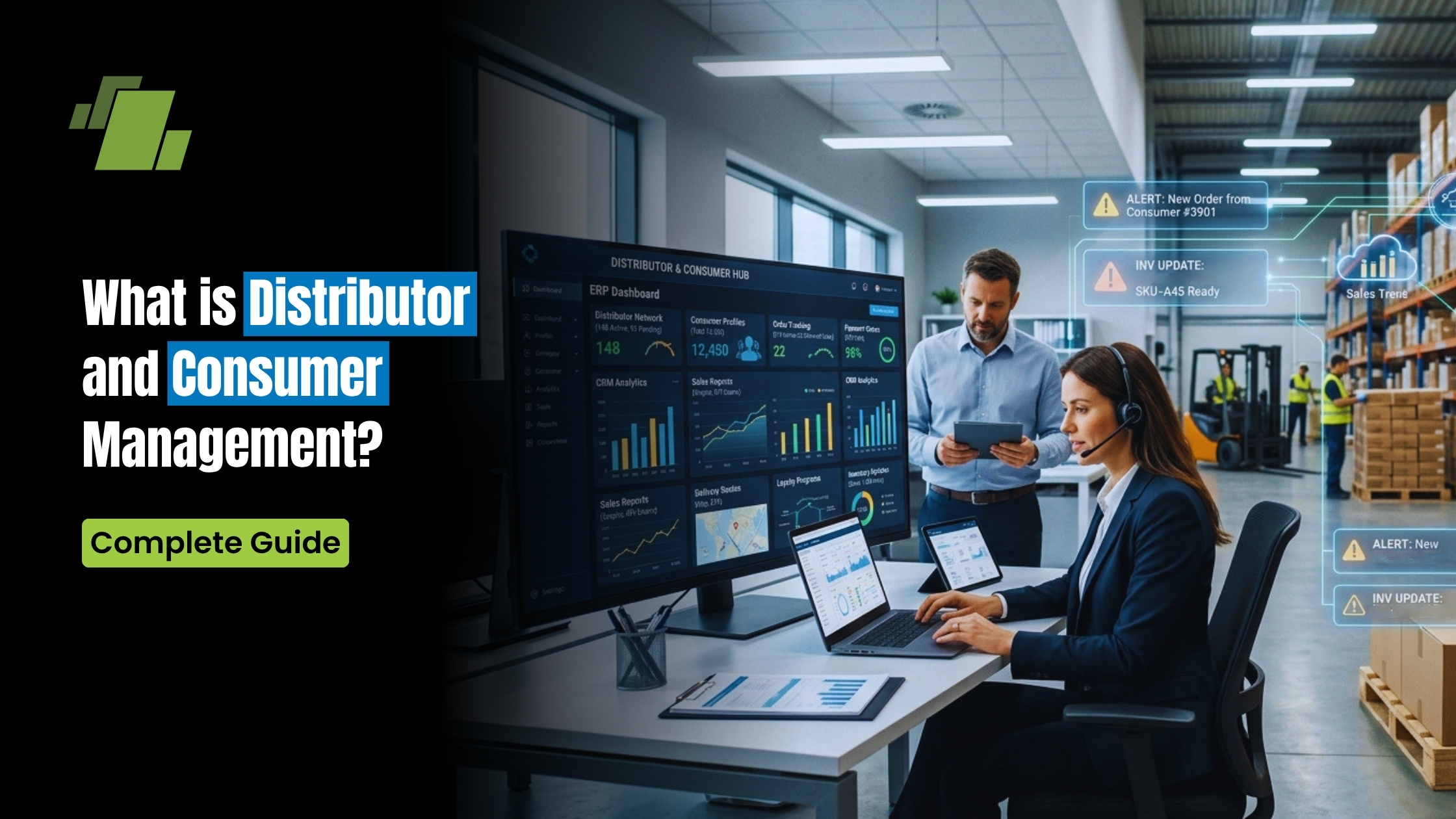
A Distributor and Consumer Management System (DCMS) streamlines supply chain operations by connecting distributors, retailers, and consumers on a single platform. It improves inventory tracking, order management, field sales automation, and analytics, helping businesses reduce stockouts, increase efficiency, and enhance customer experience. LOGIC ERP offers scalable solutions for FMCG, retail, pharma, and manufacturing businesses to optimize distribution and drive growth.
Contact Us
Free Demo Request
Table of Content
- Introduction
- Understanding Distributor and Consumer Management
- Core Components of Distribution Management
- Consumer Management Elements
- Key Features and Capabilities of Modern Systems
- Real-Time Inventory and Sales Tracking
- Mobile Field Force Automation
- Analytics and Business Intelligence
- Implementation Process and Best Practices
- Step-by-Step Implementation Process
- Technology Integration Comparison
- Common Challenges and Solutions
- Data Integration and System Compatibility
- User Adoption and Change Management
- ROI Measurement and Performance Tracking
- Conclusion and Next Steps
- Additional Resources
Introduction
Distributor and consumer management represents the integrated approach businesses use to coordinate every link in their supply chain from manufacturers through distributors to retailers and end consumers. This comprehensive system ensures products flow efficiently while capturing valuable data at each touchpoint, enabling companies to make faster decisions and maintain competitive advantage in complex markets.
This guide covers distributor and consumer management for FMCG and CPG brands, retail goods, manufacturing, and pharmaceutical industries where distribution networks involve multiple distributors, warehouses, and customer touchpoints. Basic CRM systems or simple inventory tracking tools fall outside this scope we focus on integrated platforms that handle real-time visibility, order management, field force automation, and analytics across the entire distribution system.
Business owners expanding through distribution networks, distribution managers coordinating stock data and sales teams, operations executives responsible for supply chain efficiency, and IT decision-makers evaluating technology solutions will find actionable guidance here. Engaging and training the sales team, including sales reps, is critical during DCMS implementation to ensure smooth adoption and maximize system benefits. A dedicated DCMS provides mobile-friendly workflows and real-time order management core features tailored for sales reps, significantly enhancing their field experience and productivity. Whether you’re dealing with lost sales from stockouts, manual processes creating errors, or blind spots in your channel operations, this content addresses those challenges directly.
Direct answer: A Distributor and Consumer Management System (DCMS) integrates a company’s entire supply chain, providing a centralized platform that connects manufacturers, distributors, retailers, and consumers. It combines real-time inventory management, automated order processing, field team coordination, and consumer feedback analysis into a single platform that eliminates blind spots and enables proactive decision-making.
By reading this guide, you will gain:
- Clear understanding of distribution management and consumer management components and how they work together
- Implementation strategies with step-by-step processes for deploying integrated systems
- ROI measurement frameworks with specific metrics to track performance
- Technology selection criteria for evaluating DMS software and vendors
- Operational optimization methods that reduce manual errors and improve cash flow
Understanding Distributor and Consumer Management
Distributor and consumer management connects all supply chain stakeholders through technology that provides real-time data access and coordinated operations. Rather than treating distribution logistics and customer relationships as separate functions, modern businesses integrate these elements to create seamless experiences from production to purchase.
This integration matters because customer expectations have shifted dramatically. End consumers expect immediate availability, consistent pricing across various channels, and responsive service. Meeting these expectations requires distributors, retailers, and manufacturers to operate on the same page with shared stock data, synchronized sales data, and unified consumer interactions. Modern DCMS platforms ensure that critical information, such as orders and feedback, is routed instantly across the supply chain, streamlining operations and reducing delays.
Core Components of Distribution Management
Distributor onboarding encompasses legal compliance, contract management, price list assignments, territory definitions, credit limits, and training programs. Effective onboarding establishes clear expectations and provides distributors with the tools needed for success within your distribution network.
Inventory synchronization maintains real-time visibility across multiple warehouses and distributor locations. Key features include SKU tracking with batch and serial numbers, expiry management, multi-unit handling, and automated reorder triggers when low stock thresholds are reached. A Distributor Consumer Management System (DMS) provides real-time visibility into inventory levels, enabling businesses to react promptly to demand fluctuations and avoid stockouts.
Order processing handles quotations, purchase orders, approval workflows, back-order management, and returns. Systems must accommodate promotional schemes, tiered pricing, and credit notes while maintaining accuracy across many distributors.
Performance tracking monitors distributor KPIs including sales volume, margin contribution, order fulfillment speed, stock turns, and retailer coverage. Live data dashboards enable distribution managers to identify issues before they impact operations.
These distribution management components create the foundation for effective consumer management by ensuring products reach the right locations at the right time with accurate inventory tracking throughout.
Consumer Management Elements
A distributor and consumer management system (DMS) centralizes customer data, allowing businesses to track customer preferences, buying behaviors, and feedback in real time, which enhances personalized communication. Customer data collection draws from POS systems, e-commerce platforms, secondary sales reports, and direct consumer feedback channels.
Feedback systems capture retailer observations, field rep reports, online reviews, and formal complaint processes. For regulated industries like pharmaceuticals, this includes adverse event tracking and compliance documentation.
Loyalty programs operate at both distributor and consumer levels. Distributors earn incentives for volume targets while end consumers access rewards through retail or direct channels. The consumer management system tracks scheme utilization and measures margin impact.
Purchase behavior analysis examines sales data across primary, secondary, and tertiary channels. By leveraging analytics capabilities within a DMS, companies can identify trends and areas of improvement, which helps businesses adapt their offerings to meet evolving customer needs effectively, thereby strengthening customer relationships over time.
Effective communication is a significant aspect enhanced by a DMS, as it provides streamlined channels for outreach, enabling companies to quickly respond to inquiries or concerns, which fosters customer trust and loyalty. This responsiveness directly supports building trust with both distribution partners and end consumers.
The integration of distributor and consumer management elements proves essential because distributor activities directly affect customer experience. Stockouts at distributor level cascade to retailers and ultimately disappoint consumers, while pricing inconsistencies across channels erode consumer trust.
Key Features and Capabilities of Modern Systems
Modern distributor consumer management systems deliver capabilities that legacy systems and manual processes cannot match. Understanding these core features helps businesses evaluate technology options and identify gaps in existing tools.
Real-Time Inventory and Sales Tracking
Real-time data access allows businesses to respond swiftly to inquiries and concerns, enhancing customer satisfaction and trust. Live stock monitoring across multiple warehouses and distributor locations eliminates the delays inherent in periodic reporting.
Key capabilities include:
- Cloud-based dashboards providing real time dashboards that display stock levels, pending orders, and sales performance across the entire distribution network
- Automated reorder alerts triggered by low inventory thresholds, preventing stockouts before they cause lost sales
- Sales data synchronization capturing primary, secondary, and tertiary transactions for complete visibility
- API integration connecting the DMS with existing ERP systems, POS platforms, and e-commerce channels
A Distributor Consumer Management System (DCMS) can reduce stockouts by approximately 25% shortly after implementation, which directly recoups lost sales and improves customer satisfaction. This improvement comes from replacing batch reporting with continuous inventory sync that flags issues immediately.
Real-time visibility enables predict demand capabilities by combining current stock data with historical patterns and external factors like seasonality or promotional schedules.
Mobile Field Force Automation
Field force automation transforms how sales teams interact with retailers and manage territory coverage. Field reps equipped with mobile apps capture orders, update inventory records, and report market intelligence without returning to back office locations.
Core mobile capabilities include:
- Offline functionality ensuring order capture works even in areas with poor connectivity, with automatic synchronization when connections resume
- GPS tracking providing visibility into field team locations and visit completion
- Route optimization reducing travel time and ensuring efficient coverage of retailer accounts
- Instant log orders capability allowing sales reps to enter orders that route instantly to fulfillment systems
These mobile tools connect directly to real-time tracking systems, creating closed-loop visibility from order capture through delivery. Field reps see accurate stock levels before committing to orders, reducing situations where pending orders cannot be fulfilled.
Analytics and Business Intelligence
With real-time analytics, companies can identify trends and areas for improvement, allowing them to adapt their offerings to meet evolving customer needs effectively. Analytics capabilities differentiate modern systems from basic inventory management tools.
Predictive analytics use historical sales data, promotional patterns, and external variables to forecast demand. Accurate forecasting reduces both stockouts that cause lost sales and excess inventory that ties up cash flow.
Performance KPIs tracked include order fill rates, inventory turnover, margin by SKU and customer, distributor compliance rates, and field team productivity. These actionable insights enable faster decision making at both operational and strategic levels.
AI-driven optimization represents the newest capability layer, with vendors offering machine learning for pricing optimization, anomaly detection, and demand prediction. One industrial parts distributor achieved approximately $450,000 in gross margin lift over nine months and 7× ROI by implementing AI-powered pricing and inventory optimization.
A DCMS enhances decision-making by providing real-time visibility into sales performance, inventory levels, and consumer feedback, allowing businesses to respond proactively to market changes.
These technology capabilities collectively enable the complete control businesses need to manage complex distribution networks effectively.
Implementation Process and Best Practices
Successful deployment requires structured planning that accounts for existing processes, stakeholder needs, and integration requirements. Engaging the sales team early in the implementation process and providing them with targeted training and support is crucial to maximize adoption and ensure the system delivers its full benefits. Rushing implementation creates adoption problems and limits ROI realization.
Step-by-Step Implementation Process
When evaluating a distributor and consumer management system (DCMS), businesses should consider their specific needs, including the size of their operation and the complexity of their distribution network.
- Needs assessment and stakeholder mapping: Analyze current inefficiencies including stockouts, order delays, manual errors, and data blind spots. Document processes across manufacturing, distribution, sales, and finance teams. Identify regulatory requirements specific to your industry.
- System selection and vendor evaluation: Researching available systems in the market is crucial; look for software solutions that offer customization to fit your business model and ensure user-friendly interfaces to save time during onboarding and training. Evaluate vendors on cloud vs. on-premise options, mobile capabilities, API availability, industry specialization, and support quality. Seeking feedback from current users through reviews or case studies can reveal potential challenges or hidden benefits of a DCMS that may not be highlighted in sales pitches.
- Data migration and integration planning: Determine what existing data needs conversion including customer records, distributor information, inventory records, and historical sales. Integration capabilities with existing tools are essential when choosing a DCMS, as seamless connections ensure smoother workflows and better data tracking across platforms. Plan connections with existing ERP, accounting systems, POS platforms, and e-commerce channels.
- Pilot program with key distributors: Begin with limited SKUs, one geography, or select distributors to test workflows. Measure order accuracy, user adoption, margin impact, and fulfillment speed. Gather feedback and refine processes before broader rollout.
- Full rollout with training and support: Scale across all distributors, warehouses, and SKUs based on pilot learnings. Provide comprehensive training for field sales, distributor personnel, and internal teams. Document procedures and establish ongoing support channels.
Technology Integration Comparison
| Factor | Cloud-Based Solutions | On-Premise Solutions |
|---|---|---|
| Scalability | High: easily add users, locations, and distributors without hardware investment | Lower: scaling requires new hardware and longer lead times |
| Cost Structure | Lower upfront CAPEX, recurring subscription; maintenance included | Higher upfront CAPEX; ongoing costs for support and upgrades borne by customer |
| Maintenance | Vendor handles updates, patches, and new features; faster deployment of new technologies | Customer responsible; upgrades may be delayed; risk of outdated systems |
| Security | Cloud vendors invest heavily in security certifications; ensure data privacy compliance | More control over data residency and security policies; higher IT burden |
| Integration | Modern APIs and connectors; easier connection with POS, e-commerce, and field apps | More customization possible but may require bespoke integration work |
| Best For | Organizations planning rapid growth, limited internal IT, needing agility | Organizations with regulatory constraints, data sovereignty concerns, existing major on-premise systems |
LOGIC ERP offers both cloud-based and on-premise deployments, providing flexibility based on organizational requirements. The platform supports integration with accounting environments, enabling businesses to maintain existing tools while adding distribution capabilities.
For most growing businesses, cloud-based solutions provide faster time-to-value and lower total cost of ownership. Organizations with complex legacy systems or specific compliance requirements may benefit from on-premise or hybrid approaches that allow gradual change management.
Common Challenges and Solutions
Implementing a DCMS can lead to operational efficiency improvements, with companies potentially unlocking 1-2 percentage points of EBITDA margin by reducing manual processes and errors. However, achieving these gains requires addressing common obstacles proactively.
Data Integration and System Compatibility
Many businesses struggle when merging data from legacy systems, distributor POS systems, and field apps. Compatibility issues arise from inconsistent product codes, mismatched units of measure, and missing data fields.
Solution: Choose API-first platforms designed for integration with multiple systems. LOGIC ERP’s compatibility with multiple accounting systems and support for data import/export, multiple units, and batch tracking addresses common integration challenges. Run phased integrations with pilot testing, establish canonical data models, and clean master data before migration. Align on SKU identifiers across manufacturer and distributor systems to eliminate synchronization errors.
User Adoption and Change Management
Resistance from distributor personnel, field sales teams, and internal staff can derail implementations. Users comfortable with manual processes may resist new technologies that change their workflows.
Solution: Implement comprehensive training programs tailored to each user role. Mobile-first interfaces reduce learning curves for field reps accustomed to phone-based work. Gradual feature rollout prevents overwhelming users with complete system changes simultaneously. One mid-market distributor achieved 99.5% adoption of new pricing systems by combining training with feedback loops that demonstrated quick wins for sales teams.
ROI Measurement and Performance Tracking
Without baseline metrics, businesses cannot demonstrate system value or identify optimization opportunities. Vague ROI expectations lead to executive skepticism and reduced investment in scaling sustainably.
Solution: Establish baseline metrics before implementation covering inventory carrying costs, order fulfillment speed, stockout frequency, margin per SKU, returned stock rates, and working capital tied up in inventory. Post-implementation, track improvements in inventory turnover, gross margin lift, operational time savings, order accuracy, and customer satisfaction. Conduct quarterly business reviews comparing current performance against baselines.
One international industrial parts distributor achieved 204% ROI with a 6-month payback period after implementing warehouse management optimization, saving approximately $63,800 annually in administrative time and avoiding $405,000 in headcount costs.
These challenges are surmountable with proper planning, but ignoring them creates extended implementation timelines and reduced benefit realization.
Why Choose LOGIC ERP Distribution and Consumer Management System Software?
LOGIC ERP stands out as a comprehensive solution designed to streamline and optimize distributor and consumer management for businesses across industries such as FMCG, retail, pharmaceuticals, and manufacturing. Its platform offers both cloud-based and on-premise deployment options, providing flexibility to suit organizational needs and regulatory requirements.
Key reasons to choose LOGIC ERP include:
- Seamless Integration: LOGIC ERP integrates smoothly with popular accounting systems, ensuring that your existing financial and operational tools remain synchronized without duplication of effort.
- Real-Time Visibility: The platform delivers live dashboards for inventory levels, sales performance, and order status, enabling proactive management to prevent stockouts and improve fulfillment rates.
- Mobile Field Force Automation: Equipped with mobile applications featuring offline capabilities, GPS tracking, and route optimization, LOGIC ERP empowers field sales teams to capture orders instantly and manage retailer relationships efficiently.
- Advanced Analytics and AI: LOGIC ERP leverages predictive analytics and AI-driven insights to forecast demand, optimize inventory, and enhance pricing strategies, driving higher margins and smarter decision-making.
- Comprehensive Features: From distributor onboarding and scheme management to claims processing and reverse logistics, LOGIC ERP covers the full spectrum of distributor and consumer management needs within a unified platform.
- User-Friendly and Scalable: Designed with intuitive interfaces and modular architecture, LOGIC ERP supports rapid adoption across teams and scales effortlessly as your distribution network grows.
By choosing LOGIC ERP, businesses gain a powerful tool that reduces manual errors, cuts operational costs, and strengthens relationships with distributors and consumers alike ultimately driving growth and competitive advantage in fast-moving markets.
Conclusion and Next Steps
Integrated distributor and consumer management transforms how businesses handle complex supply chains. By combining real-time inventory tracking, field force automation, consumer feedback integration, and advanced analytics on a single platform, companies eliminate blind spots, reduce manual errors, and create competitive advantage through superior customer experience.
A DCMS provides seamless communication tools that enhance consumer interactions among all stakeholders, ensuring timely updates and responses to inquiries, which improves overall service delivery. The evidence supports significant returns: 25% stockout reductions, 1-2 percentage points of EBITDA margin improvement, and ROI multiples of 7× within the first year for well-executed implementations.
Immediate actionable steps:
- Assess current distribution challenges by documenting stockouts, order delays, and data gaps affecting your operations
- Evaluate existing technology gaps by comparing current capabilities against the key features outlined in this guide
- Research system vendors and integration partners, prioritizing those with experience in your industry and strong case study evidence
- Plan pilot program timeline targeting implementation with a subset of distributors to validate workflows before full rollout
Related topics worth exploring include supply chain optimization methodologies, customer experience management frameworks for B2B2C businesses, and digital transformation strategies for traditional distribution models.
Call at +91-73411-41176/75 or send us an email at sales@logicerp.com to book a free demo today!
Distributor And Consumer Management System FAQs
1. What is a Distributor and Consumer Management System?
A Distributor and Consumer Management System is a centralized platform that integrates all supply chain activities, connecting manufacturers, distributors, retailers, and consumers to streamline operations and improve real-time visibility.
2. How does a Distributor and Consumer Management System Improve Inventory Management?
It provides real-time inventory tracking across multiple locations, enabling businesses to avoid stockouts and overstocking by triggering automated reorder alerts and syncing sales data instantly.
3. What Features are Included in a Distributor and Consumer Management Report Module?
This module offers live dashboards and analytics on sales performance, distributor KPIs, stock levels, and consumer feedback, helping managers make informed decisions and optimize distribution strategies.
4. How Does Consumer and Distributor Management Enhance Customer Relationships?
By centralizing customer data and feedback, it enables personalized communication, faster complaint resolution, and loyalty program management, fostering stronger trust and repeat business.
5. What Benefits Does a Distributor Consumer and Management System Bring to FMCG Companies?
It reduces fmcg products face stockouts by approximately 25%, improves order processing speed, enhances field force coordination, and boosts overall operational efficiency.
6. Can the Consumer and Distributor Management System Handle Claims and Promotional Schemes?
Yes, it automates scheme enforcement and claims processing, ensuring accuracy and transparency across the distribution network, which increases distributor trust and compliance.
7. Why is a Distributor Consumer Management System Important for Modern Supply Chains?
Because it routes orders instantly, provides seamless communication among stakeholders, and delivers real-time data access, enabling proactive decision-making and competitive advantage.
8. What is Inventory Sync in a Distributor and Consumer Management System?
Inventory sync refers to the real-time synchronization of stock levels across multiple warehouses, distributors, and retail locations. This core feature ensures accurate inventory visibility and prevents stockouts or overstock situations.
9. How Does Real-time Visibility Improve Distributor and Consumer Management?
Real-time visibility provides up-to-date information on inventory, sales, and order status across the distribution network. It enables proactive decision-making, faster response to demand changes, and enhances overall supply chain efficiency. With real-time analytics, companies can identify trends and areas for improvement, allowing them to adapt their offerings to meet evolving customer needs effectively.
10. What Role Does Route Optimization Play in Distributor and Consumer Management?
Route optimization uses data-driven algorithms to plan efficient delivery routes for field teams and distributors. This core feature reduces travel time, lowers transportation costs, and increases the number of retailer visits, improving sales coverage and customer satisfaction.
11. What are the Core Features to Look for in a Distributor and Consumer Management System?
Key core features include inventory sync, real-time visibility, automated order processing, route optimization, mobile field force automation, analytics and reporting, scheme and claims management, and seamless integration with existing ERP and accounting systems.
Additional Resources
- Industry benchmarking studies comparing inventory turnover, fill rates, and margin performance across distribution sectors
- ROI calculation templates for building business cases that quantify stockout reduction, labor savings, and working capital improvements
- Vendor evaluation checklists covering functionality requirements, integration capabilities, deployment options, and support quality criteria
- Integration planning guides documenting data mapping requirements, API specifications, and phased rollout approaches
LOGIC ERP documentation provides detailed specifications for distribution management capabilities including multi-warehouse inventory control, field sales automation, scheme management, and GST-compliant billing. Case studies from FMCG brands with 3,500+ distributors across 40+ countries demonstrate real-world application of these capabilities at scale.

Author
Gurbir Singh
Co-founder & Managing Director | LOGIC ERP Solutions Pvt. Ltd.
With 30+ years of experience in the tech industry, I took the helm of technology & product development, ensuring LOGIC ERP’s continuous innovation & leadership in the evolving tech landscape.