Supermarket Promotion Management: A Complete Guide to Discounts, Combo Offers and Promotional Profitability

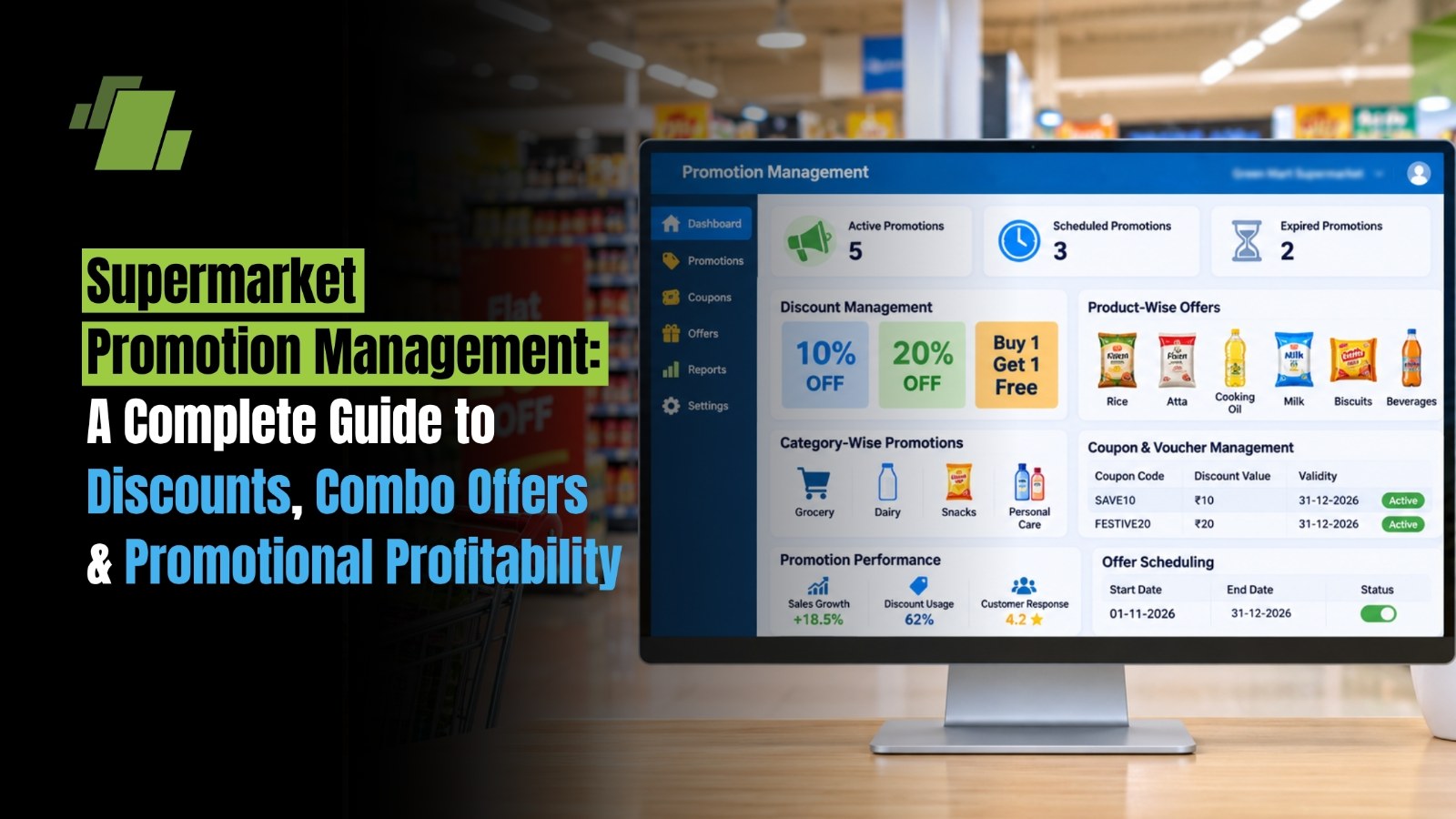
Discounts, combo offers and festival promotions are common strategies used by supermarkets to attract customers and increase product sales. From Buy One Get One offers on packaged groceries to monthly household bundles and festive discounts, promotional activities influence what customers purchase, how much they spend and where they choose to shop.
However, running promotions without proper planning can reduce profit margins, create inventory imbalances and increase operational costs.
For supermarket owners, promotion management is not simply about offering lower prices. It involves selecting the right products, defining promotional objectives, calculating discount costs, managing stock availability and evaluating the financial results of every campaign.
An effective supermarket promotion management process helps retailers attract customers while maintaining control over pricing, margins and inventory.
This guide explains how supermarkets can plan promotional campaigns, manage discounts, create profitable combo offers and use POS and ERP technology to monitor promotional performance.
Contact Us
Free Demo Request
What is Supermarket Promotion Management?
Supermarket promotion management is the process of planning, implementing, monitoring and evaluating promotional activities to increase sales, attract customers and achieve defined business objectives.
It includes managing product discounts, combo offers, quantity-based schemes, seasonal campaigns, loyalty rewards and promotional pricing.
The major components include:
-
Promotion Planning: Selecting products, promotional objectives, campaign duration and target customers.
-
Discount Management: Configuring percentage discounts, flat discounts and special selling prices.
-
Combo Offer Management: Creating product bundles and complementary product combinations.
-
Quantity-Based Promotions: Offering benefits when customers purchase specified quantities.
-
Promotional Pricing: Managing offer prices across products, categories and store locations.
-
Inventory Coordination: Ensuring sufficient stock of promoted products.
-
Performance Measurement: Evaluating sales growth, discount expenditure and promotional profitability.
For example, a supermarket in Mohali may launch a festive grocery promotion offering a discount on selected cooking oils, packaged foods and household essentials.
While the offer may increase customer footfall, the supermarket must also consider product margins, supplier support, additional inventory requirements and the actual increase in sales.
A successful promotion should achieve its intended objective without unnecessarily sacrificing profitability.
Why is Promotion Management Important for Supermarkets?
Promotional activities can influence customer purchase decisions, product movement and store revenue. However, their effectiveness depends on how well retailers plan and manage them.
1. Attracts Customers to the Store
Promotional offers give customers an additional reason to visit a supermarket.
Discounts on frequently purchased products, attractive grocery bundles and seasonal schemes can encourage customers to choose one retailer over another.
2. Increases Average Basket Value
Combo offers and quantity-based discounts can encourage customers to purchase additional products.
For example, a supermarket offering a discounted breakfast bundle containing bread, butter and jam may encourage customers to purchase all three products instead of selecting only one.
3. Helps Move Slow-Moving Inventory
Products with low sales velocity may occupy valuable shelf and warehouse space.
Targeted promotions can help retailers increase the movement of selected products, subject to their expiry dates, margins and inventory requirements.
4. Supports Seasonal and Festival Sales
Indian supermarkets experience changes in purchasing patterns during festivals, holidays and special occasions.
Promotions around Diwali, Holi, Raksha Bandhan and other shopping periods can help retailers create relevant product bundles and seasonal campaigns.
5. Improves Product and Category Visibility
Promotional displays, special pricing and bundled offers can increase customer attention towards selected products.
This can be particularly useful for new product introductions, seasonal categories and products with complementary purchasing relationships.
6. Encourages Repeat Purchases
Loyalty-linked promotions and member-specific offers can encourage customers to revisit the supermarket.
Retailers can use previous purchase information to provide offers relevant to customer preferences.
What are the Different Types of Supermarket Promotions?
Supermarkets can use different promotional formats depending on their sales objectives, product categories, customer segments and profit margins.
Understanding these formats helps retailers select the right offer instead of relying on discounts for every product.
1. Percentage-Based Discounts
Percentage discounts reduce the regular selling price by a specified percentage.
Examples:
-
10% off on packaged groceries.
-
15% off on selected personal care products.
-
20% off on household cleaning products.
Example:
If a product has a selling price of ₹500 and the supermarket offers a 10% discount:
-
Original price: ₹500.
-
Discount: ₹50.
-
Promotional price: ₹450.
Percentage-based discounts are useful for seasonal campaigns, category promotions and customer acquisition activities.
2. Flat-Amount Discounts
Flat discounts reduce the product price by a fixed amount.
Examples:
-
₹50 off on purchases above ₹500.
-
₹100 off on selected grocery products.
-
₹200 off on a qualifying shopping basket.
These offers are particularly useful when supermarkets want to encourage customers to reach a minimum purchase value.
3. Buy One Get One (BOGO) Offers
Buy One Get One promotions provide an additional product when customers purchase a qualifying item.
Examples:
-
Buy one packet of biscuits and get another free.
-
Buy one shampoo and get a selected conditioner free.
-
Buy one household cleaning product and get another at no additional cost.
BOGO offers can encourage product trials and increase the quantity sold.
However, supermarkets should calculate the cost of the free product and evaluate whether the combined transaction remains profitable.
4. Buy More, Save More Offers
These promotions reward customers for purchasing larger quantities.
Examples:
-
Buy 2 and get 5% off.
-
Buy 3 and get 10% off.
-
Buy 5 and get 15% off.
These schemes can increase units per transaction and help move products faster.
However, the discount should be structured around product margins and customer demand.
5. Combo and Product Bundle Offers
Combo offers combine two or more products and sell them together at a promotional price.
Examples:
-
Tea + biscuits.
-
Bread + butter + jam.
-
Rice + pulses.
-
Shampoo + conditioner.
-
Floor cleaner + toilet cleaner.
Combo promotions are particularly useful for complementary products that customers may naturally purchase together.
6. Category-Wise Promotions
Category-wise promotions apply discounts to a selected group of products.
Examples:
-
10% off on all personal care products.
-
Special prices on packaged food products.
-
Discounts on selected dairy products.
-
Festival offers on household essentials.
These promotions help supermarkets increase visibility and sales across specific product categories.
7. Seasonal and Festival Promotions
Seasonal promotions are planned around specific shopping occasions and demand patterns.
Examples in Indian supermarkets include:
|
Occasion |
Possible promotional products |
|
Diwali |
Sweets, dry fruits, cooking oils and gift hampers |
|
Holi |
Colours, snacks, beverages and household products |
|
Raksha Bandhan |
Chocolates, confectionery and gift bundles |
|
Summer |
Cold beverages, juices and ice creams |
|
Winter |
Dry fruits, packaged soups and personal care products |
|
Wedding season |
Grocery hampers and bulk household purchases |
Seasonal promotions should be planned in advance to ensure adequate stock and timely campaign execution.
8. Loyalty-Based Promotions
Loyalty promotions offer special benefits to registered customers.
Examples:
-
Exclusive discounts for loyalty members.
-
Additional reward points on selected products.
-
Cashback on qualifying purchases.
-
Birthday-month offers.
-
Special discounts based on purchase history.
These promotions can support customer retention and encourage repeat purchases.
9. Time-Based Promotions
Time-based promotions are available only during specific hours, days or promotional periods.
Examples:
-
Weekend grocery offers.
-
Evening discounts on selected fresh products.
-
Monday household essentials offers.
-
Limited-period festival deals.
They can help retailers distribute customer traffic and stimulate sales during slower business hours.
How to Create Profitable Combo Offers in a Supermarket?
Combo offers can increase the number of products sold per transaction, but their profitability depends on product selection, pricing and the combined cost of the bundle.
A supermarket should not combine products simply because they are available at discounted prices.
Instead, products should be selected based on customer purchase patterns, complementary demand, stock availability and individual product margins.
1. Identify Products Customers Commonly Purchase Together
Analyse sales transactions to identify products that frequently appear in the same shopping basket.
Examples include:
-
Bread and butter.
-
Tea and biscuits.
-
Rice and pulses.
-
Shampoo and conditioner.
-
Detergent and fabric conditioner.
This approach helps supermarkets create bundles that are relevant to actual shopping behaviour.
2. Evaluate the Profit Margin of Each Product
Before creating a combo offer, calculate the cost and selling price of every included product.
For example:
|
Product |
Regular selling price |
Cost price |
|
Tea |
₹250 |
₹190 |
|
Biscuits |
₹100 |
₹70 |
|
Total |
₹350 |
₹260 |
The regular gross profit on the combined purchase is ₹90.
If the supermarket offers both products together for ₹330, the promotional gross profit becomes ₹70.
The customer saves ₹20, while the supermarket still earns a positive gross profit of ₹70 before other operating costs.
3. Set a Promotional Bundle Price
The promotional price should provide a visible customer benefit without unnecessarily reducing profitability.
A supermarket should consider:
-
Combined product cost.
-
Regular selling prices.
-
Desired promotional margin.
-
Supplier-funded discounts.
-
Applicable taxes and promotional pricing rules.
4. Ensure Product Availability
A combo offer should not be launched if one of its products is likely to run out before the campaign ends.
Check inventory levels, expected demand, replenishment lead times and stock availability across participating stores.
5. Measure Combo Offer Performance
After the campaign, analyse:
-
Number of bundles sold.
-
Total bundle revenue.
-
Gross profit earned.
-
Discount expenditure.
-
Incremental units sold.
-
Impact on individual product sales.
-
Remaining inventory.
This helps determine whether the bundle generated additional business or simply shifted existing purchases into a discounted package.
How to Calculate Promotional Profitability in Supermarkets?
Promotional profitability measures whether a discount or promotional campaign generates sufficient financial returns to justify its cost.
Higher sales revenue does not necessarily mean higher profit because discounts reduce the selling price and may increase other campaign-related expenses.
Supermarkets should evaluate promotions using product costs, regular margins, promotional discounts and incremental sales.
1. Calculate Gross Profit Margin
Gross profit margin measures the percentage of sales revenue remaining after deducting the cost of goods sold.
Formula:
Gross Profit Margin = (Selling Price - Cost Price Selling Price / Selling Price) X 100
Example:
-
Selling price: ₹100.
-
Cost price: ₹70.
-
Gross profit: ₹30.
100-70/100 X 100 = 30%
The gross profit margin is 30%.
2. Calculate the Promotional Selling Price
Suppose a supermarket offers a 10% discount on a product with a regular selling price of ₹500.
500 - (500 X 10% )= ₹450
The promotional selling price becomes ₹450.
If the product's cost price is ₹350:
-
Regular gross profit: ₹150.
-
Promotional gross profit: ₹100.
-
Reduction in gross profit per unit: ₹50.
This calculation highlights why discount depth must be considered before launching an offer.
3. Calculate Incremental Sales
Incremental sales represent the additional sales generated during a promotion compared with an appropriate baseline.
Formula:
Incremental Sales=Actual Promotional Sales-Expected Baseline Sales
For example:
-
Expected sales without promotion: 500 units.
-
Actual promotional sales: 700 units.
Incremental sales = 200 units.
However, the baseline should account for seasonality, regular demand patterns and other factors that may independently influence sales.
4. Calculate Promotional Profitability
Consider an illustrative supermarket promotion:
|
Particulars |
Value |
|
Regular selling price |
₹100 |
|
Promotional selling price |
₹90 |
|
Cost per unit |
₹70 |
|
Expected sales without promotion |
500 units |
|
Actual promotional sales |
700 units |
|
Promotional advertising cost |
₹1,000 |
Profit without promotion:
500(100-70)=₹15,000
Profit during promotion:
700(90-70)-1,000=₹13,000
Illustrative result
Despite selling 200 additional units, the promotion generates ₹2,000 less gross contribution after the stated advertising cost.
This demonstrates why supermarkets should evaluate incremental profit rather than relying only on sales growth.
The example excludes other variable operating costs, taxes and any supplier-funded promotional support.
5. Calculate the Discount Required to Break Even
Retailers can also estimate how much additional volume is required to maintain the same gross profit after a discount.
Suppose:
-
Regular selling price: ₹100.
-
Cost price: ₹70.
-
Regular gross profit: ₹30.
-
Promotional selling price: ₹90.
-
Promotional gross profit: ₹20.
To generate the same gross profit of ₹3,000 earned from 100 regular-price units:
3000/20=150 units
The supermarket must sell 150 promotional units instead of 100 regular-price units to generate the same gross profit before other costs.
This means the promotion requires a 50% increase in unit sales simply to maintain the original gross profit.
Key takeaway: Always calculate the required sales lift before deciding the discount percentage.
How to Plan and Execute a Supermarket Promotional Campaign?
An effective promotional campaign requires coordination between marketing, merchandising, procurement, inventory and billing teams.
Follow this process to plan and execute promotions systematically.
Step 1: Define the Promotional Objective
Determine whether the campaign aims to:
-
Increase store footfall.
-
Improve product sales.
-
Increase average basket value.
-
Clear slow-moving inventory.
-
Introduce new products.
-
Increase repeat purchases.
-
Improve seasonal category performance.
Step 2: Select the Products
Identify suitable products using sales history, product margins, inventory levels and customer purchasing patterns.
Step 3: Decide the Promotional Format
Choose between percentage discounts, flat discounts, BOGO, quantity-based schemes, combo offers or loyalty promotions.
Step 4: Calculate the Promotional Price
Evaluate the product cost, regular selling price, discount amount, supplier support and expected profit margin.
Step 5: Check Stock Availability
Confirm that sufficient stock is available across all participating stores and that replenishment can support expected promotional demand.
Step 6: Configure Promotional Rules in the POS
Set the offer period, eligible products, quantities, discount conditions, store applicability and customer eligibility.
Step 7: Communicate the Offer
Promote the campaign through in-store displays, shelf labels, WhatsApp, SMS, social media, mobile applications and other relevant channels.
Step 8: Monitor Live Performance
Track promotional sales, stock movement, discount utilisation and margin performance during the campaign.
Step 9: Evaluate Campaign Results
Compare actual performance with the expected baseline and calculate incremental profitability.
Step 10: Improve Future Promotions
Identify which offers performed well, which products experienced stockouts and which campaigns reduced margins without generating sufficient additional sales.
How to Manage Promotional Pricing Across Multiple Supermarket Stores?
Supermarket chains often operate outlets in different locations, with variations in customer demand, product movement and competition.
Applying the same promotional offer everywhere may not always produce the best results.
A structured promotional pricing process should consider:
-
Store-wise sales performance.
-
Local customer preferences.
-
Product availability.
-
Outlet size and customer footfall.
-
Competitor pricing.
-
Promotional stock allocation.
-
Supplier schemes.
-
Local campaign requirements.
For example, a supermarket chain with outlets in Mohali, Chandigarh and Ludhiana may experience different demand patterns for selected grocery categories.
Management can use branch-wise sales and stock reports to decide where a promotion should be introduced, how much inventory should be allocated and which offers should be prioritised.
A centralised pricing and promotion system can help maintain authorised selling prices and promotional conditions across participating outlets.
What is the Role of POS Software in Supermarket Promotion Management?
Supermarket POS software plays an important role in executing promotional offers at the billing counter.
It helps ensure that eligible discounts and promotional schemes are applied correctly during customer transactions.
Important capabilities include:
1. Automatic Discount Application
The POS should automatically apply eligible discounts based on configured product, quantity, customer and promotional conditions.
For example, when a customer purchases two qualifying products, the system should calculate the applicable discount without requiring manual intervention.
2. Combo and Bundle Billing
A suitable POS system should identify eligible product combinations and apply the configured bundle price.
This reduces manual calculations and helps cashiers process combo offers consistently.
3. Quantity-Based Promotional Schemes
The system should support offers such as:
-
Buy 2, get 5% off.
-
Buy 3, get 10% off.
-
Purchase 5 units and receive a fixed discount.
4. Customer-Specific Offers
Where customer identification and loyalty functionality are implemented, POS systems can support member-specific pricing, selected discounts and eligible rewards.
5. Discount Authorisation
Retailers should be able to define permissions for manual discounts, price overrides and promotional exceptions.
This helps prevent unauthorised discounting and protects pricing controls.
6. Promotional Sales Reports
POS reporting should help managers monitor:
-
Product-wise promotional sales.
-
Scheme-wise sales.
-
Discount amounts.
-
Counter-wise promotional transactions.
-
Store-wise campaign performance.
-
Promotion redemption.
-
Sales before and during campaigns.
These reports provide the information required to evaluate promotional performance.
How Does Inventory Management Affect Supermarket Promotions?
Promotional success depends not only on pricing but also on product availability and stock planning.
A supermarket may create an attractive offer, but if the promoted product becomes unavailable halfway through the campaign, the promotion may fail to achieve its objective.
Inventory management plays an important role in promotional planning.
1. Forecast Demand for Promotional Products
Use historical sales, seasonal trends and previous promotional results to estimate expected demand.
For example, if a supermarket normally sells 100 units of a product per week but expects promotional demand to increase to 160 units, it should plan stock accordingly.
2. Maintain Sufficient Promotional Stock
Check available stock across warehouses and outlets before launching a campaign.
Ensure that procurement teams can replenish products within the promotional period.
3. Monitor Slow-Moving and Fast-Moving Products
Promotions can be used to improve the movement of slow-moving products or support demand for fast-moving categories.
However, discounts on slow-moving products should account for remaining shelf life, product condition and potential margin loss.
4. Track Batch and Expiry Information
Supermarkets selling packaged food, dairy products and other expiry-sensitive goods should monitor batch-wise stock and expiry dates.
Promotional pricing may help move products approaching their expiry dates, but products must remain within applicable quality and sale requirements.
5. Review Post-Promotion Inventory
After a campaign, analyse the remaining inventory to identify overstocking, excess purchases and products requiring revised replenishment plans.

Common Supermarket Promotion Management Mistakes to Avoid
Promotional campaigns can become costly when supermarkets focus only on discount percentages and sales volumes.
|
Common Mistake |
Business Impact |
Recommended Solution |
|
Offering discounts without calculating margins |
Reduced profitability |
Calculate promotional gross profit before launch |
|
Running too many promotions |
Discount dependency and margin pressure |
Prioritise high-impact campaigns |
|
Selecting unrelated combo products |
Low customer interest |
Use purchase history and complementary product data |
|
Ignoring stock availability |
Lost promotional sales |
Plan inventory before launching |
|
Applying incorrect promotional prices |
Billing disputes and customer dissatisfaction |
Maintain centralised pricing |
|
Not defining campaign duration |
Uncontrolled discount expenditure |
Set clear start and end dates |
|
Applying identical offers across all outlets |
Uneven campaign performance |
Analyse branch-wise demand |
|
Ignoring supplier support |
Missed opportunities to reduce promotion costs |
Coordinate promotional funding with suppliers |
|
Not measuring incremental profit |
Incorrect campaign evaluation |
Compare actual results against a baseline |
|
Allowing unauthorised discounts |
Revenue leakage |
Implement user permissions and approval controls |
Best Practices for Better Supermarket Promotion Management
Supermarket owners can follow these practices to manage promotional activities more effectively.
-
Define Clear Campaign Objectives: Decide whether the promotion aims to increase footfall, basket value, product movement or customer retention.
-
Select Products Strategically: Consider product demand, margins, stock availability and customer preferences.
-
Calculate Discount Profitability: Evaluate promotional prices and required sales lift before approving offers.
-
Create Relevant Combo Offers: Combine products customers naturally purchase together.
-
Use Supplier-Funded Promotions: Coordinate with suppliers to identify opportunities for promotional support.
-
Maintain Centralised Pricing: Ensure that authorised promotional prices are consistent across billing counters.
-
Plan Inventory in Advance: Allocate sufficient stock to participating stores and monitor replenishment.
-
Control Discount Permissions: Restrict manual discounts and price overrides through user-level controls.
-
Track Promotional Performance: Monitor sales, discount costs, units sold and gross profit.
-
Review Campaigns After Completion: Use actual results to improve future promotional planning.
How LOGIC ERP Helps Supermarkets Manage Promotions and Discounts
Managing multiple promotional schemes across products, billing counters and store locations requires coordination between pricing, sales, inventory and reporting.
LOGIC ERP provides an integrated business management platform connecting Retail POS, inventory management, procurement, warehouse operations and business reporting.
Its retail capabilities can support supermarket operations where promotional activities need to be coordinated with everyday billing and stock management.
Retail POS for Promotional Billing
LOGIC ERP supports retail POS operations that help supermarkets manage product billing and sales transactions.
Retail POS functionality can support the execution of configured pricing and promotional rules, helping cashiers process eligible offers during billing.
Product and Pricing Management
Supermarkets regularly manage different product prices, discounts and promotional schemes.
Centralised product and pricing information helps retailers maintain consistency across their billing operations.
Inventory Management for Promotional Stock Planning
Promotional campaigns can increase demand for selected products. LOGIC ERP connects sales and inventory operations, helping retailers monitor stock movement, product availability and replenishment requirements.
Multi-Store Retail Management
Supermarket chains require visibility into promotional sales and inventory across different outlets.
An integrated ERP platform helps management access branch-wise business information and coordinate retail operations.
Sales Reporting and Business Insights
Evaluating promotions requires reliable information about product sales, transaction values and stock movement.
LOGIC ERP's reporting and Business Insights capabilities help management analyse business performance and make informed decisions.
Connected Procurement and Warehouse Operations
Promotional campaigns can create additional procurement and replenishment requirements.
LOGIC ERP connects procurement, inventory and warehouse workflows, helping businesses coordinate product movement and stock availability.
The advantage of an integrated approach is that promotional activities can be evaluated alongside actual sales, inventory and business performance rather than being managed through disconnected spreadsheets.
Specific promotional rules, scheme configurations, loyalty offers and approval workflows should be validated against the LOGIC ERP modules and implementation selected by the business.
Conclusion: Make Supermarket Promotions Profitable with Better Planning and Control
Supermarket promotion management requires more than offering attractive discounts. Retailers must select the right products, calculate promotional margins, create relevant combo offers, maintain stock availability and measure the actual financial impact of every campaign.
A well-planned promotion can attract customers, increase basket value and improve product movement. However, without proper pricing controls and performance monitoring, higher sales can come at the expense of profitability.
Integrated retail technology helps supermarkets connect promotional billing with inventory management, procurement and business reporting, making it easier to monitor operations and evaluate campaign performance.
LOGIC ERP supermarket retail software connects POS, inventory management, procurement, warehouse operations and business reporting to help supermarkets streamline promotional and retail operations.
Explore how integrated retail technology can support better pricing control, inventory visibility and business performance. Running discounts and combo offers without clear visibility into promotional profitability?
Call at +91-73411-41176/75 or send us an email at sales@logicerp.com to book a free demo today!
Frequently Asked Questions
1. What is Supermarket Promotion Management?
Supermarket promotion management is the process of planning, executing and evaluating discounts, combo offers, promotional schemes and seasonal campaigns to increase sales while controlling costs and profit margins.
2. What are the Different Types of Supermarket Promotions?
Common supermarket promotions include percentage discounts, flat discounts, Buy One Get One offers, quantity-based discounts, product bundles, category-wise offers, seasonal promotions and loyalty-based rewards.
3. How can Supermarkets Create Profitable Combo Offers?
Supermarkets can create profitable combo offers by identifying complementary products, analysing individual product margins, calculating combined costs, setting suitable bundle prices and monitoring actual sales and profitability.
4. How do Supermarkets Calculate Promotional Profitability?
Supermarkets calculate promotional profitability by comparing promotional revenue and product costs against the expected baseline, while accounting for discounts, campaign expenses and supplier-funded support.
5. What is the Difference Between a Discount and a Combo Offer?
A discount reduces the selling price of a product or purchase, while a combo offer combines multiple products and sells them together at a promotional price. Both aim to encourage purchases but work through different pricing structures.
6. How do Buy One Get One Offers Work in Supermarkets?
A Buy One Get One offer allows customers to receive an additional qualifying product when purchasing the specified product. The supermarket should calculate the combined product cost and evaluate the effect on promotional profit margins.
7. How can Supermarkets Increase Sales Through Promotional Offers?
Supermarkets can increase sales through targeted product discounts, complementary product bundles, quantity-based schemes, seasonal offers and loyalty promotions. Campaign performance should be evaluated using incremental sales and profit.
8. What is Incremental Sales in Supermarket Promotion Management?
Incremental sales represent the additional sales generated by a promotional campaign compared with the expected sales without that campaign. They help retailers evaluate whether an offer generated additional demand.
9. How can Supermarkets Prevent Excessive Discounting?
Supermarkets can prevent excessive discounting by defining minimum margin requirements, setting discount approval permissions, configuring authorised promotional prices and reviewing discount expenditure through POS reports.
10. How does POS Software Help Manage Supermarket Promotions?
POS software can automate eligible discounts, apply combo pricing, manage quantity-based schemes, record promotional transactions and generate reports to evaluate promotional sales and discount utilisation.
11. Why is Inventory Management Important for Supermarket Promotions?
Inventory management ensures that sufficient stock is available for promoted products. It helps retailers plan replenishment, prevent promotional stockouts and monitor remaining inventory after campaigns.
12. What KPIs Should Supermarkets Track to Measure Promotion Effectiveness?
Important KPIs include incremental sales, promotional gross margin, discount expenditure, units sold, average basket value, redemption rate, promotional revenue, stock movement and incremental profit.

Author
Gurbir Singh
Co-founder & Managing Director | LOGIC ERP Solutions Pvt. Ltd.
With 30+ years of experience in the tech industry, I took the helm of technology & product development, ensuring LOGIC ERP’s continuous innovation & leadership in the evolving tech landscape.

