Discover how Direct Store Delivery software helps FMCG distributors manage orders, route planning, van inventory, deliveries, invoicing, payments, and collections from one system.
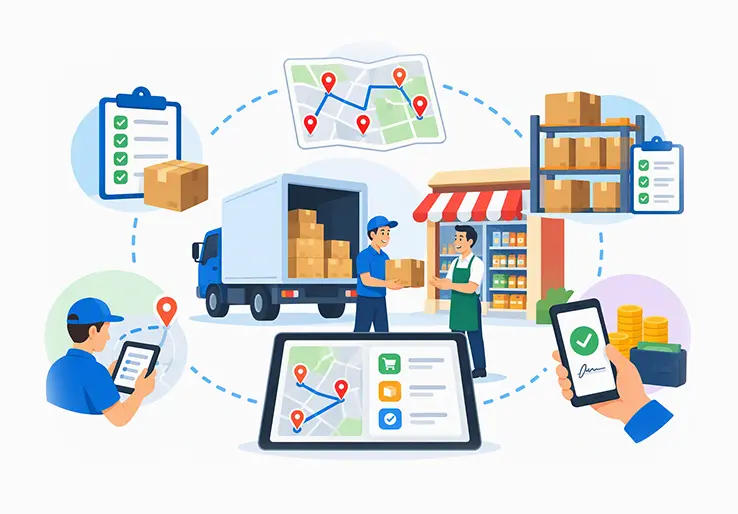
Picture an FMCG distributor in 2025 managing 300+ retail stores, 40+ direct store delivery routes, and a product line spanning dairy, snacks, and beverages. Orders come in through WhatsApp messages, phone calls, and scribbled paper pads. Drivers decide their own stop sequences. Van stock never matches system records at the end of the day. And outstanding dues from hundreds of small retailers sit buried in spreadsheets that nobody updates on time.
This is not an edge case. It is the daily reality for thousands of distributors across India and other emerging markets. Manual order books lead to wrong SKUs, duplicate entries, and pricing errors that trigger disputes at the store. Route planning done from memory means excessive kilometres, missed delivery windows at modern trade outlets, and low drops-per-route. Van inventory discrepancies — unaccounted free samples, unrecorded returns, and "missing" cartons — erode margins quietly. And when drivers handle cash, cheques, and UPI payments without a system to reconcile them, finance teams lose sight of credit exposure until it is too late.
What distributors need is real-time visibility stretching from the central warehouse to every retail store shelf and till. They need a single platform that connects the full cycle: order capture, route planning, delivery, invoicing, payment collection, returns, and reconciliation.
That platform is direct store delivery software. DSD software manages routes, inventory, ordering, and proof of delivery processes within one integrated system, replacing fragmented tools and manual workarounds with a structured, auditable workflow. It connects suppliers, delivery trucks, field teams, and back-office finance into one operating system.
LOGIC ERP is one such end-to-end FMCG distribution software provider that maps its ERP, WMS, and mobile capabilities to the complete DSD cycle.
Here are the core problems DSD software addresses:
Direct store delivery is a distribution method where a manufacturer or distributor delivers products directly to retail stores, bypassing the retailer’s warehouse or traditional distribution centers. Instead of shipping in bulk to a central warehouse that then redistributes to individual stores, DSD puts products on store shelves through dedicated routes operated by the supplier’s own fleet or contracted vehicles.
Direct store delivery DSD is widely used for FMCG categories where freshness, on-shelf availability, and timely replenishment are non-negotiable:
In U.S. grocery channels, DSD products represent approximately 24% of unit volume sold in stores but account for 52% of gross contribution margins. Seven of the top ten grocery categories by unit sales are managed through direct store delivery.
Who uses a DSD? FMCG manufacturers running their own fleets, regional distributors serving kirana stores and supermarkets, wholesale distributors covering modern trade, and route sales companies managing hundreds of individual stores across territories.
The focus of DSD goes beyond transportation. It encompasses orders, merchandising, invoicing, collections, and returns — all executed at the store level. Direct store delivery minimizes warehousing needs for perishable goods by moving them quickly from production to retail.
A typical DSD day starts before dawn. The warehouse team picks and stages orders by route. Drivers load their vehicles against a manifest, confirming quantities with barcode scanning or manual checks. They then follow a planned sequence of stops, visiting each retail outlet to deliver products, capture invoices, collect payment, handle returns, and sometimes merchandise shelves.
In modern direct store delivery operations, each step is captured digitally through DSD software and synced with ERP or accounting systems. GPS coordinates, timestamps, and user IDs attach to every action, creating a clear audit trail and assigning responsibility.
Here is the workflow broken down:
Many FMCG businesses use both models. Understanding when each applies helps allocate resources and choose the right software solution.
In traditional distribution, products flow from manufacturer to regional warehouse to retailer distribution center to store — with longer lead times and more handling at each stage. DSD cuts that chain short: manufacturer or distributor trucks deliver straight to retailers’ stores, often multiple times per week.
| Factor | Direct Store Delivery | Traditional Distribution |
|---|---|---|
| Delivery path | Direct to retail outlet | Through distribution network and distribution centers |
| Replenishment speed | Faster, often same-day or next-day | Longer cycle through bulk shipping and staging |
| Order capture | Field order capture at the store | Orders often processed centrally |
| Field visibility | Real-time monitoring via mobile apps | Greater dependence on back-office updates |
| Best for | Perishable, high-turnover SKUs | Slow-moving, non-perishable goods |
| Cost structure | Higher per-delivery cost, lower spoilage | Lower transport cost per unit, higher warehousing |
| Shelf execution | Driver/merchandiser manages displays | Retailer manages stocking |
Key takeaways:
Direct store delivery software is a unified platform — typically a mobile app for field staff paired with a web-based backend and ERP integration — that manages the entire DSD cycle from order capture through route settlement. DSD software manages inventory, sales, and deliveries in real time, replacing disconnected spreadsheets and paper processes with a single digital workflow.
Modern DSD management software is usually cloud-based and integrates with back-end ERP or accounting systems such as LOGIC ERP, Microsoft Dynamics, and similar platforms. Compared to generic delivery management tools, DSD software is built specifically for FMCG and distribution use cases: beat planning, route accounting, van sales, trade schemes, and frequent replenishment cycles.
The global DSD software market is valued at approximately USD 2.74 billion in 2026 and is projected to reach USD 4.7 billion by 2030, growing at a CAGR of about 14.5%.
Core modules typically included in DSD software:
Rising outlet counts, expanding product portfolios, and tighter margins make manual DSD operations unsustainable. DSD adds complexity due to coordination between multiple parties — sales reps, drivers, warehouse staff, finance teams, and retailers — all operating simultaneously across dozens of routes.
DSD software helps move from people-dependent, paper-heavy processes to standardized, system-driven workflows. Without it, distributors face:
Most distributors still rely on paper pads, WhatsApp messages, phone calls, and next-day Excel uploads to ERP. This creates wrong SKU codes, incorrect quantities, duplicate orders, and pricing mismatches. A dairy distributor mis-pricing a single SKU across 50 outlets in a week generates disputes, returns, and lost shelf space. Automated workflows in DSD software reduce manual data entry errors by enforcing structured product catalogs, customer-specific pricing, and validation rules at the point of order.
When drivers decide their own sequence based on habit, the result is unnecessary kilometres, poor territory coverage, and missed time windows for large-format stores. Direct costs include higher fuel, overtime, truck under-utilization, and penalties from modern trade chains for late deliveries. Route optimization in DSD software reduces fuel consumption and travel time for deliveries while improving stops-per-route and on-time delivery percentages. Heavy traffic and local laws can hinder DSD efficiency, making intelligent route planning even more critical. Transportation costs can escalate rapidly with DSD implementation if routes are not optimized systematically.
When van stock is tracked manually, discrepancies between loaded stock and end-of-day balance are routine. Free samples go unrecorded. Cartons go "missing." Mistakes in inventory stocking can lead to high return costs, especially when expired products are loaded onto vans without batch-level tracking. Direct store delivery minimizes the risk of overstocking or understocking when proper van inventory management is in place, tracking every stock transfer from warehouse to vehicle, every sale, every return, and every damage.
DSD routes involve a mix of cash, cheque, UPI, and credit sales. When these are recorded on paper slips and reconciled days later, receipts get lost, cash doesn’t match, and cheques are not banked on time. Credit control becomes impossible when hundreds of small retailers have different terms. DSD software allows immediate payment collection at delivery points, issuing digital receipts and reconciling collections route-wise while instantly updating head office.
A typical fragmented setup: one app for sales reps, a separate tool for delivery tracking, Tally for accounting, and manual updates for collections. The sales team doesn’t see van stock. Finance doesn’t see proof of delivery. Logistics doesn’t see order priorities. Without an integrated DSD platform, managers cannot answer basic questions: "What is today’s delivery success rate?" "Which routes have the highest returns?" Integrated distribution software links sales, inventory, delivery, accounting, and collections into one consistent data model.
This section details the capabilities FMCG distributors should look for in DSD software. Different vendors use varied labels — route sales software, van sales software, FMCG distribution software — but these features are common foundations across mature platforms.
Field sales reps or route drivers use Android/iOS mobile apps to capture orders at the store, supporting both pre-sell and on-the-spot ordering. The app displays a product catalog with images, customer-specific price lists, promotions, and schemes. Reps can view previous order history, use repeat/reorder templates, and track order status from confirmed through delivered. Offline order capture stores orders locally when there is no network and syncs automatically once connectivity returns. In LOGIC ERP, mobile DSD order management is linked with central order processing so there is a single source of truth.
DSD software includes route management tools to define territories, beats, and delivery routes for each day. Multi-stop route planning sequences stops based on distance, service windows, and vehicle constraints. Drivers and vehicles are assigned with the ability to reschedule mid-day for urgent orders. Recurring beats (A-route Monday/Thursday, B-route Tuesday/Friday) and ad-hoc modern trade deliveries are both supported. Managers analyze route productivity: stops per route, km per stop, sales per route, and on-time performance. Fleet management and delivery planning in DSD software optimize logistics costs across the entire network.
Van sales means selling and invoicing directly from truck inventory without pre-booked orders — common for snacks, beverages, and impulse categories. DSD software handles vehicle loading (stock transfer from warehouse to vehicle), including batches, expiry dates, and units of measure. Real-time van stock visibility on the mobile app shows available quantities per SKU during order entry. Stock issues (samples, damages, breakages) are recorded with reason codes and photos. End-of-day vehicle reconciliation compares loaded stock, sales, returns, damages, and closing stock, then syncs back to central inventory management.
DSD software assigns orders to routes and drivers, generating delivery manifests for each truck. Key capabilities include tracking delivery status (planned, in-progress, delivered, partially delivered, failed), handling schedule changes, and reattempting failed deliveries. Partial delivery scenarios — out-of-stock items on the van, quantity adjustments, or customer refusing part of the order, are managed within the workflow. Dispatch teams can see live route progress and intervene proactively when delays happen.
Electronic proof of delivery captures signatures and images to confirm delivery conditions. Common POD data includes e-signature, photos of delivered goods, driver notes, timestamps, and GPS coordinates. POD is linked directly to delivery documents and invoices for quick retrieval during disputes. It can trigger automatic workflow steps: invoice posting, payment collection prompts, or credit note approval. A beverage distributor, for example, can reduce delivery confirmation disputes significantly by requiring photo capture at every drop.
Mobile invoicing allows field teams to process payments on-site efficiently. DSD software supports GST-compliant invoice generation at the store, printed via Bluetooth printer or shared by SMS/email. Features include customer-specific pricing, trade schemes, quantity discounts, free items, and tax calculation (CGST/SGST/IGST for Indian operations). Credit notes and debit notes handle returns, short supplies, and rate differences. Invoices post automatically into the ERP or accounting ledger.
Drivers record cash, cheque, UPI, card, or digital payments against specific invoices at delivery. Digital receipts link back to invoices and customer data. Route accounting at day-end reconciles opening truck cash, collections, credit sales, and outstanding invoices per route and salesperson. Finance teams get real-time views of route-wise collection, customer-wise outstanding, DSOs, and ageing reports. Tightly linked payment collection reduces days-sales-outstanding and speeds up the order-to-cash cycle.
FMCG DSD operations see significant returns: expiry, short shelf life, damaged packaging, wrong items. DSD software lets drivers record return reasons (expired, damaged, near-expiry, scheme return, order error) with quantities. Returned goods can be moved back to the warehouse, written off, or reallocated depending on condition. Credit notes generate automatically from return transactions, linked to original invoices. A dairy distributor managing near-expiry returns can process them systematically instead of accumulating unresolved claims.
Real-time inventory visibility prevents stockouts and improves replenishment efficiency across warehouse, van, and store. Stock availability checks during order capture prevent taking orders that cannot be fulfilled. Key capabilities include batch tracking, expiry alerts, min/max levels, and stock transfers. Real-time inventory tracking reduces overstocking and understocking risks. Real-time inventory management minimizes overstocking and understocking risks across the entire supply chain. LOGIC ERP acts as the central inventory control engine, with DSD apps as connected front-end channels.
DSD systems maintain a detailed retailer master: store name, address, route, channel type (kirana, supermarket, HoReCa), and contact details. Credit-related customer data includes credit limits, payment terms, outstanding balances, and blocking rules. The system simplifies customer management by providing 360° store history: orders, deliveries, invoices, returns, collections, and visit history. This data supports better trade promotions and joint business planning with retail partners.
Many direct store delivery routes operate in low-connectivity or rural areas. Offline capabilities let reps capture orders, invoices, POD, and payments without network, then auto-sync when back online. Conflict resolution handles changes that occur offline. Offline mode is essential for field sales continuity and avoiding data loss. LOGIC ERP’s mobile stack supports intermittent connectivity scenarios typical across India and other emerging markets.
Each step below maps to a status or workflow stage in the DSD system, visible to field teams and back office simultaneously.
Capture Customer Orders
Sales reps capture orders during customer visits using a mobile DSD app, call-center entry, or EDI/portal for large retailers. Pre-sell and van-sell modes are supported, with quick re-ordering from templates and promotions applied automatically. Validation at this stage includes credit limit checks and product availability warnings.
Check Product Availability
The system performs real-time checks against warehouse and planned van inventory. It flags potential stock shortages and suggests substitutions or partial fulfilment. Integration with ERP stock reservations prevents over-committing inventory.
Allocate and Pick Inventory
The warehouse team generates pick lists by route or zone. Barcode scanning confirms picks and reduces errors. Once picked, stock is allocated to specific vehicle loads.
Load the Delivery Vehicle
The system creates a loading manifest per truck listing SKUs, quantities, free goods, and samples. Vehicle loading confirmation via scan or manual check establishes starting van inventory. Multiple vehicles per route or multiple routes per vehicle are supported.
Plan Delivery Routes
Routes are finalized using optimization or predefined beats. Drivers, helpers, and delivery vehicles are assigned with planned stop sequences and ETAs. The route plan is pushed to the driver's mobile device before departure.
Visit Retail Stores
At each store: GPS-based check-in, review open orders, propose upsell items, verify shelf conditions. New orders or adjustments can be captured during the visit. Visit logs feed route analytics and compliance tracking.
Deliver Products and Generate Invoice
The driver hands over products, adjusts quantities if the retailer changes part of the order, and confirms delivered quantity in the app. Instant invoice generation includes GST/tax and discounts. Invoices are printed via portable printer or shared via SMS/email.
Capture Proof of Delivery
E-signature on the driver's device, optional photos of delivered goods, and notes are captured. POD links automatically to the delivery note and invoice. Timestamps and location data prove time and place of delivery.
Collect Payment
Payment is captured in the mobile app for cash, cheque, or digital methods, and a receipt is issued. Partial payments and multi-invoice settlements can be applied (e.g., clearing older invoices first). Collections and outstanding balances update in real time when synced.
Manage Returns and Reconciliation
Returns (expired, damaged, rate difference) are recorded at the store with reason codes. End-of-route reconciliation settles cash, cheques, digital payments, returns, and closing van stock. Stock adjustments and financial entries post automatically into ERP.
Analyze Route and Sales Performance
Daily and weekly reports cover route productivity, sales per route, return percentages, on-time delivery, and collection efficiency. DSD systems provide analytics for tracking delivery performance and vehicle utilization. Managers use insightful sales data to redesign routes, adjust capacity, and refine credit policies.
DSD software benefits span operational efficiency (lower cost per delivery, fewer errors) and commercial gains (higher on-shelf availability, better retailer service). Here are the specific outcomes.
Structured mobile ordering with validation rules and customer-specific pricing eliminates wrong items, quantities, and price disputes. Order-related credit notes and returns drop measurably. Back-office workload for corrections shrinks, streamlining order fulfillment.
Optimized delivery routes increase stops per day and reduce km per stop. Vendors report 10–20% reduction in route distance after optimization. Fuel savings and better utilization of vehicles and drivers follow directly. Route optimization reduces fuel consumption and travel time for deliveries.
Barcoded picking, POD, and structured workflows ensure the right product reaches the right store in the right quantity. Disputes and short/over-delivery claims drop. Accuracy improves retailer trust and shelf allocation. DSD software enhances customer experience by ensuring product availability.
Real-time view of van stock for drivers and managers with accurate records of opening and closing balances. Shrinkage decreases. Unexplained losses become traceable. Compliance and auditability improve for finance teams. Improved inventory management across the van fleet reduces write-offs.
Accurate store-level demand data and route history help plan the right quantity per route. Fewer out-of-stock incidents for fast-moving SKUs. Lower write-offs for slow movers. Retailers experience more consistent shelf availability. DSD enhances inventory turnover for fast-moving consumer goods.
Shift from next-day invoicing to instant invoicing at the store. On-the-spot payment collection shortens the order-to-cash cycle. DSO improves. Cash flow strengthens. DSD reduces delivery times by streamlining distribution processes from order to payment.
More reliable deliveries, accurate invoicing, and faster issue resolution improve customer satisfaction. Benefits include higher share of shelf, better placement, and preferred-partner status. Digital records make it easy to respond to retailer queries about past orders. Service quality rises across the board.
Automatic sync between mobile DSD app and ERP eliminates re-keying of orders, invoices, and collections. Automated workflows in DSD software eliminate manual data entry errors. Staff focus on analysis and customer service instead of data entry.
Management sees near real-time sales tracking, returns, coverage, and collections by route, territory, and sales rep. Trend analysis identifies top-performing products, high-return items, and under-served territories. Sales data drives better schemes and product portfolio decisions.
Integrating orders, deliveries, invoices, and collections within one system creates an unbroken digital trail. Audit becomes easier. Account closing accelerates. Credit control strengthens. This benefit scales as you add new routes and territories. DSD enhances supply chain efficiency and product availability across all channels.
While DSD concepts apply broadly, FMCG has specific complexities: high SKU counts, promotions, near-expiry handling, special handling requirements for cold chain, and frequent deliveries to hundreds of outlets weekly. DSD is commonly used for fast-moving consumer goods. DSD is ideal for perishable goods requiring frequent restocking where traditional cycle times cause spoilage. DSD ensures products reach shelves faster and fresher than centralized alternatives.
Typical FMCG use cases for DSD software include:
Terms like FMCG distribution software, FMCG route sales software, FMCG delivery management software, and distributor management system (DMS software) all describe overlapping capabilities within this space. DSD is less effective for small-scale businesses with low-volume orders where bulk shipping through centralized channels may be more cost-efficient.
DSD requires substantial investment in logistics infrastructure — vehicles, mobile devices, training, and software — but for mid-to-large FMCG operations, the payoff in freshness, availability, and margin justifies the spend.
Direct store delivery software and van sales software are related but not identical. Many modern solutions combine both, but understanding the distinction helps match the right tool to your sales process.
| Aspect | DSD Software | Van Sales Software |
|---|---|---|
| Scope | Broader: pre-orders, delivery-only, and van sales | Focused on selling from vehicle stock |
| Order flow | Pre-sell orders + planned deliveries | Direct sales from van, on-the-spot billing |
| Inventory focus | Warehouse → vehicle → store visibility | Vehicle → store sale systems |
| Payment pattern | Payment collection against invoices (same-day or credit) | Immediate payment at point of sale |
| Route management | Full route planning with delivery scheduling | Route-based but sales-driven |
| Integration | Connects to ERP, WMS, finance, and CRM | Often standalone or lighter integration |
A pre-sell DSD route with planned deliveries to 30 supermarkets looks very different from a van sales route covering 60 kirana stores with impulse snack products. LOGIC ERP’s DSD capabilities support both models within the same platform, configurable per route and territory.
Distribution management software (DMS) is a broader category managing primary and secondary sales, inventory, claims, trade schemes, and analytics across the entire distribution operations. DSD software is typically a specialized component within a larger DMS ecosystem, focused on secondary/tertiary distribution and last-mile direct delivery.
A full DMS covers:
Integrating DSD within DMS ensures consistent pricing, schemes, and inventory control across all channels. LOGIC ERP provides ERP, WMS, Retail POS, and DMS modules, with DSD as an integrated layer for route-based deliveries. This creates a seamless connection from supply chain management to the last mile.
DSD software is a long-term infrastructure decision. Choosing based only on price or a single feature is risky. Create a checklist based on process coverage, ease of use, offline capabilities, ERP integration, and scalability. Involve operations, sales, finance, and IT teams in evaluation and run a pilot on a few routes before full rollout.
Verify that the solution provides robust Android/iOS apps, not just a web portal. Check usability in field conditions: low-light, one-handed operation, limited connectivity. Customer-specific pricing, schemes, and offline order capture are essential.
Ensure configurable beats, territories, and optimized route planning for multiple vehicles. Ask vendors to demo scenarios matching your geography and outlet density. Support for delivery time windows, vehicle capacity, and driver work hours matters.
Accurate stock transfer from warehouse to van and back, including batch and expiry tracking, is non-negotiable. Check how the system handles samples, damages, and free-of-cost items. Confirm how end-of-day reconciliation works and how discrepancies are flagged.
Evaluate how quickly store orders, picks, loads, and van sales update central inventory. Sales teams must see current stock positions when booking orders. Batch visibility and expiry alerts are must-haves for managing inventory in FMCG.
Ensure all typical payment types (cash, cheque, UPI, card) can be captured and reconciled route-wise. Customer-wise outstanding and credit limits should be visible on the mobile app. Secure handling of payment data and audit logs protect the business.
Review POD capabilities: e-signature, photo capture, notes, location and time stamping. Verify how POD is stored, searched, and linked to invoices. Some modern trade chains require specific formats; flexibility is key.
Stress-test offline performance: ability to create orders, invoices, POD, and collections with zero network. Ask vendors about sync frequency, conflict handling, and storage limits. Offline reliability is critical for rural and semi-urban delivery routes.
Verify correct tax calculation based on place of supply, HSN codes, and e-invoicing. DSD invoices must integrate with the main ERP tax engine. Support for different invoice formats, credit notes, and debit notes is essential.
Seamless integration with ERP and accounting software (e.g., LOGIC ERP, Microsoft Dynamics) for items, pricing, customers, and financial postings is critical. Check whether integration is real-time or batch-based. Seamless integration with ERP systems enhances inventory and order management in DSD.
Ensure ready-made DSD dashboards: route KPIs, sales per route, returns, collection efficiency, and van stock accuracy. Check export options and BI integration (e.g., Power BI). Drill-down from summary to route, driver, and invoice-level detail is essential for real time visibility.
Evaluate whether the platform can handle more routes, new cities, multi-warehouse setups, and multiple legal entities. Support for multi-currency and multi-tax regimes matters for cross-region operations.
Review user roles and permissions for sales reps, drivers, supervisors, finance, and admins. Mobile device security (login control, remote wipe, data encryption) protects sensitive customer data. Audit trails for price overrides, returns, and write-offs are necessary.
Both field sales and delivery drivers often use the same or closely integrated mobile apps. Check app store availability, supported OS versions, and update frequency. Conduct user testing with real route staff to confirm the app is intuitive.
DSD KPIs span service, cost, sales, inventory, and collections. Monitor these weekly or monthly to drive continuous improvement:
Build these KPIs into dashboards within your DSD system or BI tools for real time monitoring.
LOGIC ERP provides an integrated ERP, WMS, Retail POS, and DMS platform with capabilities mapped directly to the DSD workflow described throughout this article. Here is how each area connects.
LOGIC ERP’s mobile apps let field reps capture store orders with customer-specific price lists, schemes, and minimum order quantities enforced. Offline support and instant sync to the central database ensure no orders are lost. Sales orders flow directly into warehouse picking and route planning, connecting suppliers, delivery trucks, and back-office operations.
LOGIC ERP maintains detailed distributor and retailer masters including route mapping, channel classification, and credit terms. Outstanding balances, credit limits, and trade promotions are visible at the store level. This single master feeds DSD operations and other channels (retail POS, eCommerce, telesales), strengthening customer relationships.
LOGIC ERP’s central inventory engine manages warehouse, van, and secondary locations with SKU, batch, and expiry-level tracking. Real-time stock updates from DSD mobile transactions flow back into ERP, supporting accurate records across all channels. Automated alerts flag low stock and near-expiry inventory processes.
LOGIC ERP supports defining beats, routes, and territories assigned to vehicles and drivers. Delivery manifests and route execution status are tracked alongside delivery KPIs. Integration with mapping services provides distance and time estimates for optimizing delivery routes.
LOGIC ERP handles van sales workflows: vehicle loading, on-the-spot ordering from truck inventory, mobile invoicing, and real-time van stock updates. Both van-sell and pre-sell models run within the same environment, configurable per route. Field sales activities including visits and surveys are captured through the mobile app. DSD software reduces delivery times significantly for perishable goods in these workflows.
LOGIC ERP generates GST-compliant invoices from DSD transactions with correct taxes, discounts, and schemes. Multiple invoice templates (general trade vs modern trade) and automated posting to financial ledgers are supported. Credit note and debit note handling covers returns, rate differences, and claim settlements.
Payments collected in the field via mobile app sync into LOGIC ERP’s finance module and reconcile per route and driver. Route-wise and salesperson-wise collection reports, along with real-time ageing and outstanding tracking, give finance teams full visibility. Digital payment references (UPI transaction IDs, cheque numbers) are stored for audit.
LOGIC ERP provides structured handling of returns: reasons, quantities, conditions, and linkage to original invoices. Automatic stock adjustments for returned and damaged goods include proper valuation and accounting entries. Analysis by SKU, route, and retailer helps identify systemic issues and suppliers optimize their product mix.
Dashboards and MIS reports cover sales, inventory, routes, returns, and collections for DSD operations. Drill-down from company-level to route, vehicle, and invoice-level detail is supported. Integration with BI tools enables advanced analytics combining DSD and other sales channels.
LOGIC ERP is both the core ERP and DSD engine, so integration is native. For external systems, APIs and connectors are available. Master data (items, prices, customers), transactions (orders, invoices, payments), and inventory movements stay synchronized in one database — a single version of truth with unified security and access controls.
Direct store delivery is a distribution method where products are delivered directly from suppliers or distributors to retail stores, bypassing traditional distribution centers. It is preferred for categories like beverages, dairy, snacks, and bakery where freshness and speed matter. DSD covers order capture, delivery, merchandising, and collections at the store level.
DSD software is a system that manages orders, routes, van inventory, deliveries, invoicing, proof of delivery, and payment collections for direct store operations. It includes mobile apps for field teams and a central web/ERP backend. Benefits include fewer errors, better real time visibility, and faster order-to-cash cycles.
The workflow flows: order → stock allocation → loading → route → delivery → POD → payment → reconciliation. Each step is tracked digitally on mobile and synced to ERP for inventory and finance updates. Managers monitor progress via dashboards. The sales process is digitized end to end.
Core benefits include faster replenishment, fresher products, stronger retailer relationships, and better shelf execution. Operational gains: fewer stockouts, reduced handling, more accurate deliveries. DSD helps manufacturers and distributors respond quickly to demand changes and promotions, improving operational efficiency.
Key features: mobile order management, route optimization, van inventory control, delivery tracking, proof of delivery, invoicing, payment collection, returns handling, and analytics. Offline capability and ERP integration are essential. The feature set should align with your delivery models (pre-sell, van-sell, delivery-only).
DSD is any model of delivering directly to stores (with or without pre-orders). Van sales refers specifically to selling from vehicle stock on the spot. Van sales is a subset of DSD. A good DSD platform supports both pre-sell and van-sell routes within a single sale systems framework.
Central inventory tracking covers warehouses and vans, with updates from orders, picks, loads, deliveries, and returns. Batch, lot, and expiry tracking handle perishable goods. Real time inventory tracking prevents stockouts and write-offs, helping track deliveries and stock movements accurately.
DSD route planning tools create efficient sequences of store visits meeting delivery windows and capacity constraints. Features include distance minimization, territory balancing, and multi-vehicle planning. Performance data from past routes feeds future planning decisions, reducing operational costs over time.
Yes. Modern DSD solutions let drivers record cash, cheque, and digital payments at the store, collect payment instantly, and issue receipts. Payments post to ERP finance modules automatically. This improves visibility into collections and reduces outstanding receivables.
Robust DSD software allows most field tasks — orders, deliveries, POD, collections — to work without continuous connectivity. Data is stored locally on mobile devices and synchronized when a network is available. Reliable offline operation matters for rural routes and areas with patchy coverage.
FMCG distributors are one of the primary user groups for DSD software worldwide. FMCG-specific features (promotions, schemes, expiry management, high outlet counts) are available in mature platforms. Look for systems with references in your product category — food, beverage, dairy, bakery, or personal care.
Integration uses APIs or native connectors to sync masters (items, customers, prices), transactions, and inventory data. With LOGIC ERP, DSD is part of the same ecosystem, so integration is seamless and real-time. Good integration ensures a single source of truth for finance, inventory, and sales reporting across the entire supply chain.
Direct store delivery routes are predefined paths that delivery vehicles follow to deliver products directly from the supplier or distributor to retail stores. These routes are optimized to maximize delivery efficiency, reduce travel time, and ensure timely replenishment of store shelves.
By planning and optimizing direct store delivery routes, companies can reduce fuel consumption, improve vehicle utilization, minimize missed delivery windows, and increase the number of stops per route, leading to cost savings and better customer service.
Managing direct store delivery routes involves challenges such as traffic congestion, local delivery regulations, route optimization complexity, and ensuring timely deliveries across multiple outlets with varying order sizes and schedules.
DSD operations refer to the end-to-end processes involved in direct store delivery, including order capture, inventory allocation, route planning, vehicle loading, delivery execution, invoicing, payment collection, returns management, and reconciliation.
DSD operations enable FMCG distributors to deliver products faster and fresher by bypassing traditional distribution centers. Efficient DSD operations improve on-shelf availability, reduce stockouts, and enhance retailer relationships, ultimately driving sales growth.
Technology, especially direct store delivery software, supports DSD operations by automating order management, optimizing routes, providing real-time inventory visibility, enabling mobile invoicing and payment collection, and generating proof of delivery.
Direct delivery refers to the process of shipping products straight from the manufacturer or distributor to the retail store without passing through intermediate warehouses or distribution centers. This approach shortens the supply chain and speeds up product availability.
Direct delivery reduces delivery times, minimizes product handling and damage, ensures fresher products on shelves, improves inventory turnover, and enhances responsiveness to market demand.
Unlike traditional distribution, which involves multiple steps through warehouses and distribution centers, direct delivery bypasses these intermediaries to deliver products directly to retail outlets, enabling faster replenishment and better control over inventory.
Popular Products