Assemble to order (ATO) is a manufacturing strategy where a company stocks components and sub-assemblies in advance but only assembles the final product after a customer places an order — balancing customization, delivery speed, and inventory costs.
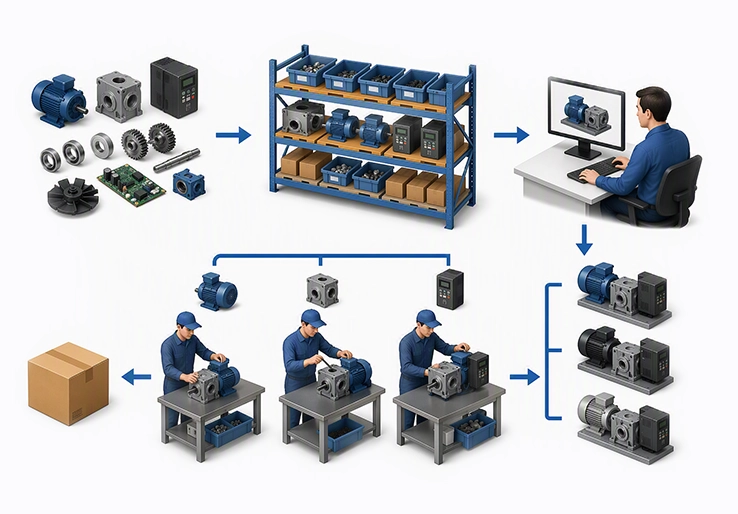
Assemble to order (ATO) is a manufacturing strategy where a company stocks components and sub-assemblies in advance but only assembles the final product after a customer places an order. In practice, that means manufacturers can deliver customized goods faster while carrying less finished goods inventory and reducing the cost and risk of unsold stock.
This article explains the full assemble to order process flow — from demand forecasting and component planning through final assembly and delivery — and shows how ATO compares with make to order and make to stock strategies. It also covers implementation best practices, real-world examples from companies like Dell Technologies and Apple, common challenges with practical solutions, and how LOGIC ERP supports ATO operations. The scope excludes engineer-to-order (ETO) workflows, which require custom engineering work beyond standard assembly.
If you are a manufacturing manager reviewing production strategy, a supply chain professional improving inventory control, a business owner considering the assemble to order model, or a student researching production processes, this guide is built to help you evaluate whether ATO fits your operation and customer demand.
After Reading this Article, you will:
Assemble to order (ATO) is a manufacturing strategy in which a manufacturer forecasts orders at the component level, stocks sub-assemblies and parts in inventory, and only begins the final assembly process once customer orders are received. The finished product is built to the customer's specifications using pre-made modules — allowing customers to choose from defined configuration options without waiting for raw materials to be sourced or sub-assembly parts to be manufactured from scratch.
Assemble-to-order combines make-to-order and make-to-stock strategies into a practical middle ground. In an era of mass customization — where customers demand personalized products but still expect fast delivery — ATO has become a critical manufacturing strategy for industries ranging from personal computers to automotive and fashion. It enables companies to balance customization, production efficiency, and storage costs effectively.
Make to stock is a production model where finished goods are manufactured in advance of customer orders, based entirely on demand forecasts. The goal is immediate product availability — items sit in warehouses ready for same-day or next-day shipping. MTS works well for standardized products with predictable customer demand, but carries significant risks: overproduction, high storage costs, and obsolete inventory when forecasts miss the mark.
Assemble-to-Order differs from Make-to-Stock as it stocks sub-assemblies instead of finished goods. Where MTS manufacturers hold complete products in inventory, ATO manufacturers hold components and modules. This distinction reduces the capital investment tied up in unsold inventory and dramatically lowers the risk of dead stock. ATO still maintains faster delivery than full make to order because sub-assemblies are ready — only the final assembly step remains after an order arrives.
Make-to-order products are manufactured only after an order is received. In a pure make to order strategy, production starts from raw materials, meaning lead time is significantly longer. MTO offers maximum customization — the manufacturer orders materials, fabricates components, and assembles everything from scratch per customer requirements. However, longer lead times can deter customers from purchasing, and sensitivity to supply chain delays increases costs.
ATO occupies the middle ground between MTS and MTO. It offers partial customization with substantially shorter lead times than full MTO. Because components are pre-stocked, the manufacturer assembles the finished product in days rather than weeks or months. For businesses where customers value both personalization and speed, the assemble to order strategy delivers the strongest balance.
Understanding these distinctions is essential — but the real power of ATO becomes clear when you examine how the process works from end to end.
With the foundational comparison established, let's break down the ATO workflow into its three core stages: forecasting, inventory management, and final assembly. Each stage must function precisely for the assemble to order model to deliver on its promise of customized products with fast delivery.
Every ATO production cycle begins with forecasting — but unlike MTS, the manufacturer forecasts orders at the component and sub-assembly level rather than trying to predict demand for every finished product variant. Companies use historical data, seasonal patterns, macroeconomic trends, and point-of-sale information to estimate which components will be needed and in what quantities. Smart manufacturing software supports ATO by optimizing production planning and reducing forecast error at the module level. Because the number of unique components is far smaller than the number of possible finished configurations, forecast accuracy improves substantially compared to predicting demand for every SKU of finished goods.
Once demand forecasts establish component needs, the focus shifts to inventory management — stocking the right subassemblies, setting reorder points, and maintaining optimal stock levels. A manufacturer stocks components like processors, chassis, display panels, or fabric modules depending on the industry. Assemble-to-order relies on strong inventory management systems to track parts inventory in real time, manage supplier lead times, and prevent stockouts caused by low supply. Modular product design is critical here: maximizing parts commonality across variants through well-structured bills of materials (BOMs) reduces the total number of unique items that must be held. ATO software reduces carrying costs by minimizing inventory levels while ensuring components are available when orders arrive.
When a customer places an order, the ATO workflow activates: the system validates the configuration, checks component availability, schedules the assembly, and the manufacturer assembles the final product. Assemble-to-order software helps track orders from quotation to dispatch, ensuring nothing falls through the cracks. Assembly lines use kitting, pick-to-light systems, and standardized sequences to minimize errors and accelerate the final assembly process. After quality checks, the customized product ships.
Key Points of the ATO Process Flow:
Assemble-to-order systems allow for quick delivery of customized products because most of the production work is already complete before the manufacturing order is triggered. This process foundation makes ATO practical — but successful implementation requires careful planning.
Moving from theory to practice, implementing an assemble to order strategy involves systematic changes to product architecture, inventory systems, assembly processes, and technology infrastructure. Here's how companies approach it, along with real-world order examples that demonstrate ATO in action.
Companies should consider ATO adoption when their product lines support modular configurations, customer demand for customizable products is growing, and finished goods inventory is becoming a financial burden. The implementation follows a structured path:
Review product lines to identify which items can be broken into standardized sub-assemblies. Analyze SKU proliferation and determine what level of customization customers actually require. Not every product benefits from ATO; some are better suited to MTS or MTO.
Define modular BOMs, establish which components and sub-assembly parts to stock, set reorder points and safety stock policies, and align with suppliers on reliable lead times.
Design flexible assembly workflows that minimize changeover time. Implement kitting stations, error-proofing mechanisms, and quality control gates at the assembly stage.
Deploy ERP/MRP software with strong BOM management, product configurators for sales teams, real-time inventory tracking, and advanced planning and scheduling (APS) modules. Platforms like LOGIC ERP provide end-to-end visibility across the ATO workflow.
Train assembly workers to handle variable configurations. Establish standard work procedures, build QA gates, and implement continuous improvement cycles to drive increased efficiency over time.
Assemble-to-order allows for customization while balancing speed and inventory costs across a wide range of industries. The following table illustrates how different companies apply the ATO strategy:
| Industry | Company Example | Components Stocked | Customization Options | Delivery Timeline |
|---|---|---|---|---|
| Computer Manufacturing | Dell Technologies | CPUs, RAM, storage, displays, chassis, keyboards | Dell allows customers to customize computer components — processor, memory, graphics, storage | Days from order; inventory often ~1/10 of traditional PC makers |
| Consumer Electronics | Apple | Processors, memory modules, storage drives, displays | Apple enables product customization through its assemble-to-order process — storage, RAM, accessories | Typically 1–2 weeks for configured models |
| Safety Equipment | Flint Subsea | Standardized safety components, housings, connectors | Flint Subsea assembles safety solutions after receiving orders to meet specific operational requirements | Project-dependent; days to weeks |
| Fashion / Apparel | Oliver Charles | Pre-manufactured fabric panels, trims, hardware | Oliver Charles uses ATO for custom sweater production — size, color, fit specifications | ~3 weeks for custom orders |
| Handcrafted Goods | Fringe & Free | Pre-made components, decorative elements, base structures | Fringe & Free assembles handcrafted products based on customer orders — style and material choices | Variable; typically 1–3 weeks |
Dell Technologies remains the most cited assemble to order examples globally. Dell's ATO production model revolutionized personal computers manufacturing — order information reaches the factory in under 24 hours, and the company maintained ultra-low finished goods inventory compared to competitors using MTS. Dell's quarterly inventory value reached approximately $10.4 billion in Q1 2026, up roughly 55.4% year-over-year, reflecting increased component stockpiling to meet growing demand and supply chain considerations. This illustrates how even best-in-class ATO manufacturers must carefully manage where capital investment sits across the supply chain.
Assemble-to-order supports high customizability to meet specific customer preferences. Customization can increase product prices by up to 20%, making ATO not just an operational strategy but a business model that drives higher margins on customized products. Industries with moderate to high variant demand — where customers value choice but still expect reasonable lead time — benefit most from ATO production.
These examples highlight the versatility of the approach, but every ATO implementation faces common obstacles that must be addressed proactively.
While the assemble to order strategy offers clear advantages, manufacturers face real obstacles during implementation and ongoing operations. Understanding these challenges — and their solutions — is critical for sustainable ATO success.
ATO increases the number of component SKUs that must be tracked, with each sub-assembly requiring its own reorder points, safety stock levels, and supplier management. Stockouts can occur due to low supply in ATO systems, halting assembly and causing delivery delays. If component availability is disrupted, the entire production schedule stalls.
Solution:
Implement ERP systems with real-time inventory tracking and automated reorder points. Use modular product design to reduce unique part counts. Integrate supplier lead time data directly into planning systems so that stock levels reflect actual supply conditions, not just historical averages. Assemble-to-order reduces inventory carrying costs significantly when paired with the right inventory control techniques.
Demand forecasts at the component level must be accurate — errors cascade quickly. If a manufacturer under-forecasts a critical module, assembly halts and customer satisfaction drops. Over-forecasting ties up capital in excess inventory parts. During periods of unusually high demand or unusually low demand, standard forecasting models can break down, leading to either lost sales or surplus stock.
Solution:
Deploy demand planning software that leverages historical data, market trend monitoring, and AI-driven analytics. Scenario planning — modeling best-case and worst-case demand — helps build resilient safety stock policies. Companies can avoid dead stock by using assemble-to-order methods combined with intelligent forecasting that adjusts to real-time signals rather than relying solely on static demand forecasts.
Assemble-to-order allows for quick delivery of customized products — but only if the final assembly process is genuinely efficient. Poorly designed assembly workflows, inadequate training, or excessive changeover times between product variants can erode the speed advantage that makes ATO compelling. Assemble-to-order reduces the risk of unsold inventory, but if assembly lead time stretches too long, the model loses its competitive edge over MTO.
Solution:
Invest in production scheduling optimization, standardized assembly sequences, and ongoing workforce training. Use kitting systems to pre-stage components for each order. Implement manufacturing ERP modules that connect production schedules directly to order intake, ensuring assembly capacity matches incoming customer demand. Assemble-to-order reduces storage costs significantly when assembly throughput is optimized to meet demand without overbuilding capacity.
Addressing these challenges systematically — through technology, process design, and supplier partnerships — transforms ATO from a theoretical advantage into a reliable production strategy. Solutions like LOGIC ERP provide the integrated visibility across inventory, production, and order management that ATO manufacturers need to operate efficiently.
LOGIC ERP stands out as a comprehensive solution tailored to meet the unique demands of assemble to order (ATO) manufacturing processes. Its robust platform integrates advanced inventory management, production planning, and order tracking capabilities, enabling manufacturers to optimize every stage of the ATO workflow.
With LOGIC ERP, businesses can accurately forecast demand at the component level, ensuring optimal holding inventory and minimizing carrying costs. The system's real-time inventory visibility helps prevent stockouts by maintaining the right balance of sub-assemblies and parts, critical for seamless final assembly.
Moreover, LOGIC ERP's flexible manufacturing process management supports modular product configurations, allowing quick customization without sacrificing efficiency. Its intuitive interface streamlines order processing and final assembly scheduling, helping manufacturers deliver goods quickly to meet customer expectations.
By choosing LOGIC ERP, companies gain a powerful tool that reduces operational complexity, enhances supply chain coordination, and drives cost savings. This makes LOGIC ERP an ideal partner for manufacturers aiming to leverage the benefits of assemble to order production while maintaining high quality and fast delivery.
Assemble to order is a manufacturing strategy that occupies the practical middle ground between make to stock and make to order — enabling companies to deliver customized goods quickly while keeping inventory costs controlled and finished goods waste minimized. It works by forecasting and stocking at the component level, then triggering final assembly only when a customer places an order. The ATO strategy is proven across industries from personal computers to fashion, and its relevance continues to grow as customers increasingly expect customizable products with fast delivery.
To evaluate whether ATO fits your operations:
For manufacturers exploring related strategies, lean manufacturing principles and just-in-time production methods are closely related to ATO and can further optimize production processes. Understanding warehouse management systems and purchase order workflows also strengthens the operational foundation that ATO depends on.
Call at +91-73411-41176 / +91-73411-41175 or send us an email at sales@logicerp.com to book a free demo today!
No. Stockouts can occur due to low supply in ATO systems if component forecasting is inaccurate or supplier deliveries are disrupted. However, because forecasting happens at the component level (fewer unique items than finished product variants), forecast accuracy is generally higher than in MTS. Strong inventory management and supplier integration minimize stockout risk.
Assemble-to-order allows for quick delivery of customized products, which directly improves customer satisfaction. Customers receive a product built to their specifications without the extended wait associated with full make-to-order. When combined with clear communication about delivery timelines and a well-managed order system, ATO strengthens customer loyalty and reduces lost sales from excessive lead times.
In a make-to-order strategy, production starts from raw materials only after an order is received, resulting in longer lead times. In assemble to order, sub assemblies and components are pre-stocked based on demand forecasts, and only the final assembly process begins after the customer places an order. ATO delivers faster because most production work is complete before the manufacturing order is triggered. Make-to-stock involves producing goods in advance of customer orders, making it the fastest but least customizable approach.
Industries with moderate to high product variant demand benefit most: computer manufacturing (Dell Technologies), consumer electronics (Apple), automotive, fashion and apparel, furniture, and specialty equipment. The assemble to order model is ideal when customers want customization but expect delivery in days or weeks - not months.
For small to medium manufacturers, implementation generally takes 6 to 18 months, covering BOM modularization, inventory system setup, process redesign, and staff training. Larger OEMs with complex product lines and many variants may require 1 to 2 years for full ATO adoption.
Essential tools include ERP/MRP software with robust BOM management, advanced planning and scheduling (APS) modules, product configurators for the sales team, real-time inventory management software, and manufacturing execution systems (MES) for shop-floor control. Assemble-to-order software helps track orders from quotation to dispatch and ensures component availability matches incoming orders. ATO software solutions like LOGIC ERP and Katana support managing ATO product inventory, production planning, and order fulfillment.
Companies often report inventory carrying cost reductions of 20–50%, improved inventory turnover, reduced warehousing expenses, and lower obsolescence losses. Assemble-to-order reduces storage costs significantly compared to MTS. Additionally, customization can increase product prices by up to 20%, improving margins on customized products.
No. Stockouts can occur due to low supply in ATO systems if component forecasting is inaccurate or supplier deliveries are disrupted. However, because forecasting happens at the component level (fewer unique items than finished product variants), forecast accuracy is generally higher than in MTS. Strong inventory management and supplier integration minimize stockout risk.
Assemble-to-order allows for quick delivery of customized products, which directly improves customer satisfaction. Customers receive a product built to their specifications without the extended wait associated with full make-to-order. When combined with clear communication about delivery timelines and a well-managed order system, ATO strengthens customer loyalty and reduces lost sales from excessive lead times.
The assemble to order (ATO) business model combines the benefits of make-to-stock and make-to-order strategies. Manufacturers stock standardized components and sub-assemblies in advance, then assemble the final product only after receiving a customer order. This approach balances inventory costs and delivery speed while allowing product customization, making it ideal for industries where customers demand personalized goods with quick turnaround.
Yes, several companies exemplify the assemble to order strategy. Dell Technologies customizes computers by assembling pre-stocked parts like processors and displays after orders arrive. Apple uses ATO to enable product customization with various configurations. In fashion, Oliver Charles produces custom sweaters by assembling pre-manufactured fabric panels. Fringe & Free assembles handcrafted home goods based on customer orders. These examples show ATO’s versatility across sectors.
Customizable products are central to the ATO model’s appeal. By stocking components rather than finished goods, manufacturers can quickly assemble products tailored to individual customer specifications. This flexibility allows companies to offer a wide range of options without the high costs and risks of holding large inventories of finished variants. Customization can also increase product value, with customers often willing to pay a premium for personalized goods.
Assemble to order (ATO) is a manufacturing approach where components are produced and stocked in advance, while the final product is assembled only after receiving a customer order. This helps businesses reduce lead times while offering product customization.
The assemble to order strategy involves keeping standard components in inventory and assembling the final product based on customer specifications. It balances inventory efficiency with faster order fulfillment and customization.
In assemble to order, pre-manufactured components are assembled after an order is placed, resulting in quicker delivery. In make-to-order, the entire product is manufactured only after receiving the customer order, leading to longer production times but greater customization.
Assemble to order manufacturing is a production method where standardized parts are manufactured and stocked in advance, and final assembly takes place after customer demand is confirmed. It improves production flexibility and reduces delivery time.
A common example of assemble to order is a computer manufacturer that keeps processors, memory, and storage devices in stock but assembles the final computer based on the customer's selected configuration after the order is received.
Make to stock produces goods before demand, assemble to order assembles stocked components after an order, and make to order manufactures the complete product only after an order is placed. Each approach differs in inventory levels, customization, and delivery speed.
Popular Products