A Batch Manufacturing Record (BMR) is the definitive GMP document that captures the complete manufacturing history of a specific product batch — from raw material dispensing through final packaging — providing verifiable proof that every step followed the approved process.
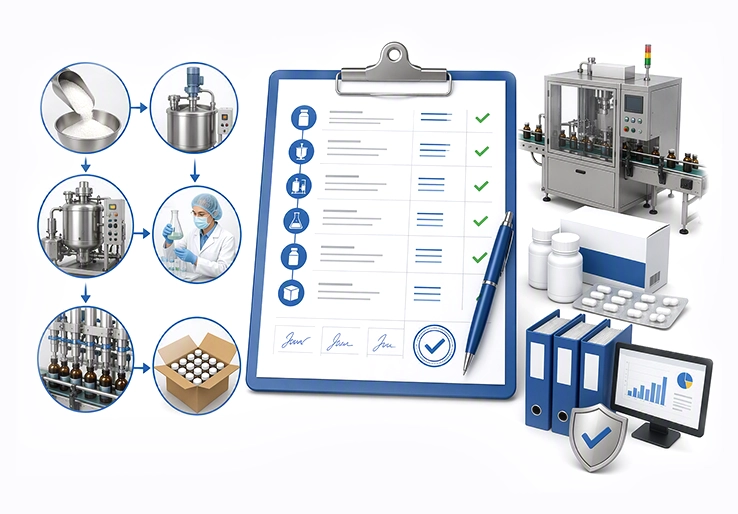
A Batch Manufacturing Record (BMR) is the definitive GMP document that captures the complete manufacturing history of a specific product batch — from raw material dispensing through final packaging — providing verifiable proof that every step followed the approved process. A Batch Manufacturing Record documents the entire production history, ensuring compliance with Good Manufacturing Practices (GMP) and serving as the backbone of batch traceability and quality assurance across regulated manufacturing industries.
Direct answer: A batch manufacturing record (BMR) documents every aspect of batch production — including raw materials used, critical process parameters, in-process controls, equipment details, personnel involved, yield calculations, and batch release decisions — serving as legal proof of GMP compliance and manufacturing consistency.
By reading this guide, you will:
A Batch Manufacturing Record is a controlled documentation system that records the actual manufacturing process execution data for a specific batch of product. BMRs are essential in regulated industries for compliance with Good Manufacturing Practices (GMP), and they support quality assurance by providing evidence of adherence to established procedures. Every pharmaceutical manufacturing facility, food production plant, or chemical manufacturing site relies on BMRs to prove that each batch met predetermined quality standards before reaching consumers.
BMRs maintain traceability from raw materials to final products, ensuring that if a quality issue arises, manufacturers can trace the entire production process backward to identify root causes. They also help in identifying deviations from standard manufacturing processes, enabling corrective actions that protect patient safety and product quality. Beyond compliance, BMRs facilitate continuous improvement and operational efficiency in manufacturing processes by providing the raw data needed for trend analysis and process optimization.
Key components of a BMR include batch information and manufacturing instructions that together form a comprehensive record of every significant production activity. Regulatory bodies like the FDA require BMRs to ensure Good Manufacturing Practices compliance, and the specific elements they must contain are well-defined:
The master batch record (also called the master formula record or master production record) is the approved template containing standardized manufacturing instructions, formulation details, equipment specifications, testing methods, and acceptance criteria. It represents the approved master batch record — what should happen during production.
The Batch Manufacturing Record, by contrast, is the execution document that captures the actual manufacturing process data based on MBR guidelines. While the MBR is static (changed only through formal change control), the BMR is dynamic — generated fresh for each batch and filled with real-time production data. BMRs include batch identifiers, raw material details, and equipment IDs that are specific to each production run.
The relationship between MBR version control and BMR generation is critical: controlled printing ensures only the approved MBR version is used when generating a new BMR. Under US regulations (21 CFR §211.186), a written master production and control record is required for each product, while §211.188 defines what each batch production record must contain. Any deviation from the MBR during batch execution must be documented and justified in the BMR.
Both documents carry significant legal weight during regulatory inspections: inspectors routinely compare the batch record against the master batch record to confirm conformity. In product liability cases, the BMR serves as primary evidence of manufacturing diligence.
Manufacturers employ different BMR formats depending on their regulatory environment, production volume, and digital maturity:
BMR documentation intersects with multiple global regulatory frameworks, all rooted in good manufacturing practices principles that demand accurate, contemporaneous, and complete batch documentation. Understanding these regulatory requirements is essential for any manufacturer operating in regulated markets.
FDA 21 CFR Part 211 mandates accurate BMR documentation for all pharmaceutical products manufactured or distributed in the United States. BMRs must document every significant manufacturing step per FDA regulations, with specific requirements including:
European regulatory compliance for BMRs follows equally rigorous standards:
Beyond the pharmaceutical industry, BMR requirements extend to other regulated sectors:
Implementing an effective BMR system requires a systematic approach spanning the entire BMR lifecycle — from document creation through execution, review, and long-term archival. The BMR lifecycle has six key stages, each with distinct responsibilities and compliance checkpoints.
BMRs capture actual execution data from raw material dispensing to packaging. Following is the step-by-step procedure with detailed implementation guidance:
Controlled printing ensures only the approved MBR version is used. The generated BMR must carry proper version references, batch number assignment, and authorization signatures from qualified personnel before production begins.
Issue materials against verified lot numbers with certificates of analysis documentation. Record quantities dispensed versus quantities required, noting any adjustments. Confirm equipment calibration certificates and line clearance status for all major equipment.
Execution of the BMR captures real-time manufacturing data including critical process parameters, equipment settings, and environmental conditions. Operators must sign each step upon completion, with supervisors verifying critical operations. All entries must be contemporaneous — recorded at the time of activity, not retrospectively.
Documenting in-process controls with immediate recording of test results is essential. Deviation reporting must occur in real-time during production, with any out-of-specification results triggering investigation protocols. Quality control testing at defined stages (e.g., blend uniformity, tablet hardness, fill weight) must be compared against predetermined quality standards.
Execute batch packaging records with reconciliation of packaging materials, labeling specimens, batch coding verification, and container/closure integrity checks following packaging instructions. Master packaging records provide the template for these operations.
BMR review verifies accuracy before batch release decisions. The quality assurance unit conducts a comprehensive batch record review covering all raw data, deviations, laboratory control results, yield calculations, and audit trails before granting disposition.
Archiving requires secure storage for the entire retention period — whether physical or digital — with controlled access and retrieval capabilities that meet regulatory expectations.
Electronic Batch Records (eBRs) are a modern transition from traditional paper-based BMRs. The following comparison helps manufacturers evaluate the right approach for their operations:
| Criterion | Paper BMR | Digital BMR |
|---|---|---|
| Data Integrity | Manual entries prone to errors and alterations; difficult to enforce ALCOA+ | Automated validation and tamper-proof electronic records; enforces procedural adherence through system checks |
| Compliance | Requires manual verification and physical signatures | Built-in regulatory compliance checks and electronic signature validation per FDA Part 11 and EU Annex 11 |
| Efficiency | Time-intensive review and approval processes across multiple reviewers | Real-time data access and automated workflow management; case studies show up to 60% faster review times |
| Storage | Physical archival space with document retrieval challenges; prone to damage over time | Secure cloud or on-premise storage with instant search and retrieval capabilities |
| Cost | Lower initial investment but higher long-term operational costs from labor and error correction | Higher initial setup cost but significant operational savings; streamlines documentation processes |
| Error Prevention | Relies on human diligence; blank fields and missing signatures are common | Can flag missing data in real-time, preventing incomplete documentation |
The total cost of ownership analysis consistently favors digital records for mid-to-large manufacturers. BMR software improves accuracy and reduces human error through built-in validation rules, mandatory field completion, and automated data collection from manufacturing equipment. Automated systems enhance real-time data access for BMRs, enabling quality teams to monitor production status and intervene proactively.
Integration with ERP systems like LOGIC ERP amplifies these benefits by connecting batch documentation directly to inventory management, procurement workflows, and quality control records — creating a unified manufacturing data ecosystem. Software solutions provide centralized data storage for BMRs, eliminating the fragmented information silos that plague paper-based operations.
Even well-established manufacturers encounter recurring BMR management challenges. Understanding these pitfalls — and their practical solutions — is critical for maintaining regulatory compliance and operational efficiency.
Data integrity failures remain the most frequently cited GMP deficiency during regulatory inspections. Common violations include backdating entries, leaving blank fields, altered or missing signatures, shared login accounts, and disabling audit trails.
Solution: Implement electronic batch manufacturing records with built-in validation rules and automated data collection from process manufacturing equipment. BMR software enhances compliance by enforcing ALCOA+ principles at the system level. Establish dual verification procedures and mandatory field completion to prevent incomplete documentation. Train all personnel involved on good documentation practices and the consequences of data integrity breaches.
Template-version mismatches — using obsolete MBRs to generate BMRs — represent a significant compliance risk. Failure to control versioning leads to non-conformance findings during audits and potentially compromises product quality.
Solution: Deploy validated BMR software solutions that automatically enforce version control, ensuring only the current approved master batch record generates new batch records. Conduct regular internal audits comparing batch execution against master production instruction documents. Invest in ongoing staff training covering GMP documentation best practices and evolving regulatory expectations. BMR software enhances compliance with regulatory standards through systematic enforcement.
Paper-based BMR systems often create severe bottlenecks during the batch record review process. Documents traverse many hands sequentially, delaying batch release by days or weeks. Manual QA review frequently repeats basic compliance checks instead of focusing on meaningful exceptions and deviations.
Solution: Streamline approval workflows with digital routing and parallel review processes. A case study from Ferring Pharmaceuticals (Germany) demonstrated a 60% faster batch record review process and a 25–40% reduction in documentation time during production after implementing MES-based electronic batch records, along with elimination of typical documentation errors via built-in validity checks. Integrate BMR systems with quality management platforms for automated deviation flagging and CAPA tracking to further accelerate the entire manufacturing process review cycle.
Regulatory retention requirements — at least one year after expiry under FDA rules, with EU GMP requiring retention covering the full product shelf life plus additional periods — create significant storage and retrieval burdens for paper-based systems.
Solution: Implement centralized document management with secure cloud storage and advanced search capabilities. Establish automated retention policies and regular backup procedures to ensure long-term data accessibility. Manufacturing ERP systems can integrate batch documentation archival with broader enterprise records management, ensuring digital records remain accessible, encrypted, and compliant throughout the required retention period.
LOGIC ERP offers a powerful, industry-specific solution designed to optimize batch manufacturing processes and ensure full GMP compliance. By integrating batch manufacturing record management directly into a comprehensive ERP platform, LOGIC ERP provides manufacturers with unparalleled control, traceability, and efficiency.
Key reasons to choose LOGIC ERP Batch Manufacturing Software include:
Choosing LOGIC ERP Batch Manufacturing Software empowers manufacturers to transform their batch documentation from a compliance obligation into a strategic asset that drives quality, efficiency, and competitive advantage.
The batch manufacturing record stands as the foundation of GMP compliance and quality assurance in every regulated manufacturing operation. From documenting the actual manufacturing process to enabling batch traceability, recall investigations, and continuous process improvement, the BMR is far more than a compliance checkbox — it is the single most important document proving that a specific batch was manufactured safely, consistently, and in accordance with strict quality standards.
To strengthen your BMR processes, take these immediate steps:
For deeper exploration, consider related topics including quality management systems, manufacturing execution systems (MES), inventory control strategies, and comprehensive ERP integration for end-to-end production control.
Call at +91-73411-41176 / +91-73411-41175 or send us an email at sales@logicerp.com to book a free demo today!
The terms are largely interchangeable. A batch record (or batch production record) and a batch manufacturing record (BMR) both refer to the documented history of a specific batch's production. Some organizations use "batch record" as a general term encompassing the manufacturing record and batch packaging records together, while "batch manufacturing record" specifically emphasizes the manufacturing and quality control portions.
Under FDA 21 CFR Part 211, BMRs must be retained for at least one year after the batch's expiration date. If the product does not carry an expiry date, records must be maintained for at least three years after the batch is distributed. EU GMP requires retention sufficient to cover the full product shelf life plus any additional regulatory or legal obligations.
Yes. Electronic signatures can fully replace handwritten signatures provided the system meets FDA 21 CFR Part 11 (US) and EU GMP Annex 11 requirements. This means each signature must be unique to the individual, include a timestamp, indicate the signing purpose or role, be permanently linked to the record, and be supported by validated systems with detailed audit trails.
Every BMR must include: batch number and product identification, reference to the approved master batch record version, complete raw materials documentation with lot numbers and quantities, step-by-step manufacturing operations with timestamps and operator signatures, equipment identification and calibration status, in-process control data and quality control records, yield calculations, deviation reports, final product testing results, and the batch release decision by the quality unit.
BMRs maintain traceability from raw materials to final products, making them indispensable during recalls and investigations. When a quality issue is detected, the BMR allows manufacturers to trace the entire production process — identifying which raw material lots were used, which personnel involved performed each step, what equipment was employed, and whether any deviations occurred. This raw data enables rapid root cause analysis, precise scope determination for recalls, and effective corrective actions.
LOGIC ERP serves as a comprehensive manufacturing management platform that can integrate batch documentation with broader enterprise functions including inventory management, procurement, quality management, and production planning. By connecting BMR workflows with ERP systems, manufacturers gain centralized data storage, automated data collection, real-time visibility into batch status, and seamless coordination between production, quality, and supply chain teams — reducing batch release times and improving regulatory compliance readiness.
Quality testing data refers to the results and records of tests performed during the manufacturing process to ensure that products meet predefined quality standards and regulatory requirements. This data is critical for verifying product safety, efficacy, and compliance.
The manufacturing process outlines the step-by-step procedures and parameters used to produce a specific batch of product. Batch production follows this process to ensure consistency, traceability, and compliance with quality standards for each batch.
Electronic Batch Manufacturing Records are digital versions of traditional batch records that capture and store all manufacturing data electronically. eBMRs improve data integrity, streamline documentation, and facilitate real-time monitoring and compliance with regulatory standards.
Electronic batch records enable faster and more accurate batch release by automating data capture, enforcing procedural adherence, and providing instant access to complete batch documentation for quality review and approval.
In-process controls are quality checks performed at various stages during batch production to monitor critical parameters and ensure the product remains within specified quality limits. These controls help detect deviations early and maintain consistent product quality.
Batch release is the final approval step confirming that a batch meets all quality and regulatory requirements before it is distributed. It ensures only compliant and safe products reach the market, protecting consumers and maintaining regulatory compliance.
Electronic batch manufacturing records integrate quality testing data by capturing test results in real time within the digital record. This integration enhances traceability, facilitates quicker decision-making, and supports comprehensive batch documentation for audits and inspections.
Batch manufacturing is a production method where products are made in defined quantities or "batches" following a specific set of instructions. Each batch is processed separately, allowing manufacturers to maintain consistent quality, traceability, and control over production variables. This approach is common in industries such as pharmaceuticals, food, cosmetics, and chemicals, where precise adherence to formulations and processes is critical.
Batch processing in manufacturing refers to producing products in groups or batches rather than in a continuous flow. This method involves completing all steps for one batch before starting the next, enabling better control over quality, flexibility in production scheduling, and easier identification of deviations. Batch processing is best for products that require strict quality standards and traceability.
A batch number is a unique identifier assigned to a specific quantity of product manufactured under the same conditions. It allows manufacturers to track and trace the batch throughout the production, distribution, and post-market phases. Batch numbers are essential for quality control, recall management, and regulatory compliance, enabling quick identification of affected products in case of issues.
Batch Manufacturing Records are typically prepared and maintained by production personnel, including operators and supervisors, who document the actual manufacturing activities in real time. Quality assurance (QA) teams review and verify the records to ensure accuracy and compliance with regulatory standards before batch release. In digital systems, electronic batch records may be generated automatically based on approved master batch records and real-time data capture.
Popular Products