Learn what lean manufacturing is, its 5 principles, 8 types of waste, key tools, benefits, KPIs, and how ERP software can support lean manufacturing.
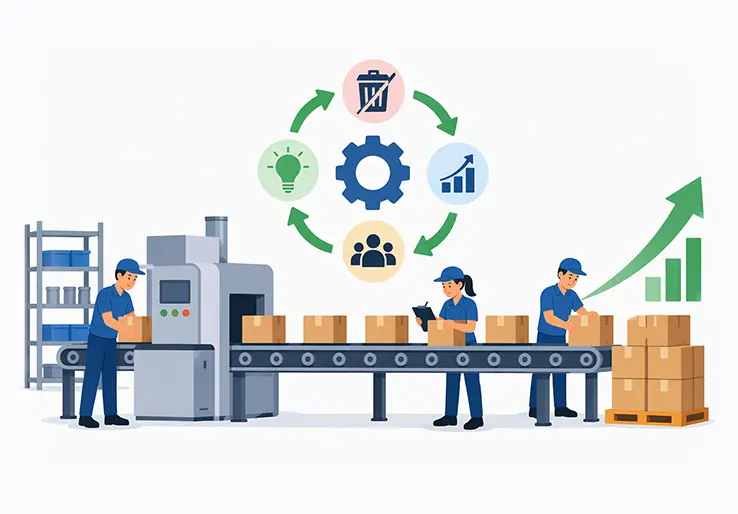
Lean manufacturing aims to eliminate waste from production processes while maximizing customer value through a systematic approach to continuous improvement. Every step that does not add something a customer would pay for is a target for removal. The result of reducing waste: lower costs, shorter lead times, fewer defects, and faster response to changing demand.
The lean production system traces its roots to the Toyota Production System, developed in post-WWII Japan by Taiichi Ohno and the Toyoda family. Toyota’s methods spread globally through the 1980s and 1990s as western manufacturers realized Japanese automakers were outperforming them on cost, quality, and flexibility. The term itself was coined in 1988 by MIT researcher John Krafcik, then popularized by James Womack and Daniel Jones in their landmark books The Machine That Changed the World (1990) and Lean Thinking (1996).
For manufacturing professionals, business leaders, and supply chain managers looking to improve efficiency, cut waste, and raise customer satisfaction, this article explains the five key principles of lean manufacturing, the eight types of manufacturing waste, core lean tools such as 5S, Kanban, JIT, TPM, and Poka-Yoke, measurable benefits, KPIs, a practical implementation roadmap, sector-specific examples, and how ERP systems like LOGIC ERP support lean operations.
Why does lean matter now? Volatile demand patterns, global supply chain disruptions triggered by events like COVID-19, persistent cost inflation, and customer expectations for fast, customized delivery make reducing waste an operational survival skill, not just an efficiency exercise. Sustainability pressures add another layer: cutting waste now means reducing energy use, material consumption, and emissions at the same time.
Lean manufacturing (also called lean production) is the practice of maximizing customer value while minimizing waste across an entire manufacturing process. Every process step is evaluated against a simple test: does it create something the customer values? If the answer is no, that step is waste.
The key objectives of a lean manufacturing system are to reduce lead time from order to delivery, lower production costs per unit, raise first-pass quality (fewer defects and returns), optimize inventory of raw materials and finished goods, and improve customer satisfaction through reliability and speed.
Traditional manufacturing uses a push approach: large batches built to forecast, high machine utilization as a priority, and large work-in-process (WIP) buffers between stations. Lean manufacturing seeks the opposite. It uses a pull system where production is triggered by actual customer demand, runs in small batches, prioritizes end-to-end flow over local machine efficiency, and treats inventory as a cost to minimize rather than a buffer to maximize.
The historical roots go deeper than Toyota. Henry Ford’s moving assembly line in the early 1900s introduced flow concepts. Frederick Winslow Taylor’s 1911 book on scientific management influenced process standardization. But it was Taiichi Ohno who developed the Toyota Production System after World War II, combining Just-in-Time delivery, jidoka (automation with human judgment), and standardized work into a coherent production system. The principles of lean manufacturing were formalized in the 1950s and 1960s within Toyota, then codified for global audiences by Womack and Jones in the 1990s.
Understanding lean manufacturing requires recognizing it as part of a broader lean management approach while still applying its principles on the factory floor. The tools (value stream mapping, Kanban, 5S) help teams improve manufacturing processes. The culture of continuous improvement, respect for people, and data transparency is harder to build but determines whether lean improvements last.
Womack and Jones formalized the five lean principles that underpin any lean manufacturing system. The five core principles of lean manufacturing are value, value stream, flow, pull, and perfection. Key principles of lean include identifying value, mapping the value stream, and creating continuous flow.
These lean manufacturing principles shift the focus from internal efficiency metrics (machine utilization, department output) to what matters from the customer’s perspective: getting the right product, at the right quality, at the right time, at a price that reflects real value. Each principle builds on the previous one.
Value is determined from the customer’s perspective regarding price, quality, delivery speed, and customization. A manufacturer of automotive brake components, for example, must understand that an OEM customer values dimensional accuracy within ±0.02 mm, on-time delivery within a four-hour window, and a target cost per unit. Anything the manufacturer does that doesn’t contribute to those specifications is, by definition, waste.
How do you identify value? Customer interviews, net promoter scores, complaint and returns data, competitive benchmarking, and sales pattern analysis all help. ERP and CRM data, including platforms like LOGIC ERP, can quantify which product features and order attributes drive repeat purchases and which generate returns or complaints.
The critical point: value definition should drive design, production, and supply chain decisions. If the customer does not care about a polished internal surface on a cast part, polishing it is extra processing waste, regardless of how well the team performs it.
A value stream includes every step from raw materials through manufacturing, logistics, and delivery that a product passes through on its way to the customer. To map the value stream means documenting each step, measuring cycle times, queue times, inventory levels, and information flows, then identifying which steps add value and which do not.
Value stream mapping identifies waste in the production process. A typical current-state map reveals that only 5-10% of total lead time consists of actual value-adding work; the rest is waiting, transport, inspection, and storage. An apparel SME in Mexico mapped its value stream and discovered that rearranging its cutting, sewing, and finishing sequence reduced lead time by 24.46% and WIP units by 45.45%.
Value stream mapping helps identify waste in production processes across functions: procurement, production planning, quality, and the broader supply chain. The output is a future-state map with a concrete implementation plan to close the gap.
Creating flow ensures smooth production with minimal delays. Flow is created through lean processes that minimize delays and interruptions, so products and information move continuously through the value stream without waiting, batching, or backtracking.
Practical techniques to create flow include cell-based layouts (grouping machines by product family instead of function), smaller batch sizes, SMED (Single-Minute Exchange of Dies) for quick changeovers, standardized work at each station, and balanced workloads across operators. An electronics assembly plant that reorganized from a functional layout (all soldering in one room, all testing in another) to product-family cells cut travel distance by 60% and reduced WIP by a third, because parts no longer sat in queues between departments.
Improved production flow shortens lead time and surfaces problems immediately. When a defect occurs in a flow line, it is visible within minutes, not days.
A pull system starts production based on actual customer demand rather than a forecast. In a push system, a planning department generates a monthly schedule based on projected orders. In a pull system, production of a part begins only when the downstream process (or end customer) signals that it needs one.
The most common pull mechanism is Kanban: physical or digital cards that travel upstream to signal replenishment. When a downstream station consumes a bin of parts, the empty bin (or its Kanban card) returns to the upstream station, triggering production of exactly that quantity. This is directly tied to Just-in-Time delivery and reduced finished-goods inventory.
Consider an automotive supplier that switched from monthly batch schedules to Kanban-based replenishment for an OEM customer. Instead of building 10,000 brackets in one run and storing them for four weeks, the supplier now produces 2,500 per week, triggered by daily Kanban signals. Result: 75% less finished-goods inventory and a three-day lead time instead of 30 days.
ERP systems like LOGIC ERP’s production module support pull by providing real-time demand signals, inventory visibility, and production planning aligned with actual orders rather than static forecasts.
Kaizen means continuous improvement in Japanese. Pursuing perfection involves continuous improvement of processes, and it is the principle that keeps lean alive after initial gains.
Kaizen is not a one-time event. As part of the broader lean model, it relies on daily, incremental improvements and active employee involvement from operators to executives. Typical behaviors include regular Gemba walks (going to the actual workplace to observe), structured problem-solving routines like the 5 Whys, suggestion systems where any worker can propose changes, and small experiments using PDCA (Plan-Do-Check-Act) cycles. Kaizen encourages small, incremental changes over time rather than large, disruptive overhauls.
"Perfection" does not mean a fixed target. It means continuously closing gaps in quality, cost, lead time, safety, and flexibility, never assuming a process is finished. A stamping shop that runs a three-day Kaizen event on a recurring paint defect might discover that ambient humidity above 65% causes adhesion failures. The fix (installing a dehumidifier and adding a humidity check to the standard work sheet) is small, but it eliminates 40% of rework on that line.
A lean culture of psychological safety and data transparency sustains this cycle. If operators fear blame for reporting problems, problems stay hidden until they become expensive.
Waste (Muda in Japanese) is any activity that consumes resources but does not add customer value. Lean manufacturing identifies seven types of waste from the original Toyota Production System. Modern lean practitioners add an eighth: underutilized talent. The 8 wastes of lean include Transportation, Inventory, Motion, Waiting, Overproduction, Overprocessing, Defects, and Skills (often remembered by the acronym DOWNTIME).
Identifying waste requires direct observation on the shop floor, data on cycle times and OEE, and input from operators who perform the work every day.
Defects lead to reworking or scrapping of products. Every defective unit carries the full cost of materials, labor, and machine time consumed up to the point of detection, plus the cost of rework, re-inspection, or disposal. A PCB manufacturer that catches a soldering defect at final test has already invested assembly time, components, and energy. Lean tools that target defects include Poka-Yoke (error-proofing), standardized work, quality at the source, and Andon systems that allow operators to stop the line immediately when a defect appears.
Overproduction is a key type of waste in lean manufacturing because it triggers almost every other waste: excess inventory, extra transport, more storage space, and hidden defects. It occurs when a factory makes more than needed, earlier than needed, or faster than downstream processes can handle. Root causes include push scheduling, inaccurate forecasts, and batch-size economics that reward long runs. Pull systems, Kanban, and smaller batch sizes directly counter overproduction.
Waiting occurs when operators stand idle because parts haven’t arrived, machines wait for changeovers to finish, or information is delayed (an approval email, a quality sign-off). Unbalanced workloads, long changeover times, and poor planning are the usual culprits. Reducing waiting improves throughput and often improves employee engagement, because idle time frustrates skilled workers.
Underutilized talent occurs when workers’ insights are ignored. Operators who perform the same task eight hours a day often know exactly why a defect happens or where a layout wastes motion, yet many organizations exclude them from improvement decisions. Countermeasures: cross-training, structured suggestion programs, Kaizen events that include frontline workers, and visual management boards that make problems and improvement ideas visible to everyone.
Unnecessary movement of materials between storage and machines, between buildings, or between suppliers and the plant adds cost and time without changing the product. Layout redesign, supermarket-style staging locations near the point of use, and milk-run logistics (fixed-route, frequent deliveries) cut transport waste. Supply chain optimization and warehouse management functions within ERP also help.
Excess inventory increases carrying costs and ties up capital. Large stockpiles of raw materials, WIP, or finished goods hide quality problems (defects sit undetected in bins), consume floor space, and risk obsolescence. Just-In-Time production, better forecasting, and integrated planning tools like LOGIC ERP’s inventory management module help bring inventory to the minimum level needed to protect flow.
Motion waste is unnecessary movement by people or equipment: bending to reach a tool on a low shelf, walking across a shop to fetch a gauge, searching for the correct fixture. Implementing 5S can help organize the workspace and reduce motion waste. Ergonomic workstation design and standardized tool layouts eliminate most motion waste and improve operator safety at the same time.
Extra processing is work that does not create customer value: redundant inspections, overengineering beyond specification, unnecessary polishing, or documentation that no one reads. Root causes include unclear quality standards, legacy procedures inherited from discontinued products, and misaligned incentives (rewarding perfection where "good enough" is what the customer specified). The fix: align quality criteria with customer value and simplify approval workflows to streamline processes.
Lean tools are practical methods used to apply lean principles and remove waste from the manufacturing process. The tools listed below are not standalone projects. Each one supports strategy and culture; deploying a tool without understanding why it exists in the lean system produces short-lived results.
5S stands for Sort, Set in Order, Shine, Standardize, and Sustain. Sort removes unnecessary items from the work area. Set in Order assigns a labeled place for every tool and material. Shine establishes cleaning routines that double as inspection. Standardize creates visual standards and checklists. Sustain ensures audits and habits keep the system alive.
A machining cell that runs a 5S event typically cuts tool-search time by 30-50% and reduces setup errors because the correct fixture is always in the same location. Digital 5S audits via ERP-based maintenance tasks help sustain the discipline over months and years.
Kaizen fosters a culture of improvement across all organization levels. A typical Kaizen event lasts three to five days: a cross-functional team selects a problem, gathers data, maps the current process, brainstorms solutions, implements changes, and measures results before the week ends. Kaizen helps identify problems and develop solutions for efficiency. Continuous improvement (Kaizen) involves all employees in process enhancement, not just engineers or managers.
Kaizen is integral to the Toyota Production System and uses PDCA or DMAIC cycles to structure improvements. A garment factory in Peru ran a Kaizen + TPM project that dropped its defect rate from 11.7% to 5.1% and cut average production time by 7.1%.
Kanban uses physical cards, bins, or digital signals to authorize production or movement of materials. The basic rules: limit work-in-progress to a fixed number of cards, assign clear ownership of each card, and make queues visible. When downstream consumes a unit, the Kanban signal flows upstream to trigger replenishment of only what was consumed. Establish a pull system to produce based on customer demand, not forecasts.
Kanban boards integrate naturally with production planning and inventory control in an ERP environment, where digital Kanban signals can trigger purchase orders or production work orders automatically.
Just-In-Time production aligns raw material orders with production schedules to reduce inventory. Materials arrive at the production line only when needed, in the exact quantity required. Benefits include lower carrying costs, shorter lead times, and reduced floor-space requirements. The risk: supply chain fragility. COVID-19 exposed JIT vulnerabilities when PPE, semiconductor, and raw material supplies were cut overnight. Risk-mitigation practices include dual sourcing, safety stock for critical items, and collaborative supplier relationships.
VSM follows a structured sequence: select a product family, gather data on cycle times and queue times, draw the current state map, identify waste, design the future state, and build an implementation plan. Typical metrics on a VSM include takt time, process time, queue time, inventory levels, and first-pass yield. VSM can extend beyond the factory walls into the supply chain, covering supplier lead times, 3PL transit, and distribution.
Total productive maintenance aims for zero breakdowns, zero defects, and zero accidents through proactive, operator-led maintenance. Core TPM pillars include autonomous maintenance (operators perform basic cleaning, lubrication, and inspection), planned maintenance, training, and early equipment management (designing maintainability into new equipment). TPM feeds directly into Overall Equipment Effectiveness (OEE) metrics: availability × performance × quality.
Poka-Yoke designs processes and fixtures so that errors are difficult or impossible. Examples: a USB-C connector that can only be inserted one way, a sensor on an assembly jig that blocks the next step if a bolt is missing, or a packaging machine that weighs each box and rejects any outside the tolerance band. Poka-Yoke focuses on prevention, not inspection-only quality control.
Standardized work documents the best known method to perform a task safely, with high quality, within takt time, supporting a standard lean production model at the task level. It has three components: the work sequence (order of steps), standard WIP (minimum inventory between steps), and take time (pace set by customer demand). Standard work documents and visual work instructions enable fast training of new operators, process stability, and a baseline for Kaizen; you cannot improve a process that isn’t defined.
A well-executed lean manufacturing system delivers measurable results across financial, operational, and customer metrics.
Lean practices can lead to faster production cycles, reduced inventory, and higher product quality. Specific benchmarks from published studies:
Lean manufacturing can save time and money for businesses by stripping out non-value-adding steps. Lean practices can improve customer satisfaction because on-time delivery and consistent quality build trust. Reduced material and energy consumption also aligns with sustainability goals, making waste reduction an environmental benefit as well as a financial one. These outcomes contribute to substantial cost savings and stronger competitive positioning.
Lean manufacturing requires a mindset shift throughout the organization, not just a set of tools installed in one department. Here is a practical roadmap.
Define Goals and Scope
Start with a specific, measurable objective tied to business needs: reduce lead time by 25% on Product Family X, cut defect rate below 2%, or free up USD 500,000 in inventory. Avoid vague goals like "become lean."
Select a Pilot Area
Choose one production line or product family with high volume and visible problems. Pilot success builds credibility for broader rollout.
Map the Current Value Stream
Walk the process from raw materials receipt to finished goods shipment. Document every step, queue, and inventory point. Involve operators; they know where the real bottlenecks sit.
Identify and Classify Waste
Use the eight-waste framework. Quantify each waste type in hours, units, or dollars.
Design the Future State
Apply lean principles: redesign layout for flow, size batches for pull, add Poka-Yoke at known defect points, implement 5S, and define standardized work for each station.
Train and Engage Employees
Training and engaging employees is crucial for successful lean implementation. Run Kaizen events that include operators, supervisors, and support functions to improve cross-functional communication and lead management during rollout. Cross-train workers to handle multiple stations.
Implement lean tools
Deploy the selected lean manufacturing techniques in the pilot area. Track changes daily.
Monitor KPIs
Measure cycle time, defect rate, OEE, inventory levels, and on-time delivery weekly. Use ERP dashboards to automate data collection where possible.
Standardize and Sustain
Document improved processes as new standard work. Audit compliance. Celebrate wins publicly.
Scale and Repeat
Once the pilot stabilizes, replicate the approach in adjacent production cells or product families. This is the path from a pilot to a lean enterprise.
Common pitfalls: cutting inventory before stabilizing processes (creates stockouts), ignoring operator input (creates resistance), and declaring victory after the first Kaizen event (improvements decay without sustain mechanisms).
Modern ERP systems act as the data backbone that makes lean manufacturing implementation scalable and sustainable. LOGIC ERP supports lean across several dimensions.
Integrating ERP systems enhances visibility across the value chain. Real-time dashboards show WIP levels, machine status, throughput, and bottlenecks. This visibility replaces daily spreadsheet updates, removing a form of administrative waste.
For inventory management, LOGIC ERP’s MRP module enables pull-based replenishment by triggering purchase or production orders when inventory hits predefined Kanban thresholds, preventing overproduction and excess inventory at the same time. Effective inventory control techniques integrated into the ERP reduce carrying costs and improve materials management.
Production planning and scheduling features help balance workloads, sequence jobs to minimize changeovers, and enable smaller batch sizes. Shop-floor management modules collect actual cycle times, downtime events, and defect counts, feeding this data back into continuous improvement efforts.
Digital tools help track the effects of changes in lean practices, allowing teams to verify that a Kaizen improvement actually moved the KPI in the expected direction. Automated reporting surfaces trends in OEE, defect rate, and inventory turnover without manual compilation.
The key requirement: ERP must be configured with accurate BOMs, routings, and master data. Garbage data in an ERP system will produce garbage decisions, regardless of how lean the tools around it are.
KPIs are the feedback loop that tells lean practitioners whether improvements are working. Without measurement, continuous process improvement becomes guesswork.
ERP and MES integration, such as through LOGIC ERP’s production management module, can automate collection and visualization of these KPIs on digital Andon boards and management dashboards.
Lean production originated in the automotive industry, but its principles apply wherever a manufacturing process converts raw materials into finished goods.
Apparel and Garment Manufacturing faces frequent changeovers (many SKUs, short fashion cycles) and variable quality from manual operations. SMEs that apply lean principles report productivity gains of 30-40% and defect reductions above 50%. Garment manufacturing ERP supports these efforts through real-time tracking of cut-to-ship cycle times and fabric utilization.
Automotive manufacturing is the classical lean pilot, and high-performing automotive facilities are often described as lean manufacturing plants. Tier-1 suppliers use Kanban and JIT for supplier replenishment, takt-time-based line balancing, and Andon systems for immediate defect response. The industry’s high-performance supplier network depends on lean practices flowing across company boundaries.
FMCG Manufacturing deals with rapid demand variation and shelf-life constraints. Lean + green initiatives reduce both cost and environmental footprint. TPM, flow mapping, and buffer-level strategies address the tension between efficiency and supply chain risk. FMCG manufacturing ERP connects production planning to distribution to manage perishability.
Electronics manufacturing faces component obsolescence, where excess inventory of a chip that becomes outdated is especially costly. Small batch sizes, fast changeovers, and precise demand sensing are critical lean adaptations.
Pharmaceutical Manufacturing operates under strict regulatory constraints. Quality at source, robust standardized work, and Poka-Yoke are essential, while pull systems must account for qualification lead times for raw materials and long regulatory approval cycles for process changes.
Many lean programs deliver initial gains that erode within 12-18 months. Understanding the common failure modes helps prevent them.
Employee Resistance is the most cited obstacle. Workers fear that eliminating waste means eliminating jobs. If lean is communicated as a cost-cutting exercise rather than a quality improvement and growth strategy, resistance intensifies. Lean manufacturing can lead to employee burnout if not managed well, especially when improvements increase pace without addressing workload balance. Countermeasure: leadership commitment to transparency, early operator involvement, and visible reinvestment of gains into training and better work environment conditions.
Lack of Process Visibility and Inaccurate Data prevent teams from identifying waste or measuring improvement. Without reliable cycle times, inventory counts, and defect data, lean tools are applied blindly. ERP systems with accurate master data and real-time shop-floor input solve this problem.
Poor Inventory Planning creates either stockouts (when JIT is pushed too aggressively before processes stabilize) or hidden overstock. Lean manufacturing can create challenges in standardization across organizations, especially multi-plant operations where processes differ by site. Balanced metrics that track both efficiency and resilience are essential.
Short-term Focus is another risk. Lean manufacturing may hinder future development due to short-term focus if all resources go to cutting today’s waste while neglecting investment in new capabilities, plant technology, or product development.
Lean and Six Sigma share the goal of process improvement but differ in method and emphasis.
Lean focuses on eliminating waste, improving flow, and reducing lead time using tools like value stream mapping, Kanban, and 5S. Its orientation is speed: how fast can we remove non-value-adding steps? Six Sigma focuses on reducing variation and defects using statistical tools like control charts, hypothesis testing, and the DMAIC (Define-Measure-Analyze-Improve-Control) cycle. Its orientation is precision: how do we bring a process to near-zero defects (3.4 per million)?
Lean is qualitative and observation-driven (Gemba walks, VSM). Six Sigma is quantitative and data-driven (statistical process control, regression analysis). Lean tends to deliver faster initial results; Six Sigma typically requires more training and longer project cycles but addresses root causes of variation that lean alone may miss.
Lean Six Sigma combines both toolsets. A common approach: use lean to simplify and speed up the process first, then apply Six Sigma to reduce variation in the critical remaining steps. Many organizations now train teams in both disciplines under a unified continuous improvement program.
Lean thinking extends beyond the factory floor into the supply chain. Supplier development programs, logistics optimization through milk-run routes, and end-to-end value stream management across supplier-manufacturer-distributor networks are all lean practices applied at scale.
However, aggressively lean supply chains are fragile. COVID-19 exposed the risks: semiconductor shortages halted automotive production lines worldwide, and PPE stockouts endangered healthcare workers. A risk-balanced lean strategy maintains safety stocks for critical items, develops multiple sourcing options, and uses scenario planning to prepare for disruptions.
Digital technologies are accelerating lean improvements. IoT enables real-time monitoring of production processes, feeding machine health, cycle time, and environmental data into dashboards that surface problems instantly. AI provides predictive insights for process optimization, from demand forecasting that reduces overproduction to predictive maintenance that prevents breakdowns before they occur. Digital twins allow teams to simulate future-state value stream maps before committing to physical changes. Lean automation focuses on eliminating inefficiencies, not just increasing capacity.
LOGIC ERP fits into this digital lean ecosystem by integrating shop floor data, warehouse operations, procurement, and finance into a single platform. When a Kanban signal triggers a purchase order that flows through MRP, lands on a supplier portal, and updates inventory in real time, the entire pull system operates with minimal human intervention and maximum transparency.
Lean manufacturing is a transformative approach that enables businesses to improve efficiency, reduce costs, and deliver greater value to customers by systematically eliminating waste and optimizing production processes. Rooted in the Toyota Production System and built on five core principles; identifying value, mapping the value stream, creating flow, establishing pull, and pursuing continuous improvement, lean manufacturing fosters a culture of operational excellence and employee engagement.
The adoption of lean manufacturing tools such as 5S, Kanban, Just-In-Time, and Kaizen helps organizations streamline workflows, reduce inventory, and enhance product quality. Supported by modern ERP software like LOGIC ERP, lean manufacturing becomes scalable and sustainable through real-time data visibility, automated planning, and continuous performance monitoring.
Despite challenges like employee resistance and the need for accurate data, the benefits of lean manufacturing including faster production cycles, lower costs, improved customer satisfaction, and environmental sustainability make it essential for modern manufacturers facing volatile markets and rising customer expectations.
By embracing lean manufacturing principles and leveraging technology, companies across industries can build productive processes that meet production targets efficiently while fostering a culture of continuous improvement and innovation for long-term success.
Call at +91-73411-41176 / +91-73411-41175 or send us an email at sales@logicerp.com to book a free demo today!
Lean manufacturing is a method for producing goods using fewer resources by identifying and removing activities that do not add value for the customer. The goal is to deliver only what the customer wants, when they want it, with no excess.
The five lean principles are: identify value from the customer’s perspective, map the value stream, create flow through the process, establish a pull system based on actual demand, and pursue perfection through continuous improvement.
The eight types of manufacturing waste are Defects, Overproduction, Waiting, Non-utilized talent, Transportation, Inventory, Motion, and Extra processing (DOWNTIME).
Lower production costs, reduced inventory and wasted resources, faster production cycles, higher product quality, improved on-time delivery, and better customer satisfaction. Published case studies show lead-time reductions of 20-33%, productivity increases of 30-40%, and cost savings in the hundreds of thousands to millions of dollars.
Lean targets waste and flow; Six Sigma targets variation and defects using statistical methods. Lean uses tools like VSM and Kanban. Six Sigma uses DMAIC and control charts. Many organizations combine both into Lean Six Sigma.
ERP provides real-time visibility into inventory, production, and quality data. It supports pull-based replenishment (digital Kanban), automates reporting, and reduces administrative waste like manual data entry and paper-based approvals.
Yes. Multiple studies show SMEs achieving 30-45% productivity gains and defect reductions above 50% through lean tools like 5S, VSM, and Kaizen. The key is starting with a focused pilot and scaling gradually, using efficient processes and tools like industry-specific ERP to sustain improvements.
Lean production is a systematic approach to manufacturing that focuses on eliminating waste while maximizing customer value. It streamlines processes to improve operational efficiency, reduce costs, and enhance product quality, ensuring that every step adds value from the customer’s perspective.
The key principles of lean manufacturing include identifying customer value, mapping the value stream, creating continuous flow, establishing a pull system based on demand, and pursuing perfection through continuous improvement. These principles help organizations optimize processes and reduce waste.
Common lean tools include 5S (workplace organization), Kaizen (continuous improvement), Kanban (visual workflow management), Just-In-Time (JIT) production, Value Stream Mapping (VSM), Total Productive Maintenance (TPM), Poka-Yoke (error-proofing), and Standardized Work. These tools facilitate waste reduction and operational efficiency.
Organizations apply lean principles by first understanding customer value, mapping their value streams to identify waste, redesigning processes to create flow, implementing pull systems to align production with demand, and fostering a culture of continuous improvement. Employee engagement and training are critical for success.
A lean enterprise is an organization that applies lean manufacturing principles across all functions and departments, not just production. It integrates lean thinking into strategy, culture, and daily operations to deliver maximum value to customers while minimizing waste throughout the entire value chain.
Lean manufacturing enhances customer value by focusing on producing exactly what the customer wants, at the right quality and time, while eliminating activities that do not add value. This results in better product quality, faster delivery, and competitive pricing.
Customer satisfaction is central to lean manufacturing. By aligning production with actual customer needs and reducing defects and delays, lean systems improve reliability and responsiveness, leading to higher customer satisfaction and loyalty.
Lean manufacturing reduces costs by eliminating wasteful activities, optimizing inventory levels, and improving process efficiency. This lowers production expenses, reduces carrying costs, and minimizes rework, contributing to better profitability.
Lean manufacturing improves operational efficiency by streamlining workflows, reducing cycle times, balancing workloads, minimizing downtime, and ensuring smooth production flow. This leads to higher throughput, better resource utilization, and consistent quality.
Popular Products