Explore the complete Make to Order (MTO) manufacturing process, understand its advantages and limitations, compare it with MTS and ATO, and learn how businesses improve efficiency through customer-driven production.
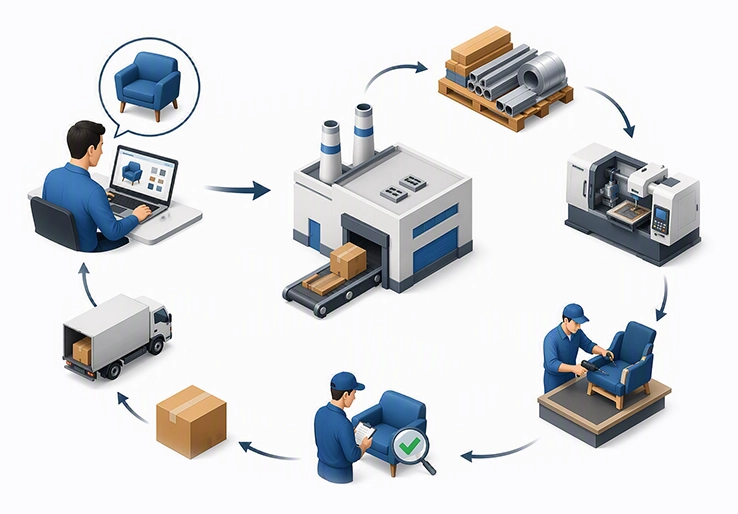
Make to order (MTO) is a production strategy where manufacturing begins only after a customer places an order, ensuring that finished goods align precisely with the customer's specifications. Unlike make to stock (MTS) approaches that rely on demand forecasting and pre-built finished goods inventory, make to order manufacturing ties every production order directly to actual demand-eliminating guesswork and reducing the risk of dead stock sitting in warehouses.
This complete guide covers the make to order process from end to end: how it works, where it fits in the entire supply chain, the key differences between MTO and other manufacturing methods like make to stock (MTS) and assemble to order, and the industries where MTO manufacturing thrives. Whether you're a supply chain professional evaluating production planning approaches, a business owner considering customized products, or a student studying manufacturing methods, this guide delivers the depth you need.
By the end of this guide, you will:
Make to order is a manufacturing philosophy rooted in a simple principle: produce nothing until a customer orders it. This stands in direct contrast to mass production models that fill warehouses with finished product inventory based on historical data and predicted future demand. In an MTO environment, every unit manufactured corresponds to a confirmed customer order, making it a textbook example of a pull supply chain strategy.
The relevance of MTO has grown as 76% of customers expect personalization in products. Businesses across specialized industries-from aerospace to custom furniture-have adopted this production model to meet customer expectations for products tailored to individual customer preferences.
Make to order manufacturing operates on several foundational principles:
The key differences between MTO and traditional manufacturing center on when and why production starts. In a make-to-stock (MTS) environment, MTS produces and stores goods based on demand forecasts-companies analyze market trends and historical data to predict product demand, then manufacture large quantities in advance. MTS reduces customer wait times by having products ready for immediate shipment, but MTS risks overproduction and high inventory costs when forecasts miss the mark.
Make to order flips this model entirely. Rather than building to predicted demand, MTO waits for actual demand signals. This distinction affects everything from warehouse management to production scheduling and raw materials procurement.
Understanding these foundational differences sets the stage for examining the complete MTO process and where it delivers the greatest operational efficiency.
The make to order process follows a structured sequence that connects every stage-from order receipt through final assembly to delivery. Each step ensures that the final product matches the customer's specifications without creating unnecessary processes or excess inventory along the way.
The MTO process begins when a customer places a sales order specifying exactly what they need. Unlike MTS workflows where production planning happens independent of individual buyers, MTO production planning starts here. The order captures the customer's specific requirements: dimensions, materials, features, delivery date expectations, and any other customization parameters.
Once received, the order undergoes feasibility review. Production capacity is assessed, raw materials availability is confirmed, and a realistic delivery timeline is communicated. This stage is critical-accurate forecasting of material needs and production scheduling prevents bottlenecks downstream. Purchase requisitions for specialized raw materials may be generated at this point if stock levels are insufficient.
Defining every BOM component and raw material needed for the customized products.
Reserving manufacturing resources and labor for the specific production orders.
Setting milestones from manufacturing begins through final assembly to shipment.
Advanced planning systems help MTO manufacturers juggle multiple simultaneous customer orders, each with different specifications. Production scheduling in MTO is inherently more complex than in mass production because no two orders may be identical.
Once planning is complete, production begins. The manufacturing process follows the exact specifications captured in the sales order. Because MTO allows for high product customization, the production process often requires flexible equipment, skilled operators, and adaptable workflows.
Quality checkpoints are embedded throughout. Since MTO minimizes waste by producing only what is sold, catching defects early prevents costly rework on customized products that cannot simply be returned to a generic finished goods inventory.
After final assembly and quality verification, the finished product ships to the customer. Delivery times in MTO are inherently longer than in MTS models because the entire production cycle occurs after order placement. Managing customer expectations around these delivery times is essential for maintaining customer satisfaction.
Get MTO Manufacturing Software Request a Callback| Factor | Make to Order (MTO) | Make to Stock (MTS) |
|---|---|---|
| Production Trigger | Customer places a sales order | Demand forecasting and historical data |
| Inventory Approach | Minimal; minimize excess inventory | Safety stock and finished goods inventory |
| Customization Level | High; built to exact specifications | Standardized; limited variation |
| Delivery Speed | Longer lead time | Faster delivery from existing stock |
| Waste Risk | Low; produces only what is sold | Higher; risks dead stock and overproduction |
| Production Costs | Generally higher due to customization | Lower per unit via mass production |
MTO production costs are generally higher due to customization, but reduced inventory costs and elimination of dead stock often offset this premium, particularly in specialized industries where product value is high.
Get Make to Order Production Software Free Demo Request a CallbackMTO manufacturing is not universally applicable-it thrives in sectors where customization, high value, and individual customer preferences define the market. Understanding where MTO delivers the greatest value helps businesses determine whether this production strategy aligns with their operational reality.
MTO is common in the aerospace industry, where every aircraft component may need to meet unique regulatory and performance specifications. The assembly industry deals with complex products where mass production of standardized units is impractical. Production orders are driven entirely by contracts and customer orders, with manufacturing goods built to exact specifications.
Automotive manufacturers often use MTO for custom vehicles. While base models may follow MTS patterns, premium and configured vehicles—where buyers select engines, interiors, colors, and features—follow a make to order production approach. This hybrid strategy allows manufacturers to balance production efficiency with the growing demand for personalized products.
Furniture manufacturers utilize MTO for customized orders, building pieces to the buyer's chosen dimensions, materials, and finishes. The custom furniture segment exemplifies MTO's strength: each piece reflects individual customer preferences, and maintaining a finished goods inventory of every possible configuration would be economically impossible.
MTO is prevalent in construction for custom homes, where every project follows unique architectural plans and the customer's specifications. Raw materials are procured, subcontractors are scheduled, and final assembly occurs according to a specific project scope—a pure make-to-order process.
Jewelry makers frequently adopt the MTO strategy, creating pieces to order based on customer-selected stones, metals, and designs. The high value and personalization inherent in luxury goods make MTO the natural production model, as carrying large quantities of finished luxury inventory introduces substantial financial risk.
The advantages of MTO extend across the entire supply chain, from procurement through warehouse management to customer satisfaction.
MTO reduces inventory costs by minimizing excess stock. Because production starts only after a confirmed order, businesses avoid the financial burden of maintaining large finished goods inventory. There is no dead stock, no write-downs from obsolescence, and no warehouse space consumed by unsold products. MTO produces only what is sold, making it one of the most resource-efficient manufacturing methods available.
MTO enables businesses to manufacture products according to exact customer specifications, from material selection and dimensions to finishes and design preferences. Unlike mass production, it supports highly customized products, helping improve customer satisfaction, strengthen brand loyalty, and create a competitive advantage.
Because MTO links production directly to confirmed customer orders, businesses eliminate the risks associated with inaccurate demand forecasting. Every production order is backed by an actual sales order, improving cash flow predictability and operational efficiency.
Operating as a pull-based model, MTO streamlines the supply chain by ordering raw materials only against confirmed customer requirements instead of forecasts. This reduces waste, optimizes resource utilization, and supports more sustainable manufacturing practices.
Despite its advantages, MTO manufacturing presents distinct operational challenges. Understanding these obstacles-and their solutions-is essential for any business considering or optimizing a make to order production strategy.
The challenge:
MTO typically has longer delivery times than MTS. Since manufacturing begins only after order placement, customers must wait through the entire production cycle. MTO often results in longer delivery times for customers, which can strain customer satisfaction in markets accustomed to immediate availability.
Solution:
Invest in production scheduling optimization and maintain strategic partnerships with suppliers who can provide raw materials on short notice. Some manufacturers adopt a hybrid strategy, pre-manufacturing standard components while customizing during final assembly-an approach sometimes called assemble to order. Communicating realistic delivery date expectations upfront also manages customer expectations effectively.
The challenge:
MTO can lead to higher production costs due to customization. Each unique order may require different setups, tooling changes, and specialized materials, driving per-unit production costs above what mass production achieves.
Solution:
Standardize sub-components where possible without compromising customization. Invest in flexible manufacturing systems that reduce changeover time. Analyze production costs across order types to identify efficiency opportunities and price products appropriately to reflect the value of customization.
The challenge:
MTO requires accurate demand forecasting to avoid material shortages. While MTO eliminates the risk of overproduction, it introduces the risk of insufficient stock of raw materials when customer orders arrive-especially during demand spikes or irregular sales periods.
Solution:
Build strong supplier relationships with guaranteed lead time agreements. Use historical data and market trends analysis to maintain appropriate stock levels of commonly used raw materials without creating excess inventory. Implement advanced planning software that connects customer orders to purchase requisitions automatically.
The challenge:
Customization in MTO increases complexity in order management. Managing multiple concurrent production orders-each with unique specifications, timelines, and material requirements-demands robust systems and processes. MTO demands greater flexibility in materials and production capacity than standardized manufacturing.
Solution:
Deploy integrated order management and ERP systems that provide visibility across the entire supply chain. These platforms connect sales orders to production scheduling, inventory management, and procurement in a single workflow, reducing errors and improving timely delivery performance.
The challenge:
MTO businesses with unpredictable demand or irregular sales face a major challenge in maintaining production capacity utilization. Unlike make to stock MTS operations with predictable demand and steady production runs, MTO workloads can fluctuate dramatically.
Solution:
Develop flexible workforce strategies and cross-train production teams. Consider maintaining a small safety stock of high-demand raw materials. Use accurate forecasting tools that analyze historical data alongside real-time market trends to anticipate demand shifts without overcommitting resources.
Selecting between make to order MTO, make to stock MTS, and assemble to order depends on your product type, customer demand patterns, and operational capabilities.
| Criterion | Make to Order (MTO) | Make to Stock (MTS) | Assemble to Order (ATO) |
|---|---|---|---|
| Best for | Customized products, specialized industries | Standardized goods, predictable demand | Modular products with configurable options |
| Inventory Model | Minimal finished goods inventory | Large quantities of finished goods | Component inventory; assembled per order |
| Customer Wait Time | Longer delivery times | Faster delivery | Moderate |
| Production Trigger | Customer orders | Demand forecasting | Customer orders (final assembly only) |
| Waste Risk | Minimal | Dead stock, excess inventory | Moderate |
| Cost Structure | Higher per-unit production costs | Lower per-unit via mass production | Balanced |
Businesses with product demand characterized by high customization and lower volume typically benefit most from MTO. Those selling standardized products at scale with predictable demand lean toward MTS. The assemble-to-order model serves as a hybrid strategy for companies that want to offer customization while maintaining faster delivery than pure MTO.
LOGIC ERP software offers a comprehensive solution tailored specifically for make-to-order (MTO) manufacturing environments. It integrates all critical functions from sales order processing and production scheduling to inventory management and procurement, into a single, unified platform. This integration ensures real-time visibility across the supply chain, enabling accurate demand forecasting and efficient material planning essential for MTO operations.
With LOGIC ERP, manufacturers gain the flexibility to manage complex customization requirements seamlessly, reducing lead times and minimizing the risk of material shortages. Its advanced workflow management tools optimize production processes, allowing businesses to allocate resources effectively while maintaining high product quality.
Moreover, LOGIC ERP enhances communication and collaboration between departments, ensuring that customer specifications are accurately captured and translated into production orders. This reduces errors and rework, improving overall operational efficiency.
By leveraging LOGIC ERP's robust analytics and reporting capabilities, companies can monitor order status, track production progress, and respond swiftly to changing customer demands. This results in improved customer satisfaction and stronger brand loyalty.
In summary, LOGIC ERP empowers make-to-order manufacturers to overcome typical challenges such as order complexity, inventory costs, and delivery delays, making it an indispensable tool for businesses seeking to excel in customized production and supply chain agility.
Request a Callback Try MTO SoftwareMake-to-order manufacturing aligns production directly with actual demand, delivering customized products to exact specifications while eliminating the waste and inventory costs inherent in speculative production. The trade-offs-longer lead time, higher per-unit production costs, and greater order management complexity-are manageable with the right systems, supplier relationships, and production planning processes.
To implement or optimize MTO in your operations:
For advanced exploration, consider studying pull supply chain optimization, demand-driven material requirements planning (DDMRP), and how digital manufacturing technologies like IoT and AI-powered production scheduling are transforming MTO manufacturing across the assembly industry and beyond.
Call at +91-73411-41176 / +91-73411-41175 or send us an email at sales@logicerp.com to book a free demo today!
Proper question formation facilitates clear communication between customers, sales teams, and production planners in MTO environments. Accurate questions help capture detailed customer requirements and specifications, enabling manufacturers to produce exactly what is ordered without errors or delays. This reduces misunderstandings, prevents costly rework, and improves overall customer satisfaction by ensuring timely and precise fulfillment of customized orders.
Yes/no questions in MTO contexts often begin with auxiliary verbs and seek confirmation or simple answers. Examples include: "Is the material in stock?", "Do you require expedited shipping?", and "Has the order been approved?" These questions help clarify order status, material availability, and customer preferences efficiently, supporting smooth production scheduling and inventory management.
Businesses can train staff through targeted communication workshops focusing on question formation rules, role-playing customer interactions, and providing templates for common inquiries. Emphasizing the importance of auxiliary verbs, question words, and subject-verb inversion helps staff ask clear, concise questions that gather necessary details without ambiguity. Regular feedback and practice improve proficiency, leading to better order accuracy and customer service in MTO operations.
Make to order production is a manufacturing approach where products are built only after a customer places an order. This method allows businesses to customize products according to exact customer specifications while minimizing excess inventory. By producing goods in response to actual demand, companies can reduce waste and align their operations more closely with customer needs.
Make to order differs from make to stock (MTS) in that production begins only after a confirmed customer order, enabling high levels of customization and reducing finished goods inventory. In contrast, make to stock involves producing goods based on forecasted demand and storing them as inventory for immediate availability. While MTS offers faster delivery times, it carries risks of overproduction and higher inventory holding costs.
Inventory management in make to order manufacturing focuses primarily on maintaining optimal raw material levels rather than finished goods. Since products are only manufactured after orders are placed, companies minimize excess finished inventory, reducing storage costs and waste. Effective inventory management ensures that materials are available when needed to meet production schedules without delays.
Advanced planning tools enhance make to order production by coordinating scheduling, procurement, and resource allocation. These systems help manufacturers manage the complexity of customized orders, optimize production workflows, and reduce lead times. By improving visibility and communication across the supply chain, advanced planning supports timely delivery and efficient operations.
The make to order manufacturing process typically involves several critical steps: receiving and confirming the customer order, planning and scheduling production based on order specifications, executing the manufacturing process with embedded quality controls, completing final assembly tailored to the customer's requirements, and delivering the finished product. This structured approach ensures products meet customer expectations without creating unnecessary inventory.
Make to order positively impacts customer satisfaction by providing highly customized products that meet individual preferences. Although this approach may involve longer lead times compared to make to stock models, clear communication about delivery timelines and rigorous quality assurance during final assembly help maintain strong customer relationships and trust.
A business might choose make to order over make to stock when customization and inventory cost reduction are strategic priorities. Make to order allows companies to tailor products to specific customer needs and avoid the risks and costs associated with holding large inventories. Despite longer production times, this approach can enhance customer loyalty and operational efficiency in markets where personalization is valued.
Final assembly in Make to Order (MTO) manufacturing is the stage where all customized components and subassemblies are brought together to create the finished product according to the specific customer order. This step is critical because it ensures that the product meets the exact specifications and quality standards required by the customer. Unlike mass production, final assembly in MTO often involves flexible workflows and skilled labor to handle unique configurations. Efficient final assembly helps manage longer lead times typical of MTO by streamlining production and minimizing errors, ultimately enhancing customer satisfaction through precise customization and quality assurance.
A purchase order is created by including supplier details, item descriptions, quantities, prices, delivery information, and payment terms before sending it to the vendor.
An ordered list in HTML is created using the <ol> tag, with each list item placed inside <li> tags.
To make a purchase order, enter accurate supplier information, product details, quantities, pricing, and approval before issuing the order.
Make to order is a production method in which products are manufactured only after receiving a customer order, ensuring production is based on actual demand rather than forecasts.
Make to order meaning refers to producing goods only after a customer places an order, reducing unnecessary inventory.
Popular Products