Shop-in-shop large format stores allocate space for independent brands inside larger retailers, creating strategic partnerships that deliver higher revenue per square foot, stronger customer engagement, and competitive differentiation for both host and guest brands.
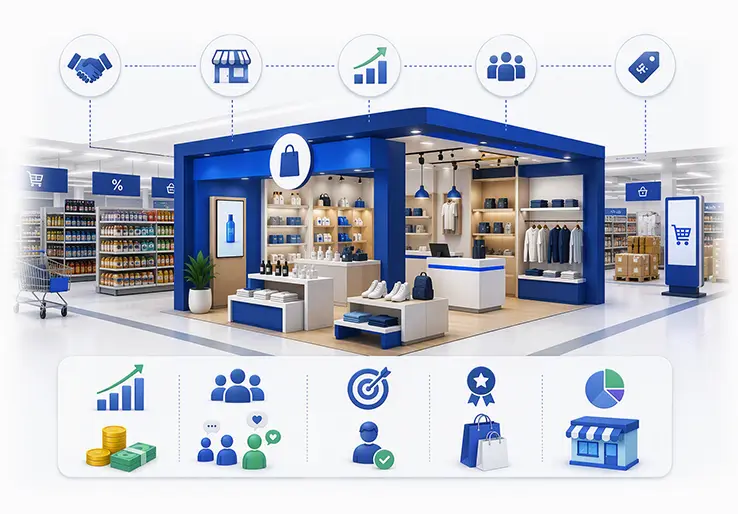
Shop-in-shop large format stores allocate space for independent brands inside larger retailers, creating strategic partnerships that benefit both host and guest brands. If your department store, hypermarket, or big-box retail chain has underperforming square footage, rising operational costs, and increasing pressure from e-commerce, the shop-in-shop model offers a proven path to higher revenue per square foot, stronger customer engagement, and competitive differentiation — without the full risk of building new product categories from scratch.
This guide covers everything retailers and brands need to know in 2026: what shop-in-shop means, how it works in large format retail, implementation steps, technology requirements, and best practices for sustainable growth.
Large format retail stores face a difficult reality. Foot traffic has declined across department stores and hypermarkets. Consumers expect curated, experiential shopping not endless aisles of generic inventory. Meanwhile, fixed costs for maintaining thousands of square feet remain high whether those spaces generate revenue or not.
Shop-in-shop eliminates these common large format store problems by transforming underutilized retail space into revenue-generating brand partnerships. Dedicated brand spaces within larger stores can enhance the shopping experience for customers while giving the host retailer rental income, fresh foot traffic, and category expertise they don't have to build internally.
The result? A successful retail business model where both parties win. The host retailer monetizes excess space and diversifies its offering. The tenant brand gains physical presence, visibility, and credibility by operating inside an established host retailer without the enormous investment of opening standalone locations.
Whether you operate a retail chain of department stores, a network of hypermarkets across multiple locations, or a growing electronics retail store, this guide provides the operational blueprint, technology stack, and partnership frameworks you need to execute shop-in-shop successfully.
A shop-in-shop (also called "store-within-a-store" or "concession") is a dedicated space within a larger retail location reserved for a specific brand to showcase its own branding, product assortment, and often its own staff while operating within the host retailer's physical footprint.
The tenant brand designs and manages its space within the host store. Key characteristics include:
This differs from traditional vendor shelving, where the host retailer simply stocks another brand's products on standard shelves. Shop-in-shop environments offer customers a specialized shopping experience with curated surroundings closer to visiting the brand's own retail shop than browsing a generic aisle.
The model also differs from classic concession arrangements. In a traditional concession model, the host retailer typically retains more control over inventory management, sales operations, and staffing. In a true shop-in-shop, the brand partner maintains greater independence and creative control.
Larger format stores, such as department stores and hypermarkets, are common hosts for shop-in-shop models. These retailers have the square footage, the foot traffic, and the infrastructure to accommodate multiple brand environments under one roof. Electronics retailers, furniture superstores, grocery stores expanding into lifestyle categories, and home improvement chains are all adopting this approach to stay competitive in 2026.
The evolution from traditional retail layouts to branded experiential zones reflects a broader shift in consumer expectations. Shoppers want brand authenticity, expert consultation, and curated experiences not just products. Shop-in-shop delivers precisely that within a convenient, familiar store environment that supports one-stop shopping convenience for customers.
Here's why the model delivers measurable results for both host retailers and brand partners:
Shop-in-shop large format stores software offers a range of features designed to streamline multi-brand retail operations and optimize store performance:
Shop-in-shop models offer significant advantages for both retailers and brand partners, creating a win-win scenario that drives growth and enhances customer experience.
Understanding how shop-in-shop compares to traditional retail operations helps retailers make informed strategic decisions:
Successful implementation starts with data. Analyze store traffic patterns using footfall heatmaps to identify zones of underperforming space areas near entrances, anchor departments, or high-traffic adjacencies where a brand partner's presence creates natural synergies.
Evaluate potential brand partners based on:
Negotiate partnership terms covering space rental (flat rate, percentage of sales, or hybrid), operational responsibilities, staffing arrangements, exclusivity clauses, and performance thresholds. Clear agreements on shrinkage responsibility, insurance, liability, and termination rights are essential from day one.
Develop shop-in-shop layouts that maintain the tenant brand's identity while integrating harmoniously with store aesthetics. The tenant brand maintains its identity while operating within a larger retail environment but the overall customer flow must feel natural, not disjointed.
Install necessary infrastructure including dedicated retail POS software, lighting systems, security measures, branded signage, and specialized fixtures. Considerations for large format stores include HVAC compatibility, ceiling height, power supply, and network cabling for separate systems.
Ensure seamless customer flow between main store areas and shop-in-shop spaces through clear wayfinding, intuitive layout design, and signage that guides discovery without overwhelming.
Establish clear operational procedures for inventory management, staff coordination, and customer service across all shop-in-shop zones. This includes defining who manages returns, handles complaints, and coordinates promotions.
Implement integrated retail store management systems to coordinate day-to-day retail store operations across host and brand zones. Multi-store management software centralizes control over multiple locations, and the same principle applies to managing multiple brand zones within a single large format store, with unified workflows across multiple sales channels helping prevent inventory inconsistency and process gaps. Real-time inventory sync prevents stockouts and overstocking across stores and across shop-in-shop partners within the same store.
Monitor business performance metrics including sales per square foot, conversion rates, dwell time, staff productivity, and inventory turnover. Adjust partnerships based on sales data and customer feedback underperforming partners should face clear review processes and, if necessary, replacement.
Implementing a successful shop-in-shop model within large format stores demands robust technology infrastructure that supports seamless multi-brand retail operations. Key technology requirements include:
By leveraging advanced retail ERP, POS, and inventory management systems tailored for multi-brand environments, large format stores can optimize shop-in-shop performance, enhance customer experience, and drive profitable growth.
Technology is the backbone of successful multi-brand retail operations. Only about 17% of fashion and retail companies have ERP systems fully integrated enterprise-wide, and real-time inventory visibility is achieved by roughly 55% of retailers. This gap represents both a challenge and a competitive opportunity.
Implement unified retail management systems that standardize retail store operations while handling separate financials and integrated inventory tracking. ERP solutions improve operational efficiency and reduce manual errors critical when coordinating between host operations and multiple brand partners.
Key technology requirements include:
Retail ERP systems support multi-store management from a single platform, and LOGIC ERP extends this capability to shop-in-shop operations where each branded zone effectively functions as a store-within-a-store requiring its own inventory capabilities, sales tracking, and performance reporting.
No strategy is without risk. Here are the primary challenges and practical solutions:
Selecting the ideal brand partners is crucial to the success of any shop-in-shop (SIS) initiative within large format stores. The right partnerships enhance customer experience, drive revenue, and create a harmonious retail environment that benefits both the host retailer and tenant brands. Here's how to choose the best brand partners for your shop-in-shop spaces:
Align Customer Demographics and Brand Values
Ensure that the prospective brand's target audience overlaps with or complements your existing customer base. A strong demographic fit maximizes cross-shopping opportunities and enhances the overall shopping experience. Additionally, partner brands should share compatible values and quality standards to maintain a cohesive store atmosphere.
Evaluate Product Category Complementarity
Choose brands that diversify your product mix without directly competing with your core offerings. Complementary categories enrich the store's appeal and encourage customers to explore multiple departments. For example, a beauty brand in a department store complements apparel and accessories without cannibalizing sales.
Assess Financial Stability and Operational Capability
Partner brands must demonstrate financial health and operational readiness to sustain their shop-in-shop presence. Evaluate their track record, supply chain robustness, and staffing capabilities. Reliable partners reduce risk and ensure consistent customer service quality.
Consider Brand Reputation and Market Strength
Brands with strong recognition and positive market perception attract loyal customers and enhance foot traffic. Established or rapidly growing brands bring credibility and excitement, helping to revitalize underperforming store areas.
Review Willingness to Invest in Fixtures and Staffing
Successful shop-in-shop setups require brands to invest in their dedicated space, including fixtures, signage, and trained staff. Partners committed to creating an immersive brand environment contribute significantly to customer engagement and sales performance.
Negotiate Clear Partnership Terms
Define mutually beneficial agreements covering rental or revenue-sharing models, performance metrics, staffing responsibilities, branding guidelines, and exit clauses. Transparent terms align incentives and set expectations, fostering long-term collaboration.
Pilot and Monitor Performance
Consider initial trial periods or pop-up shop arrangements to assess brand fit and sales potential. Use retail analytics and multi-store management software to monitor performance metrics such as sales per square foot, conversion rates, and customer feedback. Adjust partnerships based on data-driven insights.
Establishing a successful shop-in-shop (SIS) partnership requires careful attention to legal and operational details to protect the interests of both the host retailer and the tenant brand. Clear, comprehensive agreements set the foundation for smooth collaboration, minimize disputes, and ensure aligned expectations. Key considerations include:
By addressing these legal and operational elements comprehensively, host retailers and tenant brands can build strong, transparent partnerships that foster growth, mitigate risks, and enhance the shop-in-shop customer experience. Engaging legal counsel experienced in retail and commercial leasing is highly recommended to draft tailored agreements that reflect the unique needs of each partnership.
LOGIC ERP stands out as the premier choice for shop-in-shop (SIS) and large format store (LFS) retail management software due to its comprehensive, scalable, and user-friendly platform tailored for complex multi-brand environments. Here's why retailers and brand partners trust LOGIC ERP to power their shop-in-shop operations:
Choosing LOGIC ERP means empowering your shop-in-shop and large format store operations with a best-in-class retail management solution designed to maximize revenue, improve customer experience, and simplify complex business processes.
The shop-in-shop model is transforming large format retail by creating dynamic, brand-driven environments that boost sales, enhance customer engagement, and optimize space utilization. However, success hinges on robust technology, strategic partnerships, and streamlined operations.
LOGIC ERP offers the complete software foundation needed to manage multi-brand retail efficiently. Its integrated POS, inventory, CRM, and ERP capabilities enable retailers and brand partners to operate cohesively while maintaining their unique identities. Real-time data synchronization, multi-store management, and advanced analytics empower informed decision-making and continuous optimization.
As retail evolves towards experiential, curated shopping, adopting a shop-in-shop strategy powered by LOGIC ERP positions your business to thrive in today's competitive landscape. Whether you are a department store, hypermarket, or specialty retailer, leveraging LOGIC ERP's innovative solutions will help you unlock new revenue streams, improve operational efficiency, and deliver memorable customer experiences. Start your shop-in-shop journey today with LOGIC ERP — the trusted partner for modern retail success.
Call at +91-73411-41176 / +91-73411-41175 or send us an email at sales@logicerp.com to book a free demo today!
Revenue impact varies based on store size, brand selection, location, and execution quality. Top-performing shop-in-shop zones consistently generate higher sales per square foot than the surrounding host store sometimes 2–3x the store average in high-demand categories like beauty and technology. Factors that influence success include brand partner strength, demographic fit, store traffic volume, and the quality of operational integration. Retailers should set realistic targets based on category benchmarks and track performance monthly.
At minimum, retailers need an integrated retail ERP system capable of handling multiple brands with separate inventory streams, independent accounting, and unified reporting. Best retail software for shop-in-shop operations includes a retail POS system with barcode scanning, multiple payment modes and payment processing support, support for multiple sales channels, real time visibility into stock levels across all zones, low stock alerts, and automated replenishment triggers.
LOGIC ERP provides a comprehensive retail solution with key features including multi store operations management, precise inventory control, financial management, and customer data integration that help standardize retail store operations for host managers and brand partners. The user friendly interface allows both host managers and brand partners to access sales reports, manage inventory, and monitor business health without requiring extensive technical expertise.
Evaluate potential partners on:
Negotiate terms that align incentives: revenue sharing models encourage both parties to drive sales, while flat rental models provide income stability for the host. Include performance review clauses and exit provisions.
Partnership agreements should clearly define:
Both parties should involve legal counsel familiar with retail leasing and commercial partnerships.
LOGIC ERP is the best ERP software for managing shop-in-shop large format stores. It offers centralized multi-store and multi-brand management, real-time inventory synchronization, and integrated POS with multiple payment options and offline billing. Its built-in CRM and loyalty programs boost customer retention, while GST-compliant accounting and detailed analytics support efficient operations. Cloud-based and scalable, LOGIC ERP integrates smoothly with e-commerce and accounting systems. With 24×7 support and training, it simplifies complex retail management and drives growth for large format retailers.
Integrating online and offline sales is essential for modern retail businesses aiming to provide seamless customer experiences. Advanced retail POS software enables real-time synchronization of sales data across physical stores, e-commerce platforms, and multiple sales channels. This integration ensures consistent inventory tracking, unified customer profiles, and centralized order management, allowing retailers to manage omnichannel sales efficiently and avoid stock discrepancies.
Effective inventory tracking across multiple stores requires centralized retail management software that offers real-time visibility into stock levels at all locations. Implementing automated stock updates, daily stock auditing, and low-stock alerts helps prevent stockouts and overstocking. Utilizing retail ERP solutions that integrate POS, inventory, and supply chain data ensures accurate replenishment planning to improve supply chain efficiency and reduces manual errors.
Retail POS software for growing businesses should include fast and accurate billing, multi-payment support, offline billing capabilities, and integration with inventory and CRM systems. Features like multi-store management, real-time sales reporting, loyalty program integration, and GST-compliant invoicing are critical. Scalability and seamless integration with e-commerce and accounting platforms also support business expansion.
A retail POS system streamlines supply chain management by providing real-time sales and inventory data, which informs procurement and stock replenishment decisions. Integration with supplier management modules automates purchase orders and tracks vendor performance. This reduces lead times, minimizes stock discrepancies, and enhances overall retail management efficiency.
Implementing comprehensive retail management software that consolidates billing, inventory tracking, customer management, and financial reporting is key. Utilizing multi-store management tools provides centralized oversight, while real-time visibility dashboards enable proactive decision-making. Automating routine tasks and integrating loyalty programs further enhance operational control and customer engagement.
Multi-store management software centralizes data from all retail locations into unified dashboards accessible anytime, anywhere. It offers live tracking of sales transactions, inventory levels, and staff performance, keeping sales and inventory aligned across multiple sales channels. Automated synchronization ensures that stock movements and sales updates reflect instantly across stores, enabling retailers to manage inventory and pricing consistently.
Retail ERP and inventory management software equipped with features like barcode scanning, batch and expiry tracking, automated reorder points, and centralized stock control are essential. Mobile apps for stock auditing and integrated POS systems facilitate real-time inventory updates, reducing manual errors and improving accuracy across multiple retail shops.
Retail POS software integrates with e-commerce platforms and payment gateways to unify sales channels and support multiple sales channels. It supports various payment modes, including digital wallets and cards, and provides offline billing capabilities to ensure uninterrupted transactions during connectivity issues. Real-time inventory synchronization maintains accurate stock levels across all sales channels, helping improve supply chain efficiency by keeping replenishment decisions accurate.
Growing retail businesses often struggle with coordinating inventory across multiple locations, preventing stockouts or overstocking, and integrating disparate systems. Managing supplier relationships and ensuring timely replenishment can be complex without centralized retail management software. Additionally, maintaining data accuracy and real-time visibility poses ongoing challenges.
Retailers can achieve complete control by adopting integrated retail ERP solutions that combine POS, inventory management, CRM, accounting, and analytics into a single platform. Automation of billing, stock updates, and financial compliance reduces manual errors. Real-time dashboards and reporting tools provide actionable insights, enabling informed decision-making and efficient multi-store management.
Retail billing software is a digital solution designed to automate and streamline the billing and invoicing process in retail businesses. It helps reduce manual errors, speeds up checkout times, and integrates with inventory and accounting systems for accurate financial tracking. Using retail billing software improves operational efficiency, enhances customer experience, and supports compliance with tax regulations like GST.
Sale software manages and automates various sales processes, including order processing, payment handling, and sales reporting across multiple sales channels. By providing real-time insights into sales performance and customer behavior, it enables retailers to optimize pricing, promotions, and inventory levels, which can improve supply chain efficiency. Sale software also supports multiple payment modes and omnichannel sales, ensuring seamless transactions both online and offline.
Effective shop management solutions should offer integrated billing and inventory control, customer relationship management (CRM), real-time reporting, and multi-store support to manage daily operations and retail store operations efficiently. Features like automated purchase orders, loyalty program integration, and GST-compliant invoicing are essential. Additionally, user-friendly interfaces, scalability, and seamless integration with e-commerce and accounting platforms help retailers support business growth as integrations connect multiple sales channels.
Shop in shop software is a retail management solution designed to support dedicated brand spaces within larger stores. It enables centralized control over inventory, sales, and customer data for multiple brands operating under one roof, streamlining operations and enhancing customer experience.
Shop in shop POS software combines hardware and software to facilitate fast, accurate billing across multiple brand counters within a larger store. It supports various payment modes and real-time inventory sync, allowing seamless transactions even during network disruptions.
Large format store software helps retailers manage extensive store operations including inventory, billing, customer management, and reporting across multiple departments or brand zones. It improves efficiency, enables multi-store management, and supports omnichannel retailing.
Large format retail software centralizes control over large retail spaces such as department stores or hypermarkets, integrating POS, inventory, CRM, and ERP functions to optimize space utilization, enhance customer engagement, and boost sales performance.
Large format store management software typically includes real-time inventory tracking, multi-brand sales reporting, centralized pricing and promotions, customer loyalty programs, and integration with e-commerce platforms to support unified retail operations.
A shop in shop management system is a software platform that enables host retailers and tenant brands to manage dedicated brand spaces within larger stores efficiently. It handles inventory, sales, staff coordination, and financial reporting across multiple shop-in-shop zones.
Shop in shop inventory management tracks stock levels for each brand operating within a larger retail space, synchronizing data in real time across sales channels to prevent stockouts and overstocking, and facilitating automated replenishment.
Shop in Shop ERP is an enterprise resource planning solution tailored for multi-brand retail environments, integrating inventory, billing, accounting, CRM, and analytics to streamline operations and provide unified business insights.
Multi counter billing software supports simultaneous billing operations across multiple checkout counters within a store or retail chain. It provides fast, accurate transactions, real-time inventory updates, and supports multiple payment methods.
Retail space management software optimizes the allocation and utilization of physical retail space, including shop-in-shop zones, by analyzing foot traffic, sales data, and inventory performance to maximize revenue per square foot.
Store within store management refers to the operational oversight of independent brand spaces located inside larger host stores. It involves coordinating inventory, staffing, sales reporting, and customer experience across both host and tenant areas.
Retail concession management software helps manage agreements where brands operate dedicated spaces within host retailers. It handles financials, inventory tracking, staffing, and performance analytics to ensure smooth collaboration.
Brand counter management software enables brands to manage their dedicated counters within larger retail stores, overseeing inventory, sales, staff scheduling, and customer engagement to maintain brand consistency and operational efficiency.
Retail outlet management software provides tools to oversee daily operations of individual retail locations, including inventory control, billing, customer management, and reporting, supporting both standalone stores and shop-in-shop environments.
The best shop in shop management software offers comprehensive features such as multi-brand inventory control, centralized sales reporting, integrated POS, customer loyalty programs, and scalability to support growing retail chains and large format stores.
Shop in shop inventory software tracks and manages stock for multiple brands operating within a single retail location, providing real-time updates, automated reordering, and integration with POS and ERP systems.
Large format store inventory management software handles complex inventory needs of big retail spaces by offering centralized stock control, batch and expiry tracking, multi-location synchronization, and demand forecasting.
Shop in shop billing and inventory software combines point of sale and inventory management functionality to support dedicated brand spaces within larger stores, ensuring accurate sales processing and real-time stock updates.
Shop in shop retail management software India refers to solutions tailored for the Indian retail market that support shop-in-shop models by integrating billing, inventory, CRM, GST compliance, and multi-store management to facilitate efficient operations.
Popular Products