A backorder means a product is temporarily out of stock but still available to buy — the customer places an order now and receives it when new inventory arrives.
A backorder means a product is temporarily out of stock but still available to buy, so the customer places an order now and receives it when new inventory arrives. If customers frequently encounter backorders in your store, that can signal either a demand planning problem or healthy product demand, depending on how you manage it. For retail business owners, inventory managers, supply chain teams, and anyone responsible for product availability and order fulfillment, understanding backorders is essential to protect sales during stockouts, set the right customer expectations, and improve inventory decisions.
This guide breaks down the back order meaning, explains how backorders differ from out-of-stock items and pre-orders, and walks through the end-to-end process from order placement to fulfillment. It also covers the main causes and business impact of backorders, practical ways to manage them without losing customers, inventory strategies such as forecasting and safety stock, operational fulfillment, performance measurement, real-world examples, and how LOGIC ERP helps retail businesses handle backorders more effectively so inventory gaps become opportunities rather than lost sales.
A backorder is a customer order placed for a product that is temporarily out of stock in your warehouse but is still being produced or sourced from suppliers. Unlike a product that has been discontinued or pulled from your catalog, a backordered item remains available on backorder for purchase. The key difference is intent: you are actively accepting new orders and planning to ship them once stock arrives.
In simpler terms, a backorder allows customers to order out of stock items and secure their place in line for the next shipment. The product is temporarily unavailable, but a confirmed restock date or a reasonable timeframe for replenishment exists. A backorder reserves future stock for a specific customer, which prevents the revenue from walking out the door to a competitor.
Backorders are a normal inventory part of how modern supply chains operate. Demand exceeds supply more often than most retailers would like to admit, and seasonal trends, supplier delays, or sudden demand fluctuations can cause even the best-run business to run short. Rather than treating every stockout as a crisis, retailers who plan for backorders turn temporary gaps into a managed process.
LOGIC ERP helps retailers see real time inventory visibility across every store, warehouse, and incoming shipment. When a SKU hits zero, the system can flag it, mark new orders as backordered, and link those orders to expected restock data so that teams stay informed and customers stay in the loop. Backordered items are expected to be available within a timeframe that the system calculates from supplier lead time and incoming purchase order data.
These three terms often get confused, but each signals something different to your customer base.
A back order is different from an out-of-stock item because it indicates future availability. When a product is on backorder, customers can still order backordered items and expect delivery once the next batch arrives. The product page typically shows a message like "Ships when back in stock" along with an estimated dispatch date. Out of stock items, by contrast, have no confirmed restock date. The buy button is usually disabled, and out of stock items cannot be purchased until restocked.
Pre-orders apply to products that have not launched yet. Think of an electronics store listing a next-gen gaming console weeks before its November 2026 release. The product has never been on warehouse shelves in your store before. A backorder, on the other hand, applies to an existing SKU that is sold through its available stock, like a fashion retailer taking backorders on a bestselling winter jacket after Diwali 2026 sales depleted inventory.
From the customer's perspective, the checkout experience differs too. Backorder items show estimated ship dates based on incoming supply. Pre-orders typically show launch dates and may allow reservation with later payment processing. Out of stock items simply block the completed sale altogether. Understanding the distinction between backorder vs out of stock and backorder vs pre-order helps you set the right customer expectations at every touchpoint.
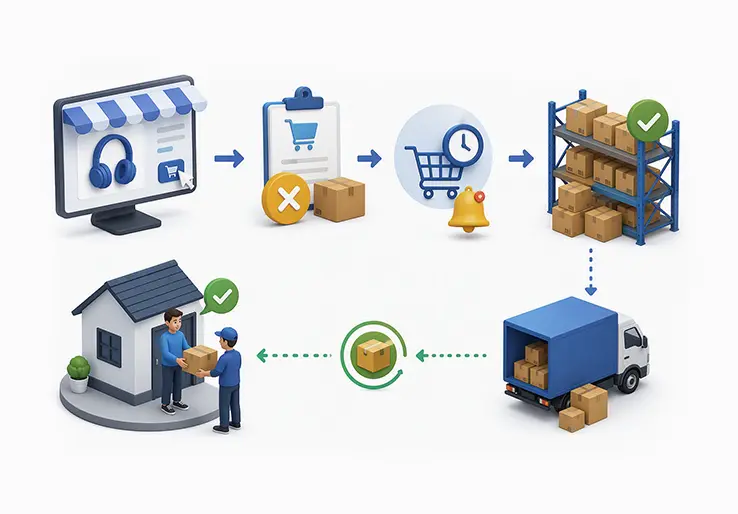
The backorder process kicks off the moment a SKU's available inventory hits zero. Here is what a typical flow looks like from stockout to doorstep delivery.
First, an item sells out online or in-store. The retailer evaluates whether to keep accepting orders based on inventory data, demand forecasting models, and the supplier lead time for replenishment. If the data supports it, the inventory management system flags any new orders as backorders rather than regular shipments. This distinction matters because it changes fulfillment priority, customer messaging, and stock allocation rules.
Next, a purchase order is raised to one or multiple suppliers. The system links that PO's expected arrival date to the queue of waiting backorders. For example, if a customer places a backorder on 1 August 2026 and the supplier lead time is 10 days, the stock arrives around 11 August. Picking, packing, and shipping begin immediately, with dispatch happening between 12 and 14 August.
Partial backorders add complexity. When a customer's order contains three items and only two are in stock, a well-configured system ships the available items first and holds the remaining line for backorder fulfillment. Back orders allow customers to secure a product with a future delivery date without needing to reorder. LOGIC ERP automates FIFO allocation, meaning the oldest backorders get filled first, and triggers notifications to customers at each stage. This reduces overselling, missed backorders, and duplicate shipments that plague manual processes.
Backorders occur whenever customer demand temporarily outpaces available supply. The causes generally fall into three buckets: demand-side, supply-side, and internal process failures.
On the demand side, sudden demand spikes can lead to backorders almost overnight. A viral social post, flash sale, or festive season like Diwali 2026 or Black Friday can generate orders far beyond what any average forecast predicted. Seasonal surges in categories like winter wear, school supplies, or wedding-season outfits in India create predictable but intense volume swings that catch under-prepared retailers off guard. Unusual demand driven by external events also plays a role.
From the supply side, supply chain disruptions often cause backorders. Supplier delays, port congestion, customs holdups, and transport disruptions can push delivery windows out by days or weeks. Production bottlenecks tied to raw materials shortages, machine downtime, or labour issues compound the problem. An estimated 88% of manufacturers cite supply chains as their primary challenge, which directly impacts downstream retail availability.
Internal process issues deserve more attention than they usually get. Inaccurate sales forecasts can result in backorders when planning teams rely only on historical data from last year and ignore current market trends. Insufficient safety stock increases the risk of backorders because there is no buffer when demand or supply deviates from plan. Human error in order entry can create backorders too, whether from miscounts, mis-picks, or data lag between physical stock and what the system shows. Consider a Delhi electronics chain during a sudden smog event: air purifier demand spiked, but the retailer lacked both adequate safety stock levels and alternate suppliers, resulting in weeks-long backlogs and a flood of customer complaints.
Backorders are not just an operational headache. They are a diagnostic signal about how well your inventory management processes actually work.
Moderate, short-duration backorders can indicate positive things. They suggest a strong product-market fit, meaning customers want your products enough to wait. They may also signal that you are running lean inventory efficiently, keeping warehousing costs low without sacrificing too much availability. Early back order placement helps retailers measure demand and adjust inventory forecasting, turning waiting orders into actionable data about future demand.
Frequent or prolonged backorders point to deeper issues. They can reveal weak demand forecasting and planning, inadequate safety stock, unreliable suppliers, or poor coordination between merchandising, procurement, and warehouse teams. When a company's backlog keeps growing despite reorders, something in the planning chain is broken.
Retailers typically track a few key metrics to gauge performance. Backorder rate, calculated as the number of delayed order lines divided by total order lines, reveals how often customers are affected. Average backorder fulfillment time shows how long customers actually wait. Fill rate measures how much demand is met on the first shipment. Stockout frequency by key SKUs identifies which products need the most attention. A modern ERP like LOGIC ERP turns this inventory data into dashboards, letting planners adjust reorder points, safety stock, and supplier allocations based on real patterns rather than guesswork.
Backorders, when managed properly, function as a strategic tool rather than a sign of failure.
The most obvious commercial benefit is revenue preservation. Instead of showing "out of stock" and losing customers to a competitor, backorders can increase sales by allowing continued orders. You capture the dollar figure that would otherwise vanish. Backorders also provide valuable market insights into product demand, giving you real data about which SKUs customers are willing to wait for, which directly refines future sales planning.
On the financial side, backorders can reduce inventory carrying costs for businesses. By not overcommitting to massive stock levels, you avoid holding excess stock that ties up working capital and fills warehouse shelves with slow-moving goods. This is particularly valuable for expensive categories like electronics, branded fashion, or jewellery, where the associated costs of overstocking are significant and improved cash flow matters.
There are marketing benefits too. Backordered products can signal popularity or exclusivity, which increases perceived value. Think of a sneaker brand releasing a limited batch that sells out within hours and then accepting backorders for the next production run. Or a limited-edition festival collection where controlled backorders build anticipation. Backorders help maintain sales during temporary stockouts while simultaneously generating buzz. The key is that the wait feels intentional, not chaotic.
Unmanaged backorders can erode trust faster than almost any other retail failure.
From the customer experience perspective, customers may experience longer wait times for back ordered items compared to in-stock products, and if those wait times are uncertain or poorly communicated, frustration builds quickly. Backorders can lead to customer dissatisfaction if delays are long, resulting in negative reviews, social media complaints, and permanent loss of customer loyalty. Poorly managed back orders can lead to customer frustration and cancellations, which means you lose both the sale and the customer's future business.
Operationally, backorders may result in increased operational workload for staff. Orders need splitting, partial shipments require separate tracking, and warehouse teams must manage complex picking and packing workflows. Human errors like double-shipping, failing to prioritize oldest backorders, or sending incorrect items become more likely under pressure. Support teams face a surge in tickets from customers asking about their backorder status.
Financial risks are equally real. If a customer's credit card has expired payment information during a long backorder window, you may need to update expired payment information before shipping, adding friction and potential chargebacks to payment processing. There is also the overcorrection risk: if a business overreacts to a backorder spike and orders excess inventory, it ends up with slow-moving stock and elevated carrying costs. Not every SKU deserves to be on backorder. Commodity items with easy substitutes should often just show as out of stock, while niche or high-margin products with loyal followings are better candidates for backorders. Clear policies prevent expensive mistakes.
The gap between a well-managed backorder and a customer disaster comes down to communication and process discipline.
Transparent customer communication starts on the product page. Show the backorder status clearly with realistic estimated dispatch dates so customers know exactly what they are agreeing to before checkout. Managing back orders involves clear communication about estimated arrival dates in the order confirmation email, reinforcing that this is not a standard shipment. Communicating estimated delivery dates builds customer trust during backorders because it removes ambiguity, the single biggest driver of customer dissatisfaction.
Service tactics matter just as much. Offer partial shipments at no extra delivery fee when some items in the order are in stock. Give customers the option to wait, switch to an alternative product, or cancel easily. Proactive notifications via email, SMS, or WhatsApp when backordered items ship or when ETAs change keep customers informed rather than leaving them guessing. These small actions help maintain customer satisfaction and resolve customer service issues before they escalate.
Keeping customers engaged during the wait also helps. Share usage tips, styling guides, or how-to content for the upcoming item. If delays extend beyond the original promise, offer small loyalty points or coupons to acknowledge the inconvenience. Customer surveys after backorder fulfillment give you direct feedback to improve. LOGIC ERP can trigger automated alerts and integrate with CRM systems to send personalized updates, ensuring that no backordered order falls through the cracks. Real-time inventory visibility prevents overselling and stockouts, which means fewer surprises for both your team and your customers.
Strong inventory management dramatically lowers both the frequency and duration of backorders.
Demand forecasting is the foundation. Use historical data alongside seasonality patterns, promotional calendars, regional events, and current market trends to predict what your customers will want and when. Relying solely on last year's averages is how backorders happen repeatedly. Real-time inventory data from stores and online channels, processed through tools like demand sensing and forecasting models, gives you a far more accurate picture than spreadsheets ever could.
Safety stock acts as your buffer against the unexpected. It is the extra inventory you hold above expected demand to absorb demand spikes or supply delays. The right level depends on demand variability, supplier lead time variability, and your service level targets. For example, holding 15 to 20 percent extra of your top 50 SKUs before the 2026 festive season can prevent most stockouts in those high-impact categories. Setting safety stock levels too lean, however, leaves you exposed to every supply chain hiccup.
Supplier strategy rounds out the picture. Using multiple suppliers reduces dependency on a single source, which is critical when your primary supplier faces production delays or shipping bottlenecks. Negotiate shorter lead times and better fill rates. Track supplier performance rigorously: on-time delivery, quality issues, and responsiveness during sudden demand spikes. Some retailers also explore drop-ship arrangements or vendor-managed inventory to shift risk. LOGIC ERP supports these strategies with centralised inventory control, multi-supplier purchase planning, and automated reorder point triggers that keep your stock levels aligned with actual demand.
Once replenishment stock arrives, the operational challenge shifts to getting backordered items into customers' hands as fast as possible.
The first rule is reserving incoming stock for existing backorders before releasing anything to general inventory on warehouse shelves. This prevents new orders from pulling units that waiting customers are counting on. Prioritization should be chronological, with the oldest backorders filled first. Batch picking or wave picking allows the warehouse management team to process many backordered orders efficiently rather than handling them one at a time.
Speed techniques make a measurable difference. Cross-docking moves inbound goods directly to outbound docks, bypassing storage entirely. Distributed warehousing or using multiple fulfillment centres closer to customers reduces transit time. During peak seasons, partnering with 3PLs while maintaining data sync through your ERP ensures capacity without chaos.
Technology holds the entire operation together. Barcode or RFID scanning reduces mis-picks for backordered SKUs. Automatic status updates flow back to ecommerce platforms and marketplaces so product pages reflect accurate availability. Consider a national retail chain with a central warehouse and ten stores using LOGIC ERP: a popular phone model sells out centrally, but the system identifies incoming PO delivery dates, assigns units to backorders, triggers transfer requests from stores with remaining stock, and coordinates 3PL shipments. Customers receive status updates throughout. That kind of orchestration across the supply chain is what separates retailers who handle backorders well from those who lose customers over them.
You cannot fix what you do not measure. Tracking backorder KPIs consistently is the only way to know whether your process is improving or quietly getting worse.
Backorder rate measures delayed orders as a percentage of total orders. It tells you how often your customers are affected by stockouts. Average backorder days, the time from order placement to shipment for backordered items, reveals how long customers actually wait. The fill rate on the first shipment shows how much demand you meet immediately. Cancellation rate for backordered orders quantifies how much revenue you are losing because customers gave up.
Interpreting these metrics together is where the real insight lives. A high backorder rate combined with a high cancellation rate is a serious danger sign: customers are not willing to wait, and you are losing customers and future sales. Short backorder times may be perfectly acceptable for high demand products, but long delays erode customer loyalty regardless of how desirable the product is. If only a handful of SKUs account for most of your backorders, the fix might be as simple as adjusting the forecast or adding a backup supplier for those specific items.
The improvement loop is straightforward. Review SKUs with recurring backorders each month or quarter. Adjust demand forecasts, safety stock, and supplier orders based on what the data actually shows, not assumptions. Test policies by enabling backorders on some SKUs while using strict out-of-stock status on others, then compare the impact on revenue and customer satisfaction. Retail analytics dashboards in LOGIC ERP centralise these KPIs for category managers, operations heads, and finance teams, making cross-functional decision-making faster.
Theory is useful, but seeing how backorders play out in practice makes the concepts stick.
A fashion retailer in Mumbai launches a Bollywood-inspired lehenga collection for Diwali 2026. The collection sells out within days online. Several sizes and colours immediately go to the backorder. Because the brand works with multiple suppliers, one local and one regional, they fulfill most sizes within two weeks. Customers who placed backorders receive photos of production progress and proactive ETA updates. For remaining delays, discount vouchers acknowledge the wait. The lesson: dual sourcing and strong customer communication turn a potential brand crisis into a positive experience that builds customer loyalty.
A consumer electronics chain across North India faces a massive spike in air conditioner demand during a May 2026 heatwave. Units fly off warehouse shelves and store floors. Supply shipments are delayed due to transport bottlenecks and import supply chain issues. Many orders move to backorder with estimated shipping times of 14 to 21 days. Some stores with remaining stock offer local pickup. After the peak passes, the retailer adjusts its forecast for the following May, ordering earlier and in larger volume. The lesson: demand forecasting for seasonal trends and climate-driven events, combined with adequate safety stock, could have cut those delays significantly.
A regional health store imports specialty probiotics that get caught in global shipping bottlenecks. The popular line becomes backordered, with customers seeing "More arriving soon" messaging. Some SKUs remain unavailable for weeks while ecommerce businesses selling the same products gain market share. The retailer responds by sourcing from a local alternate manufacturer and offering substitutions. The lesson: supply diversification and transparency are non-negotiable when your primary supplier faces disruption. Relying on a single source and hoping for the best is a strategy that eventually fails.
LOGIC ERP stands out as the best solution for retail businesses aiming to master backorder management and turn inventory challenges into growth opportunities. Here's why LOGIC ERP should be your go-to platform:
LOGIC ERP provides a unified, real-time view of inventory across all sales channels including online stores, physical outlets, warehouses, and incoming shipments. This comprehensive visibility prevents overselling and enables proactive backorder alerts, ensuring your teams can act before stockouts impact customers.
Our platform integrates powerful stock management and demand forecasting tools that leverage historical sales data, seasonality, and market trends. This helps you optimize reorder points and safety stock levels, reducing the frequency and duration of backorders while keeping inventory costs in check.
LOGIC ERP automates the entire backorder lifecycle — from flagging orders as backordered to linking them with purchase orders and supplier lead times. FIFO allocation ensures the oldest backorders are fulfilled first, while automated notifications keep customers informed at every step, enhancing trust and satisfaction.
Diversify your supply base effortlessly with LOGIC ERP's multi-supplier management features. Coordinate purchase orders across vendors, track supplier performance, and negotiate better lead times to minimize supply disruptions that cause backorders.
Keep your customers in the loop with integrated communication workflows. LOGIC ERP supports automated email, SMS, and CRM integrations to provide timely updates on backorder status, estimated delivery dates, and options for partial shipments or cancellations.
Gain actionable insights with dashboards that track key backorder metrics such as backorder rate, average fulfillment time, cancellation rate, and fill rate. Use these analytics to continuously refine your inventory strategy and improve operational efficiency.
Whether you run a single store or a nationwide retail chain, LOGIC ERP scales with your business. Its modular design and cloud-based architecture allow you to expand functionalities as your inventory complexity and customer base grow.
Trusted by numerous retailers across India and beyond, LOGIC ERP's inventory management solutions have helped businesses reduce stockouts, increase sales, and enhance customer loyalty.
By choosing LOGIC ERP, you equip your retail business with the tools and insights needed to manage backorders proactively, maintain customer satisfaction, and drive sustainable growth even in volatile supply chain conditions.
Here is a synthesis of what works, grouped into four themes that cover the full backorder lifecycle.
On data and systems, maintain accurate, real-time inventory data across all sales channels. Centralise your online store, physical stores, warehouses, and incoming purchase orders into a single view. Automate low-stock alerts and reorder points so decision-makers are warned before stockouts happen, not after. An inventory management system that links demand forecasts to actual inventory and pending orders is foundational, not optional. Systems should never provide inaccurate data to the teams relying on them.
For suppliers and logistics, diversify supply sources for critical SKUs and negotiate shorter, more reliable supplier lead times. Plan ahead for demand spikes around festivals, climate events, and promotions by securing capacity early and building safety stock. Monitor supplier performance metrics, specifically on-time delivery, quality, and PO fulfillment, and act on negative trends before they cascade into customer-facing problems.
On customer communication, make sure every product page clearly states when a SKU is backordered, with a realistic estimated dispatch date. Inform customers at checkout, in confirmation emails, and proactively if ETAs change. Offer options: wait, choose alternatives, or cancel. Acknowledge delays with small gestures like coupons or loyalty points.
For policy decisions, decide which SKUs should accept backorders and which should go straight to out of stock. Set maximum waiting periods. Define when backorder status should auto-cancel if not fulfilled. Regularly review SKU-level performance: which products are frequently backordered, which have high cancellation rates, and which drive the most customer complaints.
Technology like LOGIC ERP is an enabler, but process discipline and cross-team coordination matter just as much. Audit your current backorder business processes within the next 30 days. Identify two or three changes, whether in forecasting, supplier management, or customer messaging, and implement them first. Small improvements compound quickly.
Backorders are inevitable in dynamic retail. Customer demand shifts, suppliers stumble, and even the best forecasts miss sometimes. What separates strong retailers from struggling ones is not whether backorders happen but how they are handled.
Understanding the back order meaning and distinguishing it from out of stock and pre-order is the starting point. From there, investing in demand forecasting, accurate inventory data, safety stock, and reliable supplier relationships dramatically reduces how often backorders occur. When they do happen, transparent communication, proactive updates, and flexible options help you meet customer demand without losing customers permanently.
Integrated systems like LOGIC ERP bring these pieces together, from supplier coordination and backorder fulfillment to automated customer updates and performance dashboards. The goal is not to eliminate backorders entirely, which is unrealistic, but to manage them so well that they become a competitive advantage: capturing market insights, retaining revenue during normal inventory fluctuations, and building trust with every order you fulfill. Use what your backorder data tells you, and build a more resilient, customer-centric retail operation in 2026 and beyond.
Call at +91-73411-41176/75 or send us an email at sales@logicerp.com to book a free demo today!
A backorder means a product is temporarily out of stock but still available for purchase. Customers can place an order and secure the item, which will be shipped once new stock arrives. This allows businesses to maintain sales and customer interest during supply shortages.
Backordered items are temporarily unavailable but expected to be restocked within a reasonable timeframe, allowing customers to place orders. Out of stock items have no confirmed restock date and cannot be purchased until replenished. This distinction helps manage customer expectations and sales strategies.
A backorder applies to products previously in stock that have sold out, while a pre-order refers to products not yet released or available for the first time. Both allow customers to buy before physical availability but represent different inventory statuses.
Backorders typically happen due to demand exceeding supply. Common causes include sudden demand spikes, supply chain disruptions, inaccurate sales forecasting, insufficient safety stock, and internal errors such as order entry mistakes or inventory mismanagement.
The duration of backorders varies depending on supplier lead times, production schedules, and shipping processes. It can range from a few days to several weeks. Providing customers with realistic estimated delivery dates and regular updates is essential to maintain trust.
Accepting backorders helps businesses preserve revenue by continuing to sell products despite stockouts. It offers valuable insights into product demand, reduces inventory holding costs, and can enhance brand perception by signaling product popularity or exclusivity.
Poorly managed backorders can cause customer dissatisfaction due to long wait times or unclear communication. Operational challenges include increased workload, risk of order errors, and payment complications. Financial risks involve potential cancellations and excess inventory if demand is overestimated.
Effective backorder management involves real-time inventory visibility, clear customer communication about estimated delivery, offering partial shipments, and using automated systems to prioritize and track backorders. Diversifying suppliers and maintaining safety stock also reduce backorder frequency.
Backorder rate measures the percentage of orders delayed due to backorders. Tracking this KPI helps businesses identify inventory and supply chain issues, enabling data-driven decisions to improve stock availability and customer satisfaction.
Demand forecasting uses historical sales data, market trends, and seasonality to predict future product demand. Accurate forecasting allows retailers to optimize inventory levels, plan purchase orders effectively, and minimize stockouts that lead to backorders.
Safety stock is extra inventory held as a buffer against unexpected demand spikes or supply delays. Maintaining appropriate safety stock levels helps prevent stockouts and reduces the likelihood of backorders, especially during peak seasons or supply chain disruptions.
Using multiple suppliers for critical products decreases dependency on a single source. This diversification mitigates risks from supplier delays or shortages, ensuring more reliable stock replenishment and fewer backorders.
Best practices include displaying backorder status clearly on product pages, providing realistic estimated shipping dates, sending proactive updates via email or SMS, offering options to wait, switch products, or cancel, and acknowledging delays with compensation or loyalty rewards.
Inventory management systems, ERP platforms, and order management software automate backorder tracking, prioritize fulfillment, and synchronize data across sales channels. Integration with customer communication tools ensures timely updates, reducing errors and improving customer experience.
Once stock arrives, backordered items are prioritized for picking and shipping, often using FIFO (first-in, first-out) methods. Partial shipments may be sent if only some items are available. Efficient warehouse management and logistics coordination are crucial for timely delivery.
Yes, customers typically can cancel backorders before shipment if the wait time is too long or circumstances change. Clear cancellation policies and easy processes help maintain goodwill and prevent disputes.
3PL providers can expedite backorder fulfillment through cross-docking and advanced warehouse management. They reduce handling time, improve shipment accuracy, and provide real-time inventory visibility, enhancing overall backorder management efficiency.
Monitor key metrics like backorder rate, average fulfillment time, cancellation rate, and fill rate. Analyze trends to identify problematic SKUs or suppliers. Use insights to refine forecasting, adjust safety stock, and improve supplier coordination for continuous improvement.
Examples include seasonal spikes causing fashion items to sell out, supply chain delays impacting electronics availability, or specialty supplements facing shipping bottlenecks. Each scenario requires tailored strategies like dual sourcing, demand forecasting, and transparent customer communication.
LOGIC ERP offers real-time inventory visibility, automated backorder processing, multi-supplier management, integrated customer communication, and comprehensive analytics. Its scalable platform helps retailers reduce stockouts, improve customer satisfaction, and turn backorders into growth opportunities.
A back order means a product is temporarily out of stock but still available for purchase. Customers can place orders for these items, which will be fulfilled once new inventory arrives. This process helps businesses maintain sales and customer interest during supply shortages by reserving future stock for specific customers.
Inventory data refers to the real-time information about stock levels, product availability, and movement across warehouses and sales channels. Accurate inventory data is crucial for managing back orders effectively because it helps retailers know exactly when stock will run out and when new shipments are expected. This visibility allows businesses to flag backorders promptly, communicate realistic delivery estimates to customers, and avoid overselling.
Demand spikes are sudden increases in customer orders that exceed the available inventory. These can be triggered by factors like seasonal events, marketing campaigns, viral social media posts, or unexpected trends. When demand spikes occur, the existing
Popular Products