Inbound logistics is the complete set of activities responsible for moving raw materials, components, and supplies from external suppliers into a business's production facilities or storage locations — from sourcing and procurement through transportation, receiving, inspection, warehousing, and internal movement.
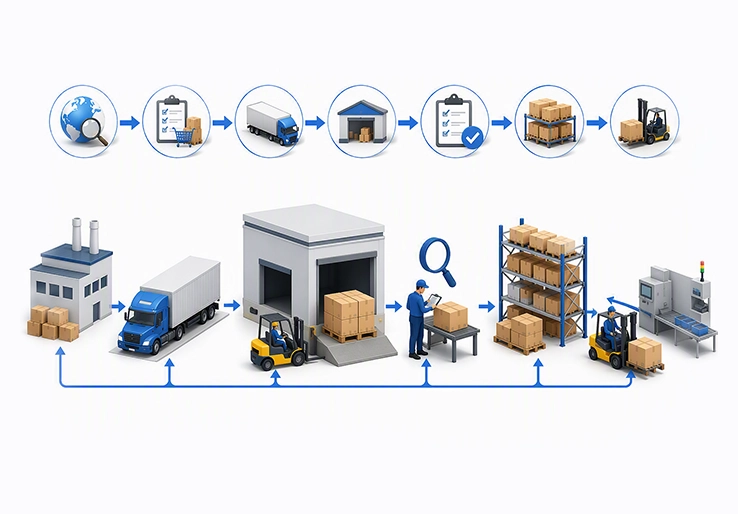
Inbound logistics refers to the complete set of activities responsible for moving raw materials, components, and supplies from external suppliers into a business's production facilities or storage locations. It covers everything from sourcing and procurement through transportation, receiving, inspection, warehousing, and internal movement — ensuring materials are available when needed, at the right quality and cost.
This guide covers the full scope of inbound logistics processes, activities, challenges, benefits, and optimization strategies that businesses need to understand and implement. Whether you operate in manufacturing, retail, food and beverage, or any sector reliant on incoming materials, these principles apply directly to your operations. The target audience includes supply chain managers, procurement professionals, business owners, and operations teams seeking to improve inbound logistics efficiency and reduce costs across their supply chain.
In short: Inbound logistics is the process of receiving, handling, storing, and managing raw materials and supplies from suppliers to support production or business operations. Effective inbound logistics reduces costs and improves supply chain visibility, directly impacting a company's ability to meet customer demand and maintain a competitive advantage.
By the end of this guide, you will:
Inbound logistics is the supply-side component of supply chain management. It deals with all the activities that orchestrate the receipt of goods, materials, and supplies into a business's supply chain — including receiving, storing, and distributing those materials to where they are needed. Inbound logistics involves receiving and storing raw materials, and it plays a foundational role in manufacturing, retail, and service businesses alike.
At its core, inbound logistics brings materials into a business. Every manufacturer needs components to assemble products. Every retailer needs merchandise to stock shelves. Every food service company needs ingredients to prepare meals. Without reliable, efficient inbound logistics, none of these operations can function consistently or profitably.
Understanding the difference between inbound and outbound logistics is essential for managing the complete flow of goods through your organization.
Inbound logistics focuses on receiving and storing goods — bringing raw materials, parts, and supplies from vendors into your facilities. Outbound logistics delivers finished products to customers, handling order processing, packaging, shipping, last mile delivery, and reverse logistics. While inbound logistics deals with supplier relationships and material quality, outbound logistics manages customer orders and delivery reliability.
| Dimension | Inbound Logistics | Outbound Logistics |
|---|---|---|
| Direction | Materials flowing in from suppliers | Finished products going out to customers |
| Key Stakeholders | Suppliers, vendors, carriers | Distributors, retailers, end customers |
| Primary Focus | Material quality, timely delivery, cost control | Order accuracy, delivery speed, customer satisfaction |
| Core Activities | Sourcing, receiving, inspection, storage | Order processing, picking, packing, shipping |
| Key Metrics | Supplier on-time delivery, inbound freight cost | Perfect order rate, order cycle time |
While outbound and inbound logistics serve different functions, they share infrastructure — warehouses, transportation networks, and technology platforms. In many organizations, outbound logistics processes and inbound operations overlap at distribution centers where goods arrive, are processed, and ship out. Outbound logistics refers to the downstream movement toward customers, but its performance depends heavily on how well inbound logistics delivers materials upstream.
Inbound logistics fits within the broader supply chain operations as the upstream foundation upon which production planning, inventory management, and cost control all depend. Poor performance in inbound operations can cascade into production delays, stockouts, excess inventory, waste, and high carrying costs.
Inbound logistics interacts tightly with procurement (supplier selection, contracts), manufacturing (just-in-time delivery, quality verification), planning (demand forecasting), and warehouse operations (put-away, staging). Integration of these functions — often via ERP, TMS, and WMS platforms — is essential for modern supply chain management.
Understanding each process step within inbound logistics allows businesses to identify bottlenecks, design effective standard operating procedures, adopt the right technologies, and benchmark performance — all necessary for optimization and sustained competitive advantage.
The inbound logistics process encompasses a series of interconnected activities, each building on the previous step. A breakdown of every stage — from initial sourcing through consumption — reveals where value is created and where inefficiencies commonly hide.
Every inbound logistics process begins with sourcing and procurement. Inbound logistics includes sourcing, purchasing, and transportation activities, and this first stage sets the foundation for everything that follows.
Supplier selection involves evaluating vendors on price, quality, delivery reliability, capacity, and geographic location. Negotiation establishes pricing agreements, quality requirements, delivery terms, and service-level agreements (SLAs). Contracts may include risk mitigation elements such as capacity visibility, lead time commitments, and tooling arrangements. Supplier management is a key component of inbound logistics — and a crucial one. Strong relationships with suppliers enhance reliability and reduce lead times. Vendor compliance programs establish clear transportation and delivery expectations, while vendor scorecards evaluate supplier performance and identify improvement areas.
Once suppliers are selected, the order management and planning phase coordinates what materials are needed, when, and in what quantities. Purchase order creation, tracking, and communication with suppliers form the backbone of this stage.
Demand forecasting breaks down projections into Bills of Materials (BOM), netting against existing inventory and in-transit stock. Collaborative forecasting involves sharing demand planning data with suppliers for better capacity management. This coordination is critical for aligning procurement with production schedules and reducing excess safety stock. Utilizing data for demand forecasting helps balance inventory levels and prevents both overstock and stockout situations.
Transportation management optimizes the movement of goods in inbound logistics. This stage covers freight coordination, carrier selection, mode choice (air, sea, truck, rail), shipment consolidation, and routing schedules. Advanced elements include Advanced Shipping Notices (ASNs), carrier ETAs, milestone tracking, and exception alerts. Implementing technology improves visibility of incoming shipments, enabling proactive responses to delays.
Receiving involves unloading and inspecting incoming supplies for quality. Dock appointment scheduling prevents congestion, while yard management ensures smooth staging of incoming vehicles. Documentation — packing sheets, bills of lading — is verified and matched against purchase orders. Early inspection of raw materials ensures quality control in production, and regular inspections on incoming materials prevent defective goods from entering production lines.
Consolidating shipments can significantly cut fuel and handling costs in logistics — a straightforward way for companies to reduce transportation costs while improving inbound efficiency.
After receiving, materials move into storage through directed put-away processes. Location assignment follows slotting strategies — placing high-turnover SKUs near production lines or points of use. Inventory tracking relies on RF scanning, barcode or RFID technology, lot/batch tracking, and FEFO (First Expired, First Out) or FIFO protocols.
Inventory control includes managing stock levels, setting replenishment triggers (such as kanban systems for line-side replenishment), and maintaining accurate counts. Integration with a warehouse management system (WMS) and ERP platforms ensures that physical and system inventories stay aligned. Inbound logistics helps maintain optimal inventory levels to avoid over- or understocking, and improved inventory management directly supports production continuity.
The consumption and reconciliation stage closes the loop: materials are issued for production, consumption is tracked, three-way matches (PO, receipt, invoice) are completed, and quality variances trigger feedback loops via supplier scorecards and performance reviews. These interconnected activities form the complete inbound logistics process — and each stage presents potential challenges that businesses must address proactively.
Even well-designed inbound logistics operations encounter obstacles. Understanding these challenges — and the strategies that address them — is essential for continuous improvement across supply chain operations.
Every inbound logistics challenge carries a direct cost: delayed production, inflated inventory costs, damaged goods, or missed customer expectations. In 2019, U.S. businesses spent $1.63 trillion on logistics, underscoring the massive financial stakes involved in getting inbound operations right.
Supplier delays, quality issues, and external disruptions — from geopolitical events to transportation breakdowns — create lead time volatility that ripples across operations. Supplier reliability issues can disrupt supply chains and increase costs substantially.
Solutions: Diversify suppliers to avoid single-source risk. Develop contingency plans and safety stock buffers for critical materials. Consider nearshoring strategies to shorten transportation distances and reduce exposure to international disruptions. Maintain multi-tier supply visibility so disruptions at any level are detected early.
High transportation costs can significantly impact supply chain efficiency. Inbound freight costs, inventory carrying costs, unplanned accessorials (demurrage, detention), and hidden waste from poor visibility all erode margins. Poor visibility can lead to delays and inaccurate stock volumes, compounding cost problems.
Solutions: Implement real-time tracking and supply chain visibility tools. Use a transportation management system to optimize freight operations and analyze total landed cost rather than just purchase price. Optimizing transportation and routing reduces shipping costs, and data-driven dashboards highlight cost anomalies before they compound.
Poor demand forecasting, information silos between procurement, operations, and finance, and lack of collaborative planning with suppliers lead to either excess inventory or stockouts. Surges in deliveries can overwhelm receiving teams and cause backlogs, further disrupting the flow of goods.
Solutions: Integrate ERP and inventory management systems to break down information silos. Share demand data with suppliers through collaborative planning processes. Implement dock scheduling to smooth receiving volumes and prevent bottleneck situations.
Addressing inbound logistics challenges requires a combination of technology, relationships, and process discipline. The following strategies consistently deliver measurable improvements.
ERP systems, transportation management systems (TMS), and warehouse management software form the technology backbone of efficient inbound logistics. These platforms provide real-time inventory tracking, automated purchase order management, supplier portal integration, and analytics dashboards.
Using a Transportation Management System can optimize freight operations through dynamic routing, load optimization, and carrier performance tracking. A warehouse management system (WMS) directs put-away, manages slotting, tracks lot/batch codes, and enforces FEFO/FIFO rules. Automation — including IoT sensors, digital twins, and robotics — extends capabilities further, particularly in high-volume or temperature-controlled environments.
Maintaining strong supplier relationships enhances reliability in inbound logistics. Beyond negotiating favorable terms, effective supplier management involves regular performance reviews, shared capacity planning, and transparent communication.
Strong relationships with suppliers reduce lead times and costs. Vendor scorecards track on-time delivery, quality acceptance rates, and compliance with specifications. When suppliers understand your production schedules and demand patterns, they can better align their own operations — creating mutual benefit.
Establishing standard operating procedures for receiving, quality checks, internal movement, and documentation ensures consistency regardless of which team members are handling the work. Standardized data formats (POs, ASNs), consistent inspection criteria, and lean principles (just-in-time, pull replenishment) reduce variability and waste.
Just-in-time inventory management minimizes excess costs by aligning material arrivals precisely with production needs. Process standardization also makes training faster, auditing simpler, and continuous improvement more systematic.
Inbound logistics varies significantly across industries based on product characteristics, regulatory requirements, and production models. The following examples illustrate how businesses in different sectors apply inbound logistics principles to solve real operational challenges.
Automotive manufacturers operate on extremely tight timing with heavy interdependency on suppliers. A typical automotive assembly line requires thousands of components arriving in precise sequence — any delay can halt production entirely.
An inbound logistics example in automotive involves just-in-time delivery, where suppliers ship components to arrive within hours of when they are needed on production lines. Quality verification happens at the receiving dock, with rigorous defect rate tracking and immediate rejection of non-conforming parts. Joint capacity planning between manufacturer and suppliers ensures that production schedules are aligned with supplier output capabilities. Rising costs and tariff volatility continue to be major concerns impacting automotive inbound logistics, pushing manufacturers toward multi-source strategies and nearshoring.
Effective inbound logistics maintains continuous production by ensuring timely arrival of raw materials — a principle that automotive manufacturers live by every day.
Retailers face SKU proliferation, seasonal demand spikes, and the need for flexible storage strategies. A retail chain managing seasonal merchandise from multiple suppliers must coordinate deliveries across dozens or hundreds of vendors into regional distribution centers.
Inbound logistics covers receiving, allocation, and staging across these facilities. During peak seasons, surges in deliveries can overwhelm receiving teams, making dock appointment scheduling and shipment consolidation critical. Warehouse automation — including high-density storage, automated mobile robots (AMRs), and modular automation — has become essential for handling volume spikes and addressing labor constraints. Efficient inventory management at the distribution center level ensures that the right products reach the right stores at the right time to meet customer demand.
Food and beverage companies face some of the most demanding inbound logistics requirements due to perishability, temperature sensitivity, and strict regulatory compliance.
A dairy distributor using F&B ERP software improved inventory accuracy to 99.7%–99.9%, reduced dispatch prep time by 25–40%, and lowered picker travel in chilled zones by 15–25% after optimizing its inbound process with FEFO rules, batch tracking, and route-based staging. In 2026, F&B firms are dealing with FSMA traceability requirements and elevated cargo theft risks, leading to investment in food-grade hubs with centralized quality governance and real-time monitoring of temperature, lot codes, and shelf life.
These companies are designing hub networks to allow two-day reach across the U.S. population, with standardized operations and lot-level traceability. This inbound logistics example demonstrates how industry-specific requirements shape every aspect of the receiving, storage, and quality control processes.
Digital Twin Application: One distribution center used an AI-powered digital twin system to optimize slotting, dock scheduling, and pick paths. By streaming both inbound and outbound data, they reduced replenishment cycles by approximately 35%, dock congestion by roughly 22.3%, and dock-to-ship time by 15 minutes while achieving approximately 99.91% accuracy in the simulated twin model.
Tracking inbound logistics performance through key performance indicators transforms subjective assessments into actionable data. Without measurement, optimization efforts lack direction and accountability.
| KPI | Description | Target Range |
|---|---|---|
| On-time supplier delivery | Percentage of PO lines delivered by agreed date | 95–98% |
| Inbound lead time | Days from PO placement to material receipt | Industry-specific; minimize variability |
| Receiving cycle time | Hours from truck arrival to put-away completion | Minimize; benchmark against peers |
| Inventory accuracy | Match between physical counts and system records | ≥99% |
| Damage/defect rate | Percentage of inbound materials rejected at inspection | <1% |
| Put-away accuracy | Percentage of materials placed in correct locations | ≥99.5% |
Transportation cost per unit, inventory carrying costs (capital, space, obsolescence, insurance), and total landed cost calculations provide the financial picture of inbound logistics performance. Total landed cost analysis includes freight, duties, insurance, and accessorials — not just purchase price. Companies that track only purchase price miss the true cost picture.
The U.S. inbound logistics market had revenue of approximately $238.1 billion in 2024, expected to reach roughly $338.2 billion by 2030, with a CAGR of about 6%. Transportation is the largest revenue service segment, while procurement services are the fastest-growing segment. U.S. business logistics costs overall reached approximately $2.58 trillion in 2024, around 8.8% of U.S. GDP, with transportation accounting for approximately 64.4% of that spend.
On-time delivery rates, inventory and order accuracy, and receiving cycle times measure the day-to-day execution of inbound logistics operations. High supplier on-time delivery rates (95–98%) correlate with smoother production and lower safety stock requirements. Below that threshold, businesses typically increase buffer stock, driving up inventory costs.
Supplier defect rates, damage rates, and compliance scores measure the quality dimension of inbound logistics. Inventory accuracy above 99% is often necessary in industries with high-volume or high-cost materials — lower accuracy causes stock shortages or overstock situations. Reducing inbound lead time variability improves forecasting accuracy and reduces the need for buffer stocks.
These metrics, tracked consistently and reviewed regularly, help you identify exactly where your inbound logistics processes need improvement and where investments will yield the highest returns.
When all the processes, technologies, and relationships described above work together, the benefits compound across the entire business.
Efficient inbound logistics reduces costs related to transportation and inventory storage. Companies can reduce transportation costs by consolidating shipments, optimizing routes, and negotiating better carrier rates. Lower inventory holding costs result from right-sized safety stock, better demand forecasting, and just-in-time practices. Cost savings also come from reduced damage rates, fewer expedited shipments, and lower accessorial charges. These savings flow directly to the bottom line.
Effective inbound logistics translates into smoother production flow, better labor utilization, and fewer bottlenecks at receiving docks and warehouses. When materials arrive on time and in specification, production schedules run without interruption. Warehouse operations become more predictable, resource allocation improves, and throughput increases. The result is cost efficiency across the entire operation.
Good inbound logistics boosts customer satisfaction by ensuring timely delivery of finished products. When production runs smoothly because materials are always available, businesses can fulfill customer orders reliably, maintain consistent product availability, and reduce lead times. Enhanced customer satisfaction becomes a competitive advantage — customers who receive what they ordered, when they expected it, return and recommend.
Inbound logistics also supports regulatory and quality compliance through traceability, quality assurance, and consistency — particularly critical in food and beverage, pharmaceuticals, and automotive industries. Sustainability gains follow naturally: efficient routes reduce emissions, right-sized inventory reduces waste and obsolescence, and optimized packaging reduces material consumption.
LOGIC ERP offers a complete inbound logistics management solution that helps to streamline and optimize every stage of your supply chain. By integrating advanced technology with industry best practices, LOGIC ERP empowers businesses to gain full visibility and control over their inbound logistics activities, reducing costs and improving operational efficiency.
Key reasons to choose LOGIC ERP for inbound logistics include:
By choosing LOGIC ERP, companies can optimize inbound logistics activities, reduce operational risks, and improve supply chain responsiveness — ultimately supporting smoother production schedules and higher customer satisfaction.
Effective inbound logistics is the upstream foundation of supply chain success and cost control. From sourcing and procurement through transportation, receiving, storage, and consumption, every stage presents opportunities to reduce costs, improve quality, and strengthen resilience. The businesses that treat inbound logistics as a strategic function — not just an operational necessity — consistently outperform those that don't.
Immediate actionable steps:
For organizations looking to extend their optimization efforts, related topics include outbound logistics optimization, integrated supply chain management, reverse logistics strategies, and advanced warehouse automation — each building on the inbound logistics foundation covered here.
Call at +91-73411-41176 / +91-73411-41175 or send us an email at sales@logicerp.com to book a free demo today!
Inbound logistics refers to the processes involved in receiving, handling, storing, and managing raw materials and supplies that enter a business from external suppliers. It encompasses sourcing, procurement, transportation, receiving, inspection, warehousing, and inventory control to ensure materials are available for production or operations at the right time, quality, and cost.
The automotive industry manages outbound logistics by coordinating the distribution of finished vehicles and parts from manufacturing plants to dealerships and customers. This involves order processing, packaging, transportation planning, and last-mile delivery. Due to the complexity and volume, automakers often use advanced logistics software, third-party logistics providers, and just-in-time delivery principles to ensure timely, cost-effective, and damage-free delivery while maintaining high customer satisfaction.
Inbound logistics means the set of activities and processes responsible for bringing raw materials, components, and supplies into a business from suppliers. It focuses on the supply side of the supply chain, including sourcing, purchasing, transportation, receiving, quality inspection, storage, and inventory management to support production and operational continuity.
Inbound logistics focuses on bringing raw materials and supplies from suppliers into a business, covering sourcing, transportation, receiving, and storage. Outbound logistics deals with moving finished products from the business to customers, including order processing, packaging, shipping, and last mile delivery. Inbound logistics deals with supplier-facing activities; outbound logistics manages customer-facing distribution.
Technology improves inbound logistics through real-time shipment tracking, automated purchase order management, warehouse management system (WMS) integration, and data analytics. ERP systems connect procurement, inventory, and production data. Transportation management systems optimize carrier selection and routing. IoT sensors monitor temperature and condition during transit. Together, these tools eliminate information silos and enable proactive decision-making.
The most important KPIs include on-time supplier delivery rate (target: 95–98%), inbound lead time and its variability, receiving cycle time, inventory accuracy (target: ≥99%), damage and defect rates at receiving (target: <1%), and total landed cost per unit. Tracking these metrics consistently reveals where processes need improvement.
Companies manage disruptions through supplier diversification, safety stock buffers for critical materials, nearshoring to reduce transportation distance, contingency planning, and real-time supply chain visibility tools that provide early warning of delays. Multi-tier supply visibility ensures that problems at any supplier level are detected before they halt production.
Supplier management is crucial for effective inbound logistics operations. Strong supplier relationships improve delivery reliability, reduce lead times, and enable collaborative forecasting. Vendor scorecards track performance across quality, delivery, and compliance dimensions. When suppliers are treated as strategic partners rather than transactional vendors, both parties benefit from improved planning and reduced costs.
Companies can reduce transportation costs by consolidating shipments, optimizing routing, negotiating volume-based carrier contracts, shifting modes where feasible (e.g., rail instead of truck for non-urgent shipments), and implementing dock appointment scheduling to reduce detention and demurrage charges. A transportation management system provides the analytics needed to identify and capture these cost savings.
Manufacturing inbound logistics challenges center on just-in-time delivery precision, component quality verification, and production line synchronization. Retail inbound logistics challenges focus on managing inventory levels across many SKUs, handling seasonal volume surges at distribution centers, and coordinating deliveries from numerous suppliers. Both face transportation cost pressures and the need for real-time visibility.
Companies should consider outsourcing to logistics providers when inbound volumes exceed internal capacity, when specialized handling is required (cold chain, hazmat), when geographic expansion makes in-house management impractical, or when the business lacks the technology infrastructure for efficient logistics management. Outsourcing allows companies to leverage provider expertise and scale without the capital investment of building capabilities internally.
Inbound logistics processes involve receiving, handling, storing, and managing raw materials and supplies from suppliers, while outbound logistics processes focus on order processing, packaging, shipping, and delivering finished products to customers. Both inbound and outbound logistics overlap in warehouse management and transportation but have distinct objectives and stakeholders.
Outbound logistics focuses on fulfilling customer orders accurately and delivering products on time, directly impacting customer satisfaction. In contrast, inbound logistics brings supplies into the business to ensure production continuity. Both are important, but outbound logistics operations are more customer-facing.
Outbound logistics operations face challenges such as last-mile delivery complexity, rising transportation costs, and managing returns efficiently. Inbound logistics challenges include supplier reliability, inbound shipping inefficiencies, and surges in deliveries. Understanding these differences helps optimize both processes.
Effective inbound logistics ensures timely replenishment of stock without overstocking, while outbound logistics focuses on efficient order fulfillment and reducing delivery lead times. Together, they improve inventory turnover by balancing supply and demand and minimizing holding costs.
Inventory management order processing integrates demand forecasting, stock control, and order fulfillment activities. It ensures that inbound logistics brings in the right materials and outbound logistics ships out accurate orders, optimizing overall supply chain flow and reducing delays.
Outbound transportation is an important component of outbound logistics operations, influencing delivery speed, cost, and reliability. Optimizing outbound transportation routes and modes reduces expenses and improves customer satisfaction by ensuring timely deliveries.
Inbound logistics brings supplies into the business, while outbound logistics delivers finished goods to customers. The overlap occurs in shared infrastructure such as warehouses, inventory management systems, and transportation networks, requiring coordination to optimize overall supply chain efficiency.
Improved inventory management ensures optimal stock levels, reducing the risk of overstocking or stockouts. This balance supports continuous production and efficient warehouse operations, enhancing overall inbound logistics performance.
Reducing costs can be achieved by consolidating shipments, optimizing transportation routes, negotiating better carrier contracts, and implementing just-in-time inventory practices. Leveraging technology like Transportation Management Systems also helps control expenses.
Key logistics costs include transportation expenses, inventory holding costs, warehousing fees, and costs related to handling and inspection. Effective management aims to minimize these while maintaining service quality and supply chain reliability.
A WMS streamlines receiving, put-away, inventory tracking, and order fulfillment processes. It enhances accuracy, reduces handling times, and provides real-time visibility into stock levels, which helps optimize warehouse space and labor utilization.
While inbound logistics focuses on receiving and storing raw materials, outbound logistics manages the distribution of finished products to customers. Both processes share infrastructure such as warehouses and transportation networks, requiring coordination to optimize supply chain efficiency.
Popular Products