An ecommerce platform lets Indian businesses create, run, and grow an online store — from catalog and GST billing to payments, logistics, and omnichannel operations. This guide covers what it is, how it works, real costs, and which solution fits your business.
Starting an online business in India has become easier than ever, thanks to a robust ecosystem of ecommerce platforms, payment gateways, logistics networks, and social commerce tools. But with so many options available, picking the right ecommerce platform can feel overwhelming.
This guide cuts through the noise. Written by LOGIC ERP for Indian businesses, it covers what an ecommerce platform is, how it works, the features that matter, realistic costs, and which solutions fit which business model. Whether you run a D2C brand, a retail chain, or a B2B distribution business, you will find a clear path forward here.
There is no single best ecommerce platform for every Indian business. The right choice depends on your business model, catalog size, technical expertise, budget, and growth ambitions. That said, for fast-growing brands that want a unified stack spanning online store, marketplace channels, ERP, and retail POS, LOGIC ERP offers a compelling integrated option. It combines ecommerce functionality with inventory, order management, GST-compliant billing, warehouse workflows, and financial accounting in one platform.
Indian SMBs in 2026 typically follow a tri-channel growth strategy: (1) their own ecommerce site built on a modern platform, (2) selling on marketplaces like Amazon India, Flipkart, and Meesho, and (3) social commerce through Instagram, WhatsApp, or ONDC. Each channel serves a different purpose: brand control and margins on your own site, volume and reach via marketplaces, and discovery through social platforms.
Here is a quick breakdown of who should pick what:
India's ecommerce market features both homegrown and global platforms catering to various business models. Popular ecommerce options in India include established marketplaces and independent store builders. This guide will compare them all and help you decide.
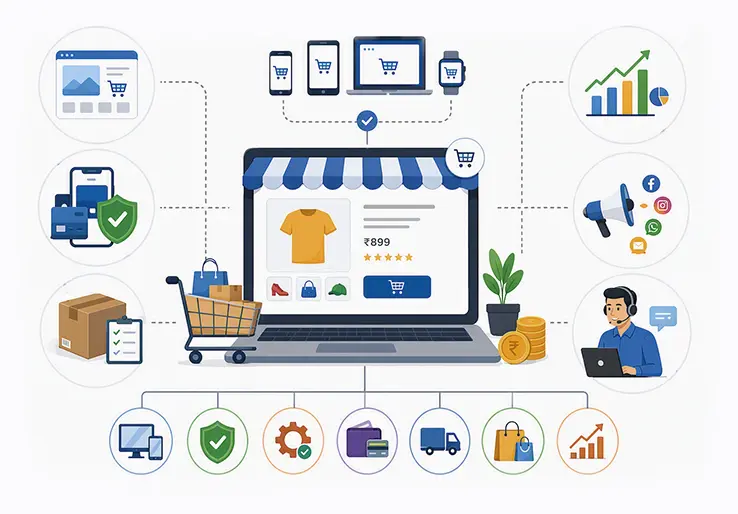
An ecommerce platform is software that lets Indian businesses create, run, and grow an online store or marketplace presence. It handles everything from product cataloging and pricing to GST billing, payments, logistics integration, and customer experience management. In India, this means supporting HSN/SAC codes, multiple GST tax slabs, MRP pricing, UPI payments, and regional courier networks out of the box.
The terms "e commerce platform," "ecommerce software," and "ecommerce solution" are often used interchangeably. In practice, "platform" refers to the core storefront plus backend software, "software" describes specific modules or components, and "solution" implies a bundle of software, services, and integrations. In 2026, most Indian merchants rely on cloud-based SaaS platforms, though a significant minority still use self-hosted open-source setups.
Core modules an ecommerce platform typically includes:
Modern architectures like headless ecommerce (front-end decoupled from backend) and composable commerce (modular microservices) are increasingly relevant for fast-growing Indian brands that need flexibility across mobile apps, websites, and social storefronts.
Modern e-commerce platforms provide a broad spectrum of functionalities to meet diverse business needs. However, certain fundamental features are essential for supporting effective sales strategies and ensuring smooth experiences for both customers and business operators. Below are key foundational use cases critical to e-commerce success.
E-commerce platforms should enhance the customer journey by simplifying product browsing, discovery, and purchase processes. Common front-end features include:
Operational efficiency is vital for scaling an online business. Effective e-commerce platforms include tools to automate and manage critical behind-the-scenes functions:
Data empowers informed decisions. E-commerce platforms offer analytics and integrations to provide insights into performance and customer behavior:
Robust data security is crucial for customer trust and business continuity. Platforms should include built-in safeguards to maintain safe online shopping:
E-commerce platforms come in various forms tailored to the needs of local businesses and global enterprises. The choice depends on organizational goals, transaction volume, and technical capabilities. Common types include:
Selecting the appropriate e-commerce platform involves balancing current operational needs with future growth plans. Considerations include:
By understanding these factors, businesses can build a customer-centric, efficient e-commerce system aligned with their goals and capabilities.
A typical purchase on an Indian ecommerce site follows a straightforward path. A customer arrives via a Google search result or an Instagram ad, lands on a product or category page, uses filters (size, color, price range), selects a product variant, and adds it to the cart. During checkout, they enter a delivery address, the platform runs a pincode serviceability check to confirm delivery feasibility and estimated timeline, and then the customer pays via UPI, card, wallet, COD, or BNPL. They receive a GST-compliant invoice and a shipment tracking link.
Behind the scenes, the backend workflow is where the real complexity lives:
Integrations connect the ecommerce platform to payment gateways like Razorpay, PayU, PhonePe, and Stripe. Logistics partners such as Delhivery, Blue Dart, DTDC, and India Post handle fulfillment. Marketplace integrations with Amazon, Flipkart, and Meesho bring orders from those channels into the same backend, keeping stock synchronized.
LOGIC ERP acts as the system of record in this flow. It provides unified inventory across warehouses, physical stores, and online channels, GST-ready billing, automated financial accounting, and POS for retail stores. Orders from marketplaces and the brand's own ecommerce site are auto-received, stock is reserved in real time, and invoices and shipping info are shared back to the respective platforms.
Indian sellers in 2026 typically choose from three main types of ecommerce platforms, plus marketplaces as a fourth channel. Here is how they compare.
Hosted SaaS Ecommerce Platforms: Platforms like Shopify, Wix, and BigCommerce are examples of a popular ecommerce platform category for Indian sellers because they bundle hosting, security, and software updates. They are fast to launch and require minimal technical maintenance. The trade-off: monthly fees, possible transaction fees on third-party payment providers, and limited deep customization unless you use higher tiers or apps. SaaS platforms are generally best for most direct-to-consumer and small-medium brands.
Self-Hosted Open-Source Ecommerce Platforms: WooCommerce is the most popular ecommerce plugin for WordPress, and it is a free plugin for WordPress sites. Adobe Commerce (Magento Open Source), PrestaShop, and OpenCart also fall in this category. Merchants or their agencies manage hosting, security, scaling, and updates. Advantages include high customization and full control. Challenges include greater technical demands and ongoing maintenance costs. Wix powers 4.3% of all websites on the internet, but WooCommerce dominates among self-hosted setups in India.
Integrated Ecommerce + ERP Platforms: LOGIC ERP is a prime example. The ecommerce engine is tightly connected to modules for inventory management, order management, procurement, warehouse, POS, and financial accounting. This architecture is ideal for omnichannel retailers, manufacturers, and distributors in India who need real-time data consistency across channels.
Marketplace-as-Platform Models: Amazon India, Flipkart, Meesho, Nykaa, and IndiaMART are not "ecommerce platforms" in the software sense, but they are critical sales channels. They offer traffic, trust, logistics support, and COD handling. However, they impose constraints on branding, margin control, and customer data ownership. Many Indian businesses use them alongside their own ecommerce store.
Any ecommerce platform India merchants seriously consider must deliver a core set of features. Later sections go deeper into advanced capabilities, but here is what your checklist should include.
Most ecommerce platforms cover these feature buckets:
Shopify is known for its user-friendly interface and customizable themes. BigCommerce supports various payment options and integrates with third-party apps. LOGIC ERP bundles all these features with retail POS and ERP, making it a strong example of a modern Indian ecommerce solution.
Customizable themes in ecommerce software mean professionally designed templates that you can adapt to your brand without writing CSS and HTML code from scratch. Good platforms offer drag-and-drop layout editors, font and color controls, and industry-specific templates for fashion, electronics, grocery, pharma, auto parts, and B2B catalogs.
In India, the vast majority of online shopping traffic comes from mobile devices on 4G and 5G networks. This makes responsive design, PWA (Progressive Web App) support, and fast page loads non-negotiable. Platforms built mobile-first tend to perform significantly better in tier-2 and tier-3 cities where network latency is higher.
Indian shoppers expect specific UX elements: quick search with autosuggest, smart product filters (size, color, price, brand), variant switchers like color swatches, product reviews, and trust badges for COD and easy returns. Local language support in Hindi, Tamil, Bengali, and other regional languages is increasingly important for reaching non-English-speaking customers.
Shopify offers over 6,000 third-party app integrations through its ecosystem, enabling merchants to add everything from review widgets to loyalty programs. LOGIC ERP's storefront capabilities let merchants adapt themes without coding, align their ecommerce site with offline store branding, and set up multi-storefront configurations for different channels or regions.
Catalog and inventory management features are critical for any ecommerce platform in India, where businesses often sell across multiple warehouses, physical stores, and online channels simultaneously.
A good ecommerce platform must support:
BigCommerce supports up to 600 SKUs per product, making it well-suited for businesses with complex variant structures like apparel or electronics.
Stock control needs go deeper. You need per-location inventory, low-stock alerts, back-in-stock notifications, pre-orders, and real-time sync with your ERP and POS to avoid overselling. Dead and slow-moving stock reports help identify items that need markdown or removal.
LOGIC ERP's integrated inventory and warehouse management ensures ecommerce stock, marketplace stock, and store stock remain consistent. It supports shade/size-wise masters for apparel, batch and MRP-wise stock tracking, and real-time stock sharing with marketplaces. This works for both B2C and B2B ecommerce business models.
The ideal Indian checkout experience prioritizes speed and trust. Here is what the best ecommerce platforms deliver:
Common Indian payment options your platform must support:
Shopify charges a 2% fee for third-party payment providers on its basic plans, which is worth factoring into your cost calculations. BigCommerce includes Level 1 PCI compliance for security, the highest certification level, which means secure transactions are handled natively.
GST billing requirements for Indian ecommerce are specific and non-negotiable. Your platform must handle automatic GST calculation based on state (CGST/SGST for intra-state, IGST for inter-state), correct HSN/SAC codes, proper tax breakups on invoices, and e-invoicing with IRN registration where applicable. Credit note functionality for returns is equally essential.
Integrated ecommerce solutions like LOGIC ERP reduce reconciliation friction by automatically mapping payment gateway settlements, COD remittances, marketplace commissions, and refunds back into the ERP accounting module. This eliminates hours of manual spreadsheet work every week.
Shipping in India is complex. With over 19 lakh PIN codes, not all courier partners deliver to every location. Volumetric weight pricing, high RTO (Return to Origin) costs, and restrictions on size and weight add layers of challenge. Managing multiple courier partners is essential for both reach and cost optimization.
The best ecommerce platforms integrate with Indian logistics aggregators like Shiprocket, Pickrr, NimbusPost, and Shyplite, as well as direct carriers including Delhivery, Blue Dart, DTDC, and India Post. These integrations auto-generate shipping labels, provide real-time tracking links, and handle partial shipments.
Key delivery options your platform should support:
Returns management is where many platforms fall short. Indian customers expect easy returns. Your platform needs to enable online return requests, assign RMA numbers, trigger reverse logistics, and process refunds or store credit. LOGIC ERP handles this end-to-end: returned items are tracked, credit notes or invoices are generated, stock is updated, and financials are reconciled automatically.
Data-driven decisions separate profitable ecommerce businesses from those that bleed money. In India's competitive landscape, monitoring CAC (customer acquisition cost), ROAS (return on ad spend), gross margin, return rates, and channel-wise business performance is not optional.
Essential reports an ecommerce platform should offer:
Integrated ecommerce + ERP solutions like LOGIC ERP go deeper than standalone ecommerce software. They link merchandising data (purchase costs, supplier performance, stock aging) with ecommerce sales analytics in a single dashboard. This means you can see not just revenue, but actual margin per order after factoring in cost of goods, fulfillment, and returns.
For mid-market and enterprise businesses, look for platforms with exportable data, custom report builders, and integration with BI tools like Power BI and Tableau. Forecasting capabilities for demand, seasonality, and return rates are increasingly important for sales trends analysis.
Launching an effective e-commerce platform is more than just going live. E-commerce systems first need a solid foundation grounded in clear business strategies and processes. From setup to long-term management, follow these key steps to maximize return on investment.
Before diving into setup, take the time to clarify the company’s core e-commerce goals. Understanding these objectives will help determine the platform’s ideal structure. For example, is the business launching a new online presence or rapidly expanding to new sales channels? Does the company prioritize deeper customer loyalty or broader outreach? These details can guide teams toward goal-oriented features that cater to their target customer base and sales channels.
Using these clear business goals as a guide, choose an e-commerce platform that aligns with the company’s technical capabilities and business model. Consider factors like customization, scalability, and ease of use. The right system should also work harmoniously with the company’s existing partners and third-party tools. These details help teams determine the best e-commerce hosting model and architecture.
Streamline operations further by connecting the e-commerce platform with other vital back-end tools. For example, CRM systems can use real-time e-commerce data to help teams build customer loyalty and increase lifetime value. ERP integration keeps supply chain, accounting, and inventory teams in sync providing real-time updates on stock levels, order fulfillment, and financial reporting. Integrated analytics tools help leadership track sales performance accurately and understand customer behavior.
Customers need to feel confident about sharing their personal information with e-commerce platforms. Companies also need to comply with international policies surrounding customer data. Ensure the e-commerce platform’s built-in security measures comply with regulations like the Payment Card Industry Data Security Standard and the EU’s General Data Protection Regulation. Regular software updates and backups also prevent fraud and security breaches.
Once the e-commerce platform goes live, focus on driving traffic and conversions. Use SEO capabilities to improve search engine results and attract organic traffic. From there, built-in promotions, discounts, and loyalty management tools can boost engagement and encourage repeat purchases and long-term relationships. Customer data insights also help personalize shopping recommendations and increase sales.
Adapt and scale the e-commerce platform as customer demand grows and company goals shift. To accommodate higher purchase volumes, consider integrating more automation and artificial intelligence (AI) tools to speed up product catalog updates, order processing, and customer service. Additional platform features and extensions can support new goals like entering new markets or launching additional sales channels.
E-commerce platforms are rapidly evolving to meet the demands of a digital-first world. Emerging technologies and shifting consumer behaviors are reshaping how businesses sell and customers shop online. Consider these key innovations for future-proofing e-commerce platforms, helping companies stay competitive and agile.
More e-commerce platforms are prioritizing mobile-first designs as smartphones become the primary device for online browsing and purchases. This means platforms must support faster load times, intuitive navigation, and seamless checkout experiences optimized for smaller screens.
AI e-commerce tools enable smarter shopping experiences powering personalized product recommendations, custom content generation, improved searches, and intelligent customer service. From direct-to-consumer to B2B business models, AI helps companies anticipate customer needs and streamline operations.
VR, or virtual reality, helps transform online shopping into rich, immersive experiences. Customers can explore virtual showrooms, try on products digitally, or visualize items in their space before buying bridging the gap between physical and digital retail.
IoT, or the Internet of Things, is a network connecting physical products and devices to e-commerce platforms. This technology allows customers to buy through their smart home assistants or appliances without touching a computer or smartphone. Businesses can also use the technology to track deliveries with GPS systems and inventory levels through RFID tags and smart shelves.
Understanding customer needs is crucial for narrowing down options when selecting an ecommerce platform. The choice of ecommerce platform in India depends on your technical skill level, budget, and business model. Here is a practical decision framework.
Classify Your Business Type
Map Your Catalog Complexity
How many SKUs? How many variants per product? Do you run seasonal promotions or frequent bulk pricing changes? Do you need bundles or configurable products?
Estimate 12–24 Month Budget
Factor in platform subscription, payment gateway fees, logistics costs, development and customization, marketing tools, and internal operations. The total cost of owning an ecommerce platform includes subscription, payment gateway charges, and development costs.
Assess Your Technical Capacity
Do you have in-house developers or will you rely on an agency? Can you manage hosting, security, and updates, or do you need a managed solution?
Define Growth Plans
Scaling to more regions, stores, or international markets? Adding B2B alongside B2C? Expanding to more marketplaces? Need multi-warehouse, multi-language, or multi-storefront support?
Shortlist 3–4 Platforms
Test demos, check for festival-season load handling, evaluate support quality.
A common strategy is to use marketplaces for customer acquisition while developing an independent store for brand building. Integrated platforms like LOGIC ERP are best where offline POS, warehouses, and multiple channels already exist. Simpler SaaS ecommerce platforms suit micro-brands testing product-market fit.
Total cost of ownership goes far beyond the monthly subscription fee. It includes payment processing fees, logistics and fulfillment, development and customization, app and integration costs, and internal operations costs like staff training and customer service.
Hosted SaaS platform pricing in 2026:
| Tier | Monthly Cost (approx.) | Examples |
|---|---|---|
| Entry / Starter | ₹1,000–₹3,000/month | Basic plans, small catalogs |
| Mid-tier | ₹5,000–₹15,000/month | Advanced features, more apps, lower transaction fees |
| Enterprise | ₹10–20 lakh/year+ | Composable, headless, or enterprise editions |
Specific platform pricing:
Paid plans across platforms vary significantly in what they include. Monthly fees are just one part of the ecommerce website cost equation. Factor in payment gateway fees (typically 1.5–3% per transaction in India), web hosting costs for self-hosted setups, and development costs for customization.
LOGIC ERP typically has a higher upfront implementation cost compared to simple SaaS plans. However, for businesses already managing multiple stores, warehouses, and channels, the long-term savings from eliminating manual reconciliation, reducing integration costs, and avoiding duplicate systems often make it more economical.
Here is an at-a-glance guide to which ecommerce solutions fit which scenario.
Small Catalogs and Beginners: If you are a micro-brand with fewer than 50 SKUs, a simple website builder or SaaS platform is ideal. Shopify, Wix, Instamojo, or Dukaan get you live fast with a free custom domain, pre-built templates, and basic features. Shopify hosts over 1 million online stores globally and has a proven ecosystem. Many offer a free plan or trial to get started.
Content-Driven WordPress Sites: If you already have an existing WordPress site for blogging or content marketing, WooCommerce is a natural fit. It adds ecommerce functionality to your existing website without rebuilding. WooCommerce offers over 800 extensions for added functionality, covering everything from subscriptions to advanced shipping rules. It works especially well for businesses with an existing site generating organic traffic.
Enterprise and Highly Customized Storefronts: Adobe Commerce (Magento) is the go-to for enterprise businesses needing complex storefronts with advanced features, heavy customization, and multi-store setups. Headless or composable architectures work well here. BigCommerce customers see a 211% ROI by year three, and the platform supports multi-storefront functionality natively, allowing management of multiple stores from a single backend. BigCommerce also supports sales channel expansion from B2C to B2B.
Retailers, Brands and Distributors Needing Unified Operations: This is where LOGIC ERP stands out as the best ecommerce solution for Indian businesses with hundreds to thousands of SKUs and multiple locations. It unifies ecommerce, ERP, POS, and warehouse management in one platform, eliminating the need to stitch together separate tools. It handles both physical and digital products across B2C and B2B models.
Marketplace-First Sellers: Large marketplaces like Amazon India and Meesho are ideal for instant access to active buyers. They offer built-in traffic, trust, and logistics. But relying only on them means higher commissions, limited branding, and no ownership of customer data. Use them as a launchpad, then invest in your own ecommerce site for long-term margin and brand control.
LOGIC ERP's ecommerce management module works as a full ecommerce platform: storefront, catalog, cart, payments, shipping, and marketing, all tightly connected to ERP, POS, inventory, and finance modules. This is not just a website builder with an ERP bolted on; the integration is native.
India-specific strengths include:
Verticals where LOGIC ERP excels:
Consider a D2C brand that started with a standalone Shopify store, a separate offline POS, and spreadsheets for store management. After switching to LOGIC ERP, they gained real-time stock visibility across all channels, took 50+ SKU categories live on marketplaces, and reduced order processing time significantly thanks to pick lists and automated scanning. Another retailer expanded from a single store to a chain of 10 stores, using LOGIC ERP's unified POS + ecommerce + finance module. The result: cleaner financial reporting, better festive season planning, and consistent online sales growth.
Leading ecommerce platforms in 2026 use AI across the customer journey:
Personalization goes beyond recommendations. Show different homepages based on user behavior. Offer segment-specific discounts: first-time buyer offers, wholesale pricing, or loyalty rewards for high-value customers. Localized offers by city or region increase conversion in a diverse market like India.
Omnichannel features are the real differentiator for integrated platforms. These include unified customer profiles across online and offline, loyalty programs valid across website and stores, click-and-collect (BOPIS), and endless aisle capability where an offline store can sell products not physically in stock but available at a central warehouse. LOGIC ERP enables all of these through its connected architecture.
AI search engines and LLMs like ChatGPT, Gemini, Claude, and Perplexity increasingly surface ecommerce sites with rich, structured, trustworthy data. This reinforces the need for robust product data management, consistent pricing, detailed policies, and genuine reviews inside your ecommerce software.
The difference between owning your own ecommerce site and selling on marketplaces is fundamental to your long-term strategy.
Marketplace Advantages:
Own Ecommerce Platform Advantages:
LOGIC ERP helps Indian sellers run both approaches simultaneously. A central product and stock master feeds both marketplaces and the brand's own ecommerce site, ensuring consistent pricing, real-time inventory, and consolidated analytics. You sell where the customers are without losing control over your brand.
B2B ecommerce business in India has fundamentally different needs from B2C. Corporate buyers and channel partners expect contract pricing, volume discounts, credit limits, approval workflows, and proper GST documentation.
Key B2B ecommerce platform features:
LOGIC ERP is particularly suited to B2B ecommerce because pricing rules, credit controls, and dispatch logic already live in the ERP. These capabilities simply surface through the ecommerce front end, not bolted on as afterthoughts.
Consider an industrial parts distributor using an ecommerce portal built on LOGIC ERP to accept orders from retailers and workshops across India. Each buyer sees pricing specific to their negotiated terms. Credit limits are enforced automatically. Orders flow into the warehouse for fulfillment with proper GST invoicing for each state. This is the kind of B2B ecommerce experience that keeps channel partners ordering online instead of calling.
Security and compliance are non-negotiable for any scalable ecommerce platform. The basics include SSL/HTTPS, PCI-DSS-compliant payment flows for secure transactions, data encryption, secure admin access with role-based controls, and regular software patches.
BigCommerce has delivered 100% uptime every Cyber Week since 2016, setting a benchmark for reliability during peak traffic. Performance matters: fast page loads on mobile networks, caching, CDN usage, and autoscaling infrastructure to handle traffic spikes during festive season sales and flash sales.
Indian regulatory considerations include:
Integrated systems like LOGIC ERP reduce risk by providing a single source of truth for transactions, tax records, and financials. This simplifies audits and statutory reporting significantly. When your ecommerce data, POS data, and accounting data live in one platform, there are no discrepancies to explain.
If you are currently selling only on marketplaces or running a legacy custom-coded ecommerce website, migration to a modern platform is inevitable as you scale.
Audit Current Systems
Catalog structure, SKUs, historical orders, inventory across stores and warehouses, pricing, customer data, content, and reviews.
Clean Data
Remove duplicates, standardize categories and attributes, update HSN/SAC codes, refresh images and descriptions.
Map Old Workflows to New
Order acceptance, payment reconciliation, shipping, and returns processes.
Plan URL Redirects
Preserve SEO equity by mapping old URLs to new ones. An SEO misstep during migration can erase years of organic ranking.
Choose Phased vs Big-Bang Go-Live
A phased rollout (launch site, keep marketplace integrations, shift traffic gradually) is safer.
Train Staff
Teams need to learn new dashboards, order fulfillment workflows, accounting modules, and POS usage.
Challenges include reconciling inventory across multiple channels, handling pending returns from old systems, and ensuring compliance continuity for past invoices and GST records.
LOGIC ERP implementation partners assist with data migration, integration with existing systems, and change management for omnichannel retail and distribution companies. The goal is to reduce disruption while unlocking the benefits of unified store management.
Several trends will shape the next five years of ecommerce in India:
Generative AI and LLM-based search are changing how product discovery works. Platforms and merchants that invest in structured data, genuine reviews, detailed product content, and transparent policies will have an advantage in being surfaced by AI assistants.
Integrated platforms like LOGIC ERP are well positioned to support these trends with unified data, API-first architecture, and ready-made ecommerce modules designed for Indian regulations and business practices.
Choosing the right ecommerce platform in India is crucial for building a successful online business. With a variety of options from hosted SaaS platforms like Shopify and BigCommerce to self-hosted open-source solutions like WooCommerce, and integrated ecommerce + ERP systems like LOGIC ERP businesses can find tailored solutions that fit their unique needs.
Consider your business model, catalog complexity, budget, and technical expertise when selecting a platform. For fast-growing brands seeking scalability and unified operations, integrated platforms like LOGIC ERP offer comprehensive features including GST-compliant billing, multi-channel inventory management, and seamless marketplace integration.
Small and medium businesses can benefit from user-friendly SaaS platforms that provide quick setup, built-in marketing tools, and reliable ecommerce hosting. Meanwhile, enterprises and B2B sellers may require advanced customization, contract pricing, and multi-storefront support found in enterprise-grade platforms.
Ultimately, a successful ecommerce strategy in India involves balancing marketplace presence with owning your brand’s ecommerce site to maximize margins, customer data control, and long-term growth. By aligning your choice with your operational needs and growth plans, you can future-proof your ecommerce business in the dynamic Indian market.
Call at +91-73411-41176 / +91-73411-41175 or send us an email at sales@logicerp.com to book a free demo today!
An e-commerce platform is software that enables businesses to create, manage, and grow an online store or marketplace. It provides tools for product cataloging, pricing, inventory management, shopping cart and checkout processes, payment gateway integration, shipping and logistics coordination, order management, and customer experience optimization. In India, ecommerce platforms also support GST-compliant billing, regional payment methods like UPI, and local courier integrations.
Using an e-commerce platform offers several advantages:
Choosing the right ecommerce platform involves several steps:
By carefully mapping your needs and resources, you can select an ecommerce platform that supports your business goals efficiently and cost-effectively.
Yes, there are mainly three types of ecommerce platforms used in India:
Additionally, marketplaces like Amazon India and Flipkart act as sales channels rather than software platforms but are critical in the Indian ecommerce ecosystem.
The best ecommerce software for Indian SMBs typically includes popular ecommerce platforms like Shopify, BigCommerce, and Wix. These platforms offer built in SEO tools, free themes, and user-friendly ecommerce website builders that help small businesses sell online effectively. WooCommerce is also a strong choice for businesses with existing WordPress websites.
Some of the more popular ecommerce platforms in India include Shopify, BigCommerce, WooCommerce, Wix, and Magento (Adobe Commerce). Marketplaces like Amazon India, Flipkart, and Meesho remain dominant sales channels but are complemented by these ecommerce platforms for building independent stores.
Ecommerce platforms support marketing strategies through built in SEO tools, integrated email marketing, social media integrations, coupon and discount management, and analytics. Many platforms also offer a built in blog to improve content marketing and organic traffic, helping businesses increase visibility and sales.
Yes, most modern ecommerce platforms support selling both digital and physical products. This flexibility allows businesses to diversify their offerings and cater to various customer needs through a single platform.
An ecommerce website builder is a tool provided by ecommerce platforms that enables users to create and customize their online store without needing advanced coding skills. These builders often include drag-and-drop interfaces, free themes, and templates to help businesses quickly launch their ecommerce site.
Enterprise tools in ecommerce platforms provide advanced features such as multi-storefront management, bulk pricing, custom workflows, and enhanced security. These tools are designed to support larger, established brands with complex operational needs.
Platforms like WooCommerce integrate seamlessly with WordPress websites, converting them into fully functional ecommerce stores. This integration leverages WordPress's content management capabilities alongside ecommerce functionalities, making it ideal for content-driven businesses.
Built in SEO tools help ecommerce platforms optimize product pages, category listings, and blog content to improve search engine rankings. This leads to increased organic traffic, better visibility, and ultimately higher sales.
Free themes are pre-designed templates offered by ecommerce platforms that users can apply to their online stores at no additional cost. These themes provide a professional look and feel while allowing customization to align with brand identity.
Ecommerce platforms provide the necessary infrastructure, tools, and integrations to enable businesses to sell online efficiently. This includes storefront creation, product management, payment processing, shipping logistics, and marketing support, all designed to streamline online selling.
A site builder is a feature within ecommerce platforms that allows users to design and customize their online store's layout and appearance. It simplifies the website creation process, often through drag-and-drop functionality, making it accessible to users without technical expertise.
An ecommerce business is a company that sells products or services online through a digital platform. It involves transactions conducted over the internet, allowing customers to browse, select, and purchase items from the comfort of their homes. Ecommerce businesses can range from small startups to large enterprises and cover various sectors including retail, wholesale, and digital goods.
An ecommerce solution is a comprehensive software or platform that enables businesses to create, manage, and grow their online stores. It includes tools for product catalog management, payment processing, order fulfillment, customer engagement, and marketing. Ecommerce solutions can be hosted (SaaS), self-hosted, or integrated with other business systems like ERP.
Customizable themes are pre-designed website templates offered by ecommerce platforms that businesses can tailor to match their brand identity. These themes allow users to modify layouts, colors, fonts, and images without needing advanced coding skills. Customizable themes help create a unique and professional online storefront that enhances user experience and drives sales.
Adobe Commerce, formerly known as Magento, is a powerful open-source ecommerce platform designed for businesses that require extensive customization and scalability. It offers advanced features for managing complex product catalogs, multi-store setups, and B2B ecommerce. Adobe Commerce provides flexibility through its modular architecture but typically requires technical expertise or developer support for setup and maintenance.
Popular Products