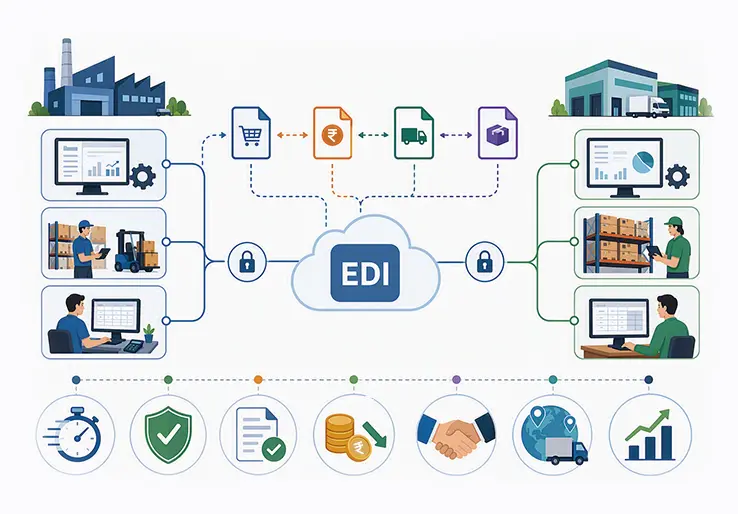
EDI integration connects your EDI system directly to your ERP, WMS, and accounting software — so purchase orders, invoices, and shipping notices flow automatically between trading partners without manual data entry.
EDI integration is the process of connecting electronic data interchange (EDI) systems directly with a company's internal systems — such as ERP, WMS, and accounting software — so that structured business documents like purchase orders, invoices, and advance ship notices flow automatically between trading partners without manual data entry. Rather than simply receiving EDI documents and rekeying them into separate applications, full integration automates the entire document lifecycle from receipt through processing to response.
This guide covers the complete landscape of EDI integration: how the technology works at an architectural level, the measurable benefits it delivers, step-by-step implementation processes, industry-specific use cases in retail, manufacturing, and healthcare, and the most common challenges businesses encounter along the way. It is written for supply chain managers, IT directors, and business leaders who are evaluating how to integrate EDI with their existing enterprise resource planning systems or modernize legacy EDI setups.
In short: EDI integration connects your EDI system to your ERP, WMS, and accounting software so that EDI transactions — purchase orders, invoices, shipping notices, and more — are processed automatically, eliminating paper-based processes and manual processing bottlenecks while improving data accuracy across business operations.
By the end of this article, you will understand:
The core components that make EDI integration work, from translation software to communication protocols.
How to choose between direct ERP integration, cloud platforms, and custom API approaches.
Quantifiable benefits including cost savings, error reduction, and faster order-to-cash cycles.
EDI (electronic data interchange) is the computer to computer exchange of structured business documents in standardized formats between organizations. EDI allows different company computer systems to talk and share information safely, replacing paper documents, fax transmissions, and email attachments with automated electronic exchange. But EDI alone — without integration — only gets documents from point A to point B. EDI integration takes this further by embedding those documents directly into your business processes, ensuring that data flows seamlessly from a trading partner's system into your own internal systems without human intervention.
Core Components of EDI Integration
Several technical layers work together to enable the automated exchange of business documents between trading partners and internal applications:
Translation software is essential for EDI integration with internal systems. It parses incoming EDI documents from their standardized EDI format (such as ANSI X12, maintained within standards developed through the American National Standards Institute framework, or EDIFACT) into a structure your ERP or accounting software can understand, and vice versa. Translation software converts internal data into standardized EDI formats for outbound transmissions. Without it, the data elements within an EDI file remain unreadable to your business applications.
Data mapping aligns internal data fields with EDI standards for accuracy. This involves defining how each segment, loop, and field in an EDI document corresponds to fields in your ERP database — matching a purchase order line item in X12 850 format to the correct product, quantity, and price fields in your order management system.
Communication protocols securely transmit EDI documents between partners. Common methods include AS2 (Applicability Statement 2), secure file transfer protocol (SFTP), and value added network (VAN) services. EDI systems can transmit files via Value-Added Networks (VAN) or cloud-based platforms, each offering different levels of security, reliability, and cost. Data encryption ensures that sensitive business transactions remain protected during data transmission.
Integration middleware serves as the bridge connecting the EDI translation layer to your ERP system, WMS, and other business applications. This layer handles routing, error management, monitoring, and orchestration — ensuring that every EDI transaction reaches the right system and triggers the appropriate business workflow.
EDI envelopes package and address documents for correct routing, using control segments (ISA/IEA in X12, UNB/UNZ in EDIFACT) that identify the sender, receiver, and document type before the actual business data is processed.
Integration vs. Standalone EDI
The difference between standalone EDI and fully integrated EDI is the difference between receiving a fax and having someone type it into your system versus having data appear automatically in the right application, validated and ready for action.
With standalone EDI, a business might receive EDI documents electronically but still rely on staff to read, interpret, and manually enter that data into their ERP or accounting software. This creates data silos — inventory data sits in one system, order information in another, and shipping details in a third. Manual processing introduces delays, increases error rates, and makes real-time visibility nearly impossible.
Fully integrated EDI eliminates these bottlenecks. EDI integration connects trading partners' systems for automated data exchange, meaning an incoming purchase order is automatically validated, mapped to internal formats, and posted in your order management system within minutes — or even seconds. EDI integration supports seamless operations with ERP and WMS systems, creating a single flow of accurate data across your entire supply chain.
Understanding this distinction is critical because the benefits of EDI — cost savings, speed, accuracy — only materialize fully when EDI is integrated rather than bolted on as a separate process. The next section explores exactly how this integration works in practice.
Moving from concept to execution, EDI integration follows a structured data flow: a trading partner's system generates an EDI document in a standardized EDI format, transmits it via a secure communication protocol, and that document passes through translation and mapping layers before arriving as usable data inside your company's internal systems. Outbound flows reverse this process — data from your ERP becomes a properly formatted EDI document sent to your business partners.
EDI Integration Architecture
The technical architecture of EDI integration consists of several interconnected components working as a pipeline:
The EDI translator is the first processing layer. It receives raw EDI data — whether in ANSI X12 (common in North America, maintained by the American National Standards Institute's ASC X12 committee), UN/EDIFACT (developed by the United Nations for international trade), or industry-specific standards like RosettaNet (XML-based, used in high tech industries) or Odette (a standard for the European automotive supply chain). The translator validates syntax, checks for required data elements, generates acknowledgments, and converts the EDI standard format into an intermediate structure.
The integration platform then performs data mapping, transforming the intermediate structure into your internal formats — the specific database schemas, field names, and code tables your ERP or WMS expects. This is where conditional logic handles variations between trading partner implementations of the same standard.
API connections increasingly complement traditional EDI processing. APIs use flexible formats like JSON and XML for data exchange, and many businesses use both EDI and APIs for different needs — EDI for high-volume, repetitive document exchanges like purchase orders and invoices, and APIs for real-time data exchange and custom integrations such as inventory queries or status checks.
Real-time vs. batch processing represents a key architectural decision. Some integrations process documents immediately as they arrive (event-driven or API-triggered), while others accumulate documents and process them in scheduled batch runs. Real-time processing suits time-sensitive scenarios like just-in-time manufacturing; batch processing works well for high-volume, lower-urgency flows like nightly invoice processing.
Common Integration Methods
Businesses typically choose from three primary approaches to integrate EDI with their internal systems:
Direct ERP integration with native connectors is the most streamlined approach. Many major ERP platforms — SAP, Oracle, Microsoft Dynamics — offer built-in EDI modules or certified add-ons that provide pre-built data mapping for common EDI transactions. This reduces complexity and leverages existing system infrastructure. For organizations already running a robust enterprise resource planning platform, native connectors offer the fastest path to integration. Direct EDI (point to point connections) between partners eliminates intermediaries but requires managing each partner connection individually.
Cloud-based integration platforms provide translation, mapping, partner onboarding, and monitoring as a service. These platforms handle the complexity of supporting multiple EDI standards, communication protocols, and trading partner requirements without requiring on-premises infrastructure. Their advantages include scalability — businesses can handle surges in transaction volumes through EDI scalability — automatic updates, and lower upfront investment. An EDI provider offering cloud-based EDI services often includes pre-built connectors to popular ERP systems.
Custom API development suits organizations with unique business requirements or those building modern, microservices-based architectures. This approach uses webhooks, REST APIs, or simple object access protocol (SOAP) services to create tailored integrations. While more flexible, custom development requires deeper technical expertise and ongoing maintenance.
Step-by-Step Integration Process
Implementing EDI integration follows a structured sequence. Initial planning involves stakeholder collaboration on EDI goals, and the process typically unfolds across five phases:
Step 1
Assess Current Systems and Integration Requirements
Inventory your internal systems — ERP, WMS, accounting software — and document their integration capabilities. Identify which trading partners require EDI, which EDI standards they use, what document types (purchase orders, invoices, advance ship notices) are needed, and what volume you expect. Map current manual processes to pinpoint automation opportunities. Trading partner agreements define terms for EDI document exchange, including required document format, timing, and security standards.
Step 2
Choose an Integration Method (Native, Cloud Platform, or Custom)
Based on your assessment, select the approach that aligns with your system maturity, partner count, transaction volume, and budget. Consider whether you need to support both ANSI ASC X12, a North American standard associated with the American National Standards Institute, and EDIFACT for international trading partners. Evaluate EDI software options and EDI solution providers against your specific requirements. Establishing infrastructure includes setting up EDI hardware and software appropriate to your chosen method.
Step 3
Configure Data Mapping Between EDI Documents and Internal Fields
Define how each data element in your EDI documents maps to fields in your ERP system. This includes segment-to-field mapping, code table translations (e.g., converting partner product codes to your internal SKUs), loop handling for line items, and conditional logic for partner-specific variations. Data mapping aligns internal data fields with EDI standards for accuracy — errors here cascade through every transaction.
Step 4
Test Document Flow with Trading Partners
Testing trading partners is crucial before going live with EDI. Exchange test documents, validate that data maps correctly end-to-end, confirm that acknowledgments generate properly, and verify error handling. Start with one or two high-volume partners to validate the integration before expanding. This phase often reveals mapping issues, timing problems, or partner-specific quirks that need resolution.
Step 5
Deploy and Monitor Ongoing Integration Performance
Move to production with monitoring dashboards, alerting for failed transmissions or mapping errors, and defined escalation procedures. EDI integration automates document processing without manual data entry, but it still requires ongoing oversight to catch exceptions, accommodate partner changes, and maintain compliance with evolving standards.
With the technical foundation established, the practical question becomes: what measurable value does EDI integration deliver? The benefits span cost reduction, operational speed, data quality, and strategic supply chain improvements — and they manifest differently across industries.
Key Business Benefits
Cost Savings through Automation
EDI reduces labor costs through automation by eliminating manual data entry, document handling, and error correction. EDI reduces costs associated with paper-based processes — printing, postage, storage, and retrieval of paper documents. Implementing EDI in supply chain management drives major cost savings, with organizations processing thousands of transactions weekly seeing dramatic reductions in cost per document. EDI leads to sustainability by cutting down on paper consumption, an increasingly important consideration for corporate environmental commitments.
Improved Accuracy
EDI minimizes human errors in data processing. When data flows directly from a partner's system to yours through validated mappings, the mistyped quantities, duplicate invoices, and transposed numbers that plague manual processing virtually disappear. EDI improves transaction speed and accuracy simultaneously — faster doesn't mean sloppier when machines handle the data exchange.
Faster Processing Cycles
Faster transaction flows reduce order-to-cash and procure-to-pay cycles significantly. What once took days of mailing, receiving, opening, reading, and keying purchase orders can happen in minutes through automated exchange. EDI provides real-time status updates on orders, shipments, and receipts, giving supply chain teams the visibility they need to make faster decisions.
Enhanced Visibility and Partner Relationships
EDI enhances communication with real-time data exchange, giving all parties in a transaction chain access to current, accurate data exchange. Improved trading partner relationships result from standardized and timely information — when your partners can trust that your data is accurate and your responses are fast, collaboration improves across the entire supply chain. Real time data exchange capabilities feed dashboards, alerting systems, and inventory management platforms with current information.
Compliance and Standardization
EDI enhances compliance by providing standardized electronic transactions that meet industry and regulatory requirements. EDI uses standardized formats like ANSI X12 and EDIFACT, with ANSI X12 forming part of the standards framework associated with the American National Standards Institute, ensuring that exchanging business documents follows established rules recognized across industries and geographies. HIPAA is a subset of ANSI ASC X12 for healthcare data, mandating specific electronic documents for claims, eligibility, and remittance.
Industry-Specific Use Cases
Different industries leverage EDI integration to address their unique operational challenges. Below are three of the most prominent.
Retail and Consumer Goods
In retail, EDI integration is the backbone of supplier-retailer relationships. Automated purchase order processing eliminates days of delay between a retailer generating demand and a supplier receiving and confirming it. EDI documents include purchase orders, invoices, and shipping notices — the core common business documents that keep retail supply chains moving. Inventory synchronization through EDI allows suppliers to monitor retailer stock levels and trigger replenishment automatically, feeding accurate inventory data back into distribution management workflows.
Compliance with major retailer EDI mandates is non-negotiable. Companies like Walmart, Amazon, and Target require their suppliers to transmit EDI documents in specific correct EDI format specifications — typically X12 850 (purchase orders), 810 (invoices), and 856 (advance ship notices). Non-compliant suppliers face chargebacks that can range from hundreds to thousands of dollars per infraction. One retail supplier reported an 85% reduction in EDI-related chargebacks after improving their EDI compliance and onboarding processes through a specialized provider.
Manufacturing
Manufacturing operations depend on EDI for just-in-time inventory management with suppliers. When production schedules are tight — particularly in automotive manufacturing — even small delays in receiving components can halt assembly lines. EDI integration connects demand forecasts, production schedules, and supplier shipment confirmations into a unified flow, supporting procurement processes that minimize carrying costs while preventing stockouts.
Automotive OEMs often require specific EDI standards depending on geography: VDA in Germany, Odette across Europe, EDIFACT or X12 elsewhere. Quality management and recall tracking also benefit from EDI integration, as lot numbers, inspection results, and certification documents can be exchanged electronically with full traceability. Production planning integration with customer demand forecasts becomes far more responsive when EDI data feeds directly into MRP (Material Requirements Planning) modules within the ERP system.
Healthcare
Healthcare represents one of the most regulated EDI environments. Under the Health Insurance Portability and Accountability Act (HIPAA), healthcare claims must be transmitted in X12 formats — 837 for claims, 835 for remittance advice, 270/271 for eligibility verification. This regulatory mandate makes EDI integration not optional but legally required for providers, insurers, and clearinghouses exchanging healthcare data.
Claims processing automation between providers and insurers through EDI integration eliminates the weeks-long delays of paper-based claims submission. Supply chain management for medical devices and pharmaceuticals also relies on EDI for e-procurement, tracking, and serialization compliance. HIPAA-compliant EDI requires secure transport channels, comprehensive audit trails, and strict data security controls — making the choice of communication protocols and data encryption methods particularly critical.
ROI Comparison Table
The following table illustrates the measurable differences between manual or standalone EDI processes and fully integrated EDI across key operational metrics:
Metric
Manual / Standalone EDI
Fully Integrated EDI
Order processing time
Hours to days
Minutes to near real-time
Error rate (orders/invoices)
5–15% or higher
Less than 1–2%
Labor cost per document
High (manual data entry, corrections)
Significantly reduced through automation
Chargebacks from non-compliance
Frequent ($500–$5,000+ per incident)
Minimal with validated, standardized documents
Inventory visibility lag
Delayed (batch, manual reconciliation)
Real-time or near real-time tracking
Customer satisfaction / on-time shipping
Lower due to delays and errors
Higher with fewer processing bottlenecks
Traditional EDI systems allocate 44–61% of engineering and data team effort to maintenance and fixing pipelines rather than new feature development or partner onboarding — highlighting why choosing the right integration architecture matters for long-term operational efficiency.
These quantifiable improvements make a compelling case, but realizing them requires navigating several common implementation challenges.
Even with clear benefits, EDI implementation projects encounter predictable obstacles. Understanding these challenges in advance — and knowing the proven solutions — significantly improves the odds of a smooth deployment.
Legacy System Compatibility Issues
Many businesses still run older ERP systems or homegrown applications that lack modern API support. These systems may rely on proprietary flat file structures with limited documentation, making EDI integration technically complex. The solution is to use cloud-based integration platforms that support older systems through adapters, flat-file connectors, or middleware layers that bridge the gap between legacy data structures and standardized EDI format requirements. API-first approaches enable gradual modernization — wrapping legacy systems with API layers that can interface with modern EDI software without requiring a full system replacement. Organizations evaluating ERP modernization should consider EDI integration capabilities as a core requirement.
Data Mapping Complexity
Data mapping is consistently the most labor-intensive aspect of EDI integration. Even when two trading partners use the same EDI standard, their implementation guides — the specific subset of segments, elements, and codes they require — can differ substantially. Conditional logic, optional fields, and partner-specific code tables create mapping permutations that are difficult to manage at scale. Leverage pre-built connectors and mapping templates for popular ERP systems like SAP, Microsoft Dynamics, and Oracle to accelerate the process. For unique or complex requirements, partner with experienced integration providers who offer version control, partner-specific mapping profiles, and tools to detect schema drift when partners update their specifications.
Trading Partner Onboarding Delays
Each trading partner brings different requirements: different EDI standards, document types, communication protocols, security certificates, and testing procedures. Onboarding delays — especially when managing dozens or hundreds of business partners — can significantly slow time-to-value. Choose managed EDI services that handle partner setup, testing, and certification as part of their offering. Implement phased rollouts starting with high-volume trading partners to realize the largest ROI first, then systematically onboard smaller partners. Trading partner agreements clarify terms and standards for EDI — establishing these early prevents misunderstandings during implementation.
Ongoing Maintenance and Support
EDI integration is not a one-time project. EDI standards evolve, trading partners update their implementation guides, and business requirements shift. Without active monitoring, mapping drift or silent failures can go undetected, leading to missed orders, incorrect invoices, or compliance violations. Select EDI solutions with built-in monitoring, alerting, and error resolution capabilities. Dashboards that track message volumes, success rates, and processing times help teams identify issues proactively. Ensure your EDI provider offers responsive support for mission-critical integrations, particularly during peak transaction periods.
Why Choose LOGIC ERP Software for EDI Integration?
LOGIC ERP stands out as a premier choice for EDI integration due to its comprehensive, industry-tailored solutions that seamlessly connect EDI technology with your existing enterprise systems. Here’s why businesses trust LOGIC ERP for their EDI needs:
Deep Industry Expertise: LOGIC ERP has extensive experience across retail, manufacturing, healthcare, and logistics sectors, ensuring that EDI implementations meet specific regulatory, compliance, and operational requirements unique to each industry.
Robust Integration Capabilities: LOGIC ERP supports native connectors for leading ERP platforms, enabling direct ERP integration with minimal disruption. Its middleware efficiently handles translation, data mapping, and communication protocols, ensuring accurate and timely business document exchange.
Scalable Cloud-Based Solutions: LOGIC ERP offers cloud-based EDI platforms that scale effortlessly with your transaction volumes, providing flexibility to handle surges without additional infrastructure costs. This scalability supports business growth and seasonal demand fluctuations.
Enhanced Data Security and Compliance: LOGIC ERP prioritizes secure communication protocols and data encryption to protect sensitive business information. It complies with industry standards such as HIPAA for healthcare and adheres to global EDI standards like ANSI X12 and EDIFACT.
Streamlined Partner Onboarding and Support: With managed services for trading partner onboarding, testing, and monitoring, LOGIC ERP reduces implementation delays and ongoing maintenance burdens. Their expert support ensures smooth operation and rapid resolution of issues.
Proven ROI and Efficiency Gains: Clients using LOGIC ERP report significant reductions in manual processing errors, faster order-to-cash cycles, and lower operational costs. The platform’s automation capabilities translate into measurable business value.
Future-Ready Technology: LOGIC ERP embraces modern integration trends, including API support alongside traditional EDI, enabling hybrid approaches that maximize flexibility and real-time data exchange.
Choosing LOGIC ERP for EDI integration means partnering with a trusted provider that delivers end-to-end solutions designed to optimize your business document exchange, improve data accuracy, and enhance supply chain visibility all while supporting your growth and compliance needs.
EDI integration transforms the exchange of business documents from a manual, error-prone process into an automated, accurate, and auditable data pipeline connecting your organization with its trading partners. The technology is mature, the standards are well-established, and the benefits — cost savings EDI delivers through reduced labor, fewer errors, faster processing cycles, and improved supply chain visibility — are well-documented across retail, manufacturing, healthcare, and logistics.
Successful EDI integration requires the right technology foundation, experienced partners who understand your industry's EDI standards and compliance requirements, and a phased implementation approach that delivers early wins while building toward comprehensive automation.
For businesses ready to move forward, here are the immediate next steps:
1
Assess current manual processes and identify where exchanging documents electronically would eliminate the most friction — typically high-volume, repetitive business transactions like purchase orders and invoices.
2
Evaluate your ERP system's compatibility and existing integration capabilities to determine whether native connectors, cloud platforms, or custom development is the right path.
3
Research EDI providers with proven experience in your industry who can support the specific EDI standards your trading partners require.
4
Start with a pilot project focusing on your highest-volume trading partners, validate the integration end-to-end, and expand systematically.
Related topics worth exploring as you plan your EDI integration journey include ERP and e-commerce integration for omnichannel operations, supply chain management optimization through ERP, and cloud migration strategies that position your systems for modern, API-enabled EDI architectures.
Data integration is the process of combining data from different sources into a unified view, enabling seamless access and analysis. In the context of EDI, data integration ensures that information exchanged electronically is accurately synchronized across business systems like ERP, WMS, and accounting software, enhancing operational efficiency and decision-making.
EDI improves data integration by automating the exchange of standardized business documents between trading partners and internal systems. This automation eliminates manual data entry errors, ensures consistent data formats, and enables real-time synchronization, resulting in more reliable and timely data across organizational platforms.
Common EDI communication protocols include AS2 (Applicability Statement 2), SFTP (Secure File Transfer Protocol), FTP, HTTP/S, and Value-Added Networks (VANs). These protocols provide secure, reliable methods for transmitting EDI documents between trading partners while maintaining data confidentiality and integrity.
Key EDI standards include ANSI ASC X12, developed under the American National Standards Institute, (widely used in North America), UN/EDIFACT (international standard developed by the United Nations), HIPAA (healthcare-specific subset of X12), RosettaNet (XML-based for high-tech industries), and Odette (for the European automotive supply chain). These standards define the format and structure of electronic business documents.
Translation software converts internal business data into standardized EDI formats and vice versa. It ensures that data from ERP or accounting systems is accurately mapped to EDI documents for outbound transmissions and that incoming EDI messages are translated into formats internal systems can process, enabling seamless data exchange.
EDI integration connects EDI document flows directly with ERP systems, automating order processing, invoicing, and inventory updates. This integration reduces manual data entry, improves transaction accuracy, and provides real-time visibility into supply chain operations within the ERP environment.
Cloud-based EDI integration offers scalability, lower upfront costs, easier maintenance, and remote accessibility. It simplifies onboarding new trading partners, provides automatic updates to standards and protocols, and supports flexible transaction volumes without the need for extensive on-premises infrastructure.
By automating the exchange of standardized documents and integrating with internal systems, EDI integration provides real-time data on order status, shipment tracking, and inventory levels. This enhanced visibility helps businesses make faster, informed decisions and improves collaboration with trading partners.
EDI uses standardized formats like ANSI X12 and EDIFACT for batch processing of high-volume, repetitive transactions, ensuring consistency and compliance. APIs use flexible formats like JSON and XML for real-time, event-driven data exchange and custom integrations. Many businesses use both to meet different operational needs.
Choosing the right EDI integration method depends on your existing systems, trading partner requirements, transaction volume, and budget. Options include direct ERP integration with native connectors, cloud-based EDI platforms, or custom API-based solutions. Evaluate scalability, ease of maintenance, and compliance needs when deciding.
Common challenges include legacy system compatibility, complex data mapping, trading partner onboarding delays, and ongoing maintenance. Addressing these requires choosing flexible integration platforms, leveraging pre-built connectors, phased onboarding strategies, and robust monitoring and support.
EDI integration reduces paper consumption by digitizing business document exchange, lowering printing, mailing, and storage needs. This contributes to environmental sustainability goals by minimizing waste and energy use associated with traditional paper-based processes.
Industries such as retail, manufacturing, healthcare, automotive, logistics, and food and beverage benefit significantly from EDI integration. It streamlines supply chain operations, ensures regulatory compliance, enhances data accuracy, and improves transaction speed across these sectors.
LOGIC ERP offers comprehensive EDI integration solutions with deep industry expertise, scalable cloud platforms, secure communication protocols, and seamless connectivity to leading ERP systems. Their managed services simplify partner onboarding and provide ongoing support for efficient and compliant EDI operations.
Business documents refer to standardized electronic files exchanged between companies to facilitate transactions such as purchase orders, invoices, and shipping notices. These documents replace traditional paper forms, enabling faster, more accurate business communication through automated systems.
EDI documents are electronic business documents formatted according to specific standards like ANSI X12 or EDIFACT. They include transaction types such as purchase orders (850), invoices (810), and advance ship notices (856), allowing seamless data exchange between trading partners' systems.
EDI software is a specialized application that facilitates the creation, transmission, translation, and management of EDI documents. It integrates with internal systems like ERP or accounting software to automate document processing, reduce errors, and ensure compliance with industry standards.
EDI format refers to the standardized structure and syntax used to encode business documents for electronic exchange. Common formats include ANSI X12, widely used in North America, and UN/EDIFACT, the international standard. These formats ensure interoperability between different companies’ systems.
EDI implementation is the process of setting up and integrating EDI technology within a business’s IT infrastructure. It involves selecting appropriate software, configuring data mapping, establishing communication protocols, onboarding trading partners, and testing to ensure seamless document exchange.
EDI Electronic Data Interchange is the automated exchange of standardized business documents between organizations in electronic format. It replaces manual paper-based processes, enhancing transaction speed, accuracy, and operational efficiency across supply chains.
Direct EDI is a method of exchanging EDI documents directly between trading partners’ systems without intermediaries like Value-Added Networks (VANs). It typically uses secure communication protocols such as AS2 or SFTP for real-time, point-to-point data transfer.
An EDI provider offers services and solutions that enable businesses to send, receive, translate, and manage EDI documents. Providers may offer cloud-based platforms, managed services, integration support, and partner onboarding to simplify EDI adoption and maintenance.
Common business documents exchanged via EDI include purchase orders, invoices, advance ship notices, order acknowledgments, inventory updates, and payment remittances. These documents automate critical business workflows, reducing manual effort and improving supply chain visibility.
Additional Resources
EDI integration checklist for ERP system evaluation: Assess your current platform's native EDI support, API availability, connector ecosystem, and scalability for multi-partner deployments.
Industry-specific EDI document standards: ANSI X12 transaction sets for North American commerce within the standards framework associated with the American National Standards Institute, UN/EDIFACT message types for international trade, HIPAA subsets for healthcare, and RosettaNet or Odette for specialized verticals.
ROI estimation framework: Calculate your current per-document processing cost (labor, error correction, chargebacks, paper handling), multiply by transaction volume, and compare against EDI solution pricing to project annual savings.
Implementation case studies: Review documented outcomes from EDI integrations in retail supply chains, manufacturing just-in-time environments, and healthcare claims automation to benchmark expected results for your industry.
Book a Free Demo
LOGIC ERP | India's #1 ERP Software for Retail | Distribution | Manufacturing | WMS