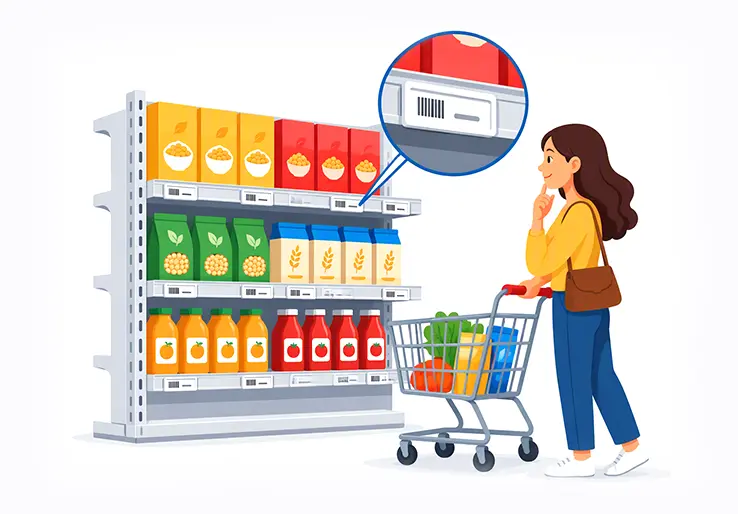
Every product sitting on a retail shelf needs to speak to the shopper walking past it. The shelf edge label is how it does that. Whether you run a single grocery store or manage a multi-location supermarket chain, understanding shelf edge labels — and the technology transforming them — is essential for pricing accuracy, customer satisfaction, and operational efficiency in 2026.
In this guide, we break down the meaning, types, uses, and benefits of shelf edge labels for retailers, covering everything from traditional paper tags to the latest electronic shelf labels and digital shelf edge labels.
What Is a Shelf Edge Label (SEL)? (Definition & Core Meaning)
A shelf edge label (SEL) is a small tag attached to the front edge of a store shelf that displays essential product information — typically the product name, price, barcode, and sometimes promotional details. SEL stands for "Shelf Edge Label" in retail terminology.
The "shelf edge" refers to the front-facing lip or trim of a retail display shelf. The SEL is the insert, printed ticket, or digital display that slides into, clips onto, or is mounted on this strip.
Shelf edge labels display product names, prices, and promotions so shoppers can quickly identify what they are buying and at what cost.
Common synonyms you will encounter include shelf labels, retail shelf labels, shelf price labels, supermarket shelf labels, grocery shelf labels, store shelf labels, shelf tags, and ticket rails (for the holder strip itself).
In short, if a product sits on a shelf, there is almost certainly a shelf edge label next to it.
Why Shelf Edge Labels Matter in Retail Today?
Shelf edge labels sit at the intersection of pricing, marketing, compliance, and customer experience. They are deceptively simple objects that carry outsized importance for the retail industry.
Price Communication and Transparency. Shelf edge labels are the primary way shoppers learn a product’s price before they reach the checkout counter. Clear, accurate pricing eliminates confusion and builds customer trust.
Promotions and Marketing. Retailers use shelf edge labels to flag discounts, bundle deals, and seasonal campaigns directly at the point of decision. Shelf edge labels improve pricing accuracy and promotional flexibility, making it possible to launch or withdraw offers quickly.
Legal and Regulatory Compliance. In markets like India, it is mandatory to display MRP (maximum retail price), inclusive taxes (GST), net quantity, and unit price. Incorrect or missing labels can result in fines and erode customer trust.
Customer Experience. Faster product discovery, transparent pricing, and fewer checkout disputes all contribute to higher customer satisfaction. Synchronized pricing enhances customer trust in retail environments where shoppers expect consistency.
Operational Efficiency. Whether paper or electronic, well-managed shelf labels reduce human error, speed up price execution, and simplify shelf audits and planogram compliance.
The Last Mile of the Pricing Chain. Shelf edge labels are the final step linking back-office ERP and POS pricing decisions to what shoppers see at eye level. They are the bridge between your retail POS software and the customer’s purchasing decisions. Shelf edge labels can facilitate omnichannel consistency between online pricing and in-store prices.
Key Components of a Shelf Edge Label (What Information Appears)
Not all shelf edge labels carry the same data. What appears depends on the format (paper vs electronic), the product category, and local regulations.
Typical Data on Paper Shelf Edge Labels: product name or description, SKU or internal product code, brand name, size or weight (e.g., "500 g," "1 L"), selling price, unit price (per kg or per litre), barcode, promotional text ("Buy One Get One," "20% off"), and offer validity dates.
Additional Fields for Grocery Shelf Labels: MRP (legally required in India), GST or VAT breakdown, pack origin, net quantity, dietary or allergen icons (gluten-free, vegan, halal), and sometimes ingredient highlights.
Information on Electronic Shelf Labels and Digital Shelf Edge Labels: all of the above, plus dynamic elements such as real-time stock levels, discount percentages, member or loyalty pricing, QR codes for mobile interaction, online price parity displays, and LED indicators for promotions. Interactive labels provide additional product information via QR codes, and digital labels can display additional product information via QR codes linking to product pages or mobile apps.
Mandatory vs Optional (Indian Supermarket Example, 2026): Mandatory fields include MRP, net quantity, unit price per specified base (e.g., per 100 g), and product description with all applicable taxes included. Optional fields include promotional messaging, country of origin, allergen symbols, and ratings.
Real-world Example: In a major Indian supermarket chain, a paper shelf edge label typically shows MRP, selling price, net weight, brand, product name, and GST percentage, with an occasional promotional line such as "10% off until 15/09." In a European grocery chain deploying electronic labels, the display shows price, a product icon, loyalty price, online price comparison, stock level indicator, and a color flag (red or yellow) for active promotions.
Types of Shelf Edge Labels (Paper, Plastic, Electronic, Digital)
Retailers can choose from several types of shelf edge labels depending on store format, budget, and operational needs.
Paper and Cardboard Shelf Price Labels. Printed using thermal transfer, inkjet, or laser printers on heavy paper or cardstock, then placed into data strips or plastic rails. Widely used in small and mid-sized retail stores due to low upfront cost.
Plastic and Laminated Labels. More durable than paper labels, used in environments where damage is likely — hardware stores, outdoor goods, freezer sections, or furniture showrooms. These are typically static, holding information that does not change often.
Electronic Shelf Labels (ESL Systems). Tags with e paper display or LCD screens, connected wirelessly to a central system. They update automatically when prices or promotions change. Designed to last years on a single battery, they are the fastest-growing segment in shelf label technology.
Digital Shelf Edge Labels and Digital Shelf Labels. Often used interchangeably with ESLs but tend to emphasize richer content beyond price — images, QR codes, online and offline price parity, loyalty messaging, and full integration with omnichannel retail systems.
Temporary Promo Labels (Shelf Barkers, Wobblers, Ticket Strips). Disposable paper or plastic attention-grabbers placed alongside core shelf edge labels. Retailers use bright colors to highlight discounts and promotions on shelf edge labels, making these promo elements highly visible at the point of purchase.
Paper Shelf Edge Labels: Traditional SELs Still Used in 2026
Traditional paper shelf edge labels remain the most common format across much of the retail sector, especially in markets like India.
These labels are printed on heavy paper or card and inserted into data strips, plastic holders, or clip-on rails along the shelf edge. Standard sizes are aligned to fit common holder widths.
Indian supermarkets managing 8,000 to 15,000 SKUs per store rely heavily on paper shelf labels, particularly for weekly offers and festive promotions.
Advantages: Low upfront cost (printers, paper stock, and rails are inexpensive); simple to understand and deploy; no batteries, electronics, or wireless infrastructure required; functional in any store regardless of digital maturity.
Drawbacks: Manual replacement is labor-intensive and slow; risk of mislabeling (old price left on shelf, wrong label placed); slow promotion rollout; generates significant paper waste and toner or ink consumption; no ability to dynamically update stock information or synchronize with online pricing.
Typical workflow: A price change is triggered in ERP or POS → data is exported to shelf label printing software → template and layout are selected → labels are printed in batches (by department or aisle) → staff physically walk each aisle replacing traditional paper price tags. This process can take hours and is inherently error-prone.
Electronic Shelf Labels (ESL) & Digital Shelf Edge Labels Explained
Electronic shelf labels are wireless electronic price tags mounted on the shelf edge, using e paper display or LCD panels to show pricing and product information. They are updated automatically from a central system, eliminating manual label changes for the vast majority of price updates.
Digital shelf labels and electronic shelf edge labels function like paper SELs in their shelf placement, but update automatically via radio signals (2.4 GHz, Bluetooth Low Energy, proprietary RF) or Wi-Fi. Wireless communication between labels and store gateways ensures data reaches every tag reliably.
ESL systems connect to central pricing platforms for real-time updates. Prices on electronic shelf labels update in real time from a central system, ensuring the correct price is always visible to shoppers.
Most electronic labels are battery-powered, with typical battery life of five to seven years when using e ink technology that only draws power during screen updates. E ink displays are bistable — they consume virtually zero energy when holding a static image.
Core ESL use cases include automatic price changes, synchronized pricing with POS, multi-page product information (normal price, sale price, stock alert), loyalty offers, and dynamic pricing in grocery stores.
Vocabulary clarification: SEL is the broad term covering any shelf edge label, paper or electronic. ESL refers specifically to the electronic subtype. Terms like electronic price tags, digital price tags, and digital shelf labels are practically interchangeable in retail usage.
Electronic shelf labels integrate with existing ERP systems, which means the pricing data managed in platforms like LOGIC ERP flows directly to the shelf edge without manual intervention.
Generations of Electronic Shelf Edge Labels (From LCD to Geo-Location)
ESL technology has evolved through several distinct generations since the late 1990s, each improving display technology, communication, and functionality.
First Generation (mid-1990s to early 2000s). Seven-segment LCD displays showing numeric-only information. Communication relied on infrared reflections, which required line-of-sight. These labels needed constant power to maintain their display, limiting battery life and practicality.
Second Generation (2000s–2010s). Introduction of e paper and e ink displays brought full graphic capability — product names, simple icons, and promotional flags. Communication shifted to RF, Wi-Fi, or ZigBee. Ultra-low power consumption dramatically extended battery life, and e ink technology became the industry standard for readability under store lighting.
Third Generation (2020s onward). Fully connected digital shelf edge labels with four-color e ink displays (black, white, red, yellow), NFC chips, LED indicators, and integration with digital signage, analytics platforms, and people counters. Geo-location and Bluetooth connectivity enable new use cases like in-store navigation and customer engagement.
Emerging Fourth Generation. Batteryless or energy-harvesting ESLs powered by RF or NFC signals, higher resolution color displays, faster refresh rates, and deep AI integration for planogram compliance, automated replenishment triggers, and machine learning analytics.
A typical modern ESL hardware stack includes a low-power microcontroller, an e ink or low-power LCD display, a radio transceiver, a lithium coin cell battery, and sometimes NFC or LED indicators for staff interaction.
The global ESL market has grown from approximately US $0.95 billion in 2022 to a projected US $2.4 billion by 2026, reflecting a compound annual growth rate of around 18.9%. In Europe, adoption is estimated at roughly 80% of supermarkets, while the US sits at only 5–10%.
How Electronic Shelf Edge Labels Work (End-to-End ESL System)?
An ESL system consists of three main components: the labels themselves, wireless infrastructure (gateways and transceivers in-store), and ESL management software integrated with ERP or POS systems.
Communication Flow
A price or promotion change is made in the central system (ERP, pricing engine, or POS). The update is pushed to the ESL management platform, packaged for transmission, and sent to store gateways. Gateways broadcast wireless signals to individual electronic labels, which refresh their screens accordingly.
Update Speed
Price updates can be pushed to thousands of labels in seconds. Individual ESLs typically update in under five seconds for small payloads. Prices can be updated in real time across all labels, making store-wide promotional rollouts a matter of minutes rather than hours.
Multi-template Capability
Each ESL can store and display multiple templates or "pages" — a standard price view, a promotional price view, a staff-facing stock alert, or a loyalty price overlay — all controlled from a central dashboard.
Security and Reliability
Communication between gateways and labels is encrypted to protect pricing data and prevent tampering. Labels acknowledge receipt of updates, and the management system monitors battery status, signal quality, and display health. If a tag fails, alerts are triggered so staff can intervene.
Shelf Edge Labels in Grocery Stores & Supermarkets
Grocery retail is the single largest user of shelf edge labels — both paper and electronic — because of high SKU counts, frequent promotions, and perishable inventory.
Daily and Hourly Pricing Adjustments. Fresh produce, meat, dairy, and bakery items near expiry require rapid markdowns. Dynamic pricing helps reduce waste for perishable goods by making it economically attractive for shoppers to buy items before they expire.
Festival and Seasonal Promotions. In India, activity around Diwali, Holi, and other festivals drives massive promotional campaigns across thousands of products. Grocery shelf labels need to reflect these offers instantly.
Scale Challenge. Managing 10,000 or more paper shelf labels per store is labor-intensive and error-prone. A centralized ESL system can push changes across all aisles simultaneously, turning a multi-day effort into a few clicks.
Regulatory and Trust Aspects. Electronic shelf labels reduce checkout disputes to near zero because the price on the shelf always matches the price at the POS. This is critical in supermarket operations where MRP compliance, offer validity dates, and allergen or ingredient information are under scrutiny.
Customer Experience. Modern grocery shelf labels — whether paper or electronic — improve customer experience by ensuring transparent pricing, reducing complaints at checkout, and providing relevant information at the point of decision.
What are Shelf Edge Labels Used For? (Core Retail Use Cases)
Shelf edge labels serve multiple functions across retail stores, supermarkets, pharmacies, and specialty retailers.
Product Identification. Each shelf label links items on the shelf to database records via barcode or QR codes, enabling staff to scan and verify product placement during shelf audits and inventory checks. Shelf edge labels assist in inventory management by allowing staff to verify product placement quickly.
Shelf Edge Pricing. Labels show the standard price, promotional price, unit price per kg or litre, and loyalty pricing where applicable. Customers benefit from clear, accurate, and real-time pricing information that helps them make confident purchasing decisions.
Promotions and Marketing. Shelf edge labels highlight discounts, bundle offers, multi-buy deals ("Buy 2 Get 1 Free"), and seasonal advertising campaigns. Retailers use bright colors to draw attention to active offers and influence purchasing decisions at the shelf.
Inventory and Operations. ESLs can display real-time stock levels to improve inventory management, signal restocking priorities, confirm planogram positions, and support pick-by-light functionality in warehouses and dark stores. This turns the shelf edge into a live operational tool, not just a customer-facing display.
Omnichannel Alignment. Ensuring shelf edge label retail prices match online and app prices avoids conflicts, returns, and customer frustration. This is a growing priority as omnichannel retail strategies mature across the retail industry.
Benefits of Shelf Edge Labels for Retailers (Paper & Electronic)
The business case for investing in shelf edge labels — particularly electronic ones — spans revenue, cost reduction, customer experience, and regulatory compliance.
Customer Experience. Clear prices, fewer disputes, easier product comparison, and better product information all contribute to higher customer satisfaction. Electronic labels improve customer trust in pricing consistency, especially when prices are synchronized across the entire chain.
Operational Efficiency. Electronic shelf labels reduce manual label changes by 90%, freeing staff from tedious aisle walks and allowing them to focus on higher value tasks like customer service. Integration with inventory management systems enhances operational efficiency across the store.
Pricing Accuracy. Electronic shelf labels eliminate manual pricing errors in retail. Fewer errors between ERP price, POS price, and what shoppers see on the shelf edge means electronic labels eliminate pricing discrepancies at checkout. Retailers report significant improvements in pricing accuracy with ESLs.
Labor Cost Savings. Electronic shelf labels reduce labor costs by up to 80%, translating paper-and-toner expenses plus staff hours into significant labor savings over time. Labor savings from ESLs allow staff to focus on customer service and other higher value tasks.
Marketing Agility. Electronic shelf labels enable rapid price changes for promotions. Retailers can launch or withdraw promotional campaigns in minutes, test offers regionally, and run A/B experiments without new print runs.
Compliance and Audit Trail. ESL systems log every price change — when it occurred, who initiated it, and what value was applied. This documentation is invaluable for regulatory checks, internal controls, and audit readiness.
Sustainability. Electronic shelf labels reduce the ongoing consumption of paper and ink. Electronic shelf labels reduce paper waste significantly, supporting environmental goals and reducing the store’s material costs over time. This reduction in paper waste aligns with growing sustainability expectations in the retail sector.
Paper Shelf Labels vs Electronic Shelf Labels (SEL vs ESL)
Many retailers in 2026 are weighing shelf edge label vs electronic shelf label as a strategic investment. Here is how the two compare across key dimensions.
Initial Investment. Paper shelf labels require minimal hardware — a printer, paper stock, and plastic rails. ESL systems demand purchasing display tags, wireless gateway infrastructure, and software licenses.
Ongoing Labor Cost. Paper labels carry high recurring costs: staff must print and physically swap labels for every price change. ESL systems allow centralized control of pricing across multiple stores, drastically reducing manual overhead. Electronic shelf labels reduce manual data entry errors significantly.
Speed and Agility. ESLs update instantly or on a schedule. Paper labels require manual replacement that can take hours or days, particularly during large promotional campaigns.
Accuracy. Traditional paper tags are prone to human error — wrong label, old price left on shelf, misalignment with POS. Real-time updates enhance pricing accuracy for customers, and electronic shelf labels reduce checkout pricing discrepancies to near zero.
Sustainability. Paper labels generate ongoing paper waste and toner consumption. ESLs produce some electronic waste at end of life but dramatically reduce consumables during their 5–7 year lifespan.
Suitability. Small single-store retailers with low SKU variety or static pricing may find traditional pricing labels and paper SELs more cost-effective. Large supermarket chains, electronics stores, and retailers with frequent price changes benefit most from ESL systems. Hybrid models are common — paper shelf edge labels for slow-moving categories and digital shelf edge labels for high-change zones like fresh produce, promotions, and electronics.
ESLs support dynamic pricing and omnichannel pricing strategies that are simply not realistic with manual paper label changes.
Dynamic Pricing & Advanced Use Cases with Digital Shelf Edge Labels
One of the most compelling reasons to adopt digital shelf edge labels is their ability to support dynamic pricing — adjusting shelf edge pricing multiple times per day based on demand, stock, competitor activity, and time of day.
Concrete Examples. Evening markdowns on fresh bakery items. Surge pricing on high-demand products during festival weekends. Clearance pricing for soon-to-expire inventory. Prices can be adjusted in real-time based on demand, enabling pricing strategies that directly increase sales and reduce waste.
Rule-based Automation. ESL systems connect to product pricing software and retail pricing management systems integrated with ERP. Rules can factor in cost, margin targets, demand forecasts, competitor pricing, and stock levels. Dynamic pricing strategies improve overall store performance by optimizing margins while remaining competitive.
Competitor Responsiveness. Retailers can adjust prices based on competitor activity instantly, an advantage that is impossible with paper tags and manual processes.
Omnichannel Price Synchronization. Digital shelf labels ensure the same price appears on the app, website, and physical shelf, improving customer trust. A store manager can verify price parity across channels from a single dashboard.
Experimentation. Retailers can A/B test promotions in specific stores or micro-regions, run time-limited flash sales, or create localized promotional offers tailored to specific demographics — all without a single new print run.
Whether you use paper or electronic labels, managing shelf edge labels at scale requires a structured system combining software, templates, hardware, and clear processes.
What is a Shelf Label Management System? It is a combination of software, design templates, printers (for paper) or ESL gateways (for electronic), and workflows that control all shelf price labels across a store or an entire chain.
Paper Label Workflow. A price update occurs in the ERP → the shelf label printing software generates a label batch → the appropriate layout and barcode standard are applied → data is merged → labels are printed → staff replace traditional paper tags on the shop floor. Quality checks ensure legibility and barcode scan-ability.
ESL Management Software. For electronic labels, the software maps each tag to a specific SKU, manages display templates, schedules wireless updates, monitors battery life and signal quality, and logs every change for audit purposes. Integration with inventory systems enhances operational efficiency across the board.
ERP Systems as the Backbone. The ERP or POS system is the single source of truth for product data, pricing, tax, and promotions. Connecting this to the shelf label system — whether paper or ESL — ensures that the correct price reaches the shelf edge without manual intervention, eliminating manual label changes in the process.
How LOGIC ERP Supports Shelf Edge Label & ESL Systems?
LOGIC ERP serves as a centralized retail and ERP platform that manages product, price, promotion, and inventory data — all the inputs that shelf edge labels need.
Paper SEL Generation. LOGIC ERP can produce accurate shelf price labels for paper SELs, including supermarket shelf labels and grocery shelf labels with India-specific fields like MRP, GST breakdown, unit price, and net quantity. Predefined label templates and batch printing capabilities streamline the process.
ESL Integration. Through open APIs and connectors, LOGIC ERP can push price updates directly to ESL management systems and gateways. When a price or promotion changes in LOGIC ERP, the update flows automatically to digital displays on the shelf edge — no manual data entry required.
Barcode and Standards Support. LOGIC ERP supports standard barcode formats including EAN-13, Code 128, and QR codes, ensuring compatibility with both paper and electronic labels across product ranges.
Multi-store Roll-outs. For chains, LOGIC ERP enables central head office control over label content, templates, and pricing rules, while individual stores maintain their hardware and physical labels.
Commercial Benefits. Retailers using LOGIC ERP for shelf label management gain reduced manual work, faster promotion execution, higher pricing accuracy, lower labor costs, and readiness for a digital shelf transformation.
Choosing the Right Shelf Edge Label System for Your Store
Selecting the right shelf label system is a strategic decision. Here are the key criteria to evaluate.
Store Profile. Consider your store size, SKU count, frequency of price changes, promotional activity volume, number of locations, available budget, and IT maturity. A high-volume supermarket with thousands of SKUs and weekly promotions has very different needs than a boutique with 500 items and stable pricing.
Display Hardware. Choose between e ink displays (excellent readability, ultra-low power, long battery life), LCD (faster refresh, potentially color), or paper (lowest cost, highest labor). Consider whether you need color displays, how the labels perform in freezer sections, and whether NFC or LED indicators add value.
Wireless Communication. Evaluate protocols — BLE, sub-GHz RF, Wi-Fi, or the emerging Bluetooth ESL Profile standard (Bluetooth Core 5.4) that promotes interoperability and reduces vendor lock-in.
Software Integration. Ensure the shelf label system connects smoothly with your ERP systems (such as LOGIC ERP) and POS for real-time price updates. Look for template management, deployment scheduling, remote monitoring, and compliance reporting.
Phased Roadmap. Start with high-ROI categories — perishables, promotions, high-velocity SKUs — where ESLs deliver the fastest payback. Keep paper SELs in slow-moving, static categories. Scale gradually, monitoring ROI, user acceptance, and tag reliability.
Future of Shelf Edge Labels & Digital Shelf Technology
The shelf edge is becoming one of the smartest surfaces in retail. Here is what is coming next.
Smarter ESLs. Labels with NFC and Bluetooth will enable customer engagement directly at the shelf — tap a label with your phone to see reviews, nutritional details, or personalized recommendations. These interactive digital displays transform a passive price tag into an active sales tool.
Display Advances. E ink technology continues to evolve with higher resolution, more colors, faster refresh rates, and extended battery life. Energy efficient designs and solar-powered ESLs are on the horizon, further reducing the environmental footprint.
IoT and Smart Stores. ESLs linked to cameras, sensors, RFID, and inventory management systems will enable automated replenishment, planogram compliance verification, and real-time stock information across the entire chain.
AI-driven Pricing. Pricing engines powered by AI will work with ESL systems to automate dynamic pricing while protecting margins and ensuring compliance. These systems will analyze demand patterns, competitor activity, and stock levels to recommend or auto-apply up to date pricing in real time.
Standardization. The Bluetooth ESL Profile 1.0 is driving interoperability among vendors, moving the industry away from proprietary systems toward open protocols that lower costs and reduce vendor lock-in.
Combining a robust ERP like LOGIC ERP with modern shelf edge label systems positions retailers for a data-driven, omnichannel future where the digital shelf and the physical shelf are one and the same.
The shelf edge label may be a small piece of retail infrastructure, but its impact on profitability, compliance, and customer experience is anything but small. Whether you start with paper or go fully digital, the key is connecting your labels to a reliable ERP backbone that keeps pricing accurate, promotions agile, and customers happy.
Ready to streamline your shelf edge label management? Explore LOGIC ERP’s retail solutions to see how centralized pricing, label printing, and ESL integration can transform your store operations.
Shelf edge labels, though small in size, are vital components in retail operations that significantly impact pricing accuracy, customer trust, and operational efficiency. As retail evolves towards greater digitization, the transition from traditional paper labels to electronic and digital shelf edge labels offers numerous advantages. These include real-time price updates, dynamic pricing capabilities, reduced labor costs, and enhanced customer experience through clear, accurate, and interactive product information.
Electronic shelf labels (ESLs) integrate seamlessly with modern POS and ERP systems, enabling retailers to synchronize pricing across multiple channels and stores effortlessly. They support compliance with legal requirements, reduce errors at checkout, and facilitate agile promotional strategies that can be deployed instantly. Moreover, the sustainability benefits of reducing paper waste and ink consumption align with growing environmental concerns.
For retailers, choosing the right shelf edge label system depends on store size, SKU complexity, pricing dynamics, and budget. While paper labels remain suitable for smaller or low-change environments, ESLs offer superior scalability and efficiency for supermarkets and large retail chains.
Looking ahead, advancements in ESL technology, such as NFC interactivity, solar-powered displays, AI-driven pricing, and integration with IoT and smart store ecosystems, promise to further transform the retail shelf into a dynamic, customer-engaging platform.
By leveraging shelf edge labels effectively, retailers can enhance shopper satisfaction, streamline operations, and future-proof their business in an increasingly competitive market. Investing in integrated shelf edge label solutions, supported by robust ERP platforms like LOGIC ERP, is a strategic step towards a more efficient, transparent, and customer-centric retail environment.
A shelf edge label (SEL) is a small tag attached to the front edge of a retail shelf displaying key product information such as price, product name, barcode, and promotional details. It helps customers quickly identify product pricing and details.
Shelf edge labels include traditional paper labels, plastic or laminated labels, electronic shelf labels (ESLs) with e-ink or LCD displays, and digital shelf labels that offer richer content like images and QR codes.
ESLs are battery-powered digital displays connected wirelessly to a central system. Price and product information is updated remotely in real time, eliminating manual label changes and improving pricing accuracy.
They ensure pricing transparency, improve customer trust, support promotional campaigns, enhance operational efficiency, and help retailers comply with legal pricing display requirements.
Yes, modern shelf edge label systems integrate seamlessly with POS and ERP software, enabling automatic price updates and synchronization across all sales channels.
ESLs reduce labor costs by up to 80%, minimize pricing errors, enable dynamic pricing strategies, improve customer experience with real-time accurate pricing, and reduce paper waste.
They are especially beneficial for high SKU count stores like supermarkets with frequent price changes, but smaller stores with stable pricing may still prefer traditional paper labels or a hybrid approach.
Digital shelf edge labels allow retailers to adjust prices multiple times daily based on demand, stock levels, competitor prices, or time of day, helping reduce waste and optimize margins.
Common info includes product name, selling price, unit price, barcode, promotional messages, stock availability, loyalty pricing, and QR codes for additional product details.
Using shelf label management software integrated with ERP and POS systems automates label printing or electronic updates, tracks changes, monitors battery status, and ensures audit compliance.
Future trends include NFC-enabled interactive labels, higher-resolution color displays, solar-powered ESLs, AI-driven dynamic pricing, and deeper integration with IoT and smart store technologies.
They provide clear, accurate, and real-time pricing, reduce checkout disputes, highlight promotions effectively, and offer additional product information via QR codes or NFC interaction.
The Electronic Shelf Label (ESL) market is a rapidly growing segment within retail technology, driven by increasing demand for real-time price updates, operational efficiency, and enhanced customer experience. Valued at nearly $1 billion in 2022, it is projected to reach over $2.4 billion by 2026, reflecting strong adoption globally, especially in Europe where up to 80% of supermarkets use ESLs. Growth is fueled by retailers seeking to reduce labor costs, improve pricing accuracy, and implement dynamic pricing strategies.
Inventory information integration with shelf edge labels enables real-time display of stock levels directly on the labels, helping staff and customers know product availability instantly. ESL systems connect with inventory management and ERP platforms to update shelf labels automatically when stock changes occur. This integration supports efficient restocking, reduces out-of-stock situations, and enhances operational workflows by turning shelf labels into live inventory indicators.
Shelf edge labels can display a variety of promotional information including discount percentages, "Buy One Get One" offers, bundle deals, seasonal campaign highlights, and limited-time flash sales. Electronic and digital labels can use color coding, flashing icons, or LED indicators to draw attention to promotions. They can also offer validity dates and loyalty pricing, helping retailers communicate marketing messages effectively at the point of purchase.
Manual labor significantly impacts shelf label management, especially with traditional paper labels. Staff must print, cut, sort, and physically replace labels for every price change, which is time-consuming, labor-intensive, and prone to errors like mislabeling or outdated prices. This process slows down promotional rollouts and increases operational costs. Electronic shelf labels reduce manual labor by automating price updates, freeing staff to focus on customer service and other value-added tasks.
Digital shelf labels are electronic displays mounted on retail shelves that show product information such as prices, promotions, and stock levels. Unlike traditional paper labels, digital shelf labels update wirelessly and in real time from a central system, enabling dynamic pricing and richer content including images, QR codes, and loyalty messages. They improve pricing accuracy, operational efficiency, and customer engagement.
Shelf edge labels enhance customer experience by providing clear, accurate, and real-time pricing information that reduces confusion and checkout disputes. Electronic labels highlight promotions effectively using colors and icons, helping customers make informed purchasing decisions. Interactive features such as QR codes or NFC enable access to additional product details, reviews, or personalized offers, creating a more engaging and trustworthy shopping environment.
E Ink technology is a low-power electronic paper display technology used widely in electronic shelf labels. It mimics the appearance of ink on paper, offering high readability under various lighting conditions without glare. E Ink displays consume power only when updating the screen, enabling ESLs to operate for 5 to 7 years on a single battery. This technology is ideal for shelf labels as it provides clear, stable images with minimal energy use, making electronic price updates efficient and sustainable.
SEL stands for Shelf Edge Label. It is the general term for any label — paper, plastic, or electronic — mounted on the front edge of a retail shelf. A shelf label is not the same as a price tag (which may hang from the product itself) or a product label (which is printed on the packaging by the manufacturer).
Use shelf label printing software connected to your ERP or POS. Export product data (name, SKU, price, unit price, MRP, net weight), select a template sized to your data strip holders, and print. Standard sizes and formats ensure clean insertion into shelf rails.
Choose a printer type based on your needs: laser for high-volume batches, thermal transfer for durable labels, or inkjet for color. Print in batches organized by department or aisle. Run quality checks for legibility, barcode scan-ability, and data accuracy before distributing to the shop floor.
Large chains use centralized shelf label management teams. ERP and POS integration automates the export of label change data. Store-level staff handle physical replacement and periodic audits of shelf edge pricing vs POS pricing. Price coordinators verify accuracy especially during major promotional campaigns.
Not always. High-volume supermarkets, electronics retail stores, and chains with frequent price changes benefit most. Smaller stores with low SKU variety or static pricing may find paper SELs more cost-effective. Many retailers adopt a hybrid approach, using digital labels for energy efficient, high-change categories and paper for static ones.