Discover the Everyday Low Price (EDLP) strategy, its benefits, challenges, and how LOGIC ERP helps retailers implement and manage this pricing approach effectively for better inventory, pricing, and sales performance.
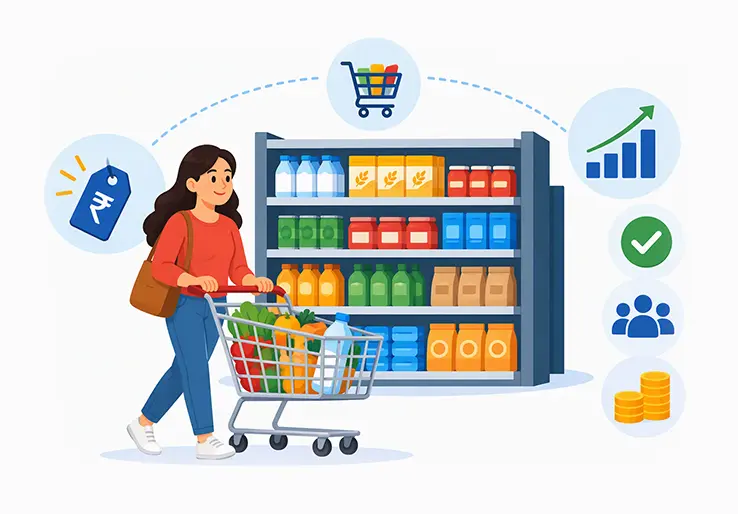
Choosing the right pricing strategy can make or break a retail business. Everyday low price (EDLP) is a retail pricing strategy where products are offered at consistently low prices instead of relying on frequent promotions or temporary discounts. For retailers and retail business managers weighing pricing strategy, inventory control, and sales performance, EDLP affects far more than shelf pricing. It shapes purchasing, inventory planning, demand forecasting, marketing costs, customer trust, and even store culture. This guide explains How the Everyday Low Pricing Strategy Works, how it compares with high-low pricing, its benefits and risks, which product categories suit it best, how it impacts inventory management, which KPIs to track, and how retail technology like LOGIC ERP supports EDLP at scale to improve operational efficiency and profitability.
Everyday Low Pricing (EDLP) is a retail pricing strategy in which products are offered at consistently low prices instead of relying on frequent promotions, temporary discounts, or periodic sale events. The goal is to give customers confidence that the price they see today is close to the lowest they will find — without waiting for a coupon or a weekend deal.
Under an everyday low pricing strategy, a retailer sets a stable low price on core SKUs — think staples like rice, detergent, cooking oil, or toiletries — rather than cycling between a high "regular" price and a discounted "sale" price. EDLP maintains consistently low prices without promotional sales, making the value proposition simple and transparent.
The concept became widely known through Walmart’s EDLP strategy, which began in the 1960s with Sam Walton’s first stores and expanded into a global model. Today, EDLP is used by grocery chains, discount retailers, big-box stores, and e-commerce platforms worldwide. It applies equally to brick-and-mortar stores, online channels, and omnichannel retail environments where customers expect the same low price regardless of how they shop.
The core goals behind EDLP are straightforward:
LOGIC ERP works with retailers who use both everyday low pricing and high-low pricing models. Its configurable pricing rules, multiple price lists, and margin protection features allow businesses to define and manage either approach — or a hybrid of both.
The primary alternative to EDLP is High-Low (Hi-Lo) pricing. Understanding the differences between these two pricing strategies is essential before choosing one.
High-low pricing involves initially high prices followed by temporary discounts. Retailers set a higher list price on items and then drive volume through periodic promotions — festival sales, "buy one get one" offers, weekend doorbusters, end-of-season clearance, and flash discounts. High-low pricing creates urgency through promotional events, encouraging customers to act fast when prices drop.
EDLP takes the opposite approach. It maintains stable low prices year-round. Price swings are minimal, and changes happen only when input costs, taxes, or inflation force an adjustment — not because of a promotional calendar.
The customer expectations under each model are distinct. EDLP shoppers look for fairness, predictability, and the assurance that they are getting fair value every visit. Hi-Lo shoppers, on the other hand, enjoy the hunt — browsing ads, comparing coupons, and timing purchases around sale events. Research from Lal and Rao (1997) found that EDLP stores perform better with time-constrained shoppers, while Hi-Lo tactics appeal to deal-chasing consumers willing to invest effort for the best deal.
Operationally, EDLP stabilizes demand and eases inventory management, while Hi-Lo requires strong promotion planning, advertising coordination, and careful markdown control to manage unsold promotional stock. High-low pricing can lead to higher profits during sales peaks, but it also creates demand troughs between promotions.
Many modern retailers use a hybrid model: EDLP on essentials like milk, bread, and eggs, and promotional pricing on discretionary items like fashion, electronics, and seasonal merchandise. This lets them balance steady sales with promotional excitement.
An EDLP strategy operates through a structured flow — from supplier cost analysis to shelf price and ongoing monitoring. Here is how it typically works:
EDLP requires tight cost control and stable supplier relationships, and an EDLP strategy relies on high-volume sales, disciplined inventory management, and customer trust to stay profitable. The strategy relies on historical sales data (ideally 12–24 months), competitive price benchmarks, demand elasticity estimates, and customer base analysis to determine which categories can sustain an everyday low price. Ultimately, EDLP becomes part of the broader business model — purchasing, assortment, store format, and supply chain must all support the consistent low price promise.
An effective EDLP strategy shares several defining characteristics:
When implemented well, the benefits of EDLP span customer perception, operations, and financial predictability. However, these advantages assume proper cost control, reliable inventory management, and accurate demand data. EDLP is not a silver bullet — it rewards disciplined execution.
The main benefits include stronger customer trust, simpler decision-making for shoppers, better demand forecasting, streamlined operations, and more stable revenue trends. Retailers like Walmart in the US, Aldi in Germany, and Reliance Smart in India have used EDLP to drive consistent footfall and basket size.
EDLP reduces marketing costs by eliminating promotional campaigns — fewer flyers, SMS blasts, and digital banners — allowing budgets to shift toward brand building, customer experience, and technology. Let’s break these benefits down.
EDLP builds customer trust through consistent pricing. When shoppers see the same low price for months on staples like 5 kg atta, 1 L cooking oil, or cleaning supplies, they develop confidence that they are getting fair value without needing to track promotional cycles.
This trust translates into customer loyalty. Shoppers who know they will get a fair price every visit are less likely to comparison-shop across multiple stores. EDLP attracts price-sensitive customers seeking consistent value — particularly family shoppers managing a monthly budget and small business buyers like kiranas or cafés purchasing in bulk. Walmart, for example, serves approximately 150 million US customers every week who rely on its EDLP promise.
Everyday low pricing reduces the cognitive load of comparing leaflets, apps, and loyalty offers across multiple stores. Customers save money and time simultaneously.
Consider a simple scenario: a weekly grocery trip where the shopper knows their supermarket keeps detergent at ₹295 every day, instead of swinging between ₹340 and ₹260 depending on whether a promotion is running. There is no need to plan trips around sale events or clip coupons. This convenience leads to higher visit frequency and larger average basket size. Simpler pricing signage and fewer exceptions also reduce confusion at checkout and customer service counters.
EDLP improves demand forecasting by smoothing sales patterns. Stable pricing eliminates the artificial demand spikes and troughs caused by promotions, making forecasting models significantly more accurate.
Under high-low pricing, retailers often face overstock before promotions and stockouts during sale events. EDLP avoids both extremes. A 1994 US supermarket study found that a 10% EDLP price decrease in a product category increased sales by approximately 3%, with demand remaining stable and predictable over time. Accurate demand forecasting is crucial for successful EDLP, and the smoother demand curve directly improves inventory turnover, stock availability, and carrying cost.
LOGIC ERP’s inventory management and reporting capabilities help retailers analyze fast-moving versus slow-moving items, making it easier to manage stock for EDLP categories.
A retailer moving from weekly "deal" flyers to a core EDLP message can meaningfully reduce spend on print, digital promotions, and in-store markdown labor. EDLP reduces marketing costs by eliminating the cycle of creating, distributing, and managing promotional campaigns.
Walmart and Aldi both invest more in supply chain efficiencies than in constant promotional advertising. For multi-store chains, the administrative cost of frequent price updates — relabeling, POS changes, staff coordination — is substantial. EDLP cuts these lower marketing costs free for reinvestment into customer experience, loyalty programs, and technology such as modern POS systems and ERP platforms.
EDLP is not universally suitable. It carries structural risks around margins, competitiveness, and brand perception. Businesses must carefully align EDLP with their customer segments, product mix, and operational capabilities before committing.
High-level risks include thinner margins, limited pricing flexibility, quality perception issues, vulnerability to aggressive competitors, and dependency on high volume. EDLP can lead to undesirable competitive price responses and price wars if competitors feel pressured to match or undercut.
Perhaps the most cited cautionary example: JCPenney’s 2012 switch to EDLP caused a 25% revenue collapse. Customers accustomed to deals and coupons interpreted the change as a loss of value, and sales dropped sharply before the company reversed course. The lesson is clear — switching pricing strategies without managing customer expectations is dangerous.
EDLP can lead to lower profit margins due to consistent pricing. Selling all units at a low price removes the "margin cushion" that comes from full-price sales in a high-low model.
Consider a simple example: a product that sells at ₹200 regular and ₹150 during promotions under Hi-Lo pricing. Under EDLP, the everyday price might settle at ₹155. The retailer permanently gives up the margin earned on units sold at ₹200. Volume dependency creates breakeven fragility in EDLP businesses — if sales volume doesn’t increase enough to compensate, net profitability declines. Walmart’s gross margin is approximately 24% under EDLP, which works at their enormous scale but would be difficult for a smaller retailer with slim margins and limited buying power.
Detailed cost and margin simulations using ERP or BI tools are essential before adopting an EDLP price level. Without scale discounts and efficient operations, the margin squeeze can be severe.
EDLP removes pricing flexibility to respond to competitors’ promotions. In highly competitive markets, this rigidity can be a liability.
Online price comparisons through marketplaces and price-check apps can quickly expose an "everyday low price" that is not actually the lowest. If a competitor undercuts the EDLP price on key visible items, customer trust erodes, and retailers can lose credibility for failing to keep competitive prices through consistent market benchmarking. Ongoing competitive monitoring and periodic price reviews are non-negotiable to maintain credibility and a strong competitive position.
LOGIC ERP can support store-wise and category-level reporting for this purpose, though retailers may also use external price intelligence tools to benchmark against the market.
In some categories — electronics, cosmetics, fashion — persistent low pricing can signal "cheap" or low quality to certain customer segments. A high price often serves as a quality cue, and removing it can hurt brand perception.
Retailers must counter this by emphasizing value: reliable sourcing, decent quality, clear product information. Combining EDLP on basics with curated, higher-margin or premium ranges helps maintain an aspirational brand image. Communication — both in-store and online — should highlight the value story, not just the low price tag.
EDLP depends heavily on accurate inventory management. Overstocking ties up capital, while stockouts break the "always available, always low price" promise. EDLP requires tight cost control and steady supply chains to keep anchor items consistently in stock.
Perishable or highly seasonal items (fresh produce, fashion apparel) can be risky under strict EDLP because they often need markdown strategies to clear aging stock. Retailers should use real-time stock visibility, automated reorder levels, and aging stock reports to keep EDLP inventory healthy. LOGIC ERP’s inventory management module is designed to provide such controls across stores and warehouses.
EDLP works best in markets with price-sensitive customers and on products with frequent, predictable demand.
Well-Suited Categories Include:
These categories fit because of high purchase frequency, stable year-round demand, and strong price comparison behavior by shoppers. Trader Joe’s uses a low-price strategy with curated items in this space, focusing on everyday essentials with a limited but well-chosen assortment.
Categories Less Suited to EDLP:
Retailers should segment their catalog, applying EDLP selectively to essentials while using mixed or high-low pricing elsewhere. ERP sales analysis can identify items with stable demand curves and low seasonal variation as prime EDLP candidates.
Long-term EDLP success — as demonstrated by Walmart, Aldi, Costco, and IKEA — depends on "Everyday Low Cost" (EDLC) as much as low everyday prices. You cannot sustain low selling prices on a high-cost structure indefinitely.
The structural levers include:
Costco operates on a membership-driven EDLP model with capped margins around 14%, relying on membership fees and bulk-pack formats rather than high per-unit margins. Aldi limits SKUs to maintain its EDLP strategy, typically stocking around 1,400 items versus 30,000+ in a conventional supermarket. IKEA applies EDLP principles through cost-effective product design, flat-pack logistics, and self-service store formats.
Before shifting to EDLP, management should model unit economics, overhead absorption, and supplier terms using ERP and BI tools. LOGIC ERP provides integrated purchase, inventory, and sales data required for such holistic evaluations.
Pricing and inventory management are deeply linked, especially under a stable-price model. When prices don’t fluctuate, demand becomes more uniform over time, and the entire inventory planning process benefits.
EDLP generally leads to smoother sales curves, enabling better forecasts, more stable reorder points, and improved inventory turnover. Without promotional spikes, safety stock calculations become more reliable, and the risk of emergency procurement and high logistics costs drops significantly.
Key inventory tasks under EDLP include:
Real-time stock visibility across stores and warehouses is critical. A stockout on an anchor EDLP item — say, a 1 kg detergent that is always supposed to be ₹95 — directly undermines the price promise. LOGIC ERP’s stock-level dashboards, demand planning features, and alerts for low stock on EDLP SKUs help retailers keep availability high.
To see how these two pricing strategies play out, consider a 1 L shampoo bottle over an entire year.
Under EDLP, the retailer sets a stable everyday price of ₹260. This is the price every day, every week, every month. No flyers, no coupon codes, no "this weekend only" banners.
Under high-low pricing, the same bottle carries a regular price of ₹310. Each month, one or two promotions reduce it to ₹230 for a few days. Outside the promotion window, the customer sees the full price of ₹310.
The customer perception differs sharply. EDLP customers believe they get fair value without having to time their purchase. Hi-Lo customers may feel the regular price is inflated and tend to wait for deals, reducing purchases outside promotional windows. When demand fluctuates this way, sales cycles become harder to predict.
The inventory impact is equally different. Hi-Lo requires building stock before promotions and managing leftover inventory through markdowns afterward. EDLP requires a stable replenishment rhythm, good forecasting, and consistent stock availability year-round.
For marketing, high-low pricing needs frequent ad campaigns, promotional slots, and in-store signage updates. EDLP focuses on a simple, repeatable "low price always" message — cutting promotional complexity and the associated costs.
Many retailers combine both approaches by category. Software like LOGIC ERP must support both everyday low and promotional price lists, enabling multi-store retail management with flexible pricing rules.
Here is a practical step-by-step guide for retailers considering EDLP:
Analyze Product Demand and Price Sensitivity
Use 12–24 months of sales data to identify categories where customers are most price-driven. Look for items with high purchase frequency and strong competitive dynamics.
Calculate Sustainable Everyday Low Prices
Build a detailed cost model per SKU — purchase cost, tax, logistics, and target gross margin. Determine the low pricing strategy that covers all costs while remaining attractive.
Negotiate with Suppliers
Pursue volume discounts, long-term contracts, and private label opportunities to support lower purchase costs. Shift from vendor promotional funding to lower base costs from merchandise suppliers.
Configure EDLP Price Lists Centrally in ERP/POS
Ensure price consistency across all stores and channels. Define approval workflows and override processes for local competitive pressures.
Communicate the EDLP Promise
In-store signage, online messaging, and customer-facing campaigns should clearly explain the new pricing approach. Educate store staff to handle questions about "no sale" policies.
Monitor KPIs and Adjust
Track volume, margin, inventory turnover, customer purchase frequency, and stock availability. Adjust the EDLP assortment or prices based on data, not instinct.
Before launching EDLP, ensure you have:
EDLP success must be measured continuously. Tracking the right KPIs lets retailers confirm whether the strategy is delivering steady sales, sustainable margins, and reliable stock availability — or whether adjustments are needed.
| KPI | Why It Matters |
|---|---|
| Sales volume and revenue | Measures unit movement in EDLP vs non-EDLP categories |
| Gross margin and margin per sq. ft. | Ensures profitability despite lower per-unit margins |
| Inventory turnover | Tracks how quickly EDLP SKUs move through stock |
| Stock availability | Monitors whether EDLP items are consistently in-stock |
| Customer purchase frequency | Indicates whether EDLP drives more frequent visits |
| Average basket size | Shows if customers are buying more per trip |
| Price perception (surveys/NPS) | Confirms whether customers recognize and value the EDLP promise |
| Annual revenue by category | Enables comparison on a monthly basis and year-over-year |
LOGIC ERP provides many of these analytics through its sales, inventory, and store-wise reporting tools, feeding into dashboards for ongoing performance review.
EDLP requires tight integration between pricing, inventory management, purchasing, and POS systems. Without a single source of truth, price consistency breaks down across stores and channels.
A centralized ERP allows retailers to define everyday low price lists once and push them consistently to all connected POS terminals, online channels, and mobile apps. Digital controls — approval workflows for price changes, validity dates, and store-wise overrides — ensure governance while allowing necessary local flexibility.
Software also connects purchase cost updates to margin alerts. When a supplier raises costs, the system flags affected EDLP SKUs for price review. Near real-time sales and inventory data support continuous monitoring, letting retailers adjust assortment or stock levels before problems become visible to customers.
Modern solutions like LOGIC ERP also support integration with external tools — price intelligence platforms, e-commerce marketplaces — to help EDLP retailers keep prices competitive in market conditions that shift quickly.
LOGIC ERP is an integrated retail platform covering POS, inventory, purchasing, pricing, and analytics. For retailers running an EDLP model, several capabilities are directly relevant:
Everyday low pricing is a powerful retail pricing strategy built on consistent low prices, disciplined cost control, and a clear value proposition for shoppers. But it is far more than a number on a shelf tag. EDLP affects the entire business model — purchasing, supply chain, marketing, inventory management, and how customers perceive your brand.
EDLP is not automatically better than high-low pricing. Its success depends on your product mix, customer base, market competition, and operational readiness. For price sensitive customers buying staples at high frequency, EDLP can be a strong competitive position. For premium or seasonal categories, a hybrid or promotional approach may be more effective.
The retailers who win with EDLP are the ones who build every part of their operation around the promise of consistent value — backed by the data and systems to keep that promise.
If you are evaluating your current pricing strategy, start by reviewing your demand data, cost structure, and inventory processes. LOGIC ERP’s retail POS, inventory management, and pricing features give you the tools to test and scale an everyday low pricing strategy with confidence — or to run a hybrid model that fits your business exactly.
Call at +91-73411-41176 / +91-73411-41175 or send us an email at sales@logicerp.com to book a free demo today!
EDLP stands for "Everyday Low Pricing." It is a strategy of maintaining consistently low prices without frequent promotions or coupons. The term is most widely associated with large retailers like Walmart, Aldi, and Costco that communicate an "always low price" promise.
EDLP keeps one low price most of the time, while the high low pricing strategy alternates between higher regular prices and temporary discounts during sale events. EDLP focuses on predictability and customer trust; high-low pricing leverages deal excitement and promotional urgency.
Key benefits include stronger customer trust, simpler decision-making for shoppers, smoother demand patterns, better inventory management, and lower promotional costs. These benefits materialize only when supported by efficient operations, supply chain discipline, and accurate data from systems like LOGIC ERP.
Core risks include thinner profit margin per unit, reduced pricing flexibility, vulnerability to competitors undercutting prices, and difficulty raising prices once customers expect low everyday prices. EDLP can also create quality-perception challenges in premium categories if not supported by a strong value story.
EDLP is generally well-suited for supermarkets, hypermarkets, and grocery chains because customers buy staples frequently and are highly price-sensitive. Even within grocery, retailers may use EDLP on core staples while keeping promotional tactics for seasonal or premium items. Walmart has used EDLP since the 1960s, and this approach underpins much of the modern supermarket model.
EDLP usually leads to more stable demand, which improves forecast accuracy, stock-level planning, and inventory turnover. Poor inventory control, however, can undermine EDLP benefits — causing stockouts on key low-price items or tying up capital in overstock on slow movers.
Yes. Retail ERP and POS software are critical for managing EDLP pricing centrally, tracking margins, and coordinating inventory and purchasing. LOGIC ERP provides centralized pricing, stock visibility, and analytics needed to maintain everyday low pricing at scale across multiple stores and channels.
A gradual, data-driven transition is safest. Pilot EDLP in selected categories, renegotiate supplier terms for better base costs, and communicate the change clearly to customers to manage consumer behavior and customer expectations. Use ERP data to monitor the impact on volume, margin, and inventory before rolling out broadly — avoiding the kind of abrupt shift that led to JCPenney’s 2012 revenue collapse.
Sales promotions are minimal or absent in an EDLP strategy. Instead of relying on frequent sales events, EDLP focuses on maintaining consistently low prices every day to build customer trust and simplify operations.
EDLP aims to smooth demand fluctuations by offering stable prices year-round. This consistency helps retailers forecast demand more accurately and manage inventory efficiently without the spikes and drops caused by promotions.
Maintaining margins under EDLP requires tight cost control, high sales volume, and efficient supply chains. Since prices are kept low consistently, retailers rely on volume and operational efficiency rather than high per-unit margins.
Unlike promotional retailers who depend heavily on temporary discounts and sales events, EDLP retailers offer stable prices daily. This approach reduces marketing complexity and builds long-term customer loyalty through predictable pricing.
EDLP depends on customers expecting consistent low prices. Meeting these expectations is crucial to maintaining trust and preventing customers from waiting for deals or switching to competitors.
Price increases can be challenging in EDLP because customers associate the brand with low, stable prices. Raising prices risks damaging customer loyalty and may lead to lost sales if not communicated carefully.
Maintaining low prices is fundamental to EDLP. Consistent low pricing differentiates the retailer, builds trust, and encourages repeat purchases. Any deviation can undermine the strategy’s effectiveness.
By offering predictable and fair prices, EDLP fosters strong customer loyalty. Shoppers are more likely to return to a retailer they trust for consistent value without the hassle of hunting for promotions.
The customer base for EDLP retailers often includes price-sensitive shoppers, families on budgets, and small businesses seeking reliable value without promotional complexity.
Hi-Lo pricing involves setting higher regular prices and offering frequent promotions or discounts to drive sales. In contrast, EDLP maintains low prices consistently, focusing on simplicity and steady demand rather than promotional spikes.
Popular Products