How to Track Customer Credit and Outstanding Dues in a Kirana Business?

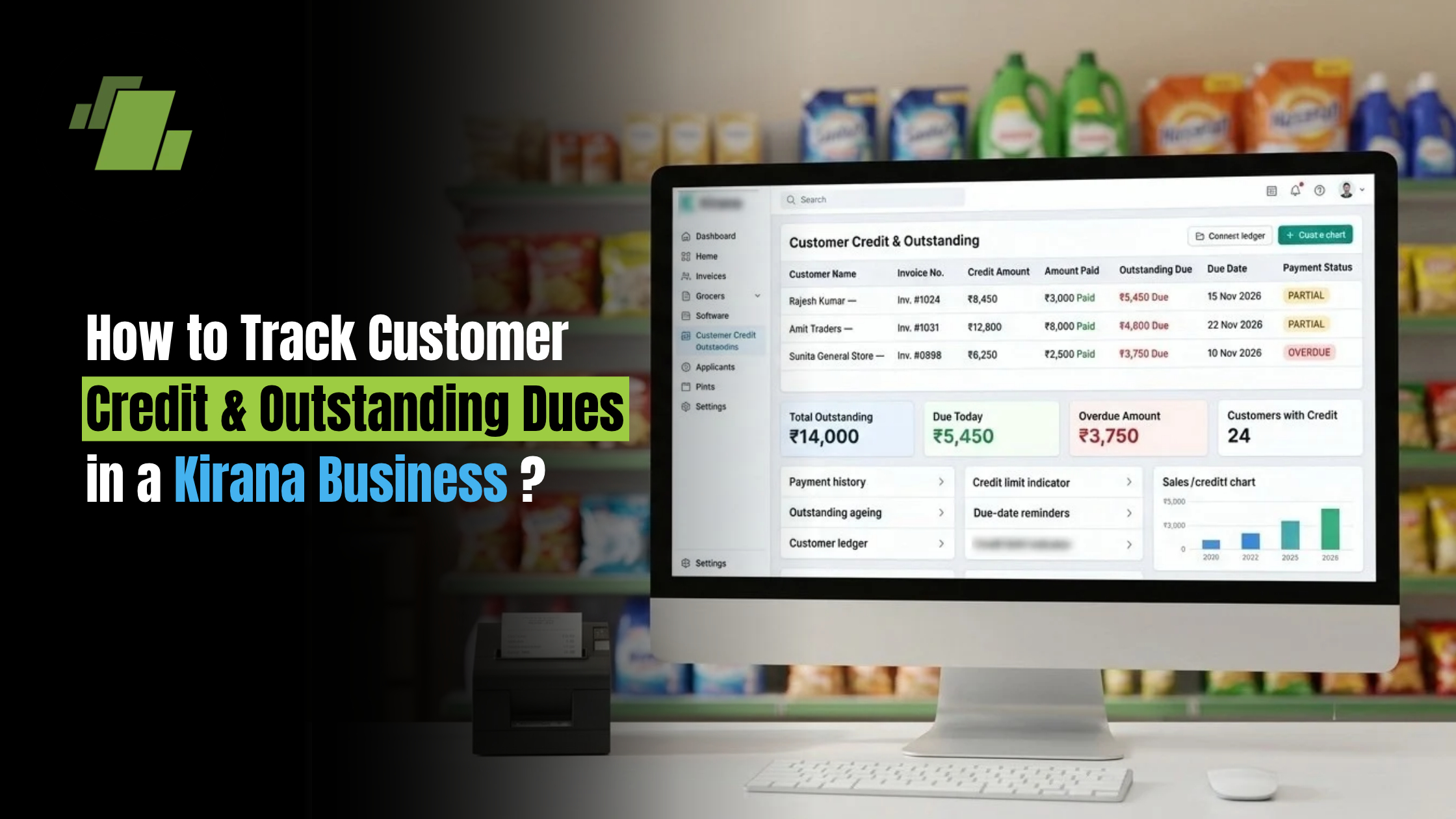
Credit sales are common in many kirana stores. Regular customers may purchase groceries and household essentials today and pay later, either after a few days or at the end of the month. While customer credit can help build long-term relationships, poor tracking of outstanding payments can create cash-flow problems for the business.
A simple notebook may work when the number of credit customers is small. But as the store grows, manually recording purchases, payments, partial settlements and pending dues becomes increasingly difficult.
A structured customer credit management process helps kirana retailers know exactly who owes money, how much is outstanding, how long the payment has been pending and when the customer last made a payment.
Contact Us
Free Demo Request
Why is Customer Credit Difficult to Manage in a Kirana Store?
Managing credit sales manually can become complicated because a customer may make several purchases before making a payment. They may also make partial payments or return products, which changes the outstanding amount.
Common challenges include:
- Recording credit transactions manually
- Forgetting to update customer payments
- Difficulty tracking partial payments
- Errors while calculating outstanding balances
- Losing or damaging physical credit registers
- Difficulty finding older transactions
- No clear view of overdue payments
- Customers disputing the amount they owe
- Multiple purchases being made before settlement
- Spending too much time calculating customer-wise dues
Without accurate records, it becomes difficult for the retailer to understand how much money is currently tied up in customer credit.
What Happens When Customer Dues are Not Tracked Properly?
Uncontrolled customer credit can affect the financial health of a kirana business.
Cash Flow Gets Tied Up
When customers delay payments, money remains blocked in outstanding receivables. This can make it harder to pay suppliers or purchase new inventory.
Outstanding Balances Keep Increasing
Small unpaid amounts can accumulate when every transaction is not properly recorded or followed up.
Payment Disputes Become More Common
If the retailer and customer maintain different records, disagreements can occur over previous purchases, payments or balances.
Overdue Customers Become Difficult to Identify
A retailer may know that money is pending but may not know which customers have the oldest or largest outstanding balances.
More Time is Spent on Manual Tracking
The retailer or staff may have to search through notebooks, bills and payment records before confirming a customer’s balance.
10 Ways to Track Customer Credit and Outstanding Dues
A systematic approach can make credit management easier and more accurate.
1. Maintain a Customer-Wise Credit Ledger
Every customer who purchases on credit should have a separate account showing their transactions and payments.
A basic customer ledger can include:
- Customer name
- Mobile number
- Transaction date
- Invoice number
- Purchase amount
- Payment received
- Payment date
- Remaining balance
This gives the retailer a clear record of how the outstanding amount was calculated.
2. Record Every Credit Sale Immediately
Credit sales should be recorded as soon as the transaction takes place.
Delaying entries until the end of the day can lead to missed transactions, incorrect balances or confusion when several customers have made purchases.
An immediate record ensures that the customer’s outstanding balance reflects the latest transaction.
3. Track Partial Payments Separately
Customers do not always clear their entire balance in one payment.
For example:
| Transaction | Amount | Status |
|---|---|---|
| Grocery purchase | ₹2,500 | Credit |
| Payment received | ₹1,000 | Partially paid |
| Remaining balance | ₹1,500 | Outstanding |
The remaining ₹1,500 should automatically become the customer’s updated outstanding balance.
Tracking partial payments separately prevents the retailer from treating the entire original invoice as unpaid.
4. Set Customer Credit Limits
Not every customer needs to have the same credit limit.
A retailer can consider factors such as:
- Previous payment history
- Purchase frequency
- Average monthly purchases
- Existing outstanding balance
- Payment delays
Setting reasonable credit limits can help prevent excessive amounts from being tied up in unpaid customer accounts.

5. Monitor Overdue Payments
Knowing the total outstanding amount is useful, but knowing how long the money has been pending is even more important.
Retailers can classify outstanding payments into ageing categories such as:
- 0–7 days
- 8–15 days
- 16–30 days
- 30+ days
This makes it easier to prioritise collection efforts.
For example, a ₹1,000 amount pending for three days may require less attention than a ₹1,000 amount that has remained unpaid for two months.
6. Maintain Complete Customer Transaction History
A customer account should provide a complete view of purchases and payments.
The retailer should be able to check:
- Previous purchases
- Credit invoices
- Payments received
- Returns
- Adjustments
- Current outstanding balance
Having this information available makes it easier to answer customer queries and resolve payment disputes.
7. Send Timely Payment Reminders
Payment reminders can help retailers collect dues without repeatedly checking every customer manually.
Depending on the communication channels used by the business, retailers can send reminders containing:
- Customer name
- Outstanding amount
- Invoice details
- Payment due information
- Payment instructions
Regular reminders can also reduce the chances of older dues being forgotten.
8. Reconcile Payments Regularly
Every payment received should be matched with the correct customer account.
This is particularly important when customers make payments through different methods or pay a combined amount against multiple purchases.
Regular reconciliation helps ensure that:
- Payments are recorded correctly
- Customer balances remain accurate
- Duplicate entries are avoided
- Outstanding reports reflect actual dues
9. Identify Customers With High Outstanding Balances
Retailers should regularly review customers whose outstanding balances are increasing.
A customer with frequent purchases and consistently rising dues may require a review of their credit limit or payment terms.
Customer-wise outstanding reports can help retailers identify these patterns before they become a major cash-flow problem.
10. Review Outstanding Reports Regularly
A daily or weekly outstanding report can give the retailer a quick overview of the business’s credit position.
Important figures may include:
- Total credit sales
- Total payments received
- Current outstanding
- Overdue amount
- Customer-wise outstanding
- Ageing of receivables
Regular review helps retailers make better decisions about credit sales and collections.
How a Customer Credit Ledger Should Work
Consider a customer who makes several purchases during the month.
The ledger could look like this:
| Date | Transaction | Debit | Payment | Balance |
|---|---|---|---|---|
| 2 Oct | Grocery purchase | ₹1,800 | — | ₹1,800 |
| 8 Oct | Household products | ₹1,200 | — | ₹3,000 |
| 15 Oct | Payment received | — | ₹1,500 | ₹1,500 |
| 22 Oct | Grocery purchase | ₹900 | — | ₹2,400 |
| 28 Oct | Payment received | — | ₹1,000 | ₹1,400 |
The retailer can immediately see that the customer currently has an outstanding balance of ₹1,400.
This is much easier to manage than calculating the balance from several pages of handwritten entries.
Use Credit Ageing to Prioritise Collections
Credit ageing helps retailers understand how long outstanding amounts have remained unpaid.
For example:
| Ageing Period | Outstanding | Priority |
|---|---|---|
| 0–7 days | ₹8,000 | Normal follow-up |
| 8–15 days | ₹5,000 | Monitor |
| 16–30 days | ₹3,500 | Follow up |
| 30+ days | ₹7,500 | High priority |
This type of analysis helps retailers focus on older outstanding amounts rather than treating every pending payment in the same way.
How to Reduce Customer Credit Disputes
Accurate records can significantly reduce disagreements between retailers and customers.
Kirana stores can follow a few simple practices:
Provide a Bill for Every Transaction
A bill creates a clear record of what the customer purchased and how much was charged.
Record Payments Immediately
When a customer makes a payment, update the account without unnecessary delay.
Maintain Transaction History
Keep purchase and payment records available for future reference.
Share Outstanding Statements
When required, retailers can provide customers with a summary of their pending transactions.
Record Returns and Adjustments
Product returns, discounts or adjustments should be reflected in the customer’s account so that the outstanding balance remains accurate.
How Customer Credit Data Can Improve Business Decisions
Customer credit information is not only useful for collection. It can also help retailers understand their overall business position.
By analysing customer transactions, retailers can identify:
- Frequent customers
- Average customer purchase value
- Credit sales volume
- Payment behaviour
- Customers with consistently high dues
- Customers who regularly purchase specific product categories
This information can help the retailer make better decisions about credit policies, purchasing and working capital.
Why Manual Credit Registers Become Difficult as a Kirana Business Grows
A physical credit notebook may be sufficient for a small number of customers. However, managing hundreds of transactions manually creates several challenges.
| Manual Tracking Challenge | Business Impact |
|---|---|
| Handwritten entries | Higher risk of errors |
| Manual calculations | Time-consuming |
| Multiple registers | Difficult to find records |
| Delayed payment updates | Incorrect balances |
| No automatic ageing | Difficult to prioritise collections |
| Limited reporting | Poor visibility |
| Lost or damaged records | Risk of missing transaction history |
As transaction volumes increase, digital records can make customer credit management considerably easier.
How Retail Technology Can Simplify Customer Credit Management
A retail management system can connect customer accounts with sales and payment records, reducing the need for manual calculations.
Depending on the solution, retailers can manage:
- Customer-wise credit ledgers
- Credit sales
- Outstanding balances
- Partial payments
- Customer credit limits
- Payment history
- Outstanding ageing
- Customer statements
- Sales history
- Collection reports
For a growing kirana business, connecting billing, sales, inventory and customer accounts can provide a more complete view of daily operations.
Retailers evaluating a technology solution can explore Kirana POS Software to understand how digital billing and customer management can support day-to-day store operations.
Key Customer Credit Metrics Kirana Retailers Should Monitor
Tracking a few important metrics can help retailers keep credit under control.
| Manual Tracking Challenge | Business Impact |
|---|---|
| Handwritten entries | Higher risk of errors |
| Manual calculations | Time-consuming |
| Multiple registers | Difficult to find records |
| Delayed payment updates | Incorrect balances |
| No automatic ageing | Difficult to prioritise collections |
| Limited reporting | Poor visibility |
| Lost or damaged records | Risk of missing transaction history |
Conclusion
Customer credit can help kirana stores maintain strong relationships with regular customers, but uncontrolled credit can put pressure on cash flow.
The key is to maintain accurate customer-wise records, record every credit sale and payment, monitor ageing, set appropriate credit limits and regularly review outstanding balances.

Moving from manual credit registers to connected digital records can make it easier to track dues, reduce calculation errors, improve collection visibility and make better credit decisions as the kirana business grows.
Call at +9173411-41176/75 or send us an email at sales@logicerp.com to book a free demo today!
FAQs
1. How Can a Kirana Store Track Customer Credit?
A kirana store can maintain customer-wise ledgers containing credit sales, payments, returns and outstanding balances. Digital records can make it easier to update and review this information.
2. How Do I Maintain Customer-Wise Outstanding Balances?
Record every credit transaction and payment against the correct customer account. The outstanding balance should be calculated by considering all purchases, payments and adjustments.
3. How Can I Track Partial Payments from Customers?
Record each payment against the customer’s account and deduct it from the outstanding balance. This allows the retailer to see the remaining amount after every payment.
4. What is a Customer Credit Ledger?
A customer credit ledger is a record of a customer’s credit purchases, payments, adjustments and remaining outstanding balance.
5. How Can Kirana Stores Reduce Overdue Payments?
Retailers can set reasonable credit limits, monitor ageing, maintain accurate transaction records and send timely payment reminders.
6. Why is Credit Ageing Important for a Kirana Business?
Credit ageing shows how long payments have remained outstanding. It helps retailers identify older dues and prioritise collection efforts.
7. Can Software Track Customer Credit Automatically?
Yes. Retail management systems can record credit sales, payments and customer balances and generate reports for outstanding amounts and ageing.
8. How Can a Retailer Set Customer Credit Limits?
Credit limits can be based on factors such as the customer’s purchase frequency, payment history, average outstanding amount and ability to settle dues on time.

Author
Gurbir Singh
Co-founder & Managing Director | LOGIC ERP Solutions Pvt. Ltd.
With 30+ years of experience in the tech industry, I took the helm of technology & product development, ensuring LOGIC ERP’s continuous innovation & leadership in the evolving tech landscape.