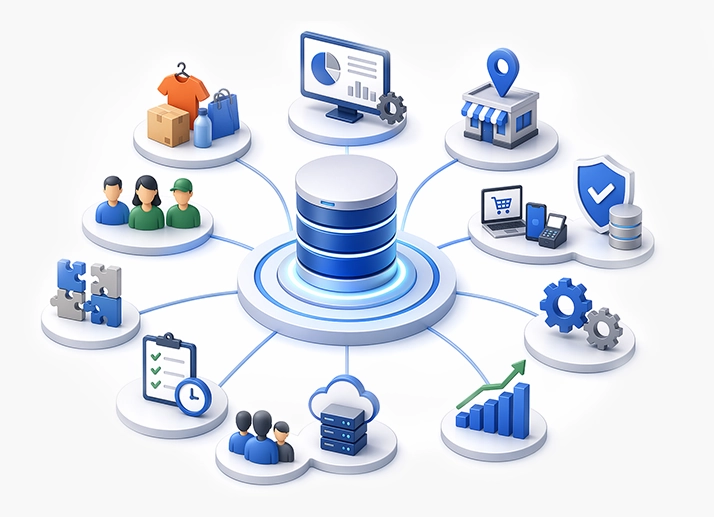
Centralize and govern product, customer, vendor, pricing, location, and operational data with enterprise-grade master data management software built for accurate decisions, cleaner ERP operations, and stronger data governance.
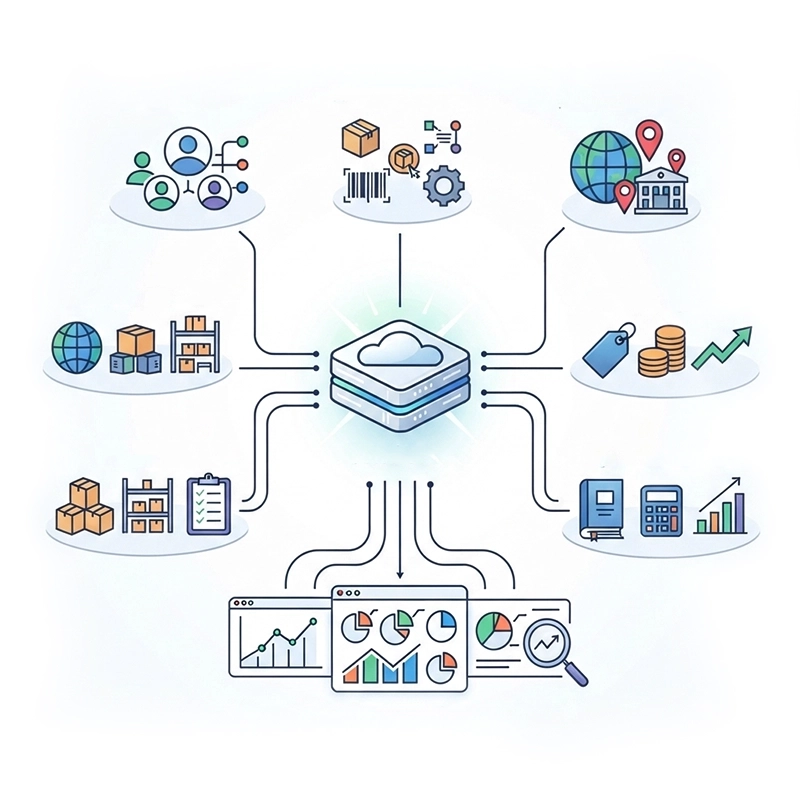
Master data management (MDM) is the process of creating and maintaining a single master record for each key entity in a business, ensuring that all departments work with the same accurate information. MDM ensures consistency, eliminates duplicates, and provides a trusted source of critical data across an organization’s systems. By centralizing, governing, validating, and synchronizing master data, MDM supports better decision-making, operational efficiency, and regulatory compliance.
Master Data Management Software centralizes critical business information into one trusted source to improve consistency, eliminate duplication, and support better business decisions. It helps organizations manage master data entities such as customer data, product data, supplier data, location data, pricing data, financial data, inventory data, and other operational data used across core business processes.
BUSINESS VALUE
Different industries need different data domains, data quality rules, workflows, and compliance controls. LOGIC ERP supports industry-specific master data management solutions for businesses with complex products, locations, suppliers, pricing, and customer operations.
Synchronize product, pricing, promotion, customer, supplier, and inventory data across stores and head office to deliver unified customer experiences and optimize supply chain operations.
Standardize customer, vendor, inventory, pricing, route, warehouse, and credit data to improve procurement accuracy and operational efficiency.
Manage bills of materials, components, vendors, plant-level data, obsolete parts, and production attributes to support efficient production planning and quality control.
Manage styles, sizes, colors, seasons, collections, barcodes, pricing, and store-wise availability to ensure consistent product data and streamline inventory management.
Control product variants by size, color, style, season, brand, and location, ensuring precise inventory tracking and consistent product information.
Govern fast-moving SKUs, batches, schemes, distributors, pricing, taxes, and supply chain data to maintain accuracy and compliance in high-volume environments.
Ensure accurate drug master data, supplier details, batch tracking, expiry management, and regulatory compliance to support safe and efficient pharmaceutical operations.
Handle complex product specifications, component sourcing, warranty tracking, pricing, and multi-location inventory to maintain product integrity and customer satisfaction.
Run your Food & Beverage Outlet with the most comprehensive ERP Software with features like Touch/Mobile POS, KOT, table management, recipe management, combo meals/addon items, home delivery, CRM, accounting, GST, reports on mobile and much more
BUSINESS VALUE
Master data is typically categorized into four main types: customer data, product data, supplier data, and location data, each representing critical business entities essential for operations and decision-making.
Customer master data includes all core data needed to do business with customers, such as contact information, purchase history, and payment terms, ensuring a unified view across systems.
Product master data management encompasses attributes like product number, category, price, and features, which are crucial for sales, marketing, and supply chain processes.
Supplier master data includes vendor accounts, contracts, and pricing information, which are vital for procurement activities and managing supplier relationships effectively.
Location master data contains key attributes related to physical locations, such as offices and distribution centers, which support location-based decision-making and operational efficiency.
Solutions
Managing master data effectively involves overcoming several challenges that can impact data quality and business operations. Below are the main challenges, each with a dedicated subheading for clarity:
Multiple versions of the same customer, vendor, product, or location data cause confusion and errors.
Conflicting price lists across teams result in billing mistakes, lost revenue, and unhappy customers.
Disjointed product data leads to stockouts, overstocking, and delayed procurement decisions.
Inconsistent vendor details complicate procurement and supplier management.
Reconciling inconsistent data sources slows down reporting and hampers timely insights.
Decision-makers hesitate to rely on reports built from inaccurate or incomplete data.
BUSINESS VALUE
Master Data Management (MDM) is the essential process of creating and maintaining a single, accurate master record for key business entities like customers, products, suppliers, and locations. It eliminates duplicates, ensures data consistency, and provides a trusted source of critical information across your organization.
By providing a single source of truth, master data management serves every department with consistent, accurate data, empowering leaders to make informed, timely decisions based on reliable information.
MDM streamlines workflows by eliminating errors from duplicate or conflicting data, reducing operational disruptions and optimizing resource use across all business functions.
With robust governance, master data management supports adherence to legal and industry regulations by maintaining audit trails, enforcing policies, and minimizing the risk of non-compliance penalties.
By consolidating customer information from multiple systems, MDM enables personalized interactions, faster service, and higher satisfaction through a unified, trusted customer view.
Flow
MDM centralizes data from multiple systems, then validates, cleanses, and standardizes it through automated rules and workflows. Data stewards approve changes before synchronized distribution across all business units and applications. This continuous cycle of capture, validation, approval, synchronization, monitoring, and optimization guarantees high-quality master data that supports all business functions effectively.
Collect data from multiple sources such as ERP modules, CRM systems, spreadsheets, supplier portals, ecommerce platforms, legacy systems, and data warehouses.
Apply data quality rules, reference data checks, required-field controls, duplicate detection, data cleansing, and transformation to improve accuracy.
Use role-based workflows to send new records and changes to the right data stewards, managers, or business users for review and approval.
Distribute approved master records across business units, locations, operational systems, and connected applications through live sync, APIs, or structured integrations.
Track data accuracy, completeness, consistency, timeliness, duplicate rates, and data governance compliance using dashboards and logs.
Continuously refine rules, adjust workflows, improve data management practices, and expand MDM to new data domains as business needs evolve.
Customer Reviews
What Top Industry Experts Say About LOGIC ERP Software for Master Data Management
Example
Effective master data management safeguards against inconsistencies in data quality and usability across various domains.
Maintains a single source of customer data to prevent billing errors and duplicate marketing communications.
Ensures consistent product information across systems, which is vital for inventory control, pricing strategies, and supply chain efficiency.
Delivers accurate, up-to-date data to help organizations comply with regulations and avoid penalties.
Integrates data from multiple departments to facilitate data-driven decision-making and enhance operational efficiency.
Steps
Implementing master data management involves a structured approach to ensure accurate, consistent, and trusted data across your organization. Follow these key steps:
Establish clear data governance rules that specify data ownership, stewardship roles, and responsibilities. This framework sets the foundation for accountability and consistent data management practices.
Prioritize critical master data domains such as customer, product, supplier, location, and asset data. Focusing on these areas ensures that your MDM efforts address the most impactful business entities.
Choose and implement an MDM platform that enforces governance policies, automates data validation, and supports role-based approval workflows. This technology centralizes master data management and reduces manual errors.
Form teams comprising IT, business units, and data stewards to collaboratively oversee data quality and maintenance. Cross-departmental collaboration ensures alignment with business needs and promotes data ownership.
Design approval processes that route data changes to authorized personnel for review and validation. This step maintains data accuracy and prevents unauthorized modifications.
Use dashboards and reports to track key quality metrics such as accuracy, completeness, timeliness, and duplicate rates. Ongoing monitoring helps detect issues early and maintains high data standards.
Adapt validation rules, workflows, and governance policies as business requirements evolve. Continuous improvement ensures that your MDM program remains effective and responsive.
Ensure that approved master data is consistently synchronized across all relevant systems, locations, and applications. This guarantees that every part of the organization works with the same trusted data.
Train users on MDM best practices and emphasize the importance of data quality. Encouraging a culture of accountability helps sustain long-term data governance success.
Regularly assess the impact of your MDM program on operational efficiency, decision-making, and compliance. Use these insights to optimize strategies and demonstrate value to stakeholders.
Need
Every business has unique reasons for seeking master data management solutions. Whether you're managing rapid data growth, enforcing enterprise-wide governance, synchronizing multi-branch operations, or driving digital transformation with intelligent automation, LOGIC ERP delivers the precision and control you require.
Start strong with streamlined master data management. As your business scales from spreadsheets and scattered sales tools to complex systems, LOGIC ERP helps you standardize master records early. This reduces duplicates, resolves data inconsistencies, and empowers sales, finance, procurement, inventory, and operations teams with accurate, reliable master data. Avoid billing errors, SKU confusion, and reporting headaches from day one.
Achieve enterprise-wide data consistency across departments, regions, and systems. LOGIC ERP’s integrated MDM framework fosters collaboration between IT, business units, and data stewards, establishing clear governance and accountability. With robust data stewardship, role-based permissions, audit trails, and ERP-native architecture, your organization gains trusted master data that supports complex operations and strategic decisions.
Synchronize product, pricing, customer, vendor, promotion, and inventory data seamlessly across all branches, stores, warehouses, and distribution centers. LOGIC ERP’s multi-location data control balances centralized governance with local flexibility, ensuring consistent pricing, accurate inventory visibility, and unified customer information. Optimize supply chain efficiency and deliver consistent experiences across every location.
Fuel your digital initiatives with high-quality, governed master data. LOGIC ERP integrates cloud-native SaaS technology, AI, and machine learning to automate data validation and workflows. This creates a unified master data foundation that powers automation, advanced analytics, personalized customer experiences, dynamic pricing, and omnichannel commerce, enabling faster, smarter business decisions.
LOGIC ERP Master Data Management Software is your all-in-one solution for centralized, accurate, and real-time data control.
Features
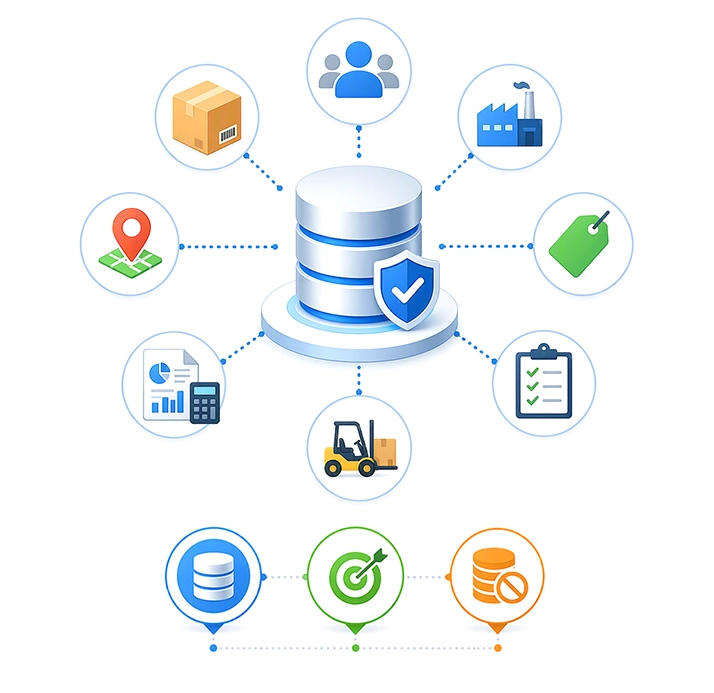
An effective MDM framework relies on three foundational pillars: Data Governance, Data Quality, and Data Integration & Architecture. LOGIC ERP master data management software brings together the core capabilities businesses need to control high quality master data across departments, locations, and systems.
Product master data management helps businesses manage product number, category, brand, size, color, price, features, tax attributes, barcodes, images, units of measure, and inventory classification. Clean product master data supports sales, marketing, ecommerce, procurement, inventory management, and supply chain management.
Customer data governance ensures consistent customer data across sales, billing, service, credit control, and customer relationship management systems. Customer master data management helps consolidate customer information, contact details, purchase history, payment terms, credit limits, and segmentation attributes into one trusted view.
API-based integrations connect MDM with ERP, CRM, ecommerce, supplier portals, analytics tools, data warehouse platforms, and other data sources. Data Integration & Architecture refers to the technical infrastructure, including Master Data Hubs, APIs, and ETL pipelines, that consolidates data from disparate systems and synchronizes the golden record.
Vendor record standardization aligns supplier names, vendor accounts, contracts, payment terms, tax information, and pricing details. This improves procurement accuracy and supplier relationship management.
Workflow-based approvals route new records and changes to the right data stewards, department heads, or authorized users. This improves data stewardship and makes maintaining master data more controlled.
Real-time data synchronization helps update critical data across connected systems without long delays. This is essential for pricing, inventory, customer service, ecommerce, and operational decision-making.
Audit trails, compliance logs, version history, and change tracking help organizations prove who changed what, when, and why. Data security and regulatory compliance depend on this level of visibility.
Multi-location data control supports head office governance, regional rules, store-level visibility, and location-based permissions. This is especially useful for retail chains, distributors, and global businesses.
Role-based permissions ensure that only authorized users can create, edit, approve, or publish master records. Data Governance includes policies, standards, and procedures that outline data ownership, compliance, and security.
Features
The biggest benefit of master data management software is that it creates a single source of truth for critical business data. Instead of letting each department maintain separate records, MDM centralizes, governs, validates, and synchronizes trusted master data across business functions.
Maintain one trusted master data record for every customer, product, vendor, location, and asset to ensure consistent information across all business systems.
Clean and standardized master data improves business dashboards, analytics, reports, and key performance indicators (KPIs) for more reliable business insights.
Establish clear data ownership, governance policies, approval workflows, and data stewardship to maintain high-quality and well-managed master data.
Minimize duplicate records, pricing inconsistencies, inventory mismatches, and supplier conflicts with centralized and validated master data.
Enable business leaders to make faster, data-driven decisions using accurate, consistent, and trusted master data across the organization.
Support regulatory compliance with standardized master data, complete audit trails, controlled data access, and enterprise data governance practices.
Integrations
Get seamless integration with eCommerce, accounting, CRM, and POS systems to centralize and synchronize business data in real time, ensuring accuracy, eliminating duplication, and enabling a single source of truth across all operations.






















Recognition
Best Software 2024
Google Reviews
Excellent
Recommended
Excellent
Recommended
Best Software 2024
Best Software 2024
Google Reviews
Excellent
Recommended
Excellent
Recommended
Best Software 2024
Flow
Master data management works by capturing data from multiple systems, validating it, routing it through approvals, synchronizing the golden record, monitoring quality, and continuously optimizing rules. LOGIC ERP follows a practical workflow designed to improve business processes and reduce data quality issues.
Data is collected from ERP modules, CRM systems, spreadsheets, supplier portals, ecommerce platforms, legacy systems, data warehouse environments, and other data sources.
The system applies data quality rules, reference data checks, required-field controls, duplicate detection, data cleansing, and data transformation to improve accuracy.
Role-based workflows send new records and changes to the right data stewards, managers, or business users for review and approval.
Approved master records are distributed across business units, locations, operational systems, and connected applications through live sync, APIs, or structured integrations.
Dashboards and logs track data accuracy, completeness, consistency, timeliness, duplicate rates, and data governance compliance.
Teams refine rules, adjust workflows, improve data management practices, and expand MDM to new data domains as business needs evolve.
How We Compare
| Feature | LOGIC ERP MDM Software | Generic Software |
|---|---|---|
| Data Management | Centralized & Unified Data Control | Scattered Data Management |
| Real-Time Sync | Instant Updates Across All Channels | Delayed Synchronization |
| Accuracy | Automated Validation & Error-Free Records | Manual Errors & Duplication |
| Multi-Location Support | Seamless Branch/Store Management | Limited Scalability |
| Integration | Fully Integrated with ERP Modules | Requires External Integrations |
| Automation | Smart Workflow Automation | Mostly Manual Processes |
| Scalability | Built for Growing Businesses | Limited Expansion Capability |
| Reporting | Accurate Insights & Analytics | Inconsistent Reporting |
| Support | Dedicated Industry Experts | Generic Support |
Uses
Organizations utilize MDM in various ways to enhance business functions and drive operational improvements.
Tools
MDM tools automate the integration, cleansing, reconciliation, and governance of critical business entities such as customers, products, suppliers, and locations. These tools significantly improve data quality, operational efficiency, and strategic decision-making.
Data from multiple sources often contains errors, inconsistencies, and duplicates. MDM tools employ advanced algorithms and rules to identify and correct these issues, ensuring master data reliability. For instance, if a customer's information appears differently across systems due to typos or formatting, MDM tools standardize the data and merge duplicates into a single profile.
Reconciliation aligns data from different sources to ensure consistency and correctness. Enrichment adds additional information to increase data value and usability. For example, an MDM tool might enhance product data with detailed specifications, images, and marketing descriptions, making it more useful for sales, marketing, and customer service.
Governance is a critical aspect of MDM tools, ensuring data management adheres to established policies and standards. These tools provide frameworks for defining data governance rules, monitoring compliance, and managing data quality. This is especially important in regulated industries where data accuracy and consistency are vital for legal and regulatory compliance.
Consolidate data from various internal and external sources. For example, customer data may come from sales, marketing, and customer service systems, while product data may be collected from inventory, manufacturing, and e-commerce platforms. Integrating this data eliminates silos and provides a comprehensive view.
Include audit trails and version control to track changes and preserve data integrity over time. These features promote transparency and accountability, allowing businesses to monitor data changes, understand data lineage, and maintain compliance with data governance policies.
Offer strong integration features, enabling seamless operation with other enterprise systems like ERP and CRM. This ensures master data is consistently used across all vital business applications, enhancing operational coherence and efficiency.
Role-based permissions ensure that only authorized users can create, edit, approve, or publish master records. Data Governance includes policies, standards, and procedures that outline data ownership, compliance, and security.
Maintain consistent data formats and values across systems and business units. Standardization makes data comparable and usable across applications and business processes.
Support managing organizational structures and relationships. This capability helps handle complex data relationships and ensures data reflects real-world structures.
Choose
LOGIC ERP is the best master data management software for centralized data control, real-time synchronization, and seamless integration across retail, distribution, and omnichannel operations.
Ensure consistent and updated information across all business locations and channels instantly.
Prevent duplicate records and maintain clean, reliable, and validated master data.
Integrate smoothly with eCommerce, accounting, CRM, POS, and ERP systems.
Automate data processes to reduce manual effort and improve operational speed.
Streamline business operations and enhance overall productivity across departments.
Enable faster insights with accurate, structured, and reliable business data.
Support growing retail and distribution businesses with flexible and scalable design.
FAQ
Master data management (MDM) software is a centralized system that creates and maintains a single, trusted master record for core business entities such as customers, products, suppliers, and locations. It consolidates data from multiple sources, eliminates duplicates, enforces data quality rules, and synchronizes accurate master data across all business systems. By providing a unified source of truth, MDM software supports consistent decision-making, operational efficiency, and regulatory compliance.
MDM improves ERP performance by providing clean, validated, and consistent master data that ERP modules rely on for transactions, reporting, and analytics. It reduces errors caused by duplicate or conflicting records, streamlines procurement, inventory, and financial processes, and enables real-time data synchronization across ERP and connected systems. This leads to more reliable ERP operations, faster processing times, and enhanced visibility into business performance.
Yes, MDM significantly reduces duplicate records by using automated data cleansing, matching, and reconciliation processes. It identifies and merges multiple versions of the same customer, product, vendor, or location records into a single, authoritative master record. This elimination of duplicates improves data quality, reduces operational errors, and ensures that all business functions are working from the same accurate information.
MDM is highly suitable for multi-store businesses as it enables centralized governance while supporting location-specific data needs. It synchronizes product, pricing, customer, vendor, and inventory data across multiple stores, warehouses, and regions. This consistency helps avoid pricing conflicts, inventory mismatches, and customer data fragmentation, improving supply chain efficiency and enhancing the customer experience across all locations.
LOGIC ERP MDM software offers enterprise-grade security features including role-based permissions, audit trails, compliance logs, and data governance policies to protect sensitive master data. It ensures that only authorized users can access or modify data, tracks all changes for accountability, and supports regulatory compliance requirements. Its secure and scalable architecture safeguards master data across multiple systems and locations, providing peace of mind for businesses managing critical information.
Master Data Management (MDM) is the process of creating and maintaining a single, accurate master record for key business entities such as customers, products, suppliers, and locations. It ensures consistency, eliminates duplicates, and provides a trusted source of critical data across an organization’s systems.
In a data warehouse context, master data management involves consolidating and harmonizing master data from various source systems into one authoritative repository. This ensures that the data warehouse uses consistent, high-quality master data to support accurate reporting and analytics.
A master data management solution encompasses the tools, processes, and governance frameworks designed to manage master data effectively. It includes software for data integration, cleansing, validation, workflow approvals, and synchronization to maintain accurate and consistent master data.
Vendor master data management focuses on standardizing and governing supplier-related data such as vendor accounts, contracts, pricing, and payment terms. This ensures procurement accuracy and improves supplier relationship management.
MDM is essential to reduce data duplication, improve data quality, support compliance, and enable better decision-making. It helps organizations maintain a consistent, reliable view of key business data, which enhances operational efficiency and customer satisfaction.
A master data management strategy defines how an organization governs, maintains, and uses master data. It includes policies, roles, workflows, and technology choices to ensure master data quality, consistency, and compliance across the enterprise.
A master data management system is the technical infrastructure and software environment that supports the creation, maintenance, governance, and distribution of master data across business units and applications.
MDM tools are software applications that automate data integration, cleansing, standardization, reconciliation, governance, and synchronization of master data. They help maintain data quality and enable a single source of truth.
Master data management is important because it prevents inconsistencies and errors in critical business data, enabling accurate reporting, regulatory compliance, improved customer experiences, and efficient business operations.
Organizations use MDM by implementing a framework that captures, validates, approves, and synchronizes master data across systems. This involves defining governance policies, deploying MDM software, and continuously monitoring data quality.
Master data management contains core business entities such as customer data, product data, supplier data, location data, pricing, financial records, and other operational data essential for business processes.
Big data refers to large volumes of diverse, high-velocity data, while master data management focuses on maintaining accurate, consistent core business data. MDM ensures that big data analytics rely on trusted reference data for meaningful insights.
Master data management is known as the discipline and technology for creating and maintaining a single, consistent, and authoritative master record for critical business entities.
Master data management services include consulting, implementation, data governance, data quality management, and ongoing support to help organizations establish and maintain effective MDM practices.
MDM master data management solutions are comprehensive offerings that combine software, processes, and governance to centralize, cleanse, validate, and synchronize master data across an enterprise.
Reference data management deals with standardized codes and classifications used across systems, while master data management focuses on core business entities. Both are critical for data consistency and governance.
The scope of master data management covers the identification, governance, quality control, integration, and synchronization of master data across all relevant business domains and systems.
MDM is important because it ensures all departments operate with consistent and accurate data, reducing operational risks, improving efficiency, supporting compliance, and enabling informed decision-making.
Reference data consists of standardized codes and classifications used across systems to ensure consistency and interoperability. It supports master data by providing common values that help maintain uniformity in data entries and reporting.
Consistent customer data provides a unified and accurate view of each customer across all systems and touchpoints. This improves personalized marketing, customer service, billing accuracy, and overall customer satisfaction.
Data quality rules are predefined criteria and validations applied to master data to ensure accuracy, completeness, consistency, and reliability. These rules help prevent errors, duplicates, and inconsistencies in critical business data.
Managing data effectively ensures that master data remains accurate, up-to-date, and trustworthy across all systems. Proper data management reduces operational risks, supports compliance, and enables better decision-making.
Data security in MDM involves protecting sensitive master data through access controls, encryption, audit trails, and compliance with regulatory standards. It ensures that only authorized users can access or modify critical business data.
Asset data refers to information about a company’s fixed and intangible assets, such as equipment, inventory, and trademarks. Accurate asset data management supports maintenance, depreciation tracking, regulatory compliance, and optimized asset utilization.
Popular Products