DRP is a time-phased supply chain planning process that decides what finished goods to send, when to send them, and where to position them across a distribution network — using demand forecasts, inventory data, safety stock, and lead times.
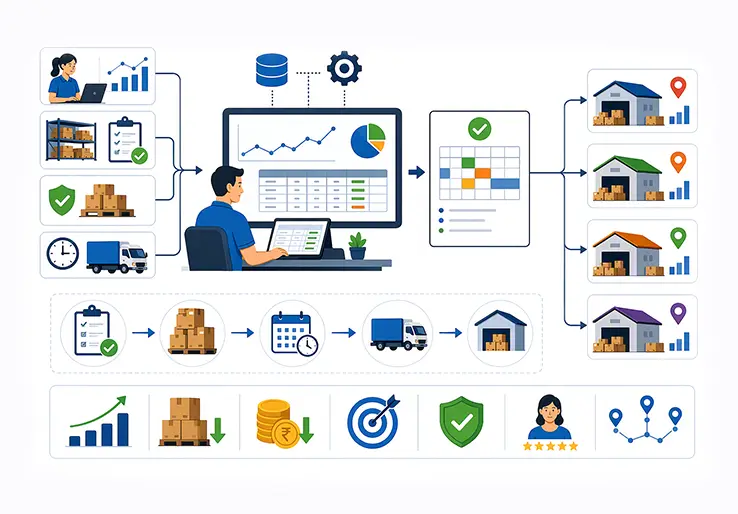
Distribution Requirements Planning (DRP) is a time-phased supply chain planning process that decides what finished goods to send, when to send them, and where to position them across a distribution network by using demand forecasts, inventory data, safety stock, and lead times. For supply chain professionals, distribution and logistics planners, manufacturing and operations managers, and businesses using or evaluating ERP platforms such as LOGIC ERP, it provides a practical way to keep multi-location inventory aligned with customer demand while reducing excess stock, storage costs, and stockouts.
In today’s volatile market environment marked by disruptions such as the pandemic, port congestions, and logistics challenges accurate demand forecasting and distribution network optimization have become indispensable for companies operating across multiple locations in India and globally. DRP fits seamlessly within enterprise resource planning (ERP) systems like LOGIC ERP, linking demand forecasting, current inventory levels, and distribution planning to synchronize operations and improve product availability, customer service, and supply chain resilience. This guide explains what DRP includes, how the step-by-step process works, how DRP tables and time-phased planning support decisions, how it connects with MRP and ERP, the common challenges and solutions, industry use cases, implementation best practices, advanced concepts, and key FAQs.
Explore the detailed benefits, processes, examples, and how DRP integrates with MRP and ERP systems in the sections ahead.
Distribution Requirements Planning (DRP) is a time-phased planning method that uses demand forecasts, current inventory data, optimal safety stock levels, and replenishment lead times to create detailed replenishment schedules and replenishment plans for each distribution center (DC) and warehouse. DRP focuses on finished goods, managing inventory flows across multiple echelons from central warehouses to regional DCs, local depots, and retail locations.
DRP extends the logic of Material Requirements Planning (MRP) downstream into the distribution network. While MRP concentrates on raw materials and components for production, DRP ensures that finished goods are available at the right place and time to meet customer demand.
Industries widely using DRP include FMCG, consumer electronics, pharmaceuticals, automotive, fashion/apparel, and grocery & food chains.
For example, an Indian FMCG company uses DRP to plan shampoo inventory across four regional distribution centers and 120 distributors, ensuring product availability aligns with sales forecasts and actual demand.
DRP, MRP, and ERP are complementary systems that collectively enhance supply chain and supply chain management efficiency.
Focuses on raw materials and components needed for production at manufacturing plants. It uses inputs like the master production schedule, bill of materials (BOM), and lead times to ensure timely material availability.
Manages the flow of finished goods between factories, warehouses, distribution centers, and retail locations, based on demand forecasts and inventory levels.
Platforms like LOGIC ERP integrate MRP, DRP, finance, procurement, sales, and warehouse management into a single database, enabling real-time data synchronization and streamlined operations.
Data flows from demand forecasts into DRP for finished goods planning, which in turn informs MRP for raw material planning within the ERP system. Inventory and order data are automatically synchronized to maintain consistency.
| System | Objective | Typical User | Supply Chain Level |
|---|---|---|---|
| MRP | Plan raw materials | Manufacturing | Upstream production |
| DRP | Plan finished goods distribution | Distribution and logistics | Downstream distribution |
| ERP | Integrate all business processes | Enterprise-wide | Entire supply chain |
Accurate DRP depends on clean, real-time data across the distribution network. Core elements include:
Demand Forecasts
Weekly or monthly forecasts by SKU and location, incorporating historical sales, promotions, seasonal demand, and market trends.
Current Inventory
Real-time stock on hand, in transit, and reserved at each distribution center and warehouse.
Safety Stock
Buffer inventory calculated based on desired service levels (e.g., 95–99%), demand variability, and replenishment lead times.
Replenishment Lead Time
Includes transport times, handling, customs clearance, and administrative delays (e.g., a 3-day lead time between central DC in Delhi and regional DC in Lucknow).
Lot Sizes and Order Constraints
Minimum order quantities, truckload capacities, pallet and carton rules.
Service Level Targets
Fill rate targets (e.g., 97%+), and on-time, in-full (OTIF) delivery goals by customer or channel.
Supporting master data includes location hierarchy, item master data, calendars, holidays, and dispatch cut-off times.
The DRP process is cyclical, typically run weekly or daily over a planning horizon of 8 to 26 weeks.
Demand Forecasting
Generate time-phased demand forecasts for each SKU-location using statistical models combined with sales input.
Inventory Analysis
Capture current inventory, goods in transit, open purchase or transfer orders, and blocked or damaged stock.
Net Requirements Calculation
Calculate net requirements per period as forecast plus safety stock minus projected available inventory.
Order Quantity and Timing
Apply lot-sizing rules (economic order quantity, minimum order sizes, truckload optimization) to determine planned order receipts and releases.
Capacity and Constraints Check
Verify warehouse capacity, transportation resources, loading docks, and labor availability.
Distribution Network Optimization
Rebalance inventory flows across plants, central DCs, regional DCs, and cross-docks to minimize costs while meeting service targets.
Review & Collaboration
Planners, sales, and logistics teams review exceptions such as stockouts or overloads and adjust plans accordingly.
Execution in ERP
Convert approved planned orders into actual purchase or stock transfer orders through ERP workflows like LOGIC ERP.
| Week | Forecast Demand | Projected Inventory | Scheduled Receipts | Planned Order Receipts | Planned Order Releases |
|---|---|---|---|---|---|
| Week 1 | 100 units | 150 | 0 | 0 | 0 |
| Week 2 | 120 units | 30 | 50 | 0 | 0 |
| Week 3 | 110 units | 0 | 0 | 100 | 100 |
| Week 4 | 130 units | 20 | 0 | 0 | 0 |
| Week 5 | 115 units | 5 | 0 | 120 | 120 |
| Week 6 | 125 units | 10 | 0 | 0 | 0 |
A DRP table is a time-phased grid central to the DRP process, showing inventory and order information across time buckets such as weeks or specific dates.
A distribution center in Mumbai manages a popular mobile phone model over 8 weeks, starting with 500 units on hand and a 1-week lead time from the central warehouse. As forecast demand reduces inventory, DRP suggests planned order receipts in week 4, which requires order releases in week 3 to meet demand on time.
Well-implemented DRP can reduce inventory levels by 15–30% while improving service levels, often pushing fill rates above 97% without overstocking.
For example, an Indian fashion retailer uses DRP within LOGIC ERP to smooth seasonal spikes around Diwali and Eid, improving customer satisfaction and reducing excess stock.
DRP is powerful but depends on data quality, process discipline, and organizational buy-in.
Track key performance indicators such as forecast accuracy, inventory turns, fill rate, on-time in-full (OTIF), and planning cycle time to monitor DRP success.
DRP principles apply universally but are tailored to industry-specific needs:
FMCG & Grocery
Manage perishable and non-perishable goods with short shelf life and frequent promotions; safety stock and lead times tuned to minimize waste.
Fashion & Apparel
Address strong seasonality and size/color complexity; push inventory by store profile ahead of festivals and new launches.
Pharmaceuticals
Meet regulatory requirements, batch tracking, and high service levels for essential medicines.
Electronics & Durable Goods
Prevent overstock and obsolescence of high-value SKUs by focusing inventory in regional DCs and urban markets.
E-commerce & Omnichannel Retail
Support fast delivery promises by positioning stock closer to customers in city hubs and dark stores.
For instance, a consumer electronics company completed a 6-month DRP rollout in 2025, reducing inventory by 20% and improving fill rates by 5%.
Implementing DRP requires a structured approach:
Includes data quality, executive sponsorship, cross-functional team, clear KPIs, and IT resources.
LOGIC ERP supports DRP with preconfigured templates, integrated demand forecasting, automated stock transfer order generation, and dashboards.
Mature organizations evolve DRP from basic to advanced demand-driven and network-optimized systems.
Replenishment based on forecasted demand; common in seasonal FMCG and fashion.
Replenishment triggered by actual consumption at downstream nodes (e.g., VMI, Kanban).
Combines buffers and dynamic adjustments based on product volatility.
Uses DRP outputs with cost data to evaluate DC locations, cross-docking, and transshipment strategies, balancing transportation costs, service levels, and inventory holding.
Include AI-enhanced demand forecasting, IoT data for real-time conditions (especially in cold chains), and scenario planning within ERP/APS integrated with DRP.
Perishable dairy distribution in a two-echelon network uses IoT sensors to adjust safety stock and replenishment dynamically.
Call at +91-73411-41176 / +91-73411-41175 or send us an email at sales@logicerp.com to book a free demo today!
DRP is a planning method that ensures the right quantity of finished goods is available at the right locations and times to meet customer demand efficiently.
MRP focuses on raw materials for production, while DRP manages finished goods distribution. Supply planning is broader, covering both production and distribution.
Key inputs include demand forecasts, current inventory levels, safety stock policies, lead times, and order constraints.
DRP is typically run weekly or daily, depending on business needs and supply chain complexity.
SMBs can benefit from DRP, especially as supply chains grow complex; scalable DRP solutions like LOGIC ERP make this accessible.
By using accurate demand forecasts and safety stock calculations, DRP balances inventory levels to meet actual and anticipated demand.
DRP modules integrate demand forecasting, inventory management, and replenishment planning to automate order releases and stock transfers.
Track forecast accuracy, inventory turns, fill rate, OTIF, and planning cycle time to evaluate performance.
DRP positions inventory closer to customers in city hubs and dark stores, enabling faster delivery and improved product availability.
FMCG brands, fashion retailers, pharmaceuticals, electronics firms, and e-commerce businesses use DRP to optimize inventory and meet customer demand.
Distribution Requirements Planning strengthens supply chain resilience by synchronizing supply and demand across distribution networks. Explore how LOGIC ERP’s DRP capabilities can optimize your distribution operations for 2026 and beyond.
A distribution center is a key location within the supply chain where inventory is stored and managed before being shipped to retailers or customers. DRP ensures the right products are available at these centers to meet forecasted demand efficiently.
Current inventory data provides real-time visibility of stock on hand, in transit, and reserved. Accurate inventory information is essential for DRP to calculate replenishment needs and avoid stockouts or excess inventory.
DRP uses demand forecasts combined with inventory and lead time data to plan order quantities and schedules. This ensures products are available at the right locations and times to meet customer demand reliably.
Order quantities calculation is the process where DRP determines how much stock to order or transfer to each distribution center based on demand forecasts, inventory levels, safety stock, and replenishment lead times.
DRP relies heavily on accurate demand forecasts, inventory data, and lead time information to create effective distribution plans. Inaccurate data can lead to stock imbalances, increased costs, and poor customer service.
The distribution requirements planning process involves forecasting future demand, analyzing current inventory, calculating order quantities, and coordinating distribution planning to ensure products are available at the right distribution centers on time.
DRP improves demand forecasting by using accurate data and artificial intelligence to analyze forecast errors and adjust future requirements, resulting in better inventory and transportation planning.
DRP systems automate the generation of purchase orders based on calculated order quantities and future demand, providing greater control over inventory replenishment and supply chain management.
Data accuracy is critical for DRP because it relies on current inventory levels, forecasted future demand, and transportation constraints to create effective distribution plans and avoid stockouts or excess inventory.
The DRP engine processes demand forecasts, current inventory, and forecast errors to calculate optimal order quantities and timing, ensuring smooth supply chain management at distribution centers.
DRP communicates future requirements and purchase orders to upstream suppliers, enabling timely production and delivery that aligns with distribution center needs.
DRP software integrates data from multiple sources, applies artificial intelligence for forecasting, and automates order releases, resulting in streamlined distribution planning and improved supply chain efficiency.
DRP optimizes supply chain operations by using accurate demand forecasts, current inventory data, safety stock levels, and lead times to create detailed replenishment plans for each distribution center. This ensures that the right quantity of finished goods is available at the right locations and times to meet customer demand efficiently. By synchronizing inventory flows across multiple echelons, central warehouses, regional distribution centers, and retail locations DRP minimizes excess stock, reduces stockouts, and improves overall product availability. It also enhances coordination between manufacturing, procurement, and logistics teams, enabling smoother order fulfillment and transportation planning. Automated DRP systems provide real-time visibility and analytics, helping businesses respond quickly to changes in demand or supply disruptions, thus increasing supply chain resilience and cost efficiency.
To reduce inventory costs while maintaining product availability, businesses can implement several strategies supported by DRP:
These strategies collectively help maintain high service levels (e.g., 97%+ fill rates) while minimizing capital tied up in excess inventory.
Businesses can ensure efficient product delivery by leveraging DRP to coordinate distribution and replenishment planning across the supply chain. This involves:
By integrating DRP within ERP systems, businesses automate many of these processes, improving accuracy and responsiveness, ultimately reducing delivery lead times and costs.
DRP employs several key techniques to accurately meet anticipated demand:
These techniques combined allow DRP to translate forecasts into actionable replenishment plans that align supply with demand efficiently.
Popular Products