Learn how quality management software helps manufacturers improve quality, reduce defects, automate inspections, manage compliance, and streamline quality processes.
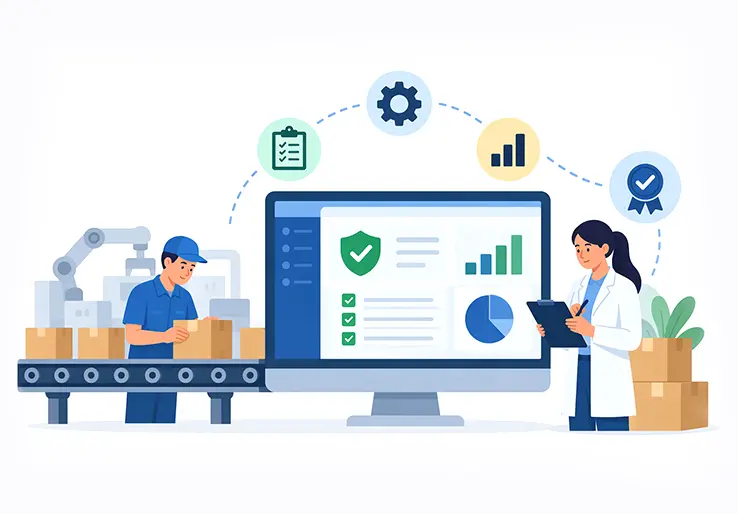
Quality management software automates the way organizations handle quality control, quality assurance, compliance, and continuous improvement. Instead of relying on paper forms, disconnected spreadsheets, and email chains, businesses use these platforms to centralize inspections, track defects, manage corrective actions, control documents, and generate real-time reports — all from a single system.
LOGIC ERP provides integrated quality management software that connects directly with its ERP modules for manufacturing, distribution, purchasing, inventory, and sales. This tight integration means quality data flows through every operational process rather than sitting in a separate silo.
Between 2024 and 2026, companies have been moving away from manual quality processes at an accelerating pace. Regulatory agencies demand better traceability. Customers expect consistent quality and fast resolution of complaints. Global supply chains require remote audit readiness and measurable quality metrics. The global quality management software market was valued at approximately USD 12.3 billion in 2025 and is projected to reach USD 28.8 billion by 2033, growing at roughly 11.5% CAGR.
The core promises of adopting quality management software are clear: higher product quality, improved operational efficiency, continuous improvement baked into daily workflows, and a sustainable competitive advantage in regulated or quality-sensitive markets. Quality management software helps organizations improve product standards and regulatory compliance across every stage of the lifecycle.
Here’s what this guide covers:
Quality management software is a digital platform that supports quality planning, quality control, and quality assurance across the full product and process lifecycle. Quality planning defines what quality means through standards and specifications. Quality control monitors and evaluates outputs against those standards. Quality assurance builds systems to ensure consistent quality and compliance over time.
The software centralizes quality data — inspections (incoming, in-process, final), non-conformances, CAPA records, customer complaints, supplier performance, audit findings, document revisions, and training records — into a single management system. This centralization eliminates data silos, enables faster root-cause analysis, and provides consolidated reporting across plants and product lines.
It’s worth distinguishing between a quality management system and quality management system software. A quality management system (QMS) is the structured framework of policies, procedures, roles, and responsibilities that defines how an organization manages quality. Quality management system QMS software is the technology that automates, monitors, enforces, and reports on that framework. A QMS documents processes, procedures, and responsibilities, while the software makes those documents actionable and traceable. QMS documentation includes policies, procedures, and work instructions that define how work gets done.
Modern quality management software supports international quality standards and local regulations. ISO 9001 is the most widely recognized QMS standard globally. ISO 13485 is specific to medical device quality management. ISO 22000 ensures food safety management compliance. The software enables features like electronic signatures, versioned documentation, training compliance mapping, and audit trails required by these standards.
LOGIC ERP embeds QMS capabilities directly into its ERP workflows. Item definitions, suppliers, BOMs, routing, and production orders all feed the quality module, meaning inspections, non-conformances, and CAPA link seamlessly to purchasing, inventory, and production flows.
Any effective quality management system is built on foundational quality management principles. The software should operationalize these principles — not just track data, but actively support the behaviors and decisions that drive quality improvement.
Here’s how each principle maps to daily system usage:
The Plan-Do-Check-Act (PDCA) cycle is reflected through configurable workflows: planning inspection procedures ("Plan"), executing inspections and audits ("Do"), analyzing performance via dashboards ("Check"), and triggering CAPA or SOP revisions ("Act"). Top management support is vital for QMS success — without it, even the best-configured system will underperform.
Here’s a checklist of the essential modules that any modern quality management software should include:
Quality Inspection Management – Configure incoming, in-process, and final inspections with sampling plans. Define inspection methods (attribute vs. variable), specification limits, and triggers tied to goods receipt, production steps, or pre-shipment.
Defect and Non-Conformance Management – Log issues with severity classification, product family, and location. Assign dispositions (scrap, rework, vendor return). CAPA systems track non-conformities and ensure thorough root cause analysis through linked investigation workflows.
Document Control – Centralized document control ensures access to the latest approved documents. Document control systems manage creation, approval, and distribution of documents including SOPs, work instructions, test methods, and quality policies. Effective document control mitigates errors and ensures compliance. Document control is crucial for a functioning QMS. Key features to consider include document control and training management.
Audit Management – Schedule and conduct internal audits with configurable checklists. Record findings, assign corrective actions, and track follow-ups. Audit management features improve traceability and transparency during reviews.
CAPA Management – Automated corrective and preventive action workflows help prevent recurrence of defects. Track target dates, responsible parties, and verification of effectiveness. Trend analytics reveal whether corrective actions are actually working.
Supplier Quality Management – Supplier quality management tracks performance and handles corrective actions for external vendors. Score suppliers on defect rate, delivery reliability, and CAPA responsiveness. Adjust inspection frequency dynamically based on vendor rating.
Automated Workflows and Approvals – Role-based routing, escalation rules, notifications, and electronic signatures support compliance-heavy industries. Quality gates in production and shipping enforce hold/release logic.
Dashboards and Analytics – Real-time quality reports show defect trends, control charts, cost of quality metrics, and supplier scorecards. Filter by product, plant, period, or customer. Export reports for audits and management reviews.
LOGIC ERP’s quality module covers inspections, rework, waste tracking, and defect monitoring with corrective actions — all within a unified manufacturing ERP interface that connects quality to production, inventory, and purchasing.
The business case is straightforward: quality management software reduces costs, accelerates audits, strengthens compliance, and raises customer satisfaction. A QMS reduces operational costs by minimizing defects and waste across the operation.
Key benefits include:
Implementing a QMS enhances customer satisfaction through consistent quality. When customers receive fewer defective products and see faster complaint resolution, trust and repeat business follow naturally.
Here’s the typical end-to-end quality workflow, mapped to software features:
In LOGIC ERP, master data (items, suppliers, BOMs) feeds directly into the quality module to generate inspection plans. Alerts and holds trigger automatically when thresholds are exceeded, and dashboards update in real time.
Many businesses still rely on spreadsheets, paper checklists, and email chains for quality management. For smaller operations with limited product variety and few regulatory demands, manual methods may seem adequate. But as complexity grows — more products, multiple plants, stricter customer requirements — manual systems create serious risks: version drift, lost documents, delayed corrective actions, poor traceability, and weak audit trails.
Here’s how the two approaches compare:
| Aspect | Manual Quality Management | Quality Management Software |
|---|---|---|
| Data entry | Paper forms, spreadsheets; prone to duplication and errors | Structured digital forms; automatic data collection; validation rules |
| Quality inspections | Paper checklists; delayed uploads; inconsistent execution | Mobile/tablet-based; instant capture and pass/fail evaluation |
| Reporting | Manually collected; weekly or monthly; high lag | Real-time dashboards; automated alerts and scheduled reports |
| Defect tracking | Separate logs; no unified view across plants | Central non-conformance module with root-cause linking and traceability |
| Compliance | Scattered records; difficult to maintain versioned documents | Document control, audit trails, electronic signatures; easy retrieval |
| Data accessibility | Local files; physical archives; shared drives | Accessible across plants; cloud or on-premise; role-based access |
| Error reduction | High error rate from manual transfers; missed steps | Lower errors through validation rules and workflow enforcement |
You’ve likely outgrown manual methods if you’re dealing with more than one plant, recurring audit findings, frequent customer returns, multiple regulatory bodies, or an expanding product portfolio. Maintaining quality standards across these complexities requires a digital system with centralized data and automated workflows.
In manufacturing, quality management software touches every stage of production.
Incoming Material Inspection – When goods are received, the system automatically triggers an inspection order. Sampling plans adjust based on supplier rating or item criticality. Results (accept/reject) post directly back to inventory in LOGIC ERP, controlling whether material can be issued to production. Learn more about batch and lot tracking software for managing incoming materials.
In-process Quality Checks – SPC charts monitor dimensions, chemical composition, temperature, or other process parameters in real time. Automated alerts notify supervisors when metrics drift toward control limits. In a garment facility, for instance, seam strength and color fastness might be tested at defined stages — production can’t advance until tests pass.
Finished Goods Inspection – Final quality checks include functional testing, measurement verification, and certificate of analysis generation. Shipment release holds prevent dispatch until QC approvals are complete. The First Article Inspection (FAI) process is critical for new product introductions.
Batch and Lot Quality Tracking – Full genealogy from raw material batch to finished product lot enables efficient recalls and complaint investigations. Traceability is non-negotiable in food, pharma, and automotive sectors.
Rejection and Rework Management – Rejected items are routed to rework with cost tracking. Recurring issues trigger root-cause investigations and CAPA to drive continuous improvement and prevent repeat failures.
Vendor Quality Evaluation – Supplier scorecards built from defect rate, on-time delivery, and CAPA responsiveness give procurement teams the data to make informed sourcing decisions and maintain service quality across the supply chain.
Quality requirements differ significantly across industries. Verticalized functionality — preconfigured templates, industry-specific workflows, and standards-aligned processes — shortens implementation time and ensures compliance from day one.
Apparel and Garment Manufacturing – Color fastness checks, size/dimension tolerances, shrinkage testing, and seam durability inspections. Inline inspections reduce customer returns. Returns analytics link to customer complaints for root-cause resolution. LOGIC ERP supports garment manufacturing workflows with built-in quality tracking.
Automotive and Engineering – Traceability for safety-critical components, PPAP documentation, and IATF 16949-aligned control plans. Process capability studies (Cp, Cpk) and measurement system analysis are standard requirements. Achieving quality policies in automotive means strict supplier change control and documented evidence of process capability.
Food and Beverage – Integration with food safety management systems like HACCP and ISO 22000. Allergen control, shelf-life testing, microbial limits, and temperature logging are core requirements. Recall readiness and ingredient traceability are regulatory mandates. Explore how food & beverage manufacturing ERP software addresses these needs.
Pharmaceuticals and Medical Devices – Batch records, validated manufacturing processes, ISO 13485, and 21 CFR Part 820 compliance. Lot-by-lot traceability, complaint trending, adverse event reporting, and strict document version control define quality in the healthcare industry.
FMCG and Electronics – Packaging integrity checks, functional and environmental stress testing, RoHS compliance, and supplier component reliability tracking. Electronics manufacturing ERP software can integrate quality checks into production workflows.
LOGIC ERP can be positioned as offering preconfigured templates and workflows for these industries, reducing configuration effort and accelerating time to value.
A standalone quality tool may offer deep regulatory features, but it creates data silos. When quality lives outside your ERP, you’re duplicating master data, fighting integration issues, and losing the ability to enforce quality gates across operations.
An ERP-embedded quality module like LOGIC ERP’s provides a single source of truth. Here’s what that integration delivers:
Concrete scenario: In a dairy plant, a microbial test on a finished batch fails. The system automatically blocks dispatch. A CAPA is raised. Upstream supplier batches are flagged. Traceability identifies which raw materials were used and stops further distribution. Financial losses and regulatory penalties are avoided — all because quality and ERP share the same data layer.
Use this as your buyer’s checklist when evaluating options. A QMS software comparison template helps evaluate vendor features side by side.
Implementation is a phased project that should align with your existing quality policies and management system goals. Leaders must actively participate in QMS development and implementation to ensure organizational alignment.
Identify Quality Management Requirements
Audit existing processes. Map regulatory requirements, customer-specific requirements, and internal goals (e.g., reduce defect rate by 30% in 12 months). Document gaps in your current system.
Map Existing Quality Processes
Document current inspection, non-conformance, and CAPA workflows. Identify inefficiencies. Don’t automate broken processes — fix them first.
Configure Master Data and Quality Parameters
Define items, tests, specification limits, sampling plans, and user roles within the software. Set up templates for inspection checklists and SOPs.
Integrate with ERP and Production Systems
Connect the quality module with production, inventory, procurement, and sales. LOGIC ERP’s factory management software provides native integration points that reduce this effort significantly.
Train Employees
Effective training is critical for QMS success and employee engagement. Training is essential for effective QMS implementation. Deliver role-based sessions for operators, supervisors, quality engineers, and management. Provide user manuals and hands-on practice.
Pilot and Test Workflows
Run the system on a single product line or plant. Simulate inspections, non-conformances, and returns. Test alerts, approvals, and reports. Collect feedback and adjust before full rollout.
Go Live and Monitor KPIs
Deploy across the organization. Track defect rate, rejection rate, rework, and CAPA closure time. Schedule regular management reviews. For midsize manufacturing firms, typical implementations run 4–10 months; multi-plant or highly regulated rollouts may take 6–18 months.
KPIs are central to making the most of quality management software and supporting continuous quality improvement. Without measurable targets, you can’t tell whether your system is delivering results.
Core quality KPIs:
Financial and operational KPIs:
Supplier and customer KPIs:
Process-effectiveness KPIs:
Dashboards in LOGIC ERP can visualize these KPIs by plant, product family, customer, or time period, giving quality professionals and leadership the visibility they need to manage quality effectively.
Quality management software makes it dramatically easier to demonstrate compliance with standards like ISO 9001, ISO 13485, ISO 22000, IATF 16949, and sector-specific regulations. A QMS ensures compliance with industry regulations and standards by providing structured, auditable processes. Quality management software facilitates regulatory compliance with standards like ISO 9001 through built-in controls and traceability.
Configuring and conducting internal audits:
Maintaining audit-ready records:
Practical examples: Preparing for an ISO 9001 certification audit in a manufacturing plant means having all inspection records, CAPA logs, document revision histories, and training records retrievable in minutes rather than days. In a dairy facility facing a food safety inspection, the system produces temperature logs, microbial test results, allergen controls, and batch genealogy on demand.
Automated reminders for calibration schedules, training expirations, and document reviews help maintain ongoing compliance without relying on someone’s memory or a wall calendar. Auditing management systems become a structured, repeatable process rather than a stressful scramble.
A robust quality management system shifts quality from reactive to proactive. Instead of fighting fires after defects reach customers, the system helps you identify patterns, prevent recurrence, and continuously raise the bar.
QMS frameworks drive continuous improvement and innovation in processes by connecting system capabilities to proven methodologies:
PDCA and Kaizen
Regular review of quality data and KPIs in management reviews identifies systemic issues. Trend analysis in dashboards highlights where to focus improvement efforts.
Six Sigma
Six Sigma aims for perfection through data-driven methods. SPC tools and process capability analysis within the QMS provide the statistical foundation.
CQI (Continuous Quality Improvement)
CAPA data linked to performance metrics helps prioritize continuous improvement initiatives with the highest impact on cost of poor quality and customer satisfaction.
Lessons Learned
Findings from CAPA and internal audits feed back into SOP updates, training programs, and risk assessments, creating a self-reinforcing improvement loop.
LOGIC ERP’s quality tools should be seen as enablers of a continuous improvement culture — not just compliance tools. When the system surfaces the right data at the right time, quality initiatives gain momentum and deliver measurable results. The goal is to drive continuous improvement as a daily practice, not a periodic event.
Even the best quality management software faces adoption hurdles. Recognizing them early helps you plan around them.
Mitigation strategies: Phase your rollout. Pilot on one line or plant. Secure visible leadership sponsorship. Set realistic milestones. And above all — don’t automate a broken process. Fix the process first, then digitize it.
There’s a direct line between system capabilities and end-customer outcomes. Fewer defects mean fewer returns. Faster complaint resolution builds trust. Reliable delivery performance earns repeat business.
A QMS enhances customer satisfaction by ensuring consistent quality across every batch, every shift, and every plant. When your quality system captures customer feedback, links it to corrective actions, and verifies effectiveness, you’re not just reacting to problems — you’re building a system that meets customer expectations and consistently works to exceed customer expectations.
Strong quality performance is often a prerequisite for entering global supply chains or winning large OEM contracts, especially in automotive, electronics, and medical devices. Certifications backed by robust audit performance become a marketing differentiator — proof that your quality system is more than a quality manual on a shelf.
Mini-scenario: An apparel manufacturer using LOGIC ERP’s quality module tracks inline defect rates and links return data to specific production batches and suppliers. Over six months, they reduce customer returns by 22% and improve online ratings. Buyers see the improvement, and the manufacturer wins a contract with a major retailer who requires auditable quality data. That’s a competitive advantage earned through a structured QMS framework that delivers consistent quality and process efficiency.
Quality management software is a transformative tool that empowers organizations to elevate product quality, ensure regulatory compliance, and drive continuous improvement across all operations. By replacing manual, error-prone processes with automated workflows, centralized data, and real-time analytics, businesses gain greater visibility and control over quality at every stage from supplier evaluation to final product inspection.
Integrated with ERP systems like LOGIC ERP, quality management software connects quality management directly to production, inventory, and purchasing, enabling seamless quality gates and traceability. This integration reduces defects, minimizes waste, accelerates audits, and fosters a culture of accountability and continuous improvement.
For manufacturers across industries from automotive to pharmaceuticals, food and beverage to apparel quality management software is essential to meet evolving customer expectations and regulatory demands. Choosing the right solution involves evaluating industry-specific features, ease of use, scalability, and integration capabilities.
Implementing quality management software requires clear planning, leadership commitment, effective training, and ongoing monitoring of key quality performance indicators. When done well, it delivers measurable ROI through lower costs of poor quality, higher customer satisfaction, and a sustainable competitive advantage.
In a rapidly changing global marketplace, quality management software is no longer optional but a strategic imperative for organizations aiming to consistently deliver superior products and build lasting customer trust.
Call at +91-73411-41176 / +91-73411-41175 or send us an email at sales@logicerp.com to book a free demo today!
A quality management system is the framework of quality policies, procedures, roles, and responsibilities an organization follows. Quality management software is the digital tool that automates, enforces, and reports on that framework. An effective quality management system becomes significantly more powerful when supported by software that provides real-time data, automated workflows, and complete audit trails. Think of the QMS as the "what and why" and the software as the "how."
For most manufacturers, the must-haves are inspection management (incoming, in-process, final), defect and non-conformance tracking, CAPA management, document control and supplier quality management. Quality tools like SPC, risk management, and dashboards with analytics round out the system. A standardized systems approach ensures these features work together rather than in isolation.
Yes — and it should. An ERP-embedded QMS like LOGIC ERP’s avoids master data duplication, ensures quality gates block non-conforming stock or dispatch, and integrates supplier, purchasing, and inventory flows into a single platform. According to ERP Research, there are 45 ERP vendors offering QMS modules, with about 18 providing strong capabilities.
By automating inspections, centralizing non-conformance data, and enforcing CAPA workflows, the software catches defects earlier, reduces rework, and prevents recurring quality management processes from breaking down. Apical Instruments, for example, reduced engineering change order cycles from months to days and saved over USD 100,000 in IT costs by consolidating systems with embedded quality management.
Absolutely. For SMEs with less complex regulatory burdens, an ERP-embedded QMS provides sufficient features without the overhead of a standalone enterprise system. As companies scale to multiple plants or regulatory jurisdictions, the system scales with them. The key is selecting software that matches your current internal processes and can grow as your needs evolve.
For midsize manufacturing firms, typical implementations run 4–10 months. Highly regulated industries or multi-plant rollouts may take 6–18 months. Success depends on clear requirements, clean data migration, phased rollout, and dedicated training. To successfully implement, assign clear ownership and set measurable milestones.
LOGIC ERP’s quality management module includes inspections, rework tracking, waste management, and defect monitoring with corrective actions — all tightly integrated with production, inventory, procurement, and sales. Whether you need to manage quality in apparel manufacturing, food processing, automotive, or electronics, LOGIC ERP provides the tools to enhance quality, ensure compliance, and build a culture of continual improvement. Ready to see how it works for your business? Request a demo or consultation today.
Continuous quality improvement (CQI) is a core principle of quality management software that focuses on ongoing efforts to enhance products, services, and processes. CQI uses data-driven insights from inspections, audits, and performance metrics to identify areas for improvement and implement corrective actions, ensuring sustained operational efficiency.
Quality principles are fundamental guidelines that underpin the design and operation of quality management software. They ensure that the software supports consistent quality practices such as customer focus, leadership engagement, process approach, evidence-based decision-making, and continuous improvement. These principles help organizations align their quality objectives with operational processes and drive effective quality outcomes.
Quality audits are systematic evaluations conducted to assess compliance with established quality standards and procedures. Within quality management systems, audits help identify gaps, verify adherence to processes, and uncover opportunities for improvement. Audits can be internal or external and are essential for maintaining certification, ensuring regulatory compliance, and fostering continual quality enhancement.
Process development involves designing, documenting, and optimizing workflows and procedures to achieve consistent quality outputs. In quality management, process development ensures that all activities are standardized, repeatable, and aligned with quality objectives. Effective process development reduces variation, enhances operational efficiency, and supports compliance with industry standards.
ISO standards, such as ISO 9001 and ISO 13485, provide internationally recognized frameworks for quality management. Quality management software that supports ISO standards enables organizations to comply with regulatory requirements, maintain consistent quality, and prepare for audits. These standards guide the implementation of best practices in quality planning, control, and assurance.
Food safety management systems focus on controlling hazards and ensuring safe food production. When integrated with quality management software, these systems automate monitoring, documentation and compliance activities related to food safety standards like ISO 22000 and HACCP. This integration helps food manufacturers maintain traceability, manage risks, and comply with regulatory requirements efficiently.
Management systems refer to the structured frameworks organizations use to manage processes, policies, and responsibilities to achieve specific objectives. In quality management, these systems encompass procedures for quality planning, control, assurance, audits, and continuous improvement. Quality management software supports these systems by automating workflows, centralizing data, and facilitating compliance.
Quality management software enhances operational efficiency by streamlining quality processes, reducing manual errors, and providing real-time insights into production quality. Automated workflows and integrated data reduce delays and redundancies, enabling faster decision-making and resource optimization. This leads to lower costs, less waste, and improved product consistency.
Medical devices are subject to stringent regulatory requirements to ensure safety and effectiveness. Quality management software that complies with medical device standards like ISO 13485 helps manufacturers maintain rigorous documentation, traceability, and process controls. This ensures that products meet regulatory expectations and patient safety is prioritized throughout the product lifecycle.
Internal audits are planned assessments carried out by an organization’s own personnel to evaluate compliance with quality policies and procedures. Quality management software facilitates internal audits by providing tools for scheduling, checklist management, recording findings, assigning corrective actions, and tracking closure. This structured approach improves audit efficiency and effectiveness.
Document control is vital for ensuring that all quality-related documents such as procedures, work instructions, and policies are current, approved, and accessible. Quality management software centralizes document control, enabling version management, electronic approvals, and audit trails. Effective document control reduces errors, supports compliance, and ensures consistent application of quality processes.
LOGIC ERP Quality Control Management Software is a comprehensive solution for businesses looking to manage and streamline their quality processes. It helps businesses monitor quality checks, inspections, production quality, non-conformities, and corrective actions while connecting quality operations with inventory, purchase, production, and other ERP processes. This integrated approach gives businesses better visibility into quality performance and helps maintain consistent quality standards across operations.
QMS stands for Quality Management System. It is a structured system of processes, procedures, responsibilities, and controls used by an organization to consistently meet quality requirements and improve its products, services, and processes.
QMS in quality management refers to the framework an organization uses to plan, control, monitor, and improve quality. It helps standardize processes, reduce errors, manage quality risks, track non-conformities, and support continuous improvement.
The scope of QMS defines the products, services, processes, departments, locations, and activities covered by an organization’s Quality Management System. The scope depends on the organization’s operations, customer requirements, applicable regulations, and quality objectives.
Popular Products