Factory management software is a digital management system that helps manufacturers plan, monitor, control, and improve manufacturing operations from one centralized platform. It connects production planning, real time monitoring, inventory management, quality control, and production data so production managers can make faster, more accurate decisions.
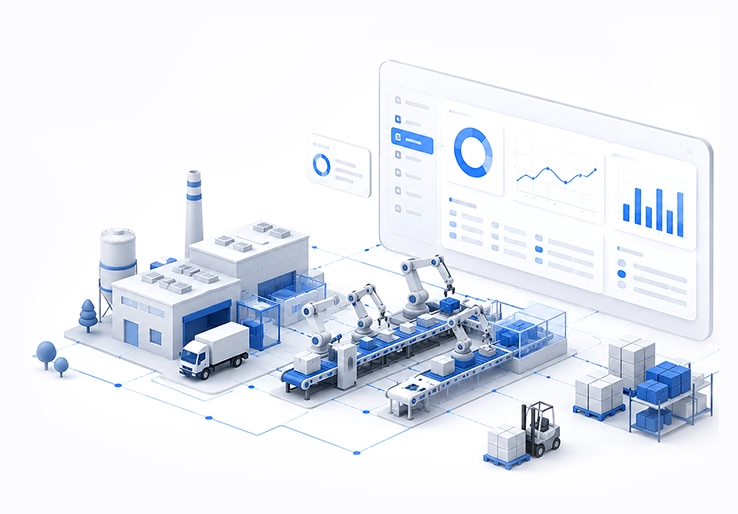
Factory management software is a digital management system that helps manufacturers plan, monitor, control, and improve manufacturing operations from one centralized platform. It connects production planning, real time monitoring, inventory management, quality control, and production data so production managers can make faster, more accurate decisions.
This article covers the operational side of manufacturing management software: production scheduling, shop floor visibility, inventory tracking, raw materials control, quality management, workflow automation, and reporting. Modern ERP software often integrates accounting, procurement, order management, and supply chain management with the manufacturing module.
Factory management software is most useful for manufacturing managers, operations directors, factory owners, small manufacturing businesses, and mid-sized manufacturing companies that want to digitize production processes, reduce material waste, and improve operational efficiency.
In this guide, you will learn:
Factory management software is a set of digital tools used to coordinate the full manufacturing process, from customer demand and production goals to raw materials, production tasks, machine performance, finished goods, and quality records. In a modern manufacturing business, the software becomes the operational source of truth for managing production, tracking production progress, and connecting the office with the shop floor.
Traditional factory management often depends on spreadsheets, paper travelers, whiteboards, manual data entry, and delayed reports. These methods create communication gaps, outdated production history, slow decisions, and limited visibility into different manufacturing stages. Digital data entry reduces communication delays between the office and the shop floor, while real-time tracking reduces errors and improves operational efficiency.
Real-time data improves decision-making and reduces waste because managers can see actual production progress instead of waiting for end-of-shift reports. Real-time visibility enhances decision-making in manufacturing processes, minimizes production delays, and enhances productivity. Real-time insights also enhance decision-making in manufacturing operations by showing bottlenecks, downtime, scrap, and material shortages as they happen.
The best manufacturing software depends on the size, complexity, and goals of the manufacturing company. Most manufacturers use one or more of the following software tools.
Enterprise resource planning systems integrate core business processes into a single system. ERP software connects production with other business functions such as finance, purchasing, sales, inventory software, order management, and supply chain management. Use ERP software to integrate production with other business functions when the business needs unified data across operations, inventory, accounting integration, and customer demand planning.
MES monitors real-time production stages and operations. A manufacturing execution system focuses on the production floor, including machine status, operator workflows, quality checks, production cycle data, traceability, and live performance monitoring. MES is especially valuable for highly specialized manufacturing processes, regulated industries, multi-line factories, and manufacturers that need detailed production data from the shop floor.
MRP focuses on procurement and inventory management. MRP systems automate raw materials procurement and shipment by calculating what materials are needed, when they are needed, and how much should be ordered based on Bills of Materials, demand, and production scheduling. MRP is often included inside erp systems, but it may also be used as a focused inventory system for small manufacturing businesses.
PLM manages product lifecycle from design to disposal. CAD is used for creating technical designs and BOMs. EAM focuses on equipment maintenance and asset management. These advanced systems may not replace a production management system, but they support specific manufacturing workflows such as engineering design, equipment maintenance, and long-term asset performance.
Manufacturing Management Software improves planning and scheduling, enhances inventory management to prevent stockouts, provides real-time visibility into production progress, automates workflows to reduce manual errors, and integrates quality control to reduce defects. Manufacturing software can improve planning and scheduling efficiency when production managers need better resource utilization, more accurate production scheduling, and fewer manual production tasks.
Factory management software works best when it connects with the broader manufacturing ecosystem. Production management, inventory management, quality assurance, supply chain process data, and accounting integration should work together instead of operating in disconnected systems.
For example, a production management software platform may receive customer orders from ERP, calculate material needs through MRP, trigger inventory tracking for raw materials, send work instructions to the shop floor, collect real time data from machines, and return completed production data for costing and reporting. This creates all the data needed for better production planning, business intelligence, and data analysis.
The relationship between production management, inventory control, and quality assurance is central. If raw materials are not available, production scheduling fails. If quality management is not integrated, defective products may continue through the production cycle. If production data does not flow back into ERP, finance and supply chain management teams cannot accurately evaluate costs, margins, or inventory value.
This foundation matters because the value of factory management software comes from its features in daily use: monitoring production progress, preventing downtime, controlling materials, enforcing standard operating procedures, and helping teams streamline operations across every manufacturing stage.
Once the fundamentals are clear, the next question is what factory management software should actually do. Strong manufacturing management software combines production management features, inventory tracking, workflow automation, quality management, equipment maintenance visibility, and analytics in one connected management system.
The most important key features are not just "nice-to-have" dashboards. They directly affect production efficiency, material waste, regulatory compliance, labor productivity, resource allocation, and the ability to meet customer demand on time.
Real-time production monitoring gives production managers live visibility into what is happening on the shop floor. Centralized dashboards provide real-time insights into production progress, including job status, planned versus actual output, downtime, cycle time, labor usage, and machine performance.
OEE dashboards calculate Overall Equipment Effectiveness by analyzing machine performance. OEE combines availability, performance, and quality to show whether equipment is producing good parts at the expected rate during planned production time. Monitoring equipment performance helps minimize downtime, and predictive maintenance detects machine anomalies before they break, reducing unplanned downtime.
Real-time scheduling synchronizes resources, labor, and materials for efficient production. Automated alerts notify teams when a line falls behind, when a machine stops, when quality results move out of tolerance, or when raw materials are running low. Real-time data helps identify inefficiencies and optimize workflows, while real-time visibility minimizes production delays and enhances productivity.
Manufacturers should also invest in the right machinery to ensure efficient production. Software improves production efficiency, but the strongest results come when the right machinery, standard operating procedures, equipment maintenance, and real time monitoring work together.
Inventory and material management features help manufacturers control raw materials, work-in-progress, finished goods, supplier lots, and warehouse movements. Real-time inventory tracking manages Bills of Materials and prevents costly material shortages by showing what is available, what is reserved, what is consumed, and what must be reordered.
A strong inventory system supports automated reorder points, safety stock, lot tracking, batch tracking, expiry dates, supplier information, and multi warehouse management. This is important for manufacturing companies that handle complex BOMs, variable demand, long lead times, or regulated materials.
Work-in-progress monitoring shows where each job sits across different manufacturing stages. Finished goods management connects completed production to order fulfillment, shipping, and supply chain management. BOM management and material requirements planning help production managers understand which components are needed for each production cycle and whether procurement must act before a shortage disrupts the schedule.
Data analytics helps managers improve operational efficiency and reduce overhead costs by identifying excess stock, slow-moving materials, scrap patterns, and inefficient resource utilization. Better inventory management also supports reducing material waste because teams can plan purchases, production tasks, and material usage based on accurate demand and production data.
Quality control is one of the most important reasons manufacturers adopt factory management software. Quality management systems enforce quality control checks and helps improve product consistency by ensuring inspections, test results, operator sign-offs, and nonconformance records are captured at the right point in the manufacturing process.
Digital checklists help standardize inspections and reduce missed steps. Establish standard operating procedures for consistency so operators follow the same approved workflows, inspection rules, and documentation requirements across shifts, lines, and sites. Automated inspection results, SPC charts, and defect tracking can help teams detect quality drift before it creates larger scrap or rework problems.
Compliance tracking and regulatory reporting are essential in industries such as food, pharmaceuticals, automotive, aerospace, medical devices, and chemicals. Factory management software supports regulatory compliance by maintaining audit trails, quality records, batch genealogy, corrective actions, and traceability data.
Defect tracking and corrective action management help production teams find root causes instead of only recording failures. MMS integrates quality control to reduce defects, and when quality management is connected with production data, managers can see whether defects are linked to a machine, operator, material batch, supplier, shift, or process condition.
Selecting factory management software should begin with business needs, not vendor demos. The right management software depends on production complexity, industry regulations, technical expertise, IT infrastructure, budget, and the production goals the manufacturer wants to achieve.
A small business may need cloud ERP with a manufacturing module, inventory tracking, and simple production scheduling. A mid-sized factory may need ERP plus MES for shop floor control, real time monitoring, and quality management. A complex multi-site manufacturer may need ERP, MES, APS, EAM, PLM, CAD integration, and business intelligence tools.
Manufacturers should consider factory management software when manual tracking, spreadsheets, disconnected systems, stockouts, quality escapes, downtime, or delayed reporting are limiting growth. Before selecting software, complete a structured assessment.
Map production processes from order intake to finished goods. Look for downtime, bottlenecks, excess material waste, manual production tasks, late orders, poor production history, and communication delays.
Set measurable targets such as higher OEE, shorter lead times, fewer stockouts, lower scrap, better resource utilization, faster reporting, or improved regulatory compliance.
Include licensing, implementation, training, technical support, integrations, customization, data migration, and ongoing maintenance. For many small-to-mid manufacturers, real operational software often falls around a few hundred dollars per user per month once scheduling, inventory, reporting, and shop floor tracking are included.
Confirm whether machines can connect through PLCs, sensors, APIs, or manual terminals. Review accounting integration, ERP integration, inventory software, warehouse systems, and network reliability.
Automated production planning creates data-driven schedules to optimize resource usage. However, planning accuracy depends on clean data, realistic capacity assumptions, correct BOMs, and disciplined use by production managers.
Cloud-based and on-premise systems can both work well, but they serve different needs. The detailed comparison table below shows common differences manufacturers should consider.
| Evaluation Criteria | Cloud-Based Solutions | On-Premise Systems |
|---|---|---|
| Implementation Time | 2-8 weeks | 3-6 months |
| Initial Investment | Small budget | Moderate budget |
| Scalability | High flexibility | Requires planning |
| Maintenance | Vendor managed | Internal IT team |
Cloud ERP is ideal for smaller businesses that want faster deployment, lower upfront cost, remote access, and vendor-managed updates. Cloud-based manufacturing software can be especially useful for small manufacturing businesses with limited internal IT teams.
On-premise systems may be better for manufacturers that need maximum control, have strict data residency requirements, have limited internet connectivity, or operate highly specialized manufacturing processes with deep custom integrations. These systems can offer more control, but they usually require more technical expertise, internal maintenance, and longer implementation timelines.
The right choice depends on company size, production complexity, security needs, available technical support, and long-term growth plans. Manufacturers should also evaluate whether the vendor can support advanced systems such as MES, predictive analytics, IIoT integration, EAM, and future Industry 4.0 initiatives.
Factory management software can deliver major gains, but implementation challenges are common. The biggest risks usually involve people, data, integrations, scope control, and underestimated complexity.
Addressing these obstacles early helps manufacturers avoid a steep learning curve, protect production continuity, and achieve ROI faster.
Employees may resist new manufacturing software if they see it as surveillance, extra work, or a threat to established routines. Operators, supervisors, maintenance teams, and production managers should be involved early in the selection and design process.
Implement comprehensive training programs that show employees how the software helps them solve daily problems, not just how management will use reports. Training should cover digital data entry, dashboards, production tasks, standard operating procedures, quality control checks, and escalation workflows.
Pilot programs are often the safest way to build confidence. Start with one line, one production module, or one plant area, then showcase quick wins such as faster shift handovers, fewer manual errors, better machine performance visibility, or reduced downtime.
Data migration risks can lead to data loss during software switching. Legacy spreadsheets, paper records, old BOMs, inconsistent item codes, and duplicate supplier records must be cleaned and validated before migration.
Plan data cleaning, field mapping, testing, and user validation before go-live. Poor data will damage production planning, inventory management, quality reporting, and cost analysis. A phased rollout reduces risk by moving one process, line, or module at a time instead of attempting a full switch overnight.
Integration is equally important. Ensure API compatibility and test integrations thoroughly before go-live, especially for ERP, MES, MRP, inventory software, accounting systems, warehouse systems, machine controls, and business intelligence tools. If production data does not move correctly between systems, managers may lose trust in the platform.
Cost overruns usually happen when scope is unclear, customizations expand, legacy equipment is harder to connect than expected, or training needs are underestimated. Timeline delays are common when manufacturers try to digitize every process at once.
Set realistic timelines with buffer periods and establish clear project scope boundaries. Decide which production management features are required for phase one and which can wait. Avoid over-customization unless the workflow is truly business-critical.
Choose vendors with proven implementation track records, transparent pricing models, strong technical support, and relevant manufacturing industry experience. A vendor that understands your production floor, quality requirements, inventory system, and supply chain can reduce risk and shorten the path to measurable ROI.
LOGIC ERP factory management software offers a comprehensive, integrated solution tailored specifically for manufacturers seeking to enhance operational efficiency and production control. With decades of industry experience, LOGIC ERP understands the unique challenges faced by small to mid-sized manufacturers and provides a scalable platform that grows with your business.
Key reasons to choose LOGIC ERP include:
LOGIC ERP delivers real-time monitoring of shop floor activities, machine performance, and production progress through centralized dashboards, enabling managers to make faster, data-driven decisions.
The software connects production management with inventory control, quality assurance, procurement, and accounting systems, eliminating silos and ensuring accurate, up-to-date information across departments.
Automated production planning optimizes resource allocation, reduces downtime, and helps meet delivery deadlines by synchronizing labor, materials, and equipment efficiently.
Integrated quality control features enforce standard operating procedures, track inspections, and manage nonconformance, helping manufacturers reduce defects and comply with industry regulations.
Designed with ease of use in mind, LOGIC ERP simplifies shop floor data entry and workflow automation, minimizing training time and increasing adoption among operators and supervisors.
Whether you prefer cloud-based access for remote monitoring or on-premise installation for greater control, LOGIC ERP adapts to your IT infrastructure and security requirements.
LOGIC ERP provides expert onboarding, training, and ongoing technical support to ensure a smooth transition and maximize your return on investment.
Choosing LOGIC ERP means partnering with a proven factory management software provider committed to helping manufacturers reduce waste, improve productivity, and gain a competitive edge in today's dynamic market.
Factory management software is important for competitive manufacturing operations because manufacturers need real-time visibility, accurate production planning, reliable inventory management, strong quality control, and faster decision-making. The right platform helps streamline operations, reduce manual errors, prevent stockouts, monitor equipment performance, improve production efficiency, and support regulatory compliance.
For most manufacturers, the goal is not simply to "buy software." The goal is to create a connected production management system that turns real time data into better decisions across the entire manufacturing process.
Recommended next steps:
After the core system is in place, manufacturers can explore advanced analytics, IoT integration, predictive maintenance, business intelligence, and Industry 4.0 tools to extend asset lifespan and continue improving operational efficiency.
Call at +91-73411-41176 / +91-73411-41175 or send us an email at sales@logicerp.com to book a free demo today!
Factory management software is a digital management system designed to help manufacturing companies streamline production processes, manage inventory, and monitor operations in real time. It integrates key functions such as production scheduling, quality control, and inventory management within a single platform, enabling manufacturers to improve efficiency and operational visibility.
Factory inventory management software provides real-time tracking of raw materials, work-in-progress, and finished goods. This reduces stockouts and excess inventory, optimizes reorder points, and improves overall supply chain efficiency for manufacturing businesses.
The best manufacturing software includes features like real-time production monitoring, automated scheduling, quality control integration, inventory software capabilities, and seamless ERP system integration to support comprehensive factory management.
Yes, modern factory management system software often integrates with ERP systems to unify production data with finance, procurement, and supply chain management, providing a holistic view of manufacturing operations.
There are some free factory management software options and factory management software free download versions available, but they may have limited features compared to paid solutions. It's important to evaluate if the free version meets your manufacturing company's needs.
Advanced systems provide enhanced capabilities such as predictive maintenance, detailed analytics, multi-site management, and workflow automation, enabling manufacturers to optimize operations and reduce downtime.
Factory store management software helps manage inventory storage, track material movements, and maintain accurate stock levels, which supports efficient production planning and reduces material waste.
Factory manager software typically refers to tools aimed at individual managers for overseeing daily production tasks, while factory management software encompasses broader systems that manage multiple facets of manufacturing operations.
Manufacturing companies gain improved operational efficiency, better inventory control, enhanced quality assurance, and faster decision-making by implementing factory management software tailored to their production workflows.
Choosing the best factory management software depends on your manufacturing business size, complexity, and specific operational needs. Leading options generally include comprehensive ERP systems with manufacturing modules, MES for real-time shop floor control, and MRP systems for inventory and procurement automation. The best software provides real-time production monitoring, inventory accuracy, quality control integration, workflow automation, and seamless ERP connectivity. Popular choices often balance scalability, user-friendliness, and industry-specific features to optimize production efficiency and reduce waste.
LOGIC ERP stands out as the best factory management software for manufacturing due to its end-to-end production visibility, seamless integration capabilities, and advanced planning and scheduling features. It offers robust quality management tools, a user-friendly interface, and flexible deployment options tailored to various IT infrastructures. With dedicated support and scalability, LOGIC ERP helps manufacturers improve operational efficiency, reduce material waste, and make faster data-driven decisions. Its comprehensive platform connects production, inventory, quality assurance, procurement, and accounting, making it an ideal choice for manufacturers aiming to enhance productivity and competitiveness.
Popular Products