Get information of 20 essential retail software terms — POS, retail ERP, CRM, omnichannel, inventory, AI automation and more — to help you compare solutions and avoid costly gaps in process, data, and integration.
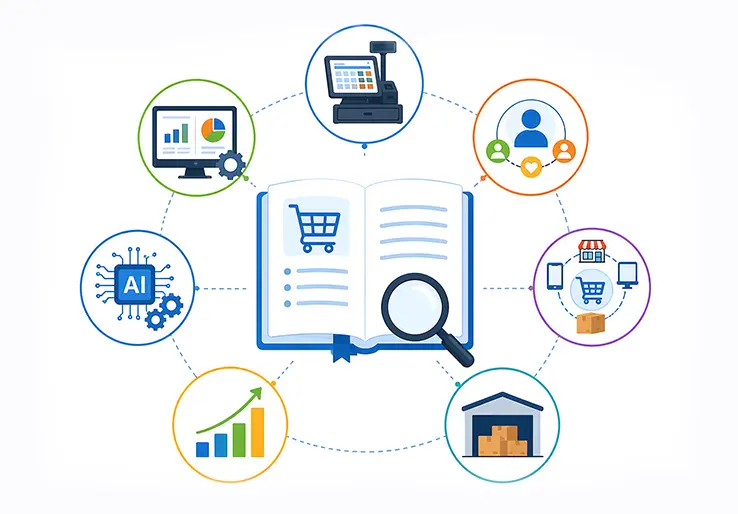
Retail software terms are the core concepts and vocabulary used to evaluate, implement, and run retail technology, from POS and retail ERP to CRM, omnichannel operations, inventory control, supply chain workflows, analytics, and AI-led automation. If you’re a retail business owner, CIO, operations leader, or another decision-maker involved in selecting or managing retail systems, knowing these terms helps you compare solutions more accurately and avoid expensive gaps in process, data, and integration.
This glossary breaks down 20 essential retail software terms for 2026, including point of sale, retail ERP systems, customer relationship management, warehouse and inventory management, pricing and promotions, cloud deployment models, personalization, SKU management, and connected concepts such as BOPIS, RFID, loyalty management, and unified commerce. In a market where retail tech decisions directly affect stock accuracy, customer experience, operating efficiency, and growth, a weak grasp of the terminology can lead to poor software choices, failed implementations, and avoidable operational friction.
Retail software manages daily operations like inventory and sales, and the vocabulary around it has expanded fast. Between 2024 and 2026, terms like "agentic AI," "unified commerce POS," and "omnichannel orchestration" entered routine vendor conversations. If you run a retail business or lead its technology decisions, misunderstanding even one of these retail software terms can lead to a bad purchase, a botched integration, or months of rework.
This glossary covers 20 terms that directly affect operational efficiency, inventory control, and customer relationship management. Each one is defined in plain English first, then expanded with the technical detail you need for vendor evaluations and internal planning. LOGIC ERP, which has served Indian and global retailers since 1993, provides the real-world lens for these explanations.
Retail software centralizes inventory, sales, and customer data. The goal of this article is to make sure you know what each piece of that centralization actually means.
You can read this end-to-end or jump to specific terms using the headings as anchors. Each entry follows a consistent pattern: definition, why it matters in 2026, and a quick example. Terms flow from store-facing (POS, CRM) to back-office (ERP, supply chain, business intelligence) to emerging tech (AI, cloud deployments).
If you are evaluating retail software solutions or comparing vendor proposals, keep this glossary open as a reference. The questions and frameworks near the end will help you translate these definitions into concrete evaluation criteria for your next RFP.
Point of sale POS is the combination of hardware (billing counter, barcode scanner, card terminal, UPI device) and software (billing, tax calculation, promotions, returns) used at the moment a customer pays. Point of Sale (POS) systems are essential for retail transactions, and POS integration connects in-store transactions to inventory and financials.
A 2026 unified commerce POS goes beyond the cash register. It syncs sales transactions across physical stores, online stores, marketplaces, and social commerce into a single database. When a customer buys a shirt via Instagram, the same stock pool updates as when someone scans that shirt at a brick and mortar stores counter.
Typical POS workflows: barcode scan, promotion application, loyalty redemption, payment (UPI, card, cash), instant stock deduction. Payment processing software integrates with POS for transaction management, keeping the financial trail clean. LOGIC ERP's retail POS modules connect to inventory control, accounting, and CRM, removing the need for manual reconciliation at day's end.
KPIs sourced from POS data include average transaction value, units per transaction, and peak-hour throughput. Errors at POS propagate downstream into inventory levels, financial reporting, and analytics; accuracy here is non-negotiable.
A retail ERP system is enterprise resource planning software built for the retail industry. It integrates purchasing, inventory management, supply chain, finance, HR, and customer management into a centralized platform. Retail ERP systems integrate sales, inventory, and customer data into one platform, giving leaders real time visibility across all operations.
The difference from a generic ERP system matters. Retail ERP handles SKU-level profitability, variant tracking (size, color, style), markdown schedules, loyalty programs, GST compliance for Indian retailers, and omnichannel order flows. Retail ERP systems are designed for omnichannel sales management, while traditional ERP systems are built for structured industries like manufacturing.
How transactions flow inside a retail ERP: purchase order → goods receipt → shelf stock → POS sale → financial posting (COGS, revenue, GST) → replenishment suggestion. LOGIC ERP applies this flow across apparel, FMCG, pharma, electronics, and beauty verticals, supporting cloud and on-premise deployment.
The retail ERP market is projected to grow from $10.34 billion in 2023 to $28.58 billion by 2032. The growth reflects a clear shift: retail companies are replacing patchwork systems with unified ERP platforms that reduce stockouts, speed up month-end closing, and deliver real time visibility across all locations and sales channels.
Customer relationship management CRM in retail means collecting and using customer data (customer purchases, returns, customer preferences, feedback, channel interactions) to drive repeat visits and higher lifetime value. CRM software manages customer interactions and tracks purchase history across every touchpoint.
Standalone CRM tools like Salesforce or HubSpot focus on marketing and outreach. CRM embedded inside retail ERP systems like LOGIC ERP connects customer profiles directly to orders, invoices, POS transactions, and loyalty points, creating a single source of truth. CRM features help retailers personalize customer experiences and build loyalty by enabling actions like birthday coupons, category-based offers, and abandoned-cart follow-ups linked to in store history.
CRM software enhances customer engagement, but in 2026, privacy expectations are rising. Indian data protection frameworks and GDPR-style regimes require consent management. Retailers must balance personalization with compliance, storing customer information with clear opt-in mechanisms and controlling who on the team accesses sensitive customer data. LOGIC ERP's CRM and loyalty management modules support segmentation, tiered loyalty, and consent tracking within a single interface.
Omnichannel provides a unified shopping experience across different platforms. In practice, this means customers move between physical stores, ecommerce sites, marketplaces, and social commerce while seeing consistent prices, inventory availability, and customer experiences.
Sales channels in 2026 include flagship stores, franchise outlets, webstores, mobile apps, Instagram shops, Amazon, Flipkart, and B2B wholesale portals. Retail ERP systems automate workflows across multiple sales channels, acting as the orchestration layer that shares stock, orders, and customer data in real time.
Concrete scenarios: BOPIS allows customers to buy online and pick up their orders in-store. "Endless aisle" lets a shopper in a store order an out-of-stock size from warehouse inventory. Real-time synchronization updates inventory immediately after sales occur, preventing overselling.
LOGIC ERP's omnichannel retail solution handles online and offline sales through a unified database. Key metrics to track: channel-wise revenue, cross-channel conversion, and channel profitability across all your sales channels.
Inventory control is the discipline of tracking, valuing, and optimizing stock to reduce shrinkage, dead stock, and lost sales. Stockouts and overstocks cost retailers $1.7 trillion worldwide in 2023, making accurate inventory management one of the highest-ROI investments a retailer can make.
Key data structures: an SKU is an alphanumeric code used to track inventory levels. Variants (size, color) extend SKUs for apparel. Batches and serial numbers serve electronics and pharma. Expiration dates are critical in FMCG.
Core software capabilities: inventory management software tracks stock levels and reorders automatically. A reorder point is the inventory level that triggers a reorder alert. Safety stock is extra inventory kept as a buffer against unexpected demand. Inventory turnover measures how quickly stock is sold and replenished. Inventory management features help track stock levels in real time across multiple locations.
LOGIC ERP's inventory modules support FIFO, LIFO, and weighted-average costing, multi-location tracking, cycle counts, and automatic purchase order generation. Inventory management systems inside retail ERP help manage inventory and cash flow by preventing overbuying and clearing slow movers before they become dead stock.
Demand forecasting tools analyze sales trends to predict customer demand, and in 2026, AI-driven models adjust safety stock dynamically based on promotions, seasonality, and local events.
Retail supply chain management covers the end-to-end flow of products: suppliers → distribution centers → regional warehouses → retail stores → customers. Supply chain software addresses purchasing, vendor management, inbound logistics, warehouse management, transportation, and returns.
Real examples: coordinating seasonal imports for an apparel chain, aligning FMCG deliveries with expiry windows, and managing supplier performance SLAs for Indian distributors. LOGIC ERP integrates SCM with sales data, enabling faster replenishment and fewer stockouts across all sales channels.
Retail ERP automates processes from supply chain to customer interactions, closing the loop between what sells and what gets reordered. KPIs: lead time, fill rate, stock turn, and on-time-in-full (OTIF) deliveries. According to NVIDIA's 2026 retail AI survey, agentic AI is expected to yield its earliest measurable value in supply chain operations, with 47% of retailers using or assessing autonomous agents.
A warehouse management system is specialized software for controlling receiving, put-away, bin locations, picking, packing, and dispatch. WMS optimizes and tracks inventory movement within a warehouse, handling everything from zone picking to cross-docking.
Features include barcode or RFID scanning (RFID technology uses radio waves to track items without line of sight), put-away strategies by product type, wave picking for batch orders, and integration with courier and transport partners. LOGIC ERP supports bin/rack/godown storage with real-time updates between warehouses and stores.
Retail-specific workflows: ecommerce order picking from a central warehouse, BOPIS staging areas in store backrooms, and reverse logistics for returns and damages. For mid-market retailers moving from spreadsheet-based warehouses, structured WMS is the single fastest way to reduce pick errors and speed up fulfillment.
Business intelligence in retail converts POS, ERP, supply chain, and CRM data into actionable insights through reporting tools, dashboards, and predictive models. Gross margin, the difference between selling price and product cost, is one of the most-watched metrics on any retail BI dashboard.
Core analytics views: daily sales by store, category, and brand; stock aging; promotion uplift; customer cohort analysis; and staff performance. In 2026, static batch reports have given way to real-time, role-based dashboards accessible by store managers, merchandisers, and CFOs via web or mobile.
LOGIC ERP's analytics capabilities allow drill-downs from company-wide revenue to specific SKU performance in a single city or store. Sales data analysis at this granularity powers smarter markdown decisions, promotion planning, and assortment choices. Emerging techniques include AI-assisted natural-language queries ("show me top 10 SKUs by margin last quarter in Delhi NCR") and anomaly detection for shrinkage or fraud.
Customer experience is the sum of every interaction a shopper has with a brand: discovery, browsing, buying, delivery, returns, and after-sales support. Retail software influences CX at each step: fast billing, accurate stock information, easy returns, click-and-collect, digital receipts, and proactive service based on history.
Personalization engines use CRM and ERP data to recommend products, time communications, and tailor pricing or bundles. LOGIC ERP-driven scenarios include suggesting complementary products at POS, targeted SMS offers for local festivals, or reordering reminders for consumables. Improved customer satisfaction follows when offers match customer preferences rather than blasting the same promotion to every phone number in the database.
Consistent CX across channels, powered by unified data, drives loyalty and increases customer lifetime value. The 2026 challenge is balancing depth of personalization with privacy compliance, especially as regulations tighten around profiling and consent.
Core terms: base price, markdown, discount, coupon, promotion, combo/kit, and loyalty points. These appear on every retail ERP and POS system screen, and getting their logic wrong erodes margin fast.
Modern retail software allows complex promotion rules: buy X get Y, slab discounts, happy hours, region-specific offers. Loyalty programs operate on earn/burn rules, tiers (silver, gold, platinum), cashback wallets, and omnichannel redemption through both POS and ecommerce.
LOGIC ERP centralizes promotions so that each store and online channel uses the same rule engine. This prevents one store from accidentally stacking discounts while another rejects a valid coupon. In 2026, real-time promotion optimization uses sales data and inventory levels to auto-boost discounts on aging stock before a season ends, while flagging negative-margin transactions before they post.
Integration is the secure data exchange between retail ERP, POS, ecommerce platforms, marketplaces, payment gateways, and accounting software. An API allows different software systems to communicate with each other; webhooks push updates in real time when events occur (e.g., "order placed" triggers stock decrement).
Common integration patterns for LOGIC ERP customers: POS-to-ERP for seamless integration of sales transactions, ERP-to-GST-compliant accounting for accurate financial reporting, ERP-to-logistics aggregators for shipping, and ERP-to-ecommerce for catalog and stock sync.
Business risks of poor integration: mismatched inventory between online and in store, double-ordering from suppliers, accounting discrepancies, and inconsistent customer experiences. PCI-DSS ensures security standards for credit card information processing, a compliance layer that integration must respect. In 2026, retailers should prioritize platforms with strong native integrations and open APIs to avoid vendor lock-in and high middleware costs.
Cloud-based retail software runs on remote servers accessed via the internet. On-premise software lives within a retailer's own data center. Hybrid mixes both: local POS servers for offline resilience, cloud for central data and analytics.
| Factor | Cloud | On-Premise | Hybrid |
|---|---|---|---|
| Upfront cost | Lower (subscription) | Higher (hardware + licenses) | Moderate |
| Offline POS capability | Requires local fallback | Native | Native |
| Scalability during festivals | Elastic | Fixed capacity | Flexible |
| Update cycle | Automatic | Manual | Mixed |
| Data sovereignty | Vendor-dependent | Full control | Configurable |
LOGIC ERP offers cloud and hybrid deployments to support both single-store retailers and large national chains with hundreds of outlets. Practical 2026 concerns include data security, backup and disaster recovery, mobile access for owners, and performance over variable internet connections across Indian geographies.
AI in retail means tools that analyze data, predict outcomes, and trigger workflows. Agentic assistants go further: autonomous agents that perform tasks like auto-replenishing stock, flagging anomalies, or drafting purchase orders without manual initiation.
According to NVIDIA's 2026 survey, 91% of retailers are using or assessing AI. Among those, 89% report revenue increases and 95% report cost decreases tied to AI deployments. A recent study showed that AI-powered planogram creation reduces cost by 97.5% with break-even in 4.4 months.
Automation opportunities inside retail ERP: recurring reports, invoice matching, promotion scheduling, and predictive maintenance for store hardware. LOGIC ERP's 2.0 release embeds AI across procurement, warehousing, and CRM modules. Automated processes replace manual steps in replenishment, sales data analysis, and exception handling.
Retailers should view AI as a co-pilot to improve operational efficiency and decision quality. Analyzing sales trends, identifying dead stock, and predicting customer demand are tasks where AI excels; merchandising judgment and customer relationships still require human expertise.
A Stock Keeping Unit (SKU) is a unique alphanumeric identifier assigned to each distinct product or product variant. SKUs facilitate detailed inventory tracking, enabling retailers to monitor stock quantities, sales velocity, and profitability at a granular level. For apparel retailers, SKUs often represent combinations of size, color, and style, allowing precise assortment planning and replenishment. Effective SKU management supports demand forecasting, inventory optimization, and SKU rationalization initiatives to eliminate slow-moving or redundant products, thereby improving turnover and reducing carrying costs.
Multichannel retail refers to selling products through multiple independent channels like brick-and-mortar stores, online shops, and marketplaces. Unlike omnichannel, multichannel does not necessarily unify inventory, customer data, or order management across channels, which can lead to inconsistent experiences and operational inefficiencies. Retailers often transition from multichannel to omnichannel strategies by adopting integrated retail ERP systems that consolidate data and workflows.
Inventory turnover is a key performance indicator measuring how often inventory is sold and replenished during a given period. A high turnover rate typically indicates strong sales and efficient inventory management, while low turnover suggests overstock or slow-moving products. Retail software calculates turnover ratios to help businesses identify product performance issues, optimize purchasing, and improve cash flow.
Stock keeping involves maintaining accurate records of inventory quantities, locations, and status. Replenishment is the process of ordering and restocking products when inventory hits predefined reorder points. Retail software automates replenishment workflows by generating purchase orders based on real-time sales data, demand forecasts, and safety stock levels. This automation prevents stockouts, reduces manual errors, and ensures optimal inventory availability across all sales channels.
An Order Management System is software that tracks and manages customer orders from placement through fulfillment and delivery. OMS coordinates inventory availability, payment processing, shipping, and returns across multiple sales channels. It ensures orders are accurately processed, routed to the right fulfillment locations, and delivered on time, improving operational efficiency and customer satisfaction.
Barcode management uses barcode labels to uniquely identify products and track inventory movements throughout the supply chain. Scanning barcodes accelerates checkout, receiving, and stocktaking processes while minimizing human errors. Retail software integrates barcode scanning with POS and inventory modules, enabling real-time updates and accurate stock visibility.
Radio Frequency Identification (RFID) technology employs radio waves to track tagged items without requiring direct line of sight, unlike barcodes. RFID tags enable faster, automated inventory counts, improved loss prevention, and enhanced supply chain visibility. Retailers use RFID for automated receiving, cycle counting, and real-time stock monitoring, leading to greater inventory accuracy and operational efficiency.
BOPIS is a retail fulfillment method where customers purchase products online but choose to pick them up at a physical store location. This approach combines the convenience of online shopping with the immediacy of in-store pickup, reducing shipping costs and delivery times. Retail ERP systems coordinate inventory between online and physical stores to ensure availability and smooth order processing for BOPIS.
Endless Aisle is a retail concept enabled by software that allows customers in a physical store to order products that are not currently in stock or available on-site. Through kiosks or mobile devices, shoppers can browse the retailer’s full online inventory and place orders for home delivery or later pickup. This expands the product assortment beyond what is physically displayed, improving customer satisfaction and sales opportunities.
Loyalty Management refers to software features that help retailers design, implement, and track customer loyalty programs. These programs reward repeat customers with points, discounts, or exclusive offers to encourage ongoing engagement and higher lifetime value. Integrated loyalty management in retail ERP connects customer purchases, points earned, and redemptions across all sales channels, enabling personalized marketing and consistent experiences.
Retail Demand Forecasting uses historical sales data, market trends, seasonality, and other factors to predict future customer demand for products. Advanced forecasting tools often incorporate AI and machine learning to improve accuracy. Accurate demand forecasting helps retailers optimize inventory levels, reduce stockouts and overstocks, and plan promotions effectively.
SKU Rationalization is the process of analyzing a retailer’s product assortment to identify underperforming or redundant stock keeping units (SKUs) and optimize the product mix. This helps reduce inventory carrying costs, improve turnover rates, and focus on high-margin or high-demand products. Retail ERP systems provide data and analytics to support SKU rationalization decisions.
Unified Commerce refers to an integrated retail approach where all sales channels, physical stores, ecommerce, marketplaces, social media, and mobile apps are connected through a single platform and database. This ensures real-time synchronization of inventory, pricing, customer data, and orders, providing a seamless and consistent shopping experience regardless of how or where customers shop. Unified commerce platforms like LOGIC ERP streamline operations and enhance customer engagement across all touchpoints.
Not every term requires immediate action. A practical staging framework:
Start with POS + inventory control
If your pos system does not connect to inventory in real time, fix this first. Accurate inventory management is the foundation everything else builds on.
Add retail ERP integration
Connect purchasing, financials, and warehouse management to eliminate manual data entry and streamline retail operations.
Layer in CRM and omnichannel
Once data flows cleanly, activate customer relationship management, loyalty programs, and multiple sales channels orchestration.
Deploy advanced BI and AI
Real-time dashboards and automated processes deliver value only when the underlying data is reliable.
Build an internal glossary so cross-functional teams (IT, finance, operations, store managers) share the same language. When evaluating the right retail erp system, ask specific questions: "How does your POS talk to inventory?" "What BI dashboards come out of the box?" "How do you support BOPIS?"
Align your software roadmap with business growth goals for 2026 through 2028.
Knowing these 20 retail software terms helps leaders make better ERP, POS, and CRM decisions, avoid buzzword confusion, and negotiate with vendors on specifics rather than slogans. Integrated platforms such as LOGIC ERP connect customer relationship management, inventory control, supply chain management, and financial management into one coherent system, covering the full spectrum of retail industry solutions.
Use this glossary as a checklist when reviewing current business operations or planning digital transformation projects. Retail business growth in 2026 belongs to teams that speak the same language across IT, finance, and the shop floor.
Call at +91-73411-41176 / +91-73411-41175 or send us an email at sales@logicerp.com to book a free demo today!
Very small retailers can start with integrated retail pos software plus basic inventory and accounting. A lightweight cloud retail ERP becomes valuable once you add multiple locations, ecommerce, or complex promotions. LOGIC ERP deploys in modular form: start with core modules (POS, inventory tracking, accounting) and scale into full enterprise resource planning as the business grows. Evaluate pain points (stock inaccuracies, manual reports, fragmented customer data) rather than store count alone. Retailers typically outgrow spreadsheets and standalone POS within 12 to 24 months of rapid expansion.
Realistic ranges: 6 to 10 weeks for a single-brand, few-store rollout with standard business processes; 4 to 9 months for multi-region or multi-format chains with heavy customization and integrations. Project phases include discovery and blueprinting, data cleansing and migration, configuration, user training, pilot store testing, and full roll-out. Cloud deployments with preconfigured retail templates compress timelines compared with older on-premise projects. Build a phased roadmap rather than a "big bang" go-live to reduce risk.
Cost components include software subscriptions or licenses, implementation services, data migration, hardware (POS terminals, scanners, printers), training, and ongoing support. Think in terms of total cost of ownership over 3 to 5 years, including upgrades and integrations. Build a simple ROI model using reduced stock losses, lower manual labor, faster closing, and higher sales from better customer experience. Cloud-based ERP solutions like LOGIC ERP reduce upfront capex by shifting to predictable opex subscriptions. Request transparent pricing breakdowns from vendors to avoid hidden integration or customization costs.
Blended training works best: short in-person sessions, role-based online tutorials, sandbox environments, and just-in-time help embedded in the software. Train store champions first; they then support peers during rollout, especially at POS and in inventory control tasks. Phase go-lives one region or pilot store at a time to capture lessons before nationwide deployment. Modern systems like LOGIC ERP use intuitive, mobile-friendly interfaces that reduce learning curves. Schedule refreshers before major festive seasons and after new feature releases.
Warning signs: frequent stock mismatches between online and in store, long billing queues, difficulty launching promotions across channels, manual consolidation of reports, and limited view of customer history. Conduct a quick audit comparing current capabilities against the 20 terms in this glossary to identify gaps in CRM, analytics, supply chain, and omnichannel orchestration. Interview store staff and customers about pain points; their feedback often reveals exactly where systems fail the customer experience. Treat this as an opportunity for strategic modernization, not just an IT replacement exercise.
Retail ERP software enhances operational efficiency by centralizing and automating core retail processes such as inventory management, sales tracking, finance, and customer relationship management. By integrating these functions into a single platform, it eliminates manual data entry, reduces errors, and provides real-time visibility across all operations. This streamlined approach enables faster decision-making, better stock control, and improved coordination between departments, ultimately reducing costs and increasing productivity.
The key benefits of retail ERP software for the retail industry include improved inventory accuracy, real-time sales and customer data synchronization, and enhanced supply chain management. Retail ERP systems support omnichannel sales, allowing businesses to manage both online and offline channels seamlessly. Additionally, these systems provide analytics and reporting tools that help retailers forecast demand, optimize pricing, and personalize customer experiences. Together, these advantages lead to higher customer satisfaction, reduced stockouts and overstocks, and increased profitability.
Operational efficiency in retail can be improved using ERP solutions by automating routine tasks such as purchase order processing, stock replenishment, and financial reconciliation. ERP systems facilitate better communication between sales, inventory, and finance teams, ensuring that information flows seamlessly. They also enable multi-location inventory tracking and real-time updates, which prevent stock discrepancies and improve fulfillment speed. By leveraging ERP technology, retail businesses can minimize manual errors, reduce operational costs, and respond more quickly to market changes and customer demands.
Popular Products