A Goods Received Note (GRN) is an internal document created by the receiving team when goods physically arrive from a supplier, confirming what was delivered, in what quantity, in what condition, and against which purchase order.
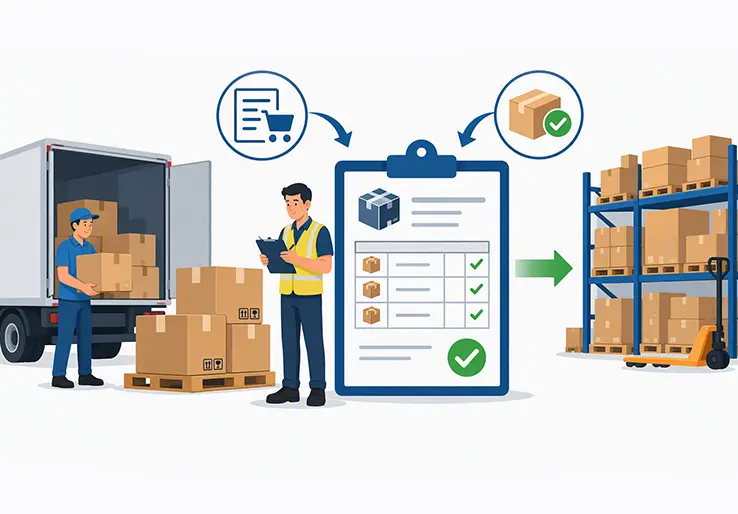
A Goods Received Note (GRN) is an internal document created by the receiving team when goods physically arrive from a supplier, confirming what was delivered, in what quantity, in what condition, and against which purchase order. Imagine an FMCG warehouse on 15 March 2026 receiving 50 cartons of cooking oil from a distributor. The moment the receiving department inspects those cartons and logs them against the original PO, they create a GRN, the official record that those goods entered the facility.
A GRN confirms the receipt of goods from suppliers and acts as the bridge between a purchase order, the physical goods receipt at the dock, inventory records, and supplier invoices in the procure-to-pay cycle. That makes it central to warehouse teams that need accurate stock levels, procurement professionals tracking supplier performance, accounts payable verifying invoices, finance controllers managing accruals, auditors checking compliance, and supply chain managers coordinating receipt across locations. Accurate GRNs help prevent payment errors and fraud, keep inventory and financial records aligned, support audit readiness, and improve supplier accountability.
This guide explains what a goods received note means in practice, how the GRN process works, which fields and formats a GRN should include, the different types used by businesses, and how GRNs support inventory control, procurement, three-way matching, ERP integration, automation, and best practices.
LOGIC ERP supports digital GRN workflows inside an integrated ERP, replacing paper-based notes and reducing manual data entry errors that commonly plague receiving operations.
A goods received note GRN is a buyer-created document that records what goods were physically received from a supplier, when, and in what condition. The full form is straightforward: GRN stands for Goods Received Note, also called goods receipt note in some organizations.
A GRN typically records:
Common terminology varies across industries. Some organizations use "material receipt note (MRN)" in manufacturing contexts, while others refer to a goods receipt note or goods received report. Regardless of the label, the document serves the same function.
The GRN acts as an official receipt and a detailed record of items delivered. It is the primary proof that goods physically entered the warehouse, supporting inventory valuation and liability recognition in accounting. In LOGIC ERP, GRN data fields and statuses are stored as structured records feeding inventory, cost, and accounts payable modules.
A GRN exists for one core reason: to create a verified, evidence-based record of what actually arrived versus what was ordered. This protects cash, ensures accuracy, and maintains compliance and audit readiness.
The GRN supports these purposes:
GRNs help protect organizations from overbilling, duplicate invoices, and fraudulent deliveries by requiring evidence-based approvals before any payment processing occurs. A consistent GRN workflow also strengthens enhanced supplier relationships by making dispute resolution faster and more transparent, with both parties referencing the same documented facts.
In multi-warehouse operations, such as a retailer with five regional distribution centers, standardized GRNs keep the supply chain synchronized and prevent one location’s receiving errors from cascading into company-wide stock mismatches.
The end-to-end flow looks like this: Purchase Requisition → Purchase Order → Supplier Dispatch → Goods Receipt & GRN → Quality Checks → Inventory Update → Supplier Invoice → Three Way Matching → Payment.
The procurement team raises and approves the PO. The supplier delivers the goods. The receiving team at the dock creates the GRN after inspection. The quality control team may flag items for hold. Warehouse teams handle put-away. The finance team and accounts payable process the supplier invoice using GRN data for verification. GRN approval is required before inventory and liability are updated.
Without a GRN, procurement software and ERP systems cannot reliably close POs or validate supplier invoices. The GRN timestamp and location also matter for month-end cut-off. For example, if goods are received on 31 March 2026 but invoiced in April, the GRN date determines when the liability is recognized in financial statements. LOGIC ERP auto-links each GRN to its originating PO and vendor invoice, giving finance and supply chain teams a single, auditable trail.
Here is how a typical note process works in a warehouse, from truck arrival to system approval.
Delivery Logging and Receipt Initiation
Goods arrive with a delivery note from the supplier. The receiving team logs the carrier, arrival time, and performs initial checks against the PO or Advance Shipping Notice (ASN).
Quantity and Quality Verification
Standard practices for creating a GRN involve inspecting goods upon arrival and noting any damages. Staff physically count items, verify batch and serial numbers, check expiry dates, and note shortages or packaging issues before acceptance.
GRN Creation
The team enters or scans the PO number into LOGIC ERP or similar procurement software. The system auto-fills line items, and staff record actual received quantities, accepted quantities, rejected quantities, and remarks.
Discrepancy Handling
Any mismatches are documented with standardized reason codes. Quality holds are raised for suspect items. The GRN becomes the basis for dispute resolution and return-to-vendor workflows.
GRN Approval
A supervisor or store manager reviews GRN data, approves the record in the system, and triggers automatic inventory updates and accounts payable accruals.
Automation through barcodes, QR codes, and handheld terminals can compress this workflow from hours to minutes. Mobile GRN apps allow real-time updates on received goods, and one automotive manufacturer reduced GRN processing time to under one minute after switching from manual processes.
Every GRN document, whether paper or digital, should contain these fields. Key information a GRN should contain includes the GRN number and details of the supplier, along with item-level and control data.
| Field Category | Field | Example |
|---|---|---|
| Header | GRN Number | GRN-DEL-2026-000317 |
| Header | GRN Date | 15-Mar-2026 |
| Header | Warehouse / Location | Delhi DC-1 |
| Header | Supplier Name & Code | ABC Distributors / SUP-0042 |
| Header | Delivery Note Number | DN-8821 |
| Header | PO Number | PO-2026-00452 |
| Line Item | Item Code / SKU | SKU-OIL-500ML |
| Line Item | Description | Refined Sunflower Oil 500ml |
| Line Item | Unit of Measure | Cartons |
| Line Item | Ordered / Received / Accepted / Rejected Qty | 100 / 98 / 96 / 2 |
| Traceability | Batch / Lot Number | BT-2026-MAR-014 |
| Traceability | Expiry Date | 14-Mar-2027 |
| Control | Inspection Status | Passed with exceptions |
| Control | Rejection Reason | 2 cartons crushed in transit |
| Control | Receiver Name | Ramesh K. |
| Control | Approver / Digital ID | Supervisor – Anil M. |
A typical GRN includes details like item descriptions and quantities received. LOGIC ERP can make critical fields mandatory, such as PO number, warehouse, and receiver, improving data quality and compliance across all locations.
A standard GRN layout has three blocks: a header (company logo, "Goods Received Note" title, GRN number/date, supplier details), an order reference block (PO number/date, terms), and an item table.
Example 1: Full Receipt
GRN No.: GRN-2026-00125 | Date: 15-Mar-2026 Supplier: ABC Distributors | PO No.: PO-2026-00452 Warehouse: Main Warehouse, Mumbai
| Product | Ordered | Received | Accepted | Rejected | Remarks |
|---|---|---|---|---|---|
| Sunflower Oil 500ml | 100 | 100 | 98 | 2 | 2 cartons crushed – kept on hold |
| Basmati Rice 5kg | 50 | 45 | 45 | 0 | 5 units short-supplied |
| Sugar 1kg | 200 | 200 | 200 | 0 | All OK |
Example 2: Partial GRN
On 10 April 2026, only 600 units of a 1,000-unit order arrive against PO-2026-00510. The GRN records the 600 received, and the remaining 400 stay open in the PO for a subsequent delivery.
Within LOGIC ERP, the digital GRN format mirrors the paper layout but supports attachments like photos of damaged pallets and inspection reports, plus role-based editing rights that prevent unauthorized changes.
Not every delivery is a simple full receipt. GRN types adapt to real-world scenarios while staying within one unified GRN workflow.
LOGIC ERP supports all these variations through configuration. Users do not need different forms, only appropriate GRN statuses and reason codes.
The GRN is the trigger that turns delivered goods into system-recognized inventory. Without it, your inventory management system is working with outdated numbers.
Approved GRNs immediately increase on-hand stock, influencing replenishment planning, MRP, and available-to-promise calculations. GRNs improve inventory accuracy by updating stock levels promptly. Timely GRN processing prevents overstocking and stockouts by keeping system quantities aligned with physical shelves.
GRN posting also triggers downstream warehouse operations like put-away, bin assignment, and staging for production or store transfer. GRNs help maintain accurate inventory records and prevent stock discrepancies that lead to emergency purchases and supply chain disruptions.
Aggregated GRN data over months reveals patterns: chronic shortages from a specific supplier, recurring damage on a particular route, or seasonal spikes that affect incoming goods volumes. LOGIC ERP gives warehouse teams dashboards of pending GRNs, recently approved receipts, and items on quality hold.
GRNs are not just a warehouse document. They are central to procurement efficiency and supplier relationships.
The procurement team compares GRN data against PO delivery schedules to measure supplier performance through on-time delivery and fill-rate KPIs. A signed or system-generated GRN serves as primary evidence in dispute resolution over shortages, incorrect items, or alleged non-delivery. Manual GRNs can lead to disputes over missing or damaged items, but a well managed GRN process reduces supplier disputes by 50%.
GRN history across a year helps categorize suppliers as reliable or high-risk when renegotiating contracts or awarding new business. Consistent, transparent GRN documentation actually protects both buyer and supplier, reducing emotional conflicts and enabling fact-based conversations that strengthen supplier compliance.
LOGIC ERP centralizes GRN data so procurement, warehouse teams, quality control, and accounts payable can all see the same record during disputes.
Three way matching is the backbone of controlled accounts payable and risk management. It reconciles three documents before payment is released: the purchase order (what was ordered), the GRN (what was received), and the supplier invoice (what is being billed).
The GRN is essential for three-way matching in accounts payable. Typical checks include item codes, quantities, unit prices from the PO, tax amounts, and any tolerances for minor differences such as a ±2% quantity variance.
The GRN is essential for validating vendor invoices before payment. GRNs ensure payments are made only for goods actually received, blocking overbilling, duplicate invoices, and billing for goods not yet delivered. Automated three-way matching speeds up invoice processing significantly, and time-consuming matching in manual processes increases costs and delays supplier payments.
Example: A supplier invoices for 100 units, but the GRN confirms only 95 were accepted. The invoice processing system flags the 5-unit mismatch for investigation before payment approval, preventing incorrect payments.
LOGIC ERP automates the three way matching process using live PO and GRN data, reducing the manual workload on accounts payable teams and improving payment accuracy.
Here is a quick comparison to clarify these commonly confused documents:
| Document | Created By | When | Purpose |
|---|---|---|---|
| Purchase Order | Buyer / Procurement | Before delivery | Expresses buying intent, items, quantities, prices, terms |
| Delivery Note | Supplier | At dispatch | Supplier’s shipping evidence of what was sent |
| GRN (Goods Received Note) | Buyer / Receiving Team | At goods receipt | Records what was physically received and accepted |
| Invoice | Supplier | After delivery | Requests payment for goods delivered |
| Goods Receipt (event) | N/A (operational event) | At arrival | The physical act of goods arriving at the dock |
A purchase order expresses buying intent and commercial terms. The received note confirms physical receipt. The invoice requests payment. The delivery note is supplier-issued shipping evidence. And "goods receipt" is the operational event, while the "goods receipt note" is the GRN document recording that event.
LOGIC ERP ties all these documents together under one transaction chain, simplifying internal and external audits.
Moving from paper GRNs to an ERP-driven GRN workflow delivers tangible results across the organization.
Inventory
Higher stock accuracy, fewer stockouts and write-offs, more reliable cycle counts. GRNs help maintain accurate inventory records after goods receipt.
Financial
Fewer payment errors, faster invoice matching, cleaner supplier reconciliations, and better cash flow planning. Lack of visibility in manual systems impairs cash flow forecasting accuracy. Automated GRN systems reduce manual data entry errors by 30%.
Operational
Faster receiving, clearer work queues for warehouse teams, and real time visibility across the supply chain. Organizations with automated GRNs are 30% more likely to pass audits.
Governance
Stronger audit trail, easier external audits, better control over who can approve GRNs, and reduced fraud risk. GRNs provide a clear audit trail for compliance and verification, supporting audit readiness across the business.
LOGIC ERP’s integrated GRN module provides real-time dashboards and reports on receipts, pending approvals, and discrepancy trends, helping drive operational efficiency.
Manual Data Entry errors: Handwritten GRNs and spreadsheet-based tracking lead to duplicated or incorrect entries. Human error in data entry can cause costly inaccuracies. Manual GRNs often lead to lost or delayed paperwork. The fix: barcode scanning, PO-based GRN creation, and field validation rules inside an ERP.
Delayed or Missing GRNs: Late GRN creation stalls invoice approvals and distorts month-end inventory records. The fix: mobile GRN capture at the dock with SLA-based approval deadlines. Recording quantities promptly ensures the finance team isn’t working with stale data.
PO Discrepancies Without Structured Handling: When mismatches between PO and delivery aren’t documented properly, dispute cycles drag on. The fix: standardized discrepancy reason codes and clear return-to-vendor workflows that reduce manual errors and processing time.
Paper Storage and Retrieval: Finding a specific GRN from six months ago in a filing cabinet wastes hours. The fix: centralized digital storage with search by supplier, GRN number, item, or date.
Fraud and Manipulation Risk: Uncontrolled GRN creation opens the door to fake receipts justifying non-existent supplier invoices. The fix: role-based access, mandatory GRN approval workflows, and system logs, all implemented in LOGIC ERP to protect financial accuracy.
Here is how LOGIC ERP’s procurement software transforms the GRN lifecycle.
PO-based GRN Creation: The receiving team selects the PO, the system auto-fills line items, and staff only enter actual received quantities and conditions. This approach helps automate GRN creation to reduce manual errors and delays.
Real-time Inventory Integration: Once GRN approval is complete, stock levels update instantly across all branches and warehouses, supporting accurate planning and inventory control.
Automated Three-way Matching: The accounts payable process matches PO, GRN, and supplier invoice automatically, reducing manual checks and accelerating payment processing. AI can automatically extract data from delivery notes for GRNs, further reducing the receiving department’s workload.
Advanced Capabilities: Barcode and QR scanning for items and pallets, batch and serial tracking, multi-warehouse GRN support, and mobile apps for on-dock receiving. Use fit-for-purpose tools like ERP-integrated GRN modules to get the most from your digital investment.
Configurable GRN approval workflows, notifications, and dashboards in LOGIC ERP enforce policies without slowing down warehouse operations.
These are practical recommendations your teams can implement immediately.
A well-designed Goods Received Note process links procurement, warehouse, inventory management, and accounts payable into a single, controlled workflow. The chain is clear: accurate GRN → accurate inventory records → accurate supplier payments → stronger supplier relationships and healthier financial statements.
Manual or ad-hoc GRN handling exposes businesses to stock issues, payment errors, and audit findings, especially as the supply chain scales with more suppliers, warehouses, and SKUs. The digital GRN platforms market is projected to grow from US$720.7 million in 2026 to US$2.16 billion by 2036, confirming that businesses worldwide are moving away from paper toward automated, ERP-integrated GRN workflows.
LOGIC ERP offers a practical way to digitize and standardize the entire GRN lifecycle, from dock receipt to three-way matching, for retailers, distributors, manufacturers, and service warehouses. If you are still managing GRNs on paper or spreadsheets, now is the time to make the switch.
Call at +91-73411-41176 / +91-73411-41175 or send us an email at sales@logicerp.com to book a free demo today!
A Goods Received Note is an internal document created when a business receives goods from a supplier. It records supplier details, item descriptions, quantities received, condition, and the related purchase order reference, serving as proof of delivery.
GRN stands for Goods Received Note. It is also referred to as a goods receipt note or receiving report in different organizations.
The receiving team or receiving department at the warehouse or store typically prepares the GRN after physically inspecting the delivered goods.
A GRN is created immediately after goods arrive and are inspected. It sits between supplier delivery and invoice verification in the procurement process.
A purchase order expresses the buyer’s intent to purchase specific items at agreed prices. A GRN confirms what was actually received. The PO is created before delivery; the GRN is created after.
A GRN is a buyer-created record of goods received. An invoice is a supplier-issued request for payment. The GRN confirms receipt; the invoice requests money.
A partial GRN is created when only part of a purchase order is delivered. The GRN records the correct quantities received, and remaining items stay open on the PO.
Yes. The GRN records both accepted and rejected quantities. Damaged goods are logged with rejection reason codes and moved to quarantine or return locations.
Three-way matching reconciles the purchase order, GRN, and supplier invoice before payment. It verifies that what was ordered, what was received, and what is being billed all align.
GRNs update inventory records by adding accepted quantities to on-hand stock. Without a GRN, system inventory does not reflect what is physically in the warehouse.
ERP systems like LOGIC ERP auto-populate GRN fields from the PO, support barcode scanning, enforce mandatory data entry, automate approval workflows, and trigger real-time inventory updates upon GRN approval. A service received note can also be managed through similar workflows for non-goods procurement.
By accelerating GRN creation and automating three-way matching, LOGIC ERP helps businesses process supplier invoices faster, enabling them to capture early payment discounts that manual processes often miss.
Machine learning can enhance the accuracy of goods receipt notes by automating data extraction from delivery documents, reducing human errors in manual entry, and identifying discrepancies between received goods and purchase orders. This technology can analyze patterns and flag anomalies, ensuring that goods receipt records are precise and reliable.
Common manual data entry errors include incorrect quantities, misrecorded item descriptions, transposition of numbers, and omission of critical details such as batch numbers or supplier information. These errors can lead to inaccurate inventory records, payment discrepancies, and delays in processing.
GRN approval is a crucial step that validates the accuracy of received goods documentation. It ensures that only verified and inspected goods are added to inventory, preventing errors from propagating through the supply chain. Timely approval helps warehouse teams maintain up-to-date stock records and supports efficient inventory management.
Machine learning can significantly reduce manual data entry errors in the Goods Received Note (GRN) process by automating and enhancing accuracy in several ways. First, ML algorithms can automatically extract and validate data from delivery documents, such as invoices and packing slips, minimizing human input errors like incorrect quantities or misrecorded item details. Second, machine learning models can detect anomalies and inconsistencies by comparing received goods data against purchase orders and historical records, flagging potential discrepancies for review before they enter the system. Third, continuous learning capabilities allow ML systems to improve over time by recognizing common error patterns and adapting to specific business contexts, reducing repetitive mistakes. Additionally, ML-powered optical character recognition (OCR) can accurately digitize handwritten or printed documents, eliminating transcription errors. Overall, machine learning streamlines the GRN creation process, reduces costly inaccuracies, and ensures reliable inventory and payment records.
A Goods Received Note (GRN) records several key data elements essential for verifying and tracking received goods. These typically include the GRN number and date, supplier details, purchase order reference, item codes and descriptions, ordered versus received and accepted quantities, condition of goods, inspection remarks, and approval details. This data ensures accurate inventory updates, supports invoice verification, and provides an audit trail for compliance and dispute resolution.
A Goods Received Note (GRN) is a document used by businesses to confirm the receipt of goods from a supplier, recording details such as quantities, condition, and purchase order references.
In logistics, GRN stands for Goods Received Note, which serves as proof of delivery and receipt of goods at warehouses or distribution centers.
In the pharmaceutical industry, GRN also stands for Goods Received Note, but it often includes additional tracking details like batch numbers and expiry dates for regulatory compliance.
Popular Products