Learn what a European Article Number (EAN) is, how EAN barcodes work, EAN-13 vs EAN-8, EAN vs UPC and GTIN, and how retailers use EANs with POS and inventory software.
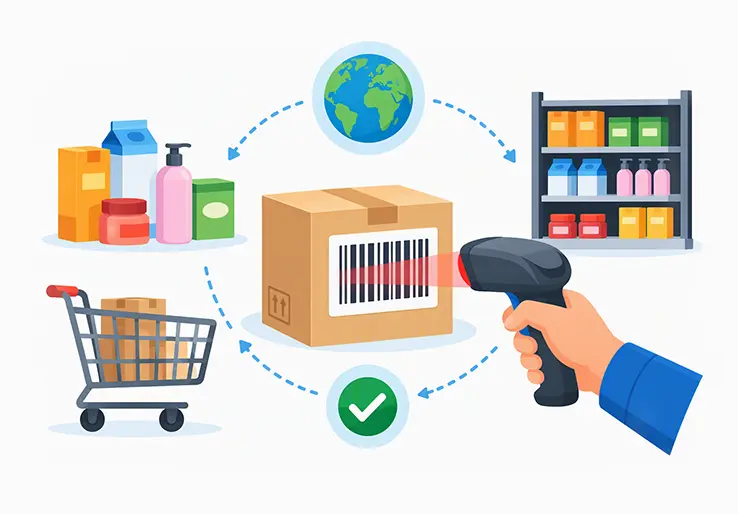
If you sell, distribute, or manage retail products, you have almost certainly encountered an EAN barcode on packaging. Understanding what this code is, how it works, and why it matters can save your business time, reduce errors, and open doors to global markets. This guide covers everything you need to know about the European Article Number system, from its structure and types to practical use in POS and inventory software.
A European Article Number (EAN) is a standardized product identification number encoded into a barcode, used worldwide in retail and supply chain operations to uniquely identify trade items. The most common formats are EAN-13 (13 digits) and EAN-8 (8 digits), and both belong to the GS1 Global Trade Item Number (GTIN) system. The EAN number is the numeric identifier assigned to a product, while the EAN barcode is the machine-readable symbol of black and white lines printed on packaging that represents that number.
EAN, originally European Article Number and now often called International Article Number, is a product identification code used on retail items, cases, and logistics units around the world. It was created in the 1970s as Europe’s answer to the Universal Product Code (UPC) system used in North America, and has since become a truly global standard.
An EAN is a specific type of GTIN (Global Trade Item Number) and is usually 13 or 8 digits long, depending on the barcode format. EAN-13 is by far the most common, serving as a unique 13-digit product identifier on everything from cereal boxes to electronics. EAN-8, with its shorter 8-digit structure, is reserved for very small products where a full-size barcode would not fit.
It helps to understand three related terms. The EAN number (or EAN code) is the numeric identifier itself. The EAN barcode is the printed symbol that encodes that number into a pattern a scanner can read. And product data — name, price, tax rate, stock level — lives in a retailer’s database, not inside the barcode. When someone scans an EAN barcode, the system uses that number as a lookup key to retrieve all relevant product details.
EAN codes are used globally for retail product identification. They appear in supermarkets, pharmacies, fashion stores, electronics shops, and on e-commerce platforms like Amazon and Flipkart. The EAN is managed globally by GS1, the official body authorized to issue these identifiers. Modern GS1 documentation prefers the term GTIN, but retailers, POS systems, and ERP software still widely use "EAN number" and "EAN code" in everyday operations.
EAN stands for European Article Number, now commonly known as International Article Number.
The name dates back to 1977 when the European Article Numbering Association was established to extend the American UPC system for international trade. Although originally European in scope, EAN barcodes are now used across countries on every continent. In GS1’s current standards documentation, the underlying product identification number is called GTIN-13 or GTIN-8, but legacy software, help pages, and most retailers still say "EAN number" or "EAN code."
A simple way to think about the terminology:
The process from assigning an EAN to completing a sale involves several connected steps. A manufacturer or brand owner first obtains a company prefix from GS1, then assigns an article number to each product variant and calculates the check digit to complete the EAN. This number is encoded into an EAN barcode using compliant software, and the barcode is printed on the product’s packaging.
At the point of sale, a barcode scanner reads the pattern of bars and spaces — not the printed digits — and transmits the decoded EAN number to the POS or ERP system. The system matches that number against its product database to retrieve the item’s name, price, applicable taxes, discounts, and current stock level. The transaction is recorded, and inventory is updated automatically.
Here is a concrete example. A 750 ml bottle of olive oil is assigned the EAN 5901234123457. That number is printed as an EAN 13 barcode on the label. A cashier scans it with a handheld barcode scanner, and the POS software instantly retrieves the product name, MRP, and GST rate, adding the item to the bill. The entire flow looks like this: Product → EAN code → EAN 13 barcode → Scanner → POS/ERP → Billing and inventory update.
The barcode itself carries only the EAN number. Product name, price, tax, batch, and stock quantity are all stored in the retailer’s database. This separation is what makes EAN codes work seamlessly across different stores, countries, and software platforms.
A typical EAN-13 barcode appears as a rectangular block of vertical black and white lines with 13 human-readable digits printed beneath. The barcode symbol has a specific structure: left and right guard bars (thin start and end markers), a center guard pattern that splits the barcode into two halves, and the encoded digit modules between them.
On either side of the barcode are quiet zones — blank spaces that give scanners a clean starting and ending reference point. Without adequate quiet zones, many scanners will fail to read the code. The barcode structure uses different width patterns for each digit, with the left-side digits encoded using a mix of odd and even parity sets. The first digit of the 13-digit sequence is not represented by its own bars; instead, it is encoded through the parity pattern of the left-side digits.
The last digit is the check digit, calculated from the preceding 12 digits using a weighted formula. It helps detect common scanning and data-entry errors. For example, in the fictional EAN 4001234567895, the digits break down roughly as follows: 400 acts as the GS1 prefix, the next several digits form the company prefix and item reference, and 5 is the check digit that validates the entire sequence.
The GS1 system includes several barcode types related to EAN. The two most common for retail products are EAN-13 and EAN-8. For logistics and wholesale operations, GTIN-14 (printed using ITF-14 or GS1-128 symbology) is used on outer cartons, cases, and pallets.
EAN-13 is the standard for most retail products — grocery items, electronics, clothing, cosmetics, and more. EAN-8 is designed for very small items like individual lip balms, candy bars, or small stationery products where a full-size EAN-13 barcode simply will not fit. GTIN-14, sometimes informally called "EAN-14" in older materials, includes an indicator digit that represents the packaging level and is used primarily in warehouse operations and barcode management for case-level identification.
All these formats encode GTINs and can be read by modern barcode scanners compatible with GS1 standards. The key distinction is context: EAN-13 and EAN-8 are scanned at retail points of sale, while GTIN-14/ITF-14 is scanned during goods receipt, warehouse management, and distribution.
EAN-13 is a 13-digit barcode format under the GTIN-13 standard, used worldwide to identify retail products. EAN-13 barcodes consist of 13 digits for product identification, making them the most widely adopted barcode format in global retail.
The number structure has four main components. The first 2 or 3 digits indicate the country code — more precisely, they identify which GS1 member organization issued the company prefix. The next 4 to 5 digits represent the manufacturer code (the company prefix assigned by GS1 to the brand owner). The following 5 digits identify the specific product code, also called the item reference or article number. And the last digit is a check digit for error detection.
The exact split between company prefix and item reference depends on the length of the GS1 company prefix a business receives. A company with a shorter prefix gets more item reference digits and can therefore identify more individual products.
The check digit is calculated using a modulo-10 formula with alternating weights of 1 and 3. This ensures compliance with GS1 standards and catches most single-digit errors and transpositions during scanning or manual data entry. EAN-13 can be scanned in any direction due to its encoding structure, which makes it highly practical for fast-moving retail checkouts.
EAN-13 barcodes have been standard in European supermarkets since the 1980s. Indian products carry the 890 prefix issued by GS1 India, and EAN-13 is mandatory on many e-commerce marketplaces such as Amazon, eBay, and Flipkart.
Consider the fictional EAN-13 number 8901234567897. This number is used here only to illustrate structure, not to represent a real product.
Breaking it down: 890 is the GS1 prefix, which identifies GS1 India as the issuing organization. 1234 is a fictional company prefix assigned to the brand owner. 56789 is the item reference or product code, identifying a particular SKU or product variant. 7 is the check digit, computed from the first 12 digits to validate the entire sequence.
Each part serves a distinct function. The prefix tells systems which GS1 office issued the number. The company prefix identifies the business that owns the product. The article number distinguishes one product from another within that company’s catalog. And the check digit acts as a safeguard — if any digit is mistyped or misread, the check digit calculation will fail, flagging the error. In LOGIC ERP, this EAN-13 can be stored against a SKU record so that scanning the barcode at POS or during stock counting automatically retrieves the correct product.
EAN-8 is an 8-digit barcode format (GTIN-8) designed for very small products where a full-size EAN-13 barcode would not physically fit. Think of small cosmetics tubes, individual candy bars, or miniature stationery items. The barcode symbol is compact enough to fit on packaging as small as a few centimeters wide.
EAN-8 contains a GS1 prefix, a short company or item reference, and a check digit. Because only 8 digits are available, the number of products that can be identified under a single EAN-8 allocation is limited. GS1 controls the issuance of EAN-8 numbers more tightly than EAN-13.
Despite its smaller size, EAN-8 is globally recognized and can be scanned by the same barcode scanners used for EAN-13 at supermarkets, pharmacies, and convenience stores. The core difference is straightforward: EAN-8 has 8 digits and a smaller barcode symbol suited for small packaging, while EAN-13 has 13 digits and a standard-size symbol for most general retail products. Both serve the same purpose of product identification at checkout.
In LOGIC ERP, both EAN-8 and EAN-13 barcodes are handled uniformly as product identification numbers in the database, so scanning either type triggers the same lookup and transaction workflow.
An EAN barcode contains only the EAN or GTIN number itself. It does not store descriptive text, pricing, or stock data inside the bars.
The number encodes the GS1 prefix (often mistaken for the country of origin, but actually identifying the issuing GS1 organization), the company prefix (brand owner), the article number (product-level identifier), and the check digit. That is all. When a barcode scanner reads an EAN code at POS, the retail or ERP system uses that number as a key to look up product details such as name, tax rate, MRP, applicable discounts, and current stock levels.
Common misconceptions worth correcting:
Such details are managed in databases and, for logistics applications, sometimes encoded using other GS1 standards like GS1-128. This simplicity is by design — it keeps EAN barcodes stable, compact, and globally interoperable across different countries and software platforms.
EAN numbers serve as the backbone of product identification in modern retail and supply chains. Here are the primary use cases:
EAN is optimized for unique item identification at retail checkouts, but its value extends well beyond the cash register.
EAN and UPC are closely related barcode systems, both managed under GS1. GTIN is the umbrella term for all these product identification numbers.
EAN vs UPC: EAN uses 13 digits while UPC uses 12 digits. EAN-13 is the standard across Europe, Asia, Latin America, and most of the world. UPC-A (also written as UPC A) historically dominates in North America. EAN is used globally while UPC is mainly for North America. Visually, the two barcode formats look nearly identical to consumers and cashiers. Modern scanners read both without issue, and most retail POS software accepts either format. UPC codes have a trailing check digit outside the bars in their visual layout, while EAN-13 encodes the first digit through parity patterns. A UPC-A number can be converted to EAN-13 by adding a leading zero, and a UPC E is a compressed 8-digit version of UPC-A used on small packages.
| Feature | EAN-13 | UPC-A | GTIN (umbrella) |
|---|---|---|---|
| Digits | 13 | 12 | 8, 12, 13, or 14 |
| Common region | International | North America | Global |
| Standard body | GS1 | GS1 | GS1 |
| Retail scanning | Yes | Yes | Depends on format |
EAN vs GTIN: GTIN is the broader data standard encompassing GTIN-8, GTIN-12, GTIN-13, and GTIN-14. EAN-13 corresponds to GTIN-13, and EAN-8 corresponds to GTIN-8. EANs provide global interoperability for international trade because the underlying GTIN numbers are recognized by systems everywhere. One GS1-issued GTIN can be encoded in multiple barcode symbologies — EAN-13 on a retail pack, ITF-14 on a carton, GS1-128 on a pallet label — but the identification number remains the same.
Legitimate EAN numbers must be obtained through GS1, the official body authorized to issue these identifiers. They should not be invented or copied from other products.
The process is straightforward regardless of country. First, determine which products need EAN or GTIN identification. Then contact your local GS1 member organization — for example, GS1 India for Indian manufacturers and exporters. Submit an application form along with required documentation. Pay the applicable registration and subscription fee. Once approved, you receive a GS1 company prefix.
To obtain an EAN code, register with GS1 India. GS1 India issues barcodes starting with "890" in India, covering manufacturers, retailers, and exporters. Registration requires documents like PAN and GST certificates, along with business incorporation details.
After receiving your company prefix, you assign item reference numbers to each product, calculate the check digit for each EAN, and generate compliant barcode symbols using software that meets GS1 specifications. Best practices include never reusing an EAN number for a different product, maintaining a master list of product-to-EAN assignments, and testing printed barcodes with a scanner before full production runs.
LOGIC ERP can store these issued EAN numbers as part of the product master, ensuring consistent use across POS, inventory, purchase, and sales modules. This ensures compliance across your entire operation.
EAN validity has two dimensions: numeric validity (correct format and check digit) and business validity (properly registered with GS1 and correctly mapped to a product record).
The check digit is the primary numeric safeguard. To verify it, multiply alternate digits of the first 12-digit base by weights of 1 and 3, sum the results, and confirm that the last digit makes the total a multiple of 10. If the calculation fails, the EAN contains an error. This method catches most single-digit mistakes and transpositions.
Businesses can validate EAN numbers using built-in functions in ERP or POS software, web-based check digit calculators, or automated scripts during product data imports. However, passing the check digit test does not guarantee that the EAN is officially issued by GS1 or correctly linked to the right company. For that level of verification, GS1 databases and supplier documentation should be consulted.
In LOGIC ERP, validation rules can be applied during data entry or bulk upload to flag invalid or mistyped barcodes before they reach the product master. This prevents scanning failures and misidentified products at the point of sale.
EAN barcodes play a central role in connecting physical products to digital records across every stage of retail operations.
At the point of sale, a cashier scans the EAN barcode with a billing machine with a barcode scanner. LOGIC ERP’s POS module reads the EAN code, matches it to a SKU, retrieves the price, tax rate, and any active promotions, and adds the item to the bill instantly. EAN barcodes enhance the customer checkout experience by speeding up transactions and eliminating manual data entry. Using EAN codes reduces manual data entry errors significantly, which directly improves billing accuracy.
On the inventory side, each scanned sale automatically deducts stock from the mapped item. Goods receipts, stock transfers between stores, and stock counts all use the same EAN code for accurate quantity updates. EAN codes improve inventory management by tracking stock levels across warehouses and branches in real time. EANs improve inventory control and automate stock tracking, helping retailers track stock levels reliably.
LOGIC ERP supports managing multiple barcode types per item — an EAN code on the consumer unit, an internal code for internal use, a carton-level barcode for logistics — while keeping the EAN as the product’s primary global identifier. EAN codes enhance accuracy in pricing and inventory updates, and EANs reduce errors in ordering and inventory management processes across multi-store retail operations. Standardized EAN barcodes combined with LOGIC ERP enable scalable, multi-store retail operations, including omnichannel and e-commerce integrations.
Most EAN-related issues in retail stem from printing, data mapping, or process errors rather than problems with the EAN system itself.
Barcode does not scan. The most common culprit is poor print quality — low contrast between bars and background, incorrect magnification (the barcode is too small or stretched), or damage to the label. Reflective or curved packaging can also interfere. The fix: adhere to GS1 print guidelines for size and contrast, and always test sample barcodes with a scanner before committing to a production run. A barcode needs to be easily scanned and scanned correctly to be useful.
Wrong Product Appears at POS. This happens when the EAN number in the product master is incorrect, duplicated across two SKUs, or linked to an obsolete item. Regular audits of master data within LOGIC ERP and enforcing unique EAN-to-SKU mapping prevent this issue. Each product’s EAN must point to one and only one active record.
EAN not Recognized by Software. The barcode may be a valid EAN code, but if it is not present in the store’s database, the POS system cannot retrieve any product details. This typically occurs when a new product has not been added to the system or when databases across branches are not synchronized. Automated master data updates and centralized product catalogs in LOGIC ERP solve this reliably.
A short note on training: staff should know not to create ad-hoc codes that look like EANs. New products should always go through a defined GS1/EAN creation workflow managed by the ERP team to maintain a valid EAN code for every item.
EAN barcodes are a reliable tool for product identification across a wide range of industries, not just supermarkets.
Retail: Grocery and FMCG retailers, fashion and footwear chains, electronics and appliance stores, pharmacies, beauty and cosmetics outlets, and department stores all rely on EAN barcodes for billing and inventory. Whether it is a garment barcode on a shirt tag or an EAN-13 on a bottle of shampoo, the system is the same.
Distribution and Logistics: FMCG distributors, wholesalers, cash-and-carry operators, and 3PL warehouse providers handle GS1-labelled cartons and pallets daily. Barcodes play a critical role in supply chain operations, from receiving to dispatch.
E-commerce and D2C: Brands selling on Amazon, Flipkart, Myntra, and their own websites use EAN codes as the standard product identification number for catalog listings. EAN is part of the Global Trade Item Number (GTIN) system that these platforms require.
The European Article Number (EAN) system is a vital component of modern retail and supply chain management. By providing a unique, standardized product identifier through EAN-13 and EAN-8 barcodes, businesses worldwide can streamline billing, inventory tracking, and logistics operations. EAN barcodes, governed by the global GS1 standards, ensure interoperability across countries and platforms, supporting everything from supermarket checkouts to e-commerce listings and international trade.
Understanding how EAN numbers work, their structure, and their role in POS and inventory software like LOGIC ERP empowers businesses to optimize their operations, reduce errors, and enhance customer experiences. Whether managing large product catalogs or small items with limited packaging space, EAN barcodes remain a reliable and efficient solution for product identification.
For manufacturers, retailers, and distributors aiming to compete in a global marketplace, obtaining and correctly managing EAN numbers is essential. Leveraging EAN barcodes with integrated ERP and POS systems ensures accurate product data, faster transactions, and better inventory control, all of which contribute to smoother business processes and improved profitability.
Call at +91-73411-41176 / +91-73411-41175 or send us an email at sales@logicerp.com to book a free demo today!
A European Article Number is a standardized numeric code used to uniquely identify products in retail and supply chain environments. It is encoded into a barcode for scanning at POS terminals and warehouses.
EAN stands for European Article Number, though it is now also referred to as International Article Number. The EAN system originated in Europe in the 1970s.
An EAN barcode is the machine-readable symbol of black and white lines printed on product packaging. It encodes the EAN number so that a barcode scanner can read and transmit it to POS or ERP software.
EAN-13 is a 13-digit barcode format used worldwide for retail product identification. EAN-13 barcodes contain 13 digits, including a GS1 prefix, company prefix, item reference, and check digit.
EAN-8 is an 8-digit barcode designed for very small products where a standard EAN-13 barcode would not fit. It serves the same purpose of product identification in a more compact format.
Not exactly. GTIN (GTIN Global Trade Item Number) is the broader standard covering GTIN-8, GTIN-12, GTIN-13, and GTIN-14. EAN-13 corresponds to GTIN-13, and EAN-8 corresponds to GTIN-8. Every EAN is a GTIN, but not every GTIN is an EAN. GTIN numbers are the data standard; EAN barcodes are specific symbologies.
No. UPC barcodes (UPC-A) are 12 digits long and were originally developed for North America. EAN-13 is 13 digits and is used internationally. Both are managed by GS1 and modern scanners read both formats.
An EAN-13 has 13 digits. An EAN-8 has 8 digits. The most common format in global retail is EAN-13.
An EAN number is used for retail billing, inventory management, warehouse operations, e-commerce product listings, supply chain tracking, and global trade documentation.
Register with your local GS1 member organization (such as GS1 India for Indian businesses). You will receive a company prefix, after which you assign item references, calculate check digits, and generate barcode symbols.
No. The EAN barcode contains only the EAN number. Product details like price, name, tax, and stock quantity are stored in the retailer’s or manufacturer’s database and retrieved when the EAN is scanned.
Yes. LOGIC ERP supports EAN-13 and EAN-8 barcodes for POS billing, inventory tracking, stock transfers, and multi-store operations. Scanning an EAN barcode in LOGIC ERP retrieves the mapped product record instantly.
A company code is a unique identifier assigned to a manufacturer or brand owner within an EAN barcode. It forms part of the EAN number and helps distinguish products made by different companies.
An EAN code is assigned by obtaining a company prefix from GS1 and then allocating unique product numbers. The full EAN code includes the company prefix, product code, and a check digit for validation.
The country code in an EAN number identifies the GS1 member organization that issued the barcode prefix. It does not necessarily indicate the product’s country of origin but shows where the barcode was registered.
The check digit is calculated using a modulo-10 algorithm with alternating weights of 1 and 3 applied to the preceding digits. It helps detect errors in scanning or data entry.
An EAN-13 barcode consists of 13 digits divided into a country code, company prefix, product code, and a check digit. The barcode symbol includes guard bars, digit patterns, and quiet zones for scanner readability.
A barcode scanner uses a laser or imaging sensor to detect the pattern of black and white bars, converting them into a numeric EAN code. This code is then sent to POS or ERP systems for product identification.
The company prefix is a GS1-assigned identifier unique to a business, used as part of the EAN number. The company code often refers to the same concept but may be used interchangeably in some contexts.
Typically, documents like business registration certificates, PAN card, GST certificate, and proof of address are required to apply for an EAN code with GS1 organizations.
Popular Products