Discover what a transportation management system (TMS) is, its key features, benefits, and how it works to optimize logistics and supply chain operations. Learn how TMS can reduce costs, improve delivery times, and increase operational efficiency.
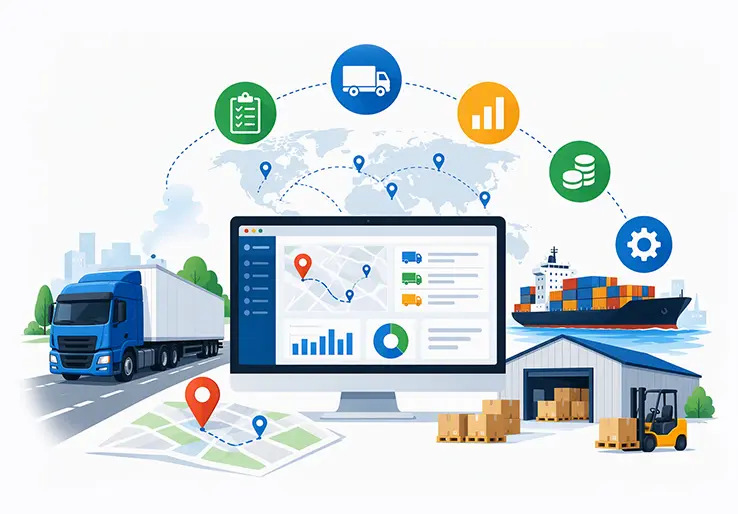
A transportation management system (TMS) is logistics software that centralizes the planning, execution, and optimization of goods movement across the supply chain, automating transport decisions from carrier selection and route planning to real-time shipment tracking, freight audit, and analytics in one platform. Whether you’re moving raw materials from suppliers or delivering finished products to customers, a TMS gives manufacturers, distributors, exporters, carriers, fleet owners, 3PLs, freight brokers, warehouses, e-commerce companies, and the finance, operations, and IT teams behind them tighter control over freight cost, delivery performance, and shipment visibility.
If your logistics operation still runs on phone calls, spreadsheets, and guesswork, this guide explains what a modern tms transport management system does, its core features and benefits, how it works step by step, how planning, execution, optimization, tracking, freight audit, ERP and WMS integrations, industry use cases, and deployment models work, what future trends such as AI and cloud TMS are changing, and what to evaluate when selecting and implementing one, including LOGIC ERP’s integrated TMS solution. The reason companies invest in TMS software is practical: poor transportation management can disrupt the entire supply chain with higher costs, delays, and customer dissatisfaction, while a well-implemented TMS can cut logistics costs by up to 20%, improve delivery times by up to 20%, support supply chain continuity, and help meet customer expectations for accurate, visible shipments.
A transportation management system is logistics management software that connects transport operations with the wider supply chain — procurement, warehousing, order management, and customers. It replaces manual processes with automated workflows for carrier selection, route optimization, shipment tracking, freight billing, and performance analytics.
Modern TMS platforms, including LOGIC ERP’s integrated module, are cloud-based, operate in real time, and support multimodal transport across road, rail, air and ocean. They’re designed to handle the complexity of both domestic and international freight.
What a TMS does at a glance:
Who typically uses a TMS:
Effective TMS leads to lower shipping costs and improved efficiency. Businesses that implement a TMS can reduce logistics costs by up to 20%, achieve timely delivery consistently, and gain the real time visibility their customers now expect.
Transportation management is a core pillar of end-to-end supply chain management. It acts as the physical bridge connecting suppliers, factories, warehouses, distribution centers, and final customers — both within India and globally.
A TMS sits within the supply chain between ERP and WMS, linking upstream procurement with downstream distribution. It interacts directly with demand planning (which forecasts transport volumes), order management (which creates outbound shipments), warehouse operations (which stage goods for loading), and inventory control (which determines what’s available to ship).
Poor transport management disrupts the entire supply chain. Delayed inbound deliveries stall production lines. Late outbound shipments cause stockouts at retail shelves. Inventory either piles up unpredictably or runs dry. Logistics costs spiral when routes aren’t optimized and trucks run half-empty.
The transportation process flow within supply chain operations:
This flow touches every supply chain partner — from the raw material supplier to the end customer. When it runs smoothly, the entire supply chain benefits.
A transportation management system (TMS) is management software that centralizes the planning, execution, monitoring, and financial settlement of goods transport. It stores data about carriers, rates, contracts, and routes; executes shipment bookings; provides tracking and performance feedback; and audits bills for accurate settlement. In essence, a TMS is software for managing logistics operations across your transportation network.
Common terms — transportation management system, transport management software, transportation management solution — all refer to the same concept.
Core capabilities of a TMS include:
A TMS supports multimodal sourcing, planning, and execution of transport — covering domestic and international freight, multiple transport modes, and both inbound and outbound logistics. LOGIC ERP provides an integrated TMS module within its broader ERP and supply chain suite, making transportation management part of a single connected platform rather than a siloed tool.
A TMS serves many roles across the logistics ecosystem — not just transport managers. Here’s who depends on it and how.
The transportation management lifecycle follows three stages: planning, execution, and optimization. Key functions of a TMS include shipment planning and tracking across all three.
The TMS imports orders — manually or via ERP/API integration with systems like order management — then identifies the best transportation modes, computes optimal routes, performs load building by consolidating orders, and selects carriers based on cost, performance, and capacity. TMS supports multimodal sourcing and planning of goods transport, including multi-leg movements for complex logistics networks.
Once planned, the TMS generates transport documentation (lorry receipts, shipping labels, challans, E-Way Bills), communicates with carriers, dispatches and assigns drivers and vehicles, and provides real time shipment tracking throughout the journey. TMS automates carrier selection and route optimization processes, replacing manual carrier calls and email chains.
After delivery, the system collects performance data — cost per shipment, on-time delivery rates, vehicle utilization, empty miles — and feeds insights back into the planning phase. Analytics capabilities measure key performance indicators like on-time performance, helping teams continuously refine routing, carrier mix, and service levels.
A typical day’s transport lifecycle:
Beyond basic tracking, a modern transport management system acts as a digital control tower for transport operations. Real-time shipment tracking is a key feature of TMS, but the platform extends much further.
Essential feature clusters:
India-specific capabilities often required:
Carrier management covers selecting, onboarding, and governing transport providers — whether third-party carriers or your own fleet.
A TMS stores carrier contracts, rate cards (per km, per ton, per lane), fuel surcharges, and service-level commitments in one centralized system. Instead of managing freight procurement through scattered emails and spreadsheets, automated workflows reduce manual errors in carrier management by enabling tendering, spot bidding, and rate comparison within the platform.
Carrier scorecards evaluate performance metrics for better selection. The TMS tracks on-time delivery percentage, damage rates, cost per shipment, and compliance with documentation requirements. Real-time shipment tracking enhances carrier performance monitoring, giving logistics managers live data rather than post-mortem reports.
Carrier performance metrics can help improve carrier management by enabling data-driven switching decisions. TMS supports freight procurement to optimize transportation costs through competitive bidding and historical cost analysis.
Example: A shipper running the Delhi–Mumbai lane with two carriers can compare cost per ton-km, average delay hours, and damage rates side by side in the TMS. If Carrier A consistently delivers 12 hours late while Carrier B holds a 98% on-time record at similar rates, the system makes the switch decision obvious — and can automate it.
Route optimization is central to reducing transportation costs and ensuring timely delivery. TMS automates carrier selection and route optimization, replacing the guesswork that inflates freight operations costs.
The TMS calculates optimal delivery routes using distance, real-time traffic data, delivery time windows, vehicle capacity, toll costs, and regulatory constraints (weight limits, state permits, restricted zones). In India, this includes factoring in state border checkpoints and FASTag toll estimates.
Load building combines orders destined for nearby locations to maximize vehicle utilization — whether Full Truck Load (FTL) or Part Truck Load (PTL). This directly reduces empty miles and the number of trips required.
Trip planning assigns specific drivers and vehicles, sequences stops to minimize deadhead distance, and plans return or backhaul loads to avoid sending trucks back empty.
Route optimization can cut fuel consumption by 15-30%. Combined with better load factors and optimized carrier selection, businesses typically see significant cost savings of 10-20% on logistics costs while improving OTIF (on-time in-full) deliveries.
Real time visibility across the transportation network is no longer optional — it’s a baseline expectation from customers, partners, and regulators alike.
A TMS provides real-time visibility into shipment status through GPS integration and map-based tracking. Logistics teams and customers can track shipments with live location data, computed ETAs, and route-taken histories. Real-time shipment tracking provides instant notifications of status changes at every milestone — pickup, loading, departure, checkpoint crossing, arrival, and unloading.
TMS enhances visibility across complex logistics networks where shipments move through multiple carriers, modes, and warehouses. Real-time tracking reduces delays and improves customer satisfaction by catching problems early rather than after a delivery window has been missed.
Exception handling is where the real value emerges. The TMS automatically detects delays, route deviations, temperature breaches (critical for cold chain and pharma), and missed milestones. It triggers alerts, escalations, and corrective workflows to protect timely delivery. TMS enables proactive communication about shipment status — notifying stakeholders before they have to ask.
Digital proof of delivery (ePOD) closes the visibility loop: drivers capture photos, signatures, and time stamps on delivery, creating an auditable record for claims and disputes.
A TMS enhances supply chain visibility through real-time tracking, giving every stakeholder — from warehouse to finance — a single source of truth. Real-time visibility enhances customer satisfaction and compliance simultaneously.
Freight audit is the process of validating carrier invoices against agreed rates, routes, accessorial charges, and surcharges. Without it, overcharges slip through, disputes pile up, and transport cost allocation becomes unreliable.
A TMS automatically compares invoices with planned costs — contracted rates, actual distance, tolls, fuel surcharges — and detects discrepancies. Flagged items are routed for approval or dispute resolution through configurable workflows, replacing manual freight billing reconciliation.
For Indian businesses, this includes handling GST calculations, origin and destination state tax differences, ODA/OPA charges, TDS where applicable, and e-invoicing compliance. Multi-currency handling applies for international freight operations.
Integration with ERP and accounting systems — including LOGIC ERP, Tally, or SAP Transportation Management — enables seamless posting and reconciliation. Transport charges flow directly into financial statements without double entry.
Key benefits of automated freight audit:
A TMS transforms operational data into decision-grade analytics for transport leaders. Advanced reporting tools turn transportation data into actionable insights that drive continuous improvement.
Common dashboards include:
| Metric | What It Measures |
|---|---|
| Cost per shipment | Total transport cost divided by shipments |
| Cost per km / ton-km | Unit economics of freight movement |
| On-time delivery rate (OTIF) | Percentage of deliveries meeting promised windows |
| Vehicle utilization | Load factor vs. available capacity |
| Lane profitability | Revenue minus transport cost per route |
| Carrier performance | Scorecard combining cost, timeliness, and damage |
A TMS generates reports that help identify trends and operational issues — whether it’s a lane that consistently costs more than budgeted or a carrier whose damage rate has crept up over three months.
Historical data supports forecasting, budget planning, and continuous improvement. Analytics capabilities measure key performance indicators like on-time performance, cost trends, and utilization rates over time.
Emerging AI/ML capabilities add predictive ETAs, risk scoring for shipments (based on weather, traffic, carrier history), and anomaly detection in freight invoices. Reports are exportable to Excel, PDF, or integrated with BI tools for management-level summaries.
Three deployment models dominate the TMS software landscape:
Within the cloud, single-tenant offers deeper customization while multi-tenant reduces costs and simplifies upgrades.
A TMS can be standalone (best-of-breed) or integrated within an ERP/SCM suite. LOGIC ERP takes the integrated approach — transportation management lives alongside finance, inventory, sales, and procurement in one platform. Enterprises already on SAP can extend capabilities with SAP Transportation Management, while Manhattan Active Transportation Management and Oracle Transportation Management serve large-scale global shippers.
For SMBs, integrated TMS modules within existing ERP avoid the complexity of managing separate vendor relationships. Large enterprises may prefer standalone TMS solutions with deeper functionality across complex logistics networks and multiple carriers.
Here’s a concrete, end-to-end scenario using an Indian context — a distributor shipping from a Mumbai DC to Pune, Nagpur, and Raipur.
At each step, the TMS automates what was previously a manual, phone-and-paper process. Users interact via web dashboards and mobile apps.
The benefits of a TMS span four domains: cost, operations, customer service and strategic capability. TMS improves operational efficiency by automating freight management processes across the board.
Cloud-native TMS platforms are becoming the standard across the transportation management industry. They offer faster deployments, automatic updates, lower upfront costs and the ability to scale without infrastructure headaches.
Emerging Capabilities Reshaping the Landscape:
Enabling Technologies:
LOGIC ERP is aligned with these trends, building cloud-first transportation management capabilities that scale with Indian businesses as these technologies mature.
Choosing the right TMS software requires a structured evaluation — especially for Indian and emerging-market shippers where compliance adds complexity.
Key Evaluation Dimensions:
| Dimension | What to Assess |
|---|---|
| Functional fit | Route optimization, freight audit, load building, multimodal support |
| Scalability | Can it grow with your transport volume and geography? |
| Integration | Connectors to your existing ERP, WMS, GPS, and carrier systems |
| Local compliance | GST, e-invoicing thresholds, E-Way Bill, state tax rules |
| Usability | Interface quality, mobile apps, regional language support |
| Support | Vendor stability, local support availability, update frequency |
| Total cost of ownership | Subscription + implementation + training + maintenance |
Scalability is crucial for adapting to transportation needs as your business grows. Integration with existing systems improves efficiency and reduces errors. User-friendliness enhances productivity and reduces training time. Cost-effectiveness is essential for a good return on investment.
Evaluate TMS based on operational fit and measurable business value — not just feature checklists.
Advise technology users to involve cross-functional stakeholders — transport, finance, IT, warehouse, sales — in requirement gathering and demos. Run a proof-of-concept or pilot project using real shipment data to validate ROI before committing to a full rollout.
LOGIC ERP’s TMS module is an integrated transportation management solution — not a disconnected add-on. It connects transportation management with finance, inventory, sales, and procurement within a single supply chain management platform.
India-Focused Capabilities:
Operational Features:
Implementation Approach: Phased rollout with training and local support. Ideal for manufacturers, distributors, retailers, and logistics service providers operating across India and nearby regions.
Tight integration between TMS, ERP, and warehouse management system is critical for end-to-end supply chain visibility. TMS integration with ERP and WMS allows for smooth data flow — eliminating double entry, synchronizing master data, and ensuring consistent reporting.
Common Integration Touchpoints:
TMS integrates with other supply chain systems for enhanced collaboration across supply chain processes. Enterprises on SAP can extend with SAP Transportation Management, while LOGIC ERP offers its own integrated stack covering the same ground for Indian mid-market businesses.
APIs, EDI, and standard connectors enable integration with external carriers, GPS providers, toll systems, and e-commerce marketplaces. The result: no duplicate data entry, synchronized information, and faster closing of transport-related financials.
While TMS principles are universal, requirements differ by industry and shipment profile. Here’s how different sectors use transportation management software:
LOGIC ERP TMS can be configured to address these sector-specific routing rules, documentation needs, and key performance indicators — whether you’re moving perishable goods from Nashik to Mumbai or auto components from Chennai to Bengaluru.
A well-implemented Transportation Management System (TMS) is more than just software; it is a strategic asset that transforms your logistics operations and drives business growth. By automating complex transportation planning, optimizing routes, and providing real-time shipment visibility, a TMS empowers companies to reduce costs, improve delivery accuracy, and enhance customer satisfaction.
Whether your business operates within India’s diverse logistics landscape or manages global supply chains, the right TMS solution adapts to your unique needs. It integrates seamlessly with your existing ERP and warehouse systems, ensuring smooth data flow and end-to-end supply chain visibility.
Investing in a modern, cloud-based TMS like LOGIC ERP’s integrated module means gaining scalability for future expansion, compliance with local regulations such as GST and E-Way Bill, and access to advanced analytics for continuous improvement. The result is a more agile, efficient, and competitive logistics operation.
Take the next step toward operational excellence. Explore LOGIC ERP’s transportation management system, request a personalized demo using your actual shipment data, and discover how it can deliver measurable cost savings, faster delivery times, and improved operational control tailored to your business.
With LOGIC ERP, transform transportation management from a challenge into a competitive advantage that propels your business forward.
Call at +91-73411-41176 / +91-73411-41175 or send us an email at sales@logicerp.com to book a free demo today!
A TMS is software for managing logistics operations — specifically the planning, execution, and optimization of goods transportation. It handles route optimization, carrier management, real time shipment tracking, freight audit, and analytics across domestic and international freight.
An ERP (Enterprise Resource Planning) system manages broad business functions — finance, HR, procurement, manufacturing, sales. A TMS focuses specifically on transportation operations. Many modern ERPs, like LOGIC ERP, include a TMS module so both work within a single integrated platform.
Yes. Cloud-based TMS solutions have lowered entry barriers significantly. SMBs benefit from route optimization, automated documentation, and freight audit without the heavy IT infrastructure that on-premise systems demanded. The key is choosing a platform scaled to your shipment volumes and complexity.
TMS automates carrier selection and route optimization, reducing planning delays. Real-time tracking catches exceptions early. Companies can achieve up to 20% improvement in delivery times with TMS, and well-optimized implementations report delivery accuracy near 99.5%.
Leading global platforms include Oracle Transportation Management, SAP Transportation Management, Manhattan Active Transportation Management, and Blue Yonder. In India and Asia-Pacific, TMS solutions like LOGIC ERP, Shipsy, and GoComet serve regional needs with local compliance features. TMS can reduce transportation costs by up to 20% regardless of platform — what matters is implementation quality.
Through route optimization (cutting fuel consumption by 15-30%), load consolidation (fewer trips, higher utilization), automated carrier selection (competitive rates), and freight audit (catching overcharges). Automated workflows can reduce planning time by up to 66%, freeing teams to focus on optimize routes and strategic decisions rather than manual processes.
At minimum: route optimization, carrier management, load building, real time visibility, freight audit, and reporting capabilities. For Indian businesses, add GST compliance, E-Way Bill integration, e-invoicing support, and FASTag toll reconciliation. Integration capabilities with your existing ERP and warehouse management system are equally important.
Popular Products