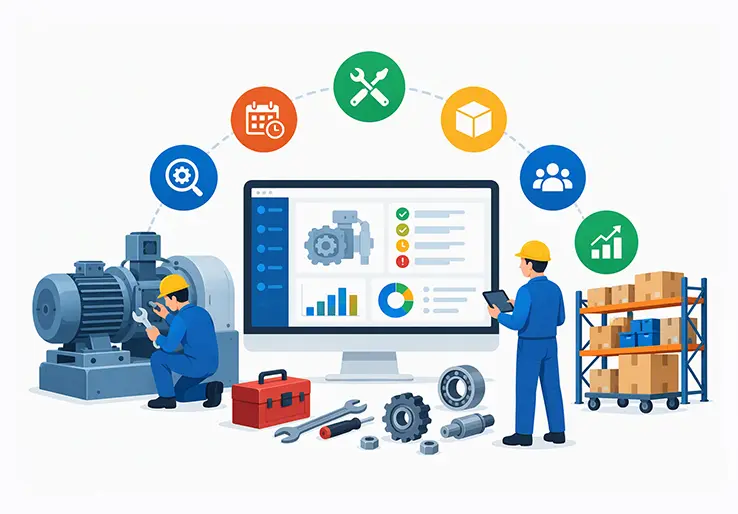
Learn what Maintenance, Repair, and Overhaul (MRO) software is, its key features, benefits, types, use cases, and how MRO software streamlines maintenance, repairs, inventory and overhaul operations.
Maintenance, repair, and overhaul software is a specialized maintenance management system that brings asset tracking, work orders, overhaul planning, spare-parts inventory, vendor management, and cost analytics into a single digital platform. For asset-intensive businesses running hundreds or thousands of machines, vehicles, or infrastructure assets, it replaces scattered spreadsheets and paper-based processes with centralized, real-time maintenance operations.
MRO inventory management software takes this a step further by linking every spare part, consumable, and tool directly to the assets and work orders that consume them. This connection enables better maintenance decision-making by linking inventory data to assets, so teams know exactly what is available, what needs reordering, and what is obsolete. Maintenance software centralizes asset maintenance activities in one platform, giving maintenance managers a single source of truth.
The measurable impact is significant. Preventive maintenance can increase asset uptime by 20 to 30 percent. Effective maintenance management can save organizations over 450,000 dollars annually through reduced emergency repairs, optimized spare-parts stock, and higher technician productivity. Maintenance software can reduce unplanned downtime significantly when preventive and predictive capabilities are properly deployed.
LOGIC ERP provides integrated maintenance and MRO inventory capabilities inside its ERP suite, connecting asset records, stock ledgers, procurement, and financial reporting in one architecture. This guide covers everything you need to know about MRO software in 2026: what it is, how it works, key features, benefits, and how to choose the right maintenance management software for your operations.
MRO stands for Maintenance, Repair, and Overhaul. It covers the full spectrum of activities and supporting resources needed to keep physical assets running reliably throughout their operational life. Here is how the three pillars break down:
Maintenance refers to routine and preventive upkeep designed to keep equipment operational: scheduled inspections, lubrication programs, filter replacements, safety checks, and calibration. This includes both time-based and usage-based preventive tasks.
Repair (also called corrective maintenance) restores function after a fault, breakdown, or detected defect. Examples include fixing a pump seal leak, replacing a worn conveyor belt, or swapping a failed PLC module.
Overhaul is a major, planned rebuild or restoration of equipment, typically scheduled after a certain number of operating hours or life cycles. In manufacturing, this might mean an 8-year gas turbine overhaul or a 5-year plant-wide shutdown. In aviation, C-checks and D-checks at fixed flight-hour or calendar intervals are classic overhaul examples.
MRO inventory includes all the physical items that support these activities. This means spare parts (bearings, belts, pumps, VFD modules, hydraulic hoses), consumables (lubricants, cleaning agents, welding rods), tools, PPE, and calibration equipment. MRO inventory includes spare parts, tools, and equipment necessary for operations.
Across the asset lifecycle, MRO touches every phase: commissioning, warranty period, steady-state operations, mid-life overhaul or refurbishment, and end-of-life replacement. Good MRO management determines whether assets deliver their full expected service life or fail prematurely.
What is MRO Software and How is it Different From Generic Maintenance Management Software?
MRO software is a specialized maintenance management system that connects assets, work orders, overhaul planning, MRO inventory, vendor contracts, cost tracking, and analytics in one integrated platform. It goes well beyond basic task scheduling.
What is MRO software? It is a digital system that coordinates all maintenance, repair, and overhaul activities and the supporting resources (spare parts, labor, vendors) needed to execute them. What does MRO software do? It schedules preventive work, tracks breakdowns, manages MRO inventory, records maintenance costs, generates reports, and supports regulatory compliance across sites.
Here is how MRO software relates to adjacent tools:
A computerized maintenance management system (CMMS) focuses primarily on maintenance execution: work orders, preventive maintenance schedules, parts, and labor tracking. CMMS automates scheduling, inventory management, and record keeping. It is strong for single-site operations with straightforward maintenance needs.
Enterprise asset management (EAM software) extends CMMS with full asset lifecycle management, capital planning, depreciation, regulatory compliance, and multi site governance. EAM is the dominant choice for large-scale, regulated operations.
MRO software sits between or overlaps CMMS and EAM, but specifically highlights overhaul planning, MRO inventory depth, vendor controls, and cost roll-ups. In practice, boundaries blur as modern platforms absorb features from all three categories.
Generic maintenance management software tends to handle work orders and basic preventive maintenance. A full MRO management system adds overhaul task management, serialized asset and rotable tracking, spare-parts criticality analysis, long-lead-time procurement, and deep cost analytics that feed repair-versus-replace decisions. Maintenance software allows tracking of asset performance and labor metrics, which is essential for continuous improvement.
How MRO Software Works: Typical Workflow From Asset to Analytics
A well-implemented MRO system follows a clear end-to-end workflow that connects every maintenance event from detection to cost analysis. Here is how it typically works, illustrated through a CNC machine spindle failure:
Asset Registration: The CNC machine is entered into the asset registry with its make, model, serial number, installation date, warranty details, and location in the plant hierarchy (site → production hall → machining line → CNC-07 → spindle assembly).
MRO Inventory Setup: Critical spares for that machine (spindle bearings, drive belts, coolant pump seals) are linked to the asset, with min/max stock levels, lead times, and bin locations configured. Maintenance scheduling integration connects inventory usage directly to work orders.
Maintenance Planning: Preventive maintenance schedules are set (e.g., spindle bearing inspection every 2,000 running hours). The system auto-generates work orders when usage counters or calendar dates trigger. Usage based triggers from machine runtime counters feed directly into the scheduling engine.
Work Order Creation: When a vibration alert flags abnormal spindle behavior, a corrective work order is created automatically, prioritized as high, and linked to the asset record.
Spare-Parts Reservation: The system checks if spindle bearings are in stock, reserves them against the work order, and if stock is below minimum, triggers an automated purchase requisition.
Technician Assignment: The work order is routed to an available technician with the right skill set, visible on their mobile device.
Execution and Inspection: The technician replaces the bearing, logs time, captures photos, completes the checklist, and marks the job complete. Automated systems reduce manual data entry and improve accuracy throughout this process.
Cost Capture: Labor hours, parts consumed, and any external service costs are posted to the work order, asset, and cost center.
Maintenance History: The entire event is stored against the asset, building a failure and repair history that informs future decisions.
Reporting: Dashboards update in real time, showing the asset’s MTBF trend, maintenance cost accumulation, and PM compliance rates.
This process cuts waiting time for permits, approvals, and parts compared to paper or spreadsheet-based maintenance, where delays of hours or days are common at each handoff.
This is the most detailed section of this guide, listing the core modules and features a buyer should expect in modern MRO software. Feature depth will vary between basic CMMS-style tools and full EAM or MRO platforms, but the themes below are consistent across the top maintenance management software solutions in 2026. Each subsection covers a specific capability area using concrete objects and metrics.
Asset & Equipment Management
A centralized asset registry is the foundation of any MRO system. It stores every detail maintenance teams need to make informed decisions.
Each asset record includes make, model, serial number, installation date, warranty status, and position in the equipment hierarchy (site → area → line → machine → component).
The system tracks the entire asset lifecycle from purchase and commissioning through steady-state operations to decommission, supporting decisions to extend asset life versus replace.
Detailed asset histories (failures, repairs, overhauls, costs) drive reliability analysis and asset performance benchmarking. Maintenance data accumulated over years becomes the basis for capital planning.
Practical scale: a multi-site manufacturing group might track 2,000+ motors across five plants, or a real-estate portfolio might manage 300 HVAC units, each with unique service histories and warranty terms.
Work Order & Maintenance Request Management
Work order management tools help prioritize and assign maintenance tasks efficiently, replacing email and phone chaos with a structured digital queue.
Maintenance teams create corrective, preventive, and overhaul work orders from desktop or mobile, with standardized fields for priority, asset, fault code, and estimated duration.
Technicians log time, parts used, photos, and checklists within each work order, improving traceability from defect to resolution. Work order management software allows tracking of tasks in real time.
Statuses follow a clear progression: Requested → Approved → In Progress → Waiting for Parts → Completed → Closed. SLAs can enforce targets like a 4-hour response for critical assets.
Maintenance software centralizes incoming work requests for better management, eliminating lost tickets and duplicate entries.
Automated work order assignment improves technician efficiency by 10 percent by routing jobs based on skills, availability, and proximity.
Preventive Maintenance Management
Preventive maintenance is the backbone of any mature maintenance program. MRO software automates the planning, reminders, and work order creation that make PM programs reliable and support a broader maintenance strategy.
Schedules are configured as time-based (every 3 months) or usage-based (every 2,000 running hours), with the system generating work orders automatically when thresholds are reached.
PM task templates include detailed checklists, estimated durations, required parts, and safety procedures, ensuring consistency across technicians and shifts.
Preventive maintenance can reduce unplanned downtime by 10 percent and decrease work order resolution time by 31 percent. Effective preventive maintenance can extend asset life significantly.
Automated preventive maintenance scheduling increases compliance and efficiency. Common use cases include lubrication programs, safety valve inspections, filter replacements, and calibration schedules.
Preventive maintenance strategies can save organizations thousands of dollars annually when decisions are guided by a data-informed maintenance strategy that catches issues before they escalate into costly breakdowns.
Corrective, Breakdown & Emergency Maintenance
When equipment fails unexpectedly, speed matters. MRO software accelerates every step from detection to resolution.
Users quickly log breakdowns from mobile, web, or QR/barcode scan, attaching photos, videos, and fault codes for fast triage.
Automatic escalation rules notify supervisors when critical assets go down. Priority workflows ensure emergency repairs jump the queue.
The system tracks MTTR (Mean Time to Repair), and historical fault data helps identify repeat failures that need root-cause analysis or redesign.
For safety-critical failures, lockout/tagout procedures are embedded in work order workflows before any repair can proceed.
Predictive & Condition-Based Maintenance
Predictive maintenance uses data analysis to anticipate failures before they happen. Condition based maintenance triggers actions based on measured equipment parameters rather than fixed schedules.
Examples include vibration monitoring on motors, oil particle analysis on gearboxes, and thermal imaging on switchgear. Sensor or IoT data feeds into the MRO system to trigger work orders when anomaly thresholds are detected.
AI and analytics dashboards predict failures days or weeks in advance, lowering unplanned downtime and helping extend asset life. One aerospace manufacturer achieved a 60 percent reduction in downtime and improved OEE from 72 to 83 percent after deploying predictive tools.
Maintenance software improves asset performance and compliance, reducing downtime when condition data is connected to work order dispatch.
Concrete KPI: organizations focused primarily on critical assets typically see a 20 to 30 percent reduction in unexpected line stops after deploying condition monitoring.
Maintenance Scheduling & Resource Planning
Scheduling preventive maintenance, repairs, and overhauls across dozens of technicians and hundreds of assets requires more than a calendar. MRO software provides planning tools that balance workloads and minimize production disruption.
Calendar views (daily, weekly, monthly) display all PMs, repairs, and overhauls across technicians and assets in a single interface.
Load balancing assigns jobs based on technician availability, skills, and location to avoid overloading certain team members while others sit idle.
Scheduling considers production windows, planned shutdowns, and regulatory inspection dates. For example, planning a 7-day plant shutdown in April 2027 means sequencing 100+ maintenance tasks and reserving MRO inventory well in advance.
Automated scheduling can decrease work order resolution time by 31 percent by eliminating manual coordination delays.
MRO Inventory & Spare Parts Management
MRO inventory management software tracks spare parts, consumables, tools, and critical spares with part numbers, warehouse locations, min/max levels, and vendor lead times. This is where maintenance execution meets supply chain discipline.
Stock movements (receipts, issues to work orders, returns, adjustments) are recorded with a full audit trail. Maintenance software tracks parts and inventory levels in real-time.
The system prevents stockouts of critical spares (e.g., VFD modules, hydraulic hoses) through re-order points and automated purchase requisitions. It automates inventory ordering when stock falls below minimum levels. In one manufacturing deployment, parts-related repair delays dropped from 23 percent to just 4 percent of events.
MRO software helps minimize downtime by ensuring critical spare parts are available when needed. It also improves labor efficiency by providing visibility into part availability, so technicians do not waste time searching for parts.
Lower inventory costs can be achieved by preventing overstocking and optimizing stock levels. MRO software can flag obsolete or unsupported parts to manage inventory efficiently.
The ability to manage multiple warehouses allows organizations to balance stock levels effectively. Real-time visibility improves inventory control across multiple sites.
Master data governance helps prevent duplicate entries and validate material data, which is critical when MRO expense accounts for 40 to 60 percent of procurement transaction volume despite being only 5 to 8 percent of total procurement spend.
Inventory optimization involves analyzing usage trends and demand forecasts. Forecasting MRO demand is necessary due to its often irregular nature, which is why advanced systems use methods like Croston’s intermittent demand model.
Maintenance management software can reduce inventory costs significantly by right-sizing stock. It helps avoid costly emergency purchases by optimizing stock levels. Inventory managers can generate customizable reports on inventory usage.
Automated reordering triggers purchase orders before critical parts run out, connecting seamlessly with reorder point logic.
Procurement, Vendor & Contract Management
Maintenance teams raise purchase requisitions for spares, tools, and contract services directly from work orders or inventory screens, ensuring procurement is driven by actual maintenance demand.
Vendor records store pricing, delivery performance, warranties, service contracts, and SLAs tied to specific asset categories. Purchase order management workflows enforce approval policies and prevent maverick spending.
Concrete examples include annual service contracts for elevators, compressors, or chillers with predefined visit schedules and penalty clauses for missed SLAs.
Integration with ERP procurement and finance modules (such as those in LOGIC ERP) eliminates double entry and ensures maintenance purchases flow into the general ledger automatically.
Cost Tracking & Maintenance Budgeting
Understanding where maintenance money goes is essential for controlling maintenance costs and making repair-versus-replace decisions.
Labor hours, parts, external services, and overheads are allocated to work orders, assets, cost centers, and projects. This gives maintenance managers granular visibility into asset-wise maintenance costs.
Example: comparing maintenance spend on three aging compressors across 2025 and 2026 reveals which units are approaching end-of-life and should be replaced rather than repaired again.
Budget planning for maintenance and MRO inventory is part of a data-driven maintenance strategy, with variance tracking versus actual spend helping organizations reduce lifecycle costs and prioritize repair-versus-replace decisions.
Mobile MRO & Connected Worker Capabilities
Mobile capabilities enable technicians to update work orders on-site, capture data at the point of work, and stay connected without returning to a desktop.
Mobile apps allow frontline teams to receive work orders, log time, capture photos, scan QR codes, and update status from the shop floor or field using phones or tablets on mobile devices.
Offline support ensures data capture continues in plants with poor connectivity, syncing back when the device reconnects.
Digital work instructions, checklists, and standard operating procedures are accessible at the point of work, improving data quality and consistency across multi site operations.
Benefits include higher wrench time, better maintenance data capture, and faster issue resolution for deskless maintenance teams.
Reports, Dashboards & Analytics
Data without visibility is wasted. MRO software turns maintenance history into actionable intelligence.
Common reports include asset downtime analysis, PM compliance, maintenance backlog, inventory turnover, technician productivity, and maintenance cost per unit produced.
Role-based dashboards for maintenance managers, plant heads, and finance show KPIs like MTBF, MTTR, overall equipment effectiveness impact, and budget adherence. MIS reporting tools consolidate these views for leadership.
AI-driven or natural-language reporting capabilities (e.g., "Show top 10 assets by downtime in Q2 2026") are emerging as standard in top maintenance management software.
Historical maintenance data supports capital planning and asset replacement decisions over a 3 to 5 year window, enabling data-driven decisions.
Technicians can update work order statuses using mobile apps, and those updates flow immediately into dashboards.
MRO programs typically combine several maintenance types for optimal reliability and cost. Naming conventions vary (reactive versus corrective, proactive versus overhaul), but MRO software must support all of them. Here are the four primary types.
Preventive Maintenance
Preventive maintenance based approaches involve scheduled tasks at fixed time or usage intervals to avoid failures: quarterly lubrication of motors, annual safety valve testing, bi-annual HVAC service in commercial buildings.
MRO software automates PM planning, reminders, and work order creation to standardize a preventive maintenance strategy across these recurring maintenance activities. Benefits include improved reliability, fewer emergency callouts, and more predictable maintenance costs.
Corrective / Reactive Maintenance
Corrective maintenance is repair work triggered by detected issues or failures, such as a pump seal leak or conveyor belt tear. Reactive maintenance is sometimes unavoidable but should be minimized.
Logging failures with root cause codes enables analysis that can lead to PM schedule changes or equipment redesign. Good MRO software helps track and systematically reduce corrective work over time.
Predictive / Condition-Based Maintenance
Predictive maintenance uses real-time or historical condition data to predict when maintenance should be done: vibration monitoring on critical fans, thermal imaging on switchgear, oil particle analysis on gearboxes.
MRO software connects sensor alerts to work orders and dashboards, enabling proactive action before failures occur.
Overhaul & Shutdown Maintenance
Overhaul is a major, planned restoration or rebuild of equipment, often during plant shutdowns or aircraft heavy checks. Examples include refinery turnarounds every 4 to 6 years, aviation C-check or D-check maintenance, and 7-day annual shutdowns in cement plants.
MRO systems manage hundreds of maintenance tasks, parts reservations, and contractor schedules during these intensive events, with full traceability from planning through completion.
Benefits of MRO Software for Asset-Intensive Businesses
This section translates features into measurable business outcomes for operations, finance, and leadership.
Reduced Unplanned Downtime. Combining preventive, predictive, and fast corrective workflows reduces equipment downtime. Case studies show reductions of 20 to 60 percent depending on baseline maturity. Preventive maintenance can increase asset uptime by 20 to 30 percent.
Extended Asset Life. Consistent PM execution, condition monitoring, and timely overhauls help organizations extend asset life well beyond original expectations, deferring capital expenditure.
Optimized MRO Inventory. Linking parts to assets and work orders reduces stockouts and overstocking simultaneously. Maintenance software can reduce work order resolution time by 31 percent when parts are readily available.
Lower Maintenance Costs. One automotive parts manufacturer improved OEE from 65 to 85 percent over 14 months, saving approximately 2.4 million dollars with full cost payback in 11 months.
Improved Compliance and Documentation. Audit-grade traceability (defect → work order → parts used → technician → sign-off) supports ISO 55000, FDA, and industry-specific regulations. Organizations can maintain regulatory compliance with complete digital records.
Better Technician Productivity. Mobile access, clear work queues, and parts visibility mean less time walking, searching, and waiting. Maintenance execution improves when frontline teams have the right information at the right time.
Standardized Multi Site Operations. For groups operating across multiple plants or regions, centralized asset hierarchies, common PM templates, and consolidated dashboards create outsized gains in operational efficiency.
Data-Driven Planning. Maintenance reporting and analytics turn years of maintenance history into actionable capital and operational plans, supporting decisions on when to repair, refurbish, or replace assets across the entire asset lifecycle.
MRO Software vs Traditional Maintenance Management
Traditional MRO management relies on paper logs, spreadsheets, phone calls, and institutional knowledge stored in individual technicians’ heads. Here is how that compares to a digital MRO platform:
Asset Records: Traditional systems scatter asset information across filing cabinets, shared drives, and personal notebooks. MRO software maintains a centralized, searchable asset registry with complete maintenance history and asset health visibility.
Maintenance Scheduling: Spreadsheet-based scheduling is error-prone and difficult to update in real time. MRO software automates scheduled maintenance with calendar and usage-based rules, generating work orders without manual intervention.
Work Orders: Paper work orders get lost, lack timestamps, and cannot be tracked in real time. Digital work orders carry full context (asset, fault code, priority, SLA, parts, photos) and update status automatically.
Spare Parts: Manual tracking cannot provide real-time stock visibility or trigger reorders. MRO inventory management software automates reorder points and connects part consumption directly to work orders and financial accounts.
Traceability: With manual systems, tracing a defect through its work order, parts consumed, technician, and cost center is nearly impossible. MRO software provides complete traceability with audit-grade records.
Scenario Example: In a traditional setup, identifying the right replacement bearing for a specific motor might take 2 days of searching catalogs and calling vendors. With MRO software, a technician scans the asset QR code, sees linked spare parts, checks stock, and reserves the part in seconds.
These categories overlap significantly in 2026. Rather than rigid boundaries, think of them as concentric layers of capability:
CMMS Software focuses on maintenance work execution: work orders, preventive maintenance schedules, basic parts tracking, and technician management. It is the best fit for single or few-site operations with limited capital assets where the primary pain is poor PM compliance and reactive maintenance.
MRO Software adds overhaul planning, deeper MRO inventory management, vendor and contract controls, cost roll-ups, and rotable tracking. It is designed for organizations where maintenance, repair, and overhaul complexity demands more than basic work order management.
EAM Software spans the full asset lifecycle: acquisition, capital planning, depreciation, compliance, and retirement, alongside all CMMS and MRO capabilities. It suits large enterprises with strict regulatory requirements and multi site, multi-company governance.
Enterprise Resource Planning (ERP) manages business-wide processes including finance, HR, procurement, production, and inventory. MRO systems should integrate with existing ERP or CMMS platforms to synchronize asset masters, stock valuations, and cost postings.
Common Deployment Patterns: Mid-size plants often use CMMS integrated with ERP for maintenance connection and financial reporting. Large enterprises may combine EAM, specialized MRO modules, and ERP in an integrated architecture. Integration capabilities between these systems are essential to avoid double entry and data silos.
While MRO principles are universal, specific needs differ by industry and operating environment. Here are major sectors and how MRO software addresses their challenges:
Manufacturing: Managing thousands of machines (CNC, presses, injection molding) across production floors with tight OEE targets. MRO software schedules PM, tracks spare parts, and monitors asset health to minimize line stops.
Automotive: Auto-parts distributors and OEMs need precise spare-parts tracking, warranty management, and multi-location inventory visibility.
Aviation and Aerospace: Strict FAA and EASA compliance, serialized component tracking, airworthiness directives, and complex overhaul work packages (C-checks, D-checks) make MRO software essential for traceability.
Oil and Gas: Remote assets, harsh environments, and high-consequence failures drive demand for predictive maintenance, turnaround planning, and rigorous safety compliance.
Energy and Utilities: Power plants, substations, and grid infrastructure require lifecycle-based maintenance programs with regulatory inspection schedules.
Pharmaceuticals: FDA 21 CFR Part 11 compliance, calibration management, and clean-room equipment maintenance demand audit-grade traceability. Indian pharmaceutical companies also need GST-compliant procurement workflows.
Chemicals and Mining: Heavy equipment in abrasive environments with long lead times for critical spares. Multi site operations across remote locations.
Transportation and Fleet: Vehicle maintenance schedules, tire and brake tracking, route-based usage triggers, and driver-reported defects.
Warehousing, Logistics, and Facilities Management: Warehouse equipment, conveyor systems, HVAC, elevators, and fire safety systems all benefit from structured PM and MRO inventory management.
How to Choose the Right MRO Inventory & Maintenance Management Software?
Choosing the right maintenance management software depends on your asset profile, team size, existing systems, and regulatory environment. Here is practical buying advice for 2026:
Asset Coverage and Hierarchy: Ensure the system supports your asset types (rotating equipment, fixed infrastructure, fleet, facilities) and allows flexible multi-level hierarchies.
Multi Site Support: For groups with multiple plants or offices, look for centralized dashboards, shared spare-parts visibility, and role-based access across locations.
MRO Inventory Depth: The best maintenance management software handles intermittent demand forecasting, criticality weighting, rotable tracking, and multi-warehouse stock balancing, not just basic min/max levels.
Preventive and Predictive Capabilities: Evaluate whether the tool supports both calendar and usage-based PM, plus integration with sensors or IoT platforms for condition-based alerts, so the fit also supports your maintenance strategy.
Work Order UX: Maintenance workflows should be intuitive enough that technicians adopt them willingly on mobile devices without extensive training.
Reporting and Analytics: Look for role-based dashboards, KPI tracking (MTBF, MTTR, OEE, PM compliance), and exportable reports for leadership.
Integration: The system should connect with your ERP, production systems, SCADA, finance, and HR for technician data. Implementing maintenance management software without integration planning leads to data silos.
Security and Access Control: Role-based permissions, audit trails, and data encryption are non-negotiable for regulated industries.
Cost Considerations: Maintenance management software cost varies widely. Evaluate total cost of ownership including licenses, sensors, integration, training, and ongoing support. Pilot on a subset of critical assets or one plant before scaling.
Linking MRO software with ERP synchronizes asset masters, cost centers, inventory valuations, and vendor data across the organization, eliminating manual reconciliation.
Faster Purchasing: Purchase requisitions from maintenance flow directly into ERP procurement workflows, with approval routing, PO generation, and GRN processing in one system.
Accurate Maintenance Costs: Spare-parts consumption and labor hours post automatically from work orders to the general ledger, giving finance teams real maintenance costs per asset, line, or plant without manual journal entries.
Unified Stock Visibility: MRO inventory and production inventory share a single stock ledger, so the same inventory control methods apply across all material types.
Consistent Approval Workflows: The same governance rules that control production purchases apply to MRO purchases, preventing maverick spend and enforcing budget discipline.
Multi Site and Multi-Company Standardization: For groups operating across India and globally, ERP integration ensures standardized maintenance KPIs, GST-compliant, procurement, and consolidated reporting across all locations.
How LOGIC ERP Supports MRO Management?
LOGIC ERP’s modules provide integrated capabilities for managing MRO inventory, maintenance costs, and multi-site asset operations within a unified ERP architecture. Here is what LOGIC ERP brings to MRO management:
Asset and Equipment Registers: LOGIC ERP links assets to locations, cost centers, and depreciation schedules in finance, providing a single master record for both operations and accounting.
Inventory and Spare-Parts Management: Stock ledgers with min/max levels, re-order suggestions, multi-warehouse visibility, and batch or serial tracking where applicable ensure parts are available when maintenance teams need them.
Purchase and Vendor Management: RFQs, purchase orders, goods receipt notes, GST-compliant invoices for Indian operations, and vendor performance reporting are all tied to MRO demand, streamlining maintenance procurement.
Cost and Accounting Integration: Maintenance-related purchases, labor, and services flow into financial statements automatically, giving leadership accurate maintenance cost visibility without manual reconciliation.
Reporting and MIS: Plant-wise maintenance spend, spare-parts consumption by equipment class, and consolidated multi-site dashboards give maintenance managers and leadership the maintenance reporting they need for informed decisions.
Multi-Location Operations: For manufacturing groups, distribution networks, and multi-plant enterprises, LOGIC ERP provides centralized data with location-specific controls, supporting multi-site operations from a single platform.
Maintenance, Repair, and Overhaul (MRO) software is an essential tool for asset-intensive organizations aiming to optimize maintenance operations, reduce downtime, and extend asset life. By integrating asset management, preventive and predictive maintenance, work order execution, spare parts inventory, vendor management, and cost tracking into a unified platform, MRO software transforms traditional maintenance processes into efficient, data-driven workflows.
The benefits of adopting MRO software are substantial: improved asset reliability, lower maintenance costs, enhanced technician productivity, and stronger regulatory compliance. Modern MRO solutions also support multi-site operations and integrate seamlessly with ERP systems like LOGIC ERP, providing centralized visibility and control across the enterprise.
Choosing the right MRO software requires careful evaluation of your asset complexity, maintenance strategies, inventory management needs, and integration requirements. A well-implemented MRO system not only streamlines daily maintenance but also supports strategic decision-making through comprehensive reporting and analytics.
In 2026 and beyond, leveraging advanced MRO software is critical for organizations seeking to maintain competitive advantage through operational excellence and asset performance optimization.
MRO stands for Maintenance, Repair, and Overhaul. It covers all routine maintenance activities, corrective repairs after faults, and major scheduled rebuilds of physical assets, along with the supporting MRO inventory of spare parts, consumables, tools, and equipment needed to perform this work.
MRO software is a digital platform that coordinates maintenance, repair, overhaul, and spare-parts inventory across an organization’s assets. It centralizes work orders, schedules, costs, vendor data, and reporting in one system to improve asset reliability and reduce maintenance costs.
MRO software schedules preventive and predictive work, tracks assets and their maintenance history, manages MRO inventory, records labor and parts costs, generates reports and dashboards, and supports compliance documentation.
Core features include asset registry, work order management, preventive maintenance scheduling, corrective and breakdown tracking, MRO inventory and spare-parts management, procurement and vendor management, cost tracking, mobile access, and analytics dashboards. See the Key Features section above for detailed explanations.
Top benefits include reduced unplanned downtime, lower maintenance costs, extended asset life, better regulatory compliance, improved technician productivity, optimized spare-parts inventory, and data-driven capital planning.
The four types are preventive maintenance (scheduled tasks to avoid failures), corrective maintenance (repairs after faults), predictive maintenance (data-driven actions based on condition monitoring), and overhaul maintenance (major planned rebuilds). See the Types of MRO Maintenance section above for details.
CMMS focuses on maintenance work execution, including work orders, PM scheduling, and basic parts tracking. MRO software includes these capabilities plus overhaul management, deeper MRO inventory controls, vendor contracts, and cost roll-ups. Modern systems often overlap.
EAM covers the complete asset lifecycle including acquisition, depreciation, capital planning, compliance, and retirement. MRO focuses specifically on maintenance, repair, overhaul operations, and supporting resources. EAM typically includes MRO capabilities as a subset.
MRO software maintains part masters with specifications, stock levels, re-order rules, and vendor lead times. When stock falls below minimum levels, the system triggers purchase requisitions automatically. Parts are issued directly to work orders, creating a complete consumption trail. This prevents line stops caused by critical spare stockouts.
MRO software reduces downtime through preventive maintenance that catches issues early, predictive alerts from condition monitoring, fast digital work orders that eliminate delays, and spare-parts availability that prevents repair wait times. Combined, these capabilities significantly reduce both the frequency and duration of equipment downtime.
The system uses scheduling rules based on calendar intervals or usage counters to support a consistent maintenance strategy and auto-generate PM work orders. Each work order includes task checklists, required parts, estimated duration, and safety procedures. Maintenance managers monitor PM compliance through dashboards and reports.
When a breakdown occurs, users log it via mobile, web, or QR scan with fault details and photos. The system prioritizes the job, dispatches a technician, reserves parts, and tracks MTTR. Maintenance history captures root causes and recurrence patterns to drive improvement.
Large overhaul or shutdown work is broken into hundreds of sequenced tasks, each linked to required parts, tools, vendors, and contractors. The system tracks progress, manages approvals, and provides full traceability from planning through completion for compliance and audit purposes.
Key industries include manufacturing, automotive, aviation, aerospace, oil and gas, energy and utilities, pharmaceuticals, chemicals, mining, transportation, warehousing, and facilities management. Any asset-heavy operation with significant maintenance processes can benefit.
Evaluate based on whether the software fits your maintenance strategy, asset criticality, multi site needs, MRO inventory depth, preventive and predictive capabilities, mobile usability, integration with existing ERP and production systems, and total cost of ownership. Pilot on a subset of assets before scaling. See the How to Choose section above for detailed criteria.
Yes. Integration with ERP systems like LOGIC ERP is common and highly valuable. It synchronizes asset data, inventory valuations, vendor records, purchase workflows, and maintenance costs with financial reporting, eliminating double entry and providing unified operational visibility across the business.
Enterprise Resource Planning (ERP) is a comprehensive business management software that integrates core processes like finance, procurement, inventory, and human resources into a unified system. ERP systems enhance operational efficiency by providing centralized data and real-time visibility across departments, enabling better decision-making and streamlined workflows.
MRO Inventory Management Software is a specialized tool designed to track and optimize spare parts, tools, and consumables used in maintenance, repair, and overhaul operations. It ensures real-time stock visibility, automates reorder points, and links inventory consumption directly to maintenance work orders, reducing downtime and inventory costs.
The best maintenance management software offers comprehensive features including asset management, preventive and predictive maintenance scheduling, work order management, MRO inventory control, and integration capabilities. It should be user-friendly, scalable, and support multi-site operations to maximize asset performance and extend asset life.
Maintenance management software helps control maintenance costs by optimizing preventive maintenance schedules, reducing unplanned equipment downtime, improving spare parts inventory management, and providing detailed cost tracking for labor, parts, and external services. This data-driven approach enables organizations to make informed repair-versus-replace decisions.
Key features of maintenance management software include asset performance tracking, work order management, preventive and predictive maintenance scheduling, MRO inventory management, multi-site management, cost tracking, and robust reporting and analytics. Integration capabilities with ERP and EAM systems further enhance operational visibility and control.
Multi-site management software centralizes maintenance data and workflows across multiple locations, enabling consistent maintenance practices, shared spare parts visibility, and consolidated reporting. This ensures standardized asset performance monitoring and cost control, improving overall maintenance efficiency.
Maintenance management software reduces equipment downtime by automating preventive maintenance, enabling predictive condition monitoring, ensuring spare parts availability through MRO inventory management, and streamlining work order execution. These capabilities minimize unexpected failures and accelerate repair processes.
By providing detailed maintenance histories, condition monitoring, and analytics, maintenance management software helps optimize asset utilization and reliability. It supports proactive maintenance strategies that extend asset life and improve overall equipment effectiveness (OEE).
Maintenance management software extends asset life by facilitating timely preventive and predictive maintenance, tracking repair quality, and managing overhaul schedules. This proactive approach reduces wear and tear, prevents catastrophic failures, and maximizes the return on asset investments.
Enterprise Asset Management (EAM) software provides comprehensive asset lifecycle management including acquisition, maintenance, compliance, and disposal. It encompasses maintenance management functionalities and integrates with ERP systems to offer a holistic view of asset performance, costs, and operational risks.
Integration capabilities enable maintenance management software to connect seamlessly with ERP, EAM, procurement, and financial systems. This ensures data consistency, reduces manual entry errors, streamlines workflows, and provides unified reporting, empowering organizations to make data-driven maintenance and business decisions.