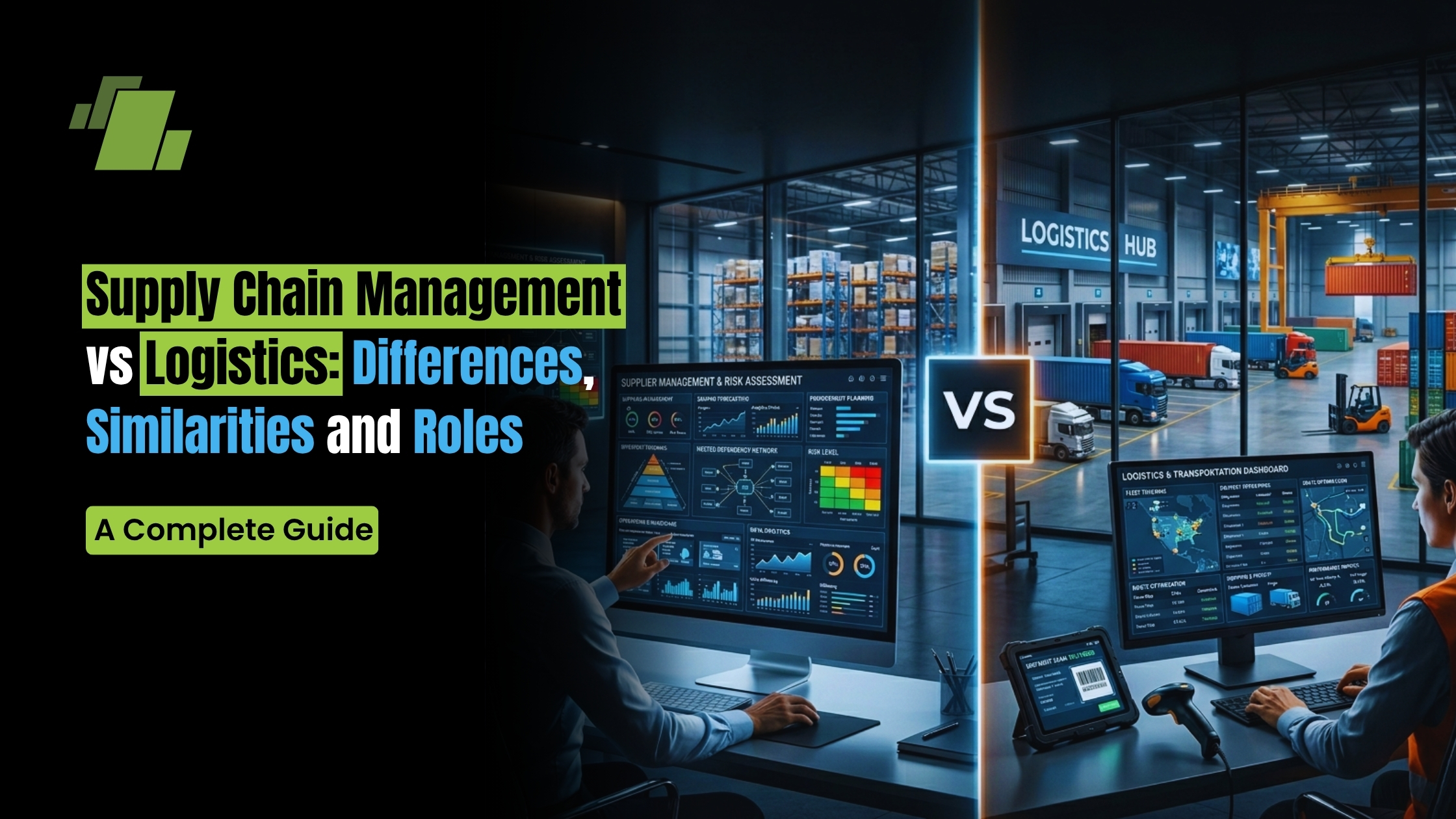
Supply Chain Management vs Logistics: Differences, Similarities and Roles – A Complete Guide

Summary
This blog explains that Supply Chain Management (SCM) is the strategic process of managing sourcing, production, and distribution, while logistics focuses on the operational movement and storage of goods. It highlights their differences, overlaps, challenges, and the role of technologies like ERP in integrating both. The key takeaway is that combining SCM strategy with efficient logistics execution improves cost efficiency, visibility, and overall business performance.
Contact Us
Free Demo Request
Table of Content
- Introduction
- What Are Supply Chain Logistics?
- Are Logistics and Supply Chain Management the Same Thing?
- Understanding Supply Chain Management
- Core Components of Supply Chain Management
- How Are Supply Chain Management and Logistics the Same?
- How Are Supply Chain Management and Logistics Different?
- Strategic vs Operational Focus in SCM
- Understanding Logistics Management
- Transportation and Distribution
- Warehousing and Inventory Control
- Information Systems and Technology
- Supply Chain Management vs. Logistics: Key Differences and Comparative Analysis
- Scope and Strategic Focus Comparison
- Functional Responsibilities Matrix
- Similarities and Integration Points
- Shared Technologies and Systems
- Common Performance Metrics
- Collaborative Planning Processes
- Common Implementation Challenges and Solutions
- Technology Integration and Data Silos
- Organizational Structure and Communication
- Skills Gap and Training Requirements
- Career Paths and Professional Development
- Why Choose LOGIC ERP Software for Supply Chain and Logistics Management?
- Conclusion
- Frequently Asked Questions
Introduction
Supply chain management (SCM) manages the entire network from raw materials to end customers, while logistics focuses on the movement and storage of goods within that network. Understanding this distinction is fundamental for any professional working in operations, procurement, or distribution-yet the two terms are frequently used interchangeably, creating confusion that leads to misaligned strategies, duplicated efforts, and missed opportunities for competitive advantage.
This guide covers everything you need to know about supply chain management vs logistics: precise definitions, key differences, where they overlap, the roles and career paths available in each discipline, the technology that powers both functions, and practical implementation strategies for organizations of any size. Whether you are a business professional evaluating your supply chain operations, a student choosing between career paths, a procurement manager looking for strategic clarity, or a technology leader selecting supply chain management software, this content is designed to deliver actionable answers.
The direct answer: The term supply chain management refers to the strategic oversight and coordination of the entire product lifecycle-from sourcing raw materials and manufacturing processes through to final delivery and returns. Logistics is a component of supply chain management that deals with the tactical execution of transporting, storing, and delivering finished goods. SCM involves overseeing the bigger picture; logistics focuses on making the physical movement happen efficiently.
By the end of this guide, you will gain:
- A clear understanding of SCM vs logistics roles, responsibilities, and how they interact
- The ability to identify which career path-strategic SCM or operational logistics-suits your strengths
- Knowledge of how both functions integrate through shared technologies like ERP, WMS, and TMS
- An understanding of the technology requirements driving supply chain efficiency in 2026 and beyond
- Actionable implementation strategies for overcoming common challenges in both disciplines
What Are Supply Chain Logistics?
Supply chain logistics refers to the specific activities involved in the movement, storage, and flow of goods, services, and information within the broader supply chain network. It encompasses transportation, warehousing, order fulfillment, inventory management, and distribution processes that ensure products move efficiently from suppliers through manufacturing to end customers. As a critical component of supply chain management, supply chain logistics focuses on the tactical execution of physical goods movement to meet customer demands effectively.
Are Logistics and Supply Chain Management the Same Thing?
No, logistics and supply chain management (SCM) are closely related but distinct concepts. Logistics is a subset of SCM, concentrating on the planning, implementation, and control of the efficient movement and storage of goods within a company or between businesses. In contrast, supply chain management encompasses the strategic coordination of the entire product lifecycle from sourcing raw materials and production through distribution and returns. While logistics handles the operational aspects of moving and storing goods, SCM oversees the broader network, relationships, and strategies that ensure overall supply chain efficiency and competitiveness.
Understanding Supply Chain Management
Supply chain management is the strategic coordination of business processes across the entire network, from sourcing raw materials to delivering products to end customers. It encompasses procurement, demand forecasting, production management, supplier management, inventory strategy, distribution, and returns-essentially every step that transforms inputs into customer value. Supply chain management covers far more than moving goods; it designs the network, manages relationships, mitigates risk, and aligns the entire supply chain with corporate strategy.
In modern business, effective supply chain management can reduce operational costs significantly while improving resource utilization and reducing waste. Hundreds of millions of jobs are linked to supply chain activities globally, and companies with superior SCM consistently outperform competitors on margins, delivery reliability, and customer satisfaction. In 2020, global supply chains faced significant vulnerabilities that exposed how critical strategic supply chain management is-not as a back-office function, but as a core driver of business resilience.
Core Components of Supply Chain Management
Key components of SCM include planning, sourcing, manufacturing, delivery, and returns. Each plays a distinct role in the entire supply chain:
- Planning involves developing a strategic plan to meet demand and manage resources. This includes demand forecasting, capacity planning, and aligning production schedules with customer demand. Planning is the foundation that connects every other component.
- Sourcing includes selecting vendors for raw materials or services based on quality and cost. Strategic sourcing goes beyond price negotiation to encompass procurement strategies that build sustainable supply chains and diversify supplier risk. Strengthening supplier relationships helps ensure consistent quality and timely delivery.
- Manufacturing involves scheduling, testing, packaging, and quality control processes. Production management decisions-make vs. buy, capacity allocation, process design-directly shape cost structure and speed to market.
- Delivery coordinates warehousing, order management, and transportation of products. The delivery phase in SCM involves moving finished goods to distributors or consumers through optimized distribution centers and outbound logistics networks.
- Returns manage defective, excess, or unwanted products through a responsive network. The returns process in SCM includes handling customer service support for product returns, making reverse logistics a critical component of comprehensive supply chain solutions.
These components create the strategic framework for all business operations. When managed cohesively, they reduce waste, optimize inventory levels, and ensure every link in the chain contributes to overall supply chain performance.
How Are Supply Chain Management and Logistics the Same?
Similarities of Supply Chain Management and Logistics
- Both focus on the efficient flow of goods, services, or information across the supply network.
- Both aim to enhance customer satisfaction by ensuring timely and accurate delivery.
- Both contribute to the company’s competitive advantage through improved operational efficiency.
- Both involve coordination among suppliers, manufacturers, distributors, and retailers to facilitate smooth product movement.
- Both rely heavily on technology and data analytics to optimize processes and decision-making.
How Are Supply Chain Management and Logistics Different?
Key differences between SCM and logistics include:
| Logistics | Supply Chain Management |
|---|---|
| Logistics is one activity within supply chain management. | Supply chain management covers a wide range of activities, including planning, sourcing materials, labor and facilities management, production, and delivery of goods and services. |
| Logistics focuses on the efficient and cost-effective delivery of goods to customers. | Supply chain management aims to improve overall operational performance and create a competitive advantage. |
| Logistics originated in military operations. Many consider Alexander the Great (356 B.C.) a master of logistics. | Modern supply chain management emerged in the 20th century, with Ford Motor Company’s production lines helping shape the concept. The term is often credited to Keith Oliver in the early 1980s. |
| Logistics centers on the movement and transportation of goods within a company. | Supply chain management oversees the transformation of raw materials into finished products and their distribution from manufacturers to retailers or consumers. |
Strategic vs Operational Focus in SCM
Supply chain management operates at two levels. Strategically, SCM encompasses long-term network design, risk mitigation, supplier development, sustainability goals, and total cost of ownership optimization. Supply chain managers make decisions about where to locate warehouses, which suppliers to partner with for the next decade, how to build redundancy against geopolitical disruption, and how to align supply chain processes with evolving market trends.
Operationally, SCM overlaps with logistics when executing day-to-day activities-managing inventory, coordinating shipments, fulfilling orders. But the strategic layer is what differentiates SCM from pure logistics. Risk mitigation is essential for maintaining steady business continuity in SCM, requiring scenario planning, dual sourcing strategies, and digital twins that simulate disruptions before they happen.
Best practices in SCM emphasize end-to-end visibility and real-time tracking systems, enabling supply chain management professionals to anticipate problems rather than react to them. This strategic oversight is precisely what guides the tactical execution that logistics performs on the ground.
Understanding Logistics Management
Where supply chain management designs the network and sets the strategy, logistics management is the execution arm that makes physical movement happen. Logistics refers to the planning, implementation, and control of the efficient forward and reverse flow of goods, services, and related information between point of origin and final destination. Logistics is a component of supply chain management-a critical one that directly determines whether strategic plans translate into timely deliveries and satisfied customers.
Transportation and Distribution
Transportation sits at the heart of business logistics. Freight transportation connects suppliers to broader markets through multiple modes-air, sea, road, and rail-each with distinct cost, speed, and capacity profiles. Logistics managers handle carrier selection, route optimization, load planning, customs compliance, and delivery scheduling. Companies can save money by optimizing transportation routes, and cutting shipping costs through strategies like consolidating LTL (less-than-truckload) shipments, using intermodal transport, and employing cross-docking to minimize handling. Fleet management and third party logistics partnerships extend capacity without proportional capital investment. E-logistics handles parcels valued under a hundred US dollars, a segment that has grown enormously as e-commerce logistics has come to dominate supply chains.
Warehousing and Inventory Control
Efficient logistics depends on well-managed warehouse space and precise inventory control. Warehousing operations include receiving, put-away, picking, packing, and shipping-the physical processes that turn customer orders into delivered products. Inventory management ensures businesses maintain optimal stock levels, balancing the cost of storing raw materials and finished goods against the risk of stockouts. A warehouse management system (WMS) coordinates these activities through barcode scanning, RFID tracking, and retrieval systems that minimize errors. Material handling equipment, slotting optimization, and warehouse layout design all contribute to operational efficiency. The connection to transportation is direct: where inventory sits determines shipping costs, lead times, and how quickly goods reach their final delivery point.
Information Systems and Technology
Modern logistics operations run on integrated technology. WMS platforms manage warehouse management at the execution level. Transportation Management Systems (TMS) optimize routing, carrier selection, and freight audit. Track-and-trace systems powered by IoT devices provide real-time information on goods’ conditions-temperature, humidity, shock-enabling proactive intervention before problems escalate. Data analytics platforms aggregate performance data across logistics operations, measuring order accuracy, on-time delivery, and cost per unit.
The key takeaway: technology enables efficient logistics by replacing manual processes with automated, data-driven decisions. Without these systems, logistics deals with blind spots that lead to waste, delays, and poor logistics outcomes. With them, logistics plays a central role in delivering the customer experience that supply chain strategy promises.
Understanding how these two disciplines compare side by side reveals where each adds the most value.
Supply Chain Management vs. Logistics
Key Differences and Comparative Analysis
While supply chain management and logistics share common ground, they differ fundamentally in scope, strategic orientation, and day-to-day responsibilities. Recognizing these differences is essential for organizations structuring their teams and for professionals choosing their career direction.
Scope and Strategic Focus Comparison
Each approach delivers its greatest value in different contexts. Here are the four key scope differences:
- SCM manages end-to-end network relationships. Supply chain management oversees the entire product lifecycle-from raw material suppliers through manufacturing processes to customer doorstep and returns. It coordinates business partners across multiple tiers and geographies to build comprehensive supply chain solutions.
- Logistics focuses on physical movement execution. Logistics focuses on internal movement of goods: inbound logistics (materials flowing in), outbound logistics (products flowing out), warehousing, and order processing. Logistics deals with transportation and warehousing as its primary domain.
- SCM involves strategic planning and risk management. Supply chain management includes sourcing, production, and distribution decisions that shape competitive positioning for years. This includes demand planning, supplier diversification, and network redesign to address geopolitical or environmental risks.
- Logistics emphasizes operational efficiency and cost control. Effective logistics management reduces overhead costs significantly through route optimization, warehouse productivity improvements, load consolidation, and labor management. Logistics operations measure success in shipping costs per unit, on-time delivery rates, and warehouse utilization percentages.
Functional Responsibilities Matrix
The following comparison shows how SCM and logistics responsibilities differ across core business functions:
| Function | SCM Role | Logistics Role |
|---|---|---|
| Procurement / Sourcing | Identify, evaluate, and contract with suppliers; strategic sourcing; sustainable sourcing practices; supplier management and diversification. | Manage inbound logistics; coordinate supplier shipments; handle receiving operations and material handling. |
| Demand & Planning | Long-term demand forecasting; scenario planning; aligning production schedules with customer demand; demand planning across the network. | Short-term demand adjustments; safety stock management; order fulfillment scheduling based on current inventory levels. |
| Production | Make-vs-buy decisions; capacity planning; production management strategy; quality control standards. | Coordinate finished goods flow from production lines; ensure materials arrive on time for manufacturing processes. |
| Distribution | Strategic network design; choosing distribution center locations; channel strategy. | Execution of freight management; carrier selection; route optimization; last-mile delivery; customs clearance. |
| Warehousing & Inventory | Decide warehouse locations; set inventory policies; centralized vs. decentralized strategy. | Day-to-day warehouse operations including picking, packing, shipping, inventory accuracy, and cycle counting. |
| Technology | Select SCM platforms (ERP, planning tools, digital twins); integrate data across the entire supply chain. | Implement WMS/TMS; deploy sensors and automation; manage track-and-trace systems. |
| Performance Metrics | Total cost of ownership; supply chain efficiency; risk exposure; sustainability metrics; inventory turnover across the network. | Transportation cost per unit; warehouse cost per unit; order accuracy; on-time shipping; local labor productivity. |
The synthesis is clear: organizations need both strategic SCM and operational logistics excellence. Poor logistics undermines even the best supply chain strategy, and exceptional logistics execution without strategic direction leads to efficiency gains that miss the larger opportunity. The most effective organizations integrate both tightly-which leads to the question of where they converge.

Similarities and Integration Points
Despite their differences in scope, supply chain management and logistics share foundational technologies, metrics, and planning processes. Their integration determines how well strategy translates into execution.
Shared Technologies and Systems
Both SCM and logistics rely on ERP systems to integrate finance, procurement, manufacturing, and distribution data into a single platform. Investing in ERP systems improves visibility and automates inventory tracking in SCM, while also giving logistics managers real-time access to order status, stock levels, and shipment data. Cloud computing enhances collaboration and data sharing in SCM, enabling both functions to operate from a unified data layer rather than disconnected spreadsheets.
AI is increasingly deployed across both domains. By 2025, 75% of supply chains were projected to use AI for decision-making, and that adoption has continued accelerating. AI algorithms optimize inventory management and demand forecasting on the SCM side, while logistics uses AI for route optimization, dynamic carrier selection, and exception detection. IoT devices provide real-time information on goods’ conditions for both warehouse managers and supply chain professionals monitoring product quality across the network. Digital twins serve dual purposes: SCM uses them for network planning and scenario simulation, while logistics uses them for warehouse layout optimization and flow analysis.
Common Performance Metrics
Supply chain management and logistics share several KPIs that measure the health of the overall operation:
- Inventory turnover measures how efficiently stock cycles through the system-critical for both strategic inventory planning and day-to-day warehouse management
- On-time delivery reflects both the reliability of the supply chain network design and the effectiveness of logistics execution
- Cost per unit delivered captures total landed cost (SCM) and transportation/warehousing efficiency (logistics)
- Customer satisfaction serves as the ultimate shared metric-supply chain management aims to improve efficiency and customer satisfaction, while logistics directly delivers the experience customers judge
- Order accuracy and fill rate bridge both functions: SCM sets service level targets, and logistics executes to meet them
Collaborative Planning Processes
Demand planning is inherently cross-functional: marketing, sales, supply chain management professionals, and logistics managers must collaborate to build accurate forecasts. Capacity planning requires alignment between manufacturing processes, warehouse space availability, and transportation capacity. Risk mitigation strategies-dual sourcing, buffer stocks, flexible transport modes-require input from both strategic SCM and operational logistics teams.
Organizations that have tightly integrated these functions through unified logistics and supply chain platforms report stronger resilience, faster response to disruptions, and lower total supply chain costs. The challenge lies in achieving that integration-which brings us to the most common obstacles organizations face.
Common Implementation Challenges and Solutions
Implementing effective supply chain logistics management requires overcoming organizational, technological, and talent-related barriers. These challenges are common across industries but solvable with the right approach.
Technology Integration and Data Silos
Many organizations operate with fragmented systems-separate ERP, WMS, TMS, and procurement tools that do not share data efficiently. This creates blind spots where supply chain managers cannot see logistics execution status, and logistics managers lack visibility into upstream supply changes.
Solution: Deploy integrated or modular systems with open APIs that enable real-time data flow. Cloud-based platforms eliminate the need for complex on-premise integrations. Start by mapping current data flows, identifying critical gaps, then implement an ERP platform that unifies supply chain and logistics data in a single environment. Adopting advanced technology helps optimize inventory levels and forecast demand accurately when all data streams feed into one system. Blockchain improves transparency and traceability in supply chains where multi-tier supplier visibility is essential.
Organizational Structure and Communication
SCM is cross-functional by nature; logistics often sits under operations. Misalignment occurs when procurement pushes for lean inventory while logistics needs buffer stock, or when strategic plans change without logistics being informed until execution day.
Solution: Establish cross-functional teams with shared KPIs that span both strategic SCM outcomes and logistics operational performance. Create leadership roles that bridge both functions-such as a VP of Supply Chain who oversees logistics operations. Implement regular alignment meetings (monthly S&OP cycles at minimum) where demand planning, capacity, and risk are reviewed jointly. Adjust incentive structures so both functions are rewarded for overall supply chain performance rather than siloed metrics.
Skills Gap and Training Requirements
Traditional logistics roles have been operational and manual; SCM demands strategic, analytical capabilities. The rapid adoption of AI, automation, and digital tools has widened this gap. Automation reduces manual labor and speeds up logistics processes, but the workforce needs new competencies to manage these systems effectively.
Solution: Invest in professional certifications-CPIM, CSCP, and CLTD from ASCM are recognized standards that boost both capability and earning potential. Develop in-house training programs focused on data analytics, digital tools, and sustainability knowledge. Create rotation programs that expose logistics professionals to strategic planning and give SCM analysts hands-on warehousing or transportation experience. Real-time data analytics now drives supply chain decisions, making data literacy a non-negotiable skill for both functions.
These challenges are surmountable, and solving them opens significant career opportunities in both disciplines.
Career Paths and Professional Development
Career opportunities in logistics and supply chain management are growing rapidly as businesses focus on improving operational efficiency and supply chain resilience. Professionals in this field typically earn between ₹6 lakh and ₹18 lakh per annum, while experienced managers and specialists can earn ₹20 lakh to ₹40 lakh or more annually. Senior leadership positions such as Vice President, General Manager, or Head of Supply Chain can command salaries exceeding ₹50 lakh per annum, depending on the industry, organization, and level of experience. Education and professional certifications also play a significant role in compensation, with professionals holding advanced degrees and industry-recognized certifications often earning 15–20% more than their non-certified peers.
Here are actionable next steps for career development:
- Assess current skills and interests. Determine whether you lean toward strategic thinking (SCM path) or operational execution excellence (logistics path)
- Choose specialization based on preference. Logistics careers often progress faster in early years (coordinator → supervisor → manager in 2–3 year increments), while SCM strategic roles involve deeper cross-functional exposure with 3–5 years per progression
- Pursue relevant certifications. CPIM for production and inventory management, CSCP for end-to-end supply chain, CLTD for logistics and transportation
- Gain hands-on experience. Internships, entry-level positions, or cross-functional rotation programs build the practical knowledge that credentials alone cannot provide
Emerging roles are expanding rapidly: digital SCM specialists, supply chain data scientists, AI and automation oversight professionals, sustainability and ESG supply chain managers, resilience planning experts, and agentic AI oversight roles. The Bureau of Labor Statistics projects approximately 17% growth for logisticians through 2034-well above average.
The global logistics automation market is expected to grow from approximately ₹8.5 lakh crore in 2026 to over ₹22 lakh crore by 2034, driven by advancements in robotics, artificial intelligence (AI), and warehouse automation. At the same time, spending on AI-powered supply chain management software is projected to increase from around ₹17,000 crore in 2025 to over ₹4.5 lakh crore by 2030. Sustainability is also becoming a major priority, creating new career opportunities in sustainable supply chain management, carbon footprint reduction, and Scope 3 emissions monitoring. As AI and digital technologies continue to transform logistics and supply chain operations, professionals who combine industry expertise with technology and data-driven skills will be in the highest demand and command premium salaries.
Why Choose LOGIC ERP Software for Supply Chain and Logistics Management?
Choosing the right software platform is crucial for achieving excellence in both supply chain management and logistics operations. LOGIC ERP offers a comprehensive, integrated solution designed to unify all supply chain activities from strategic sourcing and production planning to warehouse management and last-mile delivery. Its modular architecture supports scalability, enabling businesses to adapt quickly as market demands evolve.
LOGIC ERP enhances visibility with real-time tracking and analytics, empowering decision-makers to anticipate disruptions and optimize inventory levels. Advanced features such as AI-driven demand forecasting, automated route optimization, and seamless integration with IoT devices enable companies to reduce operational costs while improving service levels. The platform’s cloud-based infrastructure ensures secure, accessible data sharing across multiple locations and partners, fostering collaboration and transparency.
Moreover, LOGIC ERP supports sustainability initiatives by providing tools to monitor carbon footprints, optimize transportation routes for fuel efficiency, and manage circular supply chains. Its user-friendly interface and customizable dashboards simplify complex workflows, making it suitable for organizations of all sizes and industries.
By choosing LOGIC ERP, companies gain a strategic partner that not only streamlines logistics and supply chain processes but also drives innovation and resilience in an increasingly competitive global market.
Conclusion
Understanding the distinction and interplay between supply chain management and logistics is essential for businesses aiming to optimize operations and enhance customer satisfaction. Supply chain management provides the strategic framework that governs sourcing, production, distribution, and returns, while logistics translates these strategies into efficient physical movement and storage of goods.
Both disciplines rely heavily on integrated technology systems like ERP, WMS, and TMS to enable real-time visibility and data-driven decision-making. Overcoming challenges such as data silos, organizational misalignment, and skills gaps is critical to unlocking the full potential of supply chain logistics management.
As market dynamics continue to evolve, embracing advanced technologies such as AI, automation, and IoT will be vital for building agile, sustainable, and cost-effective supply chains. Whether you are a professional seeking to advance your career or an organization striving for operational excellence, mastering the synergy between supply chain management and logistics will position you for success in coming years.
Call at +91-73411-41176/75 or send us an email at sales@logicerp.com to book a free demo today!
Frequently Asked Questions
1. What Pays More: Supply Chain Management Or Logistics?
In India, Supply Chain Management (SCM) generally offers higher salaries than logistics, especially in strategic and leadership roles. SCM professionals can earn ₹15–60+ lakh per annum, while logistics professionals typically earn ₹6–25 lakh per annum. Senior positions in both fields can command significantly higher salaries depending on experience and industry.
2. Can You Transition Between SCM And Logistics Careers?
Yes, many supply chain management professionals started in logistics, procurement, or warehouse management before moving into strategic roles. Operations and logistics experience provides a practical foundation that strengthens strategic decision-making. Certifications like CSCP and cross-functional project exposure accelerate the transition.
3. What Education Is Required For SCM And Logistics Careers?
A bachelor’s degree is the baseline for most roles, with degrees in supply chain management, logistics, industrial engineering, operations research, or business administration being most relevant. A master’s degree is increasingly valuable for leadership positions. Professional certifications (CPIM, CSCP, CLTD) significantly enhance both employability and compensation.
4. How Do SCM And Logistics Roles Differ By Industry?
Industries with stringent regulatory requirements pharmaceuticals, food, aerospace demand strict logistics compliance, traceability, and environmental controls. E-commerce and fast fashion emphasize speed, agility, and last-mile focus. Heavy manufacturing involves more complexity in supplier management and inventory strategy. The core principles remain consistent, but the emphasis shifts based on customer needs and regulatory environment.
5. What Technology Skills Are Most Important?
ERP implementation and operations management, WMS/TMS proficiency, data analytics and machine learning for forecasting, real-time visibility platforms (IoT, sensors), automation and robotics oversight, and sustainability tracking tools are critical. Familiarity with cloud systems, API integration, and digital twins is increasingly expected for mid-to-senior roles.
6. How Is Automation Affecting SCM And Logistics Careers?
Automation is eliminating repetitive manual tasks such as inventory counts, basic scheduling, routine routing, and picking in warehouses. However, it is creating new roles focused on exception management, system oversight, data interpretation, and strategic decision-making. Effective SCM reduces operational expenses through automation while shifting workforce value toward higher-order problem solving. The mundane is being automated; careers are evolving toward strategic oversight and technology management.
7. What Are The Growth Prospects For These Fields?
Growth prospects are strong. The BLS projects approximately 17% growth for logisticians through 2034. The logistics automation market is expected to nearly triple by 2034. E-commerce logistics continues to dominate supply chains, driving demand for both strategic SCM and operational logistics talent. Sustainability requirements, reshoring initiatives, and AI adoption are creating new roles that did not exist five years ago.
8. How Do Small Vs Large Companies Structure SCM And Logistics Roles?
Small companies often combine SCM and logistics into a single operations management or supply chain manager role, handling everything from supplier management to order processing. Large organizations separate strategic SCM functions (procurement, demand planning, network design) from logistics operations (transportation, warehouse management, last-mile delivery). In large enterprises, a Chief Supply Chain Officer typically oversees both. The technology stack also differs larger firms invest in more advanced supply chain and distribution management systems, while smaller companies may rely on integrated ERP platforms that automate processes across both functions in a single solution.
9. What Role Does Sustainability Play In SCM And Logistics Today?
Sustainability has moved from a nice-to-have to a strategic imperative. Supply chain professionals are now responsible for Scope 3 emissions monitoring, ethical sourcing audits, packaging waste reduction, and energy optimization in warehousing and transportation. Optimized SCM improves resource utilization and reduces waste, while logistics contributes through route efficiency, load optimization, and modal shifts to lower-emission transport options. Regulatory reporting requirements are embedding sustainability metrics directly into supply chain management activities.
10. What Is The Difference Between Inbound And Outbound Logistics?
Inbound logistics covers the movement of raw materials and components from suppliers to manufacturing or storage facilities encompassing procurement coordination, supplier shipments, receiving, and storing raw materials. Outbound logistics handles the flow of finished goods from production or distribution centers to the final destination including order processing, picking, packing, shipping, and last-mile delivery. Both are essential to efficient logistics within the broader supply chain, and both benefit from integrated WMS and TMS platforms that provide end-to-end visibility.
11. What Is The Difference Between Logistics And Supply Chain Management?
Logistics is a subset of supply chain management that focuses on the planning, implementation, and control of the efficient movement and storage of goods within a company or between businesses. Supply chain management covers the entire lifecycle of a product, including sourcing, manufacturing, distribution, and returns, coordinating multiple partners to optimize the flow from raw materials to end customers.
12. What Is Inventory Control And How Does It Impact Supply Chain Performance?
Inventory control involves managing stock levels to ensure that the right amount of inventory is available to meet customer demand without overstocking or stockouts. Effective inventory control reduces costs by minimizing excess inventory and storage expenses while improving customer satisfaction through timely order fulfillment.
13. How Does Inventory Management Differ From Inventory Control?
Inventory management is a broader process that encompasses forecasting demand, ordering, storing, and tracking inventory throughout the supply chain. Inventory control specifically focuses on maintaining optimal stock levels and accuracy of inventory records within warehouses and distribution centers.
14. What Is Inbound Logistics And Why Is It Important?
Inbound logistics refers to the activities involved in receiving, storing, and transporting raw materials or components from suppliers to manufacturing facilities or warehouses. Efficient inbound logistics reduces lead times, lowers costs, and ensures smooth production schedules, which are critical for overall supply chain efficiency.
15. What Does Business Logistics Encompass?
Business logistics covers the planning and management of the movement and storage of goods, services, and related information from the point of origin to the point of consumption. It includes transportation, warehousing, order processing, inventory control, and demand forecasting to ensure products reach customers efficiently and cost-effectively.
16. What Specialized Equipment Is Used In Logistics And Supply Chain Management?
Specialized equipment in logistics includes forklifts, conveyor belts, automated storage and retrieval systems (ASRS), pallet jacks, and robotics. These tools facilitate material handling, improve warehouse management efficiency, and reduce manual labor costs.
17. How Is Managing Equipment Crucial For Effective Logistics Operations?
Managing equipment involves scheduling maintenance, tracking usage, and ensuring operational readiness to prevent downtime. Proper equipment management supports smooth material handling, reduces delays, and enhances overall logistics productivity.
18. What Does Managing The Entire Lifecycle In Supply Chain Management Mean?
Managing the entire lifecycle means overseeing all stages of a product’s journey from sourcing raw materials, production, transportation, warehousing, to final delivery and returns. This holistic approach ensures efficiency, quality, and customer satisfaction throughout the supply chain.
19. How Can Supply Chain Management Help Reduce Costs?
By optimizing processes such as demand forecasting, inventory management, transportation routing, and warehouse operations, supply chain management minimizes waste, avoids stockouts, reduces lead times, and leverages economies of scale, all contributing to significant cost savings.
20. What Role Do Customer Service Representatives Play In Supply Chain And Logistics?
Customer service representatives handle order inquiries, manage returns, and communicate delivery status to customers. They are vital for maintaining customer satisfaction and resolving issues that arise during order fulfillment and logistics processes.
21. What Is A Warehouse Management System (WMS) And Why Is It Important?
A warehouse management system is software that controls and optimizes warehouse operations, including inventory tracking, order picking, packing, and shipping. WMS improves accuracy, reduces errors, enhances inventory visibility, and increases overall warehouse efficiency.
22. How Does Effective Logistics Management Improve Business Performance?
Effective logistics management ensures timely delivery, reduces transportation and storage costs, enhances inventory accuracy, and improves customer satisfaction. It supports seamless coordination between suppliers, warehouses, and customers, driving competitive advantage.
23. Why Is Demand Forecasting Critical In Supply Chain Management?
Demand forecasting predicts future customer demand using historical data and market trends. Accurate forecasts enable better inventory planning, reduce stockouts and overstocks, and optimize production and distribution schedules.
24. What Is Material Handling And Its Significance In Logistics?
Material handling involves the movement, protection, storage, and control of materials and products throughout the supply chain. Efficient material handling reduces damage, speeds up warehouse operations, and lowers labor costs.
25. What Is Order Processing In Logistics?
Order processing includes all activities from receiving customer orders to picking, packing, and shipping products. Streamlined order processing ensures accurate, timely deliveries and is essential for customer satisfaction.
26. How Does Demand Planning Relate To Supply Chain And Logistics?
Demand planning aligns inventory levels and production schedules with anticipated customer demand. It is a collaborative process involving sales, marketing, supply chain, and logistics teams to ensure resources are allocated efficiently and customer needs are met.

Author
Gurbir Singh
Co-founder & Managing Director | LOGIC ERP Solutions Pvt. Ltd.
With 30+ years of experience in the tech industry, I took the helm of technology & product development, ensuring LOGIC ERP’s continuous innovation & leadership in the evolving tech landscape.