Demand Sensing vs Demand Forecasting in FMCG Supply Chain Management: A Complete Guide

Summary
Discover how FMCG companies use demand forecasting for long-term strategic planning and demand sensing for real-time demand adjustments to improve inventory optimization, reduce waste, and enhance overall supply chain agility. By combining historical data-driven forecasting with AI-powered real-time insights, businesses can respond faster to market changes, minimize stockouts and overstock situations, and achieve more efficient supply chain operations. LOGIC ERP supply chain management software helps streamline this process by enabling integrated demand planning, better inventory visibility, and smarter decision-making.
Contact Us
Free Demo Request
Table of Contents
- Introduction
- Understanding Demand Forecasting in FMCG
2.1 Traditional Forecasting Methods
2.2 Data Sources and Limitations
2.3 Applications in FMCG Operations - Understanding Demand Sensing Technology
3.1 Real-Time Data Integration
3.2 AI and Machine Learning Components
3.3 Short-Term Forecast Generation - Key Differences: Demand Sensing vs Demand Forecasting
4.1 Time Horizons and Planning Cycles
4.2 Data Sources and Processing Speed
4.3 Accuracy and Response Capabilities - Implementation Strategy for FMCG Supply Chains
5.1 Data Infrastructure Requirements
5.2 Technology Stack Selection
5.3 Phased Implementation Approach - Common Implementation Challenges and Solutions
6.1 Data Quality and Integration Issues
6.2 Organizational Resistance to AI-Driven Processes
6.3 ROI Measurement and Justification - Why Choose LOGIC ERP for Demand Sensing and Forecasting
- Conclusion and Next Steps
- Future Trends in FMCG Demand Management
- Frequently Asked Questions (FAQs)
Introduction
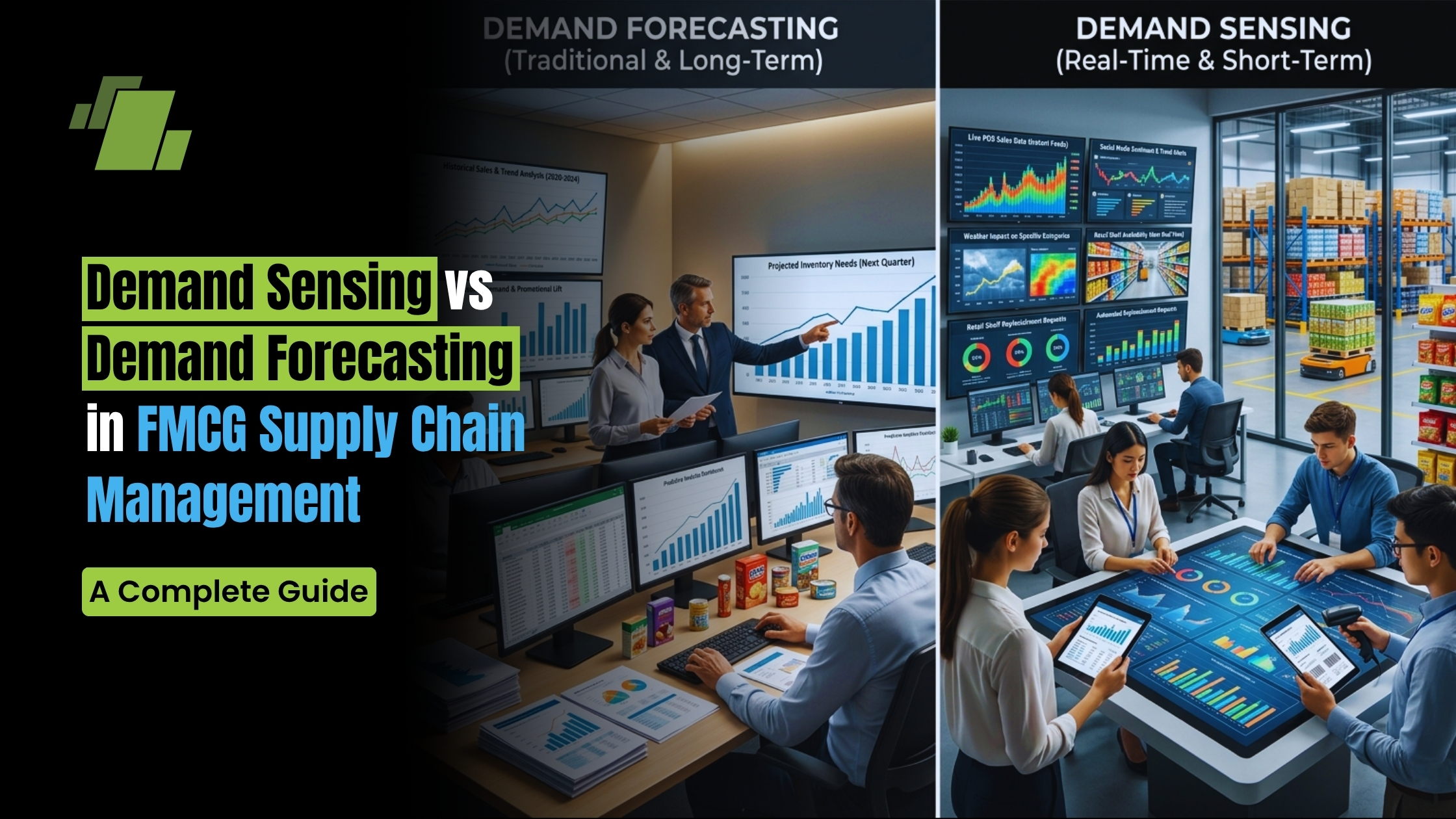
Demand sensing and demand forecasting represent two distinct approaches to predicting consumer demand in fast-moving consumer goods (FMCG) supply chains, each serving critical but different planning needs. Demand forecasting uses historical sales data and statistical models to project future demand over months or years, while demand sensing leverages real-time data and AI to capture short-term demand shifts within days or weeks. Demand sensing also incorporates external factors such as weather, social media trends, economic indicators, and competitor activities that affect demand, enabling organizations to respond quickly to changes in market trends and consumer behavior.
This guide covers the fundamental differences between these methodologies, their practical applications in FMCG operations, implementation strategies for hybrid approaches, technology requirements, common challenges, and emerging trends shaping supply chain operations in 2026. These approaches are also foundational to business intelligence, supporting supply chain decision-makers with actionable insights for more informed and agile planning. The content serves supply chain managers, demand planners, FMCG executives, and procurement professionals seeking to optimize inventory management and improve forecast accuracy across their organizations.
Direct answer: Demand forecasting relies on historical data and traditional forecasting methods for long-term strategic planning (3-18 months), while demand sensing technology integrates real-time demand signals including POS data, weather forecasts, and social media trends for short-term tactical adjustments (0-8 weeks). Modern businesses use both approaches, with forecasting serving as the foundation for strategic planning while sensing adjusts based on current market conditions.
After reading this guide, you will understand:
- The fundamental differences between demand sensing and demand forecasting methodologies
- How to select the right approach based on your FMCG supply chain requirements
- Implementation strategies for deploying hybrid demand planning systems
- Solutions for overcoming common data quality and organizational challenges
- Methods for measuring ROI and tracking forecast accuracy improvements
- How achieving more accurate forecasting for supply chain optimization can improve resource allocation and customer service
Understanding Demand Forecasting in FMCG
Demand forecasting refers to traditional methods, often called statistical forecasting, that use historical sales data, seasonality patterns, promotional calendars, and macroeconomic indicators to predict consumer demand over medium to long horizons. For moving consumer goods FMCG companies, accurate demand forecasting forms the backbone of annual budgeting, production capacity planning, and strategic inventory decisions that shape operations months or years in advance. Demand forecasting models, especially when applied to new product launches, leverage analogue modeling, external data sources, and demand planning software to improve forecast accuracy, reduce inventory risks, and enable companies to respond quickly to market fluctuations.
Traditional Forecasting Methods
Traditional demand forecasting methods rely on statistical techniques and time series analysis that assume historical patterns will partially repeat in future periods. Common demand forecasting models include ARIMA (AutoRegressive Integrated Moving Average), exponential smoothing methods like Holt-Winters, seasonal decomposition, and regression models. These models can incorporate external data sources such as market trends, weather data, and economic indicators to improve forecast accuracy and responsiveness.
These approaches typically operate on time horizons spanning 3-18 months, supporting decisions around production scheduling and raw material procurement. Models are often built at aggregated levels by brand, region, or category then disaggregated to individual SKU forecasts. Traditional forecasting methods often struggle to adapt to rapid market changes, making them less effective in today’s dynamic environment compared to modern demand sensing approaches.
Data Sources and Limitations
Primary data sources for demand forecasting include historical sales data, shipment records to retailers, distribution center orders, inventory levels, and promotional history. Some organizations incorporate external data like macroeconomic indicators and consumer confidence indices to refine predictions.
However, significant limitations affect forecast accuracy in volatile environments. Delays in shipment or sales reporting create lag in detecting actual consumer demand shifts. Static model adjustments fall behind real-time market changes. Promotional effects are frequently underestimated. External factors such as weather events, pandemics, or logistics disruptions, as well as inherent demand variability, can significantly affect demand and make forecasts inaccurate. In highly volatile conditions, traditional spreadsheet-based forecasts may achieve only 55-65% SKU-level accuracy.
Applications in FMCG Operations
Demand forecasting drives several critical operational decisions in FMCG supply chains:
- Production scheduling, production planning, and capacity planning: Determining production volumes months ahead, aligning manufacturing facilities and production plans with projected demand trends
- Raw material procurement: Making supplier agreements and capacity commitments based on anticipated requirements, with potential penalties for late changes
- Strategic inventory decisions: Setting safety stock levels, warehouse capacity, and balancing inventory carrying costs against target service levels
These applications demonstrate why traditional forecasting remains essential for strategic planning it provides the long-term visibility needed for capital investment, workforce planning, and supplier negotiations. The next section examines how demand sensing technology complements these capabilities with real-time responsiveness.
Understanding Demand Sensing Technology
Demand sensing represents an AI-powered approach to short-term forecasting that uses high-frequency, real-time demand signals combined with machine learning algorithms to detect shifts as they happen. This technology evolved from traditional methods to address the need for immediate supply chain adjustments in an increasingly volatile consumer environment.
Real-Time Data Integration
Demand sensing technology integrates internal data with external data sources to create comprehensive visibility into actual demand patterns, with a much higher level of data granularity than traditional approaches. Internal signals include point of sale data from retail stores, real-time customer orders, inventory levels across distribution nodes, and substitution or cannibalization patterns.
External signals expand this picture significantly:
- Weather data affecting product consumption patterns
- Social media trends indicating emerging consumer preferences
- Economic indicators and market changes
- Market trends that reveal short-term shifts in demand and inform adjustments to inventory, manufacturing, and logistics operations
- Competitor promotional activity and pricing
- Event calendars for festivals, holidays, and local occasions
- Search trend indices revealing consumer intent
IoT sensors provide additional real-time data points monitoring stock levels in retail coolers, tracking in-transit inventory conditions, and enabling continuous environmental monitoring. By integrating real-time data from various sources, demand sensing helps businesses optimize inventory levels, reduce waste, and ensure products are available when customers need them most.
AI and Machine Learning Components
The demand sensing process involves sophisticated AI and machine learning capabilities for pattern recognition and predictive modeling across massive datasets. Key algorithmic approaches include:
- Ensemble methods: Random forests and gradient boosting algorithms (XGBoost, LightGBM) that combine multiple models for improved accuracy
- Deep learning: LSTM (Long Short-Term Memory) and GRU networks that capture temporal dependencies and non-linear relationships
- Transformer architectures: Advanced time-series models increasingly used for complex pattern recognition
Demand sensing technology leverages AI and machine learning to analyze vast amounts of historical and real-time data, enabling businesses to respond quickly to changes in consumer behavior. Feature engineering plays a vital role creating predictors for promotions, weather impacts, holidays, and local events while weighting signals that vary by SKU or region.
Short-Term Forecast Generation
Demand sensing operates primarily within a 0 to 8 week planning horizon, making it faster and more reactive than traditional demand forecasting methods, which typically work months or years ahead. Outputs are generated at granular levels per SKU, per store location, per distribution channel with daily or even hourly updates.
The demand sensing process involves real-time data collection, integration, pattern recognition, short-term forecast generation, exception detection, and automated supply chain adjustments. Demand sensing detects significant changes in consumer behavior, inventory discrepancies, and demand spikes, enabling proactive responses such as timely replenishment and inventory adjustments to prevent stockouts and optimize supply chain operations. By addressing demand volatility a key challenge in modern supply chains these capabilities empower supply chain planners to react immediately to promotion spikes, unexpected demand surges, or supply disruptions.
Demand sensing improves short-term accuracy by incorporating real-time signals like weather changes, social media trends, and Point-of-Sale (POS) data, which can enhance accuracy by 5-20%. This responsiveness connects directly to improved customer satisfaction through reduced stockouts and better product availability.
Key Differences: Demand Sensing vs Demand Forecasting
Demand sensing and demand forecasting both aim to predict future customer demand but operate on different time horizons, with demand sensing focusing on short-term adjustments and demand forecasting on long-term predictions. Understanding these distinctions helps FMCG supply chain managers deploy each approach where it delivers maximum value, and combining both methods enhances supply chain visibility.
Time Horizons and Planning Cycles
| Dimension | Demand Forecasting | Demand Sensing |
|---|---|---|
| Time horizon | 3–18 months (up to 5 years for strategic planning) | 0–8 weeks (often 1–14 days for critical SKUs) |
| Update frequency | Monthly or quarterly batch updates | Daily or hourly continuous updates |
| Planning focus | Strategic planning, annual budgets, capacity decisions (as part of broader demand planning process) | Tactical adjustments, immediate replenishment |
| Decision types | Production capacity, supplier contracts, capital investment | Routing, stock rebalancing, promotion response |
Demand forecasting covers months and quarters, while demand sensing focuses on days to weeks. This fundamental difference determines which planning decisions each approach supports effectively.
Data Sources and Processing Speed
Demand forecasting relies on historical trends and seasonality, while demand sensing utilizes real-time, external signals such as Point of Sale data, weather, and social media. The data processing architecture differs substantially:
Forecasting data infrastructure:
- Historical sales and internal ERP data
- Structured datasets with monthly or weekly granularity
- Batch processing with periodic model updates, which introduces data latency compared to real-time sensing
- Primarily internal data sources
Sensing data infrastructure:
- Real-time POS data, retailer pos data, and external data feeds
- Streaming data pipelines with continuous ingestion
- API-based connections to external data sources
- Cloud or edge computing for processing speed
Demand forecasting often uses traditional statistical methods, while demand sensing leverages AI and machine learning for real-time analysis. This technological distinction drives different infrastructure requirements and operational workflows.
Accuracy and Response Capabilities
AI-driven demand sensing can reduce forecast errors by 20 to 50 percent, potentially saving millions annually in supply chain and inventory costs. Companies that implement demand sensing can achieve a 10% improvement in forecast accuracy, which translates directly into 5-8% reductions in inventory carrying costs and helps mitigate demand uncertainty.
| Criterion | Demand Forecasting | Demand Sensing |
|---|---|---|
| Typical accuracy | 55–70% in volatile environments | 80–85%+ at SKU-location level |
| Response time | Weeks to months for adjustment | Hours to days |
| Best for | Long-tail SKUs, trend forecasting, strategic planning | Promotions, perishables, volatile products |
| Granularity | Often aggregated by category | Specific SKU level |
Demand sensing operates at the specific SKU level, while forecasting is often aggregated by category. This granularity difference makes sensing particularly effective for optimizing inventory management at individual store and distribution center locations.
Demand sensing enables businesses to respond to real-time demand signals, which helps in minimizing stockouts and overstock situations, thus optimizing inventory levels. Companies can reduce safety stocks by 5-10% and lower working capital tied up in excess inventory by aligning stock with actual daily demand through demand sensing.
Many modern businesses use both demand forecasting and demand sensing; forecasting serves as the foundation for strategic planning, while sensing adjusts based on current conditions. This hybrid approach leads to more accurate forecasting, which improves resource allocation and customer service, optimizing both supply chain efficiency and tactical responsiveness.
Implementation Strategy for FMCG Supply Chains
Implementing a hybrid demand sensing and forecasting approach requires systematic planning across data infrastructure, technology selection, and phased deployment. Effective change management is also a critical component of successful implementation, ensuring organizational alignment and adoption of new processes. This section provides practical guidance for FMCG organizations ready to enhance their demand planning capabilities.
Data Infrastructure Requirements
Successful implementation begins with assessing data readiness and establishing robust infrastructure foundations:
Historical data preparation:
- Minimum 2-3 years of clean SKU-level sales history for baseline forecasting models; this historical data is essential for building robust demand forecasting models
- Consistent product hierarchies and master data across systems
- Accurate data on promotional events, pricing changes, and marketing activities
System integration requirements:
- Connection to existing systems including ERP systems like SAP, Oracle, or LOGIC ERP
- Real-time API pipelines for POS data from retail partners
- Cloud platforms (AWS, GCP, Azure) for scalable processing
- Data lake or warehouse architecture for unified analytics
Data governance protocols:
- Master data management for SKU hierarchies and regional taxonomies
- Automated data quality monitoring and cleansing processes
- Data harmonization to ensure consistent data definitions across systems
- Consistent definitions across departments and systems
A 2026 industry analysis revealed that twelve multinational CPG companies experienced demand sensing accuracy declines of approximately 11% year-over-year due to fragmented SKU identifiers, inconsistent promotion calendars, and pricing taxonomy issues demonstrating that architecture and data quality fundamentally determine success.
Technology Stack Selection
The technology stack must support both strategic forecasting and real-time demand sensing capabilities:
Analytics and AI components:
- ML frameworks supporting ensemble methods (XGBoost, LightGBM) and deep learning (LSTM, transformers)
- Feature engineering tools for creating demand predictors
- Automated anomaly detection and alerting systems
- Model deployment and monitoring infrastructure (MLOps)
- Explainability tools (SHAP, LIME) to build planner trust
Real-time processing:
- Streaming tools (Apache Kafka, Flink) for continuous data ingestion
- Edge computing capabilities for low-latency processing
- Real-time visualization dashboards for supply chain planners
Vendor evaluation criteria:
- Integration capabilities with existing ERP and planning systems
- Scalability for enterprise-wide deployment
- Track record with FMCG-specific use cases
- Support for explainable AI to enable data driven decisions
Phased Implementation Approach
A structured rollout minimizes risk while building organizational capability:
Phase 1 (Weeks 1-8): Baseline Creation
- Audit current forecast accuracy and establish performance benchmarks
- Collect, clean, and validate historical sales data
- Deploy baseline forecasting using existing tools
- Document current forecast errors and service levels
Phase 2 (Weeks 9-20): Demand Sensing Deployment
- Launch a pilot project for demand sensing by integrating external signals (POS, weather, events) for pilot SKUs
- Build and test short-term sensing models
- Run parallel forecasts comparing sensing vs. traditional methods
- Execute pilot replenishment actions in selected markets
Phase 3 (Weeks 21-36): Scale and Optimization
- Expand to additional SKUs, channels, and regions
- Automate data pipelines and model retraining
- Integrate demand predictions into ERP procurement workflows
- Deploy continuous monitoring and exception alerting
KPI tracking throughout implementation:
- Forecast accuracy metrics (MAPE, WMAPE, bias)
- Inventory turnover and carrying cost reductions
- Service level improvements and stockout frequency
- Operational costs and processing efficiency
Real-world results demonstrate the potential impact. One global beverage company achieved forecast accuracy improvement from 62% to 84% at the SKU-location level across 500,000+ outlets, while reducing waste from ₹80 Crore to ₹38 Crore (approximately 52.5% reduction). Another global CPG implementation delivered 6% improvement in 13-week forecast accuracy with 20% faster forecast generation.
Common Implementation Challenges and Solutions
FMCG companies frequently encounter predictable obstacles when adopting demand sensing solutions, with organizational alignment being a key factor in overcoming implementation challenges. Addressing these challenges proactively accelerates successful deployment.
Data Quality and Integration Issues
Challenge: Data silos across organizations create inconsistent data formats, conflicting SKU hierarchies, and integration issues, leading to delays in POS data availability. Messy promotion and pricing event data further undermine model performance despite sophisticated algorithms.
Solution: Establish a comprehensive data governance framework with automated cleansing processes. Create unified canonical mapping layers that reconcile different data definitions across regions and systems. Implement real-time data reconciliation to catch quality issues before they affect forecasts. Invest in promotion taxonomy alignment across all planning systems.
Process data systematically through validation checkpoints before feeding sensing models. This prevents the “garbage in, garbage out” problem that derails even advanced machine learning implementations.
Organizational Resistance to AI-Driven Processes
Challenge: Demand planners accustomed to manual adjustments and gut-feel decisions may distrust black-box AI recommendations. Fear of job displacement or concerns that models miss business nuance create adoption barriers.
Solution: Prioritize transparency and explainability by implementing tools that show why models predict specific demand patterns. Start with pilot programs that demonstrate value without requiring immediate wholesale process changes.
Include experienced planners in model validation and refinement their domain expertise improves model quality while building ownership. Actively pursue stakeholder engagement throughout the process to build trust and encourage adoption. Design user interfaces that support human-in-the-loop corrections rather than fully automated decisions. Develop training programs that position AI as augmenting planner capabilities rather than replacing judgment.
ROI Measurement and Justification
Challenge: Quantifying the business case for demand sensing investment requires clear baseline metrics and ongoing performance tracking that many organizations lack.
Solution: Establish baseline measurements before implementation begins:
- Current forecast accuracy by SKU category
- Inventory carrying costs and turnover rates
- Stockout frequency and lost sales estimates
- Current service levels by channel
Use performance metrics as essential tools for tracking improvements and ROI. Demand sensing can reduce forecast errors by 20 to 50 percent, potentially saving millions annually in supply chain and inventory costs. Track improvements against these documented baselines using consistent metrics.
Demand sensing enables companies to adjust production plans proactively, ensuring that the right products are produced at the right time and reducing the likelihood of forecast errors. Quantify these improvements in operational efficiency alongside direct cost savings.
Why Choose LOGIC ERP FMCG Software for Demand Sensing and Demand Forecasting?
LOGIC ERP offers a comprehensive FMCG software solution that helps to seamlessly integrate demand sensing and demand forecasting capabilities, empowering businesses to optimize their supply chain operations effectively. Leveraging advanced artificial intelligence and machine learning algorithms, LOGIC ERP enhances demand forecast accuracy by incorporating real-time data such as Point of Sale (POS) information, weather patterns, consumer trends, and other external data sources.
The platform supports seamless integration with existing ERP systems, ensuring smooth data flow and unified analytics across all supply chain functions. Its scalable architecture accommodates the high data volumes typical in FMCG environments, enabling granular SKU-level forecasting and short-term demand sensing within a 0 to 8 week horizon. This allows companies to respond swiftly to market shifts, seasonal demand fluctuations, and promotional activities.
LOGIC ERP’s user-friendly dashboards provide supply chain managers and demand planners with actionable insights, exception alerts, and scenario analysis powered by AI and big data analytics. These features facilitate proactive decision-making, reduce inventory carrying costs, and minimize stockouts or overstock situations.
Furthermore, LOGIC ERP robust data governance and continuous model retraining ensure sustained demand forecast accuracy and adaptability to changing market conditions. By choosing LOGIC ERP, FMCG companies gain a powerful, integrated tool that supports both strategic long-term forecasting and agile short-term demand sensing driving operational efficiency, increased customer satisfaction, and competitive advantage in dynamic markets.
Conclusion and Next Steps
Demand sensing and demand forecasting serve complementary roles in modern FMCG supply chain management. Demand forecasting provides the strategic foundation for capacity planning, supplier relationships, and annual budgeting through analyzing sales data and historical patterns. Demand sensing enables tactical agility by processing real time data and external signals to detect demand shifts as they emerge.
Demand sensing utilizes real-time data and AI to capture short-term demand shifts, while demand forecasting relies on historical data to make long-term predictions. The most effective organizations deploy both approaches in an integrated system using forecasting for strategic planning horizons while sensing adjusts operational decisions based on actual demand conditions.
Demand sensing is particularly useful in high-volatility environments or for volatile, fashion-forward, or perishable goods. Demand sensing allows for immediate adjustments to production or distribution in response to unexpected events, providing competitive advantage through supply chain responsiveness.
Demand sensing helps businesses gain certainty in an uncertain market by detecting immediate changes in demand and consumer behavior, leading to optimized production processes and reduced inventory levels.
Call at +91-73411-41176/75 or send us an email at sales@logicerp.com to book a free demo today!
Immediate Action Steps
- Assess current data infrastructure: Evaluate data quality, system integration capabilities, and historical data availability for baseline model development
- Evaluate ERP integration capabilities: Determine how your current ERP system can support demand sensing deployment and real-time data processing
- Conduct pilot program: Select high-volume SKUs in limited markets to test demand sensing approaches before enterprise-wide rollout
- Establish cross-functional team: Bring together IT, data science, supply chain, and demand planning expertise for implementation leadership
- Define success metrics: Establish clear KPIs for forecast accuracy, inventory cost reduction, and service level improvement to measure ROI
- Emphasize continuous improvement: Regularly review and refine demand planning processes to adapt to changing market conditions and enhance forecast performance
Future Trends in FMCG Demand Management
Hyper-personalized forecasting: Advanced sensing capabilities will enable forecasting at individual store and consumer segment levels, supporting micro-targeted inventory positioning based on understanding consumer demand at granular levels.
Autonomous AI systems: Emerging implementations feature AI autonomously triggering supply chain adjustments automatic replenishment, production scheduling changes, and distribution routing without human intervention for routine decisions.
Sustainability-focused planning: FMCG organizations face increasing pressure to reduce waste and support ESG goals. Accurate demand sensing directly supports sustainability by minimizing overproduction and product expiry, as demonstrated by companies achieving 50%+ waste reductions. Additionally, advanced AI-driven seasonal demand management helps optimize inventory levels, reduce stockouts, and improve revenue by accurately predicting SKU-specific seasonal patterns influenced by factors like weather, trends, and channel differences.
Digital twin integration: Creating digital replicas of supply chain networks enables scenario simulation, scenario planning, and risk management. Organizations use digital twins in conjunction with real-time sensing to test “what-if” scenarios, conduct scenario planning, and prepare contingency plans.
Ecosystem-wide collaboration: The future points toward integrated data sharing between retailers, suppliers, and logistics partners. When data ecosystems align with unified standards, demand sensing models become significantly more powerful through critical insights from across the value chain.
GenAI interfaces: Large language model-powered chatbots are emerging as interfaces for demand planners, enabling conversational querying of forecast insights, natural language scenario generation, scenario planning, and accessible explanations of model recommendations.
These advancing capabilities will continue expanding the gap between organizations that embrace modern demand planning technologies and those relying solely on traditional forecasting methods.
Frequently Asked Questions
1. What is the difference between demand sensing and demand forecasting?
Demand forecasting uses historical data and traditional models to predict long-term demand over months or years, while demand sensing leverages real-time data and AI to detect short-term demand shifts within days or weeks. Forecasting supports strategic planning; sensing enables tactical responsiveness.
2. Why is demand sensing important in FMCG supply chains?
Demand sensing is important because it improves forecast accuracy by incorporating real-time signals such as POS data, weather, and social media trends. This reduces stockouts and overstock, optimizes inventory levels, and enhances supply chain agility in volatile markets.
3. How does demand sensing work?
Demand sensing collects and integrates internal and external real-time data, applies AI and machine learning algorithms for pattern recognition, generates short-term granular forecasts, detects exceptions, and triggers automated supply chain adjustments.
4. What are the key benefits of combining demand sensing with demand forecasting?
Combining both approaches provides a strategic foundation for long-term planning while enabling rapid tactical adjustments. This hybrid approach improves forecast accuracy by up to 10%, reduces inventory carrying costs, minimizes waste, and enhances service levels.
5. What data sources are used in demand sensing?
Demand sensing uses a wide range of data including internal POS transactions, inventory levels, customer orders, and external signals such as weather forecasts, social media trends, economic indicators, and competitor activities.
6. How can FMCG companies implement demand sensing effectively?
Effective implementation requires robust data infrastructure, integration with ERP systems, phased deployment starting with pilot SKUs, continuous model retraining, and addressing organizational resistance through transparency and planner involvement.
7. What challenges do companies face when adopting demand sensing?
Common challenges include data quality and integration issues, siloed systems, organizational resistance to AI-driven processes, and difficulty measuring ROI. These can be mitigated through data governance frameworks, explainability tools, and clear performance tracking.
8. How does LOGIC ERP support demand sensing and forecasting?
LOGIC ERP integrates advanced AI and machine learning with real-time data sources, supports granular SKU-level forecasting, offers user-friendly dashboards, and ensures seamless ERP integration, helping FMCG companies improve forecast accuracy and supply chain responsiveness.
9. What future trends are shaping FMCG demand management?
Future trends include hyper-personalized forecasting at store and consumer segment levels, autonomous AI-driven supply chain adjustments, sustainability-focused planning to reduce waste, digital twin integration for scenario simulation, ecosystem-wide data collaboration, and GenAI-powered interfaces for planners.

Author
Gurbir Singh
Co-founder & Managing Director | LOGIC ERP Solutions Pvt. Ltd.
With 30+ years of experience in the tech industry, I took the helm of technology & product development, ensuring LOGIC ERP’s continuous innovation & leadership in the evolving tech landscape.