Discover how to start a successful textile business with expert insights on profitable ideas, investment planning, operations management, marketing strategies, and growth tactics. Perfect for entrepreneurs in India and beyond.
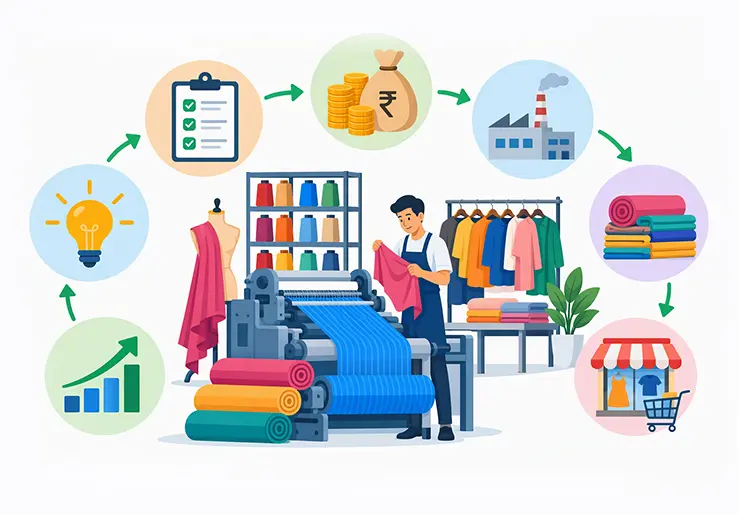
India is the world’s second-largest textile producer, with the textile sector contributing about 2.3% of GDP, 13% of industrial production, and employing over 45 million people directly. Whether you are looking at garment manufacturing, fabric trading, home textiles, or a niche online brand, the textile industry continues to offer serious business prospects for entrepreneurs willing to plan and execute well.
This guide covers everything you need to know about how to start a textile business — from choosing the right business idea and estimating investment to setting up operations, navigating business registration, adopting modern technology, and scaling profitably. The focus is practical and India-centric, but the principles apply to textile entrepreneurs globally.
You will learn how to conduct market research, write a business plan, select machinery, manage production and quality control, source raw materials, market your products across offline and online channels, and leverage government schemes designed for the textile sector. Whether you have ₹5 lakh or ₹5 crore, there is a model here for you.
The textile value chain flows in a clear sequence: raw fibre (cotton, silk, wool, synthetics) → yarn (spinning) → fabric (weaving or knitting) → finishing (dyeing, printing, bleaching) → garment manufacturing or end products → wholesale, retail, export. Each link in this chain represents a distinct business opportunity.
India’s strength lies in its established clusters, each specialising in specific products. Tiruppur dominates cotton knitwear. Surat powers synthetic and man-made fabric weaving. Ludhiana leads in woolen and winter knitwear. Panipat is the hub for home textiles. Bhilwara focuses on suiting and shirting. Jaipur and surrounding areas are known for block printing and ethnic textiles. These clusters provide backward and forward linkages that significantly reduce transportation costs and improve supply chain efficiency.
The Indian textile industry is simultaneously traditional and modern — handloom weavers using traditional skills coexist with factories running modern machinery for global brands. Demand drivers include rising domestic demand from India’s expanding middle class, the e-commerce fashion boom, and growing global markets for technical textiles in automotive, healthcare, and agriculture. Key advantages for starting a textile business in India:
A textile business is any enterprise involved in one or more stages of the textile value chain — from sourcing fibre through producing fabrics or garments to selling finished textile products via wholesale, retail, or online channels.
Major segments include:
Business model options:
Choosing the right business model impacts investment needs directly. Manufacturing requires higher capital, factory space, compliance, and modern technology. Trading and wholesale need less fixed investment but depend on supplier relationships and credit management. Online-only models have lower entry costs but demand strength in digital marketing and logistics. A home-based embroidery or printing unit can start with minimal capital, while a dyeing and processing unit needs significant infrastructure for waste management and pollution control.
Choosing the right niche matters more than the total investment you make. The most profitable textile businesses align the founder’s skills and capital with a clear target market and identifiable market demand. Below are 15 business ideas with approximate investment levels, target customers, and key success factors relevant to business in India.
Fashion rental services cater to high-end clothing needs and are an emerging adjacent opportunity. Leather garment manufacturing focuses on high-end products and can be combined with a garment manufacturing business for diversification.
The table below summarises all 15 business ideas for quick comparison. Use it to identify which business idea matches your capital, skills, and preferred target market.
| Business Idea | Investment Level | Target Market | Business Model |
|---|---|---|---|
| Garment Manufacturing | Small–Large | Domestic + Export | Manufacturing |
| Fabric Manufacturing | Medium–Large | Domestic + Export | Manufacturing |
| Textile Wholesale | Micro–Small | Domestic | Wholesale |
| Textile Retail Store | Small–Medium | Domestic | Retail |
| Cotton Yarn Trading | Micro–Small | Domestic | Wholesale |
| Textile Printing | Small–Medium | Domestic + Export | Manufacturing |
| Embroidery Unit | Small | Domestic | Manufacturing |
| Dyeing & Processing | Medium | Domestic | Manufacturing |
| Home Textiles | Small–Medium | Domestic + Export | Manufacturing/Retail |
| Saree & Ethnic Wear | Small–Medium | Domestic + Export | Retail/Manufacturing |
| Uniform Manufacturing | Small–Medium | Domestic | Manufacturing |
| Kidswear Manufacturing | Small–Medium | Domestic + Export | Manufacturing |
| Sustainable Textile Brand | Small–Medium | Export + Domestic | D2C/Retail |
| Textile Export House | Medium–Large | Export | Manufacturing/Trading |
| Online Fabric & Trims Store | Micro–Small | Domestic + Export | Online/Retail |
Market research is non-negotiable before investing in any textile or garment manufacturing business. Textile margins are often tight, and getting demand, pricing, or positioning wrong can turn a promising business idea into a loss-making one. Market research identifies customer needs and competition before you commit capital.
Start by identifying your target segment precisely. A business targeting mid-range women’s ethnic wear in Tier-2 Indian cities faces fundamentally different demand patterns, pricing, and fabrics compared to one targeting export knit T-shirts to the EU or B2B hotel linens in metros. Research customer needs and analyze demand in the textile market before making any production or sourcing decisions.
Competitive analysis helps improve business performance. Analyse competitors by:
Analyze competitors in the textile sector to spot gaps: underserved size ranges (plus-size, petite), demand for sustainable or specialized fabrics, faster delivery expectations, or better quality control. Market research identifies profitable textile products and target audiences — it is the foundation every other decision rests on. Textile businesses require identification of focus areas and gaps in the market.
Your market research findings should directly drive niche selection. Validate niche demand before investing heavily in production or inventory. The goal is to reduce risk by focusing on a segment where you have evidence of demand and a realistic shot at competing.
Examples of focused niches with clear market demand:
Trade-offs to consider:
Develop sample collections to test fabric durability and quality before committing to full production. Identify fabric suppliers and assess materials for quality and sustainability early in the process. Start with a controlled launch of core products and gather customer feedback before expanding your product range.
A comprehensive business plan is essential for success — whether you are self-funding a small retail business or seeking a bank loan for a garment manufacturing unit. A business plan should include financial goals and operational details. Indian banks and government schemes almost always require a structured plan before sanctioning loans.
Core components of a textile business plan:
Financial sections should cover:
Include India-specific assumptions: GST rates applicable to your product category, typical wholesale vs. retail margins, and credit period norms in the apparel industry.
Capital needs vary enormously depending on whether you are launching a home-based clothing business or a small garment factory. Calculate startup costs based on scale and secure funding accordingly. Initial costs include machinery, raw materials, and labor.
Major cost heads:
Illustrative investment ranges (India, 2026):
Costs for location and equipment are significant in textile startups. Monitor cash flow to prevent constraints due to inventory costs — textile businesses typically extend 30–90 day credit to buyers while paying suppliers on shorter terms.
Common funding sources: personal savings, family funds, bank term loans, working capital limits, NBFC loans, business loans that can cover machinery and operational costs, and credit-linked government schemes like MUDRA and CGTMSE.
Proper compliance builds credibility with brands, exporters, and banks. Register business structure and obtain necessary licenses for compliance from day one. Define a legal structure and ensure compliance with local regulations before you begin operations.
Key registrations:
Textile and garment-specific approvals:
If you plan to export, get an IEC code from DGFT for exporting goods. This is mandatory for any import-export activity involving fabric, yarn, or garments. Consult a Chartered Accountant or Company Secretary for state-specific requirements and a compliance calendar.
Where you set up your textile business directly affects logistics cost, delivery time, production capacity, and access to skilled labour. Locating within an established cluster like Tiruppur for knits or Surat for synthetics reduces transportation costs and gives you proximity to suppliers, job workers, and shared infrastructure like Common Effluent Treatment Plants.
Location considerations:
Infrastructure needs depend on your model: adequate factory space with proper floor area, sufficient power load (critical for weaving and dyeing), ventilation, water supply, storage, and worker amenities including sanitation and safety equipment.
Machinery and equipment selection should match your product type:
Invest in modern machinery that balances production capacity with your budget. Avoid over-investing in equipment you won’t utilize at full capacity in the first 1–2 years.
Manpower composition typically includes tailors/stitchers, machine operators, pattern masters, cutters, quality checkers, supervisors, merchandisers, storekeepers, and HR/accounts staff. Training and productivity monitoring through incentive systems directly affect margins. Do not underestimate the importance of replacing traditional tools with proper industrial equipment as volumes grow.
Even small units benefit from a defined production process. Without documented workflows, you end up with inconsistent quality, missed deadlines, and rising rework costs.
A standard production process flow:
Production planning basics include line balancing (ensuring equal workload across operators to avoid bottlenecks), batch planning to optimize machine utilisation, and realistic capacity planning based on machine efficiency and expected defect rates. Implement quality control protocols for fabric inspection and testing at every stage.
Quality control checkpoints:
Maintain quality standards by keeping QC records systematically. Buyers, especially in global markets, audit these records and expect transparency.
Poor raw material sourcing and inventory control are among the most common reasons textile businesses bleed margins. Cotton is one of the most consumed raw materials in India. Silk is a luxurious textile product in high demand for ethnic and bridal segments. Synthetic fibers like polyester and nylon are popular for textiles, especially in the fast-fashion and technical segments. High-quality raw materials are crucial for textile business success.
How to source effectively:
Core principles of textile inventory management:
Set up logistics and distribution networks for timely delivery. Plan inbound logistics (raw material arrival before production starts) and outbound delivery (speed, packaging quality). Choose reliable suppliers and transporters. Manage reverse logistics for returns and defective goods efficiently. Effective supply chain planning reduces operational costs and improves customer satisfaction.
Spreadsheets and manual registers work when you have a handful of products and a few customers. Once order volumes grow and SKUs multiply across colours, sizes, designs, and locations, manual tracking becomes error-prone and expensive. Production delays, inaccurate stock counts, mispriced orders, and weak cash-flow visibility are common symptoms.
Common operational pain points without technology:
Specialised textile ERP software like LOGIC ERP addresses these problems by integrating purchasing, inventory, production, sales, accounts, and reporting into a single system. Key ERP capabilities valuable for a textile and garment manufacturing business include:
Even the best product fails without clear marketing strategies and sales channels. Effective marketing combines online and offline strategies for visibility.
B2B marketing for textile manufacturing and wholesale:
B2C marketing for retail and D2C brands:
Online marketing:
Build long-term relationships through consistent quality, timely deliveries, and transparent communication. Repeat orders from satisfied B2B buyers are the backbone of most profitable textile businesses.
The Indian government has made India’s textile and apparel sector a priority with multiple schemes designed to reduce costs, build infrastructure, and improve competitiveness. The sector allows 100% FDI through the automatic route, signalling policy confidence.
Key schemes (check latest notifications for current status):
Government schemes support textile businesses with financial aid. Consult local industry associations and check official portals for the latest scheme updates before applying.
A textile business can be profitable, but it is highly competitive and cyclical. There is no fixed "standard profit margin" across the textile industry — profitability depends on your specific segment, scale, and execution.
Factors affecting profitability:
Common challenges:
Practical risk-mitigation strategies:
Once your model works at a small scale, the focus should shift from survival to systemisation and growth.
Growth strategies:
Improve inventory turnover through better demand forecasting, smaller but more frequent production runs, and ERP-based planning. Data from LOGIC ERP’s business intelligence tools can guide growth decisions via sales reports, SKU-wise profitability analysis, and customer-wise performance tracking.
The three dominant models — manufacturing, wholesale, and retail — suit different founder profiles. Here is a comparison:
| Factor | Manufacturing | Wholesale | Retail / D2C |
|---|---|---|---|
| Initial Investment | High (₹25 lakh–₹5 crore+) | Low–Medium (₹5–25 lakh) | Low–Medium (₹10–30 lakh) |
| Operational Complexity | High | Low–Medium | Medium |
| Margin Level | Medium–High | Low–Medium | High |
| Risk Level | High | Medium | Medium |
| Customer Type | B2B | B2B | B2C |
| Scalability | High | Medium | Medium–High |
Who should pick which:
A common growth path: start as a trader to learn the market, move into small-scale garment manufacturing for control and margins, then launch a private label brand for premium positioning. Technology and ERP help across all three models by standardising operations, managing inventory efficiently, and maintaining financial control.
Starting a textile business requires disciplined market research, a clear business plan, structured operations, and the right technology from the beginning. India’s textile and apparel sector — with its abundant raw materials, skilled workforce, government support, and growing domestic and export demand — offers long-term opportunities across manufacturing, wholesale, retail, and online models.
Start small but structured: choose a focused niche, validate demand with real customer feedback, then invest gradually in production capacity and systems. Whether you are setting up a small embroidery unit or a multi-crore garment manufacturing business, the fundamentals remain the same — know your market, control your costs, and maintain quality standards relentlessly.
As you set up or scale your textile business, explore how LOGIC ERP can help you manage inventory, production planning, GST-compliant billing, and financial reporting from a single integrated platform. Book a free demo to see how it fits your operations.
The next decade belongs to textile businesses that combine India’s manufacturing strengths with modern technology, sustainable practices, and sharp execution. The opportunity is real — the question is whether you will build the systems to capture it.
Call at +91-73411-41176 / +91-73411-41175 or send us an email at sales@logicerp.com to book a free demo today!
Yes, the Indian textile sector remains profitable when managed well. Export garments, technical textiles, and sustainable niche brands tend to show higher margins. However, profitability varies significantly by segment, scale, and operational efficiency; there is no universal profit percentage.
Small textile businesses require investments of ₹5-10 lakhs for a home-based or small retail setup. A mid-scale garment unit typically needs ₹25–75 lakh. Large-scale textile manufacturing can require ₹1–5 crore or more. Private investors or venture capital may be relevant for high-growth D2C brands.
You can start with trading, online fabric sales, small-scale embroidery, or a printing unit from home. Complexity increases for processing or large garment units due to factory license requirements and environmental norms.
You need business registration (entity type), GST registration, factory licence (if crossing employee/power thresholds), fire safety certificate, labour registrations (EPF, ESI), and an IEC code if exporting. Requirements vary by state and scale.
Track inventory by lot, batch, colour, size, and design. Set reorder levels, monitor dead stock, and use barcode-based tracking. As SKUs grow, inventory management software becomes essential to avoid errors and stockouts.
Garment manufacturing for export, sustainable and organic textile brands, technical textiles (medical textiles, automotive fabrics), home textiles for hospitality, and D2C ethnic wear brands are among the most promising opportunities.
Basic requirements include sewing machines, overlockers, a cutting table with electric cutters, pressing equipment, and packaging tools. Investment depends on production capacity and product type.
Obtain an IEC code from DGFT, understand customs and tariff procedures, leverage export incentive schemes (RoSCTL, RoDTEP), acquire compliance certifications (OEKO-TEX, GOTS), and build relationships with international buyers through trade fairs and export promotion councils.
Yes, online fabric selling, small trading operations, and print-on-demand models can work part-time initially. Manufacturing and export operations generally require full-time commitment.
LOGIC ERP provides real-time visibility into inventory, production status, and purchase orders. It manages variant SKUs (colour/size/style matrix), automates GST-compliant billing, supports multi-location warehouses, and generates MIS reports that help improve business performance and decision-making.
Raw material price volatility, managing working capital across long credit cycles, maintaining consistent quality, labour management, changing consumer preferences, and meeting environmental compliance are the biggest operational challenges.
Identify your target market within the textile industry by researching customer demographics, geographic demand, pricing expectations, and competitor gaps. Field visits to clusters and markets, online research, and attending trade fairs all provide valuable market intelligence.
The garment industry refers to the sector involved in the design, manufacturing, and distribution of clothing. It is a significant part of the textile business and includes everything from raw material sourcing to finished apparel products. The garment industry plays a vital role in the economy by providing employment and contributing to exports, especially in countries like India, which is one of the largest producers.
A textile manufacturer is a business or entity involved in producing fabrics and textiles from raw materials such as cotton, wool, silk, or synthetic fibers. They may operate at various stages of the textile value chain including spinning, weaving, knitting, dyeing, and finishing. Textile manufacturers supply fabrics to garment makers, wholesalers, and retailers.
Starting a manufacturing business in textiles involves several key steps including market research, selecting the right product niche (such as fabric, yarn, or garments), securing investment for machinery and raw materials, obtaining necessary licenses, setting up production facilities, hiring skilled labour, and implementing quality control. A detailed business plan and efficient operations management are crucial.
A garment manufacturing business focuses on producing finished clothing items from textiles. This includes processes like cutting, stitching, assembling, and finishing garments. Such businesses cater to wholesalers, retailers, exporters, and direct consumers. Success depends on production efficiency, quality control, and timely delivery.
The Indian textile industry is one of the largest and oldest in the world. It contributes significantly to the country’s GDP and employment. India produces a wide range of textiles including cotton, silk, wool, and synthetic fibers. The industry benefits from government support, established clusters, and growing domestic and export markets.
Effective marketing strategies for textile businesses include building a strong brand identity, creating an online presence through websites and social media, participating in trade fairs, developing B2B partnerships, leveraging e-commerce platforms, and focusing on customer retention through loyalty programs. Combining digital and traditional marketing channels enhances visibility and sales.
The apparel sector encompasses all businesses involved in the production, distribution, and sale of clothing. It includes garment manufacturing, textile production, retail, and export. This sector is driven by fashion trends, consumer demand, and technological innovations, making it a dynamic and competitive industry globally.
Popular Products