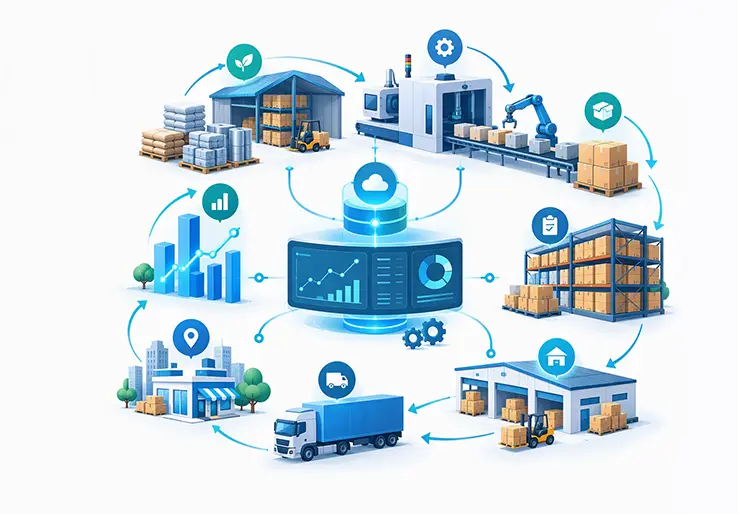
Learn what operations management is, its key functions, types, benefits, industry examples, and how ERP software helps businesses manage operations efficiently.
Operations management (OM) is the planning, organizing, execution, and continuous improvement of the processes that convert raw inputs into finished goods and services. It coordinates people, business processes, materials, technology, and information so a company delivers the right product at the right cost and time. For manufacturing, retail, and distribution companies in India and globally as well as operations professionals and decision-makers evaluating integrated ERP systems such as LOGIC ERP — operations management directly shapes efficiency, cost control, product quality, delivery speed, operational flexibility, and customer satisfaction.
This article explains the core functions of operations management, the main types and approaches used across industries, practical examples from Indian businesses, the benefits of strong OM, common operational challenges, the KPIs and metrics teams track, how operations management compares with related disciplines, and how ERP software helps manage operations more efficiently across the value chain.
Key Takeaways Operations Management:
Operations management involves planning, organizing, and improving processes across procurement, production, inventory, and delivery.
The two major goals of operations management are efficiency and customer satisfaction.
Integrated ERP systems give operations management teams real-time visibility to make faster, better decisions.
Strong operations management aligns daily activities with broader business objectives, reducing costs and improving quality.
Operations management is the discipline of designing, running, and refining the business operations that create and deliver value to customers. It covers everything from sourcing raw materials and scheduling production to managing warehouse stock and fulfilling customer orders. Operations management focuses on optimizing production and supply chain performance so that outputs meet quality standards, cost targets, and delivery commitments.
OM acts as a bridge between company operations and other business functions. Marketing estimates demand; finance sets budgets; human resources manages workforce capacity; technology enables automation. Operations management connects these functions into a coordinated flow, ensuring that what gets sold can actually get made, stocked, and delivered on time. The decisions operations managers make affect cost control, product quality, delivery speed, operational flexibility, and customer satisfaction across the entire value chain.
Operations management emerged in the early 20th century alongside mass production and Scientific Management. Ford’s assembly lines, the Toyota Production System’s lean manufacturing principles, Total Quality Management, and Six Sigma each shaped the field. Over the past decade, data driven decision making, IoT sensors, and AI-driven predictive maintenance have added new layers. The core challenge remains unchanged: convert inputs (materials, labour, capital, information) into outputs as efficiently as possible while meeting customer expectations.
The main goal is to convert inputs into outputs in the most efficient and effective way, balancing cost, quality, speed, flexibility, compliance, and customer satisfaction. Maximizing customer satisfaction is a key function of operations management; every operational decision, from batch size to delivery route, ultimately shapes the customer’s experience.
Operations management supports business growth by managing increasing demand and resource allocation. As a company scales from 10 stores to 100, or from one production line to five, OM provides the frameworks for objective management: what gets produced first, how inventory moves, and where capacity gets added.
Practical goals include:
Keep stock available without overstocking (balancing service levels with holding costs)
Deliver orders OTIF (on time, in full) to reduce lead times and backorders
Maintain consistent quality across all stores or plants, with defect rates below a defined threshold
Reduce inventory holding costs by improving raw material and finished goods turnover
Key Functions of Operations Management
The functions of operations management span the full cycle of planning, sourcing, producing, storing, delivering, and monitoring. In practice, these functions overlap. A procurement delay affects production scheduling, which affects inventory levels, which affects delivery reliability. Integrated ERP tools like LOGIC ERP connect these functions so that a change in one area is visible across the organization.
Operational planning starts with demand forecasting: analyzing historical sales, market demands, and seasonality to predict what needs to be produced or stocked. A garment manufacturer in Ludhiana, for instance, might forecast peak demand around Diwali and plan weekly production runs, matching fabric arrivals with sewing-line capacity through a Master Production Schedule.
Good planning reduces overtime, stockouts, idle machines, and last-minute firefighting. Advanced analytics improves resource allocation and planning by replacing gut-feel scheduling with capacity-aware, constraint-based plans. Tools like finite capacity scheduling, workforce planning, and calendar-based store operations planning help operations management teams turn forecasts into executable schedules.
Inventory and Materials Management
Inventory management covers raw materials, work-in-progress, finished goods, and retail stock. Accurate inventory records, safety stock thresholds, reorder points, and Economic Order Quantity calculations help businesses control operational costs while maintaining service levels.
The specifics vary by industry. An FMCG distributor managing expiry-sensitive dairy or pharmaceutical items needs strict batch and lot tracking. A fashion retailer must phase out seasonal SKUs and reallocate trending styles across locations. In both cases, real-time stock visibility across multiple locations, supported by inventory management software, prevents simultaneous overstock and stockouts.
Procurement and Supplier Management
Procurement involves sourcing materials, negotiating contracts, ensuring supply quality, and managing lead times. Operations management strengthens the supply chain by optimizing inventory and managing suppliers; poor supplier reliability disrupts production continuity and erodes customer satisfaction.
Consider an electronics retailer preparing for festive sales: fast-moving SKUs must arrive reliably from multiple vendors. If one supplier delays, alternate sources must be ready. Integrating purchase orders, Goods Receipt Notes, and invoices in an ERP system enables data driven decision making on vendors: who delivers on time, who fails quality checks, and who offers the best terms.
Production and Process Management
Production and process management designs and runs workflows on the shop floor or in service delivery. This includes process mapping, line balancing, batch sizing, and scheduling machine changeovers. Operations management drives innovation by encouraging process refinement; every cycle of review reveals waste that can be eliminated.
A food processing plant, for example, optimizes batch sizes to minimize changeover downtime and cleaning time while meeting freshness standards. Lean tools like value stream mapping, TPM (Total Productive Maintenance), and SMED (Single-Minute Exchange of Dies) help manufacturing operations squeeze more output from the same resources. Automation reduces manual errors and increases productivity by replacing repetitive manual steps with system-driven execution.
Quality Control and Assurance
Quality control is the inspection and testing of output. Quality assurance is the design of systems and standards (such as ISO 9001) to prevent defects before they occur. Operations management ensures quality through standards and continuous improvement practices, setting thresholds for defect rates and using root-cause analysis (DMAIC from Six Sigma, for example) when deviations occur.
In a pharmaceutical facility, every batch undergoes in-process checks for potency and sterility, plus final inspection before release. A packaged food manufacturer inspects sealing integrity, fill weight, and expiry label accuracy at multiple points. Efficient operations management leads to better quality control, fewer returns, lower rework costs, and stronger brand reputation.
Cost and Resource Management
Effective operations management minimizes waste and uses resources efficiently across labour, machine time, utilities, materials, and overheads. Tracking cost per unit, cost of poor quality, and contribution margins connects OM directly to financial management.
Budget and resource planning help maximize financial resources in operations management. Techniques include time-and-motion studies, energy audits, and preventive maintenance scheduling. A factory tracking machine downtime via IoT sensors, for instance, can schedule maintenance during low-demand windows rather than suffering unplanned stoppages. Operations management controls costs through strategies like lean production, reducing overproduction, excess inventory, and unnecessary motion.
Supply Chain and Logistics Management
Supply chain and logistics management coordinates inbound logistics (suppliers to factory or warehouse) and outbound logistics (warehouse to customer or store). Route planning, warehouse layout, picking methods (batch, zone, wave), and last-mile delivery all fall under this function.
A regional distributor serving 500 retailers with daily multi-drop routes from a central warehouse can yield fuel and time savings by optimizing route clusters and load consolidation. Supply chain reliability is a major driver of competitive advantage in markets like grocery, pharma, and e-commerce. Global supply chains complicate operations management due to shifting market trends, tariff changes, and geopolitical disruptions. Strong supply chain operations require visibility across every node.
Performance Monitoring and Reporting
Operations managers use key performance indicators and dashboards to monitor inventory turnover, OTIF rates, production yield, defect rates, and operating cost. Data-driven decision-making enhances operational efficiency by replacing intuition with measurable trends.
Daily, weekly, and monthly reviews feed into continuous improvement programs. LOGIC ERP-style analytics give operations management professionals real-time dashboards where leaders spot stockouts, production backlogs, and capacity imbalances early. The trend in 2024-2025 is towards visibility across the entire value chain, not just within one department.
Operations management differs based on industry context and management approach. No single classification is universal; businesses often combine types depending on their operations strategy and scale. Some follow lean manufacturing principles; others use centralized planning with decentralized execution. The common thread: every type aims to convert resources into customer value with minimal waste.
Manufacturing Operations Management
Manufacturing operations management covers production planning, Bills of Materials (BOMs), routing, shop-floor scheduling, material consumption tracking, and quality checks. An auto component manufacturer near Pune, for example, uses ERP to synchronize procurement of steel and components, plan machining and assembly sequences, run in-process quality inspections, and dispatch finished parts to OEM customers.
Automation (robotics, CNC machines), sensor integration for energy monitoring, and real-time production reporting are increasingly standard in manufacturing operations. The production process in a discrete manufacturing plant differs from a continuous process chemical plant, but both require the same OM discipline: plan, execute, measure, improve.
Retail Operations Management
Retail operations management focuses on store-level execution: POS billing, promotions and scheme management, stock transfers between outlets, and replenishment planning. A fashion chain with 40 outlets uses central purchasing and regional warehouses, tracks which SKUs sell best in which region, shifts stock accordingly, and handles markdowns while maintaining availability.
Retail OM must balance assortment, pricing, and inventory control to maximize sales and customer satisfaction. Multi-channel visibility (online plus offline), demand sensing, and returns handling add complexity that only integrated systems can manage at scale.
Distribution and Wholesale Operations Management
Distribution workflows follow a clear sequence: purchase, inbound receiving, put-away, picking, packing, loading, dispatch, and returns. Accuracy matters: a pharma distributor needs batch and expiry tracking, cold chain compliance, and documentation for every shipment. A 3PL warehouse managing order clusters for multiple brands schedules deliveries within tight retailer windows.
Inventory management accuracy and route-wise performance tracking separate profitable distributors from those bleeding margin on missed deliveries and expired stock.
Service Operations Management
Operations management principles apply equally to services: healthcare, IT support, after-sales repair, and field services. Capacity planning (appointment slots, technician schedules), service quality monitoring (SLAs, turnaround times), and resource allocation drive service operations just as production planning drives a factory.
An after-sales service network, for instance, schedules field technician visits, manages spare-parts inventory at regional hubs, tracks service requests through resolution, and measures customer feedback. The operational processes are different from manufacturing, but the OM logic is identical.
Strategic vs Tactical vs Operational OM
Strategic OM involves long-term decisions with a 3-5 year horizon: plant locations, network design, make-or-buy analysis. Tactical OM covers annual capacity plans, sourcing strategies, and inventory policies. Operational OM handles daily execution: shift schedules, purchase orders, production sequencing, dispatch routes.
Integrated ERP systems help link these levels. Strategic planning modules feed into mid-term forecasting, which feeds into daily scheduling. Feedback from daily KPIs flows back up, informing whether the strategy needs adjustment. Without this loop, strategic planning becomes disconnected from operational reality.
The operations management process is cyclical, not linear. Each pass through the cycle generates data that informs the next round of planning. The ideal operations management process looks like this:
Assess Business Goals and Demand: Understand market demand, strategic goals (quality leadership, cost leadership, growth targets), and build forecasts using historical data plus market signals.
Procure and Allocate Resources: Buy raw materials, schedule labour, manage supplier contracts, ensure inventory is positioned correctly. Resource allocation at this stage determines how smoothly execution runs.
Execute Production or Service Delivery: Run manufacturing lines, dispatch orders, fulfill customer demand, manage store operations.
Monitor Performance with KPIs: Measure yield, delivery rates, cost variances, and defect rates. Use dashboards for daily and weekly tracking.
Review and Improve: Conduct root-cause analysis on failures, apply process improvement methods (Lean, Six Sigma, TPM), redesign workflows, adopt new technology. Continuous improvement fosters a culture of ongoing operational enhancements.
Then loop back to step one. Each cycle should produce measurable gains.
How the Process Differs by Industry?
A garment manufacturer plans production 4-6 weeks ahead based on buyer orders and seasonal forecasts, focusing on fabric procurement lead times and sewing-line capacity. A retailer plans store replenishment weekly or daily, reacting to POS sales data and seasonal spikes; planning for Diwali sales starts months earlier but execution intensifies in the final two weeks. A distributor plans delivery routes and warehouse stock daily, matching inbound receipts with outbound orders.
The steps are similar, but constraints differ. Perishability matters for food and pharmaceuticals. Shelf life is irrelevant for electronics but fashion trend cycles create similar urgency. Service operations face workforce peaks rather than physical inventory constraints.
Benefits of Effective Operations Management
Effective operations management drives measurable financial performance, operational resilience, and customer loyalty. In price-sensitive and fast-moving markets like India’s retail and manufacturing sectors, the difference between well-run operations and disorganized ones shows up directly in margins, market share, and customer retention.
Improved Efficiency and Productivity
Effective operations management improves efficiency across organizations by standardizing workflows, removing bottlenecks, and deploying automation where it adds value. Effective operations management boosts profitability and productivity by enabling companies to produce more output from the same resources.
A mid-sized manufacturer that automates order import and pick-list generation can see a 15-20% improvement in order processing speed. Indian SMEs that adopted ERP reported improvements in production planning efficiency of up to 18%, according to manufacturing ERP market research. Streamlining workflows through ERP-driven task management, such as automatic purchase suggestions and production planning, frees operations management teams from manual data entry and fire-fighting.
Better Cost Control and Profitability
Operations management reduces operational costs by minimizing waste across materials, labour, and overheads. Switching from manual stock counts to system-based cycle counting, for instance, cuts stock losses from theft, damage, and miscounts. Indian SMEs that deployed ERP saw a median payback period of 22 months, with procurement savings of 8-12% in managed spend and financial closing times dropping from approximately 12 days to 4 days, according to a 2026 Indian ERP adoption survey.
Optimized budgets are a direct benefit of effective operations management. Every OM decision, from batch size selection to freight route optimization, feeds into cost benefit analysis that shapes profitability. Effective operations management can reduce operational costs by connecting procurement data, production consumption, and logistics costs into a single view.
Higher Quality and Customer Satisfaction
Operations management drives customer satisfaction by ensuring timely delivery of quality products. Stable processes and quality checks reduce errors, returns, and complaints. Higher customer satisfaction results from improved operations management because customers receive the right product, in the right condition, when they expect it.
An e-commerce seller that optimizes packaging standards, picking accuracy, and return handling directly improves ratings and repeat purchase rates. Strong operations management enhances customer satisfaction and loyalty, which in competitive markets translates to revenue growth without proportional increases in acquisition spend.
Increased Agility and Competitive Advantage
Operations management enhances decision-making through data analytics, allowing businesses to respond to demand changes, new product launches, and supply chain disruptions faster than competitors. The pandemic years (2020-2022) and subsequent supply disruptions demonstrated that companies with strong OM and integrated ERP were more resilient; they could reroute supply, shift production, and communicate realistic timelines to customers.
Streamlined operations lead to competitive advantage: faster time-to-market, better stock availability, and quicker response to competitor moves. India’s policy environment (Make-in-India, PLI incentives, e-commerce growth) has increased demand volatility, making agility a strategic necessity.
Operations management faces challenges in decision-making and resource allocation at every level. Data silos, manual processes, inventory inaccuracies, rising costs, and coordination gaps between multiple departments are common. Most of these challenges stem from fragmented systems and lack of end-to-end visibility across business operations.
Business Operations Complexity and Prioritisation
Companies with multiple plants, warehouses, or stores managing thousands of SKUs across seasons and channels face constant prioritization trade-offs. Which orders get filled first? Which production run gets priority when machine capacity is limited? Without system-defined rules (service levels, margin contribution thresholds, due dates), ad hoc decisions cost both consistency and margin.
Manual Processes and Limited Data Visibility
Spreadsheets, paper-based approvals, and disconnected point solutions cause delays, errors, and blind spots. In a 2026 survey of 500 Indian SME manufacturers, 71% cited inventory inaccuracy before ERP adoption, and 63% reported lack of visibility into production status. The result: simultaneous overstock and stockouts, unplanned purchases, and missed accountability. Companies can achieve operational efficiency through data-driven decision-making only when accurate, integrated data replaces guesswork.
Resource and Capacity Constraints
Machine downtime, labour shortages, transport limitations, and limited warehouse space constrain output. Capacity utilisation in Indian manufacturing stood at 75.8% in Q2 2024, close to pre-pandemic levels. Inefficient time allocation is a frequent challenge in operations management; poor visibility into true capacity leads to overpromising and missed delivery commitments. Techniques like finite capacity scheduling and load balancing across plants or outlets help, but they require accurate, real-time data.
Technology Adoption and Change Management
ERP systems and automation tools fail when staff resist, training is inadequate, or the software does not match actual business processes. In the same 2026 Indian survey, 42% of non-adopters cited resistance as the top barrier, and 31% cited staff refusal. Human behavior can negatively impact operational performance and decision-making when teams revert to familiar manual workarounds instead of learning new systems.
Evolving regulations challenge operations managers to find sustainable practices; GST updates, e-invoicing mandates, and environmental compliance rules demand frequent software updates and process adjustments. A phased ERP implementation, rolling out function by function (starting with inventory, then procurement, then production), reduces disruption and builds confidence incrementally.
Key performance indicators help track operational efficiency in businesses by providing measurable, comparable data points. Without consistent KPI definitions and regular reviews, improvement efforts lack direction.
KPI
What It Measures
Why It Matters
Inventory Turnover
How frequently inventory is sold or consumed (sales ÷ average inventory)
Higher turnover lowers holding costs and reduces obsolescence risk
Order Fulfilment Rate
Proportion of orders delivered correctly and completely
Directly affects customer satisfaction and return rates
On-Time Delivery Rate
Proportion of deliveries completed by the promised date
Drives customer trust and reduces downstream penalties
Production Cycle Time
Time from start to finish of producing a unit or batch
Shorter cycles enable faster response and lower WIP costs
Defect Rate / First Pass Yield
Percentage of output failing quality checks (or passing first time)
Reduces rework cost and protects brand reputation
Capacity Utilisation
Percentage of available production or warehouse capacity in use
Operations management software supports planning, execution, and monitoring of day-to-day business practices across departments. A standalone warehouse management system, a production scheduler, or a POS application each addresses one slice. An ERP system like LOGIC ERP integrates these slices into a single platform: inventory, procurement, sales, production, warehousing, and finance share one database and one set of business rules.
The difference matters. Point solutions create data islands. An operations manager oversees procurement in one tool, production in another, and billing in a third. Reconciling these systems consumes hours daily. ERP systems provide real-time visibility into operations by connecting data flows end-to-end: a sales order triggers an inventory check, which triggers a production order, which triggers a material requisition.
Key Features for Effective Operations Management
Essential capabilities for operations management software include:
Purchase and Supplier Management: PO creation, GRN processing, vendor performance scoring, and invoice matching
Sales and POS Integration: Demand signals from retail billing feeding into replenishment and production planning
Production Planning and Monitoring:BOM management, capacity scheduling, shop-floor execution tracking, and consumption posting
Warehouse Management: Inbound and outbound workflows, picking and packing, layout-based storage, and dispatch coordination
Dispatch and Logistics: Route planning, load optimization, last-mile tracking, and returns processing
Operational Dashboards and Reports: KPI visualization, cost-per-unit analysis, defect trends, and exception alerts
Modern solutions also support mobile access, approval workflows, GST and e-invoicing compliance for India, and audit trails for transparency. Technology integration streamlines workflows and reduces costs when these features work together rather than in isolation.
How LOGIC ERP Connects Business Operations??
From LOGIC ERP’s perspective, integrated modules create end-to-end visibility from purchase request to customer invoice and collection.
In manufacturing, LOGIC ERP supports BOM-based material planning, production, order generation, consumption posting against shop-floor activity, and finished goods receipt. Operations management professionals can track what is being produced, what materials are consumed, and what is ready for dispatch from a single screen.
In retail, LOGIC ERP connects centralised pricing and scheme management with POS billing at individual outlets. Auto-replenishment rules trigger store transfer suggestions based on store-wise sales velocity and current stock. This supports omnichannel retail coordination across online and offline channels.
In distribution, batch- and expiry-based inventory management, route-wise invoicing, and secondary sales visibility help distributors control both costs and compliance. Successful operations managers use this integration to make faster, more confident decisions at every level.
Industry Examples of Operations Management in Practice
Manufacturing Example: Production and Inventory Alignment
A mid-sized FMCG manufacturer producing packaged snacks faced a recurring pattern: bestselling SKUs ran out of stock within the first week of each month, while slow-moving flavours accumulated in the warehouse. Root cause: production planning relied on the previous quarter’s aggregate sales, not SKU-level weekly demand.
After implementing demand-driven production planning linked to distributor orders and retail sell-through data, the company reduced bestseller stockouts by 40% and cut obsolete inventory by 25% within six months. The ERP system synchronized sales orders, production plans, and raw material purchase schedules so that procurement, production, and dispatch operated from a shared plan.
Retail Example: Multi-Store Replenishment and Customer Experience
A regional electronics retailer with 25 stores discovered that "out of stock" complaints peaked during festive seasons, even though total network inventory was sufficient. Stock was concentrated in the wrong locations.
Implementing centralised inventory visibility and rule-based inter-store transfers reduced store-level stockouts by 30% during the next Diwali period. Transfer planning based on store-wise sales velocity moved units from low-demand locations to high-demand ones within 48 hours. The direct result: higher sales conversion and improved customer satisfaction scores.
Distribution Example: Route Optimization and Cost Control
A pharmaceutical distributor serving 600 medical stores across three districts operated 18 delivery vehicles with manually planned routes. Fuel costs were rising, and on-time delivery stood at 72%.
After restructuring delivery routes based on order clustering, geographic proximity, and vehicle capacity, the distributor reduced the active fleet to 14 vehicles while improving on-time delivery to 89%. Fuel costs dropped by 18%. Operational costs fell, and retail customers received more reliable service; operations management strategies like dispatch planning and load optimization made the difference.
Operations management overlaps with several related disciplines. Understanding the boundaries helps operations management careers and business process redesign efforts focus on the right scope.
Operations Management vs Supply Chain Management
Supply chain management covers the end-to-end flow of materials, information, and money from raw material suppliers through to end customers, often spanning multiple companies. Operations management focuses on what happens inside the organisation: production, warehousing, inventory, and service delivery. In many businesses, OM is a core component of supply chain operations; the two must work together. A chief operating officer may own both functions, or they may report separately depending on organizational structure.
Operations Management vs Project Management
Operations management deals with ongoing business functions: daily production, store operations, warehouse activity, and recurring service delivery. Project management handles temporary initiatives with a defined start and end: opening a new plant, implementing LOGIC ERP, or launching a new product line. Operations managers often sponsor or participate in projects that transform operational processes. Business process redesign, for example, is a project that permanently changes how operations run.
Well-structured operations management connects procurement, production, inventory, and delivery into a coordinated flow that reduces waste, controls costs, and meets customer expectations. Operations managers map out these connections; ERP software makes them visible and actionable. Strong leadership skills, clear process ownership, and integrated technology together drive the operational efficiency that separates growing companies from stagnating ones.
LOGIC ERP supports this by providing connected workflows for manufacturing, retail, and distribution businesses. From strategic planning through daily task management, from production planning to POS billing, from quality management systems to financial reporting, LOGIC ERP gives business leaders the visibility they need for confident, data driven decision making.
Looking to reduce operational costs and improve visibility across your business operations?
Frequently Asked Questions About Operations Management
Operations management is the coordination of all activities involved in producing goods or delivering services. It covers planning what to make or stock, organizing people and machines, executing production or service delivery, and improving efficient processes over time.
The main functions include operations planning and scheduling, inventory and materials management, procurement and supplier management, production and process management, quality control and quality assurance, cost and resource management, supply chain and logistics management, and performance monitoring.
Four commonly discussed types are manufacturing operations management, retail operations management, distribution and wholesale operations management, and service operations management. These are industry-based categories, not the only classification.
A snack food manufacturer uses demand data from distributors to plan weekly production runs, schedules machine changeovers to minimize downtime, tracks raw material consumption against BOMs, and inspects finished goods before dispatch. Every step involves OM decisions about quality management, resource management, and scheduling.
Operations management aligns daily activities with broader business goals. It ensures that business strategy translates into concrete actions on the shop floor, in the warehouse, and at the store counter. Without it, companies face higher costs, inconsistent quality, missed deliveries, and lost customers.
Supply chain management spans the entire network from suppliers to customers, including external partners. Operations management is the internal discipline of planning, executing, and improving production and service delivery within the organization.
Production management is a subset of operations management focused on the production process: scheduling machines, managing labour on the shop floor, and controlling output quality. Operations management is broader, covering procurement, inventory, logistics, and strategic planning alongside production.
ERP software integrates data from purchasing, inventory, production, sales, warehousing, and finance into one platform. This gives operations management professionals real-time visibility, automates routine tasks, enforces business rules, and supports data driven decision making across the organization. Problem solving becomes faster when all relevant data is in one place.
Common KPIs include inventory turnover, order fulfilment rate, on-time delivery rate, production cycle time, defect rate, capacity utilisation, and operating cost per unit. These metrics support process optimization and continuous improvement by providing measurable baselines.
Operational strategy in operations management refers to the long-term planning and decision-making that align business processes and resources to achieve organizational goals efficiently and effectively.
Businesses can optimize operations by streamlining workflows, reducing waste, implementing automation, and using data-driven decision making to improve efficiency and reduce operational costs.
Data analysis is crucial in operations management as it helps identify inefficiencies, forecast demand, allocate resources effectively, and support continuous improvement through informed decision making.
Business management provides the overall framework and leadership to coordinate operations management activities, ensuring alignment with strategic objectives and effective resource utilization.
Business processes define the sequence of activities in operations management, and optimizing these processes leads to improved efficiency, quality, and customer satisfaction.
Key takeaways include focusing on efficiency, customer satisfaction, cost control, integrated technology use, and continuous improvement to drive operational excellence.
Effective inventory management minimizes holding costs, reduces stockouts, and prevents overstocking, directly impacting and reducing overall operational costs.
Financial management ensures that operations are cost-effective, budgets are optimized, and investments in resources and technology deliver measurable returns.
Objectives management involves setting clear, measurable goals for operations, aligning them with business strategy, and monitoring progress to ensure targets are met.
Data driven decision making replaces intuition with evidence-based insights, leading to better resource allocation, risk mitigation, and process optimization in operations management.