A POS integrated weighing scale is a digital weighing machine connected directly to a POS system, allowing weight data to flow automatically into the billing screen — the system captures, calculates, and bills in one seamless step.
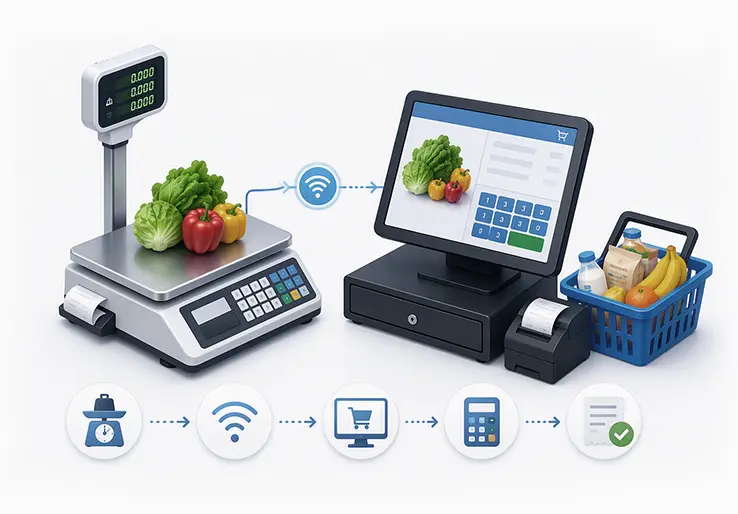
A POS integrated weighing scale is a digital weighing machine connected directly to a POS system, allowing weight data to flow automatically into the billing screen without manual entry. Instead of a cashier reading the weight and typing it in, the system captures, calculates, and bills in one seamless step.
This setup is standard across supermarkets, grocery stores, fresh produce counters, meat and seafood shops, bakeries, sweet shops, and bulk grocery outlets. Picture an Indian supermarket in 2026 where a customer places mangoes on the scale, and within seconds, the POS displays the weight in kg, applies the correct price, and generates a GST-compliant invoice — no keystrokes, no errors.
LOGIC ERP provides POS and ERP software with built-in scale integration designed for exactly this workflow. The integration works with digital weighing scale models commonly used in retail stores, supports barcode label printing for prepacked items, and updates inventory in real time. Businesses selling by weight benefit most from integration, and this guide covers everything you need to know.
POS and weighing scale integration is the automatic transfer of weight data from a connected weighing machine to the billing screen of the POS system. When a product is placed on the scale, the scale is used to measure the product's weight before the reading appears directly in the POS application — no manual data entry, no transcription errors, no delays.
Here is how the weighing scale communicates with POS software:
Weighing scales must be compatible with POS software for integration to function correctly. Digital weighing scales offer highly accurate readings, minimizing human error — and that accuracy is what makes this setup far superior to standalone operation.
LOGIC ERP links scale data not only to POS billing but also to ERP modules for inventory, purchase, and accounting — creating a single data pipeline from the weighing equipment to financial reports. The system is compatible with popular digital retail scale brands including Mettler-Toledo, Avery, Essae, Phoenix, and AND, among others.
At a busy fresh produce counter or supermarket checkout, the integration workflow runs in seconds. The cashier does not need to select weight manually, convert units, or check a separate device — the system handles it end to end.
Follow the same sequence during setup validation or live billing tests.
Place the Product on the Digital Weighing Scale
The load cell sensor begins measuring weight immediately.
The Weighing Machine
The weighing machine stabilizes and sends weight data to the POS system. A stability flag in the protocol ensures only a settled, accurate reading is transmitted. Tare functionality ensures customers only pay for the product's net weight — the container weight is subtracted automatically.
POS Price Calculation
POS automatically calculates price based on the selected item, captured weight, and configured rate per kg or gram. Integrated systems ensure accurate pricing for weight-based products without any manual calculation.
Barcode Weighing Scale
For barcode weighing scales, a label with barcode, item name, packed date, MRP, and weight is generated. Advanced integrated scales can even identify specific items like fruits and vegetables based on PLU codes, which speeds up the process further.
Barcode Scanning
Cashier scans the barcode or accepts the captured weight on the POS screen. Scanning the label completes the line item instantly.
POS Billing
The POS completes billing and prints a GST-compliant receipt with clear weight, rate, and quantity details.
Automated weight transfer speeds up the checkout process, and POS integration eliminates manual weight entry errors at every step. Automatic weight transfer ensures accurate pricing in billing — the entire chain is hands-free from scale to invoice.
A standard counter includes a POS terminal (touch screen or keyboard-based), digital weighing scale, barcode scanner, receipt printer, payment terminal, and customer display — all connected and configured to work as a single unit. The scale integration can be set up for both touch screen POS and keyboard-based billing counters, so the option works regardless of your existing equipment.
Integrated scales improve efficiency and ensure accuracy in retail businesses — and these aren't marginal gains. When every transaction at a fresh counter involves measuring weight, even small improvements compound across hundreds of daily checkouts.
LOGIC ERP uses integrated data for sales reports, margin analysis on weight-based SKUs, and forecasting demand for perishable goods — turning every weigh-and-bill transaction into actionable intelligence.
LOGIC ERP offers a complete solution where the POS system, weighing scale integration, and ERP run on a single platform — no third-party middleware required for supported scale models, and no fragmented data across separate applications.
LOGIC ERP has been serving retailers for over 30 years, with 10,000+ ERP implementations and 4,000+ businesses trusting the platform. Their grocery and supermarket software page lists scale integration as a core feature — not an afterthought.
Want a checklist of compatible weighing scale brands and models? Contact LOGIC ERP or send an email to their support team for a detailed compatibility guide.
Any business selling products by weight can benefit from POS integrated weighing scales. POS integrated weighing scales are commonly used in grocery stores and specialty food shops, but the use cases extend well beyond those categories.
| Industry | What Gets Weighed | Why Integration Matters |
|---|---|---|
| Supermarkets & Hypermarkets | Fruits, vegetables, deli items, seafood, in-store bakery products | High transaction volume — even small speed gains per checkout add up across thousands of daily customers |
| Grocery & FMCG Stores | Loose pulses, rice, flour, dry fruits, spices sold by kg or gram | Prevents under/over-measurement on staples where margins are thin |
| Sweet Shops & Bakeries | Indian sweets per kg, cakes, pastries with variable weight | Accurate pricing on high-value items; label printing for packaged boxes |
| Meat & Seafood Shops | Chicken, mutton, fish, marinated items | Wastage control, batch tracking, and traceability for food safety compliance |
| Dairy & Organic Food Stores | Paneer, cheese, organic vegetables, nuts | Precise billing on premium products where customers expect accuracy |
| Wholesale & Bulk Retail | Large-quantity items sold by weight to B2B buyers | Higher capacity platform scales (up to 200 kg) integrated with ERP for dispatch accuracy |
Multi-store retailers use LOGIC ERP to standardize scale integration across all locations. Pricing rules, barcode formats, label templates, and inventory settings are configured centrally and pushed to each store — ensuring consistent operations whether you run five outlets or fifty across different cities. You can check how growing grocery chains manage this with ERP-driven workflows.
Emerging trends point toward AI-driven demand forecasting based on historical weight sales data from POS systems integrated with weighing machines. Researchers have also explored IoT-enabled weighing systems for public distribution — demonstrating that scale-POS integration is expanding beyond retail into government and social welfare programs. Networked scales with remote calibration and predictive maintenance are on the horizon, and ERP platforms that already support API-based device integration — like LOGIC ERP — will be best positioned to adopt these innovations.
Whether you run a single grocery counter or a multi-city supermarket chain, POS integrated weighing scales are the foundation of fast, accurate, and compliant retail billing. The technology is mature, the hardware is affordable, and the right ERP platform makes the entire setup seamless.
Choosing LOGIC ERP for your POS integrated weighing scale needs means partnering with a trusted industry leader that combines decades of expertise with cutting-edge technology. With over 30 years of experience and more than 10,000 successful ERP implementations, LOGIC ERP delivers a reliable, scalable, and user-friendly solution tailored for modern retail businesses.
LOGIC ERP's weighing scale integration offers seamless connectivity with a wide range of digital scales from top brands like Mettler-Toledo, Avery, Essae, Phoenix, and AND. This ensures smooth installation and effortless operation without compatibility issues. The platform supports multiple communication interfaces including RS-232, USB, and Ethernet, providing flexibility for diverse retail setups.
Beyond hardware integration, LOGIC ERP enables real-time inventory synchronization, batch and expiry tracking, and AI-powered analytics that help retailers optimize stock levels and reduce waste. Its cloud-based and on-premise deployment options cater to businesses of all sizes, including multi-store chains requiring centralized management.
With dedicated customer support and continuous software updates, LOGIC ERP ensures your POS and weighing scale integration remains efficient, compliant, and future-ready. Experience faster billing, improved accuracy, and enhanced customer satisfaction with LOGIC ERP's end-to-end retail automation.
POS integrated weighing scales are essential for any retail business that sells products by weight, offering unmatched speed, accuracy, and operational efficiency. LOGIC ERP's comprehensive solution bridges the gap between digital weighing hardware and sophisticated POS and ERP software, delivering seamless workflows from checkout to inventory management.
By choosing LOGIC ERP, retailers gain a trusted partner that simplifies complex integrations, supports compliance with trade regulations, and leverages AI-driven insights to drive smarter business decisions. Whether you operate a single store or a multi-location chain, LOGIC ERP empowers you to weigh smarter, bill faster, and manage inventory with confidence.
Take the next step towards transforming your retail operation — request a free demo of LOGIC ERP POS integrated weighing scale today and discover how effortless accurate billing and inventory control can be.
Call at +91-73411-41176 / +91-73411-41175 or send us an email at sales@logicerp.com to book a free demo today!
Weighing scale integration is the process of connecting a digital weighing scale to a POS system so that weight data transfers automatically to the billing screen. This eliminates manual entry and ensures accurate, real-time pricing for products sold by weight.
The scale connects via RS-232, USB, or Ethernet interfaces. When a product is placed on the scale, the stabilized weight is sent directly to the POS system, which calculates the price based on the item's rate per unit. The transaction data then flows into the ERP system for real-time inventory and accounting updates.
Weighing scale integration offers numerous benefits including faster checkout processes, elimination of manual entry errors, real-time inventory updates, GST-compliant billing, reduced product waste, improved customer trust through accurate pricing, and enhanced analytics for weight-based products.
Yes, with LOGIC ERP, every sale involving a weighed product immediately reduces the inventory quantity in the ERP database. This automatic update removes the need for end-of-day manual reconciliation and helps maintain accurate stock levels.
LOGIC ERP supports barcode label printing scales that generate labels containing weight, price, MRP, batch number, expiry date, and barcode. These labels are ready for scanning at checkout, streamlining the billing process for pre-packed items.
Any business that sells products by weight can benefit from weighing scale integration. This includes supermarkets, grocery stores, sweet shops, bakeries, meat and seafood shops, dairy stores, organic food retailers, and wholesale outlets.
Yes, LOGIC ERP is compatible with major weighing scale brands. For a full compatibility list, customers can visit the LOGIC ERP website or contact their support team.
Absolutely. LOGIC ERP allows centralized configuration of scale settings, pricing rules, and label templates across all store locations. It ensures real-time synchronization of data, making it ideal for retailers operating multiple outlets.
Call at +91-73411-41176/75 or send us an email at sales@logicerp.com to book a free demo for LOGIC ERP weighing scale integration today
A weighing machine integrates with a POS system by connecting through interfaces such as RS-232 serial port, USB, or Ethernet. When a product is placed on the scale, the weight data is automatically transmitted to the POS software, which calculates the price based on the item's rate per unit. This seamless data transfer eliminates manual entry errors and speeds up the checkout process.
Connecting a weighing machine to a POS system offers several benefits, including faster billing, improved accuracy in weight-based pricing, real-time inventory updates, reduced human errors, and enhanced customer satisfaction. It also supports compliance with trade regulations and GST invoicing requirements, making retail operations more efficient and trustworthy.
Popular Products