Demand Planning in Supply Chain Management

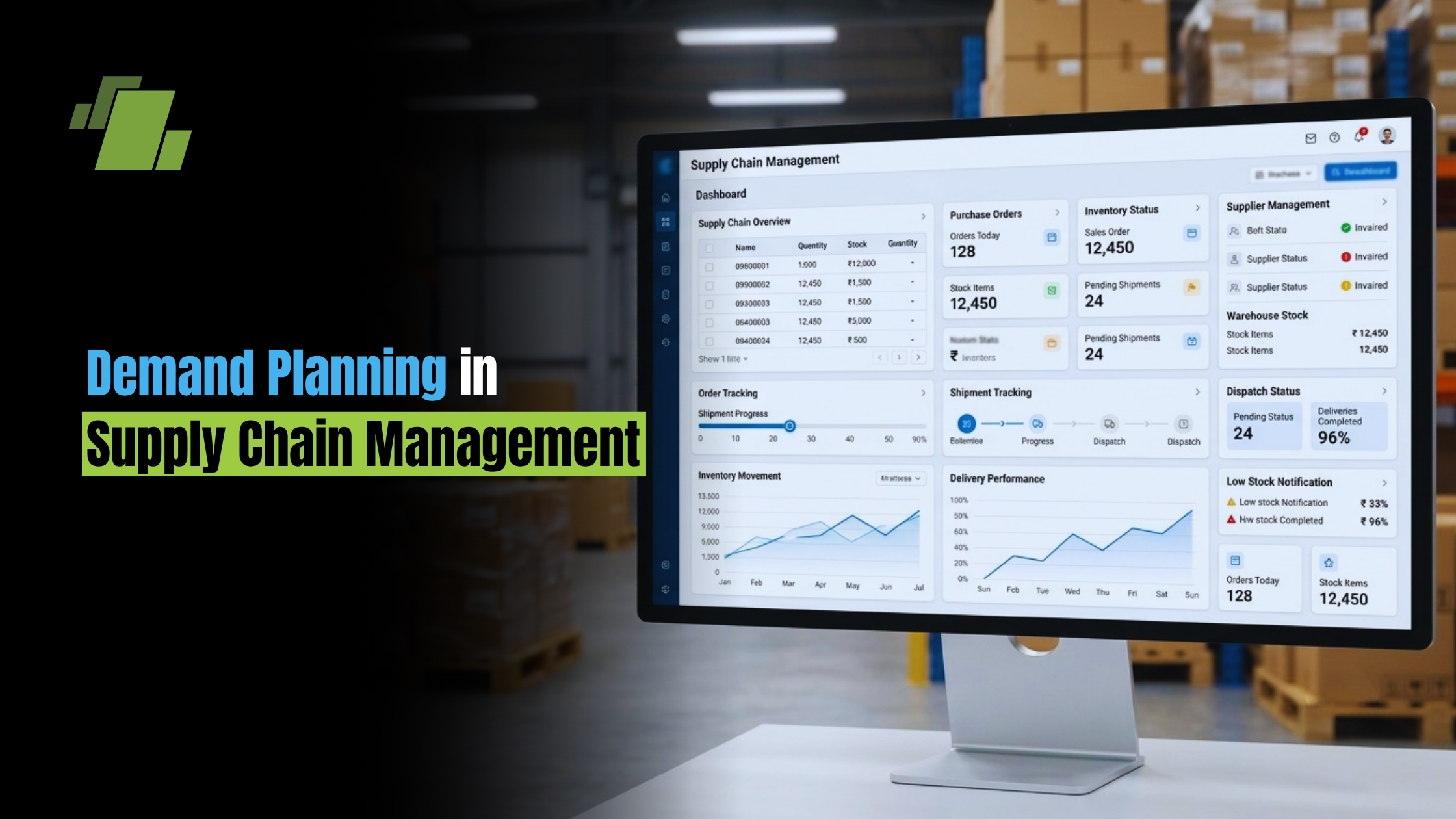
Demand planning is the process of estimating future customer demand and turning that insight into business action. It links sales planning, inventory management, supply planning, production scheduling, and finance so a company can serve customers without tying up too much cash in the wrong stock. At its best, demand planning gives teams a shared view of what customers are likely to need, when they need it, and how the business should respond.
Contact Us
Free Demo Request
What is demand planning?
Demand planning is a cross-functional business process that uses data, judgment, and collaboration to predict demand and prepare the company to meet it. If you have ever asked what is demand planning, the simplest answer is this: it is the bridge between expected customer demand and the business choices needed to satisfy that demand profitably.
Unlike a one-time estimate, demand planning is ongoing. Teams review historical sales, current inventory, customer orders, promotions, seasons, market analysis, supply constraints, and external signals. The result is not just a number on a spreadsheet. It is a plan that guides procurement, labor, warehousing, transportation, production, finance, and customer commitments.
This is why demand planning in supply chain management matters so much. A forecast may say demand will rise next month, but the planning process asks deeper questions. Can suppliers support the increase? Do production teams have capacity? Is inventory in the right place? Are marketing campaigns likely to shift demand by region or product line? These questions turn prediction into coordinated action.
Demand planning and forecasting work together
Demand forecasting is a core part of demand planning, but the two are not identical. Demand forecasting focuses on predicting future demand, often using forecasting techniques such as moving averages, seasonal models, regression, causal models, or machine learning. Demand planning and forecasting then test that prediction against business reality.
For example, a demand forecasting model may project higher sales for a product during a holiday period. Demand planning asks whether the lift is real, whether marketing supports it, whether previous promotions produced similar results, and whether the supply chain can respond in time. If the forecast is too optimistic, the business may overbuy. If it is too cautious, the company may miss sales and disappoint customers.
A helpful way to think about the relationship is:
- Demand forecasting predicts what may happen. It uses historical data, statistical methods, and external signals to estimate future demand.
- Demand planning decides what to do about it. It aligns people, inventory, production, suppliers, and budgets around the best current view of demand.
- Demand optimization improves the outcome. It refines choices around service levels, stock levels, pricing, capacity, and allocation so the plan supports both customers and profit.
This difference matters in supply chain demand planning because a forecast alone cannot resolve trade-offs. A business may know demand is likely to increase, but still need to decide which customers, channels, or regions receive limited inventory first.
The role of demand planning in SCM
Demand planning in SCM helps companies balance customer service with operating efficiency. Without it, businesses often drift between two costly extremes: too much inventory or too little inventory. Both create problems, and both usually trace back to poor visibility, weak coordination, or assumptions that were never challenged.
When demand planning is strong, inventory management becomes more intentional. The business can position stock closer to likely demand, reduce slow-moving inventory, and protect availability for high-priority products. This supports better resource allocation because capital, labor, storage space, and transportation capacity go where they create the most value.
Demand planning also improves production scheduling. Manufacturers can plan runs around expected demand, material availability, equipment capacity, and labor needs. Retailers and distributors can align replenishment cycles with sales patterns. Service organizations can plan staffing and capacity based on expected workload.
In short, demand planning in supply chain management is not only about avoiding stockouts. It also reduces waste, improves cash flow, protects margins, and gives teams time to make better decisions before problems become urgent.
How does demand and supply planning fit together?
Demand and supply planning fit together by comparing what customers are expected to want with what the business can truly provide. Demand planning defines the expected need, while supply planning determines how that need can be fulfilled through inventory, procurement, manufacturing, logistics, and capacity decisions.
The link between demand planning and supply planning is where many practical decisions happen. If demand is expected to exceed available supply, teams may need to prioritize key accounts, adjust promotional plans, find alternate suppliers, or shift production schedules. If supply is greater than expected demand, they may slow purchasing, redirect inventory, change pricing strategy, or revise sales targets.
A simple planning rhythm often includes:
- Create the baseline forecast. Start with historical sales, order patterns, seasons, and known business events.
- Add commercial intelligence. Include promotions, sales pipeline updates, product launches, customer commitments, and market analysis.
- Review supply constraints. Check supplier lead times, capacity, labor, materials, transportation, and warehouse limits.
- Resolve gaps. Decide how to handle shortages, excess stock, timing issues, or conflicting assumptions.
- Approve one shared plan. Align sales, operations, finance, and leadership around the version the business will execute.
- Measure and adjust. Track forecast accuracy, service levels, inventory turns, and plan adherence.
This process is often part of a broader sales and operations planning rhythm. The goal is not perfect numbers. The goal is clear assumptions and faster response when conditions change.
Key data inputs that make plans more reliable
Good demand planning depends on good inputs. Historical sales are useful, but they are rarely enough on their own. A product may have sold well last year because of a one-time promotion, a competitor shortage, unusual weather, or a major customer order that will not repeat.
Useful inputs often include:
- Internal demand signals: sales history, open orders, point-of-sale data, customer contracts, returns, stockouts, lost sales, and channel performance.
- Business data: current inventory, lead times, production capacity, supplier reliability, warehouse limits, and transportation availability.
- Commercial context: promotions, pricing changes, new product introductions, product phase-outs, marketing campaigns, and sales planning updates.
- External signals: economic conditions, competitor activity, market trends, weather patterns, consumer behavior, and industry demand shifts.
- Financial assumptions: margin goals, working capital targets, budget limits, and revenue expectations.
The quality of these inputs matters as much as the quantity. If teams feed outdated, incomplete, or inconsistent data into a planning tool, even advanced models can produce weak outputs. Effective demand planning requires data governance, clear ownership, and regular review of exceptions.
Forecasting techniques support better judgment
Forecasting techniques vary in complexity, but the best choice depends on the business, product, data quality, and planning horizon. A stable product with years of consistent sales may only need simple statistical methods. A volatile product with promotions, short life cycles, or regional demand swings may need more advanced modeling.
Common approaches include moving averages, trend analysis, seasonal forecasting, regression, causal modeling, and scenario-based planning. Increasingly, businesses also use AI and machine learning to detect patterns across larger sets of internal and external data. These tools can help planners identify signals faster, update plans more often, and test multiple possible outcomes.
However, technology does not replace human judgment. A model may detect a trend, but planners still need to understand whether that trend makes business sense. A sudden sales spike could reflect real demand, forward buying, a temporary competitor issue, or a data error. The best demand planning process combines statistical discipline with practical insight from sales, operations, finance, and supply chain teams.

Common challenges that weaken demand plans
Even experienced teams struggle with demand planning because the process sits at the intersection of data, behavior, and uncertainty. Plans become weaker when departments work from different numbers, when incentives conflict, or when teams treat the forecast as a fixed promise instead of a living assumption.
Common challenges include:
- Poor data quality. Duplicate records, missing stockout history, inconsistent product codes, and delayed sales updates can distort the forecast.
- Siloed decision-making. Sales, finance, operations, and procurement may each build separate plans that do not reconcile.
- Past bias. Past demand may not reflect new competitors, changing customer preferences, or shifts in channel behavior.
- Ignoring supply realities. A strong demand plan still fails if supplier lead times, capacity limits, or logistics constraints are not considered.
- Slow reaction to change. Market demand can shift faster than monthly planning cycles, especially during disruptions or sudden promotional activity.
These issues do not mean demand planning is flawed. They mean the process must be designed for transparency, challenge, and adaptation.
Practical best practices for stronger demand planning
A better demand planning process usually starts with clarity. Everyone involved should understand what the plan is used for, who owns each input, how decisions are made, and which metrics define success. Without that structure, planning meetings can become debates over opinion instead of decisions based on evidence.
Strong teams often follow these practices:
- Use one shared demand plan. Avoid competing spreadsheets and disconnected departmental versions.
- Separate baseline demand from events. Keep normal demand patterns distinct from promotions, launches, and unusual customer orders.
- Review exceptions first. Focus planning time on products, regions, or customers where the forecast changed a lot or risk is high.
- Document assumptions. Make it clear why a number changed, who approved it, and what evidence supported the adjustment.
- Connect demand to supply planning. Do not approve a demand plan without checking whether supply can support it.
- Measure bias as well as accuracy. A forecast that is always too high or always too low reveals a planning behavior problem, not just a math problem.
- Refresh plans regularly. Update the plan when meaningful demand signals change, not only at the end of a calendar cycle.
These practices help demand planning become more than a reporting exercise. They turn it into a decision system that supports better service, lower waste, and more confident execution.
Technology is changing demand planning
Modern tools are making demand planning faster, more connected, and more responsive. Cloud platforms can bring together sales, inventory, supply planning, production scheduling, and financial data in one place. AI-enhanced tools can scan large data sets, identify unusual patterns, and support scenario planning when markets shift.
This is especially useful when demand changes suddenly. A retailer may see a regional spike in sales after a social trend. A manufacturer may need to replan after a supplier delay. A distributor may need to protect limited stock for the customers most likely to need it. With better visibility, planners can test options before committing resources.
Still, businesses should choose technology based on maturity, not hype. A company with messy data and unclear ownership may need process discipline before advanced automation. A company with strong planning habits may gain significant value from more advanced analytics. The right tool should make collaboration easier, improve visibility, and support better decisions across the supply chain.
A note on demand planning beyond business
Most of this article focuses on commercial demand planning, but demand-based thinking appears in other fields too. For example, the social demand approach in educational planning estimates future demand for education based on population needs, enrollment expectations, and social priorities. The context is different, but the core idea is similar: planners use expected demand to guide resource allocation and capacity decisions.
That broader view is useful because it shows why demand planning is not just a supply chain function. Whether a business is planning inventory, a factory is scheduling production, or an institution is preparing services, the same principle applies. Better estimates lead to better preparation.
The essential takeaway
Demand planning helps organizations understand future demand and coordinate the actions needed to meet it. It combines demand forecasting, market analysis, sales planning, inventory management, supply planning, and business judgment into one practical process.
The strongest demand planning systems are not built on software alone. They depend on clean data, clear ownership, cross-functional collaboration, realistic assumptions, and a willingness to adjust when conditions change. For any organization that wants a more resilient supply chain, better resource allocation, and fewer costly surprises, demand planning is one of the most important capabilities to develop.

Call at +91-7341141176/75 or send us an email at sales@logicerp.com to book a free demo today!
Frequently Asked Questions
1. How is demand planning different from demand forecasting?
Demand forecasting predicts what customers are likely to want in the future, while demand planning turns that prediction into coordinated business action. Forecasting may use historical data, seasons, regression, causal models, or machine learning to estimate demand. Demand planning then tests that forecast against marketing plans, inventory levels, supplier capacity, production constraints, budgets, and customer priorities so the organization can decide what to do next.
2. Why is demand planning important in supply chain management?
Demand planning helps companies avoid the costly extremes of too much inventory and too little inventory. By connecting expected demand with supply planning, procurement, production scheduling, logistics, and finance, it supports better customer service, lower waste, stronger cash flow, and more effective resource allocation. It also gives teams time to respond before shortages, excess stock, or capacity problems become urgent.
3. What data should companies use to build a stronger demand plan?
Reliable demand plans usually combine internal demand signals, business data, commercial context, external signals, and financial assumptions. Examples include sales history, open orders, point-of-sale data, current inventory, supplier lead times, promotions, product launches, market trends, weather patterns, margin goals, and working capital targets. The article emphasizes that data quality matters as much as data quantity because outdated or inconsistent inputs can mislead even advanced planning tools.
4. What are the most common reasons demand plans fail?
Demand plans often fail when teams work from different numbers, rely too heavily on historical sales, ignore supply constraints, or react too slowly to changing market conditions. Poor data quality and siloed decision-making are also major problems. A strong process makes assumptions visible, encourages cross-functional challenge, and treats the forecast as a living assumption rather than a fixed promise.
5. Can technology replace human judgment in demand planning?
No. Modern tools, including cloud platforms, AI, and machine learning, can improve visibility, detect patterns, and support faster scenario planning. However, planners still need to interpret whether the patterns make business sense. A sudden sales spike, for example, could reflect real demand, forward buying, a competitor issue, or a data error. The strongest demand planning combines statistical discipline with practical insight from sales, operations, finance, and supply chain teams.

Author
Gurbir Singh
Co-founder & Managing Director | LOGIC ERP Solutions Pvt. Ltd.
With 30+ years of experience in the tech industry, I took the helm of technology & product development, ensuring LOGIC ERP’s continuous innovation & leadership in the evolving tech landscape.