What is the Difference Between Supermarket and Hypermarket?

Summary
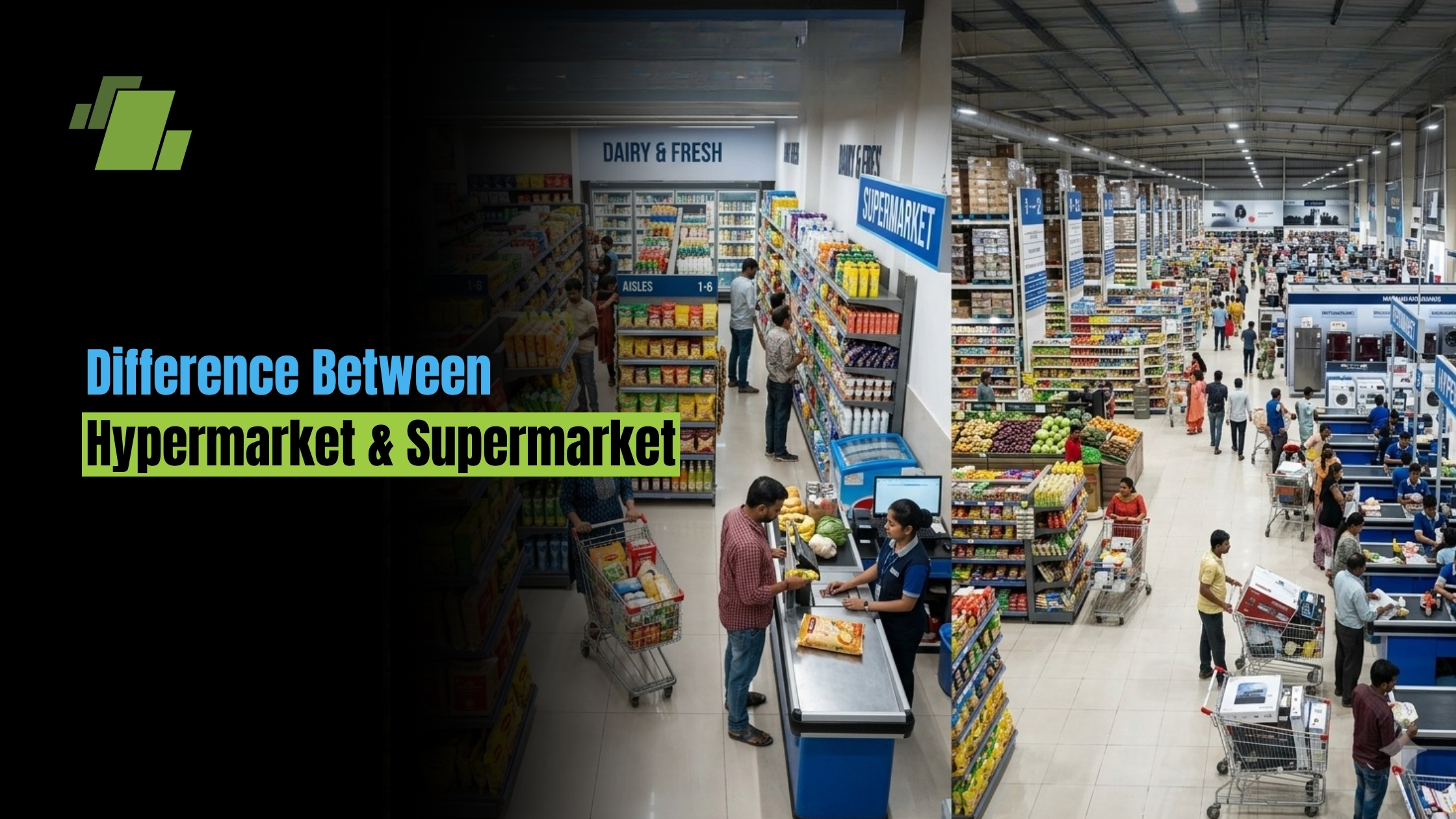
A supermarket is a retail store that primarily sells groceries, food items, household essentials, and everyday consumer products, while a hypermarket is a much larger retail format that combines supermarket and department store offerings under one roof. If you have ever wondered about the difference between supermarket and hypermarket, it comes down to store size, product range, shopping purpose, and operational scale. This guide breaks down the supermarket vs hypermarket comparison in detail, with Indian examples, operational insights, and a look at how supermarket retail software and hypermarket retail software help businesses manage billing, inventory, sales, purchasing, and day-to-day retail operations efficiently.
Contact Us
Free Demo Request
Table of Content
- What Is a Supermarket?
- What Is a Hypermarket?
- Supermarket vs Hypermarket: Key Differences
- 10 Differences Between Supermarket and Hypermarket
- Supermarket vs Hypermarket vs Department Store
- Examples of Supermarkets and Hypermarkets in India
- Supermarket vs Local Market vs Convenience Store
- How Supermarkets and Hypermarkets Manage Retail Operations
- How Retail Management Software Supports Supermarkets and Hypermarkets
- Frequently Asked Questions About Supermarkets and Hypermarkets
Supermarket vs Hypermarket (Key Differences at a Glance)
A supermarket is a self-service store that sells groceries, dairy products, fresh produce, and basic household items in a medium-sized space. It is designed for quick in-and-out shopping trips, typically serving customers in residential areas who need to purchase essentials on a daily or weekly basis. Supermarket shopping is typically for smaller basket sizes compared to hypermarkets.
A hypermarket, on the other hand, is a large retail store that combines a supermarket and a department store. Hypermarkets offer a wider variety of products under one roof, including groceries, clothing, electronics, furniture, and household appliances. They are designed for one-stop shopping and may require more time to navigate due to their expansive layouts.
Here are the key differences at a glance:
- Store size: Supermarkets occupy a few thousand square feet; hypermarkets can exceed 50,000 square feet
- Product categories: Supermarkets focus on groceries and daily essentials; hypermarkets add general merchandise like apparel, electronics, and home goods
- Shopping purpose: Supermarkets serve routine grocery shopping; hypermarkets cater to bulk shopping and combined purchases
- Location: Supermarkets sit within neighborhoods; hypermarkets are often on city outskirts or in large malls
- Parking and facilities: Hypermarkets offer large parking facilities, food courts, and additional services; supermarkets keep it simpler
- Average trip time: Supermarket visits are shorter; hypermarket trips take longer due to the diverse range of products
What is a Supermarket?
A supermarket is a large self-service store that is bigger than a traditional grocery store but smaller than a hypermarket. It sells goods across a focused product range centered on food and daily necessities. Supermarkets offer groceries and household products in aisles arranged for convenient shopping.
- Typical product mix includes fresh fruits and vegetables, dairy products, bakery items, frozen foods, packaged foods, personal care products, cleaning supplies, and a limited range of non food items
- Store size generally ranges from 400 to 2,500 square metres (roughly 4,300 to 27,000 square feet), qualifying them as medium sized stores
- Supermarkets are usually located in residential areas for convenience – along urban high streets, ground floors of mixed-use buildings, or within shopping complexes in Indian cities
- Indian examples include Reliance Fresh (neighborhood grocery format), More Supermarket (food and household essentials across Indian metros), Spencer’s (compact urban stores), and DMart’s smaller neighborhood outlets
- Supermarkets focus on daily essentials in smaller spaces and are optimized for weekly or bi-weekly shopping and quick top-up trips
- Supermarkets typically have 15,000 to 30,000 stock keeping units, covering both food and essential non-food categories
- Supermarkets require lower investment compared to hypermarkets, making them easier to establish in dense urban areas
What is a Hypermarket?
A hypermarket combines a supermarket and a department store into a single large-format retail destination. It sells goods across an extensive range of both food and non food products, making it a one stop shop for families and bulk buyers.
- Product categories span groceries, fresh produce, clothing, footwear, electronics, home appliances, furniture, toys, stationery, and sometimes pharmacy and beauty services
- Floor area usually exceeds 2,500 square metres. Many hypermarkets in India occupy 50,000 to 80,000 square feet, with some exceeding 100,000 square feet – measured in tens of thousand square feet
- Hypermarkets are commonly situated in suburban areas or retail parks to accommodate their larger size. They often sit on city outskirts, near highways, or anchor large malls with big parking lots
- Hypermarkets often include additional services like pharmacies, food courts, in store restaurants, play zones, and service kiosks, creating a family-oriented and convenient shopping experience
- Hypermarkets offer a wider variety of products than supermarkets and are designed to handle larger basket sizes, supporting bulk purchasing
Supermarket vs Hypermarket: Key Differences (Comparison Table)
The following table provides a structured supermarket vs hypermarket comparison for quick reference. These are general format distinctions based on how such stores typically operate in India and globally.
| Feature | Supermarket | Hypermarket |
|---|---|---|
| Store size | 400–2,500 m² (medium-sized stores) | 2,500 m² and above (often 50,000+ sq ft) |
| Product range | Primarily groceries and household essentials | Groceries plus clothing, electronics, furniture, and more |
| Grocery vs general merchandise | 70%+ space dedicated to food items | At least 35% space allocated to non-food products |
| Typical location | Neighborhoods, high streets, urban malls | City outskirts, highways, large mall anchors |
| Target shoppers and trip type | Local residents, daily/weekly quick trips | Families, monthly bulk shopping, one-stop trips |
| Shopping time | Shorter visits | Longer trips across multiple departments |
| Bulk shopping suitability | Limited – smaller packs, fewer combo deals | High – large pack sizes, combo offers, bulk buying incentives |
| Average basket size | Smaller baskets, fewer items | Larger baskets, higher spend per visit |
| Pricing and promotions | Weekly deals, loyalty cards, competitive prices on food | Everyday low prices, festival discounts, aggressive bundle deals |
- These are general patterns. Actual formats vary by retailer and city.
- Some retailers operate both formats under related brand umbrellas (e.g., Reliance Retail).
- Store layout, marketing strategies, and customer behaviour differ significantly between the two, even when the same company runs both.
- The major differences above hold true across most Indian and global markets but are not rigid legal definitions.
10 Differences Between Supermarket and Hypermarket
This section breaks down the 10 differences between hypermarket and supermarket into clear sub-points for students, consumers, and retail planners. The focus is on the Indian market, but the concepts apply globally.
1. Store Size and Floor Area
- Supermarkets in India typically occupy 3,000 to 6,000 square feet, with larger ones reaching up to about 27,000 square feet
- Hypermarkets are significantly larger than supermarkets, often exceeding 50,000 square feet.
- Hypermarkets require larger spaces than supermarkets, which directly affects the number of aisles, product display area, and walking distance during a trip
- In Indian cities, space constraints push supermarkets into city centres while hypermarkets settle on suburban land where large plots are available
2. Product Variety and Assortment
- Supermarkets typically have fewer product categories than hypermarkets, focusing on depth within food categories (multiple brands of rice, oil, snacks)
- Hypermarkets offer a broader range across categories – groceries, apparel, electronics, home décor, sports goods – covering both food and non-food needs
- Assortment planning in supermarkets centers on FMCG; hypermarkets must manage both fast-moving food items and slower-turning general merchandise
- This range of products directly affects customer choice and the time spent shopping
3. Grocery vs General Merchandise Mix
- Supermarkets focus on groceries and daily essentials with a limited range of general merchandise (maybe stationery, basic kitchenware)
- Unlike supermarkets, hypermarkets offer a balanced mix of food and non food items. Hypermarkets sell clothing, electronics, and furniture alongside groceries in the same store
- Hypermarkets often include non-food items like clothing and electronics, with at least 35% of selling space dedicated to non-food categories
- This difference shapes shopping missions: quick food top-ups at supermarkets vs combined grocery and durable purchases at hypermarkets
4. Store Location and Accessibility
- Supermarkets are typically located in residential areas for convenience – embedded in neighborhoods, on high streets, or inside smaller malls for walk-in and short-drive visits
- Hypermarkets are often situated on city outskirts due to size requirements, along ring roads, or within large integrated townships with extensive parking facilities
- Hypermarkets may be harder to reach in crowded cities, making them more car-dependent. Supermarkets, by contrast, are usually accessible by foot or short commute
- This location difference also affects catchment area size: supermarkets serve a tighter local radius, while many hypermarkets draw customers from across a city
5. Shopping Experience and Store Layout
- Supermarket layouts are compact and facilitate quick shopping. They typically use a grid layout with compact aisles, placing everyday items like fresh produce or dairy products at strategic points to encourage movement through the store
- Hypermarket layouts are expansive and feature distinct departmental zones – a fashion zone, electronics zone, food zone – often combining grid layouts for groceries with free-flow layouts for apparel and home goods. Hypermarkets usually feature wider aisles to accommodate higher foot traffic
- Hypermarkets often have multiple checkout counters for efficiency, along with in store events, demo areas, and family amenities like play zones and in store restaurants
- The shopping experience supermarkets provide is more transactional, while hypermarkets aim for a destination experience that can attract more customers for longer visits
6. Pricing, Promotions, and Bulk Shopping
- Pricing supermarkets typically use involves competitive prices on food with weekly promotions, discount cards, and loyalty programs for repeat shoppers
- Hypermarkets leverage significant purchasing volume for lower wholesale costs, allowing for deep discounting. They provide significant discounts through everyday low pricing, combo offers, and festival-linked promotions
- Consumers prefer hypermarkets for bulk buying and better deals, especially during Indian festivals like Diwali, Onam, and Pongal when hypermarkets offer more discounts across categories
- Hypermarkets encourage bulk purchases with larger pack sizes and price promotions designed around monthly stock-up shopping, while supermarkets cater to smaller, more frequent transactions
7. Inventory Management and Supply Chain
- Supermarkets primarily manage high-rotation FMCG and fresh items with frequent deliveries, tight expiry control, and relatively simpler inventory management processes
- Hypermarkets handle a more complex inventory: perishable groceries alongside slow-moving electronics, seasonal garments, and household appliances – each with different lead times, turnover rates, and shrinkage risks
- Demand forecasting in hypermarkets must account for both food and non-food seasonality, promo-driven surges, and a much larger number of stock keeping units
- Modern retail operations in both formats rely on barcode-based systems and ERP integration to maintain stock accuracy, but hypermarkets need more sophisticated multi-category planning
8. Target Customer Groups and Shopping Missions
- Typical supermarket shoppers include local residents, office-goers, students, and elderly customers needing quick access to everyday items. Location supermarkets choose reflects this: close to where people live
- Hypermarket shoppers tend to be families planning monthly purchases, value-seekers comparing prices across categories, and customers combining grocery, fashion, and durable shopping in one store
- Weekday traffic in supermarkets is relatively steady, while hypermarkets see heavy weekend surges – affecting staffing, promotions, and in-store activity planning
- Hypermarkets attract customers across a wider demographic by offering something for every family member under one roof
9. Operating Complexity and Retail Management
- Supermarkets usually have fewer different departments, simpler staffing structures, and more centralized control over fewer SKUs
- Hypermarkets require departmental managers for multiple departments, more complex replenishment planning, and stronger internal controls for shrinkage, theft, and stock accuracy
- Supermarkets require lower investment compared to hypermarkets – both in capital expenditure and ongoing operating overhead (staff, utilities, logistics)
- Technology like retail POS software, barcoding, and ERP systems becomes essential for managing larger hypermarket operations, where the business models demand real-time visibility across categories
10. Shopping Frequency, Trip Length, and Basket Size
- Customers visit supermarkets more frequently – daily or weekly – for fewer items, resulting in smaller baskets. Supermarkets are designed for quick in-and-out shopping trips
- Hypermarket visits are less frequent but involve longer trips and higher spending per visit. Hypermarkets are designed to handle larger basket sizes, supporting bulk purchasing
- This customer behaviour difference directly influences promotion design (weekly deals vs monthly mega sales), store layout planning, and product categories stocked
- Hypermarkets often provide significant discounts due to higher sales volume, encouraging customers to consolidate their purchases into fewer, larger trips
Supermarket vs Hypermarket vs Department Store
A department store is a multi-floor or multi-department retail format focusing primarily on non-food goods – apparel, cosmetics, home décor, accessories, and lifestyle products. Hypermarkets combine aspects of supermarkets and department stores but are not identical to either. Here is how the three formats compare:
| Feature | Supermarket | Hypermarket | Department Store |
|---|---|---|---|
| Primary product focus | Groceries and household essentials | Both food and general merchandise | Non-food: fashion, cosmetics, home décor |
| Grocery availability | Core offering | Yes, significant section | Rare or absent |
| Store format | Grid layout, self-service | Zoned layout, self-service | Floor-by-floor departments, assisted selling |
| Typical location | Residential areas, high streets | Outskirts, malls, retail parks | City centres, premium malls |
| Examples in India | Reliance Fresh, More Supermarket | Lulu Hypermarket, Big Bazaar | Shoppers Stop, Lifestyle, Westside |
- Department stores typically involve more assisted selling clothing and lifestyle products, with staff guiding customers through selections
- Pricing in department stores is often higher, reflecting brand positioning and service levels
- Unlike supermarkets, department stores rarely sell food items. Unlike hypermarkets, they do not position themselves as a one stop solution for groceries and general merchandise combined
- Hypermarkets offer lower prices on general merchandise compared to department stores because of volume-based procurement and simpler service models
Examples of Supermarkets and Hypermarkets in India
Many Indian retailers operate both formats, so classifying a store depends on its characteristics – size, product mix, and location – rather than just the brand name.
Supermarket examples:
- Reliance Fresh: neighborhood grocery stores focused on fresh produce, dairy, and packaged food
- More Supermarket: food and household products across Indian metros, typically in compact urban locations
- Spencer’s (smaller outlets): daily essentials and grocery-led format in city centres
- DMart neighborhood stores: some smaller DMart outlets function as supermarkets with a focused product range
Hypermarket examples:
- Lulu Hypermarket: large-format stores in Kerala, Karnataka, and other states selling clothing, electronics, household appliances, and groceries – such stores often exceed 100,000 sq ft
- Reliance SMART Bazaar (large format): hypermarket-style layouts combining grocery and non-food categories, formerly the Big Bazaar model
- Star Hyper: large-format outlets with a diverse range of food and non-food merchandise
Some companies like Reliance Retail operate convenience stores, supermarkets, and hypermarkets under related brands. Format classification matters for decisions on inventory, staffing, and technology investment.
Supermarket vs Local Market vs Convenience Store
Understanding how supermarkets and hypermarkets compare with local markets (kirana stores) and convenience stores helps clarify where each format fits in the Indian retail landscape.
| Feature | Local Market (Kirana) | Convenience Store | Supermarket | Hypermarket |
|---|---|---|---|---|
| Typical size | Very small (100–500 sq ft) | Small (500–1,500 sq ft) | Medium (3,000–25,000 sq ft) | Large (50,000+ sq ft) |
| Product range | Limited range of daily essentials | Limited, focused on snacks and beverages | Focused on groceries and household items | Extensive range: food, fashion, electronics |
| Service model | Counter-service, personalized | Self-service or counter | Self-service | Self-service with zoned departments |
| Pricing | Variable, credit available | Higher (convenience premium) | Competitive prices | Lower prices through volume, bulk buying deals |
| Shopping purpose | Emergency and daily needs | Quick, on-the-go purchases | Weekly grocery shopping | Monthly, bulk shopping |
- A local market or kirana store is a small, family-run outlet offering personalized service, credit facilities, and home delivery for a tight neighborhood radius
- Convenience stores operate with extended hours and a limited assortment at higher prices, often found at petrol pumps, transit hubs, or housing complexes
- Supermarkets bridge the gap between kiranas and hypermarkets, offering self-service with a broader range of products at competitive prices
- The difference between supermarket and local market lies primarily in scale, self-service model, and pricing, while convenience stores prioritize immediacy over breadth
How Supermarkets and Hypermarkets Manage Retail Operations
Both formats share common operational needs but differ significantly in complexity. Understanding these differences matters for anyone running or planning a retail business in India.
- Purchasing and vendor management: Supermarkets deal primarily with FMCG distributors and local fresh produce suppliers. Hypermarkets manage vendors across food, electronics, apparel, and seasonal categories, often requiring rate contracts and centralized procurement
- Inventory management: Supermarkets handle high-velocity perishable stock with frequent deliveries and tight expiry tracking. Hypermarkets add layers – slow-moving electronics, fashion with size/color variants, and seasonal household items – making stock management significantly more complex
- Billing and POS: Both formats need fast checkout with barcode scanning and multiple payment modes (UPI, wallets, cards, cash). Hypermarkets often have multiple checkout counters and need grocery POS software that integrates loyalty programs across categories
- Stock replenishment: Demand forecasting, supplier lead times, and managing near-expiry stock become critical as store size grows. Online orders and omnichannel fulfillment add another layer of data to process
- Multi-store visibility: As retail chains scale, central price updates, consolidated sales and MIS reporting, and unified stock views across locations become non-negotiable
- Data from POS, online shopping channels, and in-store customer tracking feeds into better decisions on category mix, promotions, and store layout optimization
How Retail Management Software Supports Supermarkets and Hypermarkets?
Modern supermarket and hypermarket operations in India rely on integrated retail ERP and POS solutions to manage the complexity described above. Here is how such systems help:
- Grocery billing and POS: Fast barcode scanning, automated scheme calculations, GST-compliant invoicing, and queue management for both small supermarket counters and hypermarket multi-lane checkouts
- Centralized inventory management: A unified stock view across outlets and warehouses, automated reordering, batch and expiry tracking for FMCG, and matrix item handling (size, color) for apparel and footwear in hypermarkets
- Purchase and supplier management: Rate contracts, purchase orders, goods receipt notes, and supplier performance monitoring in one system – critical for hypermarkets managing hundreds of vendors
- Pricing and promotion controls: Flexible discounts, combo offers, festival schemes, and integration with loyalty programs. Hypermarkets need more complex promotional logic to manage cross-category deals
- Loyalty programs: Capturing customer data, tracking points, and generating personalized offers based on category preferences (e.g., grocery vs electronics) – useful for both formats but more layered in hypermarkets handling other services and diverse customer segments
Conclusion
Understanding the difference between supermarkets and hypermarkets is essential for consumers, retailers, and students interested in retail management. While supermarkets focus on daily essentials, offering a convenient shopping experience in medium-sized stores within residential areas, hypermarkets provide a vast range of products, combining groceries with general merchandise like clothing and electronics under one large roof. The choice between the two depends on shopping needs quick, routine purchases versus bulk, one-stop shopping.
For retailers and business planners, recognizing these differences helps in choosing the right store format, managing inventory, and tailoring marketing strategies effectively. Additionally, leveraging modern retail management software like LOGIC ERP can streamline operations, improve inventory control, and support multi-location management, enabling scalable growth in both supermarket and hypermarket formats.
Whether starting a new retail venture or expanding an existing one, aligning store size, product mix, location, and technology is key to meeting customer expectations and achieving business success in India’s dynamic retail landscape.

Call at +91-73411-41176/75 or send us an email at sales@logicerp.com to book a free demo today!
Frequently Asked Questions
1. What is the Difference Detween a Supermarket and a Hypermarket?
A supermarket primarily sells groceries and household essentials in a medium-sized self service store, while a hypermarket is a much larger format that combines supermarket and department store features – selling both food and non food items like clothing, electronics, and furniture under one roof.
2. What is the Meaning of Supermarket and Hypermarket?
A supermarket is a self-service retail store focused on food items and everyday household products. A hypermarket is a large retail store that merges grocery retailing with general merchandise selling, functioning as a one stop shop for diverse consumer needs.
3. What is a Hypermarket in Simple Words?
A hypermarket is a very large store where you can buy groceries, clothing, electronics, household appliances, and more – all in one store. It combines a supermarket and a department store to offer a one stop solution for families.
4. What are the 10 Differences Between Hypermarket and Supermarket?
The ten key differences cover store size, product variety, grocery vs general merchandise mix, location, shopping experience and store layout, pricing and bulk shopping, inventory management, target customers, operating complexity, and shopping frequency with basket size. Each is detailed in the comparison section above.
5. What is the Difference Between a Supermarket and a Department Store?
A supermarket focuses on groceries and daily essentials using a self-service model. A department store focuses on non-food products like fashion, cosmetics, and home décor, often with assisted selling across multiple departments. Department stores rarely sell food.
6. What is the Difference Between a Hypermarket and a Departmental Store?
A hypermarket sells both food and non-food products in a self-service format with everyday low pricing. A departmental store focuses on lifestyle and fashion categories with higher service levels and brand-oriented pricing. Hypermarkets offer groceries; department stores generally do not.
7. What is the Difference Between a Supermarket and a Local Market?
A supermarket is a self-service format with organized aisles, barcode billing, and competitive prices. A local market or kirana store is a small, family-run outlet offering counter-service, personal credit, and home delivery but with a limited product range.
8. What is the Difference Between a Convenience Store, Supermarket, and Hypermarket?
Convenience stores are small, high-priced outlets for quick purchases. Supermarkets are medium sized stores for weekly grocery shopping at competitive prices. Hypermarkets are large destination stores for bulk shopping across food and non-food categories.
9. Is a Hypermarket Always Bigger than a Supermarket, and is it Cheaper?
Hypermarkets are considerably larger than supermarkets in virtually all cases. On pricing, hypermarkets often offer lower prices on many categories due to volume-based procurement, but supermarkets can be equally competitive on core grocery items. The best deals depend on the product category and specific retailer.
10. What is a Grocery Store?
A grocery store is a small retail outlet that primarily sells food items and everyday essentials. It typically offers fresh produce, packaged foods, dairy products, and household necessities in a compact space, serving local neighborhoods with quick and convenient shopping options.
11. How Has Online Shopping Impacted Supermarkets and Hypermarkets?
Online shopping has transformed retail by enabling customers to order groceries and general merchandise from home. Supermarkets and hypermarkets now offer online ordering, home delivery, and curbside pickup, expanding their reach and convenience for consumers.
12. What are Common Marketing Strategies Used by Supermarkets and Hypermarkets?
Supermarkets and hypermarkets use marketing strategies like weekly promotions, festival discounts, loyalty programs, combo offers, and personalized advertising to attract and retain customers, increase basket size, and boost sales.
13. How Do Loyalty Programs Benefit Supermarket and Hypermarket Shoppers?
Loyalty programs reward repeat customers with points, discounts, and exclusive offers based on their purchase history. These programs encourage customer retention, increase shopping frequency, and provide valuable data for personalized marketing.
14. What are the Major Differences Between Supermarkets and Hypermarkets?
The major differences include store size (supermarkets are smaller), product range (hypermarkets offer broader categories including non-food items), shopping purpose (supermarkets for routine shopping, hypermarkets for bulk and one-stop shopping), and location (supermarkets in neighborhoods, hypermarkets on city outskirts or large malls).

Author
Gurbir Singh
Co-founder & Managing Director | LOGIC ERP Solutions Pvt. Ltd.
With 30+ years of experience in the tech industry, I took the helm of technology & product development, ensuring LOGIC ERP’s continuous innovation & leadership in the evolving tech landscape.