FIFO stands for First In, First Out — a principle used in both inventory management and accounting where the oldest inventory is assumed to be the first goods sold or consumed.
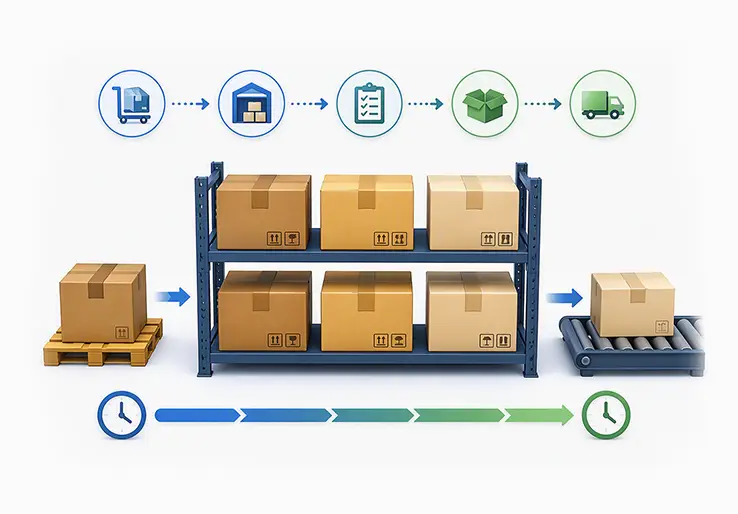
Every business that holds stock faces one fundamental question: which units should be considered sold first, and at what cost? The answer shapes everything from your reported profits to the freshness of products reaching your customers. This guide breaks down the FIFO inventory method — its full form, how it works in accounting and warehousing, its benefits and trade-offs, and how to implement it using modern ERP technology.
FIFO stands for First In, First Out. It is a principle used in both inventory management and accounting where the oldest inventory is assumed to be the first goods sold or consumed. FIFO means the earliest purchased units leave your stock before newer arrivals, whether we are talking about physical warehouse flow or financial cost assignment.
In practice, FIFO assigns older costs to the cost of goods sold, which means that during periods of rising prices, your reported COGS stays lower and your ending inventory on the balance sheet reflects more recent, higher costs. This dynamic directly influences gross profit, net income, and tax liability.
FIFO is permitted under both generally accepted accounting principles (GAAP) and international financial reporting standards (IFRS). Most Indian retailers, manufacturers, and distributors prefer it because Ind AS aligns with IFRS and prohibits LIFO. LOGIC ERP helps businesses implement FIFO across both physical inventory flow and financial records, ensuring consistency between the warehouse floor and the ledger.
The FIFO full form is First In, First Out. "First In" refers to inventory units that enter stock earliest — the first batch purchased or produced. "First Out" means those same units are treated as the first goods sold when calculating costs. FIFO sells the oldest inventory first, while LIFO sells the newest inventory first.
It is important to distinguish between FIFO as a physical inventory flow rule and FIFO as an inventory valuation method. In a warehouse, FIFO governs how staff pick and ship older stock before newer arrivals. In accounting, FIFO is a cost flow assumption that determines which cost layers are matched against revenue. Physical flow and cost flow ideally align, but the accounting assumption is what shapes your financial statements.
FIFO sits alongside other inventory valuation methods such as the LIFO method and the average cost method, which blends all unit costs into a single weighted average cost. Detail on these comparisons follows later.
Consider a simple example. A company buys 100 units in January at ₹100 each, then 100 units in February at ₹120. When it sells 150 units in March, FIFO assumes the January batch is consumed first: COGS equals 100 × ₹100 plus 50 × ₹120, totalling ₹16,000. The remaining inventory of 50 units sits at ₹120 each, valued at ₹6,000. In accounting, FIFO matches the cost of older inventory with current revenues, which in inflationary environments produces lower COGS and higher reported profit because older, cheaper inventory costs flow to COGS first. FIFO typically results in lower COGS during inflation.
The fifo method operates through a straightforward sequence during any accounting period. You start with beginning inventory, record new purchase batches with dates and costs, store the stock, then relieve inventory cost from the oldest available batch each time a sale occurs. What remains forms your ending inventory.
Here is a worked example with three batches. Beginning inventory on January 1: 200 units at ₹80 each. Purchase on February 1: 150 units at ₹100. Purchase on March 15: 100 units at ₹120. Now assume two sales — 180 units on April 1 and 120 units on May 10. Under FIFO, the April sale draws entirely from the oldest batch: 180 units at ₹80, costing ₹14,400. That leaves 20 units at ₹80 still in stock. The May sale of 120 units consumed those 20 remaining units at ₹80 (₹1,600) and then 100 units from the February batch at ₹100 (₹10,000), totalling ₹11,600 for that sale. Total COGS across both sales: ₹26,000.
The ending inventory consists of 50 units from February at ₹100 (₹5,000) plus the full March batch of 100 units at ₹120 (₹12,000), giving an inventory value of ₹17,000. You can verify using the standard formula:
FIFO requires tracking inventory entry and exit dates for every batch.
An ERP like LOGIC ERP's inventory management software automates this entirely — recording each batch with its date, cost, and quantity, then consuming the oldest cost layer on every sale. This eliminates spreadsheet errors and ensures your actual inventory flow matches your books.
As an operational strategy, FIFO ensures older stock exits before newer arrivals. This natural flow prevents spoilage, obsolescence, and the slow accumulation of dead inventory. FIFO helps maintain product freshness and reduces waste, which is why it is widely used in industries with perishable goods.
Warehouse layout is the backbone of FIFO execution. Flow racks where goods enter from one side and are picked from the other enforce the correct sequence. Receiving zones and dispatch zones should be physically separated, with shelving arranged so new deliveries go behind existing stock. Lane labels showing receipt dates or batch numbers keep pickers aligned with FIFO rules. Warehouse management software can generate pick lists sorted by the oldest receipt date, further reducing human error.
Concrete examples make this tangible. In supermarkets, dairy cartons received earliest sit at the front of the shelf; newer arrivals slot behind. In pharma warehouses, active pharmaceutical ingredients and finished medicines are dispatched by batch number in the same order they arrived, ensuring FIFO ensures that fast-changing products do not become obsolete. For Indian FMCG in modern trade channels, even non-perishable items benefit — older packaging variants and promotional SKUs need to be cleared before new lines arrive. Implementing FIFO can reduce spoilage risk in perishable goods significantly.
A related strategy is FEFO (First Expiry, First Out), where expiry date overrides receipt date. LOGIC ERP supports both FIFO and FEFO through configurable rules per product or batch, including batch and lot tracking with expiry date fields.
The fifo accounting method directly shapes two critical financial statements. On the income statement, it determines the cost of goods sold. On the balance sheet, it sets the ending inventory valuation. FIFO provides a clearer picture of current inventory value because the remaining inventory reflects the most recent purchase prices.
Consider this scenario with rising prices. Batch 1: 100 units at ₹50. Batch 2: 100 units at ₹70. Batch 3: 100 units at ₹90. You sell 200 units at ₹150 each. Under FIFO, COGS equals 100 × ₹50 plus 100 × ₹70, which is ₹12,000. Ending inventory is 100 units at ₹90 — ₹9,000. Gross profit: ₹30,000 minus ₹12,000 equals ₹18,000. Under the lifo method, COGS would be ₹16,000 and ending inventory only ₹5,000. The average cost method would blend all costs at ₹70 per unit, yielding COGS of ₹14,000. FIFO typically results in higher net income during inflation because it assigns older, cheaper costs first.
This higher gross profit flows into higher net income, which is important for metrics like gross margin, inventory turnover, and return on inventory investment. Higher ending inventory values under FIFO strengthen current assets on the balance sheet, improving ratios that lenders and investors scrutinise during funding rounds.
However, there is a trade-off. Higher reported profits under FIFO lead to increased tax liability. FIFO can result in higher income taxes for companies, and FIFO can overstate profits during inflationary periods. Finance teams using LOGIC ERP's accounting module often run scenario analyses comparing FIFO with the average cost method to plan for higher taxable income and its cash impact.
FIFO assumes the oldest inventory is sold first. The LIFO method assumes the newest inventory is sold first. The average cost method calculates a single weighted average cost per unit by dividing total inventory cost by total units. These three approaches form the core of inventory costing debates.
Under inflation, FIFO generally results in lower COGS, higher gross profit, and higher ending inventory. LIFO produces higher COGS, lower profit, and lower ending inventory. LIFO can lead to lower taxable income in inflationary periods, which is why some U.S. companies favour it — but IFRS (IAS 2) prohibits LIFO. FIFO is required under IFRS accounting standards in many jurisdictions, including India's Ind AS framework. In deflation, the effects reverse.
From an operational perspective, FIFO and the average cost method roughly mirror the actual flow of goods in most warehouses — stock physically moves in the same order it arrived. LIFO rarely reflects physical inventory flow, especially for perishable goods. Industries like food and pharma strongly favour FIFO or FEFO. Commodities and metals have historically experimented with LIFO where permitted, while high-SKU, mid-margin businesses sometimes prefer the weighted average cost for simplicity.
LOGIC ERP supports FIFO and average cost side by side across different product groups and legal entities, allowing businesses to match compliance requirements with their inventory method of choice without maintaining parallel systems.
FIFO (First In, First Out) is characterized by several key features that make it an effective and widely used inventory management and accounting method:
These features collectively make FIFO a robust method for managing inventory costs, improving operational flow, and delivering accurate financial insights.
On the operations side, FIFO keeps inventory fresh, reduces write-offs from spoilage and obsolescence, and creates a smoother inventory flow. Because cost layers are consumed sequentially, cycle counting and physical count reconciliation become simpler. FIFO helps maintain product freshness and customer satisfaction. Regular audits ensure adherence to FIFO principles, and the sequential logic makes discrepancies easier to trace.
Financially, FIFO helps maintain a clearer picture of profit margins because COGS reflects known, sequential cost layers rather than blended approximations. Ending inventory on the balance sheet closely mirrors current market prices, giving stakeholders an accurate picture of asset value. FIFO is easy to understand and implement for businesses of any size, which reduces training costs and accounting complexity. FIFO ensures fairness in processing tasks by following their order of arrival, a principle that resonates with auditors and regulators alike.
From a cash flow and working capital perspective, faster inventory turnover means capital recovers sooner. Holding costs drop because older stock does not linger. Procurement cycles become more predictable, and markdown pressure decreases.
Strategically, FIFO improves demand forecasting accuracy because sales patterns are not distorted by stale inventory sitting in storage space. Consider a mid-size Indian packaged foods company that enforced strict FIFO through LOGIC ERP's inventory solutions — within one year, expiry-related write-offs dropped by over 30%, and margin loss on forced promotions fell measurably. That is the kind of result that moves the needle.
The primary financial limitation is that during high inflation, FIFO can overstate profits during periods of rising costs. Because older costs flow to COGS while current replacement costs may be significantly higher, the reported margin may not reflect what it actually costs to replenish stock. This leads to higher income taxes and potentially misleading profitability signals. FIFO can overstate profits, leading to higher tax liabilities that affect cash reserves.
Operationally, FIFO demands discipline. Without proper warehouse layout, accurate labeling, and real-time data capture, businesses end up with "paper FIFO" — the ledger shows FIFO but the floor picks randomly. For businesses with extremely large SKU counts, frequent returns, and multi-location networks, maintaining strict FIFO without technology is error-prone and time-consuming.
In certain industries — volatile high-value commodities, project-based manufacturing — FIFO may not reflect current replacement costs well enough for internal decision-making. Here, the specific identification method or weighted average may provide more representative insights, though they come with their own trade-offs.
These challenges are significantly mitigated with integrated inventory systems like LOGIC ERP, barcode scanning at receipt and issue, batch and lot tracking, and automated pick-path generation that enforces the expected cost flow on the warehouse floor.
Start by assessing your current inventory method and data quality. Identify whether your business currently uses FIFO, average cost, or an ad-hoc approach. Reconcile physical stock against financial records and check whether batch-level timestamps exist in your system.
Next, define your FIFO policy by product category. For items with expiry dates, FEFO may take priority. For non-perishable raw materials, standard FIFO by receipt date is sufficient. Not every SKU needs the same rule — category-level configuration provides the right balance of control and flexibility.
Redesign your warehouse layout so goods enter from one side and exit from the other. Label shelf locations with receipt dates or colour-coded tags for different weeks. Ensure new deliveries are always placed behind existing stock. Use inventory management software to automate FIFO tracking — this is where configuring LOGIC ERP becomes critical. Enable batch-wise costing, capture GRN dates automatically, assign cost layers per SKU, and map them to COGS accounts.
Train your staff thoroughly. Create standard operating procedures for inbound receiving, put-away, picking, returns handling, and stock adjustments that all respect FIFO inventory flow. Everyone from the receiving dock to the accounts team needs to understand why sequence matters.
Finally, pilot before scaling. Start with a single warehouse or product category — dairy or OTC medicines work well as test cases — measure write-offs, stock age, and turnover before and after. Refine your processes, then roll out across the network. To maintain detailed records and accuracy, consider exploring LOGIC ERP's inventory and BOM module for end-to-end batch visibility.
Consistently applying FIFO prevents slow-moving older stock from quietly accumulating. When the oldest inventory is always the inventory sold first, average days-in-inventory drops, and the inventory turnover ratio improves because COGS and average inventory both reflect realistic, sequential cost layers.
Higher turnover translates directly into better cash flow. Capital locked in warehouses gets recovered faster, freeing resources for reinvestment in better-performing SKUs or expansion. A business that shifted from ad-hoc picking to rigorous FIFO enforcement through LOGIC ERP and a WMS layer saw average days inventory outstanding drop from 60 to 45 days — releasing meaningful working capital.
Accurate FIFO-based COGS and ending inventory figures also support smarter pricing, promotion planning, and purchase quantity decisions. When managers see true gross margins per item — not a blended approximation — they can time promotions to clear older stock and adjust reorder points with confidence. The most accurate method for linking sales patterns to procurement is one where your cost layers match the actual flow of goods.
While FIFO may show higher accounting profits and therefore higher tax liability during inflation, the operational savings from reduced waste, lower holding costs, and faster turnover often more than offset this in real cash terms.
Supermarkets and grocery chains rely on FIFO and FEFO daily. Fresh produce, dairy, and packaged foods are rotated by manufacture date — the most familiar example of FIFO in action. Indian modern trade chains follow strict shelf rotation policies to minimise dead stock and markdowns.
In pharmaceuticals and healthcare, FIFO and FEFO are regulatory expectations. Medicines, vaccines, and medical devices carry batch numbers and expiry dates that must be documented at every stage. Hospitals and drug retailers dispatch the oldest qualifying batch first, with full traceability required for audits.
Electronics and fashion face a different driver — obsolescence and seasonality. Older phone models or last season's collection must move before new lines arrive, even though there is no expiry date. The exact cost of each inventory item matters for markdown planning and clearance pricing. FIFO ensures these older collections reach customers or discount channels before they lose further value.
In manufacturing, raw materials and components are issued from stores based on earliest receipt or batch, maintaining quality consistency and traceability. The fifo method applied to production inputs also supports compliance in regulated sectors like food processing and automotive.
LOGIC ERP ties these sector-specific needs together through batch and lot tracking, expiry alerts, and FIFO-based costing integrated with POS, eCommerce, and production modules.
Manual FIFO using spreadsheets and paper labels inevitably breaks down at scale. Labels fade, staff pick based on convenience rather than sequence, and mismatches between theoretical FIFO costing and actual inventory movement accumulate silently. The result: your financial reporting says one thing, your warehouse reality says another.
Modern ERP and inventory systems solve this. Barcode or QR scanning at receipt captures batch, date, and cost automatically. Pick lists are generated with the oldest stock sorted first. Dynamic slotting pushes aged inventory to the most accessible locations. Mobile devices on the warehouse floor confirm that every pick follows the correct FIFO sequence.
A system like LOGIC ERP should offer configurable inventory methods — FIFO and average cost — alongside warehouse management features, integration with POS and eCommerce platforms, and real-time dashboards showing stock age buckets, cost layers, and expiry risk. Analytics covering slow-moving SKUs, projected expiry, and recent inventory costs by category help operations and finance teams stay proactive rather than reactive.
Monitoring stock aging, running periodic reconciliation, and using this data to tune reorder points and safety stock levels transforms FIFO from a policy on paper into a competitive advantage. Businesses evaluating FIFO or upgrading from manual methods can explore how LOGIC ERP supports end-to-end FIFO implementation from purchase to sale.
FIFO (First In, First Out) is a fundamental inventory management and accounting method that aligns the physical flow of goods with financial cost recognition. By ensuring that the oldest stock is sold or consumed first, FIFO helps businesses maintain product freshness, reduce waste, and achieve more accurate financial reporting. This method is especially beneficial during periods of inflation, as it assigns older, lower costs to the cost of goods sold, resulting in higher reported profits and a clearer picture of current inventory value.
While FIFO offers operational advantages such as improved inventory turnover and reduced holding costs, it also carries financial trade-offs, including potentially higher tax liabilities due to increased net income. Its straightforward approach makes FIFO easy to implement and understand, supporting compliance with accounting standards like IFRS, which prohibit alternative methods such as LIFO.
Successful FIFO implementation requires disciplined warehouse practices, including strategic layout design, accurate labeling, and robust inventory tracking supported by modern ERP systems. These technologies automate cost layer management and ensure consistency between physical stock flow and accounting records.
Ultimately, FIFO remains the preferred inventory valuation and management method for many industries, particularly those handling perishable goods or products with limited shelf life. By integrating FIFO principles with technology and process improvements, businesses can optimize inventory efficiency, enhance profitability, and maintain a competitive edge in dynamic markets.
Call at +91-73411-41176/75 or send us an email at sales@logicerp.com to book a free demo today!
FIFO stands for First In, First Out. It is commonly used in inventory management and accounting to assume the oldest inventory is sold or consumed before newer stock.
FIFO assigns older, cheaper inventory costs to COGS first, resulting in lower COGS during inflation and higher gross profit. This higher net income leads to higher taxable income and greater tax liability.
FIFO uses distinct cost layers, consuming the oldest first, while the average cost method blends all costs into a single per-unit figure. FIFO gives a more accurate picture of ending inventory at current market value; the average cost method smooths volatility.
FIFO is permitted and widely used, but not the only option. IFRS allows FIFO and weighted average cost. However, LIFO is prohibited under IFRS, making FIFO the preferred valuation method in most IFRS-aligned jurisdictions.
Not always. Businesses dealing in volatile commodities or those needing lower taxable income may find other methods more suitable where regulations permit. For most retailers, manufacturers, and distributors, FIFO aligns with actual flow and operational needs.
Review your current cost flow assumptions, clean up batch and receipt date data, configure SKUs to use FIFO in the system, ensure your warehouse layout matches the policy, and pilot in one category before a full rollout.
The inventory method affects reported profit but does not directly change when cash enters or leaves your business. However, by improving turnover and reducing waste, FIFO indirectly strengthens cash flow and working capital.
In computing, FIFO refers to a queue data structure where data is processed in the order it arrives — the first element enqueued is the first dequeued. FIFO is also applied in hardware buffering for flow control between devices. While the principle mirrors accounting FIFO, the application context — processing tasks versus valuing inventory — is entirely different. In computing, FIFO processes data in the order it arrives within a queue; in accounting, it determines which cost layers flow to COGS.
The periodic inventory system applies the FIFO flow principle by assuming that the first items purchased are the first ones sold during the accounting period. When a company sells products, it does not update inventory or COGS in real time; instead, it calculates the cost of goods sold at the end of the period by layering the oldest purchase costs against the quantity sold. This approach helps the company align COGS with the actual flow of inventory, reflecting older costs first. However, because inventory is only updated periodically, the accuracy of FIFO flow depends on proper stock counts and purchase records. This method simplifies bookkeeping but can delay insights into inventory and profit margins until the period closes.
Popular Products