Mastering Key Supply Chain Concepts for Efficiency

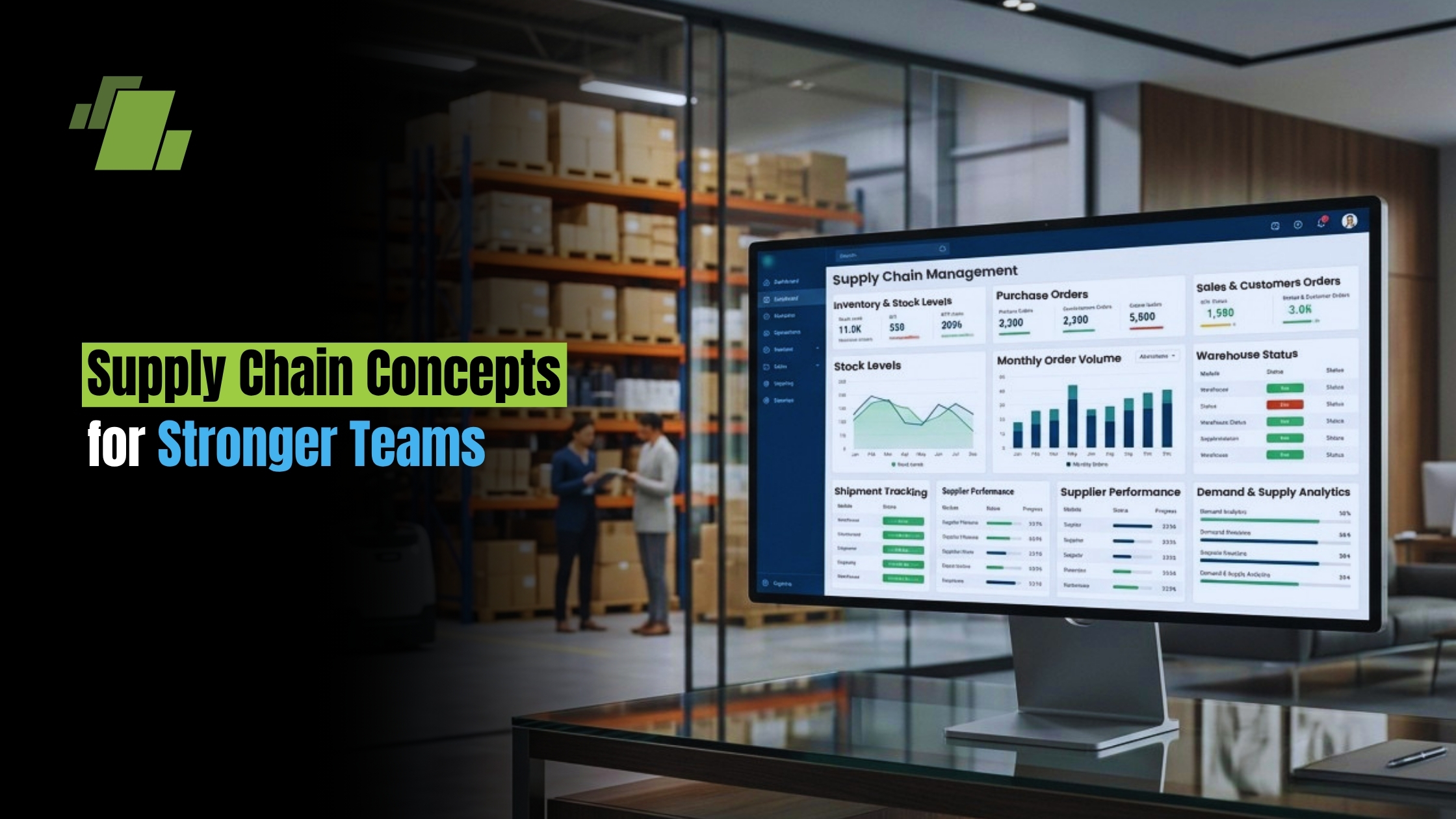
Supply chains connect the people, systems, and partners that move products from raw materials to customers. Understanding the right supply chain concepts helps teams cut waste, respond faster to change, and make better daily decisions across procurement, logistics, inventory, and distribution. Whether you are new to supply chain management or just refreshing your knowledge, the goal is not to memorize jargon. It is to see how each concept affects cost, service, risk, and customer experience.
Contact Us
Free Demo Request
Supply chain basics also matter outside operations. Sales, finance, and customer support all depend on clear supply chain data. When each team sees the same picture, they can make better promises and react faster when conditions change.
What are the key supply chain concepts every team should know?
The key supply chain concepts every team should know are demand planning, procurement, production, inventory management, logistics, distribution networks, supplier relationships, risk management, and continuous improvement. Together, these ideas explain how goods, information, and money move through a business ecosystem. When teams understand these basics, they can spot bottlenecks earlier, coordinate across functions, and build supply chain strategies that support growth and resilience.
At its simplest, a supply chain begins with a need and ends with a satisfied customer. In between, many choices shape the result: which suppliers to use, how much inventory to hold, where to store products, how to transport them, and how to balance speed with cost. These are not isolated choices. A change in procurement processes can affect lead times, inventory levels, cash flow, and service performance.
The foundation starts with planning and visibility
Planning is one of the most important supply chain concepts because it turns market expectations into action. Demand planning estimates what customers will need, while supply planning shows how the business will meet that demand. When the two are aligned, teams can reduce shortages, avoid excess stock, and improve supply chain efficiency.
Visibility supports that planning. Teams need to know what is ordered, what is in production, what is in transit, what is delayed, and what is available to sell. Without reliable data, even experienced managers react to surprises instead of managing priorities.
A practical planning rhythm usually includes:
- Demand review: Check sales history, cycles, promotions, customer forecasts, and market signals.
- Supply review: Evaluate capacity, supplier lead times, inventory constraints, and transportation options.
- Gap review: Identify where demand exceeds supply or where inventory may build needlessly.
- Decision review: Agree on trade-offs, such as expediting, moving stock, changing purchase timing, or adjusting service promises.
- Performance review: Compare the plan with actual results and improve the next cycle.
This rhythm does not need to be complex. The real value comes from consistency, shared data, and clear ownership.
Procurement processes shape cost, quality, and risk
Procurement is more than buying goods at the lowest price. Effective procurement processes help businesses select suppliers, negotiate terms, manage contracts, assess risk, and ensure materials or services arrive when needed. A low unit cost can quickly become expensive if poor quality, late delivery, or unclear terms disrupt operations.
Modern procurement also depends on stronger collaboration. Suppliers may give early warnings about capacity issues, material shortages, regulatory changes, or transportation limits. Businesses that treat suppliers as strategic partners often gain better visibility and more flexible problem-solving than those that manage every relationship one deal at a time.
Key procurement practices include:
- Supplier vetting: Confirm that suppliers can meet quality, compliance, capacity, and service expectations.
- Total cost review: Look beyond purchase price to include freight, duties, payment terms, defects, delays, and handling costs.
- Contract clarity: Define responsibilities, lead times, service levels, escalation paths, and performance expectations.
- Supplier performance tracking: Measure delivery reliability, quality, responsiveness, and issue resolution.
- Risk spreading: Avoid depending too much on one supplier, region, material, or transportation lane when alternatives are practical.
These practices connect directly to supply chain optimization because procurement decisions influence the entire flow of goods.
Inventory management turns uncertainty into control
Inventory management is the discipline of deciding what to hold, where to hold it, and how much is enough. Too little inventory can cause stockouts, missed sales, production delays, and unhappy customers. Too much inventory can tie up cash, raise storage costs, and create waste if products become obsolete or damaged.
The best approach depends on the business model. A company selling fast-moving consumer goods may need broad availability across many locations. A manufacturer using special parts may focus on securing critical items with long lead times. A distributor may group products by demand patterns, margin, and service expectations.
Useful inventory concepts include:
- Safety stock: Extra inventory held to protect against demand spikes or supply delays.
- Reorder point: The inventory level that triggers a new purchase or production order.
- Cycle stock: Inventory used to satisfy normal demand between replenishment cycles.
- ABC analysis: A method for grouping items by business importance, often based on value, volume, or demand.
- Inventory turns: A measure of how often inventory is sold or used during a period.
Good inventory management is not about holding the smallest possible amount. It is about holding the right amount in the right place for the service level the business promises.
How do logistics concepts affect customer experience?
Logistics concepts affect customer experience by shaping how reliably, quickly, and affordably products move through the supply chain. Transportation, warehousing, packaging, order fulfillment, returns, and last-mile delivery all affect whether customers receive the right product in the right condition at the right time. When logistics is well managed, it becomes a service advantage rather than just an operating cost.
For example, a business may offer fast delivery, but that promise depends on warehouse placement, carrier performance, order cut-off times, picking accuracy, and inventory availability. If any link fails, the customer sees the result. Logistics connects the internal plan to the external experience.
Distribution networks are especially important. A centralized network may reduce facility costs and simplify control, while a regional network may improve delivery speed and reduce transportation distance. The right design depends on product traits, customer locations, order patterns, service expectations, and cost limits.
A practical logistics review should ask:
- Are customers receiving orders when promised?
- Are transportation costs rising faster than sales or service value?
- Are warehouses close enough to demand?
- Are returns handled efficiently and clearly?
- Are packaging choices protecting products without adding needless cost?
These questions help teams turn operational details into better customer outcomes.
Supply chain strategies must balance efficiency and resilience
Many companies once focused heavily on lean operations, cost reduction, and minimal inventory. Those goals still matter, but recent supply chain trends have made resilience a higher priority. Disruptions can come from demand swings, supplier issues, port delays, labor shortages, weather events, cyber incidents, or world changes.
Strong supply chain strategies balance efficiency with flexibility. A highly efficient system may work well under normal conditions but struggle when assumptions change. A resilient system may include backup suppliers, alternate shipping routes, extra capacity, or strategically placed safety stock. The right balance depends on the risk profile of the products and markets served.
Common strategic choices include:
- Lean strategy: Reduce waste, simplify processes, and improve flow where demand is stable.
- Agile strategy: Respond quickly to changing demand, often useful for volatile or customized products.
- Hybrid strategy: Use lean methods for predictable products and agile methods for uncertain demand.
- Nearshoring or regional sourcing: Shorten supply lines where speed, control, or risk reduction justifies the change.
- Multi-sourcing: Build options by qualifying more than one supplier for critical materials or services.
The best strategy is not the trendiest one. It is the one that supports customer promises, financial goals, and operational reality.
Technology supports smarter supply chain management
Technology can strengthen supply chain management by improving visibility, coordination, forecasting, and decision-making. Systems may help teams track inventory, manage orders, monitor shipments, analyze supplier performance, or model different network scenarios. However, software alone does not fix unclear processes or poor data discipline.
Before investing in tools, teams should define what problem they are solving. Are they trying to reduce stockouts? Improve forecast accuracy? Shorten planning cycles? Track supplier risk? Lower freight spend? Clear goals make it easier to choose the right solution and measure whether it works.
This is where scm concepts become practical. Ideas such as integration, visibility, collaboration, and continuous improvement help teams use technology with purpose. A dashboard is useful only if people trust the data and act on it. Automation is useful only when the underlying workflow is sound.
For learners, courses, articles, and a basic concepts of supply chain management pdf can provide a helpful start. Still, real understanding comes from applying those ideas to actual decisions: what to buy, where to store it, how to move it, and how to improve the next cycle.
Learning from cases makes the concepts easier to apply
Supply chain management concepts and cases are useful because they show how decisions interact in real situations. A case might explore why a company held too much inventory, why a supplier delay created a customer service issue, or how a redesigned distribution network improved speed. These examples make abstract terms easier to understand.
When reviewing a case, focus on the decision logic rather than only the outcome. Ask what information the team had, what trade-offs they faced, what risks they accepted, and what they could have monitored earlier. This builds judgment, which is more valuable than memorizing definitions.
A simple case review checklist includes:
- What customer promise was the supply chain expected to support?
- Which constraint mattered most: cost, speed, quality, capacity, cash, or risk?
- Where did information fail to reach the right people in time?
- Which decision created unintended consequences elsewhere?
- What process, metric, or partnership would reduce the same problem in the future?
This approach helps turn important supply chain concepts into practical management habits.
The most useful concepts work together
The basic concepts of supply chain management are not separate boxes. Procurement affects inventory. Inventory affects warehousing. Warehousing affects delivery speed. Delivery performance affects customer loyalty and future demand. When teams understand those connections, they can avoid solving one problem while creating another.
That integrated view is one of the key concepts of supply chain management. A business may reduce purchase costs by ordering larger quantities, but that decision may raise storage costs and slow cash flow. Another business may speed up delivery by adding warehouses, but the added complexity may require better forecasting, replenishment, and labor planning.
The practical goal is to make decisions with the whole system in mind. Teams should define the service promise, understand demand patterns, measure constraints, and review trade-offs openly. This is the heart of supply chain optimization: improving the overall system instead of maximizing one metric in isolation.
A practical takeaway for modern supply chains
Supply chains perform best when people understand the concepts behind the work, not just the tasks in front of them. The most valuable supply chain concepts help teams plan demand, manage suppliers, control inventory, design distribution networks, improve logistics, and respond to disruption with confidence.
If you are building your knowledge, start with the basic supply chain concepts and then connect them to real decisions in your organization. Look at where delays happen, where inventory builds up, where customers experience friction, and where teams lack visibility. Those everyday signals often reveal the best ways to improve supply chain efficiency and build stronger operations for the future.
Conclusion
Understanding supply chain concepts is essential for building efficient, responsive, and resilient business operations. From demand planning and procurement to inventory management, logistics, distribution, and risk management, every part of the supply chain is connected. A decision in one area can directly affect costs, service levels, cash flow, and customer experience.
The key is to look beyond individual tasks and manage the supply chain as one integrated system. With clear visibility, reliable data, strong collaboration, and continuous improvement, businesses can reduce inefficiencies, respond faster to change, and make better decisions. By applying these supply chain basics to real operational challenges, teams can improve overall performance and build a stronger foundation for sustainable growth.

Call at +91-73411-41176/75 or send us an email at sales@logicerp.com to book a free demo today!
Frequently Aksed Questions
1. Why should non-operations teams understand supply chain concepts?
Supply chain decisions affect sales commitments, finance planning, customer support, and overall customer experience. Sales teams need realistic availability dates, finance teams need visibility into inventory and working capital, and support teams need accurate shipment and returns information. When every function understands the supply chain basics, the business can make better promises and respond more effectively when conditions change.
2. What is the difference between demand planning and supply planning?
Demand planning estimates what customers are likely to need based on sales history, cycles, promotions, forecasts, and market signals. Supply planning determines how the business will meet that demand by evaluating capacity, supplier lead times, inventory, and transportation options. The two need to work together so teams can reduce shortages, avoid excess stock, and improve service levels.
3. Why is the lowest purchase price not always the best procurement decision?
A low unit price can create higher total costs if the supplier delivers late, provides poor quality, has unclear terms, or creates operational disruptions. Effective procurement considers total cost, including freight, duties, payment terms, defects, delays, handling costs, risk, and supplier reliability. The best decision is the one that supports cost, quality, service, and resilience together.
4. How can a company decide whether to prioritize efficiency or resilience?
The right balance depends on the product, market, customer promise, and risk profile. Stable products with predictable demand may benefit from lean methods that reduce waste and improve flow. Volatile, customized, or high-risk products may require more agile or resilient approaches, such as backup suppliers, alternate routes, extra capacity, or strategically placed safety stock.
5. What is the best way to start improving supply chain performance?
Start by connecting concepts to real decisions and visible problems. Look for where delays occur, where inventory builds up, where customers experience friction, and where teams lack reliable data. Then review the trade-offs across procurement, inventory, logistics, distribution, and service promises so improvements strengthen the whole system rather than optimizing one metric in isolation.