UPI New Rules 2026: New Charges, MDR Rules & What Users and Merchants Need to Know

Summary
Learn about the new UPI rules in India for 2026, including MDR charges on transactions above ₹2,000, exemptions for small merchants, and how businesses can manage UPI payments, reconciliation, and costs with LOGIC ERP.
Contact Us
Free Demo Request
Table of Content
1. Introduction: UPI New Rules 2026 in a Nutshell
2. What Are the New UPI Rules in India in 2026?
2.1 What Is UPI MDR?
2.2 When Will the New UPI MDR Rules Take Effect?
2.3 Which UPI Transactions Will Remain Free?
3. What Is the New UPI MDR Rate for Transactions Above ₹2,000?
4. Will Customers Have to Pay UPI Charges?
4.1 Is the New UPI MDR Charged to Customers?
4.2 Can Merchants Pass UPI MDR to Customers?
5. Why Are UPI Rules Changing in India?
6. How Will New UPI Rules Affect Businesses?
7. Impact of New UPI Rules on Retail Businesses
7.1 Supermarkets and Grocery Stores
7.2 Apparel and Fashion Retail
7.3 Footwear Retail
7.4 Pharma and Healthcare Retail
7.5 FMCG Retail
7.6 Food & Beverage Retail
7.7 Electrical & Electronics Retail
7.8 Lifestyle & Fashion Retail
7.9 Wellness, Spa & Salon Businesses
7.10 Hardware, Paints & Building Material Businesses
8. Impact of UPI Changes on Distribution Businesses
8.1 FMCG Distribution
8.2 Pharma Distribution
8.3 Apparel & Footwear Distribution
8.4 Textile Distribution
8.5 Electrical & Electronics Distribution
8.6 Lifestyle & Fashion Distribution
8.7 Auto-Parts Distribution
9. Impact of UPI Changes on Manufacturing Businesses
9.1 Apparel Manufacturing
9.2 Garment Manufacturing
9.3 Footwear Manufacturing
9.4 Textile Manufacturing
9.5 FMCG Manufacturing
9.6 Food & Beverage Manufacturing
9.7 Electrical & Electronics Manufacturing
9.8 Auto-Parts Manufacturing
10. How ERP Software Can Help Businesses Manage UPI Transactions
10.1 Connect Billing With Payment Records
10.2 Track Payment Mode-Wise Sales
10.3 Reconcile UPI Payments With Invoices
10.4 Monitor Store-Wise UPI Collections
10.5 Monitor High-Value Transactions
10.6 Integrate Sales, Inventory and Finance
11. How LOGIC ERP Helps Businesses Adapt to Changing Digital Payment Rules
11.1 POS & Billing
11.2 Inventory Management
11.3 Accounts & Finance
11.4 MIS Reporting
11.5 Business Insights
11.6 Multi-Store Management
11.7 Warehouse Management
11.8 Distribution Management
11.9 Manufacturing Management
11.10 Ecommerce & Omnichannel Integration
12. UPI MDR vs ERP Payment Reconciliation: What’s the Difference?
13. What Should Businesses Do Before the New UPI Rules Take Effect?
14. UPI New Rules 2026 – Industry-Wise Impact
15. Conclusion
16. Frequently Asked Questions About New UPI Rules 2026
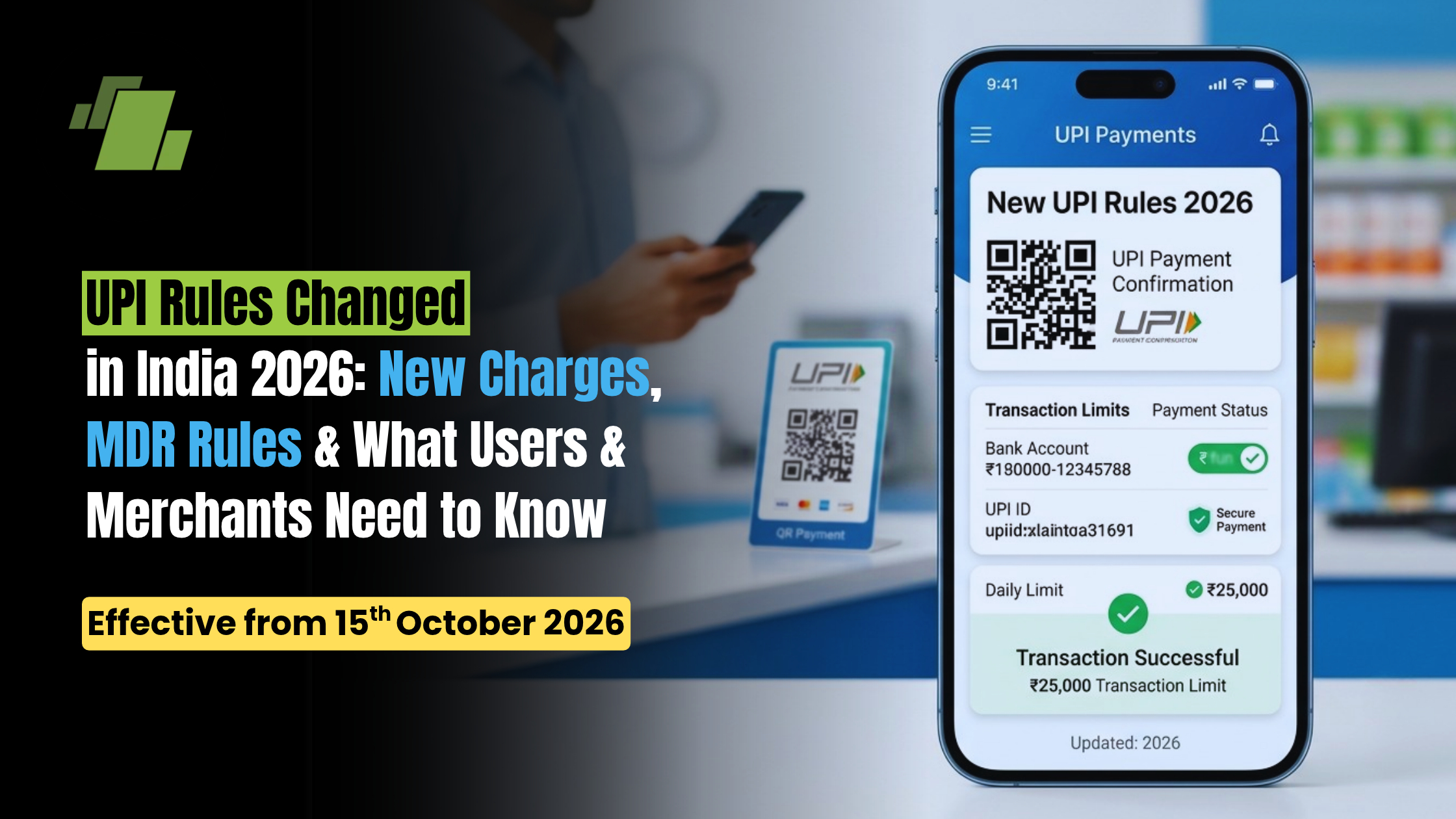
From 15 October 2026, the upi new rules 2026 in India add a 0.4% Merchant Discount Rate (MDR) on specified person-to-merchant UPI payments above ₹2,000, with caps and exemptions for small merchants and selected sectors. Person-to-person transfers and merchant UPI payments up to ₹2,000 stay free, and customers are not directly charged this fee the MDR is borne by merchants.
If you run a retail, distribution, or manufacturing business, manage merchant payments, or use ERP software to track billing and collections, these changes directly affect how you price, reconcile, and monitor digital transactions. This guide explains the new UPI MDR rules, when they apply, which transactions remain free, whether any charge can be passed to customers, why the policy is changing, the likely business impact across industries, and how LOGIC ERP can help you track payment records, reconcile invoices, and control MDR-related costs.
Introduction: UPI New Rules 2026 in a Nutshell
UPI has become the default way India pays. From kirana counters to enterprise invoices, the Unified Payments Interface now handles billions of transactions every month, making cash secondary for a growing share of businesses and individuals. In July 2026 alone, UPI processed 2,366 crore transactions worth approximately ₹29.9 lakh crore.
That scale is exactly why things are changing. From 15 October 2026, new UPI payment rules introduce a Merchant Discount Rate on select merchant payments. The key takeaways upfront:
- Person to person transfers and merchant payments up to ₹2,000 remain free.
- Above ₹2,000, specified merchant UPI transactions attract a 0.4% MDR, with caps and sector-specific rates.
- Customers are not charged MDR directly. It is a merchant-side cost.
- Roughly 96% of merchant UPI payments by volume are expected to stay unaffected.
For businesses, the question is no longer whether digital payments matter but how to track UPI transaction limits, MDR costs and bank settlements inside their operations. This article breaks down the rules, the impact across industries, and how ERP software from LOGIC ERP can help companies stay on top of the change.
What Are the New UPI Rules in India in 2026?
The Unified Payments Interface introduced a revised Merchant Discount Rate framework in 2026, ending the blanket zero-MDR regime that had been in place since January 2020. The government and the National Payments Corporation of India (NPCI) now distinguish between two types of UPI transactions for charging purposes:
- P2P (person to person): Sending money to friends, family or individuals. Completely free, no matter the amount.
- P2M (person to merchant): Paying a business, shop or service provider. Free up to ₹2,000 per transaction. Above that threshold, MDR applies based on category.
The new UPI rules do not introduce any customer-side fee. MDR is an ecosystem charge settled between banks, payment service providers and merchants. Here is a quick summary:
- P2P UPI payments stay free for all individuals, regardless of value.
- P2M UPI payments up to ₹2,000 per transaction carry zero MDR.
- Above ₹2,000, the applicable MDR depends on the merchant’s sector and transaction size.
- The framework takes effect on 15 October 2026.
What Is UPI MDR?
Merchant Discount Rate is a fee paid within the payment ecosystem whenever a customer makes a qualifying UPI payment to a merchant. It is borne by acquiring banks, payment service providers and UPI app operators, and is effectively deducted from the merchant’s bank settlement, not added to the customer’s bill.
UPI MDR is different from a “UPI transaction fee” charged to customers at checkout. Under the stated framework, merchants and apps cannot show MDR as a separate line item to the customer. UPI MDR charges exist because infrastructure maintenance, cybersecurity, dispute handling and innovation cost money. As UPI volumes scaled into the billions, a modest revenue stream became necessary for the ecosystem to remain financially sustainable.
When Will the New UPI MDR Rules Take Effect?
The new UPI MDR rules are scheduled to apply from 15 October 2026 across specified categories of merchant UPI transactions. The policy timeline is straightforward: zero-MDR regime from January 2020, legislative amendment via the Taxation and Other Laws (Amendment) Bill 2026 (signed into law around August 2026), and NPCI notification in mid-September 2026 confirming categories and rates.
RBI, NPCI and government communications have focused on sustainability of UPI payments as the core rationale. A public interest litigation was filed on 16 September 2026, but unless the court issues a stay, the rules go live as notified. Businesses should treat 15 October 2026 as the practical cut-off to review contracts with banks and payment service providers and update their ERP and reconciliation processes.
Which UPI Transactions Will Remain Free?
- Person to person UPI payments between individuals remain free, regardless of amount, under the current framework. You can send money to friends, family or anyone with a UPI ID without incurring charges.
- P2M UPI payments up to ₹2,000 per transaction stay free for both customers and merchants in terms of MDR. No fee applies on either side.
- Eligible small merchants, for example those accepting up to ₹1 lakh per month via UPI QR under zero-MDR classification, continue under the zero-MDR regime. If their monthly inward QR receipts exceed ₹1 lakh for three consecutive months, they graduate into the standard MDR-paying category.
- UPI AutoPay and mandate-based transactions are also exempt regardless of value.
- The government states that approximately 96% of P2M UPI transactions by volume are expected to remain unaffected.
What Is the New UPI MDR Rate for Transactions Above ₹2,000?
Only specified P2M UPI payments above ₹2,000 will attract MDR, and rates differ by category. Some sectors have unique pricing structures instead of the standard MDR. Here is the breakdown:
UPI MDR 2026: Key Rates and Caps
| Transaction Category | MDR / Treatment |
|---|---|
| P2P UPI | Free |
| P2M up to ₹2,000 | Free |
| Specified P2M above ₹2,000 | 0.4% |
| Transactions ₹75,000 and above | ₹300 cap |
| Specified essential sectors (railways, telecom, insurance, fuel, agricultural inputs, utility bills) | ₹5 flat MDR |
| Mutual funds / securities / stockbrokers / dealers | 0.02%, capped at ₹300 |
- MDR of 0.4% applies to transactions above ₹2,000 from October 2026 for standard merchant payments. A ₹50,000 electronics purchase via UPI means the merchant pays ₹200 in MDR.
- Transactions above ₹2,000 have a maximum MDR cap of ₹300. So a ₹1,00,000 payment still costs only ₹300, not ₹400.
- Essential sectors like railways, telecom, fuel and insurance attract a flat ₹5 MDR per transaction above ₹2,000. A ₹10,000 fuel station payment costs the merchant ₹5 instead of ₹40.
- Capital-market UPI payments (mutual funds, stocks, securities) attract just 0.02%, capped at ₹300. A ₹10,000 mutual fund investment via UPI costs ₹2 in MDR.
Will Customers Have to Pay UPI Charges?
For most users, UPI payments remain free. No extra fee applies for UPI transactions at shops or online, even after October 2026. P2P transfers and payments up to ₹2,000 remain free. The MDR is settled in the backend between banks, payment providers and merchants. Customers pay only the billed amount.
To illustrate: if you shop for ₹3,000 at a store and pay via your UPI app, you pay exactly ₹3,000. The merchant receives ₹3,000 minus MDR (0.4% = ₹12) in their settlement from the merchant’s bank. No additional charge appears on your account.
Is the New UPI MDR Charged to Customers?
MDR is not a line item on the customer’s UPI transaction. It is part of merchant-side processing costs. Approved UPI apps and banks cannot legally add hidden “UPI convenience fees” that are actually MDR. Any such attempt would be a policy violation.
Customers may still face non-UPI fees, for example wallet top-up charges or platform service fees on certain apps, but these are different from regulated UPI MDR. If you see an unexplained “UPI charge” added by a merchant or app, raise a complaint with the platform or your bank.
Can Merchants Pass UPI MDR to Customers?
The government’s stance is clear: merchants cannot pass MDR charges directly to customers. MDR is meant to be absorbed within merchant pricing or margins, not shown as a separate charge to the customer. Some merchants may adjust prices or offer cash discounts, but directly labelling a fee as “UPI extra charge” goes against the framework.
Regulators and consumer bodies monitor such practices. Merchants should treat MDR as a cost to be managed through pricing strategy, ERP-based cost tracking and payment-mode analysis rather than visible surcharges.
Why Are UPI Rules Changing in India?
The new regulations aim to balance the costs associated with digital payments while protecting consumers. UPI’s zero-MDR period created sustainability concerns for banks, payment service providers and UPI app operators who bear infrastructure costs for servers, cybersecurity, dispute handling, customer support and ongoing innovation.
The new MDR framework aims to provide revenue for maintaining the digital payment infrastructure. NSE expects short-term volume impact from new MDR charges, though transaction volumes are expected to normalize over time post-MDR. Digital payment service providers or banks may face new revenue streams from MDR. The ecosystem participants who benefit include:
- Issuing banks (customer’s bank)
- Acquiring banks (merchant’s bank)
- Payment service providers and aggregators
- UPI app providers (PhonePe, Google Pay, etc.)
- NPCI, which operates the UPI rails
How Will New UPI Rules Affect Businesses?
The real impact of new UPI rules 2026 is on merchants and businesses, not everyday consumers. The effect varies by average ticket size, share of UPI in overall collections, sector and whether most invoices are above or below ₹2,000. Changes in retail and large-ticket transaction behavior may occur due to the introduction of MDR.
Businesses need accurate tracking of UPI payments, UPI transaction limits, MDR costs and bank settlements inside their ERP or accounting software. LOGIC ERP serves multiple verticals and can unify billing, inventory and UPI payment reconciliation across retail, distribution and manufacturing.
Impact of New UPI Rules on Retail Businesses
Retail is where UPI payments are most visible. MDR mainly affects higher-value UPI bills above ₹2,000, so impact will differ significantly for kirana stores versus electronics or lifestyle showrooms. Retailers must separate UPI collections from cash, cards and other modes in their ERP to analyse MDR exposure and margins correctly.
Supermarkets and Grocery Stores
Supermarkets and grocery stores run high volumes of low-to-mid value UPI payments across many billing counters every day. Many grocery transactions stay under ₹2,000, but larger family bills can cross this threshold and attract MDR. LOGIC ERP supermarket billing software connects POS billing, UPI payments, real-time inventory updates and end-of-day reconciliation. Features like payment-mode wise MIS reports, cashier-wise collections and automated matching of UPI transaction IDs with invoices reduce manual effort.
Apparel and Fashion Retail
Apparel and fashion stores often have higher average bills, so more UPI receipts will cross ₹2,000 and fall under the 0.4% MDR. Size, colour and style SKUs add complexity, alongside seasonal discounts, returns and exchanges. LOGIC ERP’s apparel retail solution shows UPI collections by store, brand and price range, helping owners measure MDR impact on margins. Multi-store chains and franchise models get consolidated UPI payment and MDR analytics at the head-office level.
Footwear Retail
Footwear stores manage size-wise and style-wise inventory with typically mid to high ticket sizes, many above ₹2,000. LOGIC ERP footwear POS links each bill to UPI payment details, ensuring accurate stock and revenue reporting. Chains can analyse which branches see the highest share of high-value UPI payments subject to MDR, and daily reconciliation prevents discrepancies in multi-counter showrooms.
Pharma and Healthcare Retail
Pharmacies process a mix of low-value OTC sales and higher-value prescription bills, often with batch and expiry constraints. LOGIC ERP pharmacy retail software tracks batch, expiry, MRP, returns and UPI receipts together, which is crucial for audits and compliance. Pharmacies near hospitals may have many bills above ₹2,000, making MDR analysis important for profitability.
FMCG Retail
FMCG outlets and mini-marts are high-volume, promotion-heavy environments where UPI payments dominate merchant transactions. LOGIC ERP supports multiple offers, schemes and payment modes, making it easier to see MDR impact per category or brand. Daily and monthly dashboards show UPI transaction volumes, discounts and net margins, and automated reconciliation reduces manual spreadsheet work in FMCG retail chains.
Food & Beverage Retail
Restaurants, cafés, bakeries and QSRs rely on fast UPI payments at the counter and table-side QR codes. LOGIC ERP’s food and beverage POS maps each bill and table to payment mode and pushes data straight to accounts. Higher-value group bills above ₹2,000 can attract MDR, and shift-level tallying of UPI receipts with POS data prevents day-end shortages.
Electrical & Electronics Retail
Electronics stores typically have high-value invoices for mobiles, appliances and gadgets, so most UPI payments will fall under MDR. LOGIC ERP electronics retail software captures serial numbers, warranties and UPI collections per invoice. Accurate reconciliation between bank settlements and ERP prevents revenue leakage, especially during big-ticket seasonal sales.
Lifestyle & Fashion Retail
Lifestyle, cosmetics, jewellery and home décor outlets see frequent, often high-value UPI payments. LOGIC ERP’s lifestyle retail solution consolidates multi-store UPI collections, loyalty programs and omnichannel orders. Owners can view payment-mode wise profitability reports to see how MDR influences net margin per category.
Wellness, Spa & Salon Businesses
Salons and spas handle service billing, packages, memberships and product sales, with most payments now via UPI. LOGIC ERP links each appointment or package invoice to the UPI transaction, whether prepaid or postpaid. Tracking MDR on high-value annual packages above ₹2,000 and integrating it into profitability analysis is straightforward through branch-wise UPI collection reports.
Hardware, Paints & Building Material Businesses
Hardware and building-material stores see large, invoice-based transactions where UPI payments above ₹2,000 are routine. LOGIC ERP manages multiple units of measurement, item categories and UPI-based collections for contractors and retail customers. Businesses must monitor MDR cost impact on bulk orders and can reconcile part-payments in UPI, cash and bank transfers against the same invoice.
Impact of UPI Changes on Distribution Businesses
Distributors increasingly collect dues from retailers via UPI, making MDR and settlement tracking critical. UPI payments are often tagged to multiple invoices and credit notes, requiring strong ERP-based matching. LOGIC ERP provides specialised distribution ERP modules to manage collections, outstanding balances and UPI transaction reconciliation.
FMCG Distribution
FMCG distributors use UPI for quick retailer collections on beat routes and in remote areas. LOGIC ERP’s FMCG distribution module links each UPI transaction to invoice numbers, territory and salesman for accurate outstanding tracking. Mobile apps for field collection entry sync automatically with central ERP, and high-value UPI receipts where MDR may apply are visible within distributor margin analysis.
Pharma Distribution
Batch and expiry tracking alongside retailer-wise UPI collections is central to pharma distribution. LOGIC ERP’s pharma distribution module reconciles UPI receipts to ledger accounts, credit limits and ageing. Many pharmacy payments aggregate above ₹2,000, so distributors must understand MDR impact and track GST, credit notes and UPI settlement mismatches inside ERP.
Apparel & Footwear Distribution
Dealer payments via UPI for apparel and footwear consignments often come in large order values. LOGIC ERP manages order-wise and season-wise UPI receipts, returns and scheme claims. MDR on high-value collections is visible in distributor P&L dashboards, and payment-mode filters in sales and collection reports help management plan accordingly.
Textile Distribution
Textile distributors handle large B2B invoices and partial UPI payments from retailers. LOGIC ERP supports matching multiple UPI transactions to a single high-value invoice. Accounting for MDR while negotiating trade discounts and cash discounts is important, and territory-wise collections with UPI penetration analysis are available inside MIS.
Electrical & Electronics Distribution
Electrical and electronics distributors receive big-ticket payments, many via UPI, which fall under MDR. LOGIC ERP tracks serial numbers, warranty info and collection status alongside UPI receipts. Auto-matching bank UPI settlement files with ERP prevents under or overstatement of revenue.
Lifestyle & Fashion Distribution
Lifestyle and fashion distributors deal with multi-brand retailers paying via UPI and bank transfers. LOGIC ERP consolidates UPI collections by city, brand and channel, improving credit management. MDR is tracked against overall trade margins per brand or line, and omnichannel wholesale and retail flows are supported.
Auto-Parts Distribution
Auto-parts distributors collect from workshops, retailers and dealers where UPI is now common. LOGIC ERP manages complex catalogues, part numbers and UPI-linked invoices. High-value B2B UPI payments attract MDR and must be visible in profitability reports per customer. The system also monitors overdue payments and automates reminders, independent of payment mode.
Impact of UPI Changes on Manufacturing Businesses
Manufacturers often receive UPI payments from distributors, stockists and B2B buyers, especially for smaller batches and quick clearances. UPI MDR is just one part of overall financial costs, but still needs to be tracked by product, region and customer type. LOGIC ERP manufacturing modules integrate production, inventory, sales and collections, including UPI payments.
Apparel Manufacturing
Apparel manufacturers manage orders, production and finished goods shipments, then collect payments via UPI and bank modes. LOGIC ERP captures the full cycle from sales order to invoice to UPI transaction, enabling margin analysis including MDR. Smaller dealer payments may increasingly shift to UPI, making reconciliation of advance payments, part shipments and UPI receipts essential.
Garment Manufacturing
Job-work and own-production scenarios involve billing multiple buyers and receiving UPI payments. LOGIC ERP allocates UPI receipts to specific invoices and contracts. MDR costs can be captured in cost centres or ledgers to see their effect on net manufacturing margins, with MIS reports showing customer-wise UPI collections and payment behaviour.
Footwear Manufacturing
Footwear manufacturers deal with size, colour and style matrices and shipments to distributors and retailers. LOGIC ERP records UPI receipts as part of the standard receivables module, linked to dispatches. Large payments above ₹2,000 are standard here, so MDR must be captured and reported through periodic reconciliation between bank statements and ERP.
Textile Manufacturing
Raw material procurement, production and B2B billing are typical in textile manufacturing. While many high-value payments use NEFT or RTGS, some smaller or urgent payments come via UPI. LOGIC ERP classifies payments by mode and value band, helping identify where MDR applies and tying that to sales-region profitability analysis.
FMCG Manufacturing
Batch-managed FMCG production and distribution involves multiple downstream distributors and stockists. UPI payments may come in from smaller distributors or modern trade for quick settlements. LOGIC ERP aggregates UPI collections across distributors and maps MDR cost to specific brands or SKUs, supporting GST, pricing, schemes and payment-mode based margin calculations.
Food & Beverage Manufacturing
Food and beverage manufacturers handle batch and lot tracking, expiry, quality controls and wide distribution networks. UPI may be used for smaller dealer payments and urgent clearances, falling under the new MDR regime. LOGIC ERP reconciles UPI payments against invoices and batches for full audit trails, with payment-mode filters in financial and sales dashboards.
Electrical & Electronics Manufacturing
BOM, components, production and serial-number tracking are common to electronics manufacturers. LOGIC ERP ties high-value invoices, warranties and payments including UPI in one integrated record. UPI MDR on B2B receipts above ₹2,000 is visible to finance teams during costing and pricing decisions, integrated with accounts receivable ageing.
Auto-Parts Manufacturing
BOM-based auto-parts production and sales to distributors, workshops and retailers require detailed tracking. LOGIC ERP maps UPI collections to part-wise sales and customer accounts for better receivables control. MDR needs to be captured as a separate expense head linked to UPI receipts, with analytics on dealer-wise payment habits including share of UPI versus bank transfers.
How ERP Software Can Help Businesses Manage UPI Transactions?
This is where the operational rubber meets the road. ERP should bind together invoice creation, UPI payment capture, bank settlements and accounting entries. Without integrated ERP, businesses risk unmatched UPI payments, manual spreadsheets and errors in GST and financial reporting.
Connect Billing With Payment Records
The ideal flow is: Sale → Invoice → UPI Transaction → Bank Settlement → Reconciliation → Accounts posting. LOGIC ERP captures UPI reference numbers and payment modes directly at POS or billing screens. Entries auto-post into ledgers and customer accounts once payment is confirmed, reducing manual data entry and mismatch disputes.
Track Payment Mode-Wise Sales
Separating UPI, cash, card, BNPL and other digital payments in reports is critical for analysing MDR and bank charges. LOGIC ERP dashboards show daily, weekly and monthly UPI collections versus total sales, with filters by store, channel, counter and user to identify where UPI has the highest share.
Reconcile UPI Payments With Invoices
Common issues include customers paying without mentioning invoice numbers, duplicate transfers or bank settlements not matching POS data. LOGIC ERP supports automated or semi-automated mapping of UPI transaction IDs to invoices and customer accounts, with alerts for unmatched or excess payments. This drastically reduces reconciliation time compared to manual spreadsheets.
Monitor Store-Wise UPI Collections
Retail chains and franchises can use LOGIC ERP to view UPI collections per store, region and format. Management can quickly identify anomalies and combine UPI data with footfall and sales to understand customer payment preferences per outlet. This is also useful for franchise audits and revenue-sharing calculations.
Monitor High-Value Transactions
New UPI MDR rules kick in above ₹2,000, so businesses need visibility of high-value UPI transaction volumes. LOGIC ERP reports list UPI transactions by value bands (0–₹2,000, ₹2,001–₹10,000, and so on). Finance teams use these reports to estimate MDR costs and adjust pricing or offers accordingly.
Integrate Sales, Inventory and Finance
UPI data should not sit in isolation. It must link to POS, inventory, warehouse and accounts modules. LOGIC ERP connects sales orders, stock movements and UPI receipts for a single source of truth. This supports tighter GST compliance, more accurate stock valuation and cleaner financial statements, while also feeding CRM, loyalty, ecommerce and B2B portals with consistent payment data.
How LOGIC ERP Helps Businesses Adapt to Changing Digital Payment Rules?
LOGIC ERP is a comprehensive platform that goes beyond accepting UPI payments to managing the full business impact of digital payment rule changes. The same system supports retail, distribution and manufacturing, helping businesses scale as UPI rules evolve.
POS & Billing
LOGIC ERP Retail POS Software is the front-line system capturing item details, taxes, discounts and payment modes including UPI. Features like QR-based UPI acceptance, split payments and real-time sync with back-office modules provide the foundation for accurate MDR analysis across supermarkets, apparel stores and pharmacies.
Inventory Management
Every UPI-paid sale adjusts inventory in real time, reflected in stock ledgers. Support for batch and expiry, serial numbers, sizes and colours across industries ensures that accurate inventory plus payment data lets businesses see real net margins after MDR and other costs. Multi-location stock visibility is built in.
Accounts & Finance
LOGIC ERP posts UPI collections directly into cash and bank ledgers with appropriate contra or receipt entries. Automatic or rule-based allocation of MDR and bank charges to expense accounts simplifies tracking. Robust GST, TDS and statutory reporting tools rely on accurate transaction and payment records, making audits and monthly closing faster.
MIS Reporting
Managers need real-time MIS reports on sales, UPI collections, MDR costs and profitability. LOGIC ERP offers dashboards, pivot views and exportable reports filtered by business unit, date range and payment mode. MIS can show trends before and after October 15, 2026 to quantify MDR impact over time.
Business Insights
Advanced analytics reveal which categories, stores or customer segments rely most on UPI payments. LOGIC ERP helps correlate UPI usage with repeat purchases, bill values and discounts. These insights support data-driven decisions around MDR management, promotion strategies and payment-mode steering.
Multi-Store Management
For chains with many outlets, franchises and formats, LOGIC ERP provides multi-store retail POS capabilities. Central monitoring of UPI collections, settlement delays and MDR costs across locations is available, along with tools for store ranking based on sales, UPI share and profitability.
Warehouse Management
Warehouses supply goods to stores and distributors whose payments may arrive via UPI. LOGIC ERP links dispatches from warehouses to invoices and payment statuses. Reconciling UPI receipts with dispatches reduces stock and revenue mismatches, especially useful for large FMCG, pharma and electronics operations.
Distribution Management
LOGIC ERP’s distribution tools cover order processing, routing, dispatch and UPI-based collections. Support for beat planning, credit limits and outstanding tracking including UPI payments means MDR exposure can be viewed by distributor, region or channel.
Manufacturing Management
Production planning, BOMs, job work and finished goods are linked to customer orders. Accounts receivable from distributors or clients can be settled via UPI and reflected in production profitability. Cross-module traceability from raw material to payment receipt is built into the platform.
Ecommerce & Omnichannel Integration
LOGIC ERP connects ecommerce portals, marketplaces and in-store POS where UPI is a primary payment mode. Unified inventory and payment reconciliation across online and offline channels means UPI MDR and other fees from gateways can be captured per channel and order type. Omnichannel retailers see consolidated UPI collections in one place.
UPI MDR vs ERP Payment Reconciliation: What’s the Difference?
These are two distinct concepts that often get confused. One is an ecosystem charge, the other is an accounting process.
| UPI MDR | ERP Payment Reconciliation |
|---|---|
| Payment ecosystem charge | Business accounting process |
| Applies to specified transactions | Applies to all business transactions |
| Determined by UPI framework | Managed through ERP/accounting systems |
| Related to payment acceptance | Matches payments with invoices/sales |
| Merchant-side cost | Operational/financial control |
- Even with zero MDR on many UPI payments, ERP reconciliation is still essential to match every UPI transaction against sales and ledgers.
- LOGIC ERP focuses on the reconciliation side. MDR rates are defined externally by the UPI framework and banks.
- Both matter: MDR affects your costs, reconciliation ensures your books are accurate.
What Should Businesses Do Before the New UPI Rules Take Effect?
Here is a practical checklist for merchants preparing for October 15, 2026:
- Review average transaction values and the share of UPI payments above ₹2,000.
- Identify product lines and stores where high-value UPI transactions are common.
- Confirm your merchant classification and applicable MDR with your bank or PSP.
- Review UPI settlement reports and dispute processes from payment partners.
- Separate UPI, card, cash and wallet sales in your ERP and accounting systems.
- Implement or fine-tune ERP-based UPI reconciliation workflows.
- Train staff at POS and finance teams on the new UPI payment rules.
- Track MDR and other payment charges as explicit cost heads in ERP.
- Revisit pricing and discounts on high-value categories if MDR impact is significant.
- Use LOGIC ERP MIS reports to monitor store and location-wise UPI collections and margins.
Starting this preparation before October 2026 will avoid last-minute confusion. Treat UPI and digital payments as an integrated part of business strategy, not just a technical add-on.
UPI New Rules 2026 – Industry-Wise Impact
| Industry | Key Concern | ERP Requirement |
|---|---|---|
| Supermarket | High transaction volume | POS + billing + inventory |
| Apparel | High-value/variant sales | Retail ERP + POS |
| Pharmacy | Billing + batch/expiry | Pharma ERP |
| Electronics | High-value invoices | Inventory + billing |
| FMCG Distribution | Collections | Distribution ERP |
| Apparel Manufacturing | Orders & production | Manufacturing ERP |
| Textile | B2B collections | ERP + finance |
| Food & Beverage | Fast billing | POS + inventory |
| Salon & Spa | Service billing | Business management software |
| Hardware | Large-value orders | Billing + inventory |
| Auto Parts | Dealer collections | Distribution ERP |
LOGIC ERP offers solutions across all these verticals, helping firms handle UPI payments, MDR and reconciliation seamlessly. While UPI rules are the same nationally, their effect is industry-specific, and ERP support must be tailored accordingly.
Conclusion
For consumers: UPI remains free for P2P transfers and everyday merchant payments up to ₹2,000. MDR is not a charge you pay directly. Your UPI PIN authorised payment goes through at the exact billed amount.
For merchants: From 15 October 2026, specified higher-value P2M UPI payments will have MDR implications. The standard 0.4% rate, the ₹300 cap and sector-specific categories mean the actual impact varies, but monitoring your payment mix is no longer optional.
For businesses: Accurate billing, payment reconciliation, financial reporting and transaction visibility become increasingly important. Seamless integration of UPI payments with inventory, accounts and MIS via ERP like LOGIC ERP is essential to stay compliant, control MDR impact and maintain healthy margins.
As UPI rules, UPI AutoPay use and UPI transaction limits continue to evolve, having a robust ERP backbone will help businesses adapt quickly and confidently. Disclaimer: this article is for education and informational purposes. The LOGIC ERP team is responsible for the article content, but specific MDR applicability may differ based on merchant classification, bank agreements and regulatory updates. Always verify the latest updates with authorised sources before making compliance or business decisions.

Call at +91-73411-41176/75 or send us an email at sales@logicerp.com to book a free demo today!
Frequently Asked Questions About New UPI Rules 2026
1. What are the new UPI rules in India in 2026?
From 15 October 2026, specified P2M UPI payments above ₹2,000 attract MDR (0.4% in most cases, with caps and special rates for essential sectors and capital markets). P2P and low-value merchant UPI payments remain free. Other 2026 updates include enhanced security measures that require multi-factor authentication for UPI transactions, and on-device biometric authentication has been introduced for UPI payments. These changes aim to make the UPI ecosystem financially sustainable while keeping most everyday transactions free.
2. Will UPI become chargeable for customers?
Under the current framework, UPI remains free for customers for standard bank-to-bank UPI payments in shops, online and P2P transfers including transferring funds to friends or family. Customers are not supposed to see MDR as a separate charge on their bills. Some value-added services like wallets or third-party platforms may have their own fees, which are distinct from UPI MDR. Question any explicit “UPI extra charge” added by a merchant.
3. Is UPI free below ₹2,000?
P2P UPI payments are free regardless of amount. P2M UPI payments up to ₹2,000 per transaction are free from MDR under the 2026 rules. Certain small merchants continue under a zero-MDR regime even above this threshold, based on government classifications. This policy keeps most everyday payments for groceries, local travel and small bills free. Businesses with many low-ticket sales should confirm their small-merchant status with banks if applicable.
4. What is the new UPI MDR rate?
A 0.4% MDR applies to P2M transactions above ₹2,000. MDR is capped at ₹300 per transaction for P2M payments of ₹75,000 and above. Essential sectors attract a flat ₹5 MDR, and capital-market UPI payments for mutual funds and stocks incur 0.02%, capped at ₹300. Actual applicability depends on transaction type, merchant category and bank or PSP agreements.
5. When will UPI MDR start?
The new UPI MDR framework is scheduled to start from 15 October 2026. Businesses should use the period before this date to align contracts, systems and ERP reconciliation processes. Some banks or PSPs may communicate additional operational details closer to the date. Keep an eye on official RBI, NPCI and bank communications for any refinements.
6. Who will pay the new UPI MDR?
MDR is part of the merchant-side payment ecosystem cost, typically settled between the acquiring bank or PSP and the merchant. It is not to be directly charged to the customer as a separate fee on the bill. In practice, MDR reduces the net amount credited to the merchant after processing fees. Merchants should account for MDR as an expense line item and monitor it via ERP.
7. Does UPI MDR apply to small merchants?
Under the updated framework, zero-MDR benefits continue for specified small merchants, for example those with UPI QR collections up to ₹1 lakh per month per the notified criteria. Classification depends on parameters defined by the government, NPCI and banks. Small merchants should confirm with their bank or PSP whether they qualify. LOGIC ERP can still help such merchants track UPI collections and reconcile them cleanly.
8. Does UPI MDR apply to supermarkets?
Supermarkets and large-format groceries typically fall outside the protected small-merchant bracket, so higher-value UPI payments above ₹2,000 will attract MDR. Individual low-value UPI payments up to ₹2,000 remain free, even at supermarkets. Chains should use ERP reports to understand what proportion of bills cross the MDR threshold.
9. Does UPI MDR apply to apparel stores?
Apparel stores, especially branded and chain outlets, are generally subject to MDR on UPI payments above ₹2,000. Many apparel bills fall in this range, making MDR a relevant cost component. Apparel retailers should track MDR as a percentage of category sales inside their ERP.
10. How will UPI MDR affect high-value retail transactions?
High-value retail transactions for electronics, jewellery, premium fashion and furniture will commonly attract MDR when paid via UPI. The daily UPI transaction limit is ₹1 lakh, while certain transactions can have limits up to ₹5 lakh per transaction depending on the category. There is no fixed monthly cap for UPI transactions, though in the context of business finance planning for high-value retail collections, monthly flow still matters. Businesses may adjust pricing strategies or offer targeted discounts depending on MDR impact. ERP-based high-value UPI transaction monitoring and margin reporting is essential. Retailers should manage MDR within overall pricing rather than passing it as explicit surcharges.
11. How can ERP software help with UPI payment reconciliation?
ERP software like LOGIC ERP automatically links UPI payments to invoices, bank settlements and ledgers. Features include payment-mode wise reports, auto-matching against bank files and alerts for discrepancies. This reduces manual errors, speeds up closing and improves visibility into MDR and other payment charges. Integrated reconciliation is crucial when daily UPI volumes are high.
12. Can LOGIC ERP manage UPI-related sales and payment reporting?
LOGIC ERP is built to manage UPI-related sales, collections and reporting across retail, distribution and manufacturing businesses. UPI data flows from POS and billing screens into inventory, finance and MIS modules. Store-wise, customer-wise and category-wise UPI reporting capabilities are available. If you want a single system of record for sales, stock and UPI payments, LOGIC ERP is designed for exactly that.
13. Which industries does LOGIC ERP support?
LOGIC ERP serves supermarkets and grocery, apparel and footwear, pharma and healthcare retail, FMCG, food and beverage, electrical and electronics, lifestyle, wellness and salon, hardware and building materials, apparel, garment, footwear and textile manufacturing, FMCG and food and beverage manufacturing, electrical and electronics manufacturing, auto-parts and multi-channel distribution. The same ERP platform adapts for both small businesses and large enterprises. Across all industries, UPI payment tracking, MDR cost visibility and reconciliation are part of the core offering.
14. What are the new UPI rules in India 2026?
The new UPI rules in India for 2026 introduce a Merchant Discount Rate (MDR) of 0.4% on specified person-to-merchant (P2M) UPI transactions above ₹2,000, effective from October 15, 2026. Person-to-person (P2P) transfers and merchant payments up to ₹2,000 remain free. The MDR is a merchant-side charge and not directly applied to customers.
15. Will UPI become chargeable for customers under the new UPI payment rules?
No, UPI remains free for customers for all person-to-person transfers and merchant payments up to ₹2,000. The new UPI charges 2026 apply as MDR to merchants only and cannot be passed on as a separate fee to customers.
16. Is UPI free below ₹2,000 according to the new UPI transaction limits?
Yes, UPI transactions below ₹2,000 remain free for both customers and merchants. This exemption helps maintain widespread adoption of digital payments for everyday purchases.
17. What is the new UPI MDR rate for transactions above ₹2,000?
The UPI MDR 2026 rate is 0.4% on person-to-merchant transactions exceeding ₹2,000, capped at ₹300 for transactions ₹75,000 and above. Certain essential sectors have a flat ₹5 MDR, while capital market transactions incur 0.02% MDR capped at ₹300.
18. When will the new UPI MDR start?
The new UPI MDR rules take effect from October 15, 2026. Businesses and merchants should prepare their payment systems and ERP software to comply with the updated UPI payment rules by this date.
19. Who will pay the new UPI MDR charges?
Merchants bear the UPI MDR charges as part of the payment ecosystem costs. Customers do not pay MDR directly; it is deducted from the merchant’s settlement amount by banks or payment service providers.
20. Does UPI MDR apply to small merchants?
Certain small merchants with monthly UPI QR collections up to ₹1 lakh remain exempt under the zero-MDR regime. If their collections exceed this threshold, they become liable for the new MDR charges.
21. Does UPI MDR apply to supermarkets?
Yes, supermarkets with high-value UPI transactions above ₹2,000 will incur MDR charges. Low-value transactions under ₹2,000 remain free.
22. Does UPI MDR apply to apparel stores?
Apparel stores, especially those processing higher-value UPI payments above ₹2,000, will be subject to the new MDR charges as per the 2026 UPI rules.
23. How will UPI MDR affect high-value retail transactions?
High-value retail transactions above ₹2,000 will attract a 0.4% MDR capped at ₹300, impacting merchant costs. Businesses may need to adjust pricing or absorb MDR as a cost without passing it directly to customers.
24. How can ERP software help with UPI payment reconciliation?
ERP software like LOGIC ERP integrates billing, UPI payment capture, bank settlement, and reconciliation processes. It automates matching UPI transactions with invoices, tracks MDR costs, and provides detailed reports to manage payment charges efficiently.
25. Can LOGIC ERP manage UPI-related sales and payment reporting?
Yes, LOGIC ERP supports comprehensive management of UPI sales, collections, and payment reporting across retail, distribution, and manufacturing sectors. It offers store-wise, customer-wise, and category-wise UPI transaction analytics.
26. Which industries does LOGIC ERP support for UPI payment management?
LOGIC ERP supports supermarkets, apparel and footwear, pharma, FMCG, food and beverage, electronics, lifestyle retail, wellness and salons, hardware, manufacturing, and distribution industries, providing tailored ERP solutions for UPI payment tracking and MDR cost management.
27. What is a UPI ID and how is it used in digital payments?
A UPI ID, also known as a Virtual Payment Address (VPA), is a unique identifier that allows users to send and receive money digitally without sharing bank account details. It typically looks like an email ID, for example, name@bankname. Users can link their bank accounts to their UPI ID and use it to make instant payments via UPI apps by entering the UPI ID or scanning a QR code. This simplifies digital transactions, making payments quick, secure, and convenient for both person-to-person and person-to-merchant transfers.
28. How does UPI Autopay work and what are its benefits?
UPI Autopay is a feature that enables automated recurring payments through UPI. Users can set up a mandate to authorize scheduled payments for subscriptions, EMI, insurance premiums, SIPs, and other regular bills. Once authorized, the payment is automatically debited on the due date without needing manual intervention or entering a UPI PIN each time. The benefits of UPI Autopay include convenience, timely payments, reduced risk of missed dues, and seamless management of recurring expenses, enhancing user experience and financial discipline.

Author
Gurbir Singh
Co-founder & Managing Director | LOGIC ERP Solutions Pvt. Ltd.
With 30+ years of experience in the tech industry, I took the helm of technology & product development, ensuring LOGIC ERP’s continuous innovation & leadership in the evolving tech landscape.