How to Start a Boutique Business in India: Complete Guide, Costs & Business Plan

Summary
To start a boutique business in India, first choose your boutique format physical store, home-based, online, or omnichannel – then pick a niche, research your target market, create a business plan, register the business, arrange funding, source inventory, set up your store or website, and launch with marketing and reliable retail systems such as LOGIC ERP.
This guide is written for aspiring boutique owners in India, including fashion enthusiasts, homemakers, designers, merchandisers, and side-hustlers who want to turn a retail idea into a working business. It walks through boutique models and niches, market research, startup costs, legal requirements, inventory management, store setup, billing and POS, pricing, marketing, profitability, common challenges, and growth strategies.
Boutique retail continues to attract new entrepreneurs because India’s fashion market rewards curated, niche offerings, and social media plus online selling have lowered the cost of entry for small brands. With the right planning, product selection, and business systems, a boutique can start lean and scale profitably.
Table of Content
- Introduction
- What Is a Boutique Business?
- How a Boutique Business Works
- How to Start a Boutique Business in India
- Choose Your Boutique Business Type
- Choose a Boutique Niche
- Research Your Target Market
- Create a Boutique Business Plan
- How Much Does It Cost to Start a Boutique in India?
- Boutique Startup Cost Breakdown
- How to Start a Boutique from Home in India
- How to Start an Online Boutique Business
- Choose Your Online Boutique Model
- Set Up Your Online Store
- Market Your Online Boutique
- How to Choose Clothes and Products for a Boutique
- What to Consider When Selecting Boutique Products
- Boutique Store Requirements in India
- Business Requirements
- Store Requirements
- Technology Requirements
- How to Set Up a Boutique Store
- How to Manage Boutique Inventory
- Why Size and Color Inventory Management Matters
- How to Manage Boutique Billing and POS
- How to Price Boutique Products
- How to Calculate Boutique Profit Margin
- Is a Boutique Business Profitable?
- Boutique Business Ideas
- How to Market a Boutique Business
- Local Boutique Marketing
- Social Media Marketing
- Customer Retention
- How to Grow a Boutique Business
- Common Challenges When Starting a Boutique
- Boutique Business Startup Checklist
- Frequently Asked Questions About Starting a Boutique
- Final Thoughts
Introduction
A boutique business in India starts with picking a fashion niche, sourcing a focused inventory, setting up a store (physical, home-based, or online), handling registrations, and selling through channels where your target customers spend time. Launching a boutique requires careful planning and structured strategies. Startup costs range from ₹1 lakh for a home-based setup to ₹25 lakh or more for a physical store in a metro city, depending on location, interiors, and inventory depth.
Anyone with a sense of style and willingness to learn retail operations can start a boutique: fashion enthusiasts, homemakers, merchandisers, designers, and side-hustlers. The main business models are a physical clothing boutique, a home-based boutique, an online boutique, or a hybrid omnichannel setup combining two or more of these.
This guide walks through every stage: business plan, costs, legal requirements, sourcing, inventory management, marketing, profitability, and scaling. All figures, examples, and advice are specific to India.
What is a Boutique Business & Why It Works in India?
A boutique business is a small, curated retail format focused on a specific fashion niche. Instead of stocking thousands of generic styles, a boutique carries a deeper assortment within a narrow category: designer sarees, Indo-Western fusion wear, kidswear, bridal lehengas, or sustainable clothing made from handloom fabrics.
Here is how boutiques differ from other retail formats and why this model thrives in India:
- Depth over breadth. A department store carries dozens of brands across all categories. A boutique stocks fewer brands (or a single private label) but offers more sizes, colors, and styling options within its niche. Establishing a niche helps boutiques stand out in competitive markets.
- Personalization. Boutique owners typically offer styling help, alteration services, and one-on-one fitting assistance. Customer experience can be a competitive advantage for boutiques over larger retailers.
- India’s occasion economy. The wedding and festival calendar generates recurring demand for ethnic, occasion, and fusion wear throughout the year.
- Market scale. In Fiscal 2024, women’s ethnic and Indian wear held about 65.4% share of the women’s apparel market. The clothing boutique space reached $32 billion in revenue last year globally.
- Fusion and comfort trends. Lakme Fashion Week 2024 highlighted comfort-focused designs, modern-traditional fusion, and inventive prints. Successful boutiques often focus on curated and specialized offerings that align with these shifts.
- Lower entry barriers. Instagram, WhatsApp, and social media platforms have made it possible to launch an online store or home-based boutique with minimal capital and attract customers from day one.
Typical boutique customers in India include urban professionals in Tier-1 cities, college students, wedding shoppers, and festival buyers. They value uniqueness, fabric quality, fit, and a personal touch that mass retailers cannot match.
How a Boutique Business Actually Works (From Buying to Billing)
The retail cycle in a boutique follows a repeatable loop:
- Source products from wholesalers, manufacturers, or artisans.
- Receive inventory, generate barcodes, and organize items by style, size, and color.
- Display products in-store on racks and mannequins or photograph them for online listing.
- Sell and bill through POS or online order; collect payment via UPI, card, or cash.
- Collect customer data: name, contact, sizing preferences, purchase history.
- Analyze sales trends: which SKUs sell fastest, which sizes pile up.
- Reorder fast movers and reduce or clear slow movers.
Consider a women’s kurti boutique in Jaipur. The owner sources block-print kurtis from local artisans, ordering 20 pieces per design across sizes S to XL. Each kurti receives a barcode with a style code, size, and color code. In the shop, items are displayed by size and color. Online, photos are taken with size charts. Monthly reports reveal that “Block Print Floral Kurti, Red, Size M” is the top seller; the owner reorders that pattern while reducing the less popular XL count.
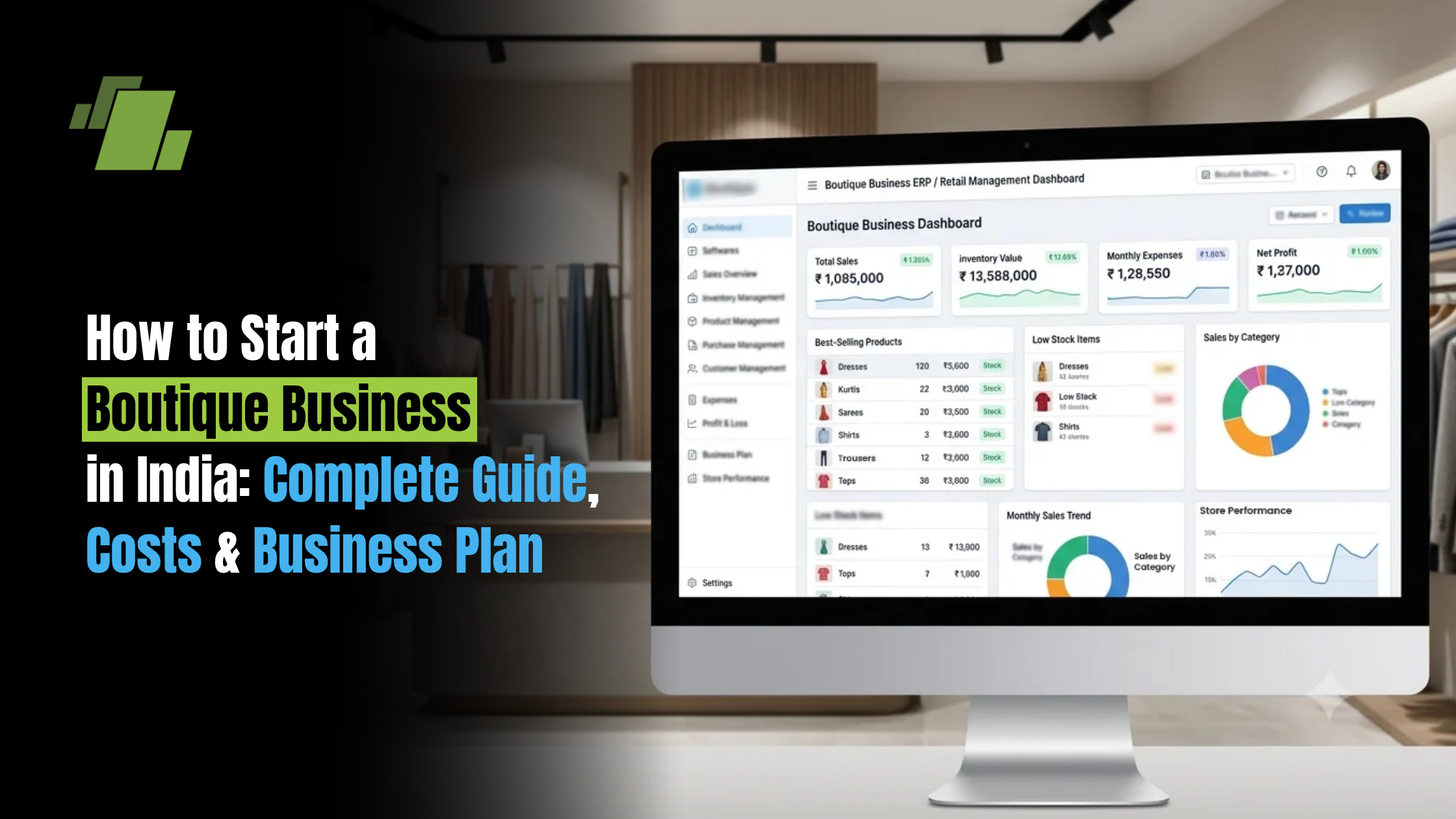
Efficient inventory management prevents unsold stock from tying up cash. Boutiques should track key performance metrics to inform business decisions. Once variants cross 300 to 500 style-size-color combinations, manual tracking in notebooks or basic spreadsheets breaks down. Systems like LOGIC ERP’s retail apparel software handle shade-size matrix inventory, real-time stock, and dead-stock reports from one dashboard.
Boutiques that also sell through WhatsApp, Instagram, or online marketplaces face additional complexity: order fulfillment, shipping logistics, return handling, and stock synchronization across channels.
How to Start a Boutique Business in India: Step-by-Step
This is the core roadmap. Whether you are planning a clothing boutique, an accessories store, or a mixed fashion setup, the sequence is similar:
- Choose your boutique business type (physical, home-based, online, omnichannel).
- Pick a fashion niche (ethnic wear, Western wear, bridal, kidswear, sustainable clothing).
- Conduct market research on local demand, competition, and pricing.
- Create a boutique business plan covering finances, suppliers, and marketing.
- Decide your business structure (sole proprietorship, LLP, private limited).
- Register and get licenses (Shop & Establishment, trade license, GST if applicable).
- Arrange finance (savings, family funding, bank loan, MSME schemes).
- Find clothing suppliers and test quality with small orders.
- Set up your store or online boutique (interiors, ecommerce platform, photography).
- Launch and market (social media, local promotions, influencer partnerships).
Each of these steps is covered in detail in the sections that follow. The order may shift slightly depending on whether you open a physical store or sell online first.
Choosing Your Boutique Type, Business Model & Fashion Niche
Your business model determines your cost structure, and your fashion niche determines your customer base. These are two separate decisions.
Business model options:
- Physical boutique store in a market, high street, or mall
- Home-based boutique with appointment-only visits or pop-ups
- Online boutique via your own website, Instagram, or marketplaces
- Omnichannel: combining a physical store with online sales
Boutique business types by product:
- Women’s ethnic wear boutique (sarees, kurtis, lehengas)
- Men’s clothing boutique (casual, formal, Indo-Western)
- Kids’ fashion boutique
- Bridal and occasion-wear boutique
- Designer or multi-brand boutique
- Accessories-only boutique (bags, jewelry, scarves)
- Sustainable clothing boutique using handloom or organic fabrics
- Resale and thrift boutique (the secondhand fashion market is projected to grow 11% in 2025)
How to pick a niche: Match your personal expertise and passion with local demand, buying power, and competition gaps. A mid-range bridal lehenga boutique in Lucknow addresses a different market than a college-wear Western clothing boutique in Pune. Avoid being “everything for everyone” at launch. Start focused, build a loyal customer base, then expand.
Understanding Your Target Market & Conducting Market Research
A boutique business lives or dies by how well it understands its target customers. Boutique businesses must define a clear target market to succeed.
How to conduct market research in India:
- Visit local markets, malls, and competing boutiques. Note what sells, what sits, and how stores price similar items.
- Check Myntra, Ajio, and Amazon Fashion bestseller lists to spot trending categories, fabrics, and price points.
- Analyze Instagram hashtags and Reels trends for your niche. Observe which styles local influencers promote.
- Run simple online surveys or in-person interviews with potential customers in your target area.
Key demographic and psychographic factors to study:
- Age, gender, income band, city tier
- Work profile (corporate, freelancer, student, homemaker)
- Occasions: weddings, festivals, office wear, casual daily wear
- Style preferences: traditional, fusion, Western, minimal, statement pieces
- Customer preferences around fabric, fit, and price sensitivity
Conducting market research helps identify customer demographics and preferences. Understanding your target market allows tailored product selection and pricing. For example, you might discover a demand gap: no boutique in your Tier-2 city stocks stylish plus-size kurtis, or the local market lacks affordable fusion wear for young professionals.
Regular engagement with customers helps refine understanding of their needs. Conduct market research to gauge interest in your niche before committing capital. Identify market gaps to position your boutique uniquely.
Globally, 22% of U.S. consumers aged 35-54 buy clothes online, signaling that fashion ecommerce is not limited to younger shoppers. In India, online shopping for fashion is growing across all age groups, making digital channels worth evaluating even for a primarily physical boutique store.
Writing a Boutique Business Plan for India
Lenders, investors, and even family backers expect a structured business plan before they commit funds. A business plan is essential for outlining startup costs and marketing strategies. A solid business plan helps secure funding from investors or lenders.
A business plan outlines your boutique’s mission and goals. Here are the core elements your plan should cover:
- Business concept and brand positioning: What does your boutique sell, and why would someone choose it over competitors? Your boutique’s style and story matter.
- Target market: Who is your ideal customer? Age, income, city, occasions they shop for.
- Product categories and collections: Which styles, price bands, and seasonal collections will you carry?
- Business model: Physical store, online store, home-based, or hybrid?
- Location strategy: Why this market/area? What’s the foot traffic like?
- Supplier plan: Where will you source inventory, and at what MOQs and payment terms?
- Staffing: How many sales associates at launch?
- Marketing strategy: Online and offline promotional plans.
- Operations: Inventory management, billing, returns, customer data.
- Financial projections: Revenue targets, expense estimates, cash flow, and break-even timeline.
- Growth plan: Online sales expansion, second location, new categories.
Include market research in your business plan to identify competitors. A solid business plan outlines your niche and target customers. Your business plan should include a financial plan covering startup costs. A solid business plan includes financial planning and revenue goals.
Example: Boutique “Varsha Couture” plans to sell women’s ethnic and fusion wear at mid-premium pricing in Ahmedabad, targeting working professionals aged 25 to 40. With an initial investment of ₹12 lakh (inventory ₹5 lakh, interiors ₹4 lakh, marketing ₹1.5 lakh, working capital ₹1.5 lakh), the plan projects break-even in 18 to 24 months.
Set specific, measurable, attainable, relevant, and time-bound goals for each quarter. Starting a boutique during economic stability increases chances of success. You do not need a 100-page document; a 10 to 15 page India-specific business plan is usually sufficient.
Choosing a Business Structure & Registering Your Boutique in India
Regulations vary by state and business structure. This section provides general guidance, not legal advice.
Common business structure options in India:
| Structure | Best For | Key Consideration |
|---|---|---|
| Sole Proprietorship | Single-owner, small boutique | Simplest setup; owner is personally liable |
| Partnership Firm | Two or more co-owners | Shared investment; needs a partnership deed |
| LLP (Limited Liability Partnership) | Liability protection with flexibility | Lower compliance than Pvt Ltd; protects personal assets |
| Private Limited Company | Raising capital, multiple outlets | Higher compliance and audit requirements |
Choose a legal structure like sole proprietorship or LLP based on your scale, risk tolerance, and growth plans. Consult a legal professional for business structure advice.
Registrations many boutiques explore:
- Shop and Establishment registration under state law (for physical stores)
- Trade license from local government municipality
- GST registration: typically required when turnover exceeds ₹40 lakh for goods (threshold varies by state; also typically required for online marketplace selling)
- Udyam (MSME) registration for access to government schemes and small business administration benefits
- Trademark your boutique’s name and logo for protection
Obtaining necessary permits and registrations is vital for legal compliance. Obtain necessary permits and licenses to operate legally. Ensure compliance with local, state, and federal regulations. For GST invoicing and billing compliance, using accounting-enabled software reduces errors and penalty risk.
Always consult a CA or legal professional for entity choice, tax planning, and city-specific requirements before finalizing your registrations.
How Much Does It Cost to Start a Boutique in India?
Startup cost depends on city, store size, interior quality, inventory depth, and whether your boutique is online, offline, or home-based. Starting a boutique typically costs between $10,000 to $100,000 (roughly ₹8 lakh to ₹85 lakh) depending on scale. Here are realistic ranges for India:
Small home-based boutique: ₹1 to ₹3 lakh (initial stock of 100 to 200 pieces, basic display, photography, and digital marketing)
Mid-size physical store in a Tier-2 city (300 to 500 sq ft): ₹7 to ₹15 lakh (rent deposit, basic interiors, inventory of 200 to 400 pieces, POS setup, launch marketing)
Premium boutique in a Tier-1 city mall or high street: ₹20 lakh and above, often reaching ₹50 to ₹150 lakh for larger stores with designer interiors and deep inventory
Major cost heads breakdown:
- Rent and security deposit: Varies from ₹10,000/month in a small town to ₹2 lakh+/month in a metro mall
- Interior and fixtures: ₹500 to ₹3,000 per sq ft depending on finish quality
- Initial inventory: Usually the largest expense. Starting inventory typically ranges from 100 to 300 items for a focused boutique
- Technology: POS system, barcode scanner, computer, ERP software
- Staffing: At least one sales associate at launch (₹10,000 to ₹20,000/month in Tier-2 cities)
- Licenses and registrations: ₹5,000 to ₹25,000 for basic registrations
- Launch marketing: ₹20,000 to ₹2 lakh depending on channels
- Working capital: 3 to 6 months of operating expenses as buffer
Understanding your credit score impacts your financing options if you plan to take a bank loan or MSME credit. Cash flow management is necessary to sustain business operations through seasonal fluctuations. Create a detailed spreadsheet and stress-test for slow sales in the first six months, higher-than-expected rent, and unsold stock.
Starting a Boutique from Home in India
Home-based boutiques work well for homemakers, students, designers testing a new business idea, and anyone unwilling to commit to commercial rent before validating demand.
How to set up a home boutique:
- Dedicate a clean, well-lit room or corner as your workspace and display area.
- Define a tight niche: pick one category (e.g., cotton kurtis, handblock print dupattas) rather than scattering across many.
- Source a small, coherent collection of 50 to 100 pieces from a wholesale market or manufacturer.
- Set up simple display racks and a full-length mirror.
- Shoot clear, well-lit photos on a plain background for WhatsApp and Instagram.
- Accept payments via UPI and QR codes; send digital invoices.
- Offer local delivery or arrange courier for outstation orders.
- Track every purchase, sale, and return in a spreadsheet or simple software.
- Build repeat customers through WhatsApp broadcast lists and personalized recommendations.
Common home-boutique models: appointment-only visits, trunk shows at housing societies, pop-ups at salons or co-working spaces, and selling through social media platforms.
Most online boutiques can launch in as little as two to six weeks since there is no lease negotiation or interior fit-out required. When demand consistently exceeds what your home space can handle, or when customers request a proper trial room and display area, consider moving to a small commercial boutique store.
Starting an Online Boutique: Business Model, Ecommerce Platform & Store Setup
The global fashion ecommerce market is projected to reach $1.058 trillion in 2025, and 22% of U.S. consumers buy clothes primarily online. In India, fashion is consistently one of the top ecommerce categories. Utilizing e-commerce platforms expands a boutique’s reach beyond local customers.
Online boutique business models:
- Own inventory: Buy wholesale, stock at home or warehouse, ship on order
- Private label: Get your designs manufactured and sell under your brand
- Made-to-order: Accept orders first, then produce (reduces dead stock, increases lead time)
- Reselling curated brands: Stock selected brands and sell through your platform
- Dropshipping: Feasible for some categories in India, but quality control and timely and efficient delivery can be challenging
Choosing an ecommerce platform:
- Shopify: easy setup, app ecosystem, monthly fee
- WooCommerce: flexible, self-hosted, needs technical setup
- Dukaan: India-focused, simple for beginners
- Social commerce: Instagram Shop, Facebook Shop, WhatsApp Catalog (low cost, high engagement)
- Online marketplaces: Myntra, Ajio, Amazon (broader reach, higher commission)
Setup essentials: domain name, mobile-first website design, professional product photography, size charts for Indian body types, secure payment gateway, and a shipping partner (Shiprocket, Delhivery, Blue Dart, or India Post). Starting an online boutique can launch in as little as two to six weeks with the right preparation.
For boutiques selling both online and offline, connecting channels through a unified system like LOGIC ERP’s e-commerce integration keeps inventory synced, prevents overselling, and consolidates order management.
Sourcing Inventory & Choosing Clothing Suppliers in India
Your sourcing strategy defines brand quality, margins, and what makes your boutique unique. Source inventory from wholesalers or directly from designers based on your business model and niche.
Common sourcing channels in India:
- Wholesale markets: Chandni Chowk (Delhi), Linking Road and Crawford Market (Mumbai), Sadar Bazaar, Surat textile markets
- Manufacturer hubs: Tiruppur for knits, Ludhiana for woollens, Jaipur for block prints and handloom
- Trade shows: India International Garment Fair, Source India. Attend trade shows to find reliable suppliers and compare options in person
- Local artisans: For handcrafted, unique pieces that justify premium pricing
- Online B2B platforms: IndiaMART, TradeIndia for discovering new suppliers
Sourcing models compared:
- Buying ready-made from wholesalers: lowest MOQ, fastest turnaround, lower margins
- Manufacturing your own designs (private label): higher MOQ (often 50+ pieces per style), better margins, more quality control needed
- Working with artisans: unique product, higher cost, variable lead times
Key criteria when evaluating clothing suppliers: fabric quality, stitching consistency, MOQs (many manufacturers allow 10 to 20 pieces per style for western wear), delivery timelines, payment terms, and whether they can offer competitive prices without sacrificing consistency or the ability to replenish fast-moving styles quickly.
Sourcing reliable suppliers ensures product quality and consistency for boutiques. Request samples to assess product quality from suppliers before committing to bulk. Evaluate supplier performance regularly to meet boutique needs. Successful boutiques curate inventory that aligns with their niche and customer preferences.
Start with smaller orders, test customer response, and track supplier performance through purchase and return data. LOGIC ERP generates supplier-wise purchase reports and return analytics that make this review process systematic.
Setting Up a Physical Boutique Store: Location, Layout & Interiors
Location and store design directly influence footfall and conversion for a clothing boutique. A well-designed store in a mediocre location will struggle. A great location with poor interiors will lose customers to competitors.
Choosing location:
- High-street shops offer walk-in traffic and street visibility
- Mall shops provide footfall from anchor tenants but require higher rent and deposits
- Neighbourhood markets work for community-focused boutiques with lower overhead
- Look for visible frontage, foot traffic, parking access, and nearby complementary businesses (salons, cafés, other fashion retailers)
Key interior elements:
- Brand-aligned color scheme, signage, and a recognizable logo at the entrance
- Mannequins and display racks organized by category, occasion, or color story
- Well-lit trial rooms with full-length mirrors (minimum one; two for stores above 400 sq ft)
- Comfortable seating for companions
- Billing counter positioned near the exit, with high-margin accessories displayed nearby
- Basic security: CCTV, electronic article surveillance if budget permits
Store layout planning:
- Place new arrivals near the entrance to draw customers coming in
- Zone by category and size for easy navigation
- Keep shopping bags, packaging, and billing supplies organized at the counter
Size and cost references:
- A 300 sq ft boutique fits basic display, one trial room, and a small storage area
- An 800 sq ft boutique allows multiple display zones, two trial rooms, seating, and back-of-house storage
- Interior costs range from ₹500 to ₹1,000 per sq ft for basic finishes in Tier-2 cities, and ₹1,500 to ₹3,000 per sq ft for mid-premium finishes in Tier-1 cities
Technology, POS & Inventory Management for Boutique Businesses
Fashion retail is operationally complex. A single kurti style in four colors and five sizes creates 20 SKUs. Multiply that across 50 styles and you have 1,000 variants to track. Notebooks and basic spreadsheets fail at this scale.
What a modern boutique POS should handle:
- Barcode billing with fast checkout
- Discount and promotion application at the counter
- GST-compliant invoices
- Multiple payment modes: UPI, cards, wallets, cash
- Customer profiles linked to purchase history
- Returns and exchanges with proper stock adjustment
Inventory needs specific to a clothing boutique:
- Style-size-color level stock visibility (not just “50 kurtis in stock” but “3 units of Floral Anarkali, Pink, Size M”)
- Purchase history and supplier tracking
- Low-stock and reorder alerts
- Dead stock and slow-moving product reports
- Seasonal stock planning and markdown management
LOGIC ERP is built for fashion and apparel retailers in India. It integrates POS billing, shade-size matrix inventory, purchasing, supplier management, customer data, loyalty programs, and analytics into one platform. For example, if “Floral Anarkali, Pink, Size M” sells out across both your store and online channel, LOGIC ERP flags the low stock and generates a reorder suggestion, while showing that Size XL in the same style has not moved for 45 days.
The key features every boutique billing software should have include barcode support, GST compliance, multi-payment integration, and customer-level purchase tracking. These features directly impact how well boutique owners manage in store operations and reduce billing errors.
Pricing Boutique Products & Calculating Profit Margins
Pricing must cover product cost, applicable taxes, operating expenses, and desired profit, while remaining acceptable to your target audience.
Simple pricing formula:
Selling Price = Product Cost + Overheads per Piece + Desired Profit
Example: You buy a cotton kurti for ₹350 from a manufacturer. Your monthly overheads (rent, staff, utilities, marketing) divided across expected units sold equal ₹150 per piece. You want a ₹200 profit per unit. Selling price: ₹700.
Typical markups in Indian boutique businesses range from 2x to 3x the cost price for most items. Unique designer pieces or handcrafted ethnic wear can command higher markups because of input costs and scarcity. Boutiques can achieve profit margins ranging from 30% to 70% depending on niche, sourcing efficiency, and pricing strategy.
Pricing strategies to consider:
- Keystone pricing: Double your cost as a baseline
- Premium pricing: For exclusive, limited-edition, or designer items
- Introductory pricing: Lower margins initially to build a customer base
- Seasonal discounts: Diwali offers, wedding season promotions, end-of-season sales
- Bundling: Pair accessories with outfits at a combined competitive price
Boutique profitability margins range from 30% to 70%, but the actual net margin depends on rent, staffing, and how much inventory ends up discounted. Using sales and margin reports from systems like LOGIC ERP, boutique owners can review which items are under-priced or over-priced and adjust based on real data rather than guesswork.
Is a Boutique Business Profitable in India?
There is no guaranteed income figure for a boutique business. Profitability depends on execution, location, niche, and cost management.
Factors influencing profitability:
- Average bill value: Higher-value items (bridal wear, designer pieces) generate more revenue per transaction
- Gross margin percentage: Most clothing boutiques operate at 40% to 60% gross margins
- Rent-to-sales ratio: Rent should ideally stay under 10% to 15% of monthly sales
- Inventory turnover speed: Faster turnover reduces holding costs and markdowns
- Discounting frequency: Heavy promotions cut into margins; better buying decisions reduce the need for clearance sales
- Online vs offline mix: Online sales often reach wider audiences but carry shipping costs and return handling costs
- Staff productivity: Fewer but better-trained sales associates outperform a larger, untrained team
Indicative timelines: Physical boutiques in expensive locations may take 12 to 24 months to break even. Home-based or small-shop boutiques with low overheads sometimes recover their investment within 6 to 12 months. A medium boutique with monthly sales of ₹6 to ₹12 lakh can generate net profits of ₹1.5 to ₹5 lakh per month when costs are managed tightly.
Track profitability monthly with P&L reports and item-wise sales performance analytics. Tools like LOGIC ERP’s reporting dashboards provide real-time visibility into what is actually making money versus what is sitting unsold.
Marketing Your Boutique: Online, Offline & Customer Retention
Even the best-curated boutique fails without consistent marketing efforts and relationship-building. Pre-launch marketing is essential for creating anticipation and gaining initial traction.
Offline tactics:
- Eye-catching signage and window displays that change monthly
- Local flyers and visiting cards in nearby salons, cafés, and gyms
- Launch events and hosting in store events for new collection reveals
- Participating in exhibitions, pop-ups, and local fairs
- Festival-time offers aligned with Diwali, Navratri, Eid, and wedding season
Online and social media marketing:
- Instagram Reels with styling videos, behind the scenes content, and customer testimonials
- WhatsApp broadcast lists for new arrivals and exclusive deals
- Collaborations with local influencers (micro-influencers with 5,000 to 50,000 followers often deliver higher engagement than celebrity accounts). Influencer partnerships can extend your brand’s reach to potential customers you would not reach organically
- Google Business Profile optimization for local SEO
- Email marketing can share new arrivals and promotions effectively
- Social media marketing helps connect directly with fashion shoppers in your city and beyond
Customer retention:
- Loyalty programs with points or store credit for repeat purchases
- Birthday and anniversary discounts sent via WhatsApp or SMS
- Early access to new collections for VIP buyers
- Personalized recommendations based on past purchase data
A strong brand identity differentiates your boutique from competitors. Your brand identity should reflect your boutique’s mission and values. Effective branding includes visual identity, brand story, and consistent aesthetic across all channels. Consistent branding across all channels builds customer recognition. A recognizable logo is essential for establishing brand identity. Brand identity influences customer loyalty and purchasing decisions.
Using POS and CRM data (visit frequency, past purchases, average spend), you can segment customers and personalize campaigns for higher ROI.
Common Challenges for New Boutique Owners & How to Handle Them
Identifying common pitfalls can help new boutiques avoid potential failures. Here are the most frequent issues and practical remedies:
- Overbuying inventory: Start with a focused assortment of 100 to 200 pieces. Expand only after seeing what sells. Resist the temptation to fill every rack before your first sale.
- Wrong size mix: Track size-wise sales weekly. If Size S sells 3x faster than Size XXL, adjust your next purchase order accordingly.
- Unsold seasonal or ethnic styles: Use pre-orders for risky or high-cost designs. Limit quantities for experimental styles. Carry a few staple basics that sell year-round alongside seasonal statement pieces.
- Cash flow crunch: Keep 3 to 6 months of operating expenses as working capital. Negotiate credit terms with suppliers. Avoid spending heavily on interiors before validating demand.
- Low footfall or poor online visibility: Focus on local influencer marketing, strong window displays, and Google Business Profile. Build social proof with customer photos and reviews. Run contests or giveaways to get customers coming to your page.
- Inconsistent customer experience: Train staff on product knowledge and service standards. Track customer feedback and respond within 24 hours.
- Stock inaccuracies: Use real-time inventory tracking through POS/ERP. LOGIC ERP’s dead-stock and slow-moving reports help spot problems early and reduce heavy discounting later.
Join local entrepreneur groups, industry WhatsApp communities, or forums to share learnings and stay updated on changing fashion and regulatory trends.
Boutique Business Startup Checklist
- Choose boutique niche and business model
- Conduct local and online market research; analyze competitors
- Finalize brand name and brand identity (logo, color palette, tagline)
- Draft boutique business plan with financial projections
- Estimate startup costs and working capital needs
- Select business structure (sole proprietorship, LLP, Pvt Ltd)
- Consult CA/lawyer for entity choice and compliance
- Complete applicable registrations and licenses (Shop & Establishment, trade license, GST, Udyam)
- Open a current bank account; explore business credit options
- Shortlist and test clothing suppliers with small sample orders
- Decide store location or ecommerce platform (or both)
- Plan interiors or website design
- Select and install POS/ERP (LOGIC ERP for boutique retail)
- Purchase inventory for launch (100 to 300 items for a focused start)
- Hire and train staff (even one strong sales associate makes a difference)
- Plan launch marketing: social media teasers, local outreach, opening offers
- Set pricing for all SKUs; create price tags and barcodes
- Soft launch; collect early customer feedback
- Review first-month data (sales, margins, top sellers, slow movers) and refine
Print or save this checklist. The order may shift based on whether you are opening a physical store or an online boutique first. Having the right systems from day one simplifies many post-launch items.
Growing & Scaling Your Boutique Business with Data & Systems
Once your boutique is profitable and running smoothly, growth paths open up:
- Expand product range: Add men’s wear, kidswear, or accessories based on what your customer data tells you they want
- Start or scale online sales: If you run a physical store, launch a website or Instagram shop. If you are online-only, consider pop-ups or a small physical store
- Go omnichannel: Maintain the same inventory across store and online, offer click-and-collect, home delivery from store, and unified customer profiles across channels. Omnichannel retail with POS integration makes this operationally feasible
- Open a second location: Use 12 to 18 months of stable profitability and a diverse inventory that consistently turns over as your readiness signal
- Use data for buying decisions: Sales reports, customer segments, and margin analytics reduce guesswork. A successful boutique runs on data, not intuition alone
An integrated system like LOGIC ERP makes scaling easier through central inventory control, multi-store management, and consolidated financial and performance reports.
For long-term growth, focus on building a recognizable brand identity, standard operating procedures, and a trained team so the retail business is not dependent only on the founder. The boutique dream becomes a real business when it can operate without the owner being present for every transaction.
Final Thoughts
The path from boutique idea to profitable store follows a clear sequence: niche, market research, business plan, legal setup, funding, suppliers, store or online setup, pricing, marketing, inventory and POS systems, profitability tracking, and expansion. Starting a boutique business in India is achievable when approached with realistic budgets, tested suppliers, and data-driven decisions at each stage.
LOGIC ERP is designed for Indian fashion and boutique retailers, offering comprehensive boutique retail software to streamline everyday operations. It brings POS billing, style-size-color inventory management, purchasing, customer management, GST invoicing, and business analytics together on one platform – whether you run a single boutique, an online store, or a growing multi-location retail business.

Call at +91-73411-41176/75 or send us an email at sales@logicerp.com to book a free demo today!
Frequently Asked Questions
1. How Much Does it Cost to Start a Boutique in India?
A home-based boutique can start from ₹1 to ₹3 lakh. A 300 to 500 sq ft store in a Tier-2 city typically costs ₹7 to ₹15 lakh including rent deposit, interiors, and initial inventory. Premium Tier-1 city or mall locations can require ₹20 lakh or more. Inventory is usually the single largest expense.
2. Is a Boutique Business Profitable in India?
Many clothing boutiques achieve gross margins of 40% to 60%. Net profitability depends on rent, inventory turnover, discounting, and operating costs. A medium boutique with monthly sales of ₹6 to ₹12 lakh can generate ₹1.5 to ₹5 lakh net profit per month when managed well.
3. How Can I Start a Boutique From Home?
Pick a tight niche, source 50 to 100 pieces from a wholesaler or manufacturer, set up a dedicated display space, photograph products, and sell through WhatsApp, Instagram, and local networks. Accept UPI payments and offer local delivery. Track all inventory and costs from day one.
4. How Do I Start an Online Boutique in India?
Choose a platform (Shopify, WooCommerce, Dukaan, or social commerce via Instagram), set up product photography and size charts, integrate a payment gateway, and partner with a courier service. Most online boutiques can launch in two to six weeks. Market through Reels, influencers, and WhatsApp.
5. What are the Legal Requirements to Start a Boutique in India?
Requirements vary by state and business structure. Common steps include registering under your state’s Shop and Establishment Act, obtaining a trade license, GST registration if turnover exceeds applicable thresholds or you sell on marketplaces, and opening a current bank account. Consult a CA for specific advice.
6. How do I Choose Clothes and Suppliers For my Boutique?
Visit wholesale markets (Chandni Chowk, Surat), attend trade shows, and check B2B platforms. Request samples before placing bulk orders. Evaluate fabric quality, stitching, MOQs, delivery timelines, and whether suppliers can offer competitive prices for your target price band before expanding beyond the first few vendors. Start with 3 to 5 reliable suppliers and expand as you grow.
7. How Do I Create a Boutique Business Plan?
Cover these elements: business concept, target market, product range, location or online strategy, supplier plan, pricing strategy, marketing plan, staffing, financial projections, and growth roadmap. Keep it 10 to 15 pages. Include market analysis and competitor research.
8. Which Type of Boutique is Best For Beginners?
A home-based or small online boutique focused on one category (e.g., cotton kurtis, western casual wear) is the lowest-risk entry point. You avoid rent commitments, test demand with minimal capital, and learn sourcing and customer management before scaling.
9. How Can I Grow my Boutique Business?
Expand your product range based on sales data. Add online sales if you are currently offline (or vice versa). Introduce home delivery. Build customer loyalty through retention programs. Use 12 to 18 months of stable profitability as a signal before opening a second location.
10. What Software is Useful for Managing a Boutique?
LOGIC ERP is designed for fashion and boutique retailers in India. It handles POS billing, style-size-color inventory, purchases, supplier management, customer profiles, GST invoicing, and business analytics from one platform. Entry editions start at approximately ₹20,000 per year.
11. How Can a Boutique Business Thrive in a Competitive World?
Boutique businesses can thrive in a highly competitive world by focusing on a unique niche and offering personalized customer experiences that larger retailers often cannot match. Leveraging digital marketing and social media platforms enables boutiques to reach their target audience effectively and build brand loyalty. Additionally, maintaining high product quality, efficient inventory management, and competitive pricing helps boutiques stand out and sustain profitability in a crowded market.
12. What Strategies Attract Eco-Conscious Consumers to a Clothing Store Business?
To attract eco-conscious consumers, boutiques should prioritize sustainable and ethically sourced products, use eco-friendly packaging, and maintain transparency about their sourcing and manufacturing processes. Highlighting certifications related to sustainability and engaging in social responsibility initiatives can build trust and loyalty among this growing segment of consumers who value environmental and social impact in their purchase decisions.
13. What are the Key Challenges Faced by a Clothing Store Business in Today’s Retail Industry?
Key challenges for clothing store businesses include managing inventory effectively to avoid overstock or stockouts, keeping up with rapidly changing fashion trends, and competing with online retailers who offer greater convenience and variety. Additionally, boutiques must navigate regulatory compliance such as sales tax requirements and provide exceptional customer service to differentiate themselves in a crowded retail industry.
14. How Does Market Demand Influence Inventory Decisions in a Boutique?
Market demand plays a crucial role in guiding boutiques on what inventory to stock, including styles, sizes, and colors. By analyzing sales data, customer feedback, and local fashion trends, boutiques can optimize their inventory levels to meet customer preferences while minimizing excess stock. Seasonal demand and cultural events also influence purchasing decisions, helping boutiques stay relevant and profitable.
15. What are the Best Practices For Target Market Identifying in the Fashion Industry?
Best practices for identifying a target market include conducting detailed demographic and psychographic research, analyzing competitors, and using online tools such as surveys and social media analytics. Understanding customer needs, preferences, and shopping behaviors enables boutiques to tailor their product offerings and marketing strategies effectively, ensuring they attract and retain the right audience.
16. Which Online Tools are Most Effective for Managing a Clothing Boutique?
Effective online tools for managing a clothing boutique include inventory management software like LOGIC ERP, which handles stock tracking and billing, social media platforms for marketing and customer engagement, customer relationship management (CRM) systems to maintain customer profiles, and e-commerce platforms such as Shopify or WooCommerce for online sales. Analytics tools also provide valuable insights into sales trends and customer preferences.
17. How Do Sales Tax Requirements Impact Boutique Business Operations in India?
Sales tax requirements significantly impact boutique operations by influencing pricing, billing, and compliance procedures. In India, boutiques must register for GST if their turnover exceeds specified thresholds and issue GST-compliant invoices to customers. Proper management of sales tax ensures legal compliance, avoids penalties, and facilitates smooth financial operations, which is essential for business sustainability.
18. What current market trends should boutique owners watch in the fashion industry?
Boutique owners should watch trends such as sustainable and ethical fashion, fusion wear that blends traditional and modern styles, and comfort-focused designs that appeal to contemporary consumers. Additionally, digital-first shopping experiences, social media-driven trends, and influencer collaborations are shaping customer preferences and driving sales in the fashion industry.
19. How Does a Clothing Boutique Differentiate Itself in a Crowded Retail Industry?
A clothing boutique differentiates itself through a strong and consistent brand identity, a carefully curated product selection that aligns with its niche, and exceptional customer service that creates personalized shopping experiences. Building a loyal community through engaging marketing and customer retention strategies helps boutiques stand out and succeed amidst intense competition.
20. Why is Brand Identity Important For a Boutique Business’s Success?
Brand identity is vital for a boutique’s success as it creates recognition and emotional connection with customers. It reflects the boutique’s values, style, and promises, influencing customer purchasing decisions and fostering loyalty. Consistent branding across all customer touchpoints builds trust and encourages repeat business, which is crucial for long-term growth.
21. How Can Boutiques Leverage Market Trends to Increase Sales and Customer Loyalty?
Boutiques can leverage market trends by staying updated on current fashion movements and adapting their inventory accordingly to meet evolving customer expectations. Marketing trendy collections, collaborating with influencers, and offering exclusive or limited-edition products help attract new customers and encourage repeat visits, thereby increasing sales and building customer loyalty.
22. What Role Do Eco-Conscious Consumers Play in Shaping the Future of the Clothing Boutique Market?
Eco-conscious consumers play a significant role in shaping the clothing boutique market by driving demand for sustainable and ethically produced products. Their preferences encourage boutiques to adopt environmentally friendly sourcing and transparent business practices. This shift not only influences product offerings but also pushes the entire industry toward more sustainable and responsible fashion solutions.

Author
Gurbir Singh
Co-founder & Managing Director | LOGIC ERP Solutions Pvt. Ltd.
With 30+ years of experience in the tech industry, I took the helm of technology & product development, ensuring LOGIC ERP’s continuous innovation & leadership in the evolving tech landscape.