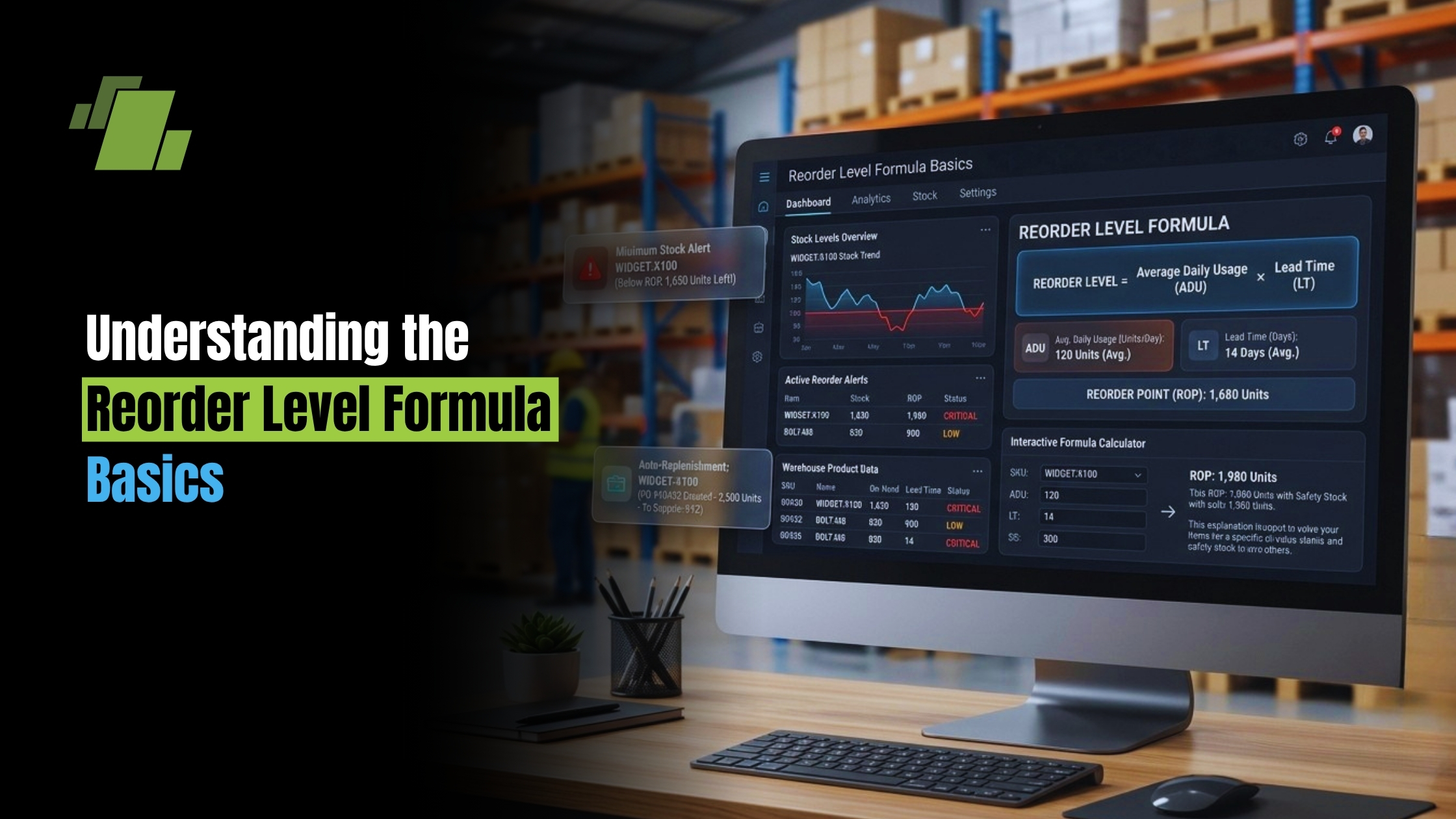
Understanding the Reorder Level Formula Basics

Summary
This blog explains the reorder level formula and its importance in inventory management. It covers how businesses can calculate the right time to reorder stock using usage rate, lead time, and safety stock, helping prevent stockouts, reduce inventory costs, improve operational efficiency, and maintain optimal inventory levels for better customer satisfaction.
Contact Us
Free Demo Request
Introduction
Inventory management is crucial for any business dealing with physical products. A key concept in this field is the reorder level formula (also called the rol formula or the re ordering level formula). This formula helps businesses maintain optimal stock levels.
Understanding the reorder level formula can prevent costly stockouts and overstock situations. It ensures that inventory is replenished before it runs out. This proactive approach is vital for smooth operations and clarifies how the reorder level in inventory management keeps stock flowing.
The reorder level formula is simple yet powerful. It involves calculating when to reorder based on usage rate, lead time, and safety stock. These components help in predicting the right time to place new orders.
By mastering this formula, businesses can improve their inventory management. This leads to better customer satisfaction and efficient resource use.
✨ Summarize this article with AI


What is Reorder Level in Inventory Management?
The reorder level is a critical metric in inventory management. If you’re asking what is reorder level, it represents the inventory threshold that triggers a reorder. Knowing this level helps maintain seamless operations.
When inventory drops to the reorder level, it’s time to place a new order. This prevents the business from running out of stock. It’s a proactive measure to manage supply and demand.
A well-calculated reorder level balances inventory costs and product availability. It is especially crucial for businesses with unpredictable demand. By ensuring timely reorders, businesses can keep customers satisfied.
Several factors influence the reorder level. These include average daily usage, lead time, and safety stock. Each plays a role in determining when to restock.
- Usage Rate: Average quantity used daily.
- Lead Time: Duration from order to delivery.
- Safety Stock: Additional stock for emergencies.
Understanding these elements ensures inventory meets business needs efficiently.
Why is the Reorder Level Important?
The reorder level prevents stockouts and keeps operations running smoothly. It ensures that inventory levels are adequate to meet customer demand.
A well-maintained reorder level helps in managing costs. It reduces excess inventory holding and associated costs. This balance is crucial for financial efficiency.
Business credibility hinges on product availability. Meeting the reorder level ensures products are always in stock, boosting customer satisfaction. This can lead to repeat business and positive reviews.
Strategically managing reorder levels is vital for companies with fluctuating demand. It helps in adapting swiftly to changes in market conditions. Implementing a tailored reorder level can set a business apart.
- Enhances customer satisfaction
- Minimizes inventory costs
- Adjusts to demand fluctuations
- Supports operational continuity
The Reorder Level Formula Explained
The reorder level formula is a cornerstone of inventory management. It tells you when to restock products to avoid shortages. Knowing this helps maintain a balance between supply and demand.
This formula considers average daily usage, lead time, and safety stock. Each component plays a unique role in determining the reorder level. Understanding how these elements interconnect is essential for efficiency.
The basic formula is:
Reorder Level = (Average Daily Usage Rate x Lead Time) + Safety Stock
The average daily usage rate is key. It reflects how much inventory is used each day, giving insight into demand patterns. The lead time refers to the period between placing an order and receiving it, while the safety stock is additional inventory to cover unexpected spikes in demand or delays.
These three elements together form a comprehensive approach. Businesses can also tweak the formula based on market trends or specific needs. It’s adaptable, which makes it suitable for diverse industries.
Proper use of the reorder level formula contributes to smooth operations. It ensures that products are available when needed, preventing lost sales. Mastery of this formula is vital for effective inventory management.
Key Components: Usage Rate, Lead Time, and Safety Stock
Understanding the key components of the reorder level formula is crucial. Each element usage rate, lead time, and safety stock serves a specific function in inventory management.
The usage rate is the average quantity of inventory consumed daily. It helps predict future demand and sets the groundwork for calculating reorder levels. Accurate usage forecasting prevents over- or under-stocking.
Lead time is the duration from ordering inventory to receiving it. Longer lead times increase the risk of stockouts. Hence, it’s critical to account for this factor carefully.
Safety stock acts as a buffer against unexpected events. These include sudden demand changes or supplier delays. Having adequate safety stock ensures continuity in operations.
To summarize, the key components are:
- Usage Rate: Daily consumption patterns
- Lead Time: Order-to-receipt period
- Safety Stock: Buffer against unpredictability
Each of these components must be aligned with your business objectives. By understanding them, you can create a robust inventory strategy. The following diagram illustrates how these parts interact within the reorder level formula.
How to Calculate Reorder Level: Step-by-Step Guide
Calculating reorder level is a systematic process. A step-by-step approach ensures accuracy and reliability in inventory management.
To start, determine the average daily usage rate. This requires historical sales data over a relevant period. The more precise your usage rate, the better your reorder level.
Next, identify the lead time. This is the time it takes from placing an order to receiving goods. Consider potential delays and variations in supply chain efficiency.
Once you have usage rate and lead time, calculate the basic reorder level. Multiply the usage rate by lead time to get an initial figure.
The final step involves adding safety stock. Safety stock acts as a safeguard against unforeseen demand or supply issues. The more volatile the market, the larger the safety stock should be.
In summary, here’s how you calculate reorder level:
- Determine Average Daily Usage Rate
- Identify Lead Time in Days
- Calculate Basic Reorder Level
- Add Safety Stock
Each step builds on the previous one, forming a comprehensive strategy. By following these guidelines, you gain better control over your inventory levels.
How to Find and Calculate Reorder Quantity
Finding reorder quantity involves a distinct process compared to determining the reorder level. This section explains how to find reorder quantity and how to calculate reorder quantity accurately. Reorder quantity specifies how much stock to order once the reorder level is triggered. This ensures a smooth supply chain and prevents excess inventory.
Start by assessing your average daily sales. This will form the foundation of your reorder quantity calculation. Accurate data will lead to better inventory decisions.
Next, evaluate your supplier’s delivery reliability. Reliable suppliers can help in optimizing your reorder quantity, leading to cost savings.
Consider the economic order quantity (EOQ) model. EOQ helps in determining the optimal order size to minimize total inventory costs. It balances order costs with holding costs effectively.
In summary, calculate reorder quantity using:
- Average Daily Sales Volume
- Supplier’s Delivery Performance
- Economic Order Quantity (EOQ)
Each component plays a vital role in inventory efficiency. By maintaining optimal reorder quantities, businesses can reduce waste and improve cash flow.
Practical Examples of Reorder Level Calculation
Understanding the reorder level formula is more effective with practical examples. Let’s consider a small retail store for illustration.
Imagine a shop selling handbags. The average daily sales are ten units, and the lead time from supplier to store is five days. For safety stock, the store maintains fifteen units. Using the reorder level formula, the calculation is:
- Reorder Level = (10 units/day * 5 days) + 15 units = 65 units
When stock dips to 65 units, an order is triggered to prevent stockouts.
For another example, picture an electronics distributor with varied demand. The average use is higher during the holiday season, prompting adjustments in reorder levels. Proper calculations prevent both surplus and shortage.
Each example demonstrates the versatility of the formula across industries, accommodating changes in demand and supply patterns. Accurate applications can drastically improve inventory efficiency.
Common Mistakes and How to Avoid Them
Reorder level errors can lead to increased costs and stock issues. Common mistakes often include miscalculating lead times or neglecting demand forecasts.
One frequent error is overlooking the need for safety stock, which buffers against unexpected demand. Another mistake is failing to adjust reorder levels for seasonal fluctuations.
To avoid these pitfalls, follow these guidelines:
- Regularly update your lead time and demand data.
- Incorporate safety stock in your calculations.
- Periodically review and adjust for market trends.
These steps can enhance inventory accuracy and reduce unnecessary expenses.
Tips for Optimizing Your Reorder Level
Optimizing your reorder level is crucial for efficient inventory management. Start by regularly revisiting your reorder levels, especially in dynamic markets where demand can change rapidly.
Leverage technology and data analytics for precise demand forecasting. This will enhance the accuracy of your reorder calculations.
Consider the following tips to optimize your reorder level:
- Use software tools for real-time inventory tracking.
- Customize reorder levels for different product categories.
- Incorporate feedback from sales and procurement teams.
These strategies will help in maintaining an optimal inventory balance and improving supply chain efficiency.
Tools and Software for Managing Reorder Levels
Modern inventory management heavily relies on digital tools. Many software solutions exist to streamline reorder level calculations.
These tools automate data collection and analysis, offering real-time insights. Here are some popular features:
- Automated reorder alerts
- Integration with supply chain systems
- Predictive analytics for demand forecasting
Utilizing such software helps businesses maintain optimal stock levels and minimize both overstock and stockouts.
Conclusion: Mastering the Reorder Level Formula
Grasping the reorder level formula is vital for efficient inventory management. It’s a tool that safeguards against stockouts and overstocking, ensuring seamless operations. By understanding its components, businesses can maintain optimal inventory levels.
Regular reviews and adjustments align reorder levels with market demands. This proactive approach minimizes risks and supports business growth. Keep refining your formula using real data for the best results.
Incorporating advanced tools and software can automate calculations, streamlining the inventory process. Mastery of the reorder level formula enhances your decision-making capability. This ultimately leads to improved service levels and reduced costs.
Call at +91-73411-41176/75 or send us an email at sales@logicerp.com to book a free demo today!
Frequently Asked Questions
1. What is a reorder level in inventory management?
A reorder level is the minimum stock quantity at which a new purchase order should be placed to replenish inventory before it runs out.
2. What is the formula for calculating the reorder level?
The reorder level formula is:
Reorder Level = (Average Daily Usage × Lead Time) + Safety Stock
This helps businesses maintain optimal inventory levels and avoid stock shortages.
3. Why is the reorder level important for businesses?
A reorder level helps prevent stockouts, reduces excess inventory, improves customer satisfaction, and ensures smooth business operations.
4. What factors affect the reorder level calculation?
The main factors include average daily usage rate, supplier lead time, safety stock, demand fluctuations, and supply chain reliability.
5. How can inventory management software improve reorder level management?
Inventory management software automates stock tracking, generates reorder alerts, provides real-time inventory visibility, and improves demand forecasting for more accurate replenishment decisions.

Author
Gurbir Singh
Co-founder & Managing Director | LOGIC ERP Solutions Pvt. Ltd.
With 30+ years of experience in the tech industry, I took the helm of technology & product development, ensuring LOGIC ERP’s continuous innovation & leadership in the evolving tech landscape.