What is Stock Management System – Meaning, Process & Benefits | A Complete Guide for Business

Summary
Take complete control of your inventory with smart stock management software from LOGIC ERP. Track stock in real time, eliminate shortages, prevent overstocking, and streamline inventory management with automated accuracy, helping your business stay efficient, profitable, and always ready to meet customer demand.
Contact Us
Free Demo Request
Table of Content
- Introduction to Stock Management
- Understanding Stock Management Fundamentals
- Types of Stock in Business Operations
- Core Components of Effective Stock Management
- How Stock Management Works in Practice
- Stock Management Methods and Implementation
- Common Stock Management Challenges and Solutions
- Benefits and ROI of Proper Stock Management
- Why Choose LOGIC ERP Stock Management Software?
- Conclusion and Next Steps
- Frequently Asked Questions (FAQs)
Introduction to Stock Management
Stock management is the systematic process of tracking, controlling, and optimizing inventory from acquisition through storage, usage, and final sale or disposal. This inventory management approach encompasses raw materials, work-in-progress (WIP), finished goods, and maintenance, repair, and operating supplies (MRO) across single or multiple warehouses and business locations. Stock management is also a critical component of a properly running supply chain, ensuring smooth flow and visibility of goods through processes like demand planning, procurement, and fulfillment.
This guide is designed for business owners, operations managers, warehouse supervisors, and procurement teams seeking to improve inventory efficiency and reduce operational costs. Whether you’re running a small retail operation or managing complex manufacturing supply chains, understanding stock management fundamentals directly impacts your bottom line and customer satisfaction.
Direct answer: Effective stock management is important because it balances inventory levels to prevent excess stock and stockouts, ensuring optimal inventory to meet customer demand while minimizing carrying costs.
Key outcomes you’ll gain from this guide:
- Reduced inventory costs through optimized stock levels and lower carrying costs
- Improved cash flow by freeing capital from excess inventory
- Enhanced customer satisfaction through consistent product availability
- Streamlined operations with fewer bottlenecks in production and distribution
Understanding Stock Management Fundamentals
Inventory management is the process of tracking and controlling the flow of goods, raw materials, works-in-progress, and finished products through every stage, from initial purchase through final sale, to meet customer demand and minimize costs. Inventory represents a current asset on the balance sheet, encompassing various types of goods, and is closely linked to production and sales processes in accounting and financial statements. Effective stock management is a systematic process of tracking and controlling goods to ensure appropriate inventory levels are maintained.
The core challenge lies in balancing supply and demand. Maintain too much inventory, and you tie up valuable capital while incurring storage costs, obsolescence risk, and potential waste. Maintain too little, and you face stockouts, lost sales, and damaged customer relationships. Successful inventory management finds the optimal middle ground.
Types of Stock in Business Operations
Understanding the different categories of inventory helps businesses apply appropriate management strategies to each type.
Raw materials and components represent the inputs for manufacturing and production. In electronics manufacturing, this includes silicon wafers, chips, and circuit boards. Raw materials tie up capital and carry supplier risk, making accurate demand forecasting crucial for determining purchase quantities.
Work-in-progress inventory consists of partially completed goods moving through the production process. Long WIP cycles tie up capital and can create production flow inefficiencies. Visibility into stock locations and levels reduces bottlenecks in production and distribution, ensuring smoother operations.
Finished goods are products ready for sale and distribution. Stock management helps avoid bottlenecks in production and distribution, ensuring a smoother flow of goods to customers. Overstock leads to markdowns and increased carrying costs; understock means lost sales and disappointed customers.
Maintenance, repair, and operating supplies (MRO) support daily operations without becoming part of finished products. This includes packaging materials, cleaning supplies, and equipment parts. Often overlooked, mismanaging MRO inventory leads to production downtime and indirect cost increases.
Each inventory type demands different tracking, forecasting, and handling approaches based on factors like perishability, obsolescence risk, and criticality to operations.
Core Components of Effective Stock Management
Inventory tracking and real-time visibility form the foundation of any inventory management system. An inventory system refers to the comprehensive software or set of processes that manage stock, track inventory levels, and coordinate with order management for efficiency. Physical records should match the actual stock on shelves to prevent “phantom” stock issues that distort planning and ordering decisions. Modern inventory tracking systems use barcode scanning, RFID technology, and integrated software to maintain accurate inventory data across locations.
Demand forecasting and planning determines how much inventory to purchase and when. Use historical sales data and seasonal trends to predict future stock needs. Accurate demand forecasting is crucial for effective stock management, as it helps businesses determine the right levels of inventory to have on hand.
Reorder points and safety stock principles establish when to replenish inventory. PAR Levels (Periodic Automatic Replacement) set a minimum stock level for each product to trigger reorder when stock falls below this level. Buffer stock, or “Safety Stock,” is maintained to protect against unexpected demand surges or supplier delays.
Understanding these fundamentals prepares you for implementing effective inventory management processes in your daily operations.
How Stock Management Works in Practice
Building on these fundamental concepts, let’s examine how stock management operates within real business environments. The operational framework connects planning, execution, and monitoring activities into a continuous improvement cycle.
Stock Management Process Flow
Planning and procurement begins with analyzing historical data and market trends to forecast demand. Improved forecasting enables better purchasing decisions by accurately predicting demand trends. Smarter reordering involves reviewing sell-through rates and using AI-powered systems to predict demand spikes during holidays or local events. Purchase orders are generated based on reorder points, safety stock calculations, and supplier lead times.
Receiving, inspection, and storage ensures incoming inventory matches purchase orders in quantity and quality. Proper documentation and immediate system updates maintain inventory records accuracy. Storage optimization places items strategically for efficient retrieval while maintaining appropriate conditions (temperature, humidity, security).
Picking, packing, and fulfillment transforms stored inventory into delivered customer orders. Accuracy and speed at this stage directly impact customer satisfaction. Efficient warehouse operations minimize handling costs while ensuring orders ship complete and on time. Reverse logistics processes handle returns, adding another dimension to inventory control.
Key Stock Management Activities
Cycle counting and physical inventory audits maintain inventory accuracy without the operational disruption of complete warehouse shutdowns. Cycle counting involves performing small, regular counts of specific sections daily or weekly to ensure ongoing accuracy. This approach catches discrepancies early, before they compound into significant problems affecting inventory visibility across the organization.
Stock level monitoring and automated alerts provide early identification of slow-moving products and allows for quick responses to potential stock issues. Modern inventory management software generates notifications when inventory levels fall below reorder points or when items approach expiration dates. Effective demand forecasting can help businesses avoid the costs associated with overstocking or stockouts, which can lead to lost sales and wasted resources. Stock outs, in particular, negatively impact customer satisfaction and sales especially in the fast-paced e-commerce and omnichannel retail environment making accurate inventory control essential to prevent stock outs and meet rising customer expectations for product availability.
Supplier management and purchase order processing ensures a reliable supply chain reduces lead times and prevents stockouts. Regular assessment of supplier performance metrics, such as fulfillment times and order completeness, is essential for effective stock management. Managing supply relationships strategically helps businesses negotiate better terms and maintain consistent product availability.
Technology Integration Points
Barcode scanning and RFID tracking systems dramatically improve inventory accuracy. Barcode scanners convert printed patterns into digital data, allowing real-time tracking of inventory across multiple locations, which enhances efficiency in stock management. Radio frequency identification (RFID) tags enable inventory tracking without a direct line of sight, improving accuracy and reducing the likelihood of theft. Barcode/QR scanning can reduce manual entry errors and speed up stock takes.
ERP integration and real-time data synchronization connects inventory management with other business functions. Enterprise Resource Planning (ERP) software centralizes inventory data across various business functions, providing a comprehensive view of inventory levels and movements. This integration ensures sales, procurement, finance, and warehouse operations all work from consistent, current information.
Reporting and analytics for decision-making transform raw inventory data into actionable insights. Predictive analytics tools utilize historical and market data to forecast demand and identify potential supply chain issues, allowing businesses to proactively manage inventory levels. Good stock management provides visibility into which products are selling, enabling informed decisions about product lines.
These technology integration points connect directly to the specific methods businesses use to manage inventory effectively.
Stock Management Methods and Implementation
Different businesses require different approaches to stock control based on their industry, scale, demand patterns, and supply chain characteristics. Inventory optimisation focuses on balancing stock levels to maximize profit margins, minimize losses, and improve efficiency. Understanding these common inventory management methods helps you select and implement the right strategy for your situation.

Popular Stock Management Methods
Each method addresses specific inventory challenges with distinct advantages and requirements.
Just-in-Time (JIT) inventory management allows companies to save money and reduce waste by purchasing and keeping only the inventory needed to produce and sell products within a certain timeframe. This approach minimizes carrying costs and storage space requirements but demands highly reliable suppliers and accurate demand forecasting accuracy. Toyota pioneered this method, demonstrating how lean inventory practices reduce waste while maintaining production continuity.
The Economic Order Quantity (EOQ) model helps businesses determine the ideal batch size to minimize inventory costs by balancing holding and setup costs. The formula calculates optimal order quantities using demand rate, ordering costs, and carrying costs. This method works best when demand remains relatively stable and predictable, allowing businesses to optimize order costs systematically.
ABC Analysis categorizes stock into three “priority buckets” based on their value and turnover rate to ensure resources are focused on the most profitable items. Segmentation, such as ABC analysis, prioritizes inventory management efforts based on the value and criticality of items, helping businesses focus on the most important stock:
- A-Items are high-value products with low sales frequency that require tight control and frequent review
- B-Items are moderate-value items with medium sales frequency
- C-Items are low-value items with high sales frequency, also known as high turnover items
Materials Requirement Planning (MRP) is an inventory management method that relies on detailed sales records to anticipate inventory needs and communicate those needs to suppliers in a timely manner. This method integrates production schedules with bills of materials to calculate precise component requirements, particularly valuable for manufacturing operations with complex assemblies.
Implementation Comparison
| Method | Best For | Key Benefits | Main Requirements |
|---|---|---|---|
| JIT | Predictable demand, reliable suppliers | Low carrying costs, minimal waste, lean operations | Reliable suppliers, accurate forecasts, agile supply chain |
| EOQ | Steady consumption, stable demand | Optimized order costs, reduced ordering waste | Accurate demand data, known ordering and holding costs |
| ABC Analysis | Diverse inventory, varied SKU values | Focused management effort, efficient resource allocation | Value classification, sales data analysis |
| MRP | Manufacturing, complex production | Production alignment, material coordination | Master production schedule, accurate BOMs |
Method selection guidance: Small businesses with limited SKUs often succeed with ABC analysis combined with simple reorder points. Manufacturing operations typically benefit from MRP integration with ERP systems. Retailers with seasonal fluctuations may combine EOQ calculations with safety stock adjustments. Utilizing predictive analytics in demand forecasting allows businesses to analyze historical data and market trends to anticipate customer needs more accurately, regardless of the primary method chosen. Supply chain management serves as the overarching process that encompasses demand planning, procurement, production, and customer service, making inventory visibility across the entire supply network essential for effective stock management.
Common Stock Management Challenges and Solutions
Even with solid inventory management methods in place, businesses encounter predictable obstacles. Recognizing these challenges and implementing proven solutions prevents costly inventory problems.
Inaccurate Inventory Records
Poor inventory management often begins with inaccurate records. When physical inventory doesn’t match system data, every subsequent decision builds on faulty information. Retail inventory accuracy averages only 63-65% before implementing systematic improvements.
Solution: Implement cycle counting programs that verify inventory accuracy continuously without operational disruption. Deploy barcode or RFID systems for automated tracking these technologies reduce manual entry errors significantly. Regular audits combined with immediate discrepancy investigation create accountability and maintain inventory visibility. Top operations using these practices achieve 97-99% accuracy.
Demand Forecasting Difficulties
Market fluctuations, seasonal variations, and changing consumer preferences make predicting future demand challenging. Poor forecasting leads to either excess inventory or stockouts, both carrying significant costs.
Solution: Use historical data analysis combined with market trend monitoring for better predictions. Good forecasting helps to avoid “emergency” reordering, which typically incurs expensive expedited shipments needed to fill sudden shortages. Implement collaborative planning with sales teams and key customers who have insight into upcoming needs. AI-powered forecasting tools analyzing economic indicators and external signals show 10-20% improvement in forecast accuracy.
Excess Inventory and Dead Stock
Inventory that does not sell ties up valuable shelf space and capital. Effective stock management helps prevent excess inventory, which can lead to increased carrying costs and potential waste, while also ensuring that there is enough stock to meet customer demand. Typical SMBs carry 20-30% more inventory than needed, representing significant trapped capital.
Solution: Establish regular inventory review processes to identify slow-moving items before they become obsolete. Effective stock management reduces waste by identifying slow-moving or obsolete items before they expire or become outdated. Liquidation of deadstock can be achieved through targeted discounting, product bundling, or donations for tax benefits. These strategies recover value while freeing storage space for profitable products.
Supply Chain Disruptions
Supplier failures, shipping delays, and logistic interruptions threaten inventory availability. These supply chain disruptions can cascade into stockouts and production stoppages without proper preparation.
Solution: Develop supplier diversification strategies that reduce dependence on single sources. Maintain appropriate safety stock levels calibrated to lead time variability and demand uncertainty. Implement risk monitoring systems that provide early warning of potential disruptions. A reliable supply chain reduces lead times and prevents stockouts, but building redundancy provides essential protection against unexpected events.
Benefits and ROI of Proper Stock Management
Effective inventory management delivers measurable returns across financial, operational, and customer-facing dimensions. Understanding these benefits helps justify investment in improved systems and processes.
Financial benefits include improved cash flow and reduced carrying costs. Inventory ties up capital, reducing liquidity for critical expenses like payroll or expansion. Carrying costs typically range from 20-30% of inventory value annually, including capital costs, storage, insurance, and obsolescence risk. Efficient stock management improves turnover, speeding up the cash conversion cycle and freeing capital for other uses.
Operational improvements span faster order fulfillment, reduced stockouts, and smoother production flows. Accurate data enhances staff efficiency by allowing teams to focus on strategic tasks instead of managing urgent purchasing or resolving stock errors. Automated guided vehicles (AGVs) are used in warehouses to transport inventory along optimized routes, enhancing operational efficiency and reducing labor costs. These improvements compound over time as processes mature.
Customer satisfaction gains come through better product availability and reliable delivery. Maintaining consistent product availability builds customer trust and loyalty, preventing competitors from taking customers away. Proper tracking of stock maximizes sales by ensuring the right items and quantities are available, preventing missed sales opportunities. Effective inventory management improves cash flow and enhances customer satisfaction by preventing stockouts and excess inventory.
ROI metrics to track include inventory turnover ratio, days sales of inventory (DSI), stockout frequency, forecast accuracy, and carrying cost percentage. SMBs implementing reorder automation and AI forecasting report reducing excess inventory by 25-35% while maintaining or improving service levels. These improvements typically deliver ROI within 12-18 months of implementation.
Why Choose LOGIC ERP Stock Management Software?
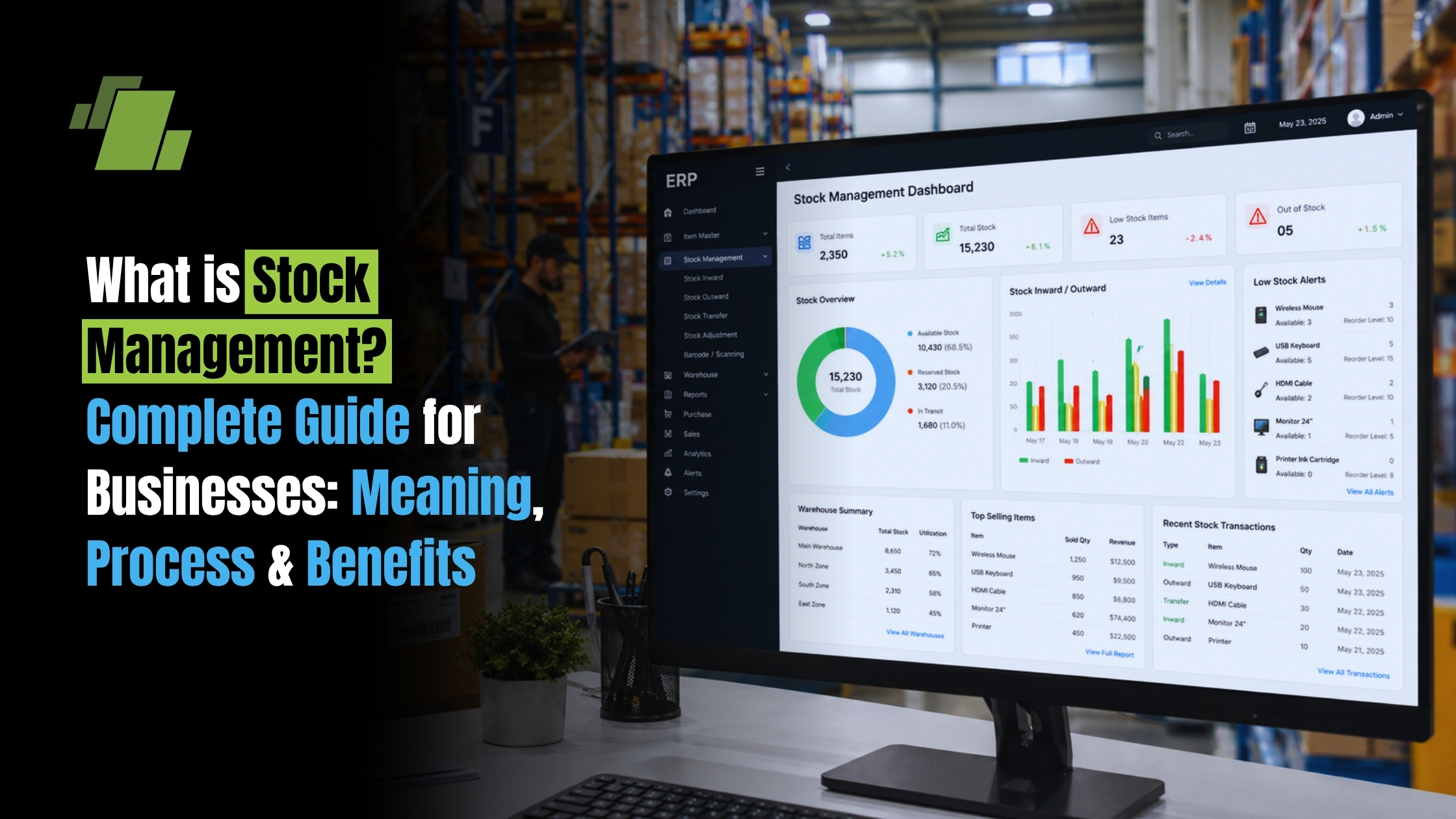
LOGIC ERP Stock Management Software offers a comprehensive, integrated solution designed to streamline inventory control and optimize stock levels across your entire supply chain. With real-time tracking capabilities, it provides visibility into inventory across multiple warehouses and business locations, ensuring you always know what stock is available and where.
The stock inventory management software features automated reorder point alerts and safety stock calculations that help prevent stockouts and overstock situations, improving cash flow and reducing carrying costs. Advanced demand forecasting tools leverage historical sales data and market trends to predict future inventory needs accurately, enabling smarter purchasing decisions.
Integration with barcode and RFID technologies enhances accuracy by automating inventory tracking and minimizing manual errors. LOGIC ERP’s analytics dashboards offer actionable insights into inventory performance, supplier reliability, and sales trends, empowering you to make data-driven decisions that improve operational efficiency and customer satisfaction.
Designed for scalability, LOGIC ERP supports businesses of all sizes and industries, from small retailers to complex manufacturing operations. Its flexibility allows customization to fit unique business processes, while seamless ERP integration connects stock management with procurement, finance, and sales functions for a unified operational view.
Choosing LOGIC ERP | the best stock management software means investing in a robust stock management system that not only optimizes inventory but also strengthens your supply chain, reduces taxable income through better inventory control, and ultimately helps improve customer satisfaction by ensuring product availability when and where it’s needed.
Conclusion and Next Steps
Effective retail stock management requires a balance between meeting customer demand and minimizing the costs of holding excess inventory. The methods, technologies, and processes covered in this guide provide the framework for achieving this balance in your business.
Immediate actionable steps:
- Assess current inventory accuracy through physical counts compared against system records
- Identify main pain points whether stockouts, excess inventory, or forecasting challenges
- Evaluate technology needs based on current gaps in inventory visibility and tracking stock capabilities
- Select appropriate inventory management methods matching your business type and complexity
Advanced exploration: As your inventory management processes mature, consider AI-powered demand planning that incorporates external signals for improved forecasting. Automated replenishment systems reduce manual intervention while optimizing reorder decisions. Integration with POS systems and multiple channels provides unified inventory visibility across all sales touchpoints.

Call at +91-73411-41176/75 or send us an email at sales@logicerp.com to book a free demo today!
Frequently Asked Questions
1. What’s the Difference Between Stock Management and Inventory Control?
Inventory management is a broader strategic oversight that encompasses the entire lifecycle of inventory, while inventory control focuses specifically on the precise tracking and accuracy of stock levels. Stock management includes demand planning, supplier relationships, and strategic decisions about what to stock; inventory control ensures counts are accurate and items are stored properly.
2. How Do You Calculate Optimal Stock Levels?
Optimal stock levels combine reorder point calculations with safety stock buffers. Calculate reorder point as average daily demand multiplied by lead time, then add safety stock based on demand variability and desired service level. Economic order quantity formulas determine optimal purchase quantities that balance ordering and holding costs.
3. What are the Main KPIs For Measuring Stock Management Performance?
Key performance indicators include inventory turnover ratio, days sales of inventory, stockout rate, forecast accuracy (measured via mean absolute percentage error), carrying cost percentage, and service fill rate. Regular monitoring of these metrics identifies improvement opportunities and validates process changes.
4. Which Stock Management Method is Best for Small Businesses?
Small businesses typically succeed with ABC analysis combined with simple reorder points. This approach focuses management attention on high-value items while using straightforward rules for routine reordering. As volume grows, adding EOQ calculations and automated tools provides incremental improvement without overwhelming complexity.
5. How Does LOGIC ERP Support Stock Management Processes?
LOGIC ERP provides integrated inventory management capabilities including real-time tracking across multiple warehouses, automated reorder point alerts, demand forecasting tools, barcode/RFID integration, and comprehensive analytics dashboards. The system centralizes inventory data across business functions while supporting ABC analysis, EOQ calculations, and supplier performance monitoring.
6. What are the Signs Of Poor Stock Management?
Warning signs include frequent stockouts of popular items, excess inventory requiring markdowns, regular “emergency” orders with expedited shipping costs, significant discrepancies between physical counts and system records, and cash flow constraints from capital trapped in slow-moving inventory.
7. How Often Should You Review and Update Stock Management Procedures?
Review reorder points and safety stock levels quarterly or when demand patterns shift significantly. Conduct full process reviews annually, incorporating lessons learned and technology improvements. ABC classifications should be updated semi-annually as sales data reveals changing product performance.
8. What’s the Role of Safety Stock in Stock Management?
Safety stock provides a buffer against uncertainty in both demand and supply. It protects against demand surges exceeding forecasts and supplier delays extending beyond expected lead times. Calculate safety stock based on demand variability, lead time variability, and target service level higher uncertainty or service requirements mean larger buffers.
9. How to Manage Warehouse Stock?
Managing warehouse stock involves accurate tracking of inventory levels, organizing storage efficiently, conducting regular physical inventory counts, and using inventory management systems to automate stock control and reorder processes.
10. How to Calculate Safety Stock in Inventory Management?
Safety stock is calculated by analyzing demand variability and lead time variability to determine a buffer quantity that protects against stockouts during unexpected demand surges or supplier delays.
11. What is Dead Stock in Inventory Management?
Dead stock refers to inventory items that have not been sold or used for a long time, often obsolete or expired, tying up capital and storage space.
12. What is Safety Stock in Inventory Management?
Safety stock is extra inventory held to mitigate the risk of stockouts caused by uncertainties in demand or supply, ensuring continuous product availability.
13. What is Stock Out Cost in Inventory Management?
Stock out cost is the financial loss a business incurs when inventory runs out, including lost sales, customer dissatisfaction, and potential damage to brand reputation.
14. How Barcode Scanner Works in Stock Management?
Barcode scanners read printed barcodes on products, converting them into digital data that updates inventory records in real-time, improving accuracy and efficiency in stock tracking.
15. How to Manage Stock Control?
Stock control is managed by monitoring inventory levels, setting reorder points, conducting regular audits, and using technology like inventory systems and barcode scanning to maintain accurate stock records.
16. How to Manage Stock in a Warehouse?
Managing stock in a warehouse requires organized storage, real-time inventory tracking, regular cycle counts, and effective use of warehouse management systems to optimize space and improve picking accuracy.
17. What is Buffer Stock in Inventory Management?
Buffer stock is a reserve quantity of inventory kept to protect against unexpected fluctuations in demand or supply delays, ensuring smooth operations.
18. What is Stock Level Management?
Stock level management involves maintaining optimal inventory quantities to meet customer demand while minimizing carrying costs and avoiding excess stock.
19. What is Stock Management in Retail?
Stock management in retail is the process of overseeing product inventory to ensure shelves are stocked appropriately, reducing stockouts and excess inventory to improve sales and customer satisfaction.
20. How to Improve Stock Management?
Improving stock management involves implementing accurate demand forecasting, using inventory management software, performing regular physical counts, optimizing reorder points, and integrating supply chain data.
21. How to Manage Stock Inventory?
Managing stock inventory includes tracking stock movements, forecasting demand, setting reorder levels, conducting audits, and leveraging technology to maintain accurate and efficient inventory control.
22. How to Manage Stock Levels?
Stock levels are managed by analyzing sales data, setting minimum and maximum thresholds, monitoring inventory in real-time, and adjusting reorder points based on demand trends.
23. What is Stock Inventory Management?
Stock inventory management is the systematic process of ordering, storing, tracking, and controlling a company’s inventory to meet customer demand efficiently while minimizing costs.
24. What Makes Stock Management Important for Businesses?
Stock management is important because it ensures the right inventory levels to meet customer demand without tying up excessive capital in stock. Effective stock management reduces carrying costs, prevents stockouts, and improves cash flow, ultimately enhancing profitability and customer satisfaction.
25. What is a Stock Inventory Management System?
A stock inventory management system is software designed to track, control, and optimize inventory levels in real-time. It automates processes such as stock tracking, reorder point alerts, demand forecasting, and reporting, helping businesses maintain accurate inventory records and improve operational efficiency.
26. How Does Stock Inventory Control Differ from Stock Management?
Stock inventory control focuses on the precise tracking and accuracy of stock levels, including physical counts and record reconciliation. In contrast, stock management encompasses broader strategic activities, including demand forecasting, supplier management, and inventory optimization to balance costs and service levels.
27. What are Common Stock Inventory Management Methods?
Common methods include Just-in-Time (JIT), Economic Order Quantity (EOQ), Materials Requirement Planning (MRP), and ABC Analysis. These methods help businesses manage stock by optimizing order quantities, timing, and prioritizing inventory based on value and demand.
28. How Does Economic Order Quantity (EOQ) Help Manage Inventory?
EOQ calculates the ideal order size that minimizes total inventory costs by balancing ordering costs with holding costs. This helps businesses avoid frequent small orders or excessive large orders, leading to cost savings and efficient stock levels.
29. What is the Role of a Stock Inventory System in Managing Stock?
A stock inventory system provides real-time visibility into inventory levels, locations, and movements. It supports automated replenishment, demand forecasting, and reporting, enabling businesses to manage stock proactively and respond quickly to changes in demand or supply.
30. How Can Businesses Improve Stock Inventory Optimization?
Businesses can improve stock inventory optimization by using predictive analytics to forecast demand accurately, setting appropriate reorder points and safety stock levels, and employing inventory segmentation to focus resources on high-value items.
31. What is Just-In-Time (JIT) Inventory Management?
Just-In-Time (JIT) is a stock management method that minimizes inventory by ordering goods only as they are needed for production or sales. JIT reduces carrying costs and waste but requires reliable suppliers and accurate demand forecasting.
32. How is Days Sales of Inventory (DSI) Used in Stock Management?
Days Sales of Inventory (DSI) measures the average number of days it takes to sell inventory. A lower DSI indicates faster inventory turnover, which improves cash flow and reduces holding costs. Monitoring DSI helps businesses assess inventory efficiency.
33. How Does Predictive Analytics Enhance Stock Management?
Predictive analytics analyzes historical sales data and market trends to forecast future demand accurately. This enables businesses to optimize inventory levels, reduce stockouts and overstock situations, and make informed purchasing decisions.
34. What is a Stock Management System?
A stock management system is software designed to track, control, and optimize inventory levels in real-time. It automates tasks such as stock tracking, reorder point alerts, demand forecasting, and reporting to improve inventory accuracy and operational efficiency.
35. How Does an Automated Stock Management System Work?
An automated stock management system uses technologies like barcode scanning, RFID, and integrated software to monitor inventory movements and levels continuously, reducing manual errors and enabling timely replenishment.
36. What are the Benefits of Using Barcode Stock Management Software?
Barcode stock management software enhances inventory accuracy by converting printed barcodes into digital data, speeding up stock takes, reducing manual entry errors, and providing real-time tracking across multiple locations.
37. How Can I Manage Warehouse Stock Effectively?
Effective warehouse stock management involves organizing storage efficiently, using inventory tracking systems, conducting regular cycle counts, and leveraging warehouse management software to optimize space and improve picking accuracy.
38. Is it Possible to Do Stock Management in Excel?
Yes, stock management in excel involves creating spreadsheets to track inventory quantities, reorder points, and stock movements manually. While suitable for small businesses, it can become cumbersome as inventory complexity grows.
39. What are the Advantages of Retail Stock Management Software?
Retail stock management software helps businesses maintain optimal product levels, automate reorder processes, track sales trends, and improve customer satisfaction by preventing stockouts and excess inventory.
40. How Does a Retail Stock Management System Improve Operations?
A retail stock management system streamlines inventory tracking, provides real-time visibility of stock levels, integrates with point-of-sale systems, and supports demand forecasting to enhance decision-making and operational efficiency.
41. Can Stock Inventory Management Be Done in Excel?
Stock inventory management in excel allows businesses to monitor stock levels, sales, and reorder points through customizable spreadsheets. However, it lacks automation and real-time updates compared to dedicated inventory software.
42. What is the Difference Between Stock and Inventory Management?
Stock management focuses on controlling and tracking finished goods ready for sale, while inventory management encompasses the broader process of managing raw materials, work-in-progress, and finished goods throughout the supply chain.
43. How Does Waste Management Stock India Relate to Stock Management?
Waste management stock india refers to inventory related to waste disposal and recycling operations. Proper stock management ensures availability of materials and equipment while minimizing excess stock and associated costs.

Author
Gurbir Singh
Co-founder & Managing Director | LOGIC ERP Solutions Pvt. Ltd.
With 30+ years of experience in the tech industry, I took the helm of technology & product development, ensuring LOGIC ERP’s continuous innovation & leadership in the evolving tech landscape.