Supply Chain Planning Guide for Better Decisions

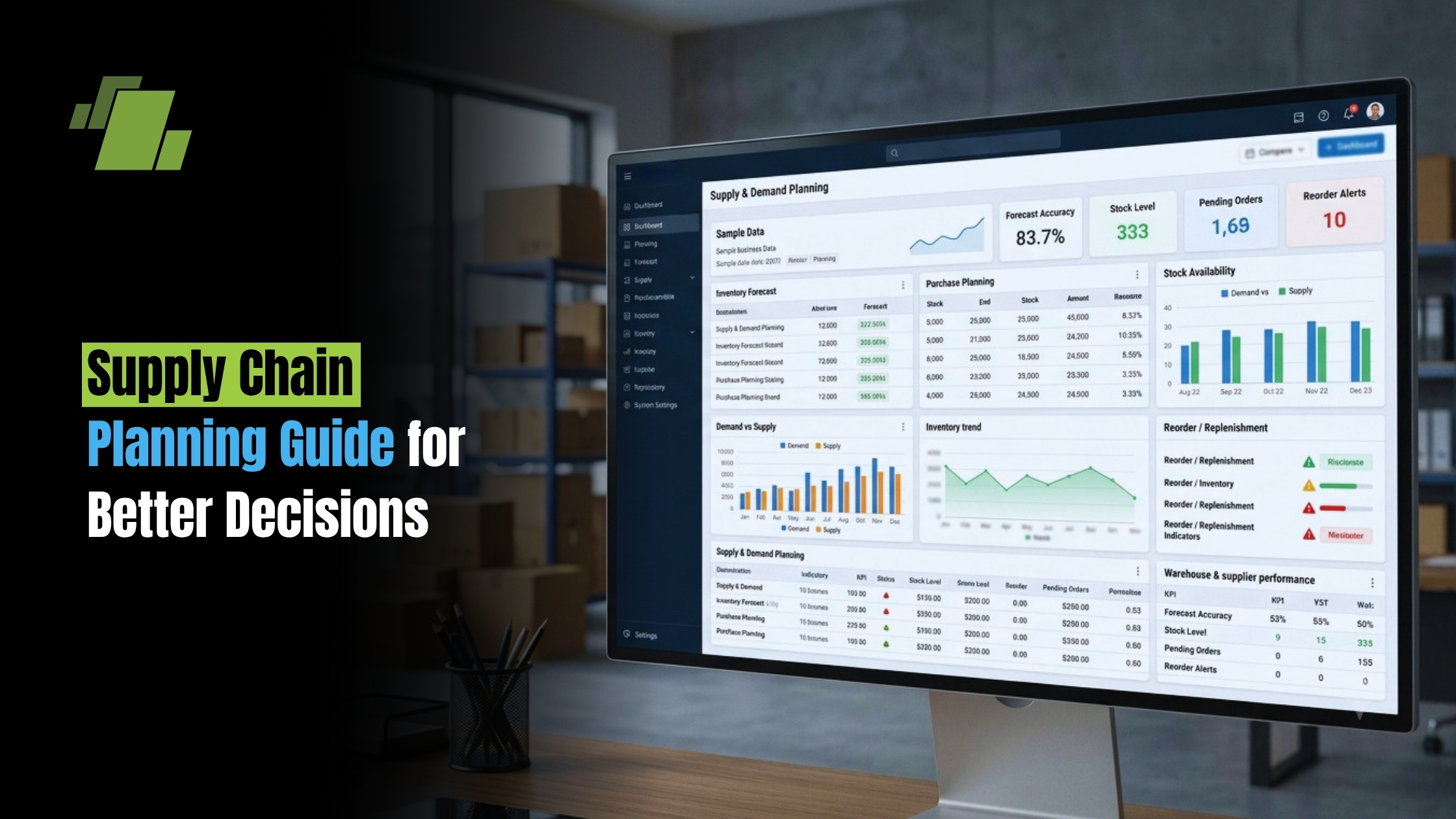
Supply chain planning matches demand, supply, inventory, production, procurement, and logistics so products move from source to customer with less friction. Done well, it improves supply chain efficiency, cuts avoidable costs, and helps teams see what to make, buy, store, and ship. The best approach uses clear process, good data, cross-team decisions, and the right supply chain planning software.
Contact Us
Free Demo Request
What makes supply chain planning effective?
Effective planning links business goals with day-to-day work. It is more than a forecast, a spreadsheet, or a weekly meeting. It is a working system that helps teams make timely calls when demand changes, suppliers delay shipments, or capacity shifts. A strong supply chain management plan gives each function a shared view of priorities, limits, and trade-offs.
The goal is balance. Too much inventory ties up cash and space, while too little stock leads to stockouts and lost sales. Rigid production scheduling may keep the factory busy but create delays for customers. Smart supply chain and planning practices help teams weigh these choices with facts, not guesses.
Build strategy before optimizing tasks
A practical supply chain strategy defines how the business wants to compete. Some companies focus on speed, while others focus on cost control, product availability, custom offers, or resilience. Without that direction, teams may improve local tasks while the full network still underperforms.
Start by setting service goals, product priorities, risk tolerance, and cost targets. Then turn those goals into planning rules. For example, high-volume products may need tighter inventory control and frequent replenishment, while slower-moving items may need make-to-order production or more careful buying.
A useful strategy should answer:
- Which products or customers need the highest service levels?
- Where should inventory sit in the distribution network?
- Which suppliers are critical, and where is backup capacity needed?
- What planning horizon matters most for purchasing, production, and logistics?
- How should teams react when demand and supply do not match?
When strategy is clear, supply chain planning becomes less reactive. Teams can focus on the decisions that matter most instead of treating every shortage, delay, or forecast change as an emergency.
Improve demand forecasting with better inputs
Demand forecasting is one of the foundations of supply chain planning, but it should not rely on historical sales alone. Past demand is useful, but it may not show promotions, market shifts, seasons, customer behavior, or product life changes. Better forecasts come from combining statistical signals with business context.
Demand planning in supply chain management works best when sales, marketing, finance, operations, and procurement share information early. A promotion that planners do not see can cause a stockout. A customer slowdown that procurement misses can leave the business with excess material.
To strengthen supply chain demand planning, use a simple process:
- Collect baseline data. Review sales history, orders, returns, seasons, and known demand patterns.
- Add commercial insight. Include promotions, launches, customer commitments, and market changes.
- Review exceptions. Focus on large gaps, unusual trends, and high-impact products.
- Agree on one demand plan. Create a shared number that guides inventory management, purchasing, and production.
- Measure forecast accuracy. Track where forecasts improve and where assumptions need work.
The point is not a perfect forecast. It is a reliable planning signal that improves procurement planning, inventory control, and production scheduling.
Why does inventory control matter so much?
Inventory control matters because inventory is where planning decisions become visible. It reflects forecast quality, supplier reliability, production discipline, warehouse capacity, and service goals. When inventory is poorly managed, the business often pays twice: once through excess stock and again through shortages in the wrong places.
Good inventory management starts with segmentation. Not every item needs the same planning effort. Fast-moving, high-margin, or business-critical items may need frequent review and tighter replenishment rules. Low-volume or uncertain items may need different safety stock policies, supplier agreements, or ordering cycles.
Effective inventory control usually includes:
- Clear minimum and maximum stock levels based on demand and lead time
- Safety stock rules that reflect variation, not guesswork
- Regular review of slow-moving, obsolete, or excess inventory
- Visibility into stock across warehouses, stores, or production sites
- Alignment between service goals and working capital limits
Inventory should support the customer promise without hiding planning problems. If teams keep adding stock to cover poor forecasts, long lead times, or weak suppliers, costs rise while root causes stay unsolved.
Align procurement planning with demand and capacity
Procurement planning turns the demand plan into supplier commitments. It answers what to buy, when to buy it, how much to order, and which supplier can meet the needed cost, quality, and timing. When procurement is cut off from demand planning, teams may place urgent orders, pay premium freight, or hold too much raw material.
The resources for supply chain planning are often the people closest to the limits: buyers who know supplier lead times, planners who understand demand change, warehouse teams who see storage limits, and production leaders who manage capacity. For supply chain planning, have resources from each function so decisions reflect reality rather than ideal guesses.
Strong procurement planning should consider:
- Supplier lead times and minimum order quantities
- Contract terms and price breaks
- Material availability and substitute options
- Supplier risk, quality performance, and reliability
- Capacity limits at suppliers and internal production sites
This is where supply chain analytics can add real value. By comparing supplier performance, order patterns, lead-time changes, and demand variation, teams can spot where purchasing rules need adjustment before small issues turn into major disruptions.

Make production scheduling practical, not perfect
Production scheduling turns plans into work. It decides when products are made, which lines or teams are used, and how materials, labor, and equipment are sequenced. A schedule that looks efficient on paper may fail if it ignores changeovers, labor availability, maintenance, material shortages, or urgent customer needs.
A practical schedule balances stability and flexibility. Too many changes create confusion on the floor and more waste. Too little flexibility keeps the business from responding to demand shifts or supply delays.
Useful scheduling habits include:
- Freeze near-term production windows where possible
- Group similar products to cut unnecessary changeovers
- Check material availability before releasing work orders
- Build realistic capacity assumptions into the plan
- Review schedule adherence and reasons for disruption
Production scheduling should also connect with inventory and procurement planning. If a factory is set to build a product but materials are delayed, the plan is not executable. If production creates stock faster than the distribution network can absorb it, warehouse pressure rises.
Use logistics optimization to strengthen the network
Logistics optimization focuses on moving products efficiently through the distribution network. It includes transportation choices, warehouse locations, shipment bundling, route planning, and service-level requirements. Even strong demand and supply plans can fall short if logistics cannot deliver products on time.
A well-designed distribution network supports the company’s supply chain strategy. For example, a business that promises fast delivery may need inventory closer to customers, while a cost-focused model may rely on fewer locations and bundled shipments. The right answer depends on customer expectations, product traits, order patterns, and transport limits.
Teams should review logistics performance often for signs of misfit. Rising expedited freight, frequent split shipments, warehouse congestion, or long delivery lead times can show that the network no longer matches demand. In that case, logistics optimization may mean changing replenishment frequency, adjusting warehouse roles, reviewing carrier options, or rebalancing inventory placement.
How can supply chain planning software help?
Supply chain planning software helps teams connect data, automate routine calculations, model scenarios, and create visibility across demand, supply, inventory, procurement, production, and logistics. It does not replace judgment, but it can cut manual work and make planning decisions faster and more consistent.
The right system should support the way the business plans. Some teams need strong forecasting and scenario modeling. Others need better inventory visibility, supplier planning, or production scheduling tools. Before choosing software, define the planning problems you need to solve and the decisions the system must support.
Look for capabilities such as:
- Demand forecasting and collaborative demand planning
- Inventory policy management and replenishment planning
- Capacity planning and production scheduling support
- Supplier visibility and procurement planning workflows
- Scenario planning for demand changes, shortages, and delays
- Dashboards that turn supply chain analytics into practical actions
Technology works best when processes are already clear. If roles are vague, data is unreliable, or teams disagree on planning rules, software may only make confusion faster. Clean data, shared ownership, and disciplined review meetings are just as important as the platform itself.
Create a repeatable planning rhythm
Strong supply chain planning depends on cadence. Teams need regular moments to review performance, update assumptions, resolve exceptions, and make decisions. Without a rhythm, planning turns into a stream of urgent messages and last-minute fixes.
A useful planning rhythm often includes short-term, mid-term, and long-term reviews. Short-term meetings focus on immediate supply issues, production changes, and customer risk. Mid-term reviews align demand, inventory, and procurement over the coming weeks or months. Long-term planning looks at capacity, supplier strategy, network design, and major business changes.
Keep meetings decision-oriented. Review the numbers, but spend most of the time on exceptions, trade-offs, and actions. Each meeting should make clear who owns the next step, what will change in the plan, and when the issue will be checked again.
Key takeaways for better planning
Improving supply chain planning is not about one perfect method. It is about building a connected system that helps people make better decisions with better information. The best gains usually come from strengthening the basics first, then adding more advanced tools where they truly help.
Focus on these priorities:
- Build a clear supply chain strategy before optimizing individual activities.
- Improve demand forecasting by combining data with commercial insight.
- Use inventory control to support service goals without hiding root problems.
- Align procurement planning with real demand, supplier capacity, and risk.
- Keep production scheduling realistic and tied to material availability.
- Review the distribution network as customer expectations and demand patterns change.
- Use supply chain planning software to improve visibility, scenarios, and consistency.
- Turn supply chain analytics into decisions, not just reports.
When these elements work together, supply chain efficiency improves because teams can spot problems earlier, respond with more confidence, and coordinate decisions across the business. The result is a supply chain management plan that is practical, adaptable, and easier to execute.
Final thoughts
Effective supply chain planning brings structure to uncertainty. Demand will change, suppliers will face limits, and logistics networks will be tested, but a disciplined planning approach helps teams respond without losing control. By connecting demand planning, inventory management, procurement, production, and logistics, businesses can create a more resilient and efficient supply chain that supports customers and growth.

Call at +91-73411-41176/75 or send us an email at sales@logicerp.com to book a free demo today!
Frequently Asked Questions
1. What is the first step in improving supply chain planning?
Start with strategy before optimizing tasks. The business should define how it wants to compete, such as focusing on speed, cost control, product availability, custom offers, or resilience. Once those goals are clear, teams can turn them into rules for inventory management, procurement, production, and logistics.
2. Why should demand forecasting include more than historical sales data?
Historical sales are useful, but they do not always capture promotions, market shifts, seasons, customer behavior, or product life changes. A stronger forecast combines data with input from sales, marketing, finance, operations, and procurement so the demand plan reflects both past patterns and current context.
3. How does inventory control reveal planning problems?
Inventory reflects decisions across forecasting, supplier management, production, warehousing, and customer service. Excess stock may point to weak forecasts or overbuying, while shortages may show supplier delays, poor replenishment rules, or bad demand signals. Good inventory control supports service goals without using extra stock to hide root causes.
4. What role should supply chain planning software play?
Supply chain planning software should improve visibility, automate routine calculations, support scenario planning, and help teams make faster and more consistent decisions. It should not replace human judgment or fix unclear processes on its own. Clean data, clear roles, and disciplined planning meetings are still essential.
5. How can teams make planning meetings more useful?
Planning meetings should follow a repeatable rhythm and focus on decisions, not just numbers. Teams should use meetings to resolve exceptions, weigh trade-offs, assign ownership, update the plan, and agree on when issues will be reviewed again.

Author
Gurbir Singh
Co-founder & Managing Director | LOGIC ERP Solutions Pvt. Ltd.
With 30+ years of experience in the tech industry, I took the helm of technology & product development, ensuring LOGIC ERP’s continuous innovation & leadership in the evolving tech landscape.