Warehouse Management Software in Wholesale Distribution

Summary
Discover the top wholesale distribution trends shaping the industry, including data-driven decision-making, eCommerce growth, digital transformation, sustainability, superior customer service, and advanced warehouse management software. Learn how wholesalers and distributors can stay competitive, improve operational efficiency, optimize inventory, and enhance customer experience with LOGIC ERP wholesale distribution ERP solutions.
Contact Us
Free Demo Request
The wholesale distribution industry is evolving rapidly due to changing customer expectations, increasing competition, and rapid technological advancements. Traditional distribution methods are no longer enough to meet modern market demands. Businesses now require intelligent systems, automation, real-time visibility, and data-driven strategies to improve efficiency and profitability.
From digital transformation and eCommerce expansion to warehouse automation and customer-centric operations, wholesalers and distributors must adapt to modern business trends to stay ahead in the competitive market. Implementing advanced wholesale distribution ERP software and warehouse management solutions helps businesses streamline operations, improve supply chain visibility, reduce operational costs, and deliver better customer experiences.
✨ Summarize this article with AI


Below are some of the most important wholesale distribution trends businesses should focus on for long-term growth and success.
Data-Driven Decision Making in Wholesale Distribution
Modern wholesalers and distributors rely heavily on real-time reporting, analytics, and business intelligence tools to make smarter and more strategic business decisions. Data-driven wholesale distribution software allows businesses to analyze sales trends, customer buying patterns, inventory movement, supplier performance, and profit margins with greater accuracy.
Instead of depending on guesswork, businesses can now use ERP-generated insights to optimize pricing, manage inventory efficiently, reduce losses, and improve overall operational performance.
How Data Analytics Helps Wholesale Businesses
- Improves Inventory Planning:
Businesses can track fast-moving and slow-moving products to maintain optimal stock levels and avoid stock shortages or overstocking situations. - Enhances Customer Retention:
Automated alerts and customer activity tracking help sales teams follow up with customers who miss regular orders, improving customer relationships and loyalty. - Reduces Dead Stock:
Detailed dead stock analysis reports help businesses identify non-performing inventory and create strategies to clear or repurpose slow-moving products. - Improves Demand Forecasting:
Sales analytics help wholesalers predict seasonal demand patterns and prepare inventory accordingly. - Supports Better Financial Decisions:
Real-time profit analysis, sales performance reports, and expense tracking help management make informed financial decisions quickly.
By leveraging advanced ERP analytics and reporting tools, wholesalers can improve operational efficiency, increase profitability, and make faster business decisions with confidence.
Rapid Growth of eCommerce in Wholesale Distribution
The rise of B2B and B2C eCommerce has significantly transformed the wholesale distribution industry. Customers now expect faster ordering processes, online product availability, real-time stock visibility, and seamless purchasing experiences.
Wholesale businesses that integrate eCommerce platforms with distribution ERP software gain a strong competitive advantage by enabling online ordering, automated inventory synchronization, and faster order fulfillment.
Benefits of eCommerce Integration for Distributors
- 24/7 Online Ordering Capability:
Customers can place orders anytime and from anywhere without depending on manual sales processes. - Real-Time Inventory Visibility:
Online platforms connected with ERP software display accurate stock availability, reducing order cancellations and customer dissatisfaction. - Multi-Channel Sales Management:
Businesses can manage website sales, marketplace orders, distributor networks, and retail channels from a single centralized system. - Faster Order Processing:
Automated order syncing reduces manual entry work and speeds up order fulfillment processes. - Improved Customer Experience:
Easy online access, digital catalogs, and faster deliveries help improve customer satisfaction and retention.
Modern eCommerce-enabled distribution systems help wholesalers expand market reach, improve operational efficiency, and increase revenue opportunities.
Increased Digital Transformation Across Distribution Businesses
Digital transformation is becoming a necessity for wholesalers and distributors aiming to remain competitive in today’s rapidly changing business environment. Businesses are increasingly adopting cloud ERP systems, automation technologies, mobile applications, and digital workflows to improve productivity and operational agility.
Modern digital transformation strategies help businesses streamline operations, reduce dependency on manual work, and improve communication across departments.
Key Benefits of Digital Transformation
- Automation of Manual Processes:
Reduces repetitive tasks such as invoice generation, inventory updates, reporting, and order processing. - Improved Supply Chain Visibility:
Businesses can monitor procurement, stock movement, deliveries, and supplier performance in real time. - Cloud-Based Business Access:
Management teams can access business data securely from any location using cloud ERP platforms. - Faster Decision Making:
Real-time dashboards and analytics enable management to respond quickly to business challenges and opportunities. - Reduced Operational Costs:
Automation minimizes human errors, paperwork, and administrative expenses.
Businesses investing in digital transformation technologies can improve efficiency, enhance scalability, and respond quickly to market changes.
Sustainability Becoming a Key Business Priority
Sustainability is becoming increasingly important for wholesalers and distributors as customers, governments, and corporate partners focus more on environmentally responsible business practices.
Businesses are now expected to reduce environmental impact, optimize resource usage, and adopt sustainable supply chain strategies.
Ways Wholesale Businesses Can Improve Sustainability
- Reduce Packaging Waste:
Use eco-friendly and recyclable packaging materials to minimize waste generation. - Optimize Delivery Operations:
Improve route planning and delivery scheduling to reduce fuel consumption and transportation costs. - Minimize Energy Usage:
Adopt energy-efficient warehouse lighting, equipment, and operational practices. - Encourage Sustainable Workplace Practices:
Promote digital documentation, remote collaboration, and reduced paper usage. - Partner with Sustainable Suppliers:
Work with vendors who follow environmentally responsible sourcing and manufacturing practices.
Sustainability initiatives not only improve brand reputation but also help businesses reduce operational costs and strengthen long-term business growth.
Superior Customer Service as a Competitive Advantage
Customer experience has become one of the biggest differentiators in the wholesale distribution industry. Businesses that deliver faster service, accurate deliveries, personalized experiences, and better communication are more likely to build long-term customer loyalty.
Modern wholesale distribution ERP software helps businesses improve customer engagement and service quality through automation and real-time visibility.
How ERP Improves Customer Service
- Faster Order Processing:
Automated order management reduces delays and improves delivery timelines. - Real-Time Order Tracking:
Customers and sales teams can track order status, dispatch updates, and delivery schedules instantly. - Personalized Pricing & Offers:
ERP systems can manage customer-specific pricing, discounts, and promotional schemes efficiently. - CRM Integration:
Businesses can track customer interactions, preferences, and purchase history to improve relationship management. - Improved Communication:
Automated notifications and alerts keep customers informed about orders, payments, and deliveries.
A customer-focused distribution strategy helps wholesalers improve retention rates, increase repeat orders, and strengthen market reputation.
Importance of Warehouse Management Software
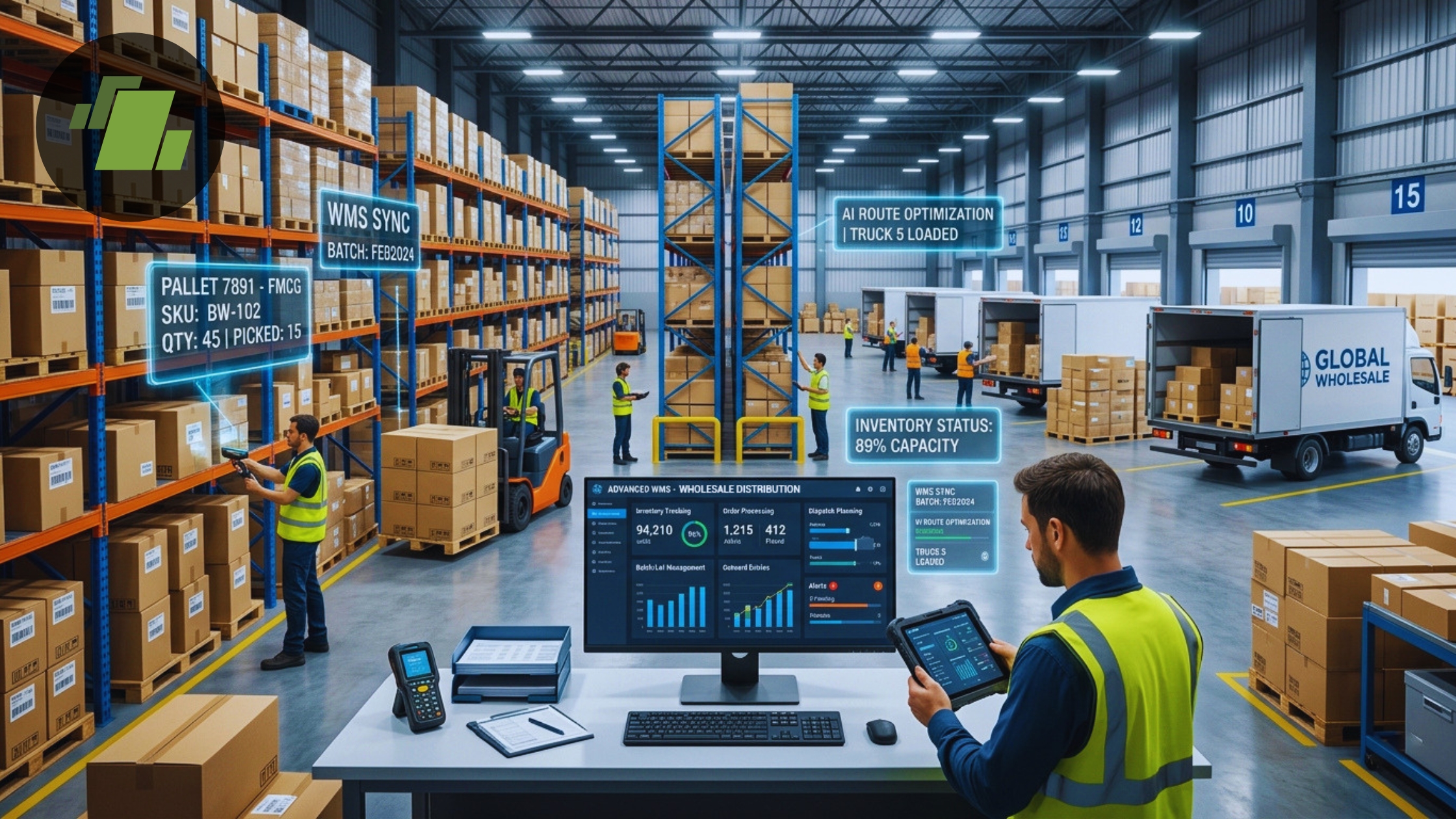
Warehouse Management Software (WMS) plays a critical role in improving inventory accuracy, warehouse productivity, and order fulfillment efficiency. Businesses handling large inventory volumes or multiple warehouse locations require advanced warehouse automation solutions to streamline warehouse operations.
Modern warehouse management systems help businesses maintain better control over inventory movement and warehouse workflows.
Key Features of Warehouse Management Software
- Real-Time Inventory Tracking:
Track stock movement, inward/outward inventory, and available stock levels instantly. - Batch & Serial Number Tracking:
Manage products using batch numbers, expiry dates, and serial tracking for better traceability. - Barcode & RFID Integration:
Improve inventory accuracy and reduce manual errors using automated scanning technologies. - Automated Stock Movement Management:
Streamline picking, packing, transfers, and dispatch operations efficiently. - Multi-Warehouse Management:
Manage inventory across multiple warehouse locations through a centralized system. - Cloud-Based Warehouse Access:
Access warehouse operations remotely from any device and location.
A robust warehouse management system helps businesses improve operational efficiency, reduce fulfillment errors, optimize inventory utilization, and accelerate order processing.
Conclusion
The future of wholesale distribution is driven by technology, automation, operational efficiency, and customer-centric business strategies. Businesses that invest in advanced ERP software, warehouse management systems, eCommerce integration, and digital transformation technologies will be better positioned to improve profitability and achieve long-term business growth.
LOGIC ERP helps wholesalers and distributors streamline procurement, inventory management, warehouse operations, sales tracking, customer management, analytics, and supply chain processes through a powerful integrated ERP platform. With advanced automation, real-time reporting, and scalable distribution management solutions, businesses can improve efficiency, enhance customer experience, and accelerate business success in the evolving wholesale distribution industry.
Call at +91-73411-41176/75 or send us an email at sales@logicerp.com to book a free demo today!
Frequently Asked Questions (FAQs)
1. What is wholesale distribution software?
Wholesale distribution software is an advanced ERP solution designed to manage inventory, sales, procurement, warehouse operations, accounting, customer management, and supply chain processes for wholesalers and distributors. It helps automate daily operations and improve business efficiency.
2. Why is warehouse management software important for distributors?
Warehouse management software helps distributors track inventory in real time, manage stock movement, improve order accuracy, reduce warehouse errors, and speed up order fulfillment. It also improves inventory visibility across multiple warehouse locations.
3. How does ERP software help wholesale distributors?
ERP software helps wholesale distributors streamline operations by integrating billing, inventory management, accounting, CRM, procurement, logistics, and analytics into a single platform. It improves productivity, decision-making, and customer service.
4. Why is digital transformation important in wholesale distribution?
Digital transformation helps wholesalers automate manual processes, improve operational efficiency, reduce costs, enable cloud access, enhance customer experience, and adapt quickly to changing market demands using modern technologies.
5. How can eCommerce integration benefit wholesale distributors?
eCommerce integration allows distributors to manage online orders, sync real-time inventory, automate order processing, and support multi-channel selling. It improves customer convenience, increases sales opportunities, and helps businesses expand their market reach.