Top POS Companies in India: Best Systems & Software

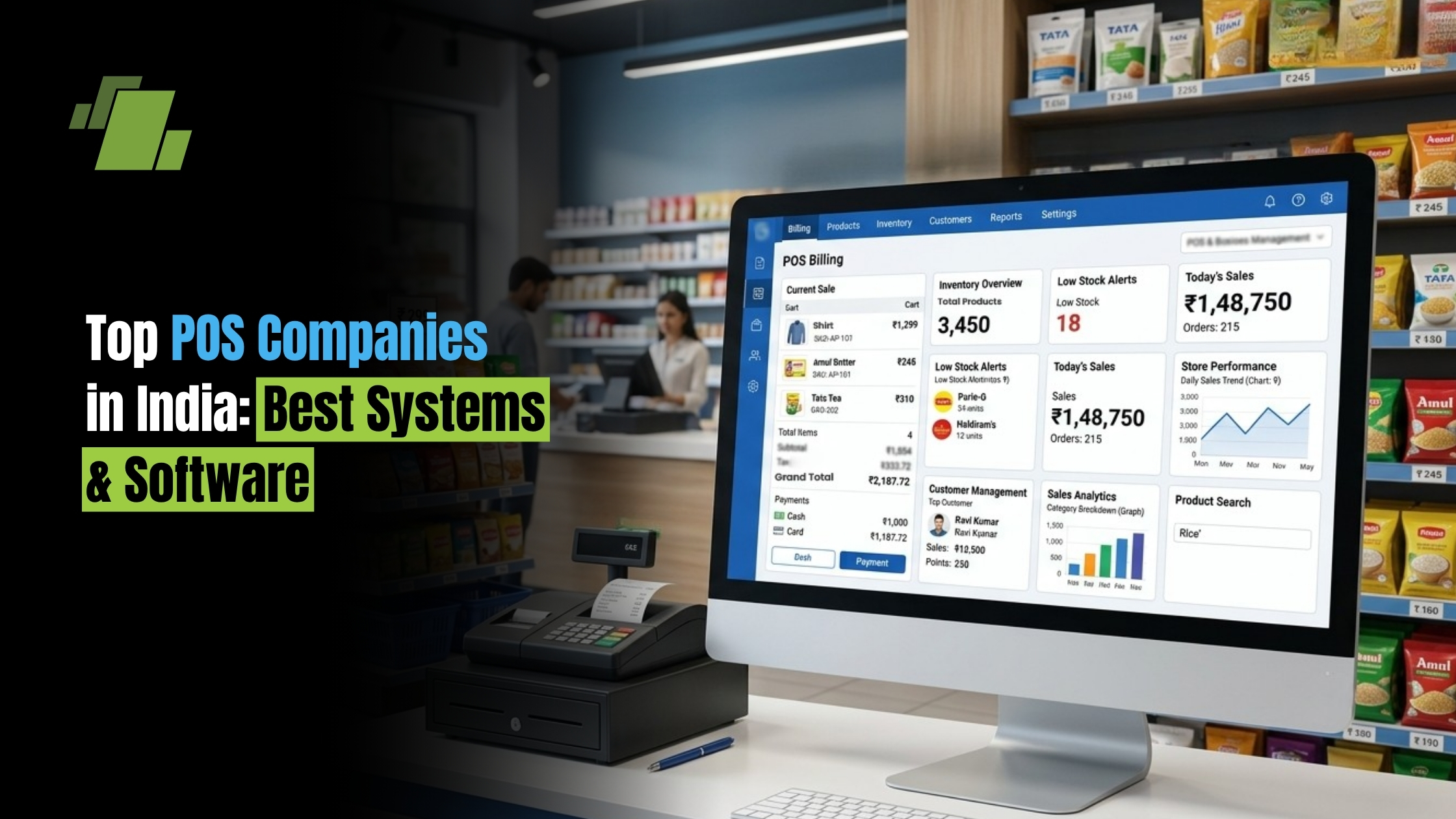
Indian retail is moving from simple billing counters to connected payment and operations hubs. The right POS software now helps a shop, restaurant, supermarket, pharmacy, or multi-store brand accept payments, manage inventory, track sales, reduce errors, and understand customers better. This guide looks at the POS companies shaping that shift in India and explains how retailers can choose a system that fits their size, sector, and growth plans.
India’s POS opportunity is expanding alongside digital payments, mobile acceptance, UPI, contactless cards, and cloud software. Industry estimates point to continued growth in POS terminals and retail point-of-sale revenue through the early 2030s, while Worldline reported 4.66 billion card transactions on POS terminals in 2025, up 5% year on year.
Contact Us
Free Demo Request
Which POS Companies are Changing Indian Retail?
The most relevant POS companies in India are not all solving the same problem. Some focus on payment acceptance, some on retail operations, some on restaurant workflows, and others on hardware that powers checkout counters. A retailer searching for the best POS India option should compare the use case first, then the brand.
What Should Retailers Compare?
Instead of comparing POS companies only by the number of features, retailers should evaluate how well each platform fits their actual operating model. Important areas include:
- Billing: Speed, barcode scanning, touch POS and offline capabilities
- Inventory: Real-time stock, variants, batch/MRP, transfers and reorder management
- Multi-store: Centralized pricing, inventory and store-wise reporting
- Customer management: Loyalty, memberships, coupons and customer history
- Payments: UPI, cards, wallets and integrated digital payments
- Compliance: GST invoicing, e-invoicing and relevant tax workflows
- Omnichannel: E-commerce and marketplace integrations
- Analytics: Sales, inventory, customer and store performance reports
- Scalability: Ability to support additional stores, users and transaction volumes
These capabilities matter because modern retail POS is increasingly expected to connect the checkout counter with the wider retail operation, rather than functioning as an isolated billing system.
Why the Right POS Depends on the Retailer
A single-store retailer may primarily need fast billing, GST invoicing, barcode scanning and basic inventory, while a fashion chain may need size and color management, promotions, loyalty, warehouse integration and centralized multi-store control. A supermarket may prioritize high-volume checkout and inventory, whereas a pharmacy may require stronger batch and expiry management.
Therefore, when comparing POS companies in India, the useful question is not simply “Which POS is the best?” but “Which POS fits my retail format, operational complexity, store network and growth plans?” Current market comparisons similarly emphasize that the appropriate solution depends on factors such as store count, retail format, required features and business workflows.
For a retailer evaluating LOGIC ERP, this distinction is particularly relevant because its POS offering can be considered as part of a broader retail ERP environment rather than only as a billing application – connecting POS with inventory, purchasing, customer management, reporting and other retail operations.
LOGIC ERP | #1 Point of Sale Software for Retail Stores
LOGIC ERP is a comprehensive Point of Sale (POS) software for retail stores, built to simplify billing, inventory management, customer engagement, payments, and day-to-day store operations.
From fast and flexible billing to barcode scanning, size and shade-wise product selection, promotions, exchanges, returns, loyalty programs, and real-time inventory visibility, LOGIC ERP helps retailers manage every aspect of the retail POS process from a centralized system.
With multi-store support, integrated digital payments, detailed sales reports, accounting, GST management, and e-commerce integrations, LOGIC ERP provides a connected POS solution for growing retail businesses.
What Should Indian Retailers Look for in POS Software?
Indian retailers should look for POS software that matches their transaction flow, inventory complexity, payment mix, compliance needs, and expansion plans. A small boutique may need fast GST billing and UPI acceptance, while a grocery chain needs barcode handling, purchase control, stock transfers, loyalty, role-based access, and branch reporting.
Use this practical checklist before choosing between POS systems India providers:
- Payment coverage: Confirm support for UPI, cards, wallets, QR, contactless, EMI, and cash where relevant.
- Billing speed: Test real checkout scenarios, not just demo screens, especially during peak hours.
- Inventory depth: Look for stock alerts, batch or expiry handling, purchase orders, returns, and transfers if your category needs them.
- GST and reporting: Ensure invoices, tax reports, credit notes, and accounting exports match your workflow.
- Cloud and offline mode: Cloud access is useful, but stores with unstable connectivity also need continuity plans.
- Integrations: Check ecommerce, ONDC, accounting, delivery, loyalty, WhatsApp, and payment integrations.
- Support and training: Ask about onboarding, local support, device replacement, escalation, and staff training.
- Security and permissions: Require role-based access, audit trails, secure payment handling, and clear data controls.
- Scalability: Make sure the system can grow from one outlet to multiple stores without rebuilding your process.
The best retail POS India choice is rarely the one with the longest feature list. It is the one your cashiers can use quickly, your managers can trust daily, and your owners can learn from without chasing manual spreadsheets.
The Market is Shifting Toward Connected Retail Operations
POS is no longer just a billing machine. It is becoming the operational center for sales, payments, stock, staff, customer data, and business intelligence. This shift is why searches for pos software companies in India, pos solutions India, and point of sale companies have become broader than hardware procurement.
Three trends are especially important:
- Mobile and Contactless Acceptance: Handheld terminals, tap-to-pay options, QR devices, and soundbox confirmations are helping smaller merchants accept digital payments with less friction.
- Cloud-Based Visibility: Owners want to see sales, margins, stock, and outlet performance without being physically present at the store.
- Sector-Specific Workflows: Restaurants, pharmacies, supermarkets, salons, apparel stores, and fuel stations all need different billing and operational logic.
There are also adoption challenges. Rural and semi-urban retailers may struggle with connectivity, device maintenance, digital literacy, or staff turnover. Urban retailers may face a different problem: too many tools that do not talk to one another. In both cases, the winning POS setup is the one that keeps transactions simple while making the back office smarter.
How Should You Choose Between Domestic and International POS Providers?
Choose domestic providers when local workflows, GST billing, UPI-first payments, Indian support, and sector-specific features are central to your business. Consider international or hardware-led providers when device quality, enterprise infrastructure, global standards, or specialised terminal requirements matter more.
A useful way to decide is to separate your needs into three layers:
- Payment Layer: If your primary requirement is reliable acceptance of multiple payment modes, evaluate support for UPI, debit and credit cards, QR payments, wallets, contactless payments, and other relevant methods.
- Operations Layer: If your main challenge is managing billing, inventory, purchasing, reporting, customer management, or industry-specific workflows, look for POS software that connects these functions within a single platform.
- Hardware Layer: If your priority is checkout durability, kiosk setups, barcode scanning, receipt printing, weighing scales, or other counter infrastructure, evaluate hardware compatibility, device reliability, peripheral support, and ease of maintenance.
Before signing, ask vendors for a live workflow demo using your product categories, taxes, discounts, return rules, and payment modes. Also verify regulatory status where payment aggregation or settlement is involved; RBI maintains lists of authorised payment system operators under the Payment and Settlement Systems Act, and payment providers must operate within applicable RBI rules.
Conclusion
The top POS companies in India are revolutionizing retail by making checkout faster, payments broader, inventory more visible, and decision-making more data-driven. But the right choice depends on whether you need a payment terminal, a complete retail management platform, restaurant POS, rugged hardware, or a mix of all four.
Start with your daily pain points, shortlist vendors by category, insist on a real workflow demo, and check support as carefully as features. That approach will help you find a POS system that works today and still supports your business as Indian retail becomes more digital, connected, and competitive.
Call at +91-7341141176/75 or send us an email at sales@logicerp.com to book a free demo today!
Frequently Asked Questions
1. What are the Top POS companies in India?
Top POS companies in India offer solutions designed to manage billing, payments, sales, inventory, and other business operations. The right POS provider depends on factors such as business requirements, transaction volume, operational needs, budget, scalability, and the features required.
2. How Do I Choose the Best POS System for my Retail Business in India?
Compare POS systems based on billing speed, inventory management, GST compliance, payment integrations, multi-store support, customer management, reporting, integrations, security, scalability, and after-sales support.
3. What Features Should Retail POS Software Have in India?
A retail POS system should ideally support fast billing, barcode scanning, GST invoicing, real-time inventory, returns and exchanges, multiple payment modes, customer loyalty, sales reporting, role-based access, and multi-store management.
4. What is the Difference Between a Payment POS and Retail POS Software?
A payment POS primarily focuses on accepting digital payments through cards, UPI, wallets, and other payment methods. Retail POS software goes further by connecting billing with inventory, purchasing, customer management, reporting, GST, and other store operations.
5. Is LOGIC ERP a POS Software for Retail Stores?
Yes. LOGIC ERP provides retail POS software that combines billing, barcode scanning, inventory management, customer engagement, payments, GST management, sales reporting, and multi-store operations within a broader retail ERP environment.

Author
Surendra Nayak
Vice President Enterprise Sales | LOGIC ERP Solutions Pvt. Ltd.
Driving LOGIC ERP’s enterprise sales with a strategic outlook, my leadership role encompasses forming & executing policies that bolster revenue, customer satisfaction & brand positioning.