Grocery Shop Business Plan: How to Start a Grocery Store in India

Summary
A grocery store business plan covers market analysis, target customers, location, product mix, investment, suppliers, pricing, operations, marketing, and financial projections. It helps assess business feasibility, manage costs, plan profitability, and identify growth opportunities such as home delivery, online sales and additional outlets.
Contact Us
Free Demo Request
Table of content
- Grocery Shop Business Plan: How to Start a Grocery Store in India
- What Is a Grocery Shop Business Plan?
- What Does a Grocery Store Business Plan Include?
- How to Start a Grocery Store in India
- Choose Your Grocery Store Business Model
- Research Your Local Market
- Select the Right Location
- Decide What Products to Sell
- Find Grocery Suppliers and Distributors
- Set Up the Store
- How Much Investment Is Required to Open a Grocery Store?
- Grocery Store Startup Cost Breakdown
- Small Grocery Store vs Supermarket Investment
- Grocery Store Business Model
- Traditional Grocery Shop
- Mini Grocery Store
- Supermarket
- Online Grocery Store
- Grocery Delivery Business
- Wholesale Grocery Business
- Grocery Store Business Plan Sample
- Grocery Store Requirements
- Grocery Store Inventory Management
- How Much Inventory Should a New Grocery Store Keep?
- How to Manage Grocery Store Billing and POS
- How to Run a Successful Grocery Store
- How to Grow a Grocery Business
- Add Home Delivery
- Start Online Ordering
- Introduce Customer Loyalty Programs
- Use Promotions Strategically
- Open Additional Stores
- Use Data to Improve Purchasing
- Grocery Store Marketing Ideas
- Common Challenges in Running a Grocery Store
- Grocery Shop Business Plan Checklist
- Frequently Asked Questions About Grocery Store Business Plans
- Final Thoughts
Introduction
India has over 12 million grocery retail outlets, and the market keeps expanding across cities and towns of every size. A grocery shop business plan is the detailed written roadmap for starting, running, and growing a grocery store in India, covering your store format, target customers, location, investment, product mix, suppliers, inventory, pricing, staffing, technology, marketing, financial projections, and growth strategy. Whether you are an entrepreneur planning a kirana, mini supermarket, or online grocery business, or an existing retailer looking to improve setup, operations, and expansion, this guide lays out the practical decisions you need to make to compete in a crowded, low-margin market.
It walks through the full process, from choosing a grocery business model and researching your local market to selecting products, finding suppliers, handling licenses and registration, setting up the store, managing billing and POS, planning investment and daily operations, marketing the business, solving common challenges, and using a checklist to move toward profitable growth. With competition rising and execution gaps quickly affecting margins, a solid plan helps you avoid costly mistakes, stay compliant, use technology well, and build a store that can sustain and scale.
What a Grocery Shop Business Plan Includes?
A grocery shop business plan is a written document that maps out how you will set up, fund, operate, and grow a grocery store in India. It connects your store concept (kirana, mini supermarket, or hybrid online-offline model) with your local market, investment capacity, daily operations, and financial goals. For a small kirana, initial investment typically ranges from ₹3 to 6 lakhs; for a mini supermarket in a metro, expect ₹15 to 40 lakhs.
Core components of any grocery business plan:
- Executive summary describing your store concept and objectives
- Market analysis of local demand, demographics, and direct and indirect competitors
- Product mix including staples, packaged goods, fresh produce, dairy, and household items
- Financial plan covering startup costs, working capital, and 12-36 month projections
- Operational plan for billing, inventory, staffing, and compliance
- Growth strategy covering home delivery, online ordering, and additional outlets
All of these components apply whether you run a traditional grocery store in a Tier-3 town or operate online grocery stores serving Indian consumers in metros.
“India’s online grocery market was valued at USD 8.82 billion in 2024 and is projected to reach USD 77.72 billion by 2030. The stores that adopt technology-driven operations today will capture a larger share of that growth through the end of the decade. Your business plan is where that advantage starts.”
What is a Grocery Shop Business Plan?
A grocery store business plan is a written roadmap for setting up, operating, and growing a grocery shop in India. It covers everything from registering the business and securing a lease to managing suppliers, pricing food products, and tracking profitability month over month.
In India’s crowded grocery business, where kirana stores dominate and competition from supermarket chains and quick-commerce apps is rising, a business plan serves multiple purposes: it helps you secure shop rent (landlords often need proof of business viability), obtain licenses like FSSAI and GST, negotiate supplier credit terms, and align family members or partners around a shared financial plan.
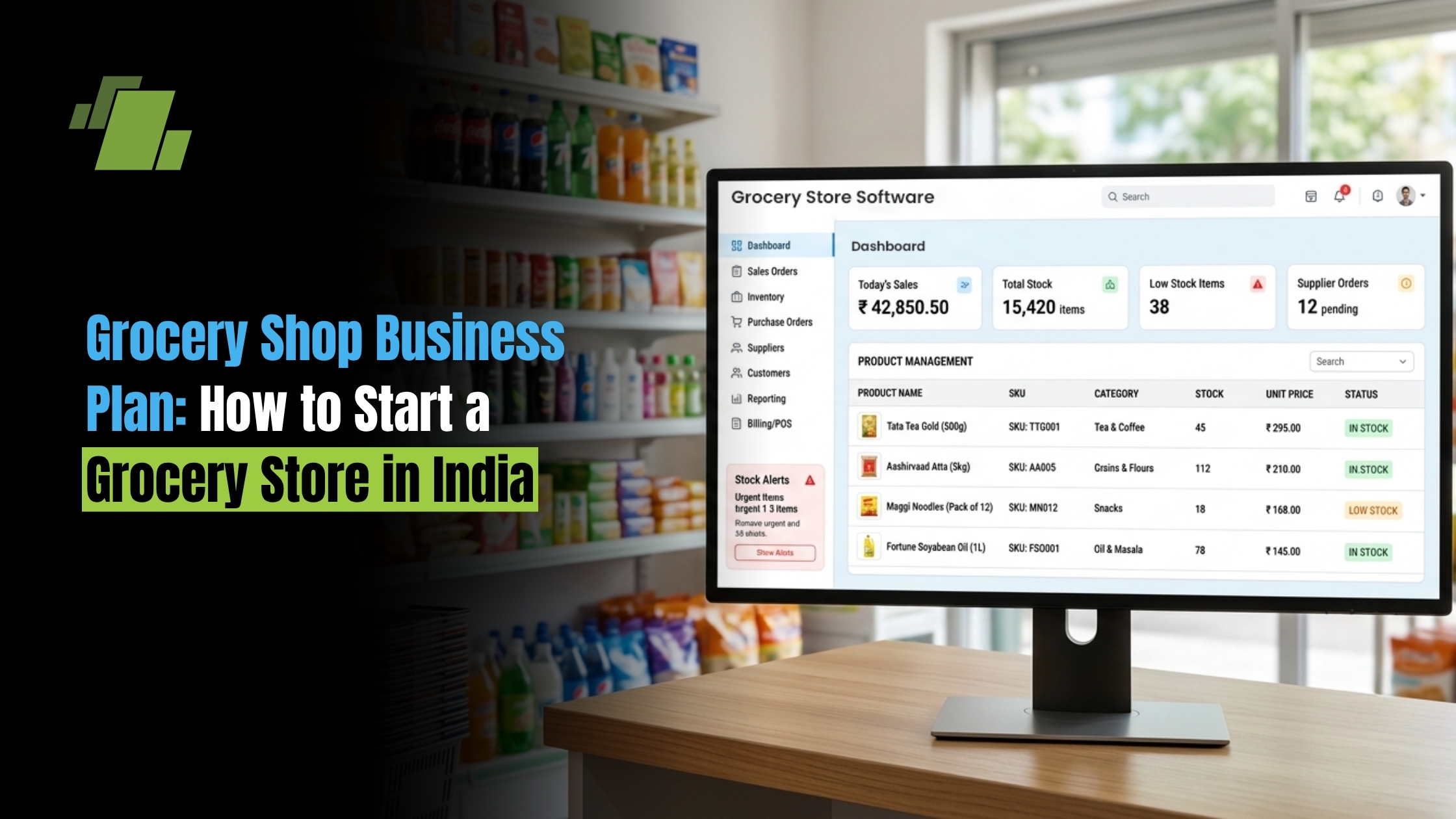
Successful grocery business plans focus on local consumer demand and preferences, not on generic assumptions. A store in Chennai needs a different product mix than one in Lucknow. A strong grocery store business plan in India links easy access location, realistic margins, daily operations, technology, and financial projections into one actionable document. From LOGIC ERP’s perspective, the plan should treat billing software, stock control, and multi-channel selling as foundational line items, not afterthoughts.
What Does a Grocery Store Business Plan Include?
Below is a structured overview of every major section an Indian grocery shop business plan should cover. A grocery business plan should include a financial plan alongside each of these operational elements.
| Element | What It Covers (India-Focused) |
|---|---|
| Business Overview | Store concept (kirana, mini supermarket, niche), legal form (proprietorship, LLP), mission, and value proposition |
| Market Analysis | Population density, household incomes, organized vs. unorganized retail share, and online grocery trends |
| Target Customers | Families, working professionals, students, income bands, purchase frequency, and average basket size |
| Location & Easy Access | Residential vs. commercial areas, proximity to housing societies and schools, parking, deposit, and rent norms |
| Product Mix | Staples, packaged foods, dairy, frozen foods, fresh fruits and vegetables, ethnic foods, ready-to-eat meals, and household supplies |
| Investment & Capital | Rent deposit, interiors, initial inventory, POS hardware, licenses, and working capital for 2–3 months |
| Suppliers | FMCG distributors, wholesale mandis, cash-and-carry stores, local dairy suppliers, and online B2B platforms |
| Pricing | Category-wise margin targets, competitive pricing, psychological pricing, and seasonal discounts |
| Operations | Stock receiving, billing, digital payments (UPI/QR), staffing, hygiene, and opening hours |
| Marketing | Signage, pamphlets, Google Business Profile, WhatsApp ordering, and loyalty programs |
| Financial Plan | Revenue, COGS, fixed and variable costs, profit & loss, and break-even analysis |
| Financial Projections | 12–36 month sales forecasts, cash flow, payback period, and ROI |
| Growth Plan | Home delivery within a 2–5 km radius, online sales, franchise model, and additional outlets |
LOGIC ERP’s reporting modules, including inventory turnover, margin analysis, and supplier lead-time tracking, can feed directly into the financial plan, product mix, and pricing sections of your business plan.
How to Start a Grocery Store in India: Step-by-Step
Whether you want to know how to start a grocery shop in a Tier-2 city or how to open a grocery store as a mini supermarket in Mumbai, the sequence is the same: choose a business model, research the local market, secure a location, obtain licenses, set up the store with the right technology, hire staff, and launch with a marketing push.
The steps below apply to a small grocery store in Jaipur just as much as to a 1,000 sq ft supermarket business in Bengaluru. They can also be adapted for online grocery models where the store doubles as a fulfillment hub.
Choose Your Grocery Store Business Model
Your grocery business model determines investment, staffing, shelf space, and technology needs. A value proposition that differentiates your store from nearby competitors starts here. Product differentiation can provide a competitive edge against larger supermarket chains, especially when you focus on a specific category or service like fresh produce or same-day delivery.
Traditional Kirana Store
Target customers: neighborhood families. Size: 100-300 sq ft. Investment: ₹2-6 lakhs. Tech: basic POS, UPI payments. Works best near dense housing societies in Tier-2 and Tier-3 cities.
Mini Grocery Store / Mini Supermarket
Size: 500-1,000 sq ft. Broader product mix including refrigerated dairy, frozen foods, and bakery items. Investment: ₹8-15 lakhs. Requires inventory tracking by batch and expiry, plus barcode billing.
Full Supermarket
1,000+ sq ft, multiple departments, several POS lanes, robust supply chain. Investment: ₹20-40 lakhs in Tier-1 cities. A supermarket business plan at this scale needs detailed financial projections and an integrated grocery management system.
Convenience Store
Small format (200-400 sq ft) in high-traffic commercial areas, offices, or near transit hubs. Focuses on packaged goods, beverages, and ready to eat meals. Higher margins per item, lower footfall than residential kiranas.
Organic / Niche Grocery
Targets affluent urban consumers seeking organic foods, health food stores items, specialty items, or imported food items. Higher margins, lower volumes. Store size: 400-800 sq ft.
Online Grocery Store
Minimal physical storefront. Investment goes into tech, last-mile delivery, and inventory software. Can start as a WhatsApp-based ordering service layered on top of an existing kirana.
Grocery Delivery-Only Model
No walk-in customers. Operates from a micro-fulfilment centre. Requires strong tech for order management and delivery routing.
Wholesale Grocery Business
Serves retailers and bulk buyers. Located near mandis or industrial zones. Large storage, high volumes, lower per-unit margins. Investment focused on logistics and bulk inventory.
Research Your Local Market and Competitors
Before signing a rental agreement, spend two to three weeks studying your local area. A grocery store business plan without real market data is guesswork.
Market analysis should contain local competitive landscape and target customer demographics. Define your target audience: are you serving budget-conscious families, young professionals, or elderly residents who value home delivery?
- Count existing grocery stores, convenience stores, and department stores within a 1-2 km radius
- Estimate household income levels and purchasing patterns in the area
- Identify direct and indirect competitors: other kiranas, discount chains, modern supermarkets, and online grocery apps
- Note average basket sizes by observing checkout lines at competitor stores
- Identify gaps: does the area lack a store with fresh produce, or are ready to eat meals unavailable nearby?
Include a competitor analysis in your grocery business plan. Identifying target customer demographics helps in tailoring product offerings in grocery shops. For example, a locality near an IT park in Pune might show high demand for packaged snacks, beverages, and quick meals, while a family-heavy neighborhood near local schools would lean toward staples, dairy, and household items.
Gather on-ground insights by observing footfall at different times (morning rush for milk, evening for dinner ingredients, weekend bulk shopping) and talking to society managers.
Select the Right Location and Store Layout
Choosing the right location is crucial for grocery store success. Grocery stores should be located in residential areas for accessibility, and an optimum grocery store location is near department stores and banks, where regular footfall already exists.
- Prioritize residential streets or neighborhood markets over isolated commercial zones
- Check proximity to housing societies, offices, local schools, and public transport
- Evaluate parking facilities and two-wheeler space; Indian shoppers often arrive on scooters
- Understand local rent norms: 3-6 months of advance deposit is standard in cities like Bengaluru, Delhi, and Jaipur
- Target 300-600 sq ft for a first store; 800-1,000 sq ft if planning a mini supermarket
For store layout, place fresh produce near the entrance to attract customers with color and freshness. Position staples and non food items in the back so customers walk past higher-margin packaged goods and specialty items. Keep the checkout counter near the exit with clear sightlines. Effective product placement can boost sales per visit when high-margin items sit at eye level.
LOGIC ERP supports item-location mapping, which helps organize shelf space for fast picking, especially useful if you also fulfill online orders from the same store.
Decide What Products to Sell (Product Mix & Fresh Produce)
Your product mix should match local demand and your target market’s spending patterns. Start with categories that generate consistent demand.
| Category | Indian Product Examples |
|---|---|
| Staples | Aashirvaad atta, India Gate rice, Toor dal, Tata Salt |
| Packaged Food | Parle-G, Maggi, Haldiram’s snacks, Sunfeast biscuits |
| Beverages | Frooti, Coca-Cola, Bisleri, Brooke Bond tea |
| Dairy | Amul milk, Mother Dairy curd, Britannia cheese |
| Personal Care | Dove soap, Head & Shoulders shampoo, Colgate |
| Home Care | Surf Excel, Harpic, Lizol, Vim |
| Fresh Produce | Seasonal fresh fruits, fresh vegetables, and herbs |
| Frozen Foods | McCain fries, ITC frozen parathas |
Fresh produce drives repeat visits because customers buy it every 2-3 days. Plan daily purchasing from local mandis. Expect 2-5% shrinkage on perishables; proper inventory practices can reduce this. Seasonal products can be marked up and sold with discounts as the season peaks; stock festival-specific items (Diwali sweets, pooja supplies) based on regional preferences. In South India, stock millets and coconut oil; in North India, mustard oil and paneer.
Find and Manage Grocery Suppliers and Distributors
Sourcing directly affects purchase price, product availability, and profitability. Building reliable supply chains is crucial for minimizing waste in grocery shops.
Supplier types for Indian grocery stores:
- FMCG company distributors (Hindustan Unilever, ITC, Nestlé)
- Wholesale mandis for fresh produce and staples
- Cash-and-carry formats for packaged goods
- Local dairy farms or cooperative brands (Amul, Nandini)
- Online B2B supply platforms
Evaluate each supplier by price, credit terms (7-30 days is common in India), delivery frequency, minimum order quantity, and return policies for damaged or expired goods. LOGIC ERP can store supplier-wise price lists, track lead times, and generate performance reports to refine purchasing decisions over time.
A practical supplier mix for a new store: 2-3 FMCG distributors for packaged goods, one or two wholesale markets for staples and local produce, and a direct tie-up with a regional dairy brand.
Licenses, Registration, and Grocery Store Requirements in India
Grocery stores need proper licenses and permits to operate. Requirements vary by state and city; treat this section as a general checklist and consult a local CA for specifics.
- Business registration: sole proprietorship, partnership, LLP, or private limited company
- Shop and Establishment Act license: issued by your municipal or district authority
- FSSAI registration: Basic Registration (₹100/year) for stores with turnover up to ₹1.5 crore; State or Central License for higher turnover or interstate trade (FSSAI guidelines)
- GST registration: mandatory if turnover exceeds ₹40 lakhs in most states
- Municipal permissions: signage permits, health/hygiene approvals
Grocery stores must comply with food safety regulations at both central and state levels. Tobacco sales require a state retailer license in most jurisdictions. Additional permits apply if you sell alcohol or meat, and rules differ between states like Maharashtra, Karnataka, and Uttar Pradesh.
For global context, grocery store requirements in countries like the US include USDA SNAP authorization, which takes 45 to 60 days to obtain, and as of 2026, eighteen states have new SNAP compliance restrictions. Over 41 million Americans receive SNAP benefits, requiring EBT processing at grocery stores; these regulations do not apply in India but illustrate how food retail compliance varies globally.
Modern ERP/POS systems like LOGIC ERP help maintain transaction records, GST invoices, and purchase documentation needed for tax filings and license renewals.
Store Setup, Equipment, Billing System, and Technology
Many grocery shop business plans fail because they under-budget technology and equipment. A store that looks good but bills slowly loses customers to the kirana next door.
Physical setup:
- Shelves, racks, and gondolas (wall-mounted and freestanding)
- Refrigerators and freezers for dairy, frozen foods, and beverages
- Storage room or back area for excess inventory
- Billing counter with adequate space for bags and packing
- CCTV cameras, fire extinguisher, and lighting
- Interior branding and boards in local language plus English
Technology stack:
- POS billing software with barcode scanning and receipt printing
- Weighing scales integrated with the billing system; a grocery store’s POS must integrate with scales for produce to bill items sold by weight accurately
- GST-compliant invoicing
- Support for UPI, QR codes, debit/credit cards, mobile wallets, and cash
- Inventory management module with batch and expiry tracking
A grocery-specific POS system is essential for high transaction volumes. Independent grocers complete approximately 13,500 transactions weekly; handling this volume manually leads to billing errors and long queues. A 600 sq ft kirana in Indore that switched from manual registers to barcode-based POS billing and digital payments reported cutting billing time by 30-40% within the first month.
LOGIC ERP grocery POS software serves as an integrated grocery store solution handling POS, billing, inventory, purchasing, pricing, supplier management, and multi-store operations from one system.
Investment Required and Financial Plan for a Grocery Store
There is no single number for “how much investment is required to open a grocery store” in India. Investment depends on city, store size, product depth, and business model. In the US, startup costs for a grocery store range from $100,000 to $300,000; Indian figures are lower but vary widely.
Grocery Store Startup Cost Breakdown
| Cost Head | Small Kirana (150–250 sq ft) | Mini Supermarket (500–1,000 sq ft) |
|---|---|---|
| Rent & Security Deposit | ₹30,000 – ₹1,00,000 | ₹1,00,000 – ₹4,00,000 |
| Interiors, Racks & Counters | ₹40,000 – ₹90,000 | ₹90,000 – ₹2,50,000 |
| Equipment (Refrigeration, Scales, CCTV) | ₹25,000 – ₹60,000 | ₹60,000 – ₹1,50,000 |
| Initial Inventory | ₹1,50,000 – ₹2,50,000 | ₹2,50,000 – ₹6,00,000 |
| POS/ERP Software + Hardware | ₹5,000 – ₹15,000 | ₹15,000 – ₹40,000 |
| Licenses & Registration | ₹500 – ₹3,000 | ₹1,000 – ₹5,000 |
| Staffing (First Month) | ₹8,000 – ₹20,000 | ₹30,000 – ₹60,000 |
| Working Capital (2 Months) | ₹50,000 – ₹1,00,000 | ₹1,00,000 – ₹2,00,000 |
Total: a small grocery store typically needs ₹3-6 lakhs; a mini supermarket in a Tier-1 city runs ₹15-40 lakhs depending on location and product depth.
Ongoing costs include monthly rent (₹10,000-₹25,000 for small stores in Tier-2 towns; higher in metros), staff salaries, electricity (especially for refrigeration), and inventory replenishment every 1-2 weeks for perishables. Independent grocers typically operate on net margins of 1% to 3%, so controlling operational costs is non-negotiable. Well-run Indian kiranas with strong supplier terms and minimal wastage sometimes achieve 5% net margins, but the global benchmark for independent grocery stores sits at 1-3%.
Connect this section to your financial projections: project 12-36 months of revenue, COGS, rent, salaries, utilities, marketing, and interest payments. Typical break-even for a well-located kirana is 12-18 months.
Grocery Store Business Plan Sample
Here is a simplified grocery business plan sample for a neighborhood store:
Business Name: Green Basket Grocery, Ahmedabad
Executive Summary: A neighborhood grocery and FMCG retailer offering staples, packaged foods, dairy, personal care, home care, and fresh produce with home delivery within 2 km. Located in an 800 sq ft shop near three housing societies built after 2020.
Target Market: Families and working professionals in a 1-2 km radius, with an average household income of ₹40,000-₹80,000 per month.
Product Categories: Staples (rice, flour, pulses, oil), packaged foods, beverages, dairy, personal care, household cleaners, cleaning supplies, and fresh fruits and vegetables.
Revenue Sources:
- Walk-in sales (70%)
- Home delivery via WhatsApp orders (20%)
- B2B bulk orders to nearby offices (10%)
Operational Plan: Open 7:30 AM to 10:30 PM, 7 days a week. Two staff for billing and stocking; owner manages purchasing and supplier relationships. Operational plans detail daily business operations, including morning fresh produce procurement from a local mandi, afternoon restocking, and evening peak-hour staffing.
Financial Highlights: First-year revenue target of ₹60-70 lakhs. Average basket size: ₹350. Gross margins: staples 8-10%, packaged foods 12-15%, fresh produce 20-25%. Expected payback period: 14-16 months.
LOGIC ERP provides templates and data formats that can help structure these projections using actual sales and inventory data from your store.
Inventory Management in a Grocery Business
Efficient inventory management sits at the center of a profitable grocery store business. With net margins of 1-3% and perishable stock, even small inefficiencies eat into profit.
- Set minimum and maximum stock levels for each SKU based on weekly sales velocity
- Use ABC classification: “A” items (top 20% of SKUs generating 80% of revenue) get priority in reordering
- Track batches and expiry dates; independent grocers lose 2% to 5% of perishable inventory annually, and proper tracking reduces this
- A grocery store’s average inventory turnover is 8, meaning stock should ideally cycle through roughly every 6-7 weeks for non-perishables
- Adjust stock levels before festivals (Diwali, Holi, Eid) and monsoon seasons when consumer behavior shifts
For fresh produce, dairy, and bread, order smaller quantities more frequently. Purchase from mandis early morning for best prices and freshness. Discount near-expiry items by 20-30% two days before expiry rather than writing them off entirely.
Inventory management software helps organize stock efficiently. LOGIC ERP’s inventory module for grocery and kirana stores provides real-time stock tracking, low-stock alerts, batch-wise pricing, multi-location stock views, and dead stock reports.
For a new grocery store, target 15-20 days of average stock cover initially. If your expected weekly sales are ₹1.5 lakhs, carry inventory worth approximately ₹3-4 lakhs. Adjust based on supplier lead times and available working capital.
Running and Growing a Successful Grocery Store
Running a grocery store day-to-day requires discipline in a few core areas. Growing it requires data.
Operational excellence
- Customize your product mix based on what your local community buys, not what distributors push
- Monitor fast-moving SKUs weekly and ensure they never go out of stock
- Control wastage on fresh produce through frequent, smaller orders and end-of-day markdowns
- Maintain a clean, well-lit store with friendly staff; exceptional customer service contributes to customer loyalty in grocery retail
- Providing excellent customer service, including handling complaints quickly and remembering regular customers’ preferences, builds a pleasant shopping experience
Growth levers
- Add home delivery within 2-5 km using a delivery person on a two-wheeler
- Enable WhatsApp and phone-based online ordering
- List your store on Google Maps and local discovery apps
- Use LOGIC ERP’s category-wise margin reports and hour-wise sales data to identify which products and time slots drive profit
- Introduce loyalty programs with points-based rewards; even a simple “₹50 off after ₹2,000 spent” card retains customers
- Create combo offers (rice + oil bundles) and festival-specific promotions to attract customers and increase basket size
Grocery Store Marketing Ideas and Brand Building
For most Indian grocery shops, marketing is local, low-cost, and relationship-driven. Competitive pricing attracts more customers to grocery stores, but pricing alone does not build loyalty.
Offline marketing
- Professional store signage with name, hours, and delivery number
- Pamphlet distribution in nearby housing societies
- Tie-ups with RWAs and residential complexes for bulk orders
- Small launch event with opening-day discounts or free samples
- In-store marketing converts at rates higher than online ads; shelf talkers and counter displays for new products work well
Digital marketing
- Create a Google Business Profile listing for “grocery store near me” searches (local SEO)
- Run a WhatsApp broadcast list for daily deals and stock updates
- Post fresh produce arrivals and seasonal offers on Instagram and Facebook
- Use psychological pricing (₹99 instead of ₹100) on high-visibility items to create low-price perceptions
Loyalty programs can increase repeat visits in competitive neighborhoods. LOGIC ERP can manage loyalty points, SMS-based offers, and customer databases directly through the POS, without needing a separate tool.
The most powerful long-term marketing strategy for a grocery store in the local community remains consistent, honest service and on-time home delivery.
Common Challenges in Grocery Store Business and How to Solve Them
Grocery retail runs on thin margins, and operational mistakes compound quickly. Here are the most common problems and their solutions.
| Challenge | Solution |
|---|---|
| Overstocking / Dead Stock | Track sales velocity and set reorder levels for each SKU |
| Frequent Stockouts of Key Items | Set minimum stock alerts and review fast-moving products weekly |
| Expiry and Wastage Losses | Use batch and expiry tracking and run clearance offers 2–3 days before expiry |
| Pricing Errors | Use barcode-based billing with pre-loaded price lists |
| Cash Leakage | Perform daily cash reconciliation and maintain a POS audit trail |
| Staff Pilferage | Use role-based ERP access and CCTV monitoring at billing and storage areas |
| Customer Credit Mismanagement | Track credit sales digitally and set credit limits for each customer |
Integrated ERP/POS like LOGIC ERP reduces these pain points with automated stock reports, audit trails, and role-based access.
A kirana in Jaipur implemented expiry alerts and weekly clearance offers through its billing system and reduced expiry losses by 30% within four months. The store also used dead stock reports to stop reordering 40 slow-moving SKUs, freeing up ₹45,000 in working capital.
Grocery Shop Business Plan Checklist
A quick, action-oriented checklist you can save and follow:
- Define your store concept and business model
- Research the local market, target audience, and competitors
- Choose a location with easy access and parking facilities
- Estimate total investment and secure funding (savings, loan, or partnership)
- Identify 3-5 suppliers for staples, packaged goods, and fresh produce
- Finalize product categories based on local demand
- Register the business and obtain FSSAI, GST, and trade licenses
- Set up store layout, shelving, refrigeration, and equipment
- Implement POS/ERP (LOGIC ERP for billing, inventory, and reporting)
- Hire and train staff on billing, stock handling, and customer satisfaction
- Launch marketing campaigns: signage, pamphlets, WhatsApp, Google Business Profile
- Monitor sales and profitability monthly; adjust product mix and pricing
This checklist is India-specific: amounts in rupees, licenses per Indian regulations, and digital payment norms (UPI, QR) as standard.
Final Thoughts
A successful grocery shop business plan connects market demand, store location, investment, product selection, suppliers, inventory management, pricing, technology, and growth into one practical document. Without this structure, even a well-funded store operates on guesswork.
The journey runs from choosing the right business model and drafting a data-backed business plan, to setting up the store with proper equipment and ERP, launching with targeted local marketing, and scaling through online channels and additional outlets.
Ready to simplify your grocery store operations? LOGIC ERP helps grocery retailers manage POS, billing, inventory, purchasing, pricing, suppliers, customer data, and business reports from one integrated platform, whether you run a single kirana or a multi-store chain.
Call at +91-73411-41176/75 or send us an email at sales@logicerp.com to book a free demo today!
Frequently Asked Questions
1. Is a grocery store profitable in India?
Yes, but margins are thin. Grocery stores operate on net margins between 1% and 3% globally; well-managed Indian kiranas with controlled wastage and strong supplier terms can reach 5%. Profitability depends on location, product mix, rent, and how well you manage inventory and operational costs.
2. How much money is needed to start a small grocery shop vs mini supermarket?
A small store (150-250 sq ft) in a Tier-2 city needs ₹3-6 lakhs. A mini supermarket (500-1,000 sq ft) in a metro requires ₹15-40 lakhs, covering higher rent deposits, more inventory, refrigeration, and staffing. Secure funding through personal savings, family, or a small business loan.
3. What are the basic requirements to open a grocery store?
Business registration, shop and establishment act license, FSSAI registration, GST registration (if applicable), commercial premises, initial inventory, suppliers, a billing system, staff, and payment infrastructure. Requirements vary by state and product type.
4. What should I include in a grocery business plan?
An executive summary, market analysis, target market definition, product mix, supplier strategy, pricing strategy, operational plan, financial plan with projections, marketing plan, and growth strategy. Each section should use local data and realistic cost estimates.
5. How do I manage inventory effectively?
Use inventory management software with batch and expiry tracking, set reorder levels, classify stock by sales velocity (ABC analysis), and monitor the store’s inventory turnover. A grocery store’s average inventory turnover is 8; tracking this metric helps you avoid both overstocking and stockouts.
6. How can I grow my grocery business?
Add home delivery, enable online ordering via WhatsApp or a basic website, introduce loyalty programs to retain customers, expand product categories based on sales data, and consider opening additional outlets. Use data from your ERP to identify which categories and customer segments drive growth.
7. Can I start an online grocery business from my existing kirana?
Yes. Many kiranas add a WhatsApp ordering channel and a delivery person to start. Use your existing inventory and store as the fulfilment hub. A POS/ERP system helps manage both walk-in and online sales from one platform.
8. Do I need software like LOGIC ERP for a small grocery shop?
Even a 300-400 sq ft store benefits from billing software with barcode scanning, digital payment support, and basic stock tracking. As you grow, features like supplier management, expiry alerts, multi-store dashboards, and financial reporting become essential. LOGIC ERP scales from single-store kiranas to multi-outlet chains.
9. What is the difference between a grocery shop and a supermarket?
A grocery shop (kirana) is typically under 500 sq ft, owner-operated, with 500-2,000 SKUs. A supermarket exceeds 1,000 sq ft, carries 5,000+ SKUs across departments, and while both formats sell food and household items, they differ in scale, staffing, and operations, with supermarkets using multiple billing counters and requiring more staff and technology. Both fall under grocery retail but differ in scale, investment, and operational complexity.
10. Can I start an online grocery store without a physical shop?
Yes, through a delivery-only or dark store model. You need a storage space, inventory, delivery personnel, and an ordering platform. The investment shifts from rent and interiors to technology and logistics. An online grocery business plan should account for customer acquisition costs, packaging, and last-mile delivery expenses.
11. What is an executive summary in a grocery shop business plan?
The executive summary is a concise overview of your grocery store concept, key objectives, target market, and financial highlights. It provides readers with a quick understanding of your business vision and strategy.
12. Why is easy access important for a grocery store location?
Easy access ensures customers can conveniently reach your store, increasing footfall and sales. Locations near residential areas, schools, and public transport hubs typically attract more customers.
13. What are the key costs involved in starting a grocery store?
Key costs include rent and security deposit, store interiors, initial inventory, POS and billing equipment, staff salaries, marketing, and licensing fees.
14. How much financial resources are needed to open a grocery store?
The financial resources required depend on store size, location, product range, and business model. Typically, a small grocery store needs ₹3-6 lakhs, while a mini supermarket may require ₹15-40 lakhs.
15. What licensing fees are required to operate a grocery store in India?
Licensing fees vary by state and license type but generally include FSSAI registration, GST registration, Shop and Establishment Act license, and local municipal permits.
16. Who are direct and indirect competitors in the grocery business?
Direct competitors are other grocery stores and supermarkets in your area. Indirect competitors include online grocery platforms, convenience stores, and specialty food shops.
17. How should financial projections be prepared in a grocery store business plan?
Financial projections should include estimated revenue, cost of goods sold, operating expenses, profit margins, cash flow forecasts, and break-even analysis over 12-36 months.
18. Why include an executive summary in the business plan?
An executive summary helps investors, lenders, and partners quickly grasp your store’s concept and financial potential, increasing confidence in your plan.
19. How does easy access impact grocery store success?
Stores with easy access tend to have higher customer traffic and repeat business, which drives sales and profitability.

Author
Gurbir Singh
Co-founder & Managing Director | LOGIC ERP Solutions Pvt. Ltd.
With 30+ years of experience in the tech industry, I took the helm of technology & product development, ensuring LOGIC ERP’s continuous innovation & leadership in the evolving tech landscape.